
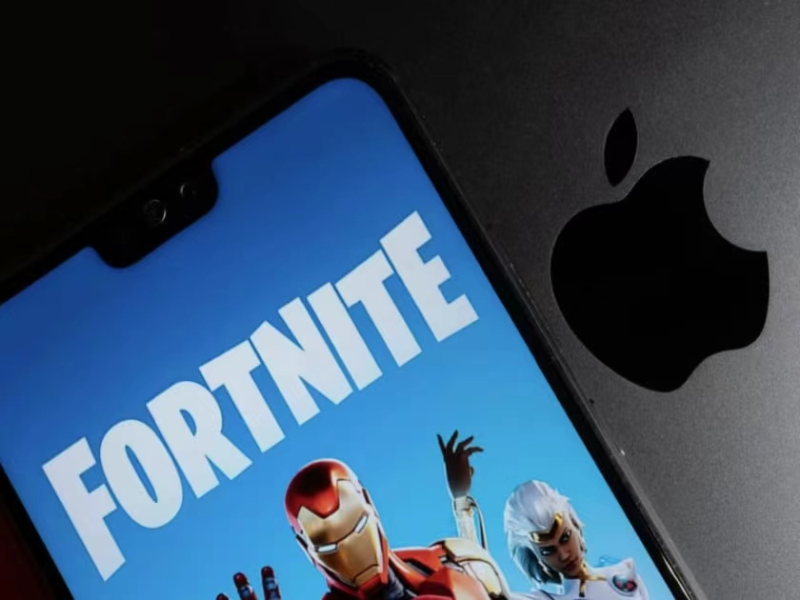
Epic Games returns ‘Fortnite’ to Apple’s iOS in EU is profiled by BTW Media because public-source evidence links it to internet infrastructure, governance, operational dependencies, or market visibility.
Epic Games returns ‘Fortnite’ to Apple’s iOS in EU is tracked as a internet infrastructure institution within the internet infrastructure ecosystem.
Epic Games returns ‘Fortnite’ to Apple’s iOS in EU has public-source relevance to network operations, governance, dependency mapping, or market structure.
Epic Games returns ‘Fortnite’ to Apple’s iOS in EU is tracked as a internet infrastructure institution within the internet infrastructure ecosystem.
Public-source signals support medium-impact monitoring for infrastructure visibility and dependency analysis.
Epic Games returns ‘Fortnite’ to Apple’s iOS in EU is profiled by BTW Media because public-source evidence links it to internet infrastructure, governance, operational dependencies, or market visibility.
Public-source signals support medium-impact monitoring for infrastructure visibility and dependency analysis.
| 0.90–1.00 | A | High — direct sources |
| 0.75–0.89 | A/B | Strong |
| 0.55–0.74 | B/C | Medium |
| 0.35–0.54 | C/D | Weak–medium |
| 0.10–0.34 | D | Weak signal |
| 0.00–0.09 | D | Internal monitoring |
Mixed-source
- Epic Games has announced the return of “Fortnite” to Apple’s iOS systems in the EU amid its long-lasting legal battle with Apple.
- Epic Games’ decision to return Fortnite to iOS in the EU challenges Big Tech’s monopoly, advocating for an open app ecosystem.
OUT TAKE
Apple’s ban on the third-party application store limits its users’ right to choose and stifles technological innovation as well. Epic Games’s move to introduce Fortnite on AltStore and hint at more third-party platforms is revolutionary, potentially reshaping app distribution.
–Ashley Wang, BTW reporter
What happened
Epic Games announced the return of its popular game “Fortnite” to Apple’s iOS systems in the European Union, marking a significant development in its ongoing legal and commercial dispute with major tech companies. This move follows a protracted legal battle with Apple over App Store policies, particularly the high commissions on in-app payments and restrictions on app distribution.
The decision to reintroduce Fortnite on iOS in the EU comes after Apple approved the Epic Games Store app for iPhones and iPads in Europe earlier this July. This approval has been made under increasing antitrust scrutiny from EU regulators, who have criticised Apple’s practices under the Digital Markets Act for stifling competition.
Epic also plans to introduce Fortnite to the AltStore, a third-party app store on iOS in the EU and hinted at future support for additional third-party platforms. This strategy underscores Epic’s advocacy for an open app ecosystem, challenging what it perceives as monopolistic practices by major tech companies.
Also read: Apple plans to launch its first foldable iPhone in 2026
Also read: Apple opens mobile payments to rivals after EU regulations
Why it’s important
In the context of increasingly stringent scrutiny, Epic Games’ decision to return Fortnite to iOS in the EU showcases its challenging against Big Tech’s iron grip. With Apple and giant companies alike depicted as gatekeepers of the digital world, Epic’s moves resonate with a public increasingly wary of tech monopolies.
The company’s stance is a critical moment in the broader debate over app store practices and digital market competition. By opposing restrictive app store policies, its advocacy for alternative app stores, like the AltStore on iOS, hints at a future where app distribution isn’t just the purview of tech giants. It is a revolutionary move, giving global users multiple choices as well as inspiring technological advancement within a freer competition environment.
Core Entity Brief
- Entity: Epic Games returns ‘Fortnite’ to Apple’s iOS in EU
- Subject Type: Internet infrastructure institution
- Region: Europe and Middle East
- Classification: Institution Type
Service Surface / Control Surface
- Public records support monitoring of governance, service, and infrastructure control surfaces.
Governance and Policy Surface
- Public-source signals support medium-impact monitoring for infrastructure visibility and dependency analysis.
- Operational criticality: Medium
- Time horizon: Quarter (30-120d)
Decision Trigger Matrix
- Monitoring focuses on verified service continuity, governance changes, and relationship signals.
Current state favours active tracking due to infrastructure relevance.
Public-source signals support medium-impact monitoring for infrastructure visibility and dependency analysis.
Long-cycle infrastructure decisions likely to remain path-dependent.
Member Unlock
Restricted Profile Intelligence
Login is required to unlock full profile briefings and deep-dive sections.
Only for Strategy Circle
Strategic Circle Access
Open to all readers. Unlock profile briefings after joining and logging in.
Join Strategic CircleOnly for Leadership Alliance
Leadership Alliance Access
For owners and management of IP-holding companies. Login required to unlock.
Join Leadership Alliance


