
Summary
- Elara should be judged by the accepted restored connection: whether a remote branch, ATM, tower site, mine, public site or industrial location can see what failed, who owns the next action, when backup capacity took over, and why the service record is credible after the incident.
- Its strongest case is in hard-to-reach Mexican connectivity where satellite, fibre, copper, microwave, CPE, monitoring and field service have to be managed as one operating commitment. Its risk is that vendor coverage claims, failover language and NOC visibility do not by themselves prove site-level reliability, SLA performance or lower lifecycle cost.
The Restored Connection Is the Product
The useful test for Elara Comunicaciones is not whether it can describe coverage. Coverage is an input. The product that matters to a distributed customer is a restored connection that the customer can accept after something has gone wrong. A branch has to reopen card payments. A tower has to return to a stable backhaul state. A mine has to regain operational communications. A public site has to know whether local Wi-Fi is unavailable because the satellite link failed, the power supply failed, the CPE locked up, rain degraded the link, the upstream carrier had trouble, or a support ticket sat in the wrong queue.
That accepted restored state is much harder than a sales phrase. It requires a chain of facts. The customer needs to know the site, the circuit, the modem or router, the last known service state, the primary path, the backup path, the failover event, the operator responsible for the next move, and the evidence that the connection is actually usable again. A link light can come back while packet loss remains too high for point-of-sale traffic. A satellite path can pass basic tests while a VPN is still unstable. A field technician can swap equipment while the upstream provider still has a route issue.
A NOC can clear an alarm while the local manager still cannot close the day.
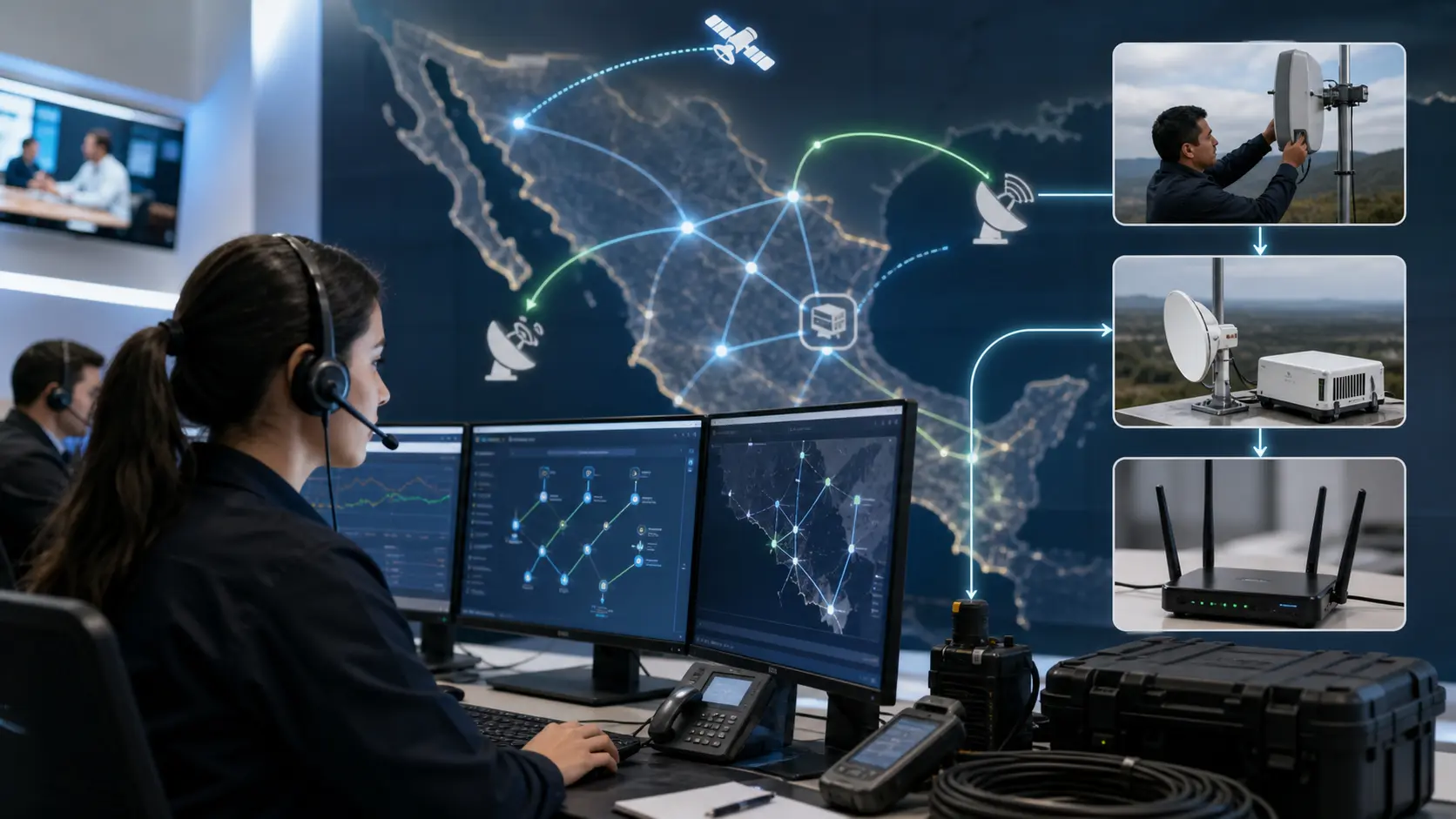
Elara's public positioning sits directly in this difficult middle. The company presents itself as a Mexican telecommunications and technology provider with more than two decades of activity, a Mexico City teleport, satellite and multitechnology connectivity, a CNOC/NOC function, certified installers, more than 70 field crews, 24/7/365 monitoring and support, and managed products aimed at backup links, quick-start service, Linktegra X, NOC Vx, Smart ATM+, Smart BTS and Smart Agro.
It also presents regulatory, infrastructure and investor context: a public telecom network concession history, a telecommunications commercialization authorization, Northgate Capital backing, and network-resource records that identify AS262927 and Elara-held IPv4 ranges.
Those facts make Elara more than a reseller brochure. They also do not settle the reliability question. The company may control a teleport, manage its own ASN, resell or combine public telecom network capacity, dispatch crews, operate support, and supervise customer equipment. A distributed customer still pays for the outcome at a particular site. The decisive question is whether Elara can keep service state visible when satellite, terrestrial, CPE and provider boundaries overlap.
That distinction matters because managed connectivity is often sold as simplification. A customer wants one party to own the headache. But the actual fault path is not simple. Elara can be responsible for design, monitoring, first-line triage, CPE, a backup service, a satellite path, a terrestrial handoff, or a provider escalation. It may not be responsible for the customer's LAN, power, building wiring, business application, bank switch, carrier core, weather, construction damage or endpoint device. The quality of the service is determined by how cleanly those boundaries are handled when a site is down.
Where Elara Sits in the Chain
Elara's own public material gives a clear shape to the business. The company emphasizes connectivity for sites where terrestrial infrastructure is weak, unavailable, delayed or insufficiently resilient. It describes primary satellite links for branches and remote operations, backup links that can take over when a primary path fails, quick-start links for temporary operation before a permanent connection is ready, multicast and streaming to multiple locations, managed NOC service, and multitechnology continuity through Linktegra X. The technology mix is not a single access method.
Elara refers to satellite in Ku, Ka and C bands, fibre, copper, microwave, multiple satellites, multiple platforms, and managed monitoring.
This is a service chain rather than a pure software product. The customer buys a bundle of design, installation, access, monitoring, escalation, support and proof. The same customer may also buy equipment control, remote reboot, sensor monitoring, site security or tower supervision through smart offerings. That makes Elara closer to an operating partner than to a one-time circuit seller. Its work is repeated: deploy, monitor, detect, classify, escalate, restore, report and adjust.
The chain starts before an outage. Site surveys, coverage checks, antenna placement, CPE selection, backup-path design, power design, cabling, firewall and routing policy, failover rules, customer acceptance tests and support contacts all affect later reliability. A branch that has a poorly documented local network will be harder to restore. A tower with unstable power will generate noisy incidents. A satellite site with insufficient line of sight or weak rain margin will look unreliable even if the NOC follows the playbook.
A customer with no clear application priority may blame the link for a business process that was never protected end to end.
The chain continues during normal operation. Monitoring has to distinguish a degraded link from a total outage, local power from access failure, terrestrial primary from satellite backup, traffic congestion from device failure, and customer-LAN issues from provider transport. It has to create tickets that are specific enough to drive action. It has to decide when remote remediation is enough and when a crew is needed. It has to know when to call another carrier or satellite capacity provider. It has to keep a record that survives the shift change.
The chain is completed after restoration. The customer should be able to accept a service state, not simply hear that a case is closed. Acceptance can include service-up observation, packet loss, latency, application checks, uptime calculations, failover logs, route confirmation, device status, field technician notes, and an explanation of whether the incident is likely to recur. Without that record, a restored link remains a promise rather than an operating fact.
This is the context in which Elara's coverage and continuity claims should be read. The company appears to have real infrastructure and real market experience in Mexican satellite and managed connectivity. Its current public pages also use broad language: total visibility, instant failover, optimized latency, uninterrupted satellite connectivity, reduced support and maintenance costs, higher ATM uptime, and proactive detection before problems affect operations. Those are useful claims to examine, but they are not the same as independently measured service results.
Repeated Work Is Where Value Accumulates
Elara's value, if it is delivered, comes from repeated operating work that many distributed customers do not want to build themselves. A retailer with dozens or hundreds of locations can negotiate individual circuits, install routers, monitor alarms, maintain spare equipment, coordinate carriers, hire field technicians and reconcile support tickets. Some large companies do exactly that. Many others find that the work is too fragmented. The expensive part is not one router.
It is the steady burden of knowing which site is healthy, which link is primary, which ticket matters, which vendor owns the next step, and which outage is harming revenue.
The same pattern applies to public-sector sites. A one-time installation program is only the visible part. Remote connectivity also requires ongoing service, equipment maintenance, usage monitoring, power management, local support and replacement planning. The older public-sector record around Elara's role in connecting thousands of marginal-area sites for a Mexican communications ministry project illustrates the scale of this kind of work: equipment, installation, operation, maintenance, satellite segment and remote stations.
That does not prove current service quality, but it shows the kind of distributed field problem Elara has been associated with.
Industrial and mining customers create another version of the same repeated work. Mines, oil and gas locations, maritime sites and remote industrial locations need voice, data, video, operational monitoring and often backup to terrestrial routes. Public interview material from Elara describes satellite as a complement to terrestrial links and as a way to reach sites where terrestrial infrastructure is difficult. Again, the point is not that satellite makes the site easy. It is that the customer would rather buy managed reach, installation and continuity than build a full specialist satellite operations function internally.
Smart ATM+ and Smart BTS extend this repeated-work logic from connectivity into managed devices and sites. An ATM outage or a tower-site fault is not only a bandwidth event. It can involve power, local hardware, security, environmental conditions, remote restart, alarms, field dispatch and customer impact. Elara's public pages present remote reboot, failure monitoring, configurable alerts, dashboards, reports, camera-based site monitoring and centralized infrastructure control. Those functions are valuable only if they reduce unproductive visits, shorten restoration, and create a trustworthy record.
If they merely add another dashboard, they increase supervision cost without enough benefit.
The repeated work around NOC Vx is similar. Elara says its NOC service offers proactive monitoring, incident management, critical-device administration, centralized visibility and support options such as 18x7 or 24x7. The meaningful question is how the NOC classifies and resolves incidents in practice. A good NOC makes fewer people guess. It tells the customer whether the problem is site power, terminal equipment, access path, satellite impairment, provider route, congestion or customer application. A weak NOC produces vague ticket updates and forces the customer's IT staff to supervise the supervisor.
That is why Elara's core automation task should be framed as moving a distributed-site connectivity problem into an accepted restored-service state. It is not enough to alert. It is not enough to switch paths. It is not enough to close a ticket. The company has to turn noise into a service record that lets the customer make business decisions.
Satellite Changes the Supervision Cost
Satellite connectivity is attractive in precisely the places where ordinary network operations become harder. A satellite link can bypass missing fibre, poor copper, slow construction, mountain terrain, dispersed sites and temporary project constraints. It can also act as backup when terrestrial access fails. Elara's public material repeatedly leans on this benefit: connectivity where others cannot reach, quick-start service for sites without terrestrial infrastructure, backup links compatible with fibre, copper, microwave or another satellite path, and satellite access for remote industrial or governmental operations.
The tradeoff is that satellite introduces its own supervision cost. Different orbits, frequency bands and ground infrastructure have different performance profiles. GEO systems offer broad coverage but higher latency. LEO and MEO systems can reduce latency but require more moving parts and more complex constellation operation. Ku, Ka and C band choices affect equipment, bandwidth, rain sensitivity, antenna size and economics. Ka-band capacity can be attractive, but heavy rainfall can degrade high-frequency links unless the system has sufficient fade margin, adaptive techniques or site diversity.
None of these constraints makes satellite unsuitable. They mean the service record has to be more precise than a simple up/down label.
Latency is the most obvious boundary. Some applications can tolerate high latency: email, messaging, file transfer, many monitoring tasks and buffered video. Others are more sensitive: voice, video meetings, interactive cloud applications, VPN-heavy workflows, payment processing, remote control and operational telemetry. Elara's solution pages refer to optimized latency, Linktegra X analytics for latency and uptime, and continuity for real-time or critical operations. The buyer should ask which applications were tested on which path, under which load, and whether failover changes latency enough to affect the user.
Weather is another boundary. A site can be properly installed and still face rain fade, especially in higher-frequency satellite bands. A managed provider can mitigate the risk through design, redundancy, capacity choices and operational planning. It cannot repeal physics. The customer therefore needs a clear understanding of when the satellite link is primary, when it is backup, what the expected degradation looks like, and how the service record distinguishes weather-related impairment from CPE or provider failure.
Capacity is the third boundary. Satellite bandwidth is not an infinite substitute for fibre. For a small branch, a well-designed backup path may protect critical operations while nonessential traffic is shaped or blocked. For a mine, public site or tower, the requirement may be larger. A customer should not assume that a backup link can carry the same traffic mix as the primary path unless the service has been sized and tested that way. The better question is which applications must survive, at what throughput and latency, and for how long.
These constraints make Elara's NOC and integration story more important, not less. If the customer uses satellite only for emergency continuity, the NOC must know when to fail over and how to prove it. If satellite is the primary link, the NOC must explain performance variation and restoration. If satellite and terrestrial paths are bonded or managed together, the NOC must show which path carried traffic and whether the session experience survived the transition. A connection that is technically alive but operationally confusing is not restored in the customer's eyes.
NOC Visibility Is Not the Same as Control
Elara's current pages emphasize CNOC/NOC monitoring, NOC Vx, centralized visibility, incident management and 24/7/365 support. That is the right operating vocabulary. It also raises the main technical question: what can the NOC actually see, and what can it actually control?
Visibility is layered. A NOC may see a managed router, a modem, an antenna controller, a power device, a sensor, a VPN tunnel, a circuit alarm, a traffic graph, an upstream route, a customer application probe or a ticket from another provider. Each layer changes the quality of the decision. If Elara only sees that a managed device stopped responding, it still has to infer whether power failed, a cable was cut, a user unplugged equipment, the access network failed or the device crashed. If it also sees power status, backup path state, ping and application probes, the diagnosis improves.
Control is narrower. A NOC may be able to reboot a device, change a configuration, force a path, open a provider ticket, notify a customer contact or dispatch a crew. It may not be able to repair a municipal power issue, force a third-party carrier to fix fibre, replace a satellite payload issue, or fix a customer firewall rule. A serious managed connectivity provider has to be explicit about the difference between visibility, control and responsibility.
That difference becomes commercially important in SLA disputes. The customer cares about downtime. The provider may separate causes into provider network, third-party access, customer premises, force majeure, scheduled maintenance and customer-caused failures. If the service record is weak, both sides spend time arguing about classification. If the record is strong, the customer may still dislike the outage, but it can see the chain of responsibility. In a distributed estate, reducing dispute time is part of the value.
Elara's support page says the service desk is prepared to accompany customers from installation through incident resolution, and its NOC Vx page refers to detecting, resolving and reporting before a problem affects operations. Those are strong claims. The proof would be ticket data: mean time to detect, mean time to assign, mean time to restore, false positives, repeat incidents, truck-roll avoidance, provider escalation times, and customer acceptance rates. Public pages do not provide those measurements. The article therefore should treat NOC claims as a plausible operating model, not as verified performance.
NOC visibility also has a maintenance burden. Every monitored device has to be onboarded, named, mapped, credentialed, updated and retired correctly. Every alert rule has to be tuned. Every escalation path has to remain current. Every customer contact has to be reachable. Every access provider account has to be mapped to the right circuit. A NOC with stale inventory can be worse than no NOC because it creates confidence in the wrong record. Elara's value depends heavily on the cleanliness of this operational data.
Last Mile, CPE and Truck Rolls
The last mile is where managed connectivity often loses its elegance. A customer buys a continuity service, but the outage may be a loose cable, failed power supply, water-damaged enclosure, misaligned antenna, bad modem, locked cabinet, missing access permission, incorrect VLAN, weak grounding, dust, heat, rodents, theft, or a local staff member who moved equipment. The NOC may detect the symptom quickly and still need a person at the site.
Elara's public claim of more than 70 crews and certified installers matters for this reason. A provider that sells remote and industrial connectivity without field capability is relying heavily on partners or the customer. Field presence does not guarantee speed, but it changes the operating model. It can reduce the gap between diagnosis and repair when the fault is local. It can also increase cost if incidents are not filtered well. Dispatching a technician to discover a customer-side power issue is expensive. Not dispatching when equipment is failed is also expensive.
This is where Smart ATM+ and Smart BTS are commercially interesting. Remote reboot and monitoring are not glamorous, but they target a real cost: unnecessary site visits. An ATM that can be safely power-cycled remotely may return to service without a truck roll. A tower site with camera and device telemetry may let operations distinguish intrusion, local hardware fault and access failure. A branch router with controlled failover may keep the business open while the primary carrier is repaired. The value comes from avoided visits, faster diagnosis and fewer repeated faults.
The risk is overclaiming. Remote reboot can fix a hung device, but it cannot replace hardware, repair a damaged cable, solve chronic voltage instability or correct poor installation. A dashboard can show alarms, but it cannot decide which business service matters most unless the customer and provider have configured priorities. A failover product can preserve sessions under certain conditions, but the customer should test the specific applications that matter, not accept the phrase as universal.
The customer-premises boundary is also important. Elara's managed service may stop at an antenna, modem, router, power controller or managed appliance. The customer may own the LAN, Wi-Fi access points, point-of-sale terminals, cameras, industrial control systems, servers and application credentials. When an outage occurs, customers often experience the whole site as "the network." The managed provider experiences it as a set of demarcations. A good service relationship makes those demarcations visible before the outage, not during the argument.
Linktegra X and the Failover Claim
Linktegra X is the most direct expression of Elara's continuity thesis. The public page says it is designed for last-mile challenges, combines multiple links into a single stable channel, offers session-proof failover, supports security functions such as encryption, ACLs, DPI, QoS and local internet breakout, provides historical and live analytics for performance, consumption, latency and uptime, and centralizes control. It also claims continuity, bonding, lower support and maintenance cost, stronger SLA and premium service.
That is a coherent product story. It addresses a real buyer problem: a distributed site may have more than one connection, but the business still experiences outages because failover is slow, sessions drop, routing policy is brittle, or staff cannot tell which path is degraded. A managed continuity layer can be worth buying if it makes path state visible, preserves the right traffic, and reduces manual intervention.
The hard test is application-specific. "Session-proof" has to be examined against the traffic that matters. Does a payment terminal keep its transaction state? Does a VPN reconnect silently or preserve the session? Does voice survive without a noticeable break? Does a cloud POS application retry cleanly? Does a camera stream continue? Does an industrial telemetry connection tolerate the path change? Does the service treat all traffic equally, or does it prioritize critical applications while limiting bulk traffic? These are not philosophical questions. They determine whether the restored state is accepted by the business.
The second test is observability. If a failover event happens, the customer should be able to see when the primary degraded, when the secondary took over, which sessions were affected, how latency changed, what traffic was shaped, and when the primary returned. If that record is missing, the product may work technically but fail commercially because the customer cannot explain the event.
The third test is maintenance. Multilink bonding and failover products add configuration. Policies need updates. Certificates expire. Firmware ages. Carrier circuits change. SIMs, terminals, antennas and routers fail. Local internet breakout can create security and policy questions. DPI and QoS can help, but they can also misclassify traffic when applications change. A managed product is valuable if Elara absorbs that maintenance with discipline. It is costly if the customer still has to supervise every rule.
The fourth test is substitute economics. A customer can buy dual circuits and configure SD-WAN internally. It can buy a national carrier's managed service. It can use LEO satellite as backup. It can buy a router vendor's failover appliance and hire a local integrator. It can choose lower-cost redundancy with less visibility. Linktegra X has to beat those substitutes after installation, monitoring, field support, monthly service, ticket handling and lifecycle maintenance are included.
Regulatory and Network Evidence
Elara's public record supports the view that it is operating in a real telecom context, not merely borrowing a connectivity label. Mexican regulator documents show historical concessions to install, operate and exploit public telecom networks, including services such as signal transport, data transmission and satellite mobile maritime service, and later authorization around coverage expansion.
A 2021 IFT authorization also gave Elara the right to establish and operate or exploit a telecommunications service marketer, with the definition that such a marketer provides telecommunications services to end users using capacity from one or more public telecom networks without being the concession holder for those networks.
Those regulatory facts matter because they explain the boundary around Elara's business. It can be both infrastructure operator and commercial integrator depending on the service. It can use its own capabilities and acquired capacity. It can work with carriers and satellite operators. It can be the customer's accountable service wrapper while still depending on other networks. That is normal in telecom, but it should be visible in procurement. Customers need to know which parts are Elara-controlled, which parts are partner-controlled, and how evidence flows across the boundary.
Public network-resource records also identify AS262927 as ELARA COMUNICACIONES SAPI DE CV, with two IPv4 /22 ranges totaling 2,048 addresses and LACNIC registry context. IPinfo shows upstream and peer relationships with Mexico Red de Telecomunicaciones and Coordinadora de Carrier's, and IPIP provides LACNIC-style owner and contact information. These records do not prove enterprise service quality. They do show that Elara has an identifiable autonomous-system footprint rather than only a marketing website.
The network-resource evidence should be interpreted carefully. Some IPinfo observations show very different ping times for addresses in Elara ranges, including low single-digit milliseconds for some probes and much higher times for others. That is consistent with a mixed network and possible satellite-tagged paths, but public probing cannot map a customer's service. It is useful as a reminder: one provider name may hide several access experiences. The customer should test the path it will actually use.
The teleport evidence is stronger for infrastructure credibility than for customer outcomes. Public WTA-related material reported Tier 3 full certification of Elara's Mexico City teleport in 2018 under an independent certification process involving data submission and auditor validation. Latam Satelital reported Elara in the 2016 WTA Top 20 independent teleport operators. Mexico Business News quoted Elara saying its teleport had triple-9 availability and was the only Tier 3 certified teleport in Mexico. Elara's own current site now claims 99.95 percent annual availability for its critical teleport infrastructure.
These points support the idea that Elara has serious teleport operations. They do not prove that every managed customer site receives 99.95 percent end-to-end service.
That end-to-end distinction is central. A teleport can be highly available while a branch still suffers from local power failures. A satellite platform can be healthy while an antenna is misaligned. A provider backbone can be healthy while a customer's firewall drops traffic. A NOC can be staffed while the responsible third party is slow. The customer buys end-to-end business continuity, but the components have different owners and different availability profiles.
Unit Economics for Distributed Customers
The commercial question is whether managed connectivity gains exceed installation, monitoring, truck-roll, provider, support and continuity costs. The answer is not the same for every buyer.
For a single small site in a well-served urban area, Elara's satellite and managed continuity capabilities may be more than the customer needs. A standard fibre circuit, mobile backup and basic router failover may be enough. The cost of a richer managed service may not be justified unless downtime is unusually expensive or local support is weak.
For a distributed retailer, bank, logistics operator or public-service network, the calculation changes. The cost of downtime is multiplied across sites. The cost of local diagnosis is high because each site has different staff, equipment and access conditions. A central team may not know whether a rural branch is down because the carrier failed, the router hung, the power is out or the local manager moved equipment. Managed monitoring, remote reboot, backup paths and field crews can reduce the hidden labor cost of keeping the estate alive.
For industrial and remote sites, the case can be stronger still. Fibre may be unavailable or delayed. Microwave may require line of sight. Mobile may be weak or congested. Satellite may be the only practical option or the best backup. The cost of one delayed project, one unsafe communications gap or one unmonitored remote asset can exceed the monthly service difference. But these customers also need more explicit design: bandwidth, latency, power, redundancy, environmental protection, spares, access, field safety and application priority.
For carriers and telecom infrastructure customers, quick-start and backup services can be valuable as project insurance. Elara describes quick-start links as temporary, flexible and aimed at carriers and projects with tight timelines. That is a concrete use case. A terrestrial carrier may need temporary connectivity before a permanent link is ready. The value is not just bandwidth; it is schedule protection. The risk is that temporary service becomes a long-term substitute without a proper design for capacity, SLA and operations.
The economics have several line items. Installation includes site survey, equipment, mounting, cabling, power and acceptance. Monthly service includes access capacity, satellite or terrestrial costs, monitoring and support. Maintenance includes spares, firmware, field visits, replacements and documentation. Incident management includes NOC labor, provider escalation and customer coordination. Redundancy includes secondary links, failover equipment and extra capacity. Governance includes reporting, SLA review and dispute handling. A buyer that compares only monthly circuit prices will miss much of the real cost.
The benefit side also has several line items. Avoided downtime is the obvious one. Avoided truck rolls may be equally important for ATM, tower and remote sites. Faster diagnosis reduces internal IT labor. Better reporting reduces SLA disputes. A managed backup path can preserve revenue or service continuity. A quick-start link can prevent project delay penalties. Remote monitoring can catch deteriorating equipment before failure. A single accountable provider can reduce vendor-management load.
The business case is strongest when these benefits are measured. If Elara can show a customer that truck rolls fell, outage minutes fell, ticket misclassification fell, failover succeeded for critical applications, and repeat incidents were addressed, the managed-service premium is easier to defend. If the customer receives only generic uptime claims, it is harder.
Failure Modes That Decide Value
The common failure modes for Elara are ordinary, but their interactions are costly.
The first is a site outage with weak last-mile evidence. The NOC sees loss of reachability, but cannot distinguish power, CPE, access, antenna or customer LAN quickly enough. The customer experiences a long outage even if the underlying repair is simple.
The second is CPE failure. Routers, modems, power controllers, sensors and antennas all age. A managed provider has to know serial numbers, firmware, configuration, warranty, spares and replacement path. If inventory is wrong, restoration slows.
The third is satellite impairment. Rain fade, capacity pressure, antenna problems, platform issues and latency can all affect user experience. The service record has to show whether the problem is satellite-specific or a broader site issue.
The fourth is provider handoff delay. If Elara is using another carrier's capacity or transport, the customer's restoration depends on escalation between organizations. A strong managed provider can shorten that path through established procedures. It cannot eliminate every third-party delay.
The fifth is routing or policy error. Multilink designs, failover products, local breakout, VPNs, QoS and security filtering can fail because of configuration drift. The result can be partial service: the link is up, but the application that matters is broken.
The sixth is ticket backlog or poor classification. A NOC with too many generic alarms can bury critical incidents. A service desk that classifies a customer-LAN problem as provider transport, or the reverse, burns hours.
The seventh is an SLA dispute. If the provider and customer do not agree on when the outage began, which service was affected, who owned the cause, and when restoration was accepted, the relationship becomes adversarial. Better telemetry and clearer reports reduce this risk.
The eighth is a monitoring blind spot. The provider may monitor the WAN but not the local application, the power system but not the antenna, the router but not the customer's switch, or the primary path but not the backup path. The customer may assume more coverage than it bought.
The ninth is overreliance on the backup. A backup path that was designed for emergency POS traffic may be asked to carry video, backups and cloud desktop traffic during a primary outage. If traffic policy is not tested, failover disappoints.
The tenth is organizational drift. Contacts change, site names change, local staff move equipment, providers change circuits, and documentation ages. Managed service quality decays when the operating record is not maintained.
These are not reasons to reject Elara. They are reasons to judge it by operational proof rather than by coverage language.
Substitutes Are Real
Elara's substitutes are not theoretical. A distributed customer can buy directly from national telecom carriers, regional ISPs, mobile operators, satellite operators, LEO broadband providers, SD-WAN vendors, managed service providers, systems integrators or internal network teams. Each substitute changes the boundary.
A national carrier may offer stronger terrestrial reach, simpler billing and established SLA machinery in urban areas. It may be less flexible for remote sites or multitechnology integration. A regional ISP may be cheaper or locally responsive, but may not provide satellite backup, NOC depth or field coverage across a broad estate. A direct satellite service may be fast to deploy, but the customer may have to own integration, monitoring, local support and application failover. A pure SD-WAN vendor may offer excellent policy control, but not field crews, satellite access or last-mile accountability.
An internal team may deliver the best fit for a large enterprise, but it must fund specialists, tooling, spares, contracts and 24/7 coverage.
The realistic question is not whether Elara is the only way to connect remote sites. It is whether Elara reduces coordination cost enough to justify its role. In sites where the customer already has strong network operations and multiple carrier relationships, Elara may be a specialized provider for satellite or temporary links. In sites where the customer wants one operational wrapper over satellite, terrestrial, CPE and support, Elara's managed position is more attractive.
LEO satellite is an important substitute and complement. It can reduce latency compared with traditional GEO links and expand options for remote sites. But it does not remove the need for installation quality, power, equipment management, traffic policy, monitoring, field support and customer acceptance. A company can buy LEO service directly and still need a managed layer. Elara's future value may depend on how well it integrates different orbit and access options without trapping the customer in vague continuity language.
The strongest substitute to Elara may be a deliberately simple design: one good fibre circuit, one mobile backup, a managed router, basic monitoring and a clear internal support process. For many SMEs, that is enough. Elara has to win where the simple design fails: remote geography, high downtime cost, many sites, weak customer operations, need for quick start, satellite requirement, remote device control, or field-service burden.
What Would Prove the Case
The ideal proof for Elara would not be another coverage map. It would be operating evidence at the site level.
For Linktegra X, proof would include failover tests against named applications, with latency, packet loss, session survival, restoration time and traffic-priority results. It would show what happens when the primary fibre path fails, when the satellite path degrades, when a CPE device restarts, when the provider route changes, and when both paths are congested. It would distinguish successful continuity from partial service.
For NOC Vx, proof would include detection time, classification accuracy, escalation time, resolution time, false-positive rate, repeat-incident reduction, device inventory accuracy and customer acceptance records. It would show how many incidents were resolved remotely, how many required field visits, how many belonged to third-party providers, and how many were customer-side.
For Smart ATM+ and Smart BTS, proof would include avoided truck rolls, remote reboot success rates, uptime before and after deployment, recurring hardware faults, alert-to-action time, and the percentage of incidents where remote telemetry changed the outcome. The company should avoid presenting remote monitoring as a magic layer. The value is in measurable reduction of unnecessary work and downtime.
For satellite and quick-start services, proof would include installation lead times, site acceptance tests, link availability, weather-related incident records, application performance under load, and transition from temporary to permanent service. The quick-start claim is credible only if temporary connectivity arrives before the business loses the schedule advantage.
For the broader managed service, proof would include customer-retention patterns, SLA attainment by cause category, field-service coverage, provider escalation performance and post-incident reports. The best evidence would be not simply that a link came back, but that the customer accepted the restored state with enough detail to close the business incident.
Final Judgment
Elara Comunicaciones is most interesting where connectivity is an operating problem, not a commodity circuit. Its public materials point to a company with Mexican satellite depth, a Mexico City teleport, regulatory permissions, network-resource identity, field crews, a NOC story, multitechnology links and products aimed at continuity, remote monitoring and managed infrastructure. That is a credible foundation for customers whose sites are too dispersed or too remote for ordinary access procurement to solve cleanly.
The same foundation creates the right skepticism. Elara's strongest claims sit at boundaries: satellite and terrestrial, primary and backup, NOC and field, Elara-controlled infrastructure and provider capacity, CPE and customer LAN, alert and restoration, link uptime and business continuity. These boundaries are where managed connectivity either earns its premium or becomes another layer of uncertainty.
The fair judgment is therefore conditional. Elara can be valuable for distributed enterprises, industrial sites, public-sector networks, carriers and SMEs in Mexico and Latin America when it turns fragmented connectivity work into a visible, accepted restored-service record. Its value is weaker when buyers treat teleport certification, coverage, failover language or NOC availability as proof of end-to-end reliability without site-level tests and reports.
The company should be judged by the record after the outage: what failed, how quickly it was detected, who owned the next action, which path carried the business, what evidence showed service was restored, what was done to prevent recurrence, and whether the customer could accept the result. For Elara, the restored connection is not a slogan. It is the operating unit that decides whether managed connectivity is worth paying for.