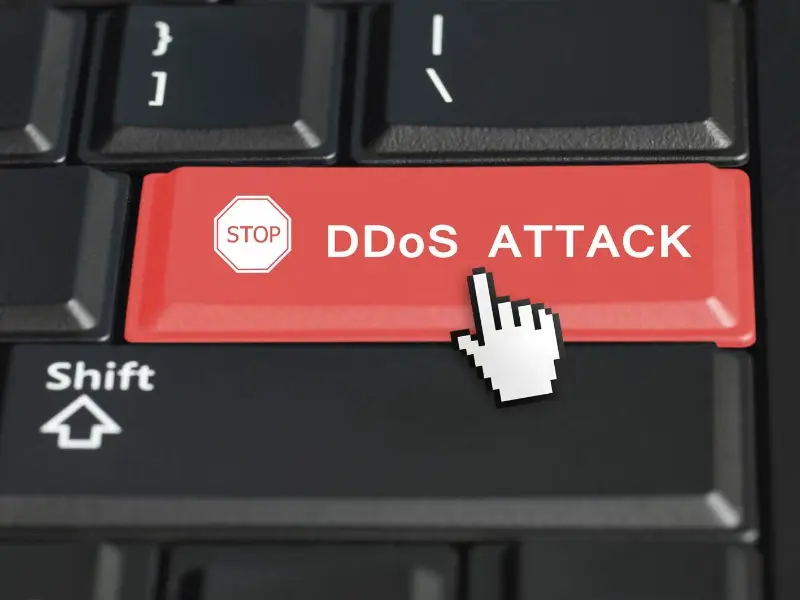
- A Distributed Denial of Service (DDoS) attack paralyses the target system through large amounts of network traffic, and firewalls can only provide limited protection, often requiring multiple layers of protection to effectively counter.
- Other defenses include content delivery networks (CDNs), load balancing, DDoS mitigation services, and traffic monitoring.
DDoS attacks disrupt the normal operation of services by exposing the target system to a large number of malicious traffic. Although firewalls can provide basic protection, they are usually limited in the face of large-scale attacks. Effective defense requires a combination of strategies and real-time traffic monitoring to enhance the system’s resilience and ensure continuous service availability.
Also read: What is a firewall?
Definition of DDoS attack
DDoS attack is a type of cyber assault aimed at disrupting the normal functioning of a targeted server, service, or network by overwhelming it with a flood of internet traffic. In a DDoS attack, multiple compromised devices, often part of a botnet, are used to send a massive amount of data requests to the target, causing it to become slow, unresponsive, or completely inaccessible to legitimate users.
DDoS attacks can be categorised based on the layers of the Open Systems Interconnection (OSI) model they target, such as the network layer (Layer 3), transport layer (Layer 4), or application layer (Layer 7). Infrastructure layer attacks (Layers 3 and 4) are usually large-scale and easier to detect, while application layer attacks (Layers 6 and 7) are more complex, often focusing on specific aspects of an application to disrupt its functionality. Protecting against DDoS attacks typically involves reducing the attack surface, scaling up resources, monitoring traffic, and deploying specialised defenses like firewalls and rate limiting.
Also read: Pakistan’s firewall risks $300M loss in IT sector
Does a firewall protect against DDoS
A firewall can provide some level of protection against DDoS attacks, but its effectiveness depends on the type and scale of the attack.
1. Basic protection: Firewalls can help by filtering out unwanted traffic and blocking certain types of attacks, such as those targeting specific ports or using known malicious IP addresses. They can enforce access control lists (ACLs) to limit the number of connections or restrict traffic from suspicious sources.
2. Limitations: Traditional firewalls are not designed to handle large-scale DDoS attacks, especially those that flood the network with massive amounts of traffic. In such cases, a firewall might become overwhelmed, leading to the same kind of service disruption the DDoS attack intends to cause.
3. Advanced protection: To effectively mitigate DDoS attacks, organisations often use specialised solutions in conjunction with firewalls. These include DDoS mitigation services, Web Application Firewalls (WAFs) for protecting against application-layer attacks, and CDNs that distribute traffic across multiple servers to absorb the impact of large-scale attacks.
In summary, while a firewall can provide basic protection against certain types of DDoS attacks, it is typically not sufficient on its own for defending against large or complex DDoS attacks. Comprehensive protection usually requires a multi-layered approach involving more advanced security measures.
Also read: Do firewalls encrypt data?
Other actions used to defend against DDoS attacks
In addition to firewalls, there are a variety of measures that can be used to defend against DDoS attacks:
1. CDNs: CDNs can mitigate the effects of a DDoS attack by spreading traffic across multiple servers around the globe, reducing the load on individual servers. CDNs can also filter malicious traffic further away from the target.
2. Load balancing: Spreading traffic across multiple servers or data centres via load balancers can avoid overloading a single server, thus improving overall resilience. This method can effectively counter large-scale traffic attacks.
3. DDoS mitigation services: Many security companies offer specialised DDoS mitigation services that can be activated quickly when abnormal traffic is detected, filtering out malicious traffic and ensuring that normal traffic can continue to access the target website or service.
4. Traffic analysis and monitoring: By monitoring network traffic in real time, abnormal behaviour can be detected and measures taken to stop it. For example, a sudden increase in traffic may be a precursor to a DDoS attack, and alerts can be set or mitigation measures can be triggered automatically.
5. Rate limiting: The impact of application layer DDoS attacks can be mitigated by limiting the number of requests from the same IP address at a given time. This method is particularly useful for protecting web applications and APIs.