
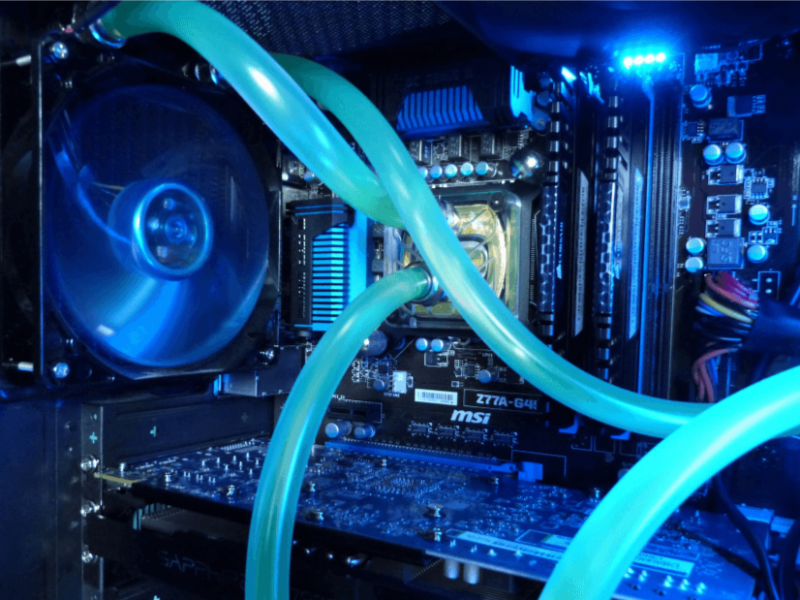
- A water cooling system is a technology that uses a liquid, usually water, to cool and dissipate heat from electronic equipment.
- Water-cooled systems have become the preferred cooling solution for high-load equipment due to their excellent heat dissipation performance and unique technical advantages.
A water cooling system is a technology that uses a liquid, usually water, to cool and dissipate heat from electronic equipment. Water-cooled systems have become the preferred cooling solution for high-load equipment due to their excellent heat dissipation performance and unique technical advantages.
In this article, we’ll take a closer look at the benefits of water cooling systems, including their superior performance in terms of cooling efficiency, space utilisation, noise control, overclocking potential, targeted cooling of specific components, aesthetics and industrial applications.
Understanding water cooling system
Water cooling system is a system that uses liquid cooling technology to dissipate heat, and is widely used in electronic equipment, automotive engines, industrial equipment and other fields. Its working principle is based on the basic principle of heat conduction, through the circulation of coolant to absorb and transfer the heat generated by the equipment.
The principle of its operation consists of the following main steps:
- Heat sink: The first step in a water cooling system is the heat sink. A heat sink is usually made of metal and has many tiny channels. Hot water enters the radiator and circulates through it.
- Water Pump: The water pump is the heart of the entire water-cooled cooling system and is driven by a motor to lift the liquid water. The pump pumps the coolant from the water tank to the water-cooling head, through which the coolant exchanges heat with the equipment to be cooled.
- Water pipework and coolant: The coolant (generally distilled water or a special cooling fluid) is circulated through the system by means of water pipework. The coolant absorbs the heat generated by the equipment at the water-cooling head and carries it back to the radiator for heat dissipation.
- Circulation system: The coolant circulates continuously between the water reservoir, water-cooled head, water pipework and radiator to carry away the heat generated by the equipment.
Also read: Liquid cooling tech from China: Saviour of the AI industry?
Advantages of water cooling system
Water-cooled systems have a number of significant advantages over traditional air-cooled systems, and these advantages enable them to perform well in a variety of application scenarios. The following are some of the key benefits of water cooling systems:
Outstanding heat dissipation performance
Water-cooled systems use liquid flow to carry away the heat generated by the hardware, and their heat dissipation effect is better than air-cooled systems. Because water has a higher heat capacity than air, water-cooled systems are able to absorb and transfer heat more efficiently.
Low noise
Water-cooled systems usually run with a water pump and fan, which is less noisy compared to air-cooled radiators, providing a quieter environment for users.
Small footprint
Water-cooled radiators are small and do not take up much chassis space, which makes it possible to install high-end configurations in a limited space, and even fit large parts such as cooling rows outside the chassis, thus making better use of the fractional space inside the chassis.
Low energy consumption
Since water has a higher heat capacity than air, water-cooled systems also consume relatively less energy, which means that they can provide a higher coefficient of performance (COP) under the same conditions.
Extended equipment life
Through effective heat dissipation, water-cooled systems prevent electronic equipment, mechanical components and other heat sources from overheating, thus extending the life of the equipment and improving efficiency.
Also read: 3 reasons why a car cooling system is pressurised
Flexible Layout
With the inherent advantage of dispersed volume, water-cooled systems can sometimes make more reasonable use of fractional space inside the machine than air-cooled systems, which is basically not limited by the layout of the motherboard, and the air ducts are also more flexible.
High Safety and Reliability
Water-cooled systems are designed to excel in handling high power loss and to quickly remove heat from the CPU side, ensuring system stability and reliability.
Suitable for overclockers
Water-cooling systems are a superior choice for overclockers, as they are able to keep the CPU temperature at a lower level, which is conducive to faster and more stable computer operation.
Eco-friendly and energy-saving
Certain water-cooling systems use eco-friendly refrigerant and optimised design, which not only saves energy significantly, but also reduces the impact on the environment.
Water-cooled systems are widely used in modern computers and data centres and other fields due to their excellent thermal performance, low noise, small space occupation, low energy consumption, extended equipment life, flexible layout, high safety and reliability, and environmental protection and energy saving.