
Summary
- delDSL Internet is best read as a Delhi-NCR local-access operator whose bargaining power depends on how much Indian households, apartment associations and small businesses value building-level responsiveness after JioFiber, Airtel Xstream Fiber, Excitel and mobile data have reset the visible rupee-per-Mbps benchmark.
- The public evidence points to a real but small access network: delDSL markets fibre, data, voice, leased-line and FTTH services, appears in Indian licence and subscriber records, originates AS23872, shows upstream dependence on large carriers, and exposes customer-support workload through app, billing and complaint surfaces.
The buyer is pricing uptime in rupees per Mbps, not in slogans
Imagine a resident welfare association in Gurugram negotiating internet service for a mid-market apartment block, or a small exporter in Delhi-NCR deciding whether to keep a local broadband line for shipping documents, video calls and accounting uploads. The comparison starts with a simple unit: rupees per advertised Mbps per month. Jio advertises Delhi-NCR fibre and AirFiber plans such as Rs 399 plus GST for 30 Mbps and Rs 699 plus GST for 100 Mbps on its city page (https://www.jio.com/fiber/en-in/broadband-plans/delhi-ncr/). Airtel’s Rs 499 Xstream Fiber plan offers up to 40 Mbps with unlimited data and free router and installation conditions on longer terms (https://www.airtel.in/plans/broadband/499-fiber). Excitel markets a 200 Mbps Wi-Fi plus OTT plan from Rs 699 per month on a 12-month term, with 300 Mbps Wi-Fi-only pricing shown lower on long terms (https://www.excitel.com/broadband-plans/).
That buyer also has a real substitute in a pocket. India’s mobile-data habit is not decorative context. The Telecom Regulatory Authority of India reported average wireless data usage of 25.70 GB per wireless data subscriber per month and average revenue realization of Rs 7.87 per GB in the quarter ended December 2025 (https://www.trai.gov.in/sites/default/files/2026-03/QPIR_03032026_0.pdf). A household that can stream, message, pay bills and run a few video calls on 4G or 5G will tolerate a local fixed-line provider only if the fixed line solves problems that mobile data and national fibre cannot solve cheaply enough: stable upload, lower latency, predictable in-building Wi-Fi, faster repair, and someone who can talk to the building guard, electrician or association treasurer.
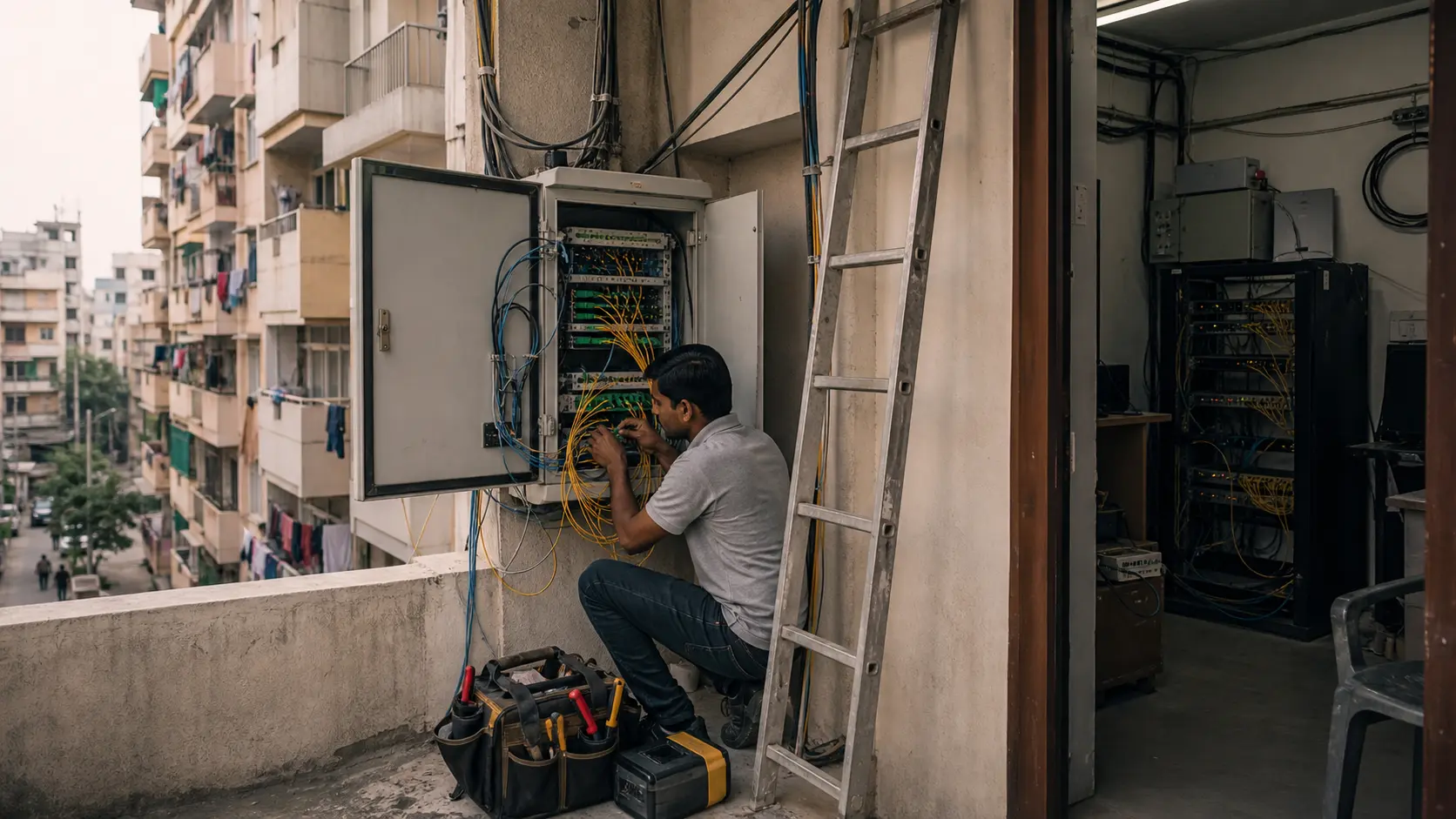
That is where delDSL Internet becomes interesting. The company is not a national mass-market fibre story. Its own pages describe a Delhi-NCR communications provider selling Internet, telecom, data, VoIP and FTTH to households and businesses, with an office at Millennium Plaza in Gurugram and a registered identity in New Delhi (https://www.deldsl.com/aboutus.html, https://www.deldsl.com/contact.php). The bargain is local access: the ability to wire a building, serve a business park, keep a helpdesk reachable, and price a custom service package that a national brand may not tailor at the same granular level.
The danger is that Indian broadband customers have been trained by national plans to see 30, 40, 100 and 200 Mbps as entry-level home units. If delDSL’s value proposition is only “we sell broadband,” the buyer’s spreadsheet will punish it. If the proposition is “we already understand this building, the last mile, the voice line, the billing dispute and the repair queue,” the same buyer may accept a higher apparent rupee-per-Mbps rate because the bought unit is not just bandwidth. It is avoided downtime, fewer escalations and a smaller coordination burden.
delDSL’s public offer is local access first, internet access second
delDSL presents itself as a communications bundle rather than a pure home-Wi-Fi brand. Its about page says it was set up in 2000 and offers DelTEL, DelNET, DelNELDEE, Internet Telephony and FTTH, while serving households, small businesses and large businesses (https://www.deldsl.com/aboutus.html). Its home page sells three product families: fibre to the home, data and voice, with messages around high-speed downloads, television clarity and sound quality (https://www.deldsl.com/). The business data page is more revealing: it says delDSL offers leased lines over its own fibre and third-party last mile, with speeds from 2 Mbps to STM-1, or 155 Mbps, and with multiple upstream and downstream interconnections (https://www.deldsl.com/data-business.html).
Those claims place delDSL in a familiar Indian local-access niche. Many city broadband providers do not win by having the cheapest national advertising budget. They win by being physically close to a set of buildings, developers, small offices and retail tenants. They know which riser has space, which duct route floods, which apartment association pays on time, which IT office needs an after-hours repair, and which customer will churn after the second unresolved outage. The public pages reinforce this: delDSL says it creates value for developers by making projects “Telecom Ready,” and that such homes are more saleable (https://www.deldsl.com/aboutus.html). Its group page places delDSL alongside Conscient Infrastructure and describes a broader property and services setting rather than a standalone consumer app story (https://www.deldsl.com/thegroup.html).
That property adjacency matters because local broadband economics are often decided before a customer sees a plan page. A building that already has a fibre cabinet, cable paths, an installed base of users and a known local contact has lower acquisition cost than a cold lead. A developer who wants a project marketed as ready for internet, voice and television may value a provider that can coordinate site work. A small exporter in a business park may care less about an OTT bundle than about a line that comes back before a shipment deadline.
The public evidence also shows delDSL still wearing older telecom-service clothes. The voice-business page advertises digital PRI lines, Centrex and VoIP services, with international-carrier tie-ups for A-Z voice termination under Indian Department of Telecommunications rules (https://www.deldsl.com/voice-business.html). The FTTH-for-home page bundles internet, telephones and television or video language (https://www.deldsl.com/ftth-me.html). That mix is not fashionable compared with a slick app-first fibre brand, but it can be economically useful. Voice, building cabling, data service and support relationships create account stickiness that a standalone cheap broadband tariff may not.
The caveat is that delDSL’s public web presence reads dated in places. Several pages carry a 2014 copyright line, and the plan table does not resemble the current mass-market speed tiers. A dated web page is not proof that the company’s current negotiated tariffs are dated, especially because the business plan page asks buyers to email for customized plans (https://www.deldsl.com/plans-business.html). But it tells the reader how to value the company: the central asset is probably not a consumer-facing digital storefront. It is local access, relationship memory, installed network paths and a support apparatus that either absorbs churn pressure or becomes overwhelmed by it.
The old price sheet is a warning about the cost stack
delDSL’s public “My Plans” page is the sharpest quantitative clue because it shows how hard the old local-ISP price stack looks after India’s cheap-data reset. The page lists home plans such as 512 Kbps with 20 GB fair usage for Rs 1,075, 1 Mbps with 20 GB for Rs 1,199, 4 Mbps with 60 GB for Rs 2,200, 8 Mbps with 150 GB for Rs 3,000, and 16 Mbps with 150 GB for Rs 3,900, with lower post-FUP speeds (https://www.deldsl.com/plans-me.html). On a raw rupee-per-Mbps basis, the 16 Mbps Rs 3,900 plan is about Rs 244 per advertised Mbps per month before any tax treatment. Jio’s public Delhi-NCR 100 Mbps Rs 699 plan is about Rs 7 per Mbps before GST (https://www.jio.com/fiber/en-in/broadband-plans/delhi-ncr/). Airtel’s 40 Mbps Rs 499 plan is about Rs 12.5 per Mbps before GST (https://www.airtel.in/plans/broadband/499-fiber).
No serious buyer would read that old delDSL page in isolation and conclude that a current home broadband bargain exists at those listed speeds. The better reading is that the public sheet preserves an older cost structure: limited bandwidth, fair-usage constraints, a higher fixed price, and a service model where support and last-mile scarcity mattered more than the headline Mbps number. In 2005 or 2010, a local DSL or fibre provider could monetize scarce fixed access. In 2026, scarcity has moved.
Bandwidth in the national advertising market is cheap; the scarce units are permissions, wiring access, repair accountability, reliable upload and low-friction service for a specific building.
That cost-stack shift is the core of delDSL’s investment and operating question. If the company can sell current negotiated plans that approach the market’s modern anchor while reusing old building access, the legacy relationship base becomes an asset. If it is stuck with old bandwidth economics, the market will turn that relationship base into churn. The public business plan page does not publish prices and instead asks buyers to email for customized assistance (https://www.deldsl.com/plans-business.html). That keeps price discovery private, which is normal for leased lines and building-level deals, but it also hides the most important variable.
The cost stack for a local operator has at least five parts. First is upstream capacity bought from larger carriers or reached through peering. Second is last-mile access: fibre, ducts, cabinets, switches, power, backup and building permissions. Third is support labour: helpdesk answering, field visits, ticket handling, billing disputes and customer education. Fourth is churn and collection: the cost of winning a customer who may leave for a national promo or mobile substitute. Fifth is regulatory and operational overhead: licences, routing records, abuse contacts, privacy, app maintenance and payment handling.
delDSL’s own pages touch each part. The data-business page says it uses its own fibre as well as third-party last mile, which means the company may face both owned-network maintenance and resale or access costs (https://www.deldsl.com/data-business.html). The contact page separates helpdesk and billdesk phone numbers, which suggests an operating split between technical support and payment handling (https://www.deldsl.com/contact.php). The customer portal at myaccount.deldsl.com presents login, registration status and password recovery, showing an account-management layer beyond one-time sales (https://myaccount.deldsl.com/). The Android app says customers can manage accounts, renew plans, raise complaints and upload documents (https://play.google.com/store/apps/details?hl=en_US&id=com.h8.delDSLSubscriber).
That labour has to be paid out of the monthly fee. National brands can amortize call centres, content bundles and procurement across millions of customers. A local operator may have lower local travel time and better building knowledge, but it does not get national-scale marketing or device purchasing. The bargain survives only when local knowledge reduces enough friction to offset scale disadvantage.
National fibre and mobile data reset the anchor price
India’s broadband market now gives customers multiple reference prices before they call a local provider. Jio’s Delhi-NCR page markets entry fibre and AirFiber options from Rs 399 plus GST for 30 Mbps and Rs 699 plus GST for 100 Mbps, with higher tiers up to 300 Mbps and more (https://www.jio.com/fiber/en-in/broadband-plans/delhi-ncr/). Airtel’s broadband pages show Rs 499 for up to 40 Mbps, Rs 799 for up to 100 Mbps and other 100 Mbps or 300 Mbps bundles with TV and OTT benefits (https://www.airtel.in/wifi-plans/, https://www.airtel.in/plans/broadband). Excitel’s national plan page advertises 200 Mbps and 300 Mbps offers where long-term monthly pricing can fall far below what older local ISP tables imply (https://www.excitel.com/broadband-plans/). ACT’s Delhi page shows another benchmark, with 100 Mbps and 200 Mbps packages in the roughly Rs 949 to Rs 1,249 range on one displayed plan set (https://www.actcorp.in/broadband/delhi/broadband-plans). Tata Play Fiber also markets 100 Mbps and 200 Mbps unlimited plans on its public plan surfaces (https://www.tataplayfiber.com/getnow).
These benchmarks do two things to delDSL. They compress the price ceiling for ordinary home broadband, and they make the customer’s mental arithmetic brutal. If a buyer expects 100 Mbps under Rs 900, a plan that begins with low single-digit Mbps looks like a relic unless it is a leased-line, dedicated-bandwidth, business-grade or building-specific offer with a different service promise. The old broadband unit of “connection” has been replaced by “Mbps plus support.” That is why the article’s unit is rupees per Mbps per month but not only rupees per Mbps per month.
For an apartment association, the hidden denominator is the number of support incidents avoided. For a small exporter, it is the value of fewer upload failures and fewer missed calls.
Mobile data is the second anchor. TRAI’s December 2025 release said India had 1,007.35 million broadband subscribers, with wireless access dominated by Reliance Jio and Bharti Airtel and the top five wireless broadband providers holding 99.98 percent of that segment (https://www.pib.gov.in/PressReleasePage.aspx?PRID=2225881&lang=2®=3). The same release reported 10.99 million 5G fixed wireless access subscriptions and 3.58 million unlicensed-band FWA subscriptions at the end of December 2025. That means fixed broadband is no longer competing only with other fixed broadband. It competes with mobile operators’ home-wireless products and with a household’s willingness to hotspot when the fixed line disappoints.
For delDSL, mobile substitution cuts both ways. It makes churn easier because a household can survive a few days on phone data and then switch. But it also clarifies what a fixed local line must provide: sustained Wi-Fi for multiple devices, lower jitter for video meetings, better upload for work documents, better indoor coverage than mobile, and support that understands the building. A local operator that wins on those factors can keep customers even when its headline Mbps looks less spectacular than a national advertisement. One that fails on those factors loses the only reason to pay a fixed-line bill.
The pressure is particularly sharp in Delhi-NCR, where density makes national rollouts more attractive but building-level complexity remains high. Jio’s own Delhi-NCR page says customers can invite a connection to the neighbourhood and describes activation and installation as quick and simple where service is available (https://www.jio.com/fiber/en-in/broadband-plans/delhi-ncr/). Airtel’s Rs 499 plan page says customers must enter address or PIN code to check feasibility, which is a reminder that even national brands still face local feasibility constraints (https://www.airtel.in/plans/broadband/499-fiber). Feasibility gaps are the opening for delDSL. If the building is already wired by delDSL, or if delDSL can solve a business last-mile problem faster than a national provider, the apparent price disadvantage can become a service bargain.
Upstream dependency turns cheap access into a margin test
The local-access bargain cannot be understood without upstream capacity. delDSL’s public routing record is AS23872. APNIC’s whois record names AS23872 as delDSLCORE-AS-AP, describes it as delDSL Internet Pvt. Ltd., an Internet Service Provider in New Delhi, and lists imports from AS9498 and AS4637 in the older aut-num record (https://wq.apnic.net/apnic-bin/whois.pl?object_type=aut-num&searchtext=AS23872). BGP.tools identifies the network as active, APNIC-allocated and “Eyeball,” with two upstreams shown as Bharti Airtel and Tata Communications, 11 originated IPv4 prefixes and one IPv6 prefix, and 27 /24-equivalent IPv4 addresses originated (https://bgp.tools/as/23872). Hurricane Electric’s BGP page shows 31 IPv4 prefixes and one IPv6 prefix announced, all RPKI-originated valid on that view, and observed peers including Bharti Airtel and Tata Communications (https://bgp.he.net/AS23872).
That routing evidence is useful because it grounds delDSL as an operating network rather than only a marketing page. It also shows the economic exposure. A small eyeball network buying or reaching upstream through Bharti Airtel and Tata Communications cannot simply match national retail offers by magic. Its wholesale capacity, peering, transit terms and cache access determine whether a cheap retail plan is profitable during evening peaks.
A Rs 699 100 Mbps national plan can be sold because the national operator controls or influences huge parts of the cost base: access network, content interconnection, customer acquisition, devices, billing, and sometimes mobile-fibre bundling. A local provider must either buy well, peer well, oversubscribe carefully, or charge for service quality.
PeeringDB adds another dimension. The delDSL network page lists organization delDSL Internet Pvt. Ltd., ASN 23872, network type Cable/DSL/ISP, 30 IPv4 prefixes, no IPv6 prefixes in that profile, undisclosed traffic levels, and an open peering policy with no contract requirement (https://www.peeringdb.com/net/13717). The organization page lists the Gurugram Millennium Plaza address and was last updated in April 2024 (https://www.peeringdb.com/org/17245). An open peering policy suggests the operator is willing to reduce transit cost and improve paths where practical. But the undisclosed traffic and small prefix footprint leave uncertainty around scale.
IPinfo’s AS23872 page adds user-behaviour hints. It says the network’s IPv4 share is 100 percent in India and describes a pronounced day-night rhythm consistent with a consumer or eyeball network (https://ipinfo.io/AS23872). It also lists place-linked IPs including a hotel, a shopping mall and a beauty salon. Those place labels are not audited customer lists, but they align with the economic shape visible in delDSL’s own pages: hospitality, retail, housing and business locations where local connectivity is tied to physical premises.
The upstream question therefore changes the valuation. If delDSL can buy capacity, cache traffic and keep contention under control, a modest customer base can still produce attractive local returns. If evening usage rises faster than revenue, support costs rise twice: customers complain about speed, and engineers spend time explaining a bottleneck that the tariff cannot fund. Cheap mobile data makes that worse because users have a comparison ready. They know what a video stream feels like on 5G. A local fibre line that feels slower than a phone loses narrative control.
Routing evidence shows a small network with a real footprint
The network-resource evidence gives delDSL a measurable but constrained footprint. BGP.tools lists prefixes including 45.64.92.0/22, 103.242.224.0/22, 203.110.80.0/20 and 2404:a200::/32 among originated resources associated with delDSL or related descriptions (https://bgp.tools/as/23872). Hurricane Electric reports 6,912 originated IPv4 addresses and one IPv6 announcement on its current view (https://bgp.he.net/AS23872). APNIC’s record includes abuse and administrative contacts, older addresses in Gurgaon and New Delhi, and maintenance through Indian registry handles (https://wq.apnic.net/apnic-bin/whois.pl?object_type=aut-num&searchtext=AS23872). Euro-IX’s IXPDB identifies delDSL Internet Pvt. Ltd. with ASN 23872 and a PeeringDB reference, while marking MANRS as false on that older record (https://ixpdb.euro-ix.net/en/explore/asn/23872/).
This is not the footprint of a national broadband giant. It is also not the footprint of a purely paper company. The prefix count, routing age, public registry trail and customer-facing portals point to a live access provider. BGP.tools says AS23872 was registered on 1 August 2003, while the company’s own pages say delDSL was set up in 2000 and the FTTH business page says the company has been around since 2002 (https://bgp.tools/as/23872, https://www.deldsl.com/ftth-business.html). The dates are not perfectly harmonized, but the direction is consistent: this is a long-lived local communications business, not a newly launched fibre reseller.
The company’s legal-identity trail adds support. ZaubaCorp lists DEL DSL INTERNET PRIVATE LIMITED with CIN U72900DL2000PTC105050, registration number 105050, directors Lalit Jain, Rajesh Jain and Jawahar Lal Mahender Kumar Lalwani, and registered address K-1 Green Park, New Delhi (https://www.zaubacorp.com/DEL-DSL-INTERNET-PRIVATE-LIMITED-U72900DL2000PTC105050). It also lists secured charges, including an HDFC Bank charge created in 2021. Tracxn’s company page describes delDSL as a Gurugram-based, unfunded fibre-optic telecom-services provider founded in 2000 and shows an annual revenue estimate of $954,000 for the year ended March 31, 2022 (https://tracxn.com/d/companies/deldsl/__mdB4CmLzS6zSb4kys2av2CFdFLWi4KRxpYHG2wBocO8). Those commercial-data pages should not be treated as audited financial statements, but they reinforce the long-tail scale.
Regulatory and subscriber references also place delDSL in that long tail. The Controller General of Communication Accounts decentralized licence listing for Delhi includes DELDSL INTERNET PVT LTD with a Delhi ISP entry in public search results (https://www.cgca.gov.in/all-decentralized-licenses?cca-id=DELHI). TRAI’s September 2024 performance-indicator annexure, as surfaced in the public PDF text, lists delDSL Internet Pvt Ltd with 3,801 broadband subscribers and zero narrowband subscribers at that date (https://www.trai.gov.in/sites/default/files/2025-01/QPIR_01012025_0.pdf). CEIC’s historical table reports delDSL Internet Private Limited at 1,192 internet subscribers in December 2018, based on India internet statistics by company (https://www.ceicdata.com/en/india/internet-statistics-number-of-subscribers-by-company/internet-statistics-number-of-subscribers-deldsl-internet-private-limited). The exact current subscriber count needs fresh regulator confirmation, but the public trail is consistent with a small operator rather than a mass-market national challenger.
Smallness is not automatically weakness. A small access network can earn local returns if acquisition costs are low, buildings are sticky and support quality is high. But smallness makes churn more dangerous. Losing a few apartment blocks or business customers can change utilization, cash collection and engineer workload quickly. It also limits bargaining power with upstream suppliers and equipment vendors. For delDSL, the footprint says: real enough to matter locally, too small to ignore every rupee of cost.
Buildings, developers and support queues are the hidden channel
The buyer does not experience the internet through AS paths. The buyer experiences it through a Wi-Fi router, a wall jack, an installation appointment, a payment screen and a phone call when service fails. delDSL’s public pages repeatedly return to that physical channel. The about page says the company creates value for developers by making projects telecom ready (https://www.deldsl.com/aboutus.html). The home FTTH page links internet, telephones and television or video for households (https://www.deldsl.com/ftth-me.html). The data-for-home page describes SOHO internet for people working from home (https://www.deldsl.com/data-me.html). The contact page provides a Gurugram office, helpdesk number, billdesk number and sales email (https://www.deldsl.com/contact.php).
In a local-access business, support labour is not a back-office afterthought. It is the product. A national provider may win on price but still disappoint a building if installation takes too long, router placement is poor, power backup is weak, or the customer cannot reach a person who understands the premises. A local provider can turn that friction into retention if it keeps field staff responsive and billing disputes contained. The Android customer app’s listed functions are revealing: account management, plan renewal, complaint raising and document upload (https://play.google.com/store/apps/details?hl=en_US&id=com.h8.delDSLSubscriber). The Apple App Store page says the iOS app allows login, ticket creation and profile viewing, but it shows a very small public rating base with user complaints about app access and update issues (https://apps.apple.com/in/app/deldsl-customer/id1551953654).
Those app reviews are not a statistically reliable measure of network quality. Four ratings cannot represent a whole customer base. But they identify a pressure point: when support moves into apps and portals, the software layer becomes part of the broadband experience. A local operator can no longer rely solely on a familiar engineer and phone number. Customers expect recharge, ticket and account workflows to work as smoothly as a national provider’s app. If the app fails, support labour rises because customers call or WhatsApp instead.
Third-party complaint surfaces show the same caution. Voxya hosts a page for Deldsl Internet Pvt Ltd complaints, but the visible page is mainly a generic complaint-intake surface rather than a verified body of resolved cases (https://voxya.com/company/deldsl-internet-pvt-ltd-complaints/20496). IndiaCustomerCare lists delDSL helpdesk and support contact details and was updated in April 2026 (https://www.indiacustomercare.com/deldsl-customer-care-numbers). These pages do not prove systemic service failure or excellence. They show that customers have enough interaction with the provider to search for support channels, which is exactly where local-ISP economics can improve or degrade.
Support labour also shapes churn. If a customer must spend two hours to resolve a billing dispute, the effective monthly price rises even when the tariff is unchanged. If a field engineer fixes a line before an online exam or export shipment, the customer may pay a premium over a headline national plan. That is why delDSL’s bargain is not simply “cheap.” It is a labour-for-churn trade. The company must spend enough human time to keep the building sticky, but not so much that every low-priced customer becomes a loss.
Business lines keep the bargain alive when homes churn
Home broadband is where rupee-per-Mbps expectations are most ruthless, but delDSL’s public positioning gives business service a larger role. The business data page says delDSL offers high-speed leased lines to corporate customers on its own fibre and third-party last mile, with speeds from 2 Mbps to STM-1 and support backed by service-level claims (https://www.deldsl.com/data-business.html). The FTTH business page says monthly or usage-based plans can be tailor-made for corporate houses, housing developers and organizations (https://www.deldsl.com/ftth-business.html). The voice-business page adds PRI, Centrex and VoIP products (https://www.deldsl.com/voice-business.html).
Business service changes the economics because the customer is buying more than throughput. A small exporter may need predictable upload at end-of-day dispatch, a hotel may need guest Wi-Fi and back-office connectivity, a shopping mall tenant may need payment terminal reliability, and a corporate office may need a named escalation path. IPinfo’s place-linked observations for AS23872, including a hotel and shopping mall category, are not a customer list but are consistent with that premises-led market (https://ipinfo.io/AS23872). delDSL’s own about page lists well-known names as clients or serviced locations, including Maruti, Fidelity, RBS, Interglobe Technologies, Group4, Bajaj, Star Health Insurance, China Trust Bank, Royal Plaza Hotel, and Ambience Mall in Gurgaon and Vasant Kunj (https://www.deldsl.com/aboutus.html). Those claims need current verification before being treated as active accounts, but they reveal the customer mix delDSL wants the market to see.
The business line can cross-subsidize or at least stabilize home access. A provider that serves a building’s developer, office tenants and households can spread field visits and fibre assets across several revenue types. A voice line, a leased line and a home FTTH connection may share local knowledge even if they use different technical and billing terms. That bundling is less glamorous than a national OTT package, but it can matter in buildings where someone wants one accountable provider.
There is also a risk. Business customers are less tolerant of vague performance. They may demand uptime, response times and billing clarity. If delDSL promises “rock solid SLAs” publicly, then the support team must deliver enough evidence of repair discipline to justify the claim (https://www.deldsl.com/data-business.html). A small operator can lose credibility quickly if a corporate customer experiences repeated outages or slow escalation. Unlike a home customer, a business may calculate downtime in revenue, staff idle time and missed deadlines. The bargain becomes more valuable but also more exposed.
The current market makes business retention harder because national operators now sell fixed wireless and fibre as business-continuity options. A small office can combine a Jio or Airtel fixed line with mobile backup. A hotel or mall can use multiple providers. Therefore delDSL’s business edge must be specific: knowledge of the premises, faster local repair, customized billing, or a service bundle that national competitors do not bother to tailor. Generic business broadband is not enough.
Regulatory records put delDSL in the long tail
India’s regulator context matters because it shows how asymmetrical the market is. TRAI’s December 2025 subscription release put total broadband subscribers at 1,007.35 million after growth from 1,003.65 million the previous month (https://www.pib.gov.in/PressReleasePage.aspx?PRID=2225881&lang=2®=3). Wireless access dominated, with Reliance Jio at 500.55 million wireless broadband subscribers and Bharti Airtel at 304.21 million. Wireline subscribers across India were 47.37 million, with urban areas accounting for 89.27 percent of wireline subscriptions. Delhi’s tele-density was reported at 359.50 percent, with a note that Delhi data includes areas served by local exchanges in Ghaziabad, Noida, Gurgaon and Faridabad.
That context helps explain delDSL’s market. Delhi-NCR is dense, high-telecom, and competitive. Customers are reachable by multiple access technologies. A long-tail ISP cannot assume that lack of connectivity will force customers to stay. It must solve a sharper problem than “internet exists.” Its advantage is likely hyperlocal: a certain building, a certain business cluster, a certain developer relationship, a certain legacy customer base, a certain field-service radius.
TRAI’s September 2024 annexure reference listing delDSL with 3,801 broadband subscribers is small beside national operators (https://www.trai.gov.in/sites/default/files/2025-01/QPIR_01012025_0.pdf). But in a local-ISP model, 3,801 customers can be meaningful if they are concentrated and profitable. At Rs 800 average monthly billing, that would be about Rs 3.0 million of monthly gross receipts before taxes, upstream cost, network operations, staff, rent, payment friction and churn. At Rs 1,500, it would be about Rs 5.7 million. These are rough scenario calculations, not reported delDSL revenue. They show why subscriber quality matters more than subscriber count alone.
The public commercial estimates are not enough to settle the financial picture. Tracxn’s $954,000 annual revenue estimate for the year ended March 2022 would imply a modest local business if broadly accurate (https://tracxn.com/d/companies/deldsl/__mdB4CmLzS6zSb4kys2av2CFdFLWi4KRxpYHG2wBocO8). ZaubaCorp’s charge history suggests bank financing or secured credit has been part of the company’s capital structure (https://www.zaubacorp.com/DEL-DSL-INTERNET-PRIVATE-LIMITED-U72900DL2000PTC105050). Neither page gives a current audited income statement. The live judgment therefore turns on operating indicators: current tariff realized, active subscriber count, churn, uptime, upstream terms, and field-staff productivity.
Regulation also imposes compliance and contact obligations. APNIC lists abuse contacts for AS23872 (https://wq.apnic.net/apnic-bin/whois.pl?object_type=aut-num&searchtext=AS23872). PeeringDB lists network contacts and an open peering policy (https://www.peeringdb.com/net/13717). The CGCA listing places the company in the ISP licensing universe for Delhi (https://www.cgca.gov.in/all-decentralized-licenses?cca-id=DELHI). Those are not customer-facing marketing wins, but they are part of the operating floor. A local provider that neglects registry accuracy, abuse handling or licence obligations can face disruptions that customers experience as service risk.
Non-official signals suggest niche relevance, not mass-market proof
Because delDSL is small, unofficial signals are useful only when they are interpreted as signals, not verdicts. LinkedIn’s company page says delDSL Internet Pvt Ltd was set up in 2000 and offers DelTEL, DelNET, DelNELDEE, Internet Telephony and FTTH to households and businesses (https://in.linkedin.com/company/deldsl-internet-pvt-ltd). That repeats company positioning rather than independently verifying scale. Komparify’s delDSL plan page surfaces delDSL as a fibre broadband provider and repeats a Rs 1,075 plan as the best delDSL fibre broadband plan in New Delhi (https://www.komparify.com/provider/deldsl/best-fiber-broadband-plans). That supports discoverability but also reinforces the suspicion that some public plan data is stale or incomplete.
There are scattered social and forum hints that delDSL is known locally. A Gurgaon Reddit thread about Airtel Wi-Fi issues includes a comment saying delDSL is also a good alternative in Gurgaon (https://www.reddit.com/r/gurgaon/comments/1mvclwu/airtel_wifi_not_working_since_morning/). A Facebook page for DelDSL Internet Pvt LTD appears in search results with informal customer-support chatter, but the visible snippets are not structured evidence of service quality (https://www.facebook.com/p/DelDSL-Internet-Pvt-LTD-100057179301820/). AppBrain reports the delDSL Customer Android app at roughly 2.4 thousand downloads and repeats its account-renewal and complaint functions (https://www.appbrain.com/app/deldsl-customer/com.h8.delDSLSubscriber). These surfaces suggest a small but real user base interacting with local service, not a mass-market brand.
A more technical unofficial signal comes from Anurag Bhatia’s 2020 post on missing IRINN route objects and a mass outage affecting Indian networks. The post lists several prefixes associated with DELDSLCORE-AS-AP among impacted Indian routes (https://anuragbhatia.com/2020/07/networking/isp-column/missing-irinn-route-objects-outage/). The point is not that delDSL caused that event. The point is that small operators sit inside shared registry, route-object and filtering systems where a missing or mishandled record can affect reachability. For a local ISP, operational hygiene can be as important as customer support. A route object problem does not care how friendly the helpdesk is.
These signals cannot prove current churn, current uptime or current customer satisfaction. They can, however, shape the questions a buyer should ask. Does delDSL publish or share current plan terms for the building? Does it show recent installation and repair performance? Are customer apps actively maintained? Are routing contacts current? Is there IPv6 support in retail service even though public profiles disagree on IPv6 prefix visibility? Does the company peer locally or rely primarily on upstream transit? Each answer changes how much the buyer should pay over the national reference price.
The valuation turns on negotiated price, churn and resilience proof
The central valuation problem is hidden current pricing. delDSL’s public residential price sheet looks too old to be used as the only current tariff reference (https://www.deldsl.com/plans-me.html). The business plan page says custom plans are available by email (https://www.deldsl.com/plans-business.html). Third-party pages and document snippets sometimes point to lower or newer service bundles, but those are not reliable enough to replace a current offer sheet. Therefore any serious judgment should be scenario-based.
In the optimistic case, delDSL has modern negotiated tariffs for selected buildings, keeps acquisition cost low through installed access, buys upstream capacity on workable terms, and uses local support to reduce churn. In that case, it does not need to beat Jio or Airtel on every rupee-per-Mbps comparison. It needs to be close enough on price while winning on responsiveness and building familiarity. A resident association may accept a local provider if the association gets a named escalation path, quicker installation for new tenants and fewer unresolved faults.
A small exporter may accept a higher price if upload reliability and repair speed prevent business interruption.
In the base case, delDSL survives as a niche provider with a mix of homes, SOHO users, business circuits, voice products and building relationships. It faces constant price pressure from Jio, Airtel, Excitel, ACT and Tata Play Fiber, but it retains pockets where national feasibility, service experience or local history are imperfect. The network footprint stays modest. Subscriber growth is less important than churn control and customer profitability. The company’s public web presence remains dated, but the actual local service continues through direct sales, helpdesk and portal workflows.
In the downside case, the old cost structure cannot adapt. National fibre and fixed wireless keep improving, mobile data remains cheap enough as a backup, and customers treat local support as insufficient compensation for lower speed or clunky apps. Upstream costs and support labour eat margin. A few building losses reduce utilization. Business customers demand service levels that require more staff time than their tariffs fund. The result is not necessarily immediate failure; it is slow squeeze, with the company forced to defend legacy relationships while new customers choose national brands by default.
The facts that would change the judgment are concrete. A current delDSL tariff card showing 100 Mbps or 200 Mbps building plans near national price anchors would make the bargain stronger. A current subscriber count materially above the 2024 TRAI reference would show the company is not just maintaining a legacy base. Evidence of local peering, cache deployment or better upstream economics would improve the margin story. Recent app updates, resolved complaints and service-level reporting would improve the support-labour story.
Conversely, falling subscriber counts, stale apps, unresolved billing disputes, shrinking prefixes, or loss of key building relationships would weaken it.
The best reading today is that delDSL is not competing for India in the abstract. It is competing for premises where local access still matters. India’s cheap-data market has made bandwidth feel abundant, but it has not eliminated the need for someone to install, repair, bill and explain connectivity in a specific building. delDSL’s bargain lives or dies in that gap between the national advertised Mbps and the local labour required to make the connection feel dependable.
What would change the judgment for delDSL
The first decisive evidence would be a current, public, building-ready residential and SOHO tariff sheet. If delDSL can show 40 Mbps, 100 Mbps or 200 Mbps offers that are reasonably close to Jio, Airtel, Excitel or ACT after GST, installation and router conditions, the dated public plan page becomes a legacy artifact rather than a valuation problem. If the only visible pricing remains low-speed, high-rupee-per-Mbps plans, customers will assume the company is expensive before a salesperson can explain local support.
The second evidence would be churn and repair data. The article’s thesis depends on support labour being valuable rather than merely costly. A local provider should be able to show time to install, time to repair, repeat-fault rates, ticket closure, billing-dispute resolution and building-level uptime. The privacy policy and refund language show delDSL has formal customer and payment processes, including no-refund terms for prepaid packages except non-feasibility of a new connection and billing-dispute review by email (https://www.deldsl.com/policy.html). Those rules protect cash flow, but customers will judge them against service reliability. Prepaid cash collection is attractive only if it does not turn into reputational churn.
The third evidence would be network resilience. AS23872 has public routing visibility, RPKI-valid announcements on current BGP views, and identifiable upstream relationships (https://bgp.he.net/AS23872, https://bgp.tools/as/23872). But a buyer cannot see contention, packet loss, cache locality or repair readiness from those pages. The strongest proof would be route diversity, local traffic exchange, published maintenance discipline and performance measurements for the served geography.
The fourth evidence would be account mix. If delDSL’s revenue is anchored by business lines, developer relationships, hotels, malls and SOHO accounts, the company can be valued as a premises-connectivity specialist. If revenue is mostly low-ARPU homes exposed to national fibre promotions, churn pressure is harsher. The public company pages emphasize businesses and developers as much as households (https://www.deldsl.com/data-business.html, https://www.deldsl.com/aboutus.html). The next step is confirming how much of today’s revenue comes from each group.
The fifth evidence would be digital-service quality. A small operator can have excellent field service and still lose young customers if the app and portal feel unreliable. Google Play says the Android app lets customers renew plans and raise complaints; Apple’s page shows a small rating base with recent negative reviews around login and app availability (https://play.google.com/store/apps/details?hl=en_US&id=com.h8.delDSLSubscriber, https://apps.apple.com/in/app/deldsl-customer/id1551953654). A clean, current app experience would lower support labour per customer. A poor app experience raises the same cost delDSL needs to control.
In short, delDSL’s economic identity is a local-access bargain under pressure. It has enough public evidence to be treated as a real Delhi-NCR access operator with its own routing footprint, customer portals, licence trail and building-oriented offer. It also operates in a market where the customer’s first thought is no longer “can I get broadband?” but “why should I pay more than the national fibre or mobile substitute?” The answer must be measurable: a fair current rupee-per-Mbps offer, proof of repair speed, controlled upstream cost and support labour that reduces churn rather than consuming the margin.