
Summary
- COMLINE Computer + Softwareloesungen SE should be assessed by whether it can maintain a coherent accepted operating record across SAP operations, Microsoft cloud work, service desk automation, security monitoring, application management and transition projects, not by the length of its service catalogue.
- The public record supports a company with real operational breadth, German delivery emphasis, recognisable upstream dependencies and named customer signals, but it does not disclose enough contract, pricing, recovery, incident or retention detail to treat its claims as proven outcomes for every buyer.
The Operating Record Is the Product
COMLINE Computer + Softwareloesungen SE presents a wide surface: outsourcing, cloud transformation, security, carve-out work, SAP operations, application management, Microsoft 365, Azure, service desk automation, security operations and newer AI-service language. A buyer could read that surface as a list of capabilities and ask whether COMLINE has enough consultants, enough certificates or enough partner badges. Those questions matter, but they are secondary. In enterprise software operations, the product is not the slide that names the capability. The product is the operating record that everyone is willing to rely on when something changes.
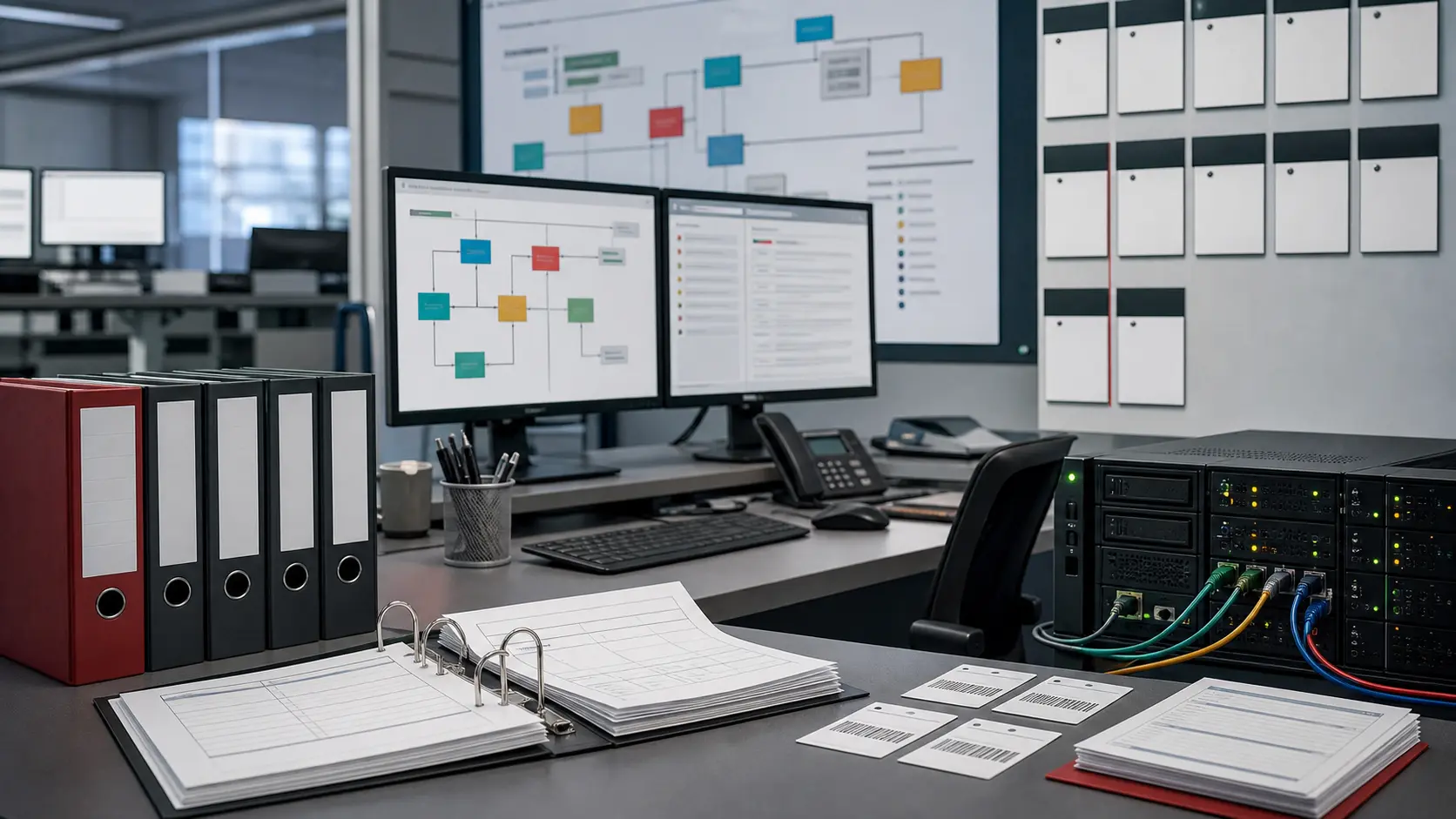
That record is made from ticket histories, role assignments, identity decisions, application ownership, integration notes, monitoring alerts, backup and recovery evidence, release calendars, customer approvals, billing assumptions and exceptions that were accepted because a business process required them. If those records drift apart, the service becomes expensive even when the underlying tooling is modern. A user is provisioned in one place and blocked in another. A self-service request closes while the permission never reaches the application. A Microsoft 365 governance rule is documented but not enforced.
A SAP patch plan is agreed, then delayed by an integration that was never captured in the transition plan. A service desk knows how to reset an account but not who owns the workflow affected by that account. This is the zone in which COMLINE has to be judged.
The company's own materials point to this operating-record problem more than to pure software development. It describes itself as a strategic consulting and implementation partner for sustainable IT services in the mid-market. It places outsourcing, cloud transformation, security and carve-out work next to one another. It says it works from status analysis through implementation and operating handover. It highlights application management, SAP operations, Microsoft cloud operations, service desk automation and a security operations center.
That combination suggests a company trying to own the connective tissue between enterprise systems, not a vendor selling one isolated application.
The test is therefore precise: can COMLINE keep the accepted operating record coherent across repeated workflow changes? A managed service is only valuable if the customer can trust that today's agreed state will still be legible after the next onboarding, tenant change, SAP release, identity-policy revision, security event, carve-out deadline, cloud migration or cost-control discussion. This is harder than it sounds because enterprise software is not a static asset. It is a moving set of dependencies between people, permissions, systems, suppliers, auditors and business exceptions.
A Boundary Around the Company
The entity in view is COMLINE Computer + Softwareloesungen SE, based in Hamburg, with its public service surface at comline-se.de. The company should be distinguished from other similarly named businesses and from its customers, partners and upstream suppliers. Its official imprint identifies the Hamburg company, names the executive board, and ties the public website to the SE entity. Its location page describes a German footprint with a branch in Poland. Its corporate page names the board and management team and frames the company as a partner for future-proof IT services in the German Mittelstand.
That boundary matters because COMLINE operates in a market where brand surfaces can blur quickly. Microsoft, SAP, HPE, ServiceNow, NVIDIA and other platform providers appear across the service descriptions and certification pages. Named customers appear in testimonials. Subsidiary and related capabilities appear through references to conplement and SAP consulting. None of those are COMLINE itself. For this article, they are evidence of the ecosystem in which COMLINE works, not proof that every technical outcome belongs to COMLINE or that every customer environment follows the same design.
The public company profile on professional networks describes more than 500 colleagues and a multi-site footprint. XING presents a similar scale signal. The official location page lists Hamburg, Bamberg, Berlin, Szczecin, Dortmund, Duesseldorf, Frankfurt am Main, Karlsruhe, Munich, Nuremberg and Stuttgart in its displayed location set, while the text says the company is represented at ten German sites and one Polish branch. Those are useful capacity clues, but they are not a substitute for contract evidence.
They say COMLINE has a delivery organisation, not that a particular buyer will receive a particular response time, staffing ratio or recovery commitment.
The same boundary applies to revenue and market-size language. A professional profile states that the company is underpinned by more than 120 million euros in revenue, but the public research surface does not provide a full set of audited financial statements in a directly readable form. It is safer to treat the company as a visible mid-sized German IT-services operator with meaningful staff and service breadth, while avoiding stronger claims about market share or financial performance.
Workflow Ownership Before Tool Ownership
The most interesting part of COMLINE's public service surface is not that it offers cloud, security or SAP work. Many firms do. The interesting part is the repeated emphasis on transitions, operating modes, application management and service desk automation. Those are the places where tool ownership becomes workflow ownership.
The "Future Mode of Operation" material describes a shift from a current operating model to a future one, using workshops, modern tools, automation and self-service. The transition-management page describes analysis, documentation, weakness identification, movement into COMLINE operations and further development toward a future architecture. Datacenter Innovation Consulting adds make-or-buy analysis, business-impact analysis and emergency-management planning.
Service Desk & Automation describes ITSM process analysis, self-service portals, integration into channels such as Microsoft Teams and operation on a ServiceNow-powered platform. Application Management extends the service surface from infrastructure-near IT services into firewall, network, workplace, server, collaboration, database and SAP application environments.
Taken together, these services sketch a concrete workflow. First, the customer's current state is inventoried. Then weak points are documented. A target model is agreed. Some tasks move into COMLINE's operating responsibility. Self-service and service-desk channels are introduced or adapted. Applications and cloud workloads are monitored. Releases, identities, tickets, permissions, incidents and compliance requirements become part of the operating record. The customer's internal team is not removed from the workflow; it is repositioned around approvals, ownership, governance and exceptions.
That is a credible operating pattern for mid-market and enterprise customers that cannot or do not want to staff every specialist function internally. But it also raises the central risk. Every handoff creates a record-keeping burden. The customer must know what was agreed. COMLINE must know what was accepted. The platform must reflect both. If a self-service catalogue is cleaner than the messy business reality, users will route around it. If the service desk resolves tickets without feeding the architecture record, the system becomes easier to operate today and harder to govern tomorrow.
If the operating model relies too heavily on one platform partner, changes in that partner's product, licensing or security defaults can force urgent renegotiation.
The public material gives some examples of repeatable work. COMLINE says it operates around 40 individual customers with different requirements on its own ITSM platform. It says a complex onboarding process can contain 8,000 lines of code. It says automations reduce manual error and relieve customer IT personnel. It states that selected automations can bring employee onboarding down to five minutes. Those are capability claims, not universal performance guarantees. They are still useful because they reveal the shape of the work: repeatable requests, scripted onboarding, ITSM records, portals, workflow channels and integration points.
SAP Operations as a State Discipline
SAP operations make the operating-record test especially visible. COMLINE's SAP operations page says the challenge is not only implementation but reliable and secure operation of complex system landscapes. It claims experience supporting more than 40,000 SAP users across sectors including automotive, waste management, public service, real estate and manufacturing. It also describes SAP hosting and SAP HANA operations certifications, SOC 1 language, 24/7 operation under individually agreed service levels, German delivery and Tier-4 data center language.
The right reading is cautious but meaningful. SAP is not a casual workload. It holds business process state: orders, invoices, procurement, asset records, service histories, master data and reporting structures. A managed SAP operation cannot be judged only by whether the infrastructure is up. It has to preserve the meaning of the business process across patches, database work, integrations, permissions and exceptions.
A system that is technically available can still fail the customer if an interface stops, a role is wrong, a change window breaks a business deadline, or a recovery action restores infrastructure while losing transaction confidence.
COMLINE's public SAP story is therefore relevant to the Batch-031 question because it points to long-running application custody. The company says its SAP team can act as an extension of the customer's IT department, with a fixed contact person and knowledge of specific business requirements. That is a labour and governance model, not merely a hosting model. The buyer is paying to reduce the need to recruit every specialist internally, but it is also accepting dependence on an external team that must understand local process detail.
The public uncertainty is also important. COMLINE does not publish a general price book, standard recovery matrix, incident distribution, outage history, sample runbook, change-failure rate or contract-level recovery evidence in the pages reviewed. It says it operates securely and reliably, and it lists certifications and customer industries. That is enough to establish a plausible service surface. It is not enough to prove how the service behaves under a customer's worst operational week. A serious buyer would still ask for service-level exhibits, role matrices, escalation examples, audit evidence, change records and exit provisions.
Microsoft Cloud Operations and the Governance Problem
COMLINE's Microsoft cloud material gives a second view of the same problem. The cloud operations page says COMLINE's core competence includes operating Microsoft cloud products, especially Microsoft 365, Azure and Microsoft Cloud Security. It says the company advises, integrates and operates Microsoft cloud services, keeps employees trained in a changing cloud product environment, and has developed an operations management portal for Azure and Microsoft 365 workloads. The modern-work page adds Exchange, SharePoint Online, Teams, Power Platform and Teams telephony.
The enterprise cloud page frames services around Azure, Microsoft 365, security, ITSM process modelling, hybrid infrastructure, Zero Trust, governance and compliance.
The technical surface is familiar. Many buyers already have Microsoft 365 and Azure. The hard part is not access to the platform. The hard part is deciding what the tenant is allowed to become. Who may create Teams? What naming rules apply? What happens when a guest user needs access to a regulated document? How are SharePoint sites retired? Which data locations are allowed? Who approves Power Platform automation? How are privileged accounts separated? How are exceptions recorded? What evidence proves that a control is not only configured but still working?
COMLINE's public positioning fits that governance layer. It talks about status-quo analysis, identifying unused potential, M365 governance workshops, implementation support, change adoption, training, self-service material and security settings. It also claims Microsoft partner coverage across Azure, security and M365 areas. Those claims point toward a managed cloud-workspace operation where value comes from reducing confusion, not from discovering that Microsoft has collaboration tools.
The repeated-task test is unforgiving in this segment. A well-governed onboarding should create the right identity, license, mailbox, Teams access, device controls, security posture and application permissions in the right sequence. A departure workflow should remove or transfer the same assets without leaving orphaned access. A department move should update permissions without breaking current work. A new compliance rule should become policy, not just a PDF. Each of these is mundane until it fails. COMLINE's claim that automations can accelerate onboarding is relevant, but the deeper question is how exceptions are supervised.
The last five percent of edge cases can decide whether automation reduces labour or merely moves labour into cleanup.
Service Desk Automation Can Hide or Reveal Complexity
Service desk automation is often sold as simplicity. A portal replaces email. A catalogue replaces informal requests. Scripts replace manual steps. A Teams integration meets users where they already work. COMLINE's service desk page uses exactly that kind of language, describing ITIL 4, compliance-oriented process analysis, ITSM solution development, self-service portals, ServiceNow, Teams integration and automation to reduce human error.
The operational truth is more complicated. A service desk is not just an intake channel. It is the place where the customer discovers whether the service provider understands the operating record. If the ticket categories map to real workflows, users get faster answers and cleaner data. If the categories are designed around the provider's internal teams rather than the customer's work, the portal becomes another obstacle. If a user asks for access to a system, the service desk needs the approval chain, role model, security exception, licensing assumption and business deadline.
If an incident arrives, the desk needs to know whether it is a local endpoint issue, a Microsoft service issue, an application integration issue, a policy decision or a business process interruption.
COMLINE's claim of operating distinct customer requirements on its own ITSM platform is therefore meaningful. It suggests the company has learned that repeatability cannot mean sameness. Around 40 customers with different requirements can only be served well if the platform separates standard patterns from customer-specific rules. The danger is configuration sprawl. Every special case added to a service catalogue, workflow script or approval rule makes the service harder to maintain. The same customisation that wins the implementation can later make upgrades, audits and staff training harder.
This is where the accepted operating record becomes a commercial issue. If COMLINE maintains the record cleanly, customers can reduce internal support load and move scarce staff toward security, architecture and business-facing work. If the record is opaque, customers may pay a managed-service fee while still retaining a shadow team to interpret exceptions. The economics depend on how much work is truly removed, how much work becomes supervision, and how much work returns during transitions, audits or incidents.
Security Operations Are a Promise of Attention
COMLINE's security surface includes consulting and implementation, a security operations center and security assessments. The SOC page describes monitoring from workplace to server, network and digital identities, with 24/7/365 coverage, automated SIEM and SOAR processes, analyst teams, German delivery and ISO 27001 certification for relevant areas. The assessment page lists cybersecurity basis checks, Active Directory security assessments, M365 governance assessments, information security governance assessments and audit consulting.
Security operations are a promise of attention. They tell the customer that someone is watching, triaging, escalating and improving the environment while threats and business systems change. But attention only becomes protection when it is connected to context. A security alert on an identity, endpoint or server is not self-explanatory. The analyst needs to know which account is privileged, which server supports a critical process, which exception was approved, which third-party tool is expected to behave unusually, and which business unit can tolerate interruption. Without that context, a SOC can produce noise or delay.
COMLINE's broader service surface could help here. A provider that also understands the customer's Microsoft tenant, application management, SAP environment, service desk workflows and transition records may have richer context for security decisions than a pure monitoring vendor. That is the positive case. The risk is concentration. If one provider handles too many layers without transparent records, the customer may struggle to independently verify security decisions, response quality, cost allocation and exit readiness.
The public security pages also illustrate a common market pattern: strong general claims combined with limited disclosed operating evidence. COMLINE references the BSI and Bitkom in explaining the cyber threat environment, lists Microsoft security partner badges, and states that services are delivered in and from Germany. Those points help a buyer frame risk. They do not reveal incident volumes, false-positive rates, median response time, escalation failures, customer-retained responsibilities or post-incident learning loops.
A buyer should therefore read the SOC offer as a serious candidate for local managed security work, while still demanding precise evidence during procurement.
Carve-Out and Transition Work Exposes the Weak Spots
Carve-outs and transitions are useful tests because they expose hidden assumptions. When a business separates, migrates or changes provider, the old operating record is often incomplete. A system that looked stable inside one organisation may rely on informal administrator knowledge, undocumented interfaces, inherited permissions, obsolete network paths, shared service accounts or licensing arrangements that were never designed for separation.
COMLINE's transition-management material speaks directly to this risk. It describes analysis and documentation of existing environments, identification of weaknesses, development of a corrected current mode, transition into COMLINE operations and later movement toward a future operating model. Datacenter Innovation Consulting adds business-impact analysis, make-or-buy evaluation and emergency-management concepts. The carve-out operations page places COMLINE's role in the secure operation of changed IT landscapes.
This is less glamorous than software innovation, but it is where customers often bleed money. A transition that misses an integration can delay a cutover. A poor identity map can strand users. A weak data-classification model can create compliance exposure. A service desk that is ready on day one but lacks historical context may close simple requests while escalating everything important. A provider that can document the current state, remove obvious weakness and keep the new operating model legible has practical value.
The public evidence does not show detailed carve-out case records. It does show that COMLINE has a dedicated carve-out and transition vocabulary, named service-manager ownership and a broader operating stack that could support this work. That is enough to include carve-out capability in the evaluation. It is not enough to assume every carve-out has been successful, cheap or fast.
AI Services Should Be Read Through Operations, Not Hype
COMLINE's newer AI as a Service page is a useful stress test for the company's operating model. The page says COMLINE was named HPE's Global Hybrid Cloud Solution Provider of the Year at HPE Discover 2025, positions AI services around German data centers, HPE Private Cloud AI with NVIDIA, data sovereignty, GDPR alignment, proof-of-concept-to-production support and enterprise workloads.
It includes a use case around AI-assisted governance and compliance for file servers, with document categorisation, identification of personal and sensitive content, DLP and ISMS support, rule-violation detection and daily delta checks after an initial full analysis.
The important point is not that COMLINE now says "AI." The important point is that its AI claim sits inside the same operating-record problem. AI-assisted file governance is only valuable if the system can identify content accurately enough, handle exceptions, provide evidence, preserve data controls, support audits and improve without creating new compliance risk. If the result is a report no one trusts, it adds work. If the classification is integrated into governance, DLP, access review and security operations, it can reduce manual burden.
COMLINE's AI offer also shows upstream dependency clearly. HPE, NVIDIA, German data centers, customer data stores, compliance expectations and the customer's own information architecture all matter. COMLINE can operate the platform and guide the workflow, but the customer still owns the meaning of its documents, the risk appetite of its business and the final governance decision. The public page acknowledges some of this by asking whether data quality is sufficient, what model fits, where limits lie, whether results are reproducible and whether the economics make sense. Those are the right questions.
The uncertainty is whether the public AI offer has enough mature customer evidence. The page describes an operating approach and use case, not a broad record of named production deployments, measured accuracy, cost benchmarks or audit outcomes. That does not make the offer weak; it makes it early in the public record. Buyers should evaluate it as an extension of COMLINE's managed operations discipline, not as a standalone AI product.
Unit Economics Depend on Labour Substitution
COMLINE's commercial case is a labour case before it is a software case. The buyer pays because enterprise software operations require people who understand SAP, Microsoft cloud, identity, security, ITSM, application dependencies, releases, user support, compliance and recovery. Hiring those skills internally is expensive and often unrealistic for a mid-sized customer. Letting an external provider spread specialist teams across multiple accounts can make sense.
But outsourcing does not erase labour. It moves labour into a different shape. The provider absorbs platform operation, monitoring, first-line handling, some automation development, specialist escalation and process maintenance. The customer retains business ownership, budget authority, data stewardship, risk acceptance, application prioritisation, procurement decisions and change approval. The cost equation works when the provider removes more work than it creates and when retained supervision is predictable.
COMLINE's public materials emphasise this value proposition repeatedly. Application management is presented as a remedy for missing know-how and capacity constraints. SAP operations are positioned against the scarcity of SAP specialists and rising availability and security demands. Service desk automation is positioned against the pressure of skills shortages and rising integration costs. Security services are positioned as a way to gain expertise without hiring a full internal security team. Modern work services are positioned around helping customers use M365 properly rather than merely owning licenses.
The buyer's commercial question is therefore direct: does the COMLINE operating model reduce work and risk enough to justify implementation, support, switching and governance cost? The answer depends on the customer's baseline. A company with weak documentation, fragmented identity, inconsistent workflows and overburdened specialists may gain a lot from a disciplined transition. A company with strong internal operations may only need selective support. A company with highly unusual processes may find that managed automation creates as many exceptions as it solves.
Switching cost is also part of the unit economics. Once COMLINE has built customer-specific ITSM workflows, automation scripts, operating records, dashboards, SAP runbooks, Microsoft governance rules and escalation habits, moving away will require careful extraction. That is not necessarily a negative; any serious managed operation creates some embedded knowledge. The question is whether the contract and records make that knowledge portable enough for the customer to retain control.
Market Signals Are Real but Incomplete
The market evidence around COMLINE is visible but not exhaustive. Official pages carry customer statements attributed to Pflegen & Wohnen Hamburg, ALBA Management and degewo. The statements broadly support COMLINE's positioning around data center optimisation, cloud operations and enterprise-scale Microsoft cloud architecture. XING posts also reference customer appreciation for cloud operations and sustainability dialogue. CyberCompare lists COMLINE as a service and product provider in cybersecurity, with managed EDR and managed SIEM as top capabilities.
Kununu shows a substantial number of employee and applicant reviews with a generally positive but not perfect employer score.
These signals matter because managed operations are delivered by people over time. A company with more than 500 employees, multiple locations, visible employer reviews and public service pages is not a paper entity. A provider listed in cybersecurity marketplaces, showing certifications and maintaining a broad services website has a market presence. Customer testimonials, while selected by the company, show the type of work COMLINE wants to be known for.
The evidence remains incomplete because public testimonials rarely disclose the hard parts: failed handoffs, delayed tickets, pricing disputes, service credits, recovery exercises, governance conflicts, user friction or exit negotiations. Employee reviews can signal culture and capacity pressures, but they are not a direct measure of customer reliability. Partner badges show ecosystem alignment, but not independent outcome quality. A buyer should use these signals to justify a deeper evaluation, not to skip it.
There is also a difference between customer evidence and customer outcomes. A named quote that says a project was implemented in time and budget is useful. It is not a statistical benchmark. A claim of many SAP users or application-management users is useful. It is not a guarantee that a new buyer's business process will be simpler. COMLINE's public record is strong enough to make its operating model worth examining. It is not transparent enough to answer every procurement question from the public web alone.
The Failure Modes Are Ordinary and Expensive
The most likely failure modes are not exotic. They are state drift, provisioning mismatch, integration break, account or permission error, support delay, billing dispute and recovery gap. Each is ordinary enough to be underestimated and expensive enough to decide whether a managed service works.
State drift occurs when documentation, configuration and business reality move at different speeds. A workflow changes, but the service catalogue does not. A security exception is accepted, but the renewal date is lost. A SAP integration is retired, but monitoring still treats it as active. A Microsoft tenant setting changes, but the training material and support script remain old. State drift is dangerous because it often looks like small local mess until an audit, outage or migration exposes it.
Provisioning mismatch is the classic automation problem. The script does what it was designed to do, but the user's actual role has an exception. The onboarding request completes, but the application owner denies a downstream permission. A license is assigned, but a data policy blocks access. A Teams workspace is created, but retention or guest-access rules are wrong. Automation reduces cost only when the record captures enough context to handle common variation.
Integration break is the managed-operations tax. COMLINE's public service surface includes SAP, databases, collaboration systems, cloud services, identity, service desk channels and security tools. Those systems produce value through integration and fragility through integration. A change in one component can create a failure in another. The provider's job is to know which dependencies matter before the customer discovers them through a broken process.
Support delay is a governance failure as much as a staffing failure. Delays happen when the support team lacks authority, context or escalation clarity. A ticket can wait because no one knows whether it is a business exception, a security incident, a vendor issue or a contract question. COMLINE's promise of fixed contacts and local teams can reduce that risk, but only if the operating model gives those contacts enough power and information.
Billing disputes are also predictable. Managed services often sit between project work, recurring operation, change requests, licensing and emergency response. If the line between included service and chargeable change is unclear, the customer may feel every improvement has become an extra. COMLINE's public terms and service pages do not disclose the commercial detail needed to evaluate that risk. It should be handled in contract schedules and change-control process.
Recovery gaps are the most serious. A backup that exists but has not been tested against the customer's business process is not full recovery. A security response that contains a threat but cannot prove clean restoration leaves uncertainty. A SAP or M365 incident that restores the platform without reconstructing business state can still harm operations. Buyers should ask COMLINE for evidence of recovery exercises, not only for certifications.
Substitutes and Competitive Pressure
COMLINE operates in a crowded substitution field. A customer can hire a global integrator, a hyperscaler-aligned managed service provider, a specialist SAP operator, a Microsoft partner, a cybersecurity managed detection provider, a local IT house, an internal platform team or a mix of all of them. Some customers may prefer direct platform-native services from Microsoft, SAP or HPE partners. Others may prefer smaller local providers with deeper personal relationships. Still others may use automation platforms and keep operations in-house.
COMLINE's competitive case is the combination of local delivery, multiple operating domains and enterprise-software workflow ownership. The company can plausibly argue that a customer's SAP environment, Microsoft cloud tenant, service desk, security posture, application management and transition work should not be split across too many providers. Fragmentation can create exactly the state drift the buyer is trying to avoid. A provider with a broader operating view can sometimes coordinate better.
The counterargument is concentration and lock-in. If one provider owns too much operational context, the customer must be more disciplined about data ownership, documentation rights, contract exit, administrative access, auditability and pricing transparency. COMLINE's public service language stresses partnership, but buyers should still design the relationship so that the accepted operating record is shared, exportable and periodically reviewed.
The strongest substitute is often not another vendor. It is a customer's own decision to simplify. Standardising workflows, reducing application sprawl, cleaning identity roles, retiring unused services and narrowing custom exceptions can do as much for reliability as changing providers. COMLINE's value is highest when it helps the customer make those simplifications instead of merely taking over a messy estate.
What a Buyer Should Test
A buyer evaluating COMLINE should test the operating record directly. Ask for a sample transition plan, not only a service description. Ask how current-state documentation is verified. Ask how customer-specific exceptions are recorded, reviewed and retired. Ask which records the customer can export at contract end. Ask how ServiceNow workflows, Microsoft tenant rules, SAP runbooks and security response records remain aligned. Ask who approves automation changes. Ask what happens when an upstream platform changes a default setting.
For service desk work, test a normal onboarding, an exception onboarding, a departure, a department move, a lost device, a privileged-access request and a disputed access denial. For SAP operations, test patch windows, interface ownership, recovery exercises, role changes and business-calendar constraints. For Microsoft 365, test guest access, retention, Teams sprawl, Power Platform governance and data-location decisions. For SOC work, test alert context, escalation thresholds, false positives, containment authority and post-incident review.
For AI services, test data classification accuracy, auditability, model-change control, privacy boundaries and the handoff from proof of concept to production.
The buyer should also test supervision cost. How many customer-side roles remain necessary? Which meetings are required? How often are service reviews held? How much customer work is needed to keep the provider informed? Who owns business-impact analysis when a system changes? What is the boundary between managed operation and paid project? How does COMLINE handle a customer that wants automation but has not cleaned its role model?
These questions do not assume COMLINE will fail. They recognise the nature of the work. Enterprise software operations fail through ambiguity long before they fail through lack of slogans. A provider that answers these questions with specific records, examples and escalation paths is more valuable than one that answers with a bigger service catalogue.
The Verdict
COMLINE Computer + Softwareloesungen SE has a credible public operating surface for German enterprise software operations. The evidence shows a company with breadth across outsourcing, SAP, Microsoft cloud, service desk automation, application management, security and transition work. It has a visible corporate identity, a multi-site footprint, certifications, partner relationships, customer statements and workforce signals. Its public language repeatedly returns to the problems that matter: current and future operating modes, application management, governance, compliance, security, automation, service desk intake and German delivery.
That does not make COMLINE automatically superior to a global integrator, a specialist managed service provider or a strong internal team. It makes the company legible as an operator whose central promise is coherence. The promise is that a customer's accepted operating record can survive repeated real-world change: new users, new policies, new cloud services, new security threats, new SAP needs, new integrations, new audits and new business pressure.
The public uncertainty is material. There is not enough public detail on pricing, contractual service levels, outage history, incident response performance, recovery tests, customer retention, automation failure rates, exportability or exit economics. The customer evidence is useful but selected. The numbers on users, customers, data points and onboarding speed come from company-controlled pages and should be tested in procurement. The certifications help but do not replace operational proof.
The practical conclusion is that COMLINE should be judged by field evidence of record discipline. If it can show clean transition records, living service catalogues, well-governed automations, auditable security response, tested recovery, transparent change control and customer-owned documentation, its breadth becomes an advantage. If it cannot, the same breadth becomes complexity rented from another organisation. In this market, the difference between those two outcomes is the whole story.