
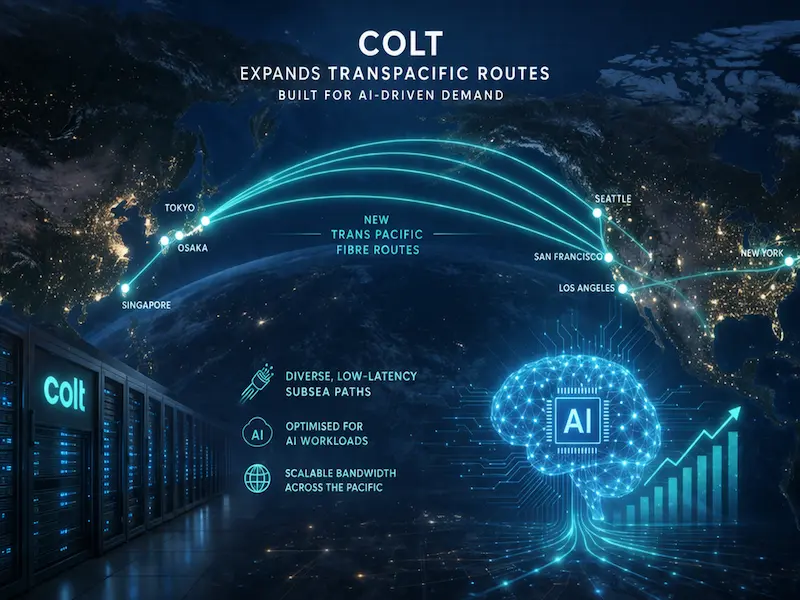
Colt Technology Services is expanding its subsea and land-based routes between the US and Asia to meet growing demand for AI-driven data traffic. The expansion reflects the increasing pressure on global networks from data-intensive applications, highlighting how artificial intelligence is reshaping network infrastructure.
- Colt plans a new transpacific backbone route over the Juno subsea cable between Tokyo and Los Angeles.
- The company says it will connect the route to its terrestrial networks in Japan and the United States to offer more routing choice and resilience.
What Colt announced
Colt Technology Services announced plans in March 2026 for new international network links between the US West Coast and Asia. The centrepiece is a backbone route over Juno, a subsea cable system connecting Japan and the United States.
In its official announcement, Colt said the route would link Tokyo and Los Angeles and connect with its terrestrial networks in Japan and the US. The company also plans to expand its on-net reach in Tokyo, including direct connections to major metropolitan data centres.
Juno runs for about 11,700 kilometres across the Pacific. It lands at Minamiboso and Shima in Japan and at Grover Beach, California, with terrestrial points of presence extending to Tokyo, Osaka, Los Angeles and San Jose. The cable system entered service in May 2025; Colt’s announcement concerns a new route using that existing system.
Colt presents the investment as a response to rising traffic associated with AI and cloud services. It identifies financial-services firms, content providers, neocloud companies and hyperscalers as early target customers, and says the additional path should improve backup and routing options for critical applications.
The announcement does not state Colt’s investment amount, purchased capacity, commercial launch date, latency commitment or service-level terms. It therefore does not support the previous article’s claims of a Q3 launch, phased service through late 2026 or terabit-scale capacity.
Why it matters
The operational value lies in route diversity rather than a new cable landing. By combining capacity on Juno with its own terrestrial footprint, Colt can offer customers another path between Japanese and US data-centre markets and reduce reliance on a single routing arrangement.
AI is the demand narrative supplied by Colt, but the route will also carry ordinary cloud, content, finance and enterprise traffic. Future evidence should distinguish marketing claims about AI-driven demand from disclosed orders, utilisation and revenue.
Watch for a commercial service date, capacity and pricing details, named customers, the exact level of route independence, and evidence that Colt’s Tokyo and US on-net integration delivers the resilience promised in the announcement.
Member Briefing
Deeper Trend Context
Sign in with the right membership level to unlock the full briefing and source notes.
Only for Strategic Circle
Strategic Circle
Open to all readers. Unlock trend briefings after joining and signing in.
Join Strategic CircleOnly for Leadership Alliance
Leadership Alliance
For operators, investors, and policy teams that need relationship evidence, failure paths, and source notes. Sign in to unlock.
Join Leadership AllianceSnapshot
Category
Asia-Pacific Cloud Services TrendsRegion
ASIA PacificSignal Focus
GovernanceContent Type
EventPrimary Domain
MarketTopic
GovernanceImpact
HighConfidence
Limited confidence (80%)Confidence score guide
Several public sources