
Summary
- CISS should be judged less by the breadth of its ERP, POS, cloud, tax, analytics and support menu than by whether it can keep an accepted retail operating record coherent across repeated changes in stores, fiscal rules, checkout flows, inventory and integrations.
- The public record supports CISS as a long-running Brazilian retail-management software vendor with official product depth, declared customer reach, visible case material and a demanding local fiscal context, but it does not independently prove benchmarked uptime, implementation economics, support speed, defect rates or customer return on investment.
The accepted retail record is the product
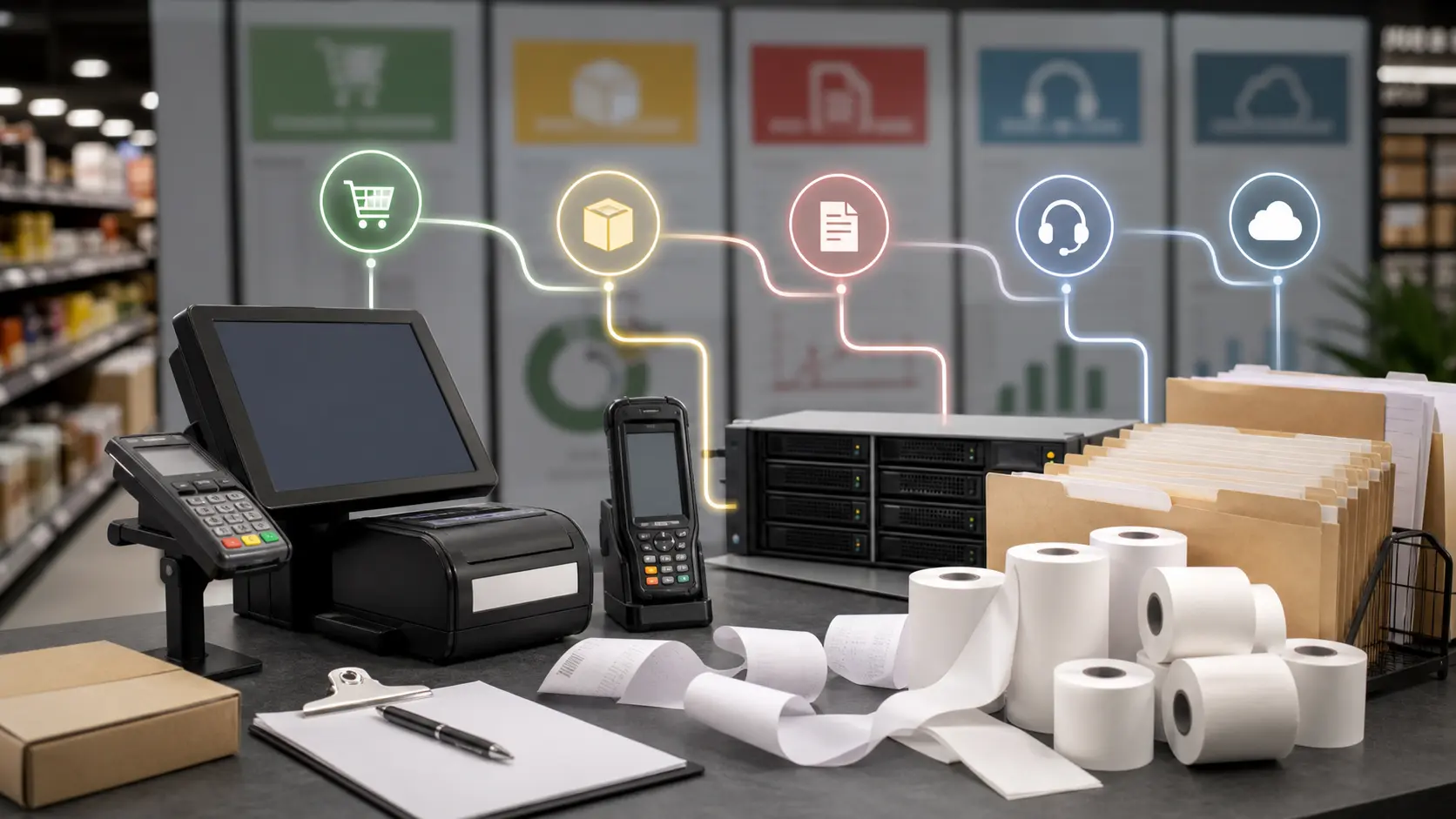
The useful way to read CISS is not as a generic enterprise software profile. It is a company that asks retailers to run consequential daily work through a shared record. In a supermarket, building-materials chain, cash-and-carry store, franchise or food-service operation, the record is not a passive database. It decides what a cashier can sell, which price applies, whether a product exists in stock, how a fiscal document is issued, whether a loss is visible, whether a promotion is valid, whether a card reconciliation can close, and whether managers trust the numbers at the end of the day.
That is why the assigned question for CISS is sharper than "does it have enough modules?" The question is whether the organization can keep the accepted operating record coherent across repeated real-world workflow changes. A retail system can be feature-rich and still fail its customer if product master data is dirty, tax classification lags a statutory change, a marketplace order does not reconcile with store stock, or a support queue cannot respond when checkout operations are blocked.
Retail management software becomes valuable only when the accepted record reduces work and risk in the store, in the office and in the accounting close.
CISS's public site presents the company as a specialist in management and operation for retail, with emphasis on supermarkets, building materials, cash-and-carry, franchises and food service. It points to CISSPoder as a long-running multi-company ERP and to CISSLive as an online ERP for small and medium retailers. Around those products sit checkout, self-service, mobile, analytics, reporting, tax, stock-control, pricing, e-commerce integration, accounting-support and training surfaces. The breadth matters, but only because retail coherence requires many operational events to meet in one place.
The accepted record lens changes the evaluation. If a product is received from a supplier, the system must connect purchase order, XML invoice data, fiscal classification, stock balance, price rules, location, expiry or lot control where relevant, and future sale. If a customer checks out, the system must connect product identity, barcode or scale data, promotion logic, payment, fiscal emission, inventory reduction and reporting. If a manager changes a price or creates a promotion, the change must reach the checkout and any electronic labels or online channels without creating a second truth.
For CISS, the public evidence is strongest on the shape of that problem. It shows a vendor whose language and product pages are built around the operational record: fewer conflicting data points, less duplicate work, less manual checking, more control, faster task execution and better decision information. The evidence is weaker on measured proof. Public pages do not show independent uptime data, defect rates, average implementation duration, ticket-resolution percentiles, migration costs or customer churn. That does not make the operating model weak.
It means readers should separate the plausible technical role from unproven performance claims.
Identity and boundary
CISS Consultoria em Inf. Serv. e Software S.A is the entity in scope. Its own governance page identifies CISS Consultoria em Informatica, Servicos e Software S/A by CNPJ 82.213.604/0001-80 and places it inside a broader Grupo CISS context with related companies. Public company-register mirrors also show the CNPJ as active, with an opening date in June 1990, a closed corporation legal form, a fantasy name associated with retail management, and software-development and related IT activities.
Those sources support the boundary: this article is about the Brazilian CISS retail-management software vendor and its public service surface at ciss.com.br.
The boundary also matters because "CISS" is not a unique global name. Search results surface unrelated organizations, financial tickers and public-sector systems with the same acronym. None of those should be used to infer anything about the Brazilian software company. Likewise, customers, integration partners, public tax authorities, retail associations and upstream software or hardware providers are not CISS. They are part of the operating environment that makes CISS useful or risky for retailers.
CISS's official "about" page says the company was founded in 1990, describes itself as a software factory for retail-management solutions, and says it is a Brazilian closed corporation from the interior that reached national scope. The same public page presents headline figures such as more than 800 collaborators, more than 130,000 users and more than 7,000 stores. The homepage also says more than 7,000 customers use CISS solutions in every Brazilian state. Those are vendor statements, not independently audited market-share numbers.
They are relevant because they indicate the scale CISS claims to support; they should not be treated as externally verified proof of active seats, paying customers or economic performance.
The company history on the official site also gives useful context. It describes early development work, the launch of the Mentor management software in 1991, segmented retail focus in 1998, CISSPoder in 2000, UniCISS in 2004, an IBM partnership in 2005, MPS-BR certification in 2009 and CISSFront that same year. The importance is not nostalgia. A company that has lived through Brazilian retail software for decades has had time to accumulate domain patterns, migration scars and support habits.
Longevity does not guarantee current quality, but it raises the probability that the product has been shaped by recurring retail problems rather than by a generic ERP template.
The legal and brand boundary should stay explicit in any commercial reading. CISS's product claims are vendor claims. Customer case pages are marketing evidence, useful for understanding adoption stories but not the same as neutral audits. Public tax pages describe obligations imposed on retailers and fiscal systems, not services delivered by CISS. Product partner pages show integration scope and dependency surfaces, not ownership of those partner systems. Keeping those distinctions clear is the first protection against over-reading the record.
The product surface maps to retail friction
CISSPoder is the clearest expression of CISS's core proposition. The official product page describes it as a multi-company ERP for retail, modular and in constant evolution, with more than 20 years in the market. Its benefits are framed in operational terms: more data security, more control over the operation, more agility in tasks and more assertiveness in decisions; less conflicting information, less duplicate-process rework, less manual checking and fewer losses from operational errors. That is not merely sales language. It reveals where the product must work if it is to matter.
The CISSPoder modules page lists functions across replenishment, commercial agreements, process release, promotions, purchasing, stock transfer, price and offer maintenance, entry invoices, purchase orders, merchandise receiving, credit consultation, fiscal control, asset control, lot control, production control, inventory, payroll, SPED, payment integration, NF-e, NFC-e, SAT, electronic funds transfer, sales, delivery logistics, MDF-e and reporting. A retailer does not buy such a list because every module is exciting. It buys the list because a store is a chain of state changes. One weak link can undermine the accepted record.
CISSLive points to a different deployment condition. CISS describes it as an online and mobile ERP for small and medium retailers, with automatic backups, reduced equipment and IT infrastructure costs, remote access to indicators, report export, competitor price quotation and cloud-based connection of store areas.
Its visible modules include product records, product hierarchy, quick tables for weighed items at checkout, user and cashier records, automatic supplier registration through XML, card administrators, purchase-order matching with entry invoices, inventory by company, multiple stock locations, scale integration, loss or surplus fiscal documents, NF-e, NFC-e, SAT, online and physical sales-channel integrations, marketplace integrations, fiscal and accounting exports, and cash movement.
That distinction between CISSPoder and CISSLive matters commercially. A larger or more complex retailer may accept a heavier implementation if the central record covers many companies, fiscal regimes, stores and controls. A small or medium retailer may value a cloud path that reduces local infrastructure work. In both cases, CISS is selling less manual supervision: fewer spreadsheet reconciliations, fewer duplicate records, fewer separate operational systems and less dependence on memory at the store level.
The POS layer is equally central. CISS presents CISSFront and CISSBox as front-of-store products, and its pages connect them with mobile POS, self-checkout and totem options. Even where public details are brief, the implication is clear. Checkout is where the retail record becomes real. A price mismatch, a tax-emission failure, a payment integration failure or a slow cashier screen is felt immediately by customers and staff. Back-office breadth cannot compensate for a front end that interrupts sales or creates data conflicts.
CISS's adjacent products make the record denser. CISSTributacao addresses tax-map configuration and product-service classification under Brazil's tax-reform context. CISSMart is described as maintaining centralized product records with automatically updated tax data. CISSControl appears in case material as a stock-control and loss-recording tool. CISSReport and CISSAnalytics sit on the reporting and decision side. Electronic labels integrate with CISSPoder and CISSLive and bring NFC or RFID-related capability to price displays.
The company also lists e-commerce, delivery, loyalty, CRM, market-intelligence, self-checkout and equipment partners. The shared theme is that retail state is spread across many surfaces, and CISS wants to be the coordinating record.
Brazil's fiscal layer raises the reliability bar
Brazilian retail software has to carry a fiscal burden that a generic ERP comparison can miss. Public fiscal-document sources describe NFC-e as a national electronic fiscal document model intended to replace paper consumer documents, with legal validity through digital signature and real-time visibility for tax authorities. Receita Federal pages for SPED list validator programs for digital bookkeeping, and the EFD-ICMS/IPI guide explains that contributors submit digital records of fiscal documents, tax calculations and other information required by federal and state tax authorities.
The guide also makes clear that omission or inaccuracy can lead to penalties and resubmission.
That fiscal context changes the definition of reliability. A retail-management system is not merely keeping inventory tidy. It is helping the retailer meet legally consequential reporting and document-emission routines. When CISSLive says it handles NF-e, NFC-e and SAT, imports invoices from SEFAZ, exports SPED Contabil, Fiscal and Contribuicoes, and generates loss or surplus fiscal documents, those are not decorative features. They touch the formal record a retailer may need to defend.
The tax-reform transition increases the system-change burden. CISS markets CISSTributacao around the new tax-reform model, including a configurable tax map, NF-e and NFC-e conformance, CST and cClassTrib selection, and classifications connected with IBS, CBS and IS. Public fiscal sources also show recent NF-e and NFC-e technical-note activity for tax-reform fields and validation rules. Sao Paulo's tax authority page says NFC-e becomes mandatory for all Sao Paulo retail from January 1, 2026, replacing legacy consumer-document models in that state.
The exact impact varies by state and business, but the direction is clear: fiscal layout change is an operating event, not just a legal update.
For a retailer, the practical question is whether CISS can make statutory change survivable. The retailer needs product classifications reviewed, fiscal rules updated, document layouts changed, test and production environments handled, staff trained and exceptions resolved without freezing daily sales. If the vendor update arrives late, if old product data is incompatible, or if staff do not understand new fields, the retailer carries the risk. CISS's public materials show awareness of this problem through CISSTributacao, reform webinars, customer training and a dedicated reform-support page.
They do not show independent evidence of how fast, accurately or cheaply the transition is handled across the installed base.
This is a recurring pattern. CISS can reduce fiscal labor only if the underlying record is clean. Automated tax classification cannot rescue chaotic product records by itself. A configurable map cannot remove the need for governance over who changes rules and why. A support channel cannot eliminate the need for customer-side responsibility. The value is in making that responsibility more manageable and less fragmented.
Master data is where automation either pays or breaks
Retail automation starts with unglamorous records. Products need descriptions, barcodes, packaging, units, prices, supplier relationships, fiscal classifications, categories, scale behavior, production links, expiry rules, lot behavior, price-chain rules and branch-specific availability. Customers, users, cashiers, suppliers, card administrators and companies need records that match the operational reality. Once a retailer runs multiple stores or sales channels, small record errors become repeated labor.
CISSLive's module detail is useful here because it exposes the record model CISS sees. It lists product registration, product hierarchy, quick tables for weighed checkout items, users and cashier operators, automatic supplier registration through XML, card administrators, production, price chain, products by company, customer profiles and product tags. Those are the inputs that determine whether later automation is trustworthy. A product that is misclassified at the record level can create wrong tax behavior, inventory mismatches and misleading reports. A cashier-user record that is loose can create accountability problems.
A supplier XML that is imported without proper review can propagate errors.
The commercial promise is not that software eliminates data work. It is that software makes data work less wasteful. If XML supplier import reduces typing but still leaves a review trail, the customer saves time. If price-chain logic reduces manual branch updates, the customer saves supervision. If user permissions are clear, the customer reduces control risk. If card administrators are recorded properly, reconciliation is less manual. But if implementation underestimates cleanup work, the customer may feel the opposite: the system becomes another layer of correction.
CISSPoder's module list reinforces this point. Purchase analysis, product checks, label issuing, price and offer maintenance, entry invoices, stock transfer management, inventory, lots, production, losses, disaggregation, fiscal control, NF-e and NFC-e all depend on master data quality. A feature catalogue cannot prove that a customer's data discipline is good. The vendor can provide tools, structure, training and support; the retailer still has to decide ownership and approve change.
This is where CISS's local-specialist position should matter. Retailers in CISS's target segments have known patterns: weighed goods, butcher or bakery production, building-material variants, franchise controls, cash-and-carry customer types, promotion complexity, supplier bonuses, delivery logistics, store-to-store transfers and fiscal-document pressure. Software that encodes these patterns can reduce the amount of custom design required. But encoded patterns can also create lock-in if the retailer adapts its procedures deeply around CISS-specific modules, terms and reports.
The right standard is coherence under change. A retailer changes prices, receives substitutes, updates a supplier, starts a marketplace channel, adds self-checkout, opens a branch, changes fiscal regime, rotates staff and changes promotion rules. The accepted record must absorb these changes without producing two realities. That is the job CISS asks to be trusted with.
POS state is the public stress test
Checkout is the point where shoppers, staff, fiscal authorities and management records meet. For a Brazilian retailer, the POS is not only a cash register. It is a tax-emission edge, a payment edge, a stock edge, a promotion edge, a loyalty edge and a customer-experience edge. The store can tolerate some back-office inconvenience longer than it can tolerate blocked sales.
CISS's public front-end surface includes CISSFront, CISSBox, CISSFly, CISSTotem and SelfCheckoutCISS. The CISSFront page describes related products such as a compact PDV console, a self-service terminal, mobile order and sale finalization with fiscal document printing, and self-checkout. The CISSLive sales module lists NF-e, NFC-e and SAT emission, physical closing, sale returns, online and physical channel integration through CISSBox, CISSFly and CISSTotem, and marketplace integrations subject to availability. The retail record therefore has to survive movement between back office, checkout, mobile sale, kiosk and external channels.
The failure modes are concrete. If a promotion exists in the ERP but not at the checkout, the cashier loses time and the customer loses trust. If stock is sold online but not reserved correctly, a store may promise unavailable goods. If a fiscal service changes validation behavior and the POS is not updated, sale authorization can become fragile. If payment integration fails, cashiers may create manual workarounds that later break reconciliation. If self-checkout reduces labor at the front but increases exception handling, the savings may be smaller than expected.
CISS case material suggests customers value POS modernization and speed. The Supermercado Vitoria page says CISSBox provides more speed in service, supports higher sales flow and saves space and energy. The blog case on supermarkets says Emporio Varanda used CISSPoder, CISSBox, SelfCheckoutCISS and ConciliadorWeb to modernize checkout and centralize financial information. Those are useful customer-market signals, but they remain vendor-published examples. The public record does not disclose before-and-after transaction times, queue reduction data, reconciliation error rates or support-call volumes.
That uncertainty matters because POS systems create visible switching pain. Hardware, cashier training, fiscal configuration, payment providers, barcode and scale behavior, store procedures and reporting all have to line up. The more a retailer depends on CISS at checkout, the more the vendor's release quality and support capacity become part of the retailer's operating risk. A good POS layer can reduce labor and friction. A brittle one can force staff into manual correction at the busiest moments.
The balanced view is that CISS appears to be focused on the right operational surfaces. It knows that checkout, tax, stock and reporting are linked. It offers multiple front-end options and surrounding modules. But the accepted record test requires proof over time at each customer: not merely whether the product can issue a fiscal document or scan a product, but whether it does so consistently after tax updates, price changes, network interruptions, staff turnover and channel expansion.
Integration is an operating condition, not a bonus
CISS's partner page is long, and that is revealing. It lists partners across CRM and loyalty, market intelligence, e-commerce, delivery apps, electronic signs, electronic labels, self-checkout, hardware and tax intelligence. Names include platforms for loyalty, pricing intelligence, marketplaces, e-commerce, delivery, labels and equipment. The important point is not that every partner is essential. It is that retail software no longer sits alone inside the store.
The integration surface raises two opposed possibilities. On the positive side, CISS can become the retailer's coordination layer. If product, stock, price and customer data connect to e-commerce, delivery, loyalty, electronic labels and analytics, the customer avoids duplicate administration. A central record can push price updates to labels, align online listings with available inventory, route promotions to loyalty systems, and feed reports back into management. That lowers labor if the integrations are stable and governed.
On the negative side, every integration is a dependency. A marketplace changes an API. A payment provider changes settlement files. A delivery app changes order status behavior. An electronic-label provider has device issues. A CRM partner needs clean customer identifiers. A self-checkout unit needs consistent product and price records. CISS may not control the failure, but the retailer experiences the failure as an operating problem. The accepted record has to mark what happened, what reconciled, what failed and what needs human review.
This is why the legal and brand boundary cannot be cosmetic. CISS does not own every partner system it integrates with. Its value is in making partner complexity workable for the retailer. Its risk is being blamed when the retailer cannot distinguish a CISS defect from a partner defect, data-quality defect, fiscal-service change or local network problem. The more CISS positions itself as the retail management center, the more it needs support processes that can triage cross-system issues without pushing customers into circular blame.
The evidence pack supports the existence of a broad partner and integration ecosystem. It does not show service-level arrangements, integration uptime, certified connector versioning, incident histories or customer-side governance templates. That leaves a practical uncertainty for buyers: integration breadth should be evaluated by the specific workflows a retailer needs, not by logos. A supermarket with heavy delivery-app use needs a different proof set from a building-materials chain focused on delivery logistics and tinting. A franchise network needs branch-control and pricing governance proof.
A small retailer may need fewer integrations but more implementation hand-holding.
Support and training are part of the product
CISS's site repeatedly surfaces support and training rather than hiding them. Product pages point customers to atendimento.ciss.com.br, knowledge base, e-learning and UniCISS. The visible support schedule on several pages shows coverage across weekdays, Saturdays, Sundays and holidays, with normal service windows and on-call or remote periods in Brasilia time. The reform-content page describes webinars, training, e-learning, a dedicated FAQ area and an AI assistant named TED for questions about tax reform and CISSTributacao.
For retail software, this is not ancillary. Support and training are part of the operating model. A store does not merely install an ERP and then "use software." Staff have to learn receiving routines, price updates, returns, loss recording, fiscal exception handling, reports, approvals, cashier flows and closing practices. New employees have to be trained. Tax changes have to be explained. Managers have to understand which numbers are authoritative. Implementation partners and support analysts become part of the customer's labor equation.
The commercial question is whether the CISS operating model reduces customer work and risk enough to justify implementation, support, switching and governance cost. Support can reduce work if it resolves ambiguity quickly and leaves the customer better trained. It can increase work if customers wait, repeat explanations, or receive fixes that do not address root causes. Training can reduce dependence on individual employees if it is accessible and updated. It can fail if materials lag product changes or if store staff cannot spare time to learn.
The public record supports CISS's awareness of this burden. It points to UniCISS, e-learning, training calendars, reform webinars and support channels. It also shows a large set of modules, which implies a large learning surface. The more modules a retailer adopts, the more supervision cost moves from manual operation to system governance: who can change tax maps, who can approve price changes, who can close cash, who can alter inventory, who can correct supplier records, who can create promotions, and who verifies reports.
This is a good trade only if the system's control structure is clearer than the manual work it replaces. A retailer may save cashier time but spend more on configuration and training. It may reduce paper loss records but add mobile-device management and exception review. It may automate tax classification but require a stronger data-governance routine. CISS's products can make those tradeoffs attractive, but the outcome depends on implementation quality and customer discipline.
No public source found in the frozen evidence pack gives independent support metrics. There is no published average time to first response, resolution percentage, defect backlog, upgrade regression rate, implementation duration by segment or customer satisfaction dataset. That absence should shape the buyer's diligence. The product pages show what CISS intends to do. A serious customer should ask how support behaves when a statutory update, checkout issue or integration mismatch lands during trading hours.
Customer evidence says where CISS is used
CISS publishes customer case material that helps locate its use in real retail operations. The cases should be read as marketing evidence, not independent measurement, but they are still valuable because they identify the workflows CISS wants associated with its products.
The Varejao case says the retailer had three stores in Fortaleza and resolved integration problems across sectors and store processes after becoming a CISS customer. The Vitoria case links CISSBox to service speed, sales flow, space and energy claims, alongside CISSContabil for pricing competitiveness. Big Beef is described as using CISSPoder across store areas, supplier relationships and customer service, and ConciliadorWEB for card-sales checking and security. Fatima Supermercados is described as using CISSPoder after growth and a tax-regime change, with CISSContabil for obligations and CISSControl for faster, more assertive stock checking.
Sao Judas Tadeu is described as moving from an incompatible and slow prior system to CISSPoder, CISSControl, CISSMart and other CISS solutions for process centralization, stock-loss automation, butchery and bakery production, tax and POS work.
The CISS blog case on supermarkets broadens the picture. It presents Emporio Varanda, Ideal Supermercados and Superbig as examples of retailers using combinations of CISSPoder, CISSBox, SelfCheckoutCISS, ConciliadorWeb, CISSControl, CISSAnalytics, CISSMart and CISSContabil. The case language emphasizes integrated management, loss reduction, reliable reports, modernization of POS and growth with process consistency.
The pattern is consistent with the operating-record thesis. Customer stories are not primarily about a new screen or an isolated module. They are about replacing fragmented processes, supporting growth, making reports reliable, controlling stock, reducing losses, modernizing checkout and meeting tax needs. That is exactly where a retail-management vendor should show evidence.
The limitation is equally clear. Vendor-published customer cases usually select successful deployments. They do not show failed migrations, slow implementations, dissatisfied customers, net retention, support backlog or how much customer labor was required to reach the outcome. Phrases such as "reduction of losses" and "more efficiency" are directionally useful but not enough to calculate return on investment.
If a retailer is deciding whether CISS will pay back, it needs its own baseline: current manual hours, fiscal-error risk, inventory shrink, checkout delays, reconciliation work, report disputes, system fees, implementation cost, training time and migration risk.
The customer evidence says CISS has operated in the right environments. It does not prove that every environment will get the same outcome. That distinction is not a criticism; it is the normal standard for enterprise software. Customer-market signals are an invitation to diligence, not a substitute for it.
Reliability versus capability
Capability answers whether software can do a task. Reliability answers whether it can keep doing the task correctly under stress. CISS's public pages show capability across ERP, cloud, POS, fiscal, accounting, reporting, analytics, stock, tax, e-commerce and partner integration. The harder question is reliability.
Retail reliability has several layers. Data reliability means the product, stock, price, customer, supplier and fiscal records are accurate enough to support decisions. Transaction reliability means sales, returns, payments and fiscal documents are recorded correctly at the time of operation. Integration reliability means external systems do not create untracked divergence. Release reliability means updates do not break established workflows. Support reliability means exceptions are resolved quickly enough for store operations. Governance reliability means the customer knows who changed what and why.
CISS's own product language points to these layers indirectly. It emphasizes fewer conflicting information points, less duplicate work, fewer manual conferences and fewer operational losses. CISSLive claims automatic backups and reduced local infrastructure. CISSPoder promises data security and control. CISSTributacao promises configurable tax maps and validation logic. These claims map to real retail needs. But public pages do not let us inspect architecture, hosting design, backup recovery objectives, audit logs, test coverage, release cadence or incident response.
That gap matters because retail-management software can fail quietly before it fails visibly. A checkout outage is obvious. A stock discrepancy, fiscal misclassification, stale electronic label or unreviewed supplier XML can compound before management sees it. Reports are only useful if the record beneath them is trusted. The accepted record must therefore support review, exception handling and correction, not just automation.
The right buyer question is not "does CISS have a module?" It is "what happens when the module is wrong?" What happens when an invoice import does not match the purchase order? When a product's fiscal classification changes? When a marketplace sale arrives after store stock changed? When a cashier closes with a payment mismatch? When a promotion is active in one branch but not another? When a statutory layout change reaches the test environment before production? When an update causes regression in a store-specific process?
The public record gives plausible confidence that CISS understands these scenarios. It does not provide proof that every failure mode is handled well. A careful editorial judgment therefore credits CISS for domain alignment while keeping performance uncertainty visible.
Unit economics and lock-in
The economics of CISS for a retailer are not simply subscription or license cost. They include implementation, migration, data cleanup, fiscal configuration, hardware, POS rollout, integrations, training, support, process redesign, temporary disruption and future upgrade work. They also include savings: fewer manual checks, faster receiving, more accurate stock, better purchase planning, less loss recording labor, cleaner card reconciliation, more reliable reports, smoother checkout, reduced local infrastructure for cloud users and lower risk of fiscal errors.
The public evidence does not provide prices or measured return on investment, so the economics have to be reasoned from workflow. A store with chaotic stock control may gain materially from a disciplined record if CISSControl and ERP inventory routines are implemented well. A retailer with frequent fiscal uncertainty may value CISSTributacao, CISSMart and CISSContabil if they reduce rework and exposure. A multi-store chain may benefit from centralized price, promotion and report control. A small retailer may value CISSLive if it reduces local IT equipment and gives mobile access.
A franchise or network may value branch governance more than any single feature.
The same conditions create lock-in. Once a retailer builds purchasing, tax, POS, reporting, labels, e-commerce and accounting routines around CISS, switching becomes expensive. Data migration is not only exporting tables. It means preserving product history, stock movement, fiscal records, price rules, customer data, supplier data, user permissions, reports, integrations, training and staff habits. If CISS performs well, lock-in may be acceptable because the system becomes an operating asset. If performance disappoints, lock-in becomes a constraint.
Substitutes exist at several levels. A retailer can use another retail ERP, a broader Brazilian enterprise software platform, a local POS provider plus accounting tools, a cloud SMB system, or specialized systems connected through integration middleware. Manual spreadsheets and local scripts can survive in small operations but become fragile as store count, fiscal complexity and channel mix grow. The substitute analysis should be workflow-specific. A competitor may be better for a particular vertical, a particular state tax pattern, a particular franchise model or a particular e-commerce stack.
CISS's commercial advantage is likely strongest where retail specificity matters more than generic enterprise breadth. Its official segmentation, product names, module details and cases are all close to Brazilian retail work. Its challenge is proving that this specificity remains efficient as customers grow, tax rules change, integrations multiply and staff turnover continues.
Labor impact is a redistribution, not disappearance
Automation in retail management rarely removes work cleanly. It moves work. A cashier may do less manual correction if product and price data are reliable. A stock worker may stop writing paper loss records but use CISSControl or another device to record the loss. A buyer may spend less time assembling purchase suggestions but more time reviewing exceptions. A fiscal worker may stop manually checking some fields but spend more time governing tax maps and product classification. A manager may stop asking for ad hoc spreadsheets but spend more time deciding which dashboard and report definitions are authoritative.
That redistribution is not a flaw. It is the point of enterprise software. The goal is to move labor from repeated low-quality correction into governed exception handling and decision-making. CISS's value depends on whether the shift actually happens. If staff keep both the old spreadsheet and the new system because they do not trust the record, labor rises. If managers use reports but still need manual reconciliation, the system has not earned authority. If fiscal automation requires constant override, the workflow has not stabilized.
The known failure modes for CISS's assigned angle are straightforward: bad master data, statutory update lag, integration mismatch, approval-state drift, report gaps, user-support delay and upgrade regression. Each one has a labor cost. Bad master data creates repeated correction. Statutory lag creates emergency work and risk. Integration mismatch creates reconciliation. Approval drift creates uncertainty over who authorized what. Report gaps push teams back to spreadsheets. Support delay keeps store teams waiting. Upgrade regression makes users resistant to updates.
The public CISS material gives examples of tools designed to reduce these costs: automatic replenishment, process release, XML supplier import, stock and loss control, fiscal exports, configurable tax maps, reporting, analytics, electronic labels and customer training. The buyer's task is to ask for proof in its own context. Which manual steps will disappear? Which new review steps will appear? Who owns the record? How many staff need training? What happens in the first close after migration? How are branch-specific procedures handled? How are fiscal rule changes communicated?
The labor result is therefore conditional. CISS can reduce work when the customer's process discipline and the vendor's implementation discipline meet. It can increase work if the product is adopted as a surface layer over unchanged disorder.
What remains uncertain
The public evidence pack leaves several important questions open. It does not show audited financials for CISS, current revenue, customer retention, active-store count, support metrics, uptime, hosting architecture, recovery objectives, security certifications, breach history, implementation success rate, average migration duration, upgrade-regression rate or independently measured customer outcomes. It also does not show how much of each product runs as cloud service, customer-managed installation or hybrid deployment in practice.
There is also uncertainty around customer diversity. Official pages and cases show supermarkets, building materials, cash-and-carry, franchises and food service as target segments. The public record is richer for supermarket-style workflows than for every other segment. That does not mean CISS lacks strength elsewhere. It means public proof is uneven.
Another uncertainty is the balance between product and service. CISS offers software, support, accounting-related services, training and tax-reform education. In retail systems, service quality can be as important as code. Public pages show the existence of support and training surfaces but not their measured quality. A customer choosing CISS is buying organizational capacity as much as software.
Finally, there is uncertainty around future fiscal and integration change. Brazil's tax-reform transition, NFC-e expansion, SPED routines and changing retail-channel mix will keep moving the operating record. CISS's long history suggests adaptation capacity, but each new statutory or integration cycle is a fresh test.
The bottom line
CISS's strongest public case is not that it has a long product list. It is that the product list maps closely to the accepted record of Brazilian retail: product, stock, price, fiscal document, checkout, payment, integration, report, training and support. That is the right surface for the problem.
The company should therefore be judged by operating coherence. Can a retailer trust CISS as the place where daily retail truth is made, updated, reviewed and defended? Public evidence supports CISS as a serious, long-running specialist with visible customer stories and relevant fiscal-product work. It does not remove the need for buyer diligence around implementation, support, reliability, migration cost and measurable outcomes.
For retailers, the commercial decision is not whether CISS sounds broad enough. It is whether CISS can reduce the specific work and risk that currently live in store routines, fiscal updates, checkout exceptions, stock corrections, integration gaps and management reports. If it can, the software becomes infrastructure for retail judgment. If it cannot, the broadest module catalogue still leaves the customer supervising the same fragile record by hand.