
Summary
- IT-Zentrum Emmental AG has a credible local-control story because company materials describe customer servers, applications and data as being stored and professionally managed in its Sumiswald data centre, while RIPE NCC records show a Swiss LIR profile and AS213059 with visible IPv4 and IPv6 announcements.
- The same evidence also narrows the claim. The company should be read as a local data-centre and managed-IT vehicle linked to Balz Informatik AG's regional service model, not as a proven carrier-scale ISP or hyperscale cloud competitor.
- Margin depends less on raw compute capacity than on paid support, service bundles, customer retention, utilization of local infrastructure, and the ability to charge for accountability without carrying every cost of a larger platform.
- The facts that would change the judgement are utilization by service line, gross margin after labour and supplier costs, churn, customer concentration, outage history, backup recovery performance, transit and data-centre cost per customer, and evidence that buyers pay a measurable premium for locality rather than merely appreciating it.
Local accountability is the product customers can understand
The strongest commercial idea behind IT-Zentrum Emmental AG is not a technical specification. It is accountability. The company's public sales page presents "the cloud in Emmental" as a place where customer data feels at home, then says that servers, applications and data are stored entirely in its Sumiswald data centre and professionally cared for there. For a local manufacturer, professional practice, retailer, school supplier or family-owned service company, that message turns a remote and abstract cloud decision into a relationship question. Who answers the telephone?
Who knows the building, the application history and the nervous owner-manager? Who carries the first explanation when employees cannot reach the system on Monday morning?
That is a real value proposition. It is also easy to romanticize. A buyer may value a local provider because the provider is reachable, culturally familiar, and able to visit the site. But reachability is not the same as durable pricing power. A customer can like a local support team and still move mail, collaboration, backup, endpoint security or line-of-business hosting into a national or global bundle if the bundle is cheaper, easier to audit, or perceived as more resilient. The strategic question is not whether the local story is attractive.
It is whether enough customers will pay enough, for long enough, to make local control a profitable operating choice rather than an expensive badge.
The evidence points to a company positioned in exactly that tension. Balz Informatik's pages show a practical regional IT house: remote support, standard support hours, service level packages, server and storage projects, network and WLAN work, web and mail hosting, security appliances, backup and business software. The team page says the customer mix is roughly 85 percent business customers and 15 percent private or small customers, and it uses the phrase "small enough to know you, big enough to support you." That is the thesis in one line.
IT-Zentrum Emmental AG can win when a customer wants the comfort of a known provider and the capabilities of a larger IT department. It loses economic leverage when the customer decides that a known provider is only needed for advice while the recurring platform revenue goes elsewhere.
The margin question therefore starts with who pays and who benefits. The customer pays for continuity, advice, local storage, support and reduced complexity. The customer benefits if downtime is shorter, migration risk is lower, security is better managed, or management sleeps better because responsibility is not scattered across vendors. IT-Zentrum Emmental AG benefits only if that trust converts into recurring revenue with controlled support effort.
The downside sits with both sides: customers become dependent on a smaller operator, while the operator must fund staff, redundancy, compliance and upstream connectivity even when larger competitors can spread those costs over a far wider base.
The entity is a Swiss IT-service and data-centre vehicle, not a carrier by default
The legal and commercial boundary matters because it keeps the analysis honest. Registry-derived sources identify IT-Zentrum Emmental AG as a Swiss Aktiengesellschaft in Sumiswald with UID CHE-487.431.752, commercial register number CH-036.3.063.790-7, and a stated purpose around information-technology services and trade, especially as an application service provider. The company's formation notice describes share capital of CHF 100,000 and asset contributions from DLZ Sumiswald AG and Balz Informatik AG. Current registry summaries list three management or signing persons and an active status.
That is a corporate identity suited to a local application and infrastructure service business.
The public operating story is tied closely to Balz Informatik AG. The it-zentrum.ch domain resolves to a Balz Informatik page for IT-Zentrum Emmental. The navigation around that page places the offer inside Balz's cloud category, with adjacent offerings such as cloud backup, managed security, secure email, Microsoft 365, backup and recovery, web and mail hosting, support and service level agreements. The contact details on the Balz pages show Sumiswald phone numbers, local support hours, and named contacts for business solutions.
In practice, the buyer is likely interacting with a regional IT-service organization that has placed the IT-Zentrum Emmental offer inside a wider managed-IT portfolio.
That boundary is important for three reasons. First, it stops the article from treating network-resource records as proof of a broad public telecommunications business. RIPE NCC membership, a local Internet registry profile and an autonomous system number show number-resource governance and a routable network footprint. They do not by themselves prove retail ISP scale, IP transit sales, carrier-neutral colocation breadth, cloud platform depth or national service coverage. Second, it clarifies the customer problem. The target buyer is probably not buying a wholesale network product.
The buyer is buying a managed environment, application hosting, support, backup and operational continuity. Third, it identifies the main economic lever: people and trust, not only racks and routers.
The best reading is that IT-Zentrum Emmental AG is a local infrastructure-control vehicle inside a broader Swiss regional IT-service model. It can own or manage enough network and hosting capability to differentiate the service, but it still depends on the commercial engine around it: advisory work, project delivery, licences, maintenance, support contracts and local relationships. That makes it more like a regional managed-service and application-hosting provider than a standalone cloud platform.
It is a tighter, more believable claim, and it is also a more demanding margin story because small providers have fewer ways to hide idle capacity or expensive support incidents.
The Sumiswald data-centre promise creates a different cost curve
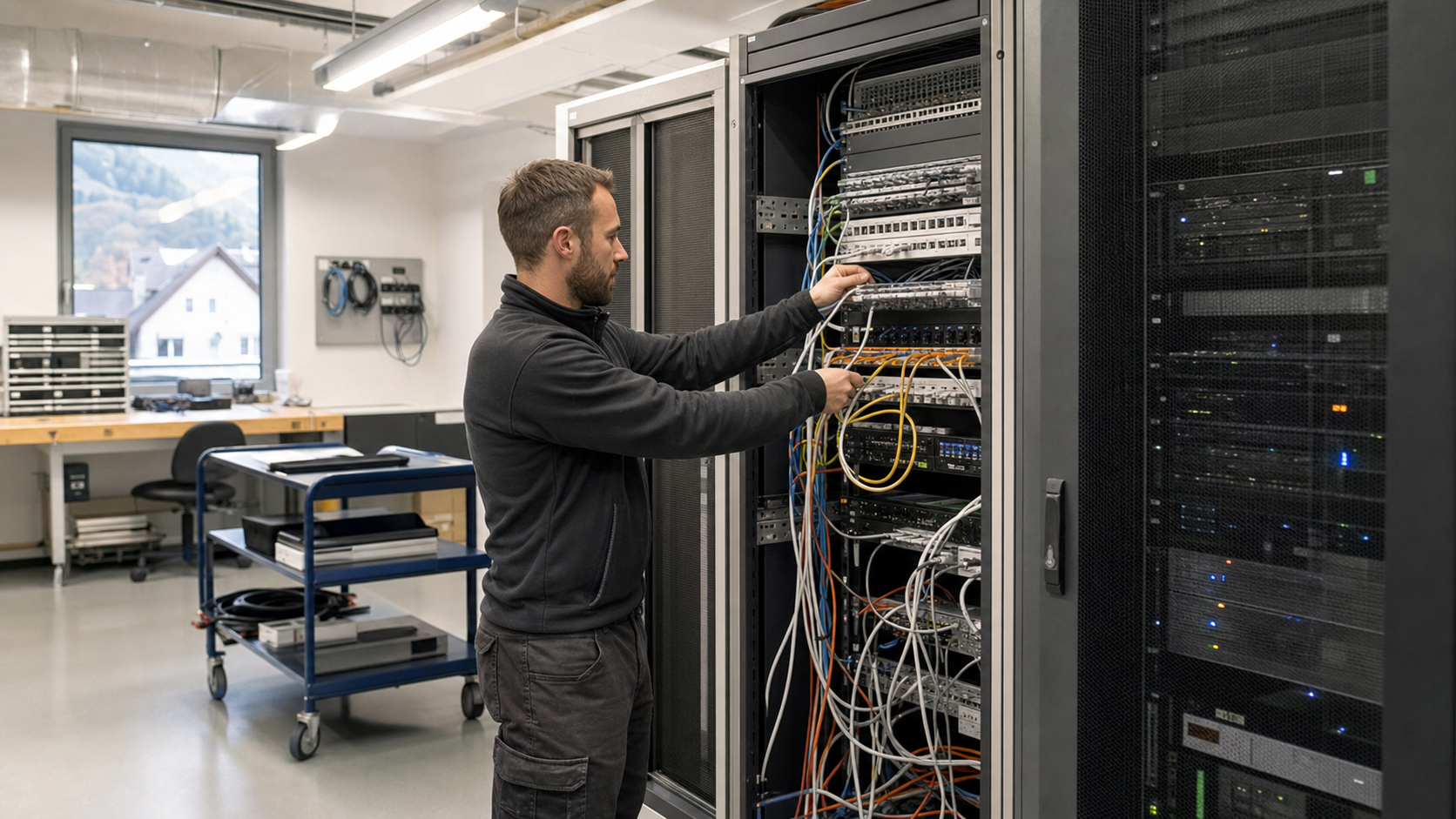
The phrase "stored in our data centre in Sumiswald" is the commercial heart of the offer. It gives customers locality, a Swiss jurisdictional story and a concrete alternative to vague cloud language. It also creates a cost curve that cannot be compared only with software subscriptions. Local data-centre operation means real estate, power, cooling, racks, network equipment, security, monitoring, backup architecture, spares, insurance, physical access procedures, and staff who can handle failure at the wrong hour. The more serious the claim, the more the provider must spend before it knows whether the next customer will arrive.
Balz's surrounding service pages show why this cost curve can be valuable. The cloud backup page frames backup as protection after cyberattack or physical damage, promising rapid renewed access to systems, applications and data without additional investment and with cost transparency. The support page presents remote assistance via TeamViewer and states that support is billed at the usual hourly rates in 15-minute intervals. The SLA page offers support extensions beyond standard hours, including Business, Enterprise, Enterprise+ and 24/7 packages. These pages imply that the product is not merely storage or compute.
It is a package of infrastructure plus response.
That package can improve economics if customers buy multiple layers from the same provider. A customer that hosts applications locally, buys backup, signs an SLA, asks for network and WLAN work, licenses Microsoft 365 through the same adviser, and calls the same support desk is more valuable than a customer that buys only a small hosting package. The provider has more account knowledge, more reasons to renew, and more chances to attach paid project work. A local data centre can then act as an anchor for recurring managed service revenue.
The opposite risk is under-absorption. If customers use the local data-centre promise mainly as reassurance but shift new workloads into Microsoft, AWS, Google, Swisscom or Infomaniak, the local provider still has to maintain the environment for a shrinking or low-growth base. Locality becomes a fixed-cost commitment rather than a margin engine. The article's core judgement therefore depends on utilization. Are racks, storage, backup capacity and engineering hours filled by profitable customers, or are they maintained because legacy relationships expect them? Public sources do not answer that.
They establish operating scope, but not the load factor.
The RIPE record proves control, but also exposes small scale
The network-resource evidence is meaningful because it shows a move beyond a purely reseller identity. RIPE NCC lists IT-Zentrum Emmental AG as a Swiss member. RIPE Database records identify ORG-IEA22-RIPE with the company name, Swiss country code, UID CHE-487.431.752, LIR type, Sumiswald address, telephone number and IT-Zentrum maintainer. RIPE records for AS213059 show the autonomous system as assigned, with the AS name "itze", organization ORG-IEA22-RIPE, and routing policy entries accepting from AS13030 and AS42346 while announcing AS213059 to them.
RIPE route records and RIPE Stat announced-prefix data show 46.247.34.0/23 and 2a06:e500::/29 as currently visible announcements, with more-specific IPv4 route entries also present in the database.
For customers, that evidence can support a control story. It suggests the company is not only buying a web-hosting reseller package and putting a local label on it. It has a registered autonomous system, its own number-resource administration, and identifiable upstream relationships. That can help with routing control, address continuity, abuse handling, provider independence and the credibility of a local data-centre claim. It also creates operational responsibilities that casual cloud resellers do not carry.
The same evidence also says the network is small. Public routing tools describe AS213059 with one IPv4 aggregate and one IPv6 aggregate in current visibility. IPinfo and other network-observation sources point to two upstreams, Init7 and NorthC Schweiz AG, and no downstream networks. PeeringDB lists the ASN, the company website, three IPv4 prefixes and one IPv6 prefix, but reports traffic levels and traffic ratios as not disclosed. BGP.tools describes a small active network. None of this is bad. In fact, a small network can be exactly right for a regional application-hosting and managed-service business.
But it limits the language one can use about market power.
The margin implication is subtle. Owning an AS and managing resources may reduce lock-in to a single connectivity supplier, improve resilience options, and give the company a more professional infrastructure posture. But it does not by itself create pricing power. Customers do not usually pay more because a provider has an ASN. They pay more if that technical control translates into better uptime, faster restoration, clearer responsibility, stronger compliance evidence, or lower migration risk. Without those outcomes, the AS is a cost and competence signal rather than a profit centre.
Revenue depends on bundles, service time and trust rather than raw capacity
The public evidence points to a revenue model built around bundled IT services, not only around renting infrastructure. Balz sells or describes server and storage projects, network and WLAN equipment, managed security appliances, cloud backup, remote support, service levels, software services, web and mail hosting, and telephony capability. The web and mail hosting page gives explicit low-price annual examples: z-email at CHF 50 per year, z-web at CHF 100 per year, and an anti-spam and anti-virus gateway package at CHF 190 per year. Those prices are not enough to carry a data-centre economics case on their own.
They are evidence of an entry layer in a wider account relationship.
The support page is more revealing for margin. It says remote assistance is billed at usual hourly rates and charged in 15-minute intervals. That creates a direct link between staff time and revenue. It can be profitable when the provider has repeatable procedures, well-documented customer environments and low rework. It can be poor-margin when every customer has a bespoke setup, urgent handholding, legacy applications and poorly defined responsibility across vendors. The customer may think it is buying peace of mind; the provider may actually be selling scarce engineering minutes.
The SLA page adds another lever. Business, Enterprise, Enterprise+ and 24/7 support packages convert availability anxiety into recurring revenue. If priced well, they let the provider reserve capacity, schedule staff, and charge for response expectations before incidents occur. If priced weakly, they turn into unpaid standby risk. The difference is not visible in public copy. It depends on contract terms, incident volume, after-hours call rates, escalation procedures and whether customers are willing to pay for the true cost of faster response.
Trust can make this model work. A local provider with long-tenured staff and known customer environments can reduce sales friction and retain accounts through personal credibility. The team page explicitly emphasizes continuity, long-standing manufacturer relationships and mostly business customers. That supports a recurring-service thesis. Yet trust can also hide poor pricing discipline. Long-standing customers often expect special treatment, legacy discounts and fast escalation. The question for IT-Zentrum Emmental AG is whether local accountability is priced as a premium service or quietly absorbed as relationship cost.
Pricing power must beat the cheap clarity of global and national substitutes
The customer alternatives are not theoretical. Swisscom markets SME cloud solutions with Swiss data storage and Swiss jurisdiction, availability and security language. Infomaniak presents itself as an independent Swiss cloud provider with data hosted in Switzerland and processed through open-source or internally developed software. Microsoft has Swiss cloud regions in the Zurich and Geneva areas and offers Microsoft 365 business plans in Swiss francs. AWS operates the Europe Zurich region with three availability zones. Google Cloud operates a Zurich region. NorthC runs and is expanding Swiss regional data-centre capacity.
Init7 offers business internet from a public starting price and is one of AS213059's named upstreams in public routing records.
These substitutes attack the IT-Zentrum Emmental margin case from different sides. Hyperscale cloud platforms attack with service breadth, automation, certifications, development ecosystems and procurement familiarity. Swisscom attacks with brand trust, national scale, connectivity, managed security and bundled SME IT. Infomaniak attacks with Swissness, privacy, email, hosting and cloud tools at consumer-to-SME price points. Colocation and connectivity providers attack with professional facilities and network reach.
Microsoft 365 attacks by making collaboration and identity a per-user subscription that a local adviser can resell or manage, but not fully own.
IT-Zentrum Emmental AG's answer cannot be to imitate all of them. Its credible advantage is accountable integration for regional buyers: the same team can discuss local servers, backup, applications, network, security appliance, Microsoft licensing, support and service levels. A global platform may be cheaper per unit of compute or email, but it will not know the customer's workshop, accounting software history or cabling map. That difference matters when the customer lacks an internal IT department.
The problem is that buyers often separate emotional comfort from budget authority. They may want the local adviser to design the environment, then push the recurring platform spend toward Microsoft, Swisscom, AWS or another provider because the monthly invoice is clearer or easier to benchmark. Durable pricing power requires IT-Zentrum Emmental AG to prove that keeping selected workloads local reduces total risk or total labour, not merely that it feels closer. If the local offer is only a comfort premium, procurement pressure will compress it.
If it demonstrably shortens recovery, reduces support hours, improves governance or preserves application continuity, it can earn a higher price.
The pricing comparison is especially hard because the alternatives are not priced in the same unit. Microsoft 365 is sold per user and per month, making it simple for a manager to multiply seats. Init7 publishes business internet from a starting monthly price, making access look modular. Balz publishes small web and mail hosting packages by the year, while its local cloud and data-centre offer is more consultative. Swisscom, AWS, Google and NorthC are often evaluated through quotes, calculators, workloads, reserved commitments or managed-service attachments.
A local provider can lose the argument if the customer compares only the visible subscription line and ignores the integration work around it. It can win if it makes the hidden cost visible: migration planning, old application support, endpoint cleanup, backup testing, access control, vendor coordination, staff training and emergency response. That means the economic sale must be framed as total operating responsibility, not as a raw cloud price. The customer needs to see why one franc paid to a local accountable team replaces more than one franc of fragmented labour, risk and escalation elsewhere.
If the provider cannot show that arithmetic, the lower-friction substitute will keep setting the ceiling.
An illustrative break-even case shows the customer density that this promise may require. Continuous coverage contains 8,760 hours a year; one genuinely staffed technical position therefore consumes roughly five to six full-time equivalents once normal working hours, leave, sickness, training and handovers are allowed for. Using a broad CHF 110,000 to CHF 150,000 fully loaded annual cost per experienced technical employee would put that coverage burden at about CHF 550,000 to CHF 900,000 before any servers run.
IT-Zentrum Emmental AG may instead spread an after-hours rota across its wider team, so this is a sensitivity bound rather than a claim about its staffing. Add an illustrative CHF 250,000 to CHF 500,000 for server and storage refresh, network hardware, software, electricity, cooling, connectivity, spares, physical security and a credible recovery site, and the annual fixed-cost envelope becomes roughly CHF 800,000 to CHF 1.4 million. At a 60 percent contribution margin after licences and other variable inputs, the local platform would need approximately CHF 1.3 million to CHF 2.3 million of recurring revenue merely to carry that envelope.
That equates to about 130 to 230 customers paying CHF 10,000 a year, or 55 to 95 customers paying CHF 24,000, before central administration, sales effort, financing and profit. The density matters as much as the count: scattered small accounts create travel, configuration and support variation, while clustered customers on standardized bundles let the same rota and recovery capacity serve more revenue. National SaaS, telecom and hyperscale alternatives reverse this burden for the buyer by charging per seat, circuit or unit of consumption; the customer does not fund one regional provider's idle capacity directly.
The local model must therefore attach enough paid support, backup, security and recovery value to each account to offset that apparent flexibility. If customers retain Microsoft or hyperscale subscriptions and buy only occasional local assistance, the fixed envelope remains while the highest-volume recurring spend escapes. If they buy a standardized managed bundle, the same local cost base can support a defensible premium.
Labour is the real scarce asset behind a local cloud
The most important cost line is likely people. Balz's team page lists about 31 named people, with many network technicians, system technicians, management, back office, business-solution project leaders and apprentices. It also says the customer base is mostly business customers and stresses long-serving employees. The jobs page describes the company's core competence as consulting, planning, implementation and support for complete IT solutions, and at the time reviewed it advertised for a 3CX telephony specialist. This is a labour-intensive business.
Swiss labour economics make that significant. Federal Statistical Office data puts the 2024 Swiss gross monthly median wage at CHF 7,024, with higher wages in skill-intensive sectors. European labour-market information identifies information and communications technology professionals as one of Switzerland's shortage occupation groups in 2024. OECD country-note material also points to tighter Swiss ICT labour than the average job. A small regional provider therefore competes for the same technical talent that national operators, software firms, banks, consultancies and hyperscale partners need.
Even if Emmental wage pressure differs from Zurich, skilled technicians are not cheap.
That creates an operating paradox. The local provider's differentiation is human: reachable support, practical knowledge, site visits, customer memory and trust. But the more it leans on people, the more margin depends on utilization, documentation and repeatability. If senior technicians spend too much time on low-value support tickets, margins erode. If junior staff need too much supervision, the model strains. If customers expect immediate answers without paying for a higher service level, local accountability turns into unpaid availability.
The upside is that labour can also defend the business. A local team that understands a customer's applications, endpoints, printers, switches, backup history and accounting software can be hard to replace. Migration to a global platform still leaves integration work, identity configuration, user training, device management, security policy and emergency response. IT-Zentrum Emmental AG can capture that work if it positions itself as the accountable operator around a hybrid estate.
The margin case is strongest when the company charges for expertise and governance while selectively using third-party platforms, rather than trying to own every layer itself.
Supplier dependence limits how much gross margin stays local
The company pages make supplier dependence visible. Server and storage pages emphasize Hewlett Packard Enterprise products, HPE ProLiant servers, HPE MSA and HPE Nimble storage. Network and WLAN pages mention HPE Aruba, HPE OfficeConnect and Ubiquiti. Support uses TeamViewer for remote assistance. The service menu includes Microsoft 365 and 3CX telephony. RIPE records for AS213059 point to Init7 and NorthC in routing policy, while public network tools also identify those names as upstreams. Web and mail hosting is described as being offered in cooperation with a professional hosting provider, with servers located exclusively in Switzerland.
This is normal for a regional IT provider. It is also a margin constraint. Hardware vendors, software licensors, transit providers, data-centre partners, security vendors and collaboration platforms all take their share before the local provider earns net profit. The local provider may obtain reseller margin, installation revenue, managed-service fees and support revenue, but it does not control the economics of all inputs. Vendor price changes, licence packaging, hardware availability, support renewals and contract terms can move customer costs faster than the provider can reprice relationship-based accounts.
The AGB makes this dependency explicit in legal form. It says third-party hardware and software warranty follows the warranty granted by the manufacturer, and that customer work after delivery, such as reinstallation or configuration, is not covered by manufacturer warranty. That protects the provider by pushing some costs into billable service. It also shows that the customer experience depends on external vendors. If hardware fails, if software licensing changes, or if upstream connectivity has an issue, IT-Zentrum Emmental AG may be the accountable face even when another supplier is part of the failure chain.
Supplier dependence can be economically healthy if the provider turns it into orchestration margin. Customers often prefer one accountable local counterparty over a stack of vendor portals. The company can charge for selecting, configuring, monitoring and repairing the mix. But it cannot let supplier pass-through revenue be mistaken for high-quality margin. The key measure is not top-line growth from hardware, licences or connectivity. It is retained gross profit after vendor costs and the engineering hours required to make those suppliers work together for each customer.
Customer concentration risk hides inside a regional relationship model
Local providers often enjoy sticky relationships, but stickiness can conceal concentration. The public record does not disclose customer names, revenue distribution or contract sizes. It does show a regional operating posture: Sumiswald location, business-customer orientation, local support hours, named staff, and a phrase that frames the company as both small enough to know customers and large enough to support them. That is a strong regional-market message, but it raises a basic investor question: how many accounts matter?
If revenue is spread across many small and mid-sized firms, the company may have resilience. A lost customer hurts but does not destabilize the cost base. If a few larger application-hosting or managed-service customers occupy a large share of data-centre capacity and technician knowledge, the risk is different. One migration to Microsoft Azure, Swisscom, AWS, Infomaniak, a sector-specific SaaS provider or an internal IT team could leave stranded capacity and staff time. Public sources do not allow a conclusion. They require a caution.
The customer mix also affects bargaining power. Small customers may lack procurement sophistication, but they are price-sensitive and can consume support disproportionate to revenue. Larger customers can pay for SLAs and project work, but they may demand better terms, audit evidence, redundancy commitments, cyber controls and exit rights. A local provider must choose where it wants to sit. Too small, and support becomes fragmented. Too large, and customers compare the provider against national managed-service firms with deeper compliance teams.
The best customer for IT-Zentrum Emmental AG is probably a regional organization with enough complexity to value accountable managed IT, but not enough internal scale to build or govern the full stack alone. That customer may pay for local data placement, backup, support and application knowledge. The worst customer is one that wants enterprise availability, custom attention and low commodity pricing at the same time. The company's future margin depends on customer selection as much as on technical quality.
Regulation and cyber risk support demand but raise the standard of proof
Swiss data protection and cyber risk create demand for local, accountable IT services. The Federal Act on Data Protection aims to protect the personality and fundamental rights of natural persons whose personal data is processed. For a Swiss SME without a large compliance team, a provider that can explain where data sits, who has access, how backups work and which party is responsible for incident response has practical value. Locality does not automatically solve legal risk, but it can simplify governance conversations and reduce the anxiety associated with cross-border processing.
Cyber risk adds urgency. The Swiss National Cyber Security Centre reported 35,727 cyberincident reports in the first half of 2025, with fraud a large share and core threats remaining high. It later highlighted ransomware as a constant threat to Swiss organizations, with 57 ransomware incidents reported in the second half of 2025. Balz's managed security page speaks directly to the SME problem: firewall investments, recurring security-service renewals and changing conditions can make the topic hard to manage, and SMEs too often neglect it. The cloud backup page similarly frames backup around cyberattack and physical damage.
These conditions should help a provider like IT-Zentrum Emmental AG. A small business can understand why backup, firewall management, support and local accountability matter. The provider can turn regulatory and cyber concerns into bundled recurring revenue. But those same concerns raise the standard of proof. A customer asking serious questions will want more than reassurance. It will want evidence of backup restoration performance, access controls, incident procedures, service levels, data location, subcontractors, vulnerability response, insurance posture and business-continuity arrangements.
Public legal terms are protective rather than expansive. The AGB disclaims uninterrupted fault-free operation, limits liability for interruptions including maintenance and technology introduction, excludes warranties for data integrity and accidental disclosure or deletion, and narrows liability for direct and indirect damage subject to mandatory law. That is commercially understandable, but it means the trust story must be supported by operational evidence outside the legal fine print. If the provider wants a premium for accountability, customers need to see what accountability actually covers.
Unofficial market signals show reach, not inevitability
Unofficial network and market signals are useful, but only if kept in their place. BGP.tools, IPinfo, IPLocate and PeeringDB all point to a small active AS213059 footprint associated with IT-Zentrum Emmental AG. IPinfo showed two peers or upstreams, named Init7 and NorthC, and recent low-millisecond Swiss probe responses to pingable addresses. PeeringDB lists the network's geography as Europe and traffic levels as not disclosed. CIDR-report style views show adjacent upstreams for IPv6. These signals support the view that the company has a real routed presence, not only a brochure.
They do not prove customer demand, margin, service quality or market share. A pingable address is not a satisfied customer. A PeeringDB entry is not a revenue base. A valid routed prefix is not a guarantee of resilience. Network-observation sites often depend on public routing data, probes, voluntary entries and third-party interpretation. They are helpful for triangulation, but they are not audited operating data.
The same caution applies to broader market commentary. Industry valuation summaries describe Swiss IT services and managed services as a fragmented market with many companies, labour-heavy cost structures, cybersecurity demand and consolidation themes. That is directionally plausible and useful context. It is not company-specific proof. It should be treated as a market signal, not evidence that IT-Zentrum Emmental AG has a particular EBITDA margin or acquisition value.
The absence of obvious public controversy is also not a positive proof. Searchable public sources did not reveal a broad set of negative market chatter, sanctions headlines or procurement disputes tied to the company. That reduces immediate reputational noise, but it cannot substitute for diligence. The more important public signal is narrowness: the company is visible in the places a real infrastructure operator should be visible, but it is not widely visible as a large public cloud brand. The investment conclusion should be modest: credible local infrastructure control, unproven economic scale.
The margin case needs evidence of utilization, retention and recovery spread
The thesis can be stated plainly. IT-Zentrum Emmental AG can turn local accountability into margin if customers pay recurring fees for a bundle that includes local hosting, backup, security, application knowledge, network support and defined service response, and if the company keeps technician utilization high while limiting low-value support leakage. It cannot rely on locality alone. Locality is a reason to listen. Margin comes from priced outcomes.
The evidence needed to prove that case falls into five groups. First is utilization: rack use, storage use, backup volume, virtual-machine count, network traffic, power and cooling cost, and the percentage of data-centre capacity tied to contracted recurring revenue. Second is service economics: gross margin by hosting, backup, SLA, security appliance, support, Microsoft licensing, telephony and project work. Third is labour productivity: tickets per technician, after-hours incidents, first-contact resolution, billable utilization, non-billable relationship time and documentation quality.
Fourth is customer quality: churn, tenure, net revenue retention, top-ten customer concentration, average revenue per business account and contract length. Fifth is risk performance: outage history, recovery-time evidence, backup-restore test success, security incidents, insurance claims and audit findings.
Those facts would separate a good local IT story from a profitable infrastructure business. A high-retention base with rising recurring revenue, disciplined service levels and strong restore evidence would support premium pricing. A low-churn but labour-heavy base with many custom exceptions would be less attractive. Strong data-centre utilization would validate the Sumiswald investment. Low utilization would suggest that the company is carrying local capacity for positioning rather than return.
The current public record supports a cautiously positive operating view and an undecided margin view. IT-Zentrum Emmental AG has a real Swiss corporate identity, a credible Sumiswald data-centre message, a RIPE NCC member and AS footprint, a regional support organization around it, and service pages that match SME demand for continuity, security and practical help. Against that, it faces national operators, hyperscale platforms, Swiss cloud providers, high labour costs, supplier pass-through economics and the need to fund trust before customers can verify it.
Local accountability can become margin, but only when it is sold as a measurable service outcome rather than a warm regional promise.