
Summary
- Glasvezel Assendorp BV has a defensible local story: a neighbourhood fibre network tied to Stichting CAI Assendorp, public claims of own-control network operation, local support hours, a RIPE NCC member record and visible routed address space associated with the brand through PLINQ's AS35224. That supports the view that BTW is looking at a real local broadband operating footprint, not only a marketing label.
- The margin case is still unproven. Public evidence shows service scope, prices, installation charges, supplier dependencies and customer sentiment, but not subscriber counts, churn, capex per passed home, wholesale fees, debt, network uptime, backhaul cost or per-product gross margin. Local accountability can justify customer loyalty; it becomes durable pricing power only if take-up density and business-service ARPU cover the fixed work of running a small network.
Local Accountability Is The Product, Not Just The Story
The strongest economic argument for Glasvezel Assendorp BV is not that it can match every headline speed from a national operator. Large Dutch providers can already advertise fibre or cable speeds that look more dramatic than what a neighbourhood network needs to sell. KPN has marketed consumer fibre up to 4 Gbit/s, Odido and DELTA have pushed 8 Gbit/s fibre offers in parts of the country, and Ziggo has been extending 2 Gbit/s cable availability at national scale. Against that backdrop, "up to 1 Gbit/s" is no longer a rare technical claim.
The local operator has to win on a different axis: whether residents and small businesses believe a nearby accountable operator will be faster to understand their street, their building, their installation problem and their continuity need.
Glasvezel Assendorp's own public pages lean into that logic. The company describes the network as a fibre network in the Zwolle district of Assendorp, built independently and in own management. Its service copy repeatedly uses the language of local presence, personal service and sharp pricing. The current Assendorp.net pages say Glasvezel Assendorp B.V. is an initiative of Stichting CAI Assendorp and trace the project back to the private central antenna arrangement that began serving Assendorp in 1964.
The renovation story is that the old CAI network needed replacement, the area had to be "glassed" with fibre, and the local network would be extended beyond the original footprint. That origin matters economically because it gives the service more than a generic retail brand: there is a neighbourhood institution behind the value proposition.
The customer promise is concrete enough to be tested. Residential pages say internet is available up to 1000 Mbps download and upload, that every home gets its own fibre connection, and that internet service starts from EUR 30 per month. Business pages say small companies and SMEs can use business internet, fixed IP service, television and telephony, with contact through internal staff and an account-manager style service model. The support promise is also local: weekdays 08.30 to 17.30, phone and email contact, advisers who can visit or explain options, and installers described as daily present in the district.
A seven-review Klantenvertellen page is too small to prove broad satisfaction, but its visible comments line up with the same theme: quick personal service, practical advice, and responsive help when speed or installation problems appear.
The business issue is that accountability has a cost. A national operator can spread call centres, systems, marketing, product design, network engineering and procurement across millions of customers. A neighbourhood operator that promises local support gives up some of that scale advantage. It may avoid part of the national operator's overhead, but it still needs people who answer calls, schedule field work, handle invoices, maintain customer equipment, coordinate with upstream providers, manage faults, pay registry and routing costs, keep TV and voice products working, and explain outages. Locality is therefore not free differentiation.
It is an operating model. The article's central judgment turns on whether enough customers pay enough recurring revenue for that operating model to be attractive rather than merely admirable.
The Company Boundary Is Narrower Than The Brand Suggests
The first discipline is to separate the brand from the legal and operational boundary. Public materials do not present a single, clean economic box. The RIPE NCC member page lists "Glasvezel Assendorp BV" with an address at Prins Hendrikstraat in Dalfsen, a phone number, an email address, and the Netherlands as the serviced area. Credit and company-index pages give a 2017 founding date and KVK number 68364768 for Glasvezel Assendorp B.V. The current Assendorp.net site says Glasvezel Assendorp B.V. is an initiative of Stichting CAI Assendorp.
Its service pages say the local fibre network was fully built in own management and that Stichting CAI Assendorp is the 100 percent owner of the local fibre network. The general terms, however, define "Glasvezel Assendorp" as the name under which Compenz Media BV, also based at Prins Hendrikstraat 9 in Dalfsen, provides services.
That does not mean the public story is false. It means the margin question cannot be answered by treating the brand, the BV, the foundation, the service operator, the network owner and the PLINQ ecosystem as the same economic unit without contracts. The neighbourhood may experience one brand; the money may move through more than one entity. Network ownership could sit with the foundation. Retail service delivery may involve Glasvezel Assendorp, Compenz Media, PLINQ, FiberNL, Netrebel or other providers depending on product and customer choice.
Public network-resource evidence also points to PLINQ: routing data shows the Glasvezel Assendorp-labelled IPv4 block announced through AS35224, which is identified as PLINQ BV rather than a standalone autonomous system for Glasvezel Assendorp itself.
This boundary problem is commercially important. If Glasvezel Assendorp BV mainly acts as a retail service brand on a locally owned network, its margin depends on retail ARPU, support cost, wholesale charges and supplier terms. If the local network owner receives access or wholesale revenue from multiple providers, the economics are closer to a small open-access infrastructure platform. If Compenz/PLINQ supplies key operational layers, the local brand may retain customer proximity while outsourcing part of the technical stack. Those are different risk profiles. The first is exposed to retail churn and helpdesk cost.
The second is exposed to take-up density and provider willingness to stay on the platform. The third is exposed to supplier concentration and service-quality dependency.
The public customer-facing model suggests all three features may matter. The FAQ says residents can sign up by taking an internet subscription from one of the providers and names Glasvezel Assendorp, FiberNL and Netrebel. It also says the network is open and that all providers are welcome if they meet quality requirements, while acknowledging that provider availability is also a provider choice. That open-network language limits the claim that local control automatically becomes monopoly pricing power.
It may give the network a route to wholesale utilisation, but it also means the local retail offer has to compete on the same fibres it helps make valuable.
For BTW's economic reading, the conclusion is cautious. Glasvezel Assendorp BV is a visible local telecom company with official registry and RIPE signals. It is also part of a layered local operating arrangement. The appropriate valuation lens is not "does the website look local?" It is "which part of the recurring customer payment is retained after network ownership, service provision, TV/voice platforms, support labour, routing, customer equipment and supplier costs are paid?"
The Revenue Model Starts With Dense Neighbourhood Take-Up
The public revenue model has three visible components: residential subscriptions, business services and one-off connection or installation-related charges. Residential internet is positioned as the base of the subscription. Customers can add television and telephony, choose packages or assemble their own bundle, and use a postcode check to determine availability. Current and legacy pages advertise internet from EUR 30 per month and up to 1000 Mbps upload and download. Telephony pages show per-minute rates for calls to Dutch fixed and mobile numbers and optional monthly calling bundles.
Television pages and extra-channel materials indicate TV service remains a product line, including linear and interactive options through the wider service ecosystem.
One-off economics show up in connection policy. Current pages say that a customer without a fibre connection can request a quotation, that an on-site survey may be needed, and that minimum connection costs are EUR 250 with higher costs possible depending on address conditions. The FAQ adds the demand-bundling logic: when an area is being built, residents who subscribe during the campaign can avoid connection charges; if they do not subscribe, fibre may be left ready near the property boundary and later connection can cost money. That is classic fibre economics.
The capital cost is incurred in streets and buildings before all customers are active. A campaign tries to pull enough subscription commitments forward to lower payback risk.
The reported take-up threshold has moved in public materials. A 2018 ZwolleNu report said the original plan discussed a 30 percent participation target, while the current FAQ describes a 25 percent minimum for areas built through demand aggregation. The exact threshold for each build phase is less important than the implication: a local fibre operator must create revenue density. If the network passes many homes but only a minority activate service, the operator carries duct, fibre, installation and maintenance cost without enough recurring revenue.
If enough residents and businesses take service, the same local infrastructure can support multiple products over the same access line.
The business-service page is therefore more important than its space on the website suggests. Residential broadband at EUR 30 to perhaps higher tiers can produce reliable recurring revenue, but a small operator needs either many residential customers or higher-margin business customers to cover support and technical overhead. The current business page targets small enterprises and SMEs, advertises business internet, TV and telephony, says fixed IP is included with business internet, and offers backup internet using an AVM router that can switch to 4G during a fixed-line interruption.
Legacy business copy also advertised business internet from EUR 45 per month. Those details point to a plausible margin lever: business customers value continuity, fixed IP, predictable support and fast fault handling more than raw household entertainment bandwidth.
Still, no public source gives enough volume data to prove the revenue model. The site says many residents already rely on the service, but not how many. It says a large part of the district has fibre, but not homes passed, homes connected or active subscriber share. It says business customers can use the network for payment terminals and camera security, but not how many businesses buy service or whether they take premium backup. The support reviews are positive, but seven public reviews cannot estimate churn.
The sensible thesis is therefore conditional: the model can work if the take-up density is high inside a compact footprint and if business accounts contribute above-residential ARPU; it is fragile if customer count remains small and product mix stays mostly low-price residential.
Network Ownership Gives Control, But It Also Locks In Cost
Network control is the heart of the local promise. Glasvezel Assendorp's pages repeatedly state that the fibre network was built in own management, that it is local, and that each address receives its own fibre connection rather than sharing neighbourhood bandwidth in the way customers may associate with older access technologies. The Assendorp.net service page says Stichting CAI Assendorp is 100 percent owner of the local fibre network. The FAQ says the old CAI network required renovation and that the whole CAI service area was to be provided with fibre.
The old public coverage described the physical build vividly: roads had to be opened, a new central CAI location was part of the plan, and fibre would be laid even in front of homes that were not ready to subscribe.
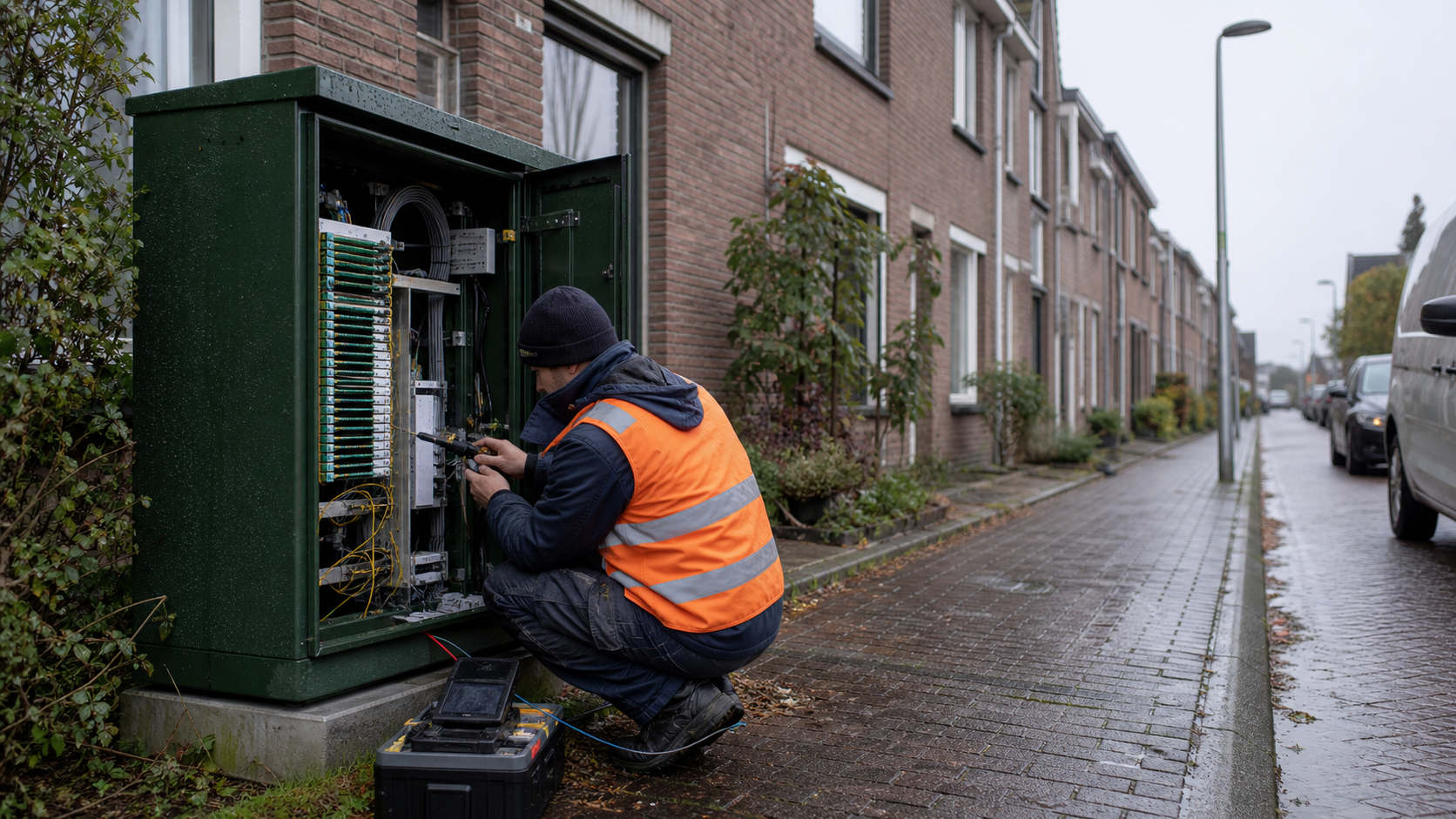
That control creates operational advantages. A local network owner can coordinate directly with contractors, adapt customer installation policies to the district, maintain knowledge of building types, and offer service that is not mediated entirely by a national wholesale interface. If a cable is damaged in the street, the FAQ tells customers to report it to their provider, which then coordinates with Glasvezel Assendorp for repair. If a customer damages fibre on private property, the company can inspect and charge recovery costs. This is not a passive reseller story.
Public materials describe an entity that owns or manages the local access layer and is directly involved when the physical network needs attention.
But physical control also fixes the cost base. Fibre may be long-lived, but it is not maintenance-free. The company has to handle street damage, building entry, high-rise access constraints, connection moves, customer premises equipment, surveys, contractor scheduling, documentation, fault triage, and changing technical standards. The general terms state that maintenance is for Glasvezel Assendorp's account, that faults should be investigated and resolved as soon as possible and within five working days after they are known, and that compensation applies when a disruption lasts more than 12 hours.
The same terms allow network changes needed for law, technology and current requirements. In other words, network ownership brings continuing obligations, not just a one-time asset.
The capital test is whether the initial renovation and expansion spend can be amortised across enough paying customers. The public build logic implies that construction was justified by a legacy customer base and a belief in future demand. The 2018 report quoted local confidence that even 20 percent participation would not sink the project over the long term, though it also described the need to finance the build and the difficulty of street work. Current FAQ language is more conservative, linking the build to at least 25 percent participation in demand-bundled areas.
A mature reader should not treat those numbers as audited economics, but they show how the operator thinks: subscription commitments are the counterweight to high upfront cost.
The most positive interpretation is that the local network inherited a captive relevance from the old CAI footprint. Residents already knew the institution, the neighbourhood had aging infrastructure, and replacing the network could defend the customer relationship before national fibre and cable substitutes absorbed it. The negative interpretation is that a local network can spend heavily only to compete in a national market where customers compare headline monthly price, streaming bundles, mobile discounts and installation promotions.
The difference between those outcomes is not ideology; it is take-up, churn, maintenance cost and the ability to sell more than commodity access.
Number Resources Point To A Dependent Routing Model
The network-resource record is useful because it anchors the company in internet infrastructure, but it must be read narrowly. The RIPE NCC member page identifies Glasvezel Assendorp BV as a RIPE member with contact details and the Netherlands as its serviced area. Third-party mirrors of RIPE allocation data show the LIR name "nl.assendorp" with 45.93.40.0/22 and 2a0e:23c0::/29 allocated in July 2019. BGP visibility sources show 45.93.40.0/22 described as Glasvezel Assendorp BV and announced through AS35224, which is PLINQ BV. Some routing-data sites mark the prefix with valid RPKI or IRR status.
IP geolocation pages for sample addresses in the block identify Glasvezel Assendorp BV as the ISP or domain context and AS35224 as PLINQ.
That evidence supports three claims. First, Glasvezel Assendorp is not only a neighbourhood brochure. It has number-resource governance context and appears in public routing datasets. Second, the IPv4 block is modest but real: a /22 is 1,024 addresses, enough to matter for a small residential and business access footprint when combined with carrier-grade NAT, dynamic addressing or IPv6 strategy. Third, the routed path appears dependent on PLINQ rather than a standalone Glasvezel Assendorp autonomous system.
That does not weaken the reality of the local access network, but it changes the meaning of "independent." The company may control the local fibre while relying on PLINQ or related operators for upstream routing, transit, TV platforms, technical operations or wholesale service layers.
For margin, that dependency can be rational. Running a fully independent network stack is expensive. Transit contracts, peering policy, abuse handling, route security, DNS, monitoring, DDoS response, lawful-interception readiness, RIPE administration and 24/7 operations are not naturally cheap for a neighbourhood operator. Using a proven upstream and operational partner can let a small access provider focus on the customer and physical network. It can also improve reliability if the partner has more scale and network engineering depth than the local operator could afford alone.
The dependency is also a bargaining and resilience risk. If a supplier controls routing, TV middleware, voice, customer equipment supply or support tooling, the local brand's service quality can be shaped by decisions outside Assendorp. A price increase from an upstream partner could squeeze margins if local customers resist retail price increases. A supplier incident could affect customers even if the local fibre is intact. A strategic change at PLINQ, Compenz or related entities could alter the economics of the local retail offer. Public sources do not show the contracts, so the risk cannot be quantified.
It should nevertheless be included in the investment judgment.
The resource evidence also prevents overclaiming. A prefix description is not proof that Glasvezel Assendorp sells IP transit, cloud hosting, managed networking or enterprise network services beyond what its public pages advertise. It is evidence of an access-ISP footprint and resource-holder context. The right claim is that the company participates in the number-resource system and has address space associated with its local service. The wrong claim would be that it has the interconnection power of a national network.
Business Service Is The Margin Test
The business page is where the local-accountability thesis becomes more than a household convenience story. Residential customers like friendly support, but many will switch for a national promotion if their connection feels adequate. Small businesses in a compact district are different. A cafe, shop, studio, office, healthcare provider or professional service firm may value payment-terminal uptime, camera connectivity, fixed IP, phone continuity and a known support contact.
Glasvezel Assendorp's business page speaks to that market: business internet for small and larger enterprises, fixed IP included, TV options for hospitality, business telephony with two call channels, advice on cloud PBX-style solutions, and backup internet using 4G failover.
Those features are economically meaningful because they let the operator sell continuity rather than just bandwidth. A household can usually tolerate a brief outage by using mobile data. A retailer may lose card payments. A small office may lose cloud access. A hospitality customer may lose TV service that affects guests. A local business customer may therefore be willing to pay for a plan that includes a clearer support path and a backup design. The company's own copy says personal attention is its strength and that business customers benefit from minimal waiting times and a personal contact.
If delivered consistently, that can justify a premium relative to the lowest consumer fibre plan.
The challenge is product depth. National and regional competitors can bundle mobile, cloud security, managed Wi-Fi, business telephony, TV, SLA options and device support at scale. They can subsidise customer acquisition with national marketing budgets and absorb churn across larger books. They can also offer mobile-fallback products and managed service through partner channels. Glasvezel Assendorp must be careful not to promise more than it can economically support. A 4G backup router is useful, but it requires SIM costs, hardware, configuration, support and clear customer expectations.
Fixed IP is useful, but it requires address management and security support. Business telephony creates number-porting and fault-handling obligations. Hospitality TV creates content and platform dependency.
The margin question is whether business services are sold as add-ons with meaningful contribution or mostly as features included to defend access revenue. The public pages do not disclose business pricing in enough detail. The legacy page advertised business internet from EUR 45 per month, while current pages steer customers to a postcode check and advice. If the real business offer is mostly a modest uplift over residential service, then it may improve retention more than margin. If it includes paid backup, fixed IP, telephony, TV and on-site support at sensible prices, it could be the engine that makes a compact network attractive.
The business customer base also determines downside risk. A small number of high-value local businesses could lift average revenue, but concentration risk rises if the operator depends on a handful of accounts. A broad set of SMEs across the district is healthier. Public materials do not disclose customer count by segment. For now, the evidence supports only a hypothesis: business continuity is the most plausible source of value creation, but the proof would be business ARPU, penetration and gross margin, not the existence of a business page.
Pricing Power Depends On Support, Not Speed Alone
Speed is now table stakes in the Dutch fixed-broadband market. ACM's Q1 2026 telecom monitor says Dutch fibre subscriptions kept growing, the country had just over 9 million fibre connections counted by network owners, and 3.68 million of those connections were in use. It also reported that 91.6 percent of households had a connection of at least 100 Mbps, with growth mainly in users taking 1 Gbit/s or higher. In that environment, a neighbourhood operator cannot rely on "fast internet" as a scarce product.
Customers see speed everywhere: KPN fibre, Odido fibre, DELTA fibre, Ziggo cable, budget providers on wholesale networks, and mobile fallback options.
Glasvezel Assendorp's public pricing signals are therefore important. Internet from EUR 30 per month is not extravagant, and the old 2018 local report already described an attempt to keep prices low compared with alternatives. Telephony rates are explicit and modest. Installation charges are waived or reduced during build campaigns but can start at EUR 250 later. Current pages emphasise package flexibility, monthly add-on changes for business options, and the ability to assemble only what the customer wants. Those are sensible tactics for a small provider.
They reduce the feeling that a local operator is expensive simply because it is local.
But sharp pricing cuts both ways. If the company prices too close to budget national alternatives, it may not recover its higher local support cost. If it prices too far above them, the customer has a reason to test KPN, Ziggo, Odido, FiberNL, Netrebel, Budget Thuis, Youfone or another available provider. The local operator needs a middle position: cheap enough to be credible, expensive enough to pay for field support and continuity, differentiated enough that customers do not judge only by headline speed.
Customer reviews provide a small but useful signal that support may be the differentiator. The Klantenvertellen page shows a 9.7 total score across seven reviews and comments about same-day technician attention, quick advice, stable internet, accurate support and good price. Because the sample is tiny, invited and public, it should not be used as statistically representative proof. It is still relevant market colour because it shows what customers notice when they are satisfied. They do not write about exotic technology. They write about being helped.
That is the difference between reachable support and durable pricing power. Reachable support can win goodwill. Durable pricing power requires that customers repeatedly choose the provider even when alternatives are available and when introductory discounts end. It also requires that the cost of providing support is lower than the extra gross profit retained through higher ARPU or lower churn. A local technician who solves a problem quickly is valuable. If that technician's cost is spread across too few customers, the economics still fail.
The company needs evidence that service quality translates into retention, upsell, business accounts or wholesale utilisation.
Suppliers And Platforms Set The Outer Edge Of Independence
Glasvezel Assendorp's independence is local rather than absolute. Its pages say the network was built and managed locally, but the service stack clearly touches outside suppliers. The FAQ and old pages mention PLINQ, and the general terms define the service name through Compenz Media BV. BGP routing points to PLINQ's AS35224. Internet pages mention AVM FRITZ!Box routers. Business backup uses 4G, which necessarily depends on a mobile network provider. TV services involve content packages and platform arrangements that a small local access network is unlikely to control alone.
The FAQ also names FiberNL and Netrebel as providers available through the local network.
This is not a defect. It is how small networks survive. They focus where local ownership matters and buy the rest. Outsourcing TV platform complexity can be rational. Using AVM routers avoids designing customer equipment. Relying on PLINQ routing can be cheaper and more reliable than building a full autonomous internet backbone. Working with other providers can lift network utilisation. The strategic question is whether the company has enough supplier diversity and bargaining power to keep the value created by the local network.
Supplier concentration can erode margin in three ways. First, input costs can rise. Transit, TV content, voice termination, routers, SIM backup, billing systems and support platforms all have suppliers. If those costs rise faster than local customer prices, a small operator has limited room to absorb the difference. Second, service failures can damage the local brand even when the failure is upstream. A TV platform issue or routing incident becomes a Glasvezel Assendorp customer experience if the customer bought service from the local brand. Third, product roadmaps may be constrained.
If a national competitor launches a new Wi-Fi 7 router, high-speed tier, security bundle or mobile discount, the local operator must wait on suppliers or fund integration itself.
There is also a governance question. If Stichting CAI Assendorp owns the network and Glasvezel Assendorp B.V. is a commercial initiative around that network, the supplier contracts determine who earns infrastructure returns. A local resident may care that the network is locally rooted. An investor or creditor would care whether the retail operator owns the customer relationship, pays a wholesale charge, receives one, or shares revenue with service partners. Public sources do not disclose that allocation.
The better way to frame the business is a controlled local access network connected to a partner-dependent service stack. That can be a strong model if contracts are stable and costs are transparent. It becomes vulnerable if the local brand carries customer expectations while suppliers control too much of the cost and technical roadmap. The evidence needed here is not another marketing page; it is supplier-term resilience, SLA structure, backhaul and transit cost, content cost, router lifecycle cost, and a map of which entity carries which obligation.
Customer Concentration Is Geographic Before It Is Contractual
Glasvezel Assendorp's most visible concentration risk is geography. The service identity is tied to Assendorp, a district in Zwolle, with public language about expanding to neighbouring districts. That compactness gives the company its local advantage, but it also narrows the addressable market. A national operator can lose share in one town and still grow elsewhere. A neighbourhood network has fewer places to hide. Civil works disruption, a local competitor build, a reputational problem, demographic change, or a slow take-up campaign affects a large part of the available opportunity.
Geographic concentration is not necessarily bad. In access networks, density can be powerful. A compact footprint lowers truck rolls, improves technician familiarity, simplifies local marketing, and creates word-of-mouth effects. If a high share of homes and businesses subscribe, the network can earn recurring revenue from assets that are already in the ground. If local providers share the network, the infrastructure can earn value even when the retail brand does not win every customer. The difference between concentration and density is utilisation.
The current public materials point to utilisation but do not quantify it. The over-ons and FAQ pages say many addresses have fibre and many residents trust the service. The old ZwolleNu article described a campaign area of roughly 400 households for an early meeting and a plan to divide the district into subareas. It also described laying fibre to homes that did not immediately subscribe, leaving a fibre bundle ready for later connection. That build style creates future option value but also stranded capital until the customer activates.
Open-network language adds another concentration layer. If residents can choose multiple providers on the local network, Glasvezel Assendorp as a network owner may benefit from provider competition. But Glasvezel Assendorp as a retail service brand must win against those providers. The FAQ names Glasvezel Assendorp, FiberNL and Netrebel as direct contact options. A retail customer dissatisfied with price or product may not need to leave the local fibre to leave the local retail brand. That is good for infrastructure utilisation and less good for retail lock-in.
Market anecdotes reinforce the point without proving it. A KPN community thread from 2020 described a resident asking whether KPN would eventually use the local fibre network and whether a EUR 250 in-home connection charge would still apply if the resident waited. A Tweakers comment in 2026 described an Assendorp home receiving a single cable with separate fibres associated with KPN and PLINQ/Glasvezel Assendorp. These are individual comments, not verified market data. They matter only because they show the customer decision frame: residents compare local fibre, KPN preference, connection charges and provider choice.
The local operator's moat is not that customers have no questions. It is whether the answer to those questions is economically convincing.
The Competitive Benchmark Is A National Bundle
The most dangerous competitor is not always the fastest fibre line. It is the simplest bundle. Dutch households increasingly buy fixed and mobile services together, and ACM has reported steady growth in combined fixed-mobile plans. National operators can use mobile discounts, TV content, streaming promotions, device offers, Wi-Fi guarantees and brand familiarity to make the decision feel low-friction. For many customers, the broadband line is not a standalone infrastructure choice. It is part of a household account with mobile phones, television, email, apps and customer-service habits.
KPN is the clearest strategic benchmark because it combines national brand, fibre rollout, wholesale access and legacy customer migration. Public reporting in late 2025 said KPN expected 85 percent fibre household coverage by 2030 and would reduce capex through a more capital-efficient rollout while focusing on connecting and activating existing fibre. For a small local operator, that matters more than the headline speed. KPN can bring existing customers from copper to fibre, bundle mobile, and compete on trust. If KPN or its wholesale ecosystem is available in or around Assendorp, local accountability has to beat national familiarity.
Ziggo is the cable benchmark. VodafoneZiggo has said Ziggo would make 2 Gbit/s internet available to nearly 7 million households by the end of 2025 with further expansion in 2026. Cable upload speeds and local network architecture differ from symmetric fibre, but for many households the perceived proposition is simple: fast enough, one bill, familiar TV, known support, and no need to understand local fibre governance. Glasvezel Assendorp can counter with symmetry, local presence and fibre future-proofing. It cannot assume customers will value those attributes equally.
Odido, DELTA, Open Dutch Fiber, Glaspoort and budget resellers add price and speed pressure. Odido's public materials highlight fibre up to 8 Gbit/s and price reductions for higher-speed plans. DELTA advertises fibre up to 8 Gbit/s and national speed awards. Open Dutch Fiber presents itself as an open fibre network with providers serving over its infrastructure. Glaspoort describes replacing copper with fibre on behalf of KPN. Budget providers can use wholesale networks to undercut headline monthly prices. The result is an outside option with more choice than a small provider would prefer.
This is why the local brand must avoid competing only on Mbps per euro. It should sell the economic outcome a resident or SME actually wants: fewer installation surprises, a reachable person when service fails, a network with local accountability, and a path to business continuity. That is a credible niche. It is also a niche that must be priced honestly. If national bundles become much cheaper, local service quality has to be visible. If national service quality improves, local differentiation narrows. If wholesale providers on the same local fibre offer lower prices, retail margin may compress even while network utilisation improves.
Regulation And Reliability Turn Local Promises Into Fixed Work
Telecom regulation makes small-provider economics less forgiving than ordinary local services. Even when a company is small, customers expect consumer protection, number portability, privacy, security, continuity, transparent contract terms, fair cancellation, outage handling and lawful behaviour. Glasvezel Assendorp's general terms reflect this regulated environment. They define ACM, contract formation, one-year initial terms, post-term monthly extension, cancellation rules, service availability, maintenance responsibilities, fault handling, compensation for long disruptions, privacy handling, traffic data and acceptable use.
Those terms are not just legal boilerplate; they are operating commitments.
Reliability is especially important because the brand sells local accountability. The terms say the operator seeks high availability, quality and security, while avoiding absolute guarantees. They say faults should be investigated and resolved as soon as possible and within five working days after becoming known. They include compensation rules when service is disrupted for more than 12 hours. Business pages promise stable and reliable service for entrepreneurs and offer 4G backup to avoid business consequences from temporary interruption.
This creates a clear commercial standard: if customers choose the local provider for support, outages are not only technical events; they test the brand promise.
Operational risk begins at the fibre layer. Street works can damage cables. Building access can complicate high-rise connections. Customers can damage fibre on private land. Moves and late connections require surveys and quotations. The current FAQ and connection pages acknowledge these situations. They are normal in access networks, but they consume labour. A national provider can manage many such events through large contractor frameworks. A local network may be faster locally, but it has less redundancy in people and process.
Regulatory and security demands are likely to rise rather than fall. The Netherlands and the European Union have been increasing attention to digital infrastructure resilience, cybersecurity and supply-chain risk. A small access provider may not be geopolitically sensitive in the way a subsea cable or national mobile network is, but it still supports homes, SMEs, payment terminals, cameras, care applications and communications. Customers will judge failures by impact, not by company size. The more the operator sells business continuity, the more it must invest in monitoring, incident response, customer communication and documented recovery.
This reinforces the margin thesis. Local accountability can command loyalty only if reliability work is funded. Underpricing a network while promising fast human support is dangerous. It creates a service expectation the cost base cannot meet. The economically healthy version of Glasvezel Assendorp charges enough, maintains enough redundancy, and uses suppliers intelligently. The unhealthy version competes on low prices, absorbs support-heavy customers, and relies on supplier goodwill when incidents occur.
Unofficial Signals Are Useful, But They Do Not Set The Verdict
Unofficial market signals help show how customers think, but they must be kept in their lane. The Klantenvertellen page is the most direct sentiment source: seven reviews, a high average score, and comments focused on personal service, fast help and stable internet. This is supportive evidence for the brand promise, but the sample is too small to measure market-wide satisfaction. It is also an invited-review environment, not a neutral customer census. The correct use is qualitative: satisfied customers seem to value exactly the service attributes the company sells.
The KPN community thread from 2020 is a different kind of signal. A resident asked whether KPN could eventually use the locally initiated Assendorp fibre network and whether the EUR 250 connection charge would be unavoidable if they did not take the local provider. That does not prove a widespread objection, but it shows that some customers separate the physical fibre from provider preference. For a local network, that is both risk and opportunity. The risk is that residents may wait for a preferred national provider.
The opportunity is that an open local network can still earn infrastructure value if those providers eventually participate under acceptable terms.
Tweakers comments around the 2026 fibre-connection milestone add another small signal. One Assendorp commenter described receiving one cable with separate fibres associated with KPN and PLINQ/Glasvezel Assendorp. Comment threads are not authoritative infrastructure records. Still, they point to a market in which overbuild, provider choice and civil-works coordination are live consumer topics. That fits ACM's view that multiple fibre connections per address can improve choice and reduce dependence on network companies for providers without their own fixed network. It also means local operators face more comparison at the doorstep.
Third-party routing and geolocation sites add evidence but also need caution. BGP.tools, IPIP, IP2Location and IPinfo-style pages can show prefixes, AS paths, descriptions and geolocation labels. They are useful for triangulating that 45.93.40.0/22 is visible in the PLINQ AS35224 context and described with Glasvezel Assendorp. They are not customer records, service-quality data or proof of direct network independence. Geolocation can be approximate. Prefix descriptions can lag business reality. Route visibility can change.
The article's judgment therefore relies most heavily on primary company pages, RIPE membership, the ACM market monitor and public terms. Unofficial signals are included only to shape the market questions: Do customers value the local service enough to overcome national-brand preference? Does open access create wholesale upside or retail leakage? Do reviews show a repeatable service advantage or just a small happy group? The answer remains open until operational metrics are disclosed.
The Evidence Needed To Prove Durable Margin
The public evidence supports a credible but unproven thesis. Glasvezel Assendorp BV can plausibly turn local accountability into margin if three conditions hold. First, the local network must have high active take-up across a compact footprint. Second, business customers must buy higher-value services such as fixed IP, telephony, TV, backup and support rather than only low-price broadband. Third, supplier costs must remain low and predictable enough that local service quality is not squeezed by upstream dependencies.
The current evidence proves identity, product scope, local network claims, number-resource context and market pressure. It does not prove return on capital. The missing facts are straightforward. How many homes and businesses are passed, connected and active? What share of customers take the Glasvezel Assendorp retail service rather than another provider on the network? What is monthly ARPU by residential, business, TV, voice and backup product? What is churn after promotional periods? What is the gross margin after wholesale, content, voice, router, support and network maintenance costs?
What was the capex per passed address and per activated address? How much debt or foundation funding supports the network? How many field visits does the operator make per thousand customers? What is actual uptime? How often does 4G backup activate for business customers? How concentrated are SME accounts?
The facts that would improve the judgment are also clear. A high activation ratio, low churn, business ARPU materially above consumer ARPU, positive customer acquisition by referral, supplier contracts with stable cost floors, low fault rates, and paid backup adoption would show that the local model creates value. Evidence that other providers pay to use the network without eroding retail economics would be especially positive, because it would turn openness from a defensive claim into an infrastructure revenue line.
The facts that would weaken the judgment are equally concrete. Low take-up, heavy reliance on low-priced residential plans, rising PLINQ or platform costs, weak business penetration, high truck-roll rates, repeated outage compensation, inability to raise prices, or customer migration to national bundles would suggest local accountability is a retention story rather than a margin engine. A confusing boundary between the BV, foundation and service operator would also matter if it obscures who funds upgrades and who keeps the upside.
For now, the most defensible conclusion is balanced. Glasvezel Assendorp BV has a real local operating surface and a sharper community narrative than a generic reseller. It appears to sit on meaningful local infrastructure, has RIPE member evidence and a visible address-resource footprint, and sells the exact support attributes that can matter to SMEs and residents who dislike distant helpdesks. But durable margin is not visible in the public record. The company has to convert trust into paid density, not just praise.
Local accountability is a product customers may pay for; only customer-count, ARPU, churn, capex and supplier-cost evidence can show whether they pay enough.