
Summary
- Brilliant Labs' strongest claim is not that it can put AI in glasses. It is that an open, camera-and-microphone wearable can turn repeated moments of visual or spoken context into useful assistance without making the user manage a fragile gadget loop.
- The evidence supports a technically serious developer platform: open repositories, documented Bluetooth interfaces, Lua scripting, mobile host apps, camera and audio APIs, and a newer Halo design with a micro-display, mics, speakers, sensors, an NPU-class microcontroller and a 300 mAh battery.
- The same evidence shows the commercial problem. Frame and Halo depend on host apps, Bluetooth, cloud AI services, privacy controls, charging behavior, firmware updates and developer maintenance. Each dependency can add latency, correction work or trust cost.
- Public user signals around Frame were mixed. Some early adopters liked the form factor and openness, while others reported pairing, onboarding, app maturity, camera utility and support frustrations. Those signals are not a controlled test, but they matter because accepted wearable AI is judged by repetition.
- Until Brilliant Labs can prove low-friction, privacy-respecting, all-day reliability across ordinary tasks, its clearest near-term value is as a developer and experimental wearable-computing platform rather than a mainstream replacement for phone-based AI.
The product is eyewear, but the job is interaction acceptance
Brilliant Labs is easy to misread if it is treated as a small hardware company trying to compete feature by feature with every smart-glasses vendor. Its public position is narrower and more ambitious at the same time. The company wants AI eyewear to be open enough for developers and personal enough for a user's real surroundings. Monocle made the thesis visible as a clip-on AR module. Frame moved it closer to ordinary glasses.
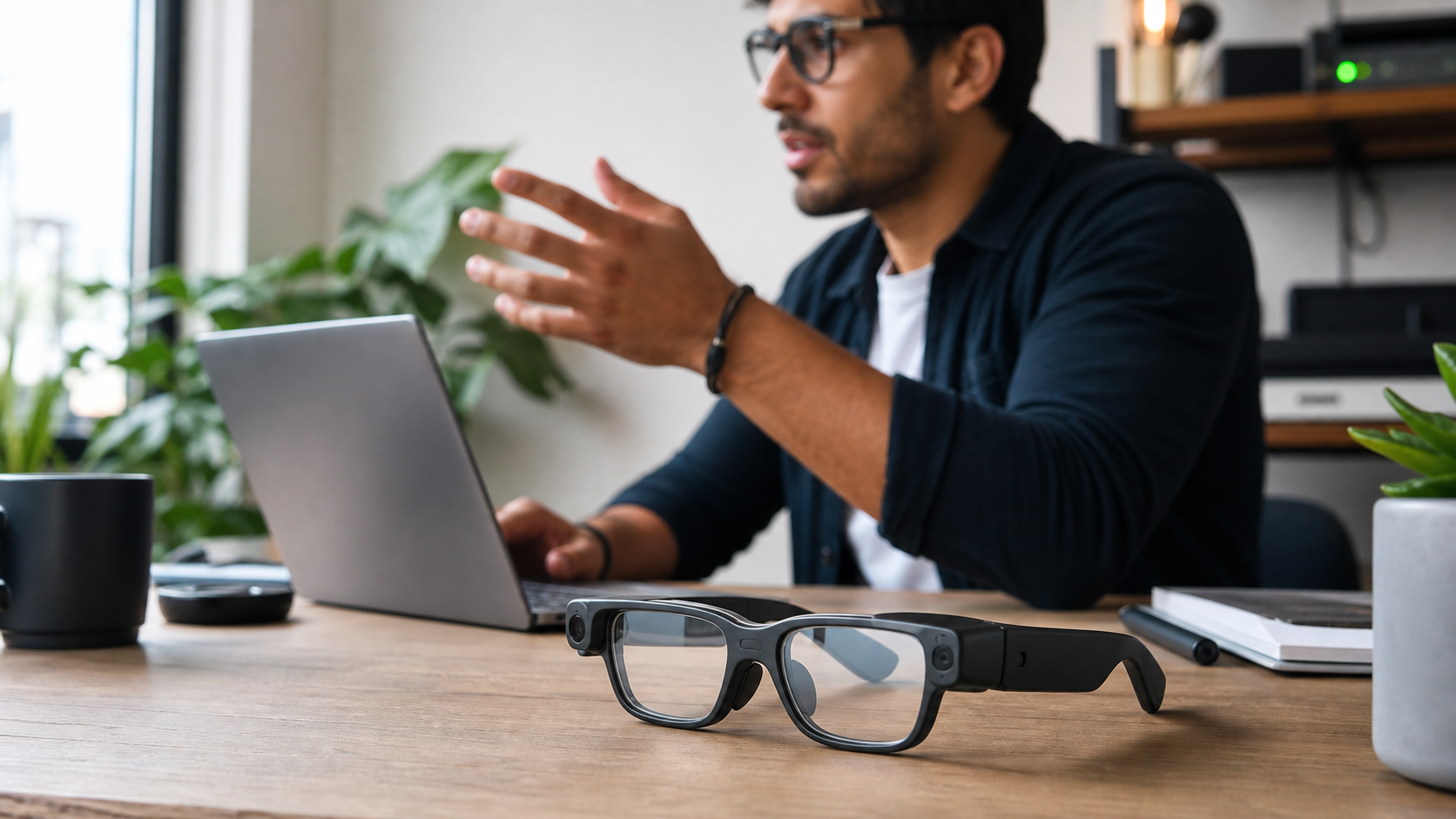
Halo, the current flagship on Brilliant Labs' own site, pushes the idea further with a color micro-display, bone-conduction audio, microphones, a low-power optical sensor, Bluetooth 5.3, ZephyrOS with a Lua interface, a cross-platform mobile app and a cloud-based AI agent.
Those specifications matter, but they are not the test. The test is whether a person accepts the interaction. A wearable assistant is not useful because it can answer once. It is useful if the user reaches for it again when the cost of doing so is lower than the cost of using a phone, a laptop, a search box, a note app or another person. That threshold is severe because the wearable sits on the face. It asks for social permission, physical comfort, battery trust, privacy confidence and a new habit.
If the device misses context, waits too long, drains too fast, exposes too much, asks for too many resets or forces the user into repeated corrections, the product can remain impressive while the interaction fails.
The useful framing is therefore not "can the glasses run AI?" It is "can Brilliant Labs make context capture reliable and controllable enough for repeated ordinary tasks?" The answer is still uncertain. The public record shows serious engineering and a coherent developer strategy. It also shows unresolved dependency risk. Brilliant Labs is not merely shipping glasses. It is asking users to trust a chain that runs from sensors to Bluetooth to a phone or host app, then to model services, memory controls, display rendering, audio feedback, app-store distribution, firmware updates and developer tooling.
A failure at any point can turn a hands-free moment into a hands-on repair.
That is why accepted wearable AI is a better standard than launch-demo novelty. A launch demo can use favorable lighting, a prepared task and a patient audience. Accepted use has no such protection. The user is walking, shopping, cooking, repairing equipment, attending a meeting, translating a sign, remembering a name, checking a route or trying to identify something in a crowded environment. The assistant must notice enough, ask for clarification when it does not know, show or say the answer without disrupting attention, and give the user an easy way to correct it. The winning product is not the one with the most magical first answer.
It is the one whose wrong answer does not make the user regret wearing it.
Brilliant Labs has chosen openness as the control surface
The most durable part of the Brilliant Labs story is its open developer posture. The company's GitHub organization includes repositories for Frame, Noa, the assistant components, utilities and SDKs. The newer Brilliant SDK repository presents a multi-platform stack for building applications that communicate with Halo and Frame. It describes devices running user scripts in an on-device Lua 5.3 virtual machine and exposing a frame.* API for display, Bluetooth, IMU, audio, file I/O and related functions. The host-side SDK handles Bluetooth Low Energy transport, message framing and rich data types such as images, text, audio, sensor data, taps and click events.
This is not a decorative open-source label. It shapes what Brilliant Labs can and cannot promise. The upside is that developers can inspect, adapt and extend large parts of the stack. The company documents Python, Flutter and Web Bluetooth routes, plus direct Bluetooth LE development for teams that want more control. It also makes hardware manuals and Lua API references available, and its docs describe an emulator for Halo apps that can run Lua scripts in software, render a virtual 256 by 256 display and inject button or IMU events.
For a small company, that is a meaningful attempt to let external developers carry some of the experimentation load.
The tradeoff is that openness does not remove maintenance cost. It often moves that cost into the hands of the people most capable of handling it. A developer can build a clever Halo or Frame app, but the user still experiences it through the same physical and connectivity constraints. The device has a limited battery, limited memory, a small display, Bluetooth packet limits, firmware behavior and a host app.
A developer who wants a robust field tool has to think about pairing recovery, offline behavior, latency budgets, privacy notices, error display, battery state, app-store rules, permission dialogs, firmware drift and support across iOS, Android, desktop or browser contexts. Brilliant Labs lowers the entry barrier for experimentation. It does not abolish the operating burden of a wearable computer.
This matters commercially because the target customer is not just a consumer who wants novelty. Brilliant Labs speaks most clearly to developers, wearable-computing enthusiasts, early adopters, accessibility experimenters, field-work tinkerers and teams evaluating hands-free AI interaction. For those users, openness is a buying argument. It reduces lock-in and makes the device useful even when the official app is not enough. But for a mainstream user, openness is usually invisible. The mainstream user sees whether the thing connects, answers, survives the day, respects the room and recovers from mistakes.
Brilliant Labs needs both audiences, but the evidence suggests the developer audience is currently the better fit.
The architecture creates power and latency boundaries before any model answers
Brilliant Labs' own documentation is clear that Frame and Halo are not tiny phones with conventional app launchers. The devices typically function as peripheral accessories for host applications running on a phone, computer or browser. The host app communicates over Bluetooth to control features such as the camera, microphone, speakers and display. Lua scripts can run on the glasses for specific behaviors, but the host app usually drives the main logic. In the example Brilliant gives for Frame and Halo, the Noa mobile app connects to the device, receives sensor data over Bluetooth, processes it and sends content back to the display.
That design is sensible. It lets the glasses remain light and power constrained while the phone or host handles heavier computation, network access and app distribution. It also means the accepted interaction depends on the entire loop. The user taps, speaks or asks. The glasses collect audio, image or sensor data. The device chunks and sends data over Bluetooth. The host app processes or forwards it. A cloud model may interpret it. A response returns. The host sends text, image or audio output back. The glasses display or play it. The user then decides whether the answer is useful.
Every step can be optimized, but every step is also a possible delay. Official materials describe low-latency ambitions for Noa and Halo, and the hardware includes components chosen for low-power sensing and on-device AI. But public materials do not provide a controlled end-to-end latency benchmark for repeated tasks in ordinary environments. That absence matters. Wearable latency is not judged like laptop latency. A two-second delay in a browser may be acceptable. A two-second delay while a person stands in front of a sign, a shelf, a machine, a patient, a customer or a stranger can feel awkward.
A five-second delay can make the user lower their head, check the phone and abandon the glasses.
There is also a difference between model latency and interaction latency. A model may answer quickly once it has the right request and context. The wearable task includes capture time, wake detection, speech transcription, image exposure, Bluetooth transfer, mobile operating system scheduling, app foreground or background behavior, network availability, model routing, memory lookup, response rendering and the user's correction path. Brilliant Labs can improve many of those pieces, but the accepted-interaction test counts all of them. The user does not care which subsystem was responsible for the stall.
The Frame documentation shows the constraints more plainly. Frame's hardware manual lists a 640 by 400 color OLED display, a 20-degree field of view optic, a 720p low-power color camera, a microphone, FPGA acceleration for graphics and imaging, Bluetooth 5.3, a 210 mAh built-in battery, accelerometer, e-compass, Lua-based OS and a charging dock with its own 140 mAh battery. That is a serious package for its size, but it is not an unlimited compute surface. It has to trade power, heat, display clarity, capture quality, connectivity and comfort.
Halo improves the platform in important ways. Its hardware manual lists a 0.2-inch color OLEDoS micro-display with a 256 by 256 drawable area, a 640 by 480 global-shutter color camera, stereo microphones, stereo bone-conduction speakers, an Arm Cortex-M55 CPU with Arm Ethos-U55 NPU, Bluetooth LE 5.3, a 300 mAh battery, accelerometer, e-compass, Zephyr OS with a Lua VM and a magnetic charging connector. The camera documentation notes low-power capture, while the microphone section describes multiple power modes including an always-on audio activity detection mode. Those choices directly target the wearable loop.
They support wake detection, context capture, audio feedback and lower-power operation. They do not by themselves prove the daily task will feel reliable.
Context capture is the product's promise and its hardest failure mode
The Brilliant Labs proposition is built on context. A phone assistant waits for the user to type, speak or attach a photo. A wearable assistant can, in principle, use what the user sees, hears and does. That is why the company talks about Noa understanding visual and audio context, why Halo includes a camera, mics, IMU and memory system, and why the developer docs expose photos, audio, IMU values, taps, clicks and display primitives. The product wants to turn the world around the user into an input stream.
That is also where failure becomes expensive. If the glasses misread a sign, capture the wrong object, hear the wrong instruction, infer the wrong intention, miss the relevant part of a scene or answer from a stale memory, the user has to repair the interaction. Correction on a phone is familiar: edit text, retake a photo, tap a menu, copy a link, check another app. Correction on glasses is harder. The user may have a tiny display, a limited control surface, speech commands, taps, a mobile companion app and social constraints. If correction requires the phone, the original hands-free benefit shrinks.
Brilliant Labs appears to understand this. The shift from Frame to Halo is not just a change in shell. It adds speakers, a newer sensing package, a low-power processor with NPU capability and a stronger memory narrative. The company's Halo materials describe Noa as a cloud-based AI agent that can remember what it saw, heard and said to personalize future assistance. Official posts about the road to Halo stress private memory, environmental context and the challenge of discerning useful signal from daily noise. Those are the right problems.
But memory is not a simple feature in wearable AI. It is a liability unless the user can understand, audit and correct it. A memory assistant that recalls a name or prior conversation is valuable only if it remembers the right person, keeps sensitive events out of unwanted contexts and lets the user delete or correct what should not persist. If a memory is wrong, the error can contaminate future assistance. If a memory is right but socially inappropriate to surface, the product creates a trust problem. If the user has to curate every memory manually, the assistance becomes a chore.
The public privacy policy tries to answer this by saying that memories support personalization and contextual recall, that users may delete individual memories or an entire memory profile, and that raw audio, video or full transcripts are not retained beyond immediate feature processing. It also says summarized memory data is stored privately in encrypted form. That is a useful commitment. It still leaves a practical question: can the user see enough of the memory state to trust it? A privacy promise can reduce fear, but accepted use also requires intelligibility.
Users need to know what the glasses captured, what it did not capture, what it stored, what it forgot and how to fix it when the assistant's account of the world diverges from theirs.
Privacy is not an edge case for camera-first AI eyewear
Privacy is central to Brilliant Labs' commercial question because the device sits on the face and captures the environment. The company has chosen to market privacy as a differentiator. Its terms and privacy materials describe products and services including Halo, Frame, Monocle, Noa, mobile apps and related platform services. The terms warn that products may process audio, video, environmental or biometric information and say users are responsible for complying with recording, surveillance and privacy laws in their jurisdiction and for obtaining necessary consent from other people who may be recorded or captured.
The privacy policy says cloud processing may use third-party processors for natural-language or vision tasks, but says they act on Brilliant's instructions and are contractually restricted from using data for their own purposes.
Those statements are important for two reasons. First, they confirm that privacy risk is not theoretical. A wearable AI assistant cannot answer many of its most useful questions without processing the user's surroundings. Second, they put some of the burden on the user. The user has to decide when it is acceptable to use the device, when to mute it, when to sleep it, when to delete memory and when not to capture at all. In a consumer product, that burden may be acceptable for enthusiasts. In workplace, education, health, retail, field-service or accessibility contexts, it becomes a deployment policy issue.
Brilliant Labs' own public language also distinguishes consumer use from high-criticality applications. The Halo hardware manual says the devices are intended for consumer and R&D applications and are not verified for use where performance and accuracy would be critical to health, safety or mission-critical operations. That boundary should be taken seriously. It does not mean the glasses cannot help a field worker, a researcher, a student, a traveler or a person with accessibility needs. It means customers should not quietly convert a developer device into an unvalidated decision system where a wrong answer can hurt someone.
The accepted-interaction test therefore includes the bystander. If the user wears camera glasses into a meeting, store, classroom, clinic, factory or private home, other people become part of the input field. A product can be technically private from the cloud provider and still socially intrusive. A local or encrypted memory system does not automatically solve the discomfort of being captured. The product needs clear indicators, fast controls and defaults that make the user's intentions obvious. The more ambient the assistant becomes, the less acceptable hidden capture becomes.
That point affects data sovereignty as well. Brilliant Labs can reduce exposure by minimizing raw media retention, encrypting memory and limiting third-party model use. But wearable AI still crosses boundaries: from a person's face to a phone, from the phone to cloud services, from cloud services back to a wearable display, and potentially from the official app to developer-built apps. Open platforms make this more flexible and more complex. They give developers room to build local-first or privacy-preserving designs, but they also require stronger developer discipline. A bad app can undermine a good hardware policy.
Battery claims have to be judged by task mix, not headline hours
Battery is another place where demos can mislead. Brilliant Labs' website presents Halo with all-day battery language. The Halo hardware manual lists two 150 mAh cells for 300 mAh total and explains the charging architecture. Press coverage of the Halo launch repeated a battery-life figure of up to 14 hours. Earlier reporting around Frame, drawing on company explanations, described a much more task-dependent picture: roughly three hours under extreme use, and around six or seven hours with frequent but normal use, according to the company's internal framing at the time.
Frame's official hardware manual lists a 210 mAh built-in battery and a 140 mAh charging dock.
The exact numbers are less important than the pattern. A wearable AI battery is not one workload. Idle sensing, wake detection, text display, camera capture, audio recording, bone-conduction playback, Bluetooth transfer, firmware update, image processing, model calls and continuous memory features draw differently. A product may last through a day of occasional questions and fail a day of visual interpretation, translation, audio responses or developer experiments. A user does not need a theoretical maximum. They need confidence that their particular use will not strand the device before the task is done.
Brilliant Labs' architecture is well aligned with power constraints. Halo's camera is described as low power, its microphones include low-current modes, the MCU includes NPU-class hardware, and the device remains dependent on host apps for heavier logic. That is the right design direction. But the accepted-interaction question is operational: how often does the user charge it, what features are disabled as the battery drops, how visible is battery state, how gracefully does the assistant degrade, and how much friction does charging add?
This is not a minor ergonomic detail. One public technical review of Frame criticized the charging adapter concept, arguing that a user who forgets or loses the adapter has a dead device even when USB-C cables are available. Another early hands-on account noted the small charging cradle and the need to remove magnetic nose pads to charge. Those are anecdotal signals, not universal defects. But they illustrate how battery trust becomes habit trust. A phone can survive some charging inconvenience because users already organize life around phone charging. A face-worn assistant has to earn that routine.
Battery also interacts with privacy and latency. More local processing can reduce cloud exposure and network dependency, but local inference consumes power and may be limited by model size. More cloud processing can save device power and improve answer quality, but it introduces connectivity, privacy and service-cost questions. More frequent sensing can improve context, but it burns energy and raises social concerns. There is no free choice. Brilliant Labs' design has to make those tradeoffs explicit enough that users and developers can choose the right mode for the task.
The Noa app is both showcase and bottleneck
Noa is the public face of the Brilliant Labs AI experience. The Google Play listing describes Noa for Frame as a personal AI assistant for Frame AR glasses with GPT-powered chat, web search and translation. It says the user taps Frame, asks Noa, gets a response on the glasses and stores chat history in the app. It also says users can tune Noa's style, tone, response format, temperature and response length. The Apple App Store listing repeats those functions and adds that Noa serves as an example for developers, including a Hack page that details Bluetooth transactions between Noa and Frame.
This is a clever product choice. The official app gives buyers an out-of-box experience while exposing enough detail to help developers learn the communication model. It also lets Brilliant Labs improve the device after shipping through mobile updates and firmware updates. App-store version notes for Noa show firmware updates, camera-quality improvements, login fixes and stability library updates through early 2025. That is a positive maintenance signal: the product did not stop at shipment.
The same app dependence is also a risk. If Noa's onboarding is unclear, if background execution is unreliable, if mobile permissions change, if app-store policies shift, if the app cannot keep pace with firmware, if third-party model costs change, or if a host operating system breaks a Bluetooth behavior, the glasses suffer. The user does not experience an elegant open architecture. The user experiences a device that either works or asks for attention.
Early app-store and community signals reflect that tension. The Apple App Store page showed a small ratings base, with one positive review calling the glasses a taste of the future and one negative review complaining that Frame did not deliver the expected camera and display experience. Google Play showed more than one thousand downloads, a March 2025 update, and a data-safety label that simultaneously says the app may share location with third parties and that no data is collected. App privacy labels are developer-provided and not a substitute for auditing, but users read them as part of trust formation.
Any ambiguity around what is collected, shared or stored becomes part of the acceptance cost.
Noa also concentrates model-dependency questions. If the assistant relies on cloud models for speech, image interpretation, search or reasoning, then Brilliant Labs has to manage service quality, cost, availability and privacy promises across providers. If it moves more functions on-device, it has to manage model size, battery, heat, accuracy and update cadence. If it lets developers plug in alternatives, it expands flexibility while making the user experience less predictable.
The most practical route is probably layered: local wake and control, efficient on-device assistance where feasible, cloud help for complex reasoning, and developer controls that make the boundary visible.
Early Frame signals show why accepted use is harder than a spec sheet
Frame is useful evidence because it has had enough public use to reveal friction. It was never framed as a polished mass-market replacement for every pair of glasses. It was a developer-forward, open-source wearable in a lightweight form factor. Some reviewers and users respected that. An early hands-on writer described it as comfortable and more approachable than Monocle, while still emphasizing that it was not a consumer-level device like more mature smart glasses.
The same account noted onboarding and multi-device pairing limitations, the reliance on a host phone, the lack of speakers in Frame, token or credit limits at launch and the charging cradle behavior.
Another technical reviewer argued that Frame was primarily for early adopters who would accept faults and difficulties. A Reddit thread contained harsher user complaints about pairing, support, app maturity and hardware reliability. Reddit is not a representative sample and should not be treated as a controlled defect rate. Still, such comments matter for this category because accepted wearable AI has a very low tolerance for repeated fiddling. The user has to decide whether to wear the device before knowing whether the day will produce a useful moment for assistance.
If the remembered pattern is pairing trouble, reset pins, uncertain support or a barebones app, the user stops wearing it.
The most charitable reading is that Frame did its job as an exploratory platform. It taught Brilliant Labs what a face-worn AI assistant needs beyond openness: better audio, a more complete sensing stack, clearer memory controls, a stronger everyday form factor and better default interactions. The company's own road-to-Halo post says the team learned hard lessons from developing and manufacturing Frame and made changes to team and supply chain before Halo. That is the right kind of admission for a hardware startup. It acknowledges that version one was not the endpoint.
The harsher reading is that Brilliant Labs' commercial challenge remains unresolved. A small company can produce a beloved developer device and still struggle to sustain official apps, customer support, model-service economics, firmware compatibility and hardware replacement expectations. Open source can preserve some value if a company slows down, but consumers generally do not buy glasses hoping to maintain them through GitHub. The market will judge Brilliant Labs by how much of the developer power becomes user reliability.
This is why Halo is pivotal. It appears to address many Frame gaps: audio output, improved camera and display choices, more explicit privacy claims, a memory system, on-device AI hardware, and a clearer story around natural, multimodal conversation. But Halo also raises the bar. A device that promises memory and everyday AI must be more trustworthy than a developer toy. The more personal the assistant becomes, the less forgiving users will be when it is wrong.
Developer economics are part of the user experience
Developer economics often disappear from consumer hardware coverage, but they are central here. Brilliant Labs' platform only becomes broadly useful if developers can justify building and maintaining applications for it. The SDK helps by supporting Python, Flutter and Web Bluetooth. The docs explain BLE communication, Lua scripts, firmware update paths, camera capture, audio streaming and message types. Community project pages show examples such as presenter displays, QR-code scanning, navigation, workout displays and WebRTC video streaming for earlier devices. That is a credible start.
But a developer evaluating Brilliant Labs still has to ask hard questions. How many devices are in the field? How stable are the APIs? How often does firmware change? Will Frame and Halo both remain supported? How much of a user's task can run locally? How much requires a mobile app? What permissions are required? Can the app pass app-store review? Can it handle offline states? Who pays model costs? How are logs and memories deleted? How much support will users expect from the app developer instead of Brilliant Labs?
For many hobbyists, those questions are part of the fun. For a team considering a field-work, accessibility, training or operations tool, they are the budget. The cost is not only device purchase. It is integration, testing, exception handling, privacy review, user training, battery routines, support scripts, app maintenance, model bills and fallback procedures. A wearable AI app that saves ten seconds per task but requires constant user correction or administrator support may be economically worse than a phone checklist.
Brilliant Labs can improve those economics by making the default stack boring in the best sense: predictable BLE behavior, stable SDK packages, clear release notes, long device-support windows, reference apps, sample privacy controls, reproducible emulator tests and simple recovery paths. The Halo emulator described in the Python docs is valuable because it lets developers test interface logic without hardware. It does not replace hardware testing, but it can reduce iteration cost. The more Brilliant Labs can make development look like ordinary software work, the more likely serious teams are to attempt it.
The company should also resist overclaiming no-code or natural-language app creation until it is proven in maintenance. Halo's Vibe Mode, as described in launch coverage, is an experimental feature for creating custom applications using natural-language commands. That is exciting, but generated apps still need correctness, security, permission handling, updates, deletion and support. A user-created app that works once but fails silently later is not an accepted interaction. It is another correction burden.
User correction cost is the hidden tax on wearable AI
The most important economic variable for Brilliant Labs may be user correction cost. A wearable assistant will be wrong. It will mishear, missee, overgeneralize, miss context, return stale information, hallucinate a relation, surface an awkward memory or answer in the wrong format. The product succeeds if the user can steer it back quickly and confidently.
Correction cost has several layers. There is input correction: the user repeats a question, retakes a photo, moves their head or changes lighting. There is interpretation correction: the user tells the assistant that it identified the wrong object, person, place or intent. There is memory correction: the user deletes, edits or suppresses remembered context. There is action correction: the user cancels or reverses a command. There is social correction: the user explains to someone else what the glasses are doing and why capture is acceptable.
There is technical correction: the user reconnects Bluetooth, opens the app, checks battery, updates firmware or restarts a script.
Each correction can be small, but repeated corrections destroy acceptance. A user will tolerate more from a developer kit than from everyday eyewear. A developer may enjoy reading BLE logs. A commuter will not. A field technician may accept a reboot if the device saves a major procedure later. A customer-facing worker may not accept any visible fiddling. A person using the device for accessibility may depend on predictable feedback and have less patience for ambiguous failures.
Brilliant Labs' open architecture can help correction if it exposes enough state. Developers can build diagnostics, fallback modes and explicit review flows. The official app can show chat history, tuning controls, firmware state and Bluetooth transactions. The privacy controls can let users remove memories. The device can support taps, clicks, voice commands and display messages. But correction must be designed as a first-class interaction, not as a developer afterthought.
A user should be able to say, in effect: that was the wrong object, forget that memory, answer shorter, show me the source of that claim, mute now, sleep now, reconnect now, or use offline mode. Without that layer, multimodal intelligence becomes brittle.
This is where Brilliant Labs' brand promise and product reality meet. "Open" is a strong answer to vendor lock-in. It is a weaker answer to a user who wants a wrong answer fixed in one second. The company has to turn openness into visible control. A user should not need to know Lua or Bluetooth to trust the assistant. A developer should not need to reverse-engineer app behavior to make a safe workflow. The best outcome is a stack where deep control exists, but ordinary correction remains simple.
The commercial case is strongest where hands-free context beats phone friction
There are tasks where Brilliant Labs' approach makes obvious sense. Presenter notes in the user's field of view can be more natural than a phone. A QR or barcode scanner can be useful when hands are occupied. Translation can benefit from a display that does not require lowering the head. Visual identification can help with objects, labels, signs, plants, parts or simple field observations. Navigation cues can be useful when they avoid phone glances. Memory nudges can help with names, prior conversations or repeated routines if privacy and accuracy are controlled.
The common pattern is not "AI everywhere." It is hands-free context where the glasses reduce a real interruption. If the task is easier on a phone, the phone wins. If the task requires a large screen, the phone or laptop wins. If the task requires high accuracy, audit trail and accountability, an unvalidated wearable assistant may be inappropriate. If the task is short, situated and improved by seeing or hearing what the user sees or hears, Brilliant Labs has a credible opening.
That opening is not limited to consumers. Developers and teams may find value in prototyping training aids, lightweight telemetry, accessibility cues, research tools, inspection checklists or context displays. The Halo hardware manual's consumer and R&D boundary points in that direction. It invites experimentation without pretending the device is certified for critical decisions. That is commercially honest, though it narrows the immediate market.
Pricing helps but does not solve the problem. Public launch coverage put Frame at $349 and Halo at $299. Those prices are accessible relative to many experimental wearables. But the true cost includes the user's time, the developer's maintenance and the organization's policy work. A cheap device can still be expensive if every useful task requires app customization, model fees and support. A more expensive device can be justified if it reliably saves labor. Brilliant Labs has to prove the latter by use case, not by category enthusiasm.
The strongest near-term commercial route may be to make Halo the default open reference device for wearable AI experiments. That would not require every buyer to become a daily consumer. It would require enough developers, researchers and early teams to treat the platform as dependable enough to build on. From there, repeated user tasks can emerge. The risk is that the company gets stuck between audiences: too technical for mainstream consumers, too small for enterprise programs, and too dependent on enthusiasts for app diversity.
What would prove the interaction is accepted
The evidence needed to upgrade the Brilliant Labs thesis is straightforward. First, repeated-task studies should show that users choose the glasses over the phone for specific jobs after the novelty period ends. Not a single demo, not a launch video, but day-after-day preference. Second, end-to-end latency should be measured by task: wake to transcript, image capture to answer, memory recall to display, translation request to useful output, offline fallback and cloud fallback. Third, battery should be measured by task mix rather than headline mode.
Fourth, privacy controls should be tested with ordinary users: can they understand what was captured, delete it, mute it and explain the device to bystanders? Fifth, developer maintenance should be measured by how long it takes to build, ship, update and support a simple but useful app across platforms.
The product should also be judged by failure recovery. How often does pairing fail? How often does an app need to be foregrounded? What happens when the phone has no network? How does the device show uncertainty? Can the user correct a memory? Does the app expose enough logs for support without exposing private content? How long will Frame be supported as Halo becomes central? How does Brilliant Labs handle model-provider changes without breaking old behavior?
These questions are not hostile. They are the ordinary due diligence for a face-worn AI device. Brilliant Labs has already made several good architectural choices: small wearable hardware, open developer materials, host-side flexibility, Lua scripting, BLE documentation, official apps, privacy claims, memory controls and a more capable Halo hardware platform. The question is whether those choices compress the user's total cost or merely distribute it across more components.
The likely answer, as of July 2026, is conditional. Brilliant Labs is credible as an open wearable AI platform. It is not yet proven as an accepted everyday AI interaction for mainstream users. Its best prospects sit where the user is technically tolerant, the task is hands-free and situated, privacy rules are explicit, latency requirements are modest, and the value of context capture is larger than the correction burden. Developers and experimental teams can make that work. Ordinary consumers will need more proof.
That conclusion should not be read as dismissal. Many important interfaces begin as awkward developer tools. The mouse, smartphone camera, smartwatch notification and wireless earbud each had to earn their place through repeated utility. Brilliant Labs is trying to add a more sensitive interface: a camera, microphone, display and assistant worn on the face. That interface can become valuable only if it behaves less like a trick and more like an accepted habit. The company's future will depend on whether Noa and Halo can make the useful answer feel less expensive than the next glance at a phone.