
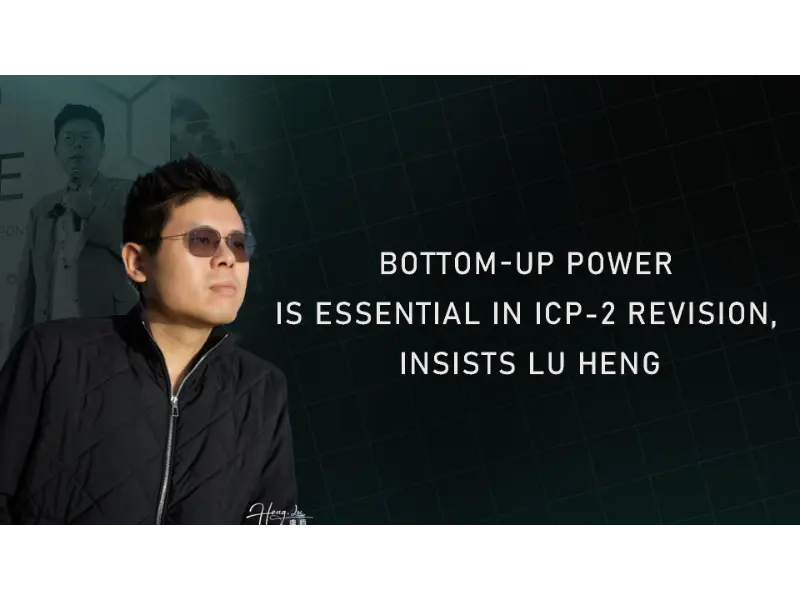
- Lu Heng argues that the revision of the Internet Coordination Policy-2 (ICP-2) must preserve the bottom-up governance model of Regional Internet Registries (RIRs).
- He warns that any attempt to centralise authority over failure standards or derecognition jeopardises accountability and member autonomy.
“The revival of ICP-2 was triggered by the AFRINIC governance crisis—and rightly so. What is not acceptable is using that process to further centralise power. Any mechanism to de-accredit or re-accredit an RIR must be driven exclusively by its members, not by the NRO or ICANN… Accountability must come from decentralisation, not hierarchy.”
——Lu Heng, CEO at Cloud Innovation, CEO at LARUS Ltd, Founder of LARUS Foundation.
Why ICP-2 Revision Matters for Internet Governance
The Internet Coordination Policy-2 (ICP-2) is a foundational document that defines criteria for recognising, maintaining and potentially derecognising Regional Internet Registries (RIRs) — the bodies that administer critical number resources such as IP addresses and autonomous system numbers on a regional basis. The current revision effort, prompted by governance failures at AFRINIC and carried out through broad community consultation, has expanded the scope of ICP-2 to cover the full lifecycle of RIRs, including operational obligations and failure standards.
Lu Heng, CEO of LARUS Limited and founder of the LARUS Foundation, emphasises that while establishing failure criteria is necessary, the process must not become a means to centralise decision-making authority. He highlights that RIRs were built on voluntary participation and a bottom-up, community-driven approach. Because the RIR system is not backed by sovereign law or enforcement, any attempt to impose top-down control could lead members to withdraw recognition — undermining the very stability the revision aims to safeguard.
Also Read: Data sovereignty’s practical reality: Why law matters more than localisation
Bottom-up governance and accountability
For Heng, preserving bottom-up governance ensures that RIR members retain control over decisions that affect their operations and resources. He argues that failure standards and mechanisms for derecognition should be designed so that decisive actions require overwhelming agreement from member communities, rather than being dictated by external entities such as the Number Resource Organization (NRO) or ICANN. This approach, he suggests, aligns with the established multistakeholder model that underpins the global Internet number registry system.
Heng also encourages active participation by all RIR community members in feedback and consultation processes. Without strong engagement, he warns, the revision could be shaped by those not directly affected by registry governance, weakening decentralised control and accountability in practice.
Also Read: Breaking the centralised choke point: Why IP addresses must be decentralised
Reinforcing the internet’s decentralised foundations
The ongoing ICP-2 revision underscores a broader trend in Internet governance: balancing resilience and accountability while avoiding unwarranted centralisation. By advocating for bottom-up power and member-driven standards, Heng frames the debate not only as a technical or procedural issue but as a defence of the principles that have sustained the Internet’s growth for decades.