Summary
- Bharath Cloud should be evaluated through an accepted Indian workload record: a server, storage path, backup schedule, access model, recovery plan and support route that can be checked repeatedly, not simply through broad cloud adoption language.
- Public evidence supports the identity boundary around BCDC CLOUD Centers Private Limited, the Bharath Cloud brand, a Hyderabad registered address, cloud and managed infrastructure service pages, a public ASN record and public customer-facing claims. It does not independently prove capacity, uptime, restore success, benchmark performance, customer economics or the details of private deployments.
- The company's strongest public case is local support plus local infrastructure control for Indian organisations that want guided cloud migration, backup, disaster recovery and managed service help without building everything in-house.
- The risk is not that the service menu is empty. The risk is that a buyer treats a menu as an operating record. Provisioning mismatch, storage incident, backup restore miss, access drift, billing dispute, monitoring blind spot, support delay, capacity constraint and migration rollback failure are the tests that decide whether the service creates value.
The accepted workload is the real product
Bharath Cloud's public presentation is broad. The site offers public cloud, private cloud, community cloud, hybrid cloud, multi-cloud, managed services, cloud migration, cloud hosting, a customer control panel, backup and recovery, disaster recovery, monitoring, SOC services, ITSM, VDI and object storage under the Bharath Big Bucket name. That breadth can be attractive to Indian SMEs, developers, hospitals, professional firms and enterprise infrastructure teams that do not want to assemble every piece of a local cloud operating model themselves.
The accepted workload is narrower and more demanding. It is not a phrase such as cloud journey, digital transformation or sovereign cloud. It is a workload that a business can actually sign off. A server request must become a running compute instance or hosted environment with the right operating system, network access, firewall posture, user permissions and monitoring. A storage request must become a known data path with capacity, retention, cost and recovery behavior understood. A backup request must become a restore that has been drilled, not just a schedule that looks reassuring.
A support request must become a case with ownership, diagnostic evidence and resolution history. A billing request must become a cost model that a finance team can forecast.
This distinction matters because Bharath Cloud's public evidence is stronger on service categories than on independently verified operating results. The legal and registry trail is real: BCDC CLOUD Centers Private Limited appears in company-information records, LEI records, GST records and APNIC-related network records. The website and related public pages describe services in detail. The network record shows AS152686 associated with BCDC CLOUD Centers Private Limited and connected upstream through CtrlS and Yotta Network Services in public routing views. Those facts establish a service surface and a technical footprint.
They do not, by themselves, prove that a buyer's application will be provisioned correctly, recover within a promised window, meet a latency target, or cost less than a hyperscale, unmanaged VPS or owned-server substitute.
The central question is therefore operational. Can Bharath Cloud keep compute, storage, access, network and recovery state coherent enough for repeated Indian workloads? The answer is likely to vary by buyer maturity. A small firm with weak infrastructure discipline may value a local team that can assess, design, deploy and support the move. A technical platform team may value locality and support only if the control plane, documentation, logs, recovery evidence and cost behavior are explicit.
A regulated or sensitive user may require stronger evidence than public pages provide, including contract terms, audit reports, physical hosting details, access logs, backup test reports and escalation records.
That is the lens for the company. Bharath Cloud is not being tested by whether it can describe cloud. It is being tested by whether it can make a workload accepted and keep it accepted after change, incident and renewal.
What the public record actually establishes
The identity boundary is important because Bharath Cloud is a brand-like service surface, while BCDC CLOUD Centers Private Limited is the legal entity that appears in public records. The public website uses the Bharath Cloud name and describes BCDC Cloud Centres Private Limited in its about material. Company-information sources identify BCDC CLOUD Centers Private Limited as an Indian private limited company incorporated in October 2021 and registered in Hyderabad, Telangana.
Bloomberg's LEI record lists the legal name, the Hyderabad address, Ministry of Corporate Affairs registration authority details, the CIN U72200TG2021PTC155718 and an active entity status. Other company-data pages repeat the legal identity and registered address, though they vary slightly on paid-up capital and the latest filing details.
That divergence is a caution. Public corporate-data aggregators can lag, format addresses differently, place some financial details behind paid reports, or show figures updated at different moments. The useful conclusion is not a precise private-company financial model. It is that the entity exists, is tied to the Hyderabad address, and is connected in public sources to the Bharath Cloud service surface. The article should not infer revenue scale, profitability, customer count, staff depth or credit strength beyond what can be directly supported.
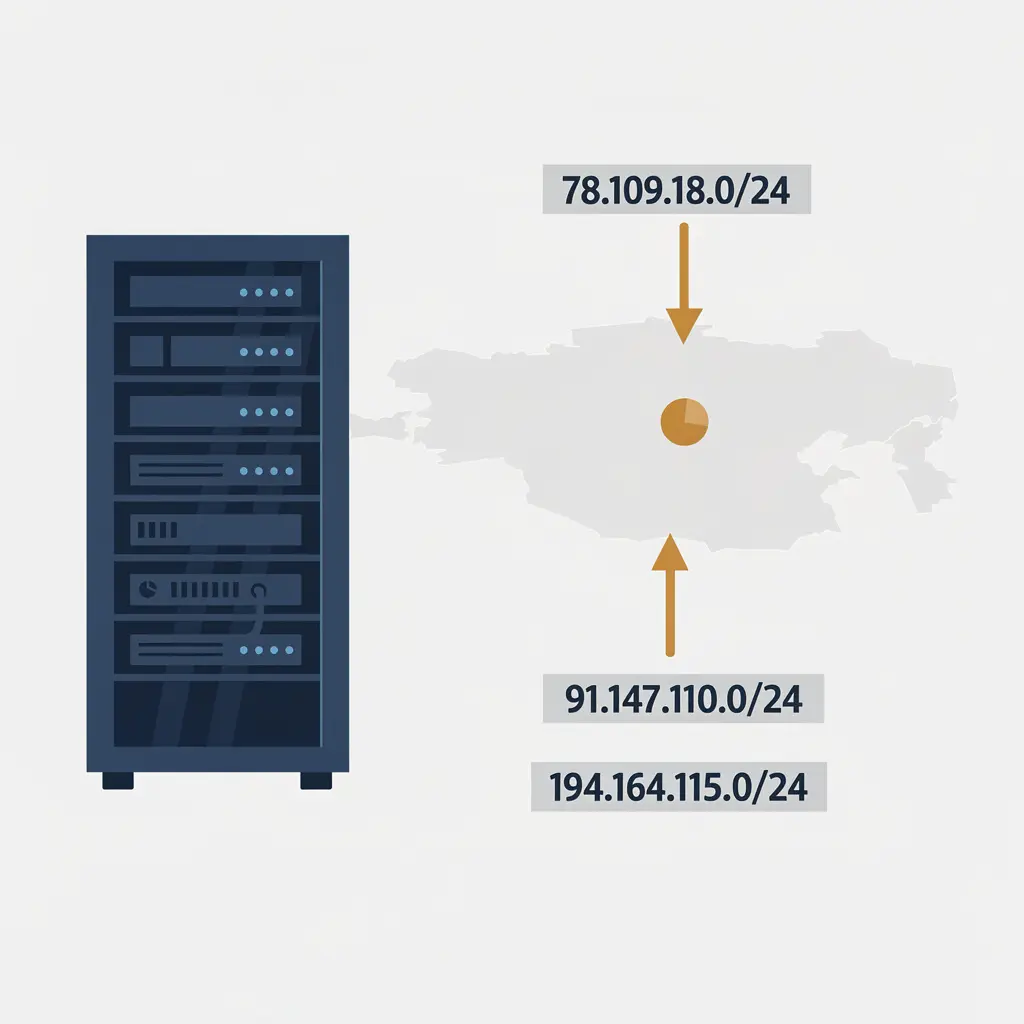
The network record gives a second kind of evidence. Public routing sources show AS152686, named BCDC CLOUD CENTERS PRIVATE LIMITED or BCDC CLOUD Centers Private Limited. BGP tools list six originated IPv4 prefixes and no IPv6 prefixes for that ASN, with upstreams shown as CtrlS and Yotta Network Services. CIDR Report and APNIC-derived whois information show the same ASN name, the APNIC source, the organisation object, contact roles and the Hyderabad address. This is meaningful because a cloud or hosting provider's operating surface is not only a website.
It is also routing, IP address management, upstream transit, abuse contact handling and network accountability.
Even here, the evidence has limits. A small ASN and a set of routed prefixes can support hosting activity, but they do not prove the size of a data center estate, the physical location of every server, the redundancy design, the real traffic mix, the customer workloads behind the addresses, or the success of incident response. Public routing also shows dependency: if the network reaches the internet through upstream carriers, service quality partly depends on those upstreams, routing policy, maintenance and peering choices outside the customer's direct control.
The website establishes a service menu. Public cloud pages mention compute infrastructure, a website portal, CPU, SSD and RAM, private VLAN language, multi-location operation and support. Private cloud pages talk about hypervisor choice, migration of mission-critical instances, security procedures, network optimization, managed services under a single SLA and customer-centric ITIL design. Managed services pages describe help desk tickets, emails, phone calls and social-media channels. Backup, disaster recovery and cloud insurance pages describe snapshot backups, drill restorations, repositories, RTO/RPO planning and restore objectives.
Monitoring pages describe health checks, CPU, disk, memory and network bandwidth tracking. A customer control panel page describes a self-service portal, virtual appliances, ticketing, payments, bandwidth management and metering.
Those pages are enough to define the questions a buyer should ask. They are not enough to answer them fully. Public service copy can describe intent, architecture categories and support promises. The accepted workload needs evidence that the stated process survives real provisioning, restore, access control, monitoring and support events.
Provisioning truth beats cloud-journey language
Cloud migration fails most often at the boundary between plan and state. A customer describes an application, database, file share, website, ERP instance, accounting system, hospital record system or internal service. The provider turns that description into compute, storage, networking, security, backup and support settings. If the state that is created does not match the business need, the workload is not accepted even if the deployment appears complete.
Bharath Cloud's public cloud and migration pages frame a discover, design, deploy, deliver and development process. The migration page specifically lists infrastructure assessment, application and service inventory, dependency mapping, risk and recommendation planning, policy definition, configuration sizing, solution outlining, customized design, blueprint submission and pricing with compliance considerations. That is the right shape for a managed local cloud motion. It recognizes that a workload is not only a virtual machine. It has dependencies, owners, access paths, recovery needs and cost expectations.
The buyer should convert that shape into evidence. A credible provisioning record should show the initial workload inventory, the agreed target architecture, the instance or hosting plan, network layout, firewall rules, identity assignments, backup schedule, monitoring thresholds and acceptance test. It should also show which parts are managed by Bharath Cloud, which remain with the customer, and which depend on third parties. Without that record, there is no clean way to tell whether a later failure is a provider issue, a customer configuration issue, an application issue, a data issue or a misunderstanding from the migration phase.
Repeated task behavior is the second test. A one-time migration can be rescued by attention. A useful cloud service must repeat. Can the customer provision the same kind of environment again? Can the support team handle a routine resize, user change, firewall change, backup exception, certificate renewal, operating-system patch or monitoring alert without rebuilding institutional memory each time? Can the same evidence be produced when a different staff member handles the account?
This is where the customer control panel matters. If the portal can create and manage virtual machines, operating systems, virtual appliances, tickets, payment routes, bandwidth metering and account state, it becomes the customer's daily control surface. A good portal reduces dependence on informal support messages. It should give users enough visibility to understand what exists, what is billed, what is exposed to the network, what is backed up and what is waiting on support. If it is weak, the managed service becomes labour-heavy: the customer must ask a person to check state, and the provider must interpret every change manually.
There is no public account-level demonstration in the evidence. That is an unresolved gap. A buyer should ask for a live walkthrough using the exact service family under consideration, not a generic slide. For a server workload, the walkthrough should create the environment, assign access, confirm network reachability, show backup policy, trigger a monitoring view and show the ticket path. For a managed migration, it should show the project record from discovery to acceptance. For a regulated workload, it should show audit and access evidence. Provisioning truth is not the claim that Bharath Cloud can migrate workloads.
It is the record that a specific workload arrived in the agreed state.
Storage and recovery decide whether the cloud is trusted
Backup language is prominent in Bharath Cloud's public materials. The homepage emphasizes backup as one reason to choose the service. The backup and recovery page describes online backup, accidental deletion, corrupted file and disk failure recovery, a 10G LAN backup architecture, centralized backup repository access, schedules by hour, day, week and month, drill restorations based on the customer's business model, and protection for files, folders, logs, databases, emails, virtual machines and hypervisors.
The disaster recovery page describes pay-per-use recovery, RTO and RPO planning, alternate sites or cloud resources and automation of recovery steps. The cloud insurance page describes a last-24-hours snapshot for virtual devices and unexpected data-loss recovery.
That is exactly where the accepted workload must be strict. Backup claims are only useful if they map to a restore contract. A customer needs to know what is backed up, how often, where it is stored, how long it is kept, who can delete it, whether it is isolated from the primary account, whether ransomware can encrypt it, how it is monitored, what restore granularity is available, who initiates recovery, how long a typical restore takes, and how often the restore is tested. Public pages describe the idea of backup, but they do not publish a universal guarantee that would answer all of those questions for every service type.
The stronger interpretation is that Bharath Cloud recognizes backup and recovery as part of its managed value. The weaker interpretation would be to assume that every workload has zero data loss or minute-level restoration in every circumstance. That assumption would be unsafe. Public cloud buyers have learned this repeatedly across providers: snapshots are not the same as backups, backups are not the same as tested restores, tested restores are not the same as complete business continuity, and a recovery objective in a proposal is not the same as a measured restore under pressure.
For a small Indian firm, the practical advantage may still be meaningful. A chartered-accountancy office, clinic, school, distributor or regional manufacturer may not have the staff to design backup policies, replicate data, monitor jobs and test restoration. A local managed provider can create value by making these routines visible and owned. But the customer should require evidence in plain form: the last successful backup time, the next scheduled backup, the storage location, the retention policy, the restore test date, the restore result, the person responsible and the escalation path if the job fails.
Recovery also intersects with storage architecture. A web server, database, file store, email archive, virtual desktop and object bucket have different restore behaviors. A database may need point-in-time recovery or transaction consistency. A file share may need version-level recovery. A VM may need image-level restoration. A critical voice or emergency-response system may require failover and network rerouting, not just a restored disk. The public service menu covers several of these categories, but a buyer should not let category names blur the difference.
The safest conclusion is that storage and recovery are Bharath Cloud's most important proof points. If the company can show repeatable restore evidence, clear retention and accountable recovery ownership, it can justify local managed cloud substitution for customers without deep cloud teams. If it cannot show that evidence, the service becomes only hosted infrastructure with comforting backup language.
Locality is a deployment condition, not a magic word
Indian cloud buying is increasingly shaped by locality. Data protection rules, financial-sector outsourcing expectations, CERT-In directions, government cloud procurement standards, latency-sensitive services and AI infrastructure investment all push buyers to ask where data is stored, where processing occurs, which jurisdiction applies, who can access systems and which provider controls the physical and network layers. Bharath Cloud's appeal sits inside that shift.
Locality, however, should be treated as a deployment condition. It is not enough to say that a provider is Indian or that a service is local. A customer needs to know which data center or region hosts the workload, whether backups are in the same city or another Indian location, whether support staff can access data, whether any management tools or subcontractors sit outside India, whether logs are retained in India, whether cloud control-plane data leaves the jurisdiction, and whether contract terms give the customer audit and exit rights.
This matters in regulated environments. RBI's IT outsourcing directions make regulated entities responsible for confidentiality and integrity of customer data available to service providers, require appropriate access controls, and expect audit and information rights over service providers and their subcontractors. CERT-In directions impose log retention and incident-reporting expectations across service providers, data centers and organisations. The DPDP Act and related rules push organisations toward clearer personal-data handling, breach notification and accountability.
MeitY cloud procurement materials frame how government buyers think about empanelment, deployment models, compliance and infrastructure requirements.
These rules do not automatically make Bharath Cloud suitable or unsuitable for any particular regulated buyer. They set the questions. For a bank, NBFC, hospital, public-service contractor or professional firm handling sensitive personal data, the provider's locality claim must be documented. Public website language about security, compliance and Indian cloud is a start, not a final answer.
The same distinction applies to performance. Local hosting may reduce latency for Indian users compared with distant infrastructure, but only if the workload, DNS, routing, CDN behavior, application design and upstream network path align. Public routing evidence shows BCDC's ASN and upstream carriers, but it does not provide measured latency for a customer workload. A buyer should test from the cities and networks that matter to its users: Hyderabad, Mumbai, Delhi NCR, Bengaluru, Chennai, Kolkata or smaller regional markets depending on the customer base.
Locality is therefore both an opportunity and a duty. It can make Bharath Cloud more relevant than a distant unmanaged VPS for some Indian workloads. It can also raise the evidence burden because locality-sensitive buyers often care most about logs, access, audit, data movement and incident records. The promise is not local cloud in the abstract. The promise is a workload whose data location, support access and recovery route can be stated and checked.
Account control is where managed service becomes either useful or expensive
Managed cloud support can reduce labour. It can also hide labour until a change or incident exposes it. Bharath Cloud's managed services page emphasizes 24/7 support through help desk tickets, emails, phone calls and social media, as well as customized services based on the customer's IT service catalogue. The customer control panel page emphasizes a self-service portal, operating-system creation, virtual appliances, help desk support, multiple payment methods, bandwidth management, metering and VM management. The monitoring page emphasizes dashboards, alerts and infrastructure health checks.
Those are the right components, but their value depends on account control. A customer should know who can create a server, who can delete it, who can change a firewall rule, who can reset access, who can view backups, who can open a support ticket, who can approve a cost-bearing change and who can see usage data. In small firms, these roles may be informal. That informality is a risk. Access drift happens when old employees, vendors or shared administrator accounts retain rights. Billing disputes happen when no one can reconstruct who ordered extra capacity.
Support delays happen when the wrong person reports an issue without diagnostic detail or authority to approve a fix.
The public evidence does not show Bharath Cloud's full identity and access model. It mentions security, authentication, audit and compliance, but it does not publish a detailed role-based access-control design for customers. That is not unusual for a provider website, but it is a key buyer diligence point. The more Bharath Cloud sells managed infrastructure to customers without cloud specialists, the more it must compensate for weak customer-side process.
A good managed service record should include an access register, named technical contacts, named billing contacts, escalation contacts, change approval rules, ticket categories, severity definitions, response targets, backup approval rules and offboarding steps. It should also separate emergency access from routine access. If a Bharath Cloud engineer needs to enter a customer environment during an incident, the customer should know how that access is approved, logged and revoked.
The labour impact is not simply staff reduction. A provider like Bharath Cloud can shift work from a customer's generalist IT staff to provider specialists. That can be positive if the provider has repeatable playbooks and if the customer gains visibility. It can be negative if the customer loses system knowledge and becomes dependent on informal support. The strongest commercial case is shared ownership: Bharath Cloud handles infrastructure routines, while the customer retains enough control and evidence to audit state, approve changes and leave if needed.
This is where local support can beat unmanaged VPS alternatives. A cheap unmanaged server may give root access and a low monthly bill, but it leaves the customer responsible for patching, monitoring, backups, security and recovery. A local managed provider can absorb that work. The buyer still has to price the supervision cost. If every change requires a call, if the portal is incomplete, if tickets lack clear status, or if billing is difficult to reconcile, managed support becomes expensive in time even when the invoice looks reasonable.
The network record shows footprint and dependency
The public ASN evidence is one of the most concrete pieces of the Bharath Cloud record. AS152686 is associated with BCDC CLOUD Centers Private Limited. Public routing views show originated IPv4 prefixes and upstream connectivity through CtrlS and Yotta Network Services. APNIC-derived records show organisation and abuse contact objects tied to the Hyderabad address and Bharath Cloud contact details. This gives the company a visible network identity rather than only a marketing site.
For a hosting and cloud provider, that matters. Network identity affects abuse handling, route visibility, IP reputation, transit dependency, troubleshooting and customer expectations. If a customer hosts applications, email, remote desktops, APIs or emergency workflows, routing is part of the service. A provider with its own ASN can originate address space, maintain abuse contacts and shape its network relationships. That does not mean it owns every physical facility or network element, but it does mean there is a public accountability point.
The dependency side is just as important. Public records show upstream carriers. That means availability and performance can depend on transit providers, data center interconnects, routing policy and maintenance events outside the direct application stack. A customer should ask how many upstreams are active for the relevant service, whether routes are redundant at the site level, how DDoS mitigation works, how IP reputation is handled, how routing incidents are communicated and whether the customer receives packet-loss or latency evidence during disputes.
The record also shows no IPv6-originated range in the public BGP tools view. For many Indian SME workloads, IPv4 may still be enough. For modern cloud architecture, IPv6 support increasingly matters for future-proofing, dual-stack applications, public-sector expectations and network simplification. The absence of visible IPv6 origination in the public view should not be overread as a permanent product limit, but it is a question for technical diligence.
Network evidence should feed acceptance testing. A customer moving to Bharath Cloud should test from the networks its users actually use. A healthcare customer should test from hospital branches and remote doctors. A professional-services firm should test from office broadband and home networks. A public-facing application should test from mobile carriers and major Indian metros. A latency-sensitive workload should test during peak and maintenance windows. If the workload depends on emergency calling, payment workflows or live customer access, generic uptime language is not enough.
The technical point is simple: cloud is not only compute. It is also address space, DNS, routing, transit, security controls, monitoring and incident communication. Bharath Cloud's public network identity strengthens its seriousness as a local infrastructure provider. It also creates a checklist of dependencies that buyers should make explicit before acceptance.
Unit economics depend on supervision, not only price
Bharath Cloud's public materials repeatedly emphasize affordability, lower capital expenditure, monthly operating expense, predictable billing and reduced infrastructure cost. That is a plausible local-cloud proposition. Many Indian businesses do not want to own servers, manage power, maintain backup appliances, renew security tools, staff after-hours support, or absorb hardware refresh risk. A provider that packages compute, storage, backup, monitoring and support can convert scattered capital and labour into a clearer service cost.
But unit economics in cloud are rarely just the quoted monthly amount. The true unit is the accepted workload over time. It includes infrastructure charges, storage growth, backup retention, restore drills, bandwidth, security add-ons, support time, migration labour, customer-side supervision, downtime risk, exit cost and contract renewal. Bharath Cloud can beat owned servers for a customer that would otherwise under-maintain hardware and backups. It may beat hyperscale cloud for a customer that values local support and does not need a vast catalogue of advanced services.
It may beat unmanaged VPS for a customer that lacks staff to run the server safely. It may lose to any of those substitutes if the workload needs global scale, specialized managed databases, deep automation APIs, independent compliance attestations, published service-level structures, or very low-cost self-managed infrastructure.
The buyer should model four substitutes. The first is owned infrastructure: servers in an office or local colocation, backed by in-house or contractor support. This offers control but often hides power, cooling, spare parts, backup and staff costs. The second is unmanaged VPS or commodity hosting. This offers low price and fast provisioning but leaves operations to the customer. The third is hyperscale cloud. This offers mature control planes and global services but can bring complexity, foreign-jurisdiction concerns, support tiers and unpredictable spend. The fourth is a local managed cloud such as Bharath Cloud.
This offers guidance and locality, but creates provider-dependence and needs evidence for capacity, restore and support quality.
Bharath Cloud's best economic fit is likely where infrastructure labour is the bottleneck. A small hospital, CA firm, distributor, school or regional business may not need hundreds of cloud services. It needs a safe server, accessible records, backups that restore, predictable support and someone accountable. For that buyer, the value is not raw compute per rupee. It is reduced failure anxiety and fewer unmanaged tasks.
For a technical startup or enterprise IT team, the economic test is sharper. They may already have automation, monitoring and cloud skills. For them, Bharath Cloud must prove control-plane quality, API maturity, capacity, transparent billing, network performance, support escalation and recovery evidence. Locality and support are useful only if they reduce operational drag. If engineers must compensate for missing automation or unclear documentation, the local-cloud discount can disappear.
Customer evidence is useful but should not be over-read
Bharath Cloud's homepage presents testimonials attributed to professional-services and healthcare users, including accounting and hospital contexts, and refers to Telangana Ambulance 108 Services in a testimonial attributed to GVK EMRI. A related public subdomain and a corporate deck hosted on Scribd present case-study narratives around GVK EMRI and Medha Servo Drives, including migration, scalability, monitoring, disaster recovery and analytics language. LinkedIn and software marketplace profiles also reinforce the company's public positioning as an Indian cloud and managed infrastructure provider.
This is market evidence, not independent performance proof. It shows the kinds of customers and use cases Bharath Cloud wants to be associated with: professional firms, hospitals, emergency services, manufacturing or IoT, and organisations seeking local cloud support. It does not give enough independent detail to verify uptime, benchmark performance, incident history, recovery times, contract terms, or exact architecture. The article should therefore use those public claims carefully.
The customer pattern still matters. The named examples are not random. Accounting firms care about financial data, access control and backup. Hospitals care about patient records, continuity and security. Emergency-response systems care about locality, latency, resilience and support availability. Manufacturing IoT cares about device data, analytics, storage and continuity. These are precisely the workloads where a local cloud provider is tested by accepted operating state, not by abstract cloud capacity.
If Bharath Cloud has performed well in those settings, the strongest evidence would be measurable and specific: migration scope, before-and-after architecture, downtime during migration, restore test results, monitoring dashboards, ticket volume, incident outcomes, user counts, data volume, performance targets and customer-side signoff. Public promotional pages rarely include that level of detail. A buyer should request it privately, under confidentiality if needed.
The risk is testimonial substitution. A customer quote can make a provider feel proven even when the buyer's workload is different. A CA firm's hosted application does not prove a hospital system. A hospital record workflow does not prove an emergency-response call platform. An IoT case study does not prove a database restore. Each workload has its own failure modes. Bharath Cloud's market evidence should open the diligence conversation, not end it.
For BTW's lens, the customer record is most useful because it points to the operating surface: local support, migration help, backup, recovery and managed monitoring. It is least useful when it becomes generic praise. The buyer should ask, "Which accepted workload is closest to mine, and what evidence exists that it kept working after the migration?"
Failure modes define the buying checklist
The known failure modes for a local cloud and managed infrastructure provider are practical. They are not exotic. Provisioning mismatch is first: the customer receives a server, network or storage configuration that differs from what the application requires. This can happen through misunderstood dependencies, wrong sizing, missing ports, incompatible OS images, insufficient storage, or firewall rules that block legitimate traffic. The prevention is a signed workload inventory and acceptance test.
Storage incident is second. A disk fills, a volume performs poorly, a file share is misconfigured, a snapshot does not cover the right data, or an object store behaves differently from the application's assumptions. The prevention is storage mapping, monitoring thresholds, retention definitions and restore drills.
Backup restore miss is third. Backups may exist but fail to restore the needed state. The cause can be corrupted backups, application inconsistency, missing databases, credentials not captured, insufficient retention, or a restore process that no one has rehearsed. The prevention is scheduled restore testing with documented results.
Access drift is fourth. Users, administrators, vendors and provider staff accumulate rights over time. Shared accounts spread. Departed staff retain credentials. Emergency changes become permanent. The prevention is role definition, access review, offboarding and logging.
Billing dispute is fifth. The customer expected a fixed cost but receives charges for bandwidth, storage growth, extra services, support scope, restore work or unused resources. The prevention is transparent metering, monthly usage review, approval rules and a clear destroy or downgrade process for unused capacity.
Monitoring blind spot is sixth. The provider watches infrastructure health but not application health. Or the customer watches the application but not storage, backup jobs or network paths. The prevention is shared monitoring scope and alert ownership. A dashboard is not enough unless alerts have owners and actions.
Support delay is seventh. Local support is valuable only if the right person gets the right diagnostic information and authority quickly. If support starts by rediscovering the environment, delay grows. The prevention is an account runbook, severity definitions and escalation rules.
Capacity constraint is eighth. A provider can have a service category but not enough immediate capacity for a specific workload, location or performance need. The prevention is capacity reservation or at least a preflight check before migration.
Migration rollback failure is ninth. A move begins, problems appear, and the customer cannot cleanly return to the old environment. The prevention is a rollback plan, data freeze rules, cutover criteria and clear decision points.
These failure modes are not accusations. They are the buying checklist for any provider in Bharath Cloud's category. A provider that can answer them clearly is selling an operating model. A provider that cannot is selling hope with servers attached.
What would make the case stronger
Bharath Cloud's public evidence would be stronger with more precise operating documentation. The company does not need to reveal private customer systems to improve trust. It could publish standard service descriptions with clearer boundaries: what is included in public cloud, private cloud, managed services, backup, disaster recovery, monitoring and customer control panel; what is self-service; what is provider-managed; what is billable; what is excluded; and what evidence the customer receives each month.
Backup and disaster recovery would benefit most from specificity. Public pages could define example retention policies, restore-test cadence, customer responsibilities, backup coverage by resource type, recovery request process, and the difference between snapshots, backups and full disaster recovery. The current public language is broad enough to interest buyers, but buyers with real risk need more.
Network and locality documentation would also help. A published network page could explain ASN use, upstream redundancy, data center locations at the level the company is comfortable disclosing, IPv6 support plans, DDoS handling, abuse process, maintenance communication and latency-testing guidance. It could avoid exaggerated claims while giving technical buyers enough to plan.
The customer control panel could be documented with screenshots or a public guide. Buyers need to know whether they can see resources, usage, tickets, backup state, alerts, access roles and invoices. A managed provider can differentiate itself by making state visible, not by hiding it behind support.
Case studies could become evidence-led without exposing secrets. A useful case study does not need to name every server. It can describe the workload class, initial problem, migration scope, recovery objective, monitoring scope, support model, acceptance criteria and lessons learned. It can state what was not measured. This is better than general improvement claims because it teaches buyers how the provider works.
Finally, Bharath Cloud could publish clearer compliance and audit material. The homepage shows certification imagery and the public pages mention security and compliance, but serious buyers will want certificate scope, validity, audited entity, service coverage and data-location boundaries. A certificate badge without scope can mislead. A scoped compliance page can reduce unnecessary sales friction.
These improvements would not change the basic thesis. Bharath Cloud is already visible enough to be considered a real local provider with legal, web, service and network evidence. The question is how much of the operating record can be inspected before a buyer commits.
The bottom line
Bharath Cloud's value is not best understood as a generic cloud-provider profile. It is a local operating proposition for Indian workloads that need migration help, hosted compute, backup, recovery, monitoring, account control and support ownership. The company's public record establishes a legal entity, a service brand, a Hyderabad base, a substantial service menu, a public ASN and public customer-facing claims. That is enough to take the company seriously. It is not enough to treat every uptime, recovery, cost, locality or customer-outcome claim as independently proven.
The strongest buyer fit is an organisation that wants local cloud substitution with guided operations: a professional firm securing records, a healthcare provider moving systems off weak local servers, an SME needing predictable backup and support, or an infrastructure team that values Indian locality and direct provider attention. The weakest fit is a buyer that needs hyperscale breadth, published global service data, advanced managed services, deep self-service automation, independently benchmarked performance or fully transparent public compliance evidence before engagement.
The decision should be made through an accepted workload record. Before committing, the buyer should ask Bharath Cloud to demonstrate provisioning, access control, monitoring, backup, restore, ticketing, billing and escalation for a workload that resembles the real one. During migration, both sides should record the state that was accepted. After migration, they should keep proving it through restore drills, access reviews, usage checks and incident records.
If Bharath Cloud can make those records routine, its local support and locality position can beat unmanaged VPS, neglected owned servers and some hyperscale complexity for the right Indian customers. If the records are missing, the buyer is left with the same old cloud problem in local clothing: capacity and responsibility are promised, but the operating truth is discovered only when something breaks.