
Summary
- Basuki Suhardiman's public record connects him to ITB's campus-network and computing infrastructure, APNIC records for BANDUNG-NET and INHERENT, IDREN/INHERENT research-network discussions, e-science and high-performance-computing activity, PANDI membership and ISOC Jakarta community governance.
- The stronger story is not that one person built or controlled Indonesia's academic internet. It is that one named operator's trace helps show how university systems, research networks, regional technical forums and .id governance overlapped across Bandung, Jakarta and the Asia-Pacific internet community.
- The important boundary is attribution. Registry contacts, university leadership listings, conference presentations and member pages are evidence of role, proximity and participation; they do not prove personal control over ITB, PANDI, IDREN, INHERENT, APAN, TEIN or Indonesia's domain-name system.
The profile begins with an attribution problem
Basuki Suhardiman is a useful subject precisely because the public record around him does not form a neat corporate biography. There is no single company page that explains his role from beginning to end.
Instead, his name appears across a set of infrastructure surfaces: APNIC routing records for BANDUNG-NET and INHERENT, ITB news and annual reporting around university information systems, conference material on Indonesian research networking and e-science, PANDI membership and governance material, a ResearchGate profile tied to Bandung Institute of Technology, a DataTempo photo lead, and an ISOC Jakarta page listing him in supervisory-board context. The fragments are not weak because they are scattered. They are revealing because the systems they describe are scattered by design.
Academic internet infrastructure rarely has one owner. A campus network depends on university budgets, directors, engineers, upstream links, autonomous-system registration, address resources, security habits and local users. A national research-and-education network depends on universities, public institutions, regional collaborations and continuity across funding cycles. A country-code domain registry depends on members, policies, registrars, administrators, legal rules and community trust. A person can be important inside those systems without being the system. That is the first rule for reading Suhardiman's public record.
The public record supports a careful profile of an infrastructure steward rather than a singular builder. APNIC records place Basuki Suhardiman as a person contact in the AS4796 BANDUNG-NET-AS-AP record and in the AS18007 INHERENT-AS-ID-AP record. ITB material identifies him in Head of USDI ITB contexts in 2010 and 2015, and the university's 2015 information-systems and technology directorate report lists him in a deputy-director leadership structure. TEIN and Asi@Connect material names him as presenter for Indonesia IDREN/INHERENT updates. ASGC and APAN material connects him to e-science and Asia-Pacific research-network discussions.
PANDI material lists him among members and in academic-representation context, while older media coverage places him in a 2011 to 2014 supervisory-board setting. ISOC Jakarta adds another internet-governance community listing.
Those facts are strong enough to matter. They are not strong enough to justify a personality profile, a private motive story or a claim that Suhardiman personally directed Indonesia's academic networking outcomes. The article therefore treats him as a lens. Through his public trace, readers can see how Indonesian academic networking developed through campus operations, number-resource evidence, research-infrastructure forums and domain-name institutions. The value of the profile is the overlap. His name appears at points where the technical and institutional layers meet.
That makes the article different from a general Indonesia connectivity piece. Indonesia's internet history includes state policy, commercial operators, local internet-service providers, community networks, exchange points, mobile networks, cloud infrastructure, submarine cables and many other actors. Suhardiman's record sits in a narrower lane: Bandung-based academic infrastructure and the governance institutions that helped make research and education connectivity durable. The story is not national connectivity as a whole. It is the institutional memory behind a slice of that connectivity.
Bandung is not background scenery
The Bandung element matters because ITB is not just an affiliation line in this record. Bandung Institute of Technology appears repeatedly in the public material that ties Suhardiman to network and computing infrastructure. APNIC identifies AS4796 BANDUNG-NET-AS-AP as Institute of Technology Bandung. ITB's own news coverage identifies him in university information-resource and high-performance-computing contexts. The university's 2015 directorate report places him inside the formal structure for information systems and technology.
ResearchGate links the same name to Bandung Institute of Technology and research activity around computer engineering, e-science, grid computing and high-performance or distributed computing.
For internet-infrastructure readers, a campus is not a small stage. Universities are often where networks become operational before they become nationally legible. They have laboratories, researchers, students, administrative systems, cross-border collaborations, grant requirements and the practical need to move data among institutions. A campus network can be a local service, a research tool, a training ground and a node in regional infrastructure at the same time. That is especially true when the university is connected to a research-and-education network and to technical forums beyond its own city.
The public record does not say that Suhardiman alone ran ITB's network. It does say that his name appears in formal and technical places where the university's network and computing work became visible. That is enough for a profile about stewardship. A named contact in a routing record is not a chief architect credit. A directorate role is not proof of every operational decision. A conference presentation is not ownership of the network it describes.
But taken together, those records show that Suhardiman belonged to the working layer where academic networking had to be described, maintained, represented and connected to outside communities.
That distinction matters because Bandung can be misread as merely local. In this record, Bandung is a hub for a wider operating problem: how Indonesian higher education connects itself to national and regional infrastructure. BANDUNG-NET gives the campus-network layer. INHERENT and IDREN give the research-and-education network layer. TEIN, Asi@Connect and APAN give the Asia-Pacific collaboration layer. PANDI gives the domain-governance layer. ISOC Jakarta gives community-governance context. The same public name recurring across those surfaces does not collapse them into one institution.
It shows that the boundaries between them had human bridges.
The best reading is therefore geographic without being parochial. Suhardiman's public record starts in a Bandung university context, but its meaning is regional. It points from ITB outward to national research networking, regional meetings and domain-name governance. The subject is not Bandung as a place of biography. It is Bandung as an operating base for academic internet continuity.
Registry records show contact, not command
The APNIC records are among the most concrete parts of the public trail. AS4796 BANDUNG-NET-AS-AP ties the autonomous system to Institute of Technology Bandung and includes Basuki Suhardiman as a person contact connected to ITB.NET and PT Jala Widya Caraka. AS18007 INHERENT-AS-ID-AP describes the Indonesia Higher Education Network and also lists him as a person contact. These are not decorative references. Autonomous-system records are part of the machinery by which networks become accountable to the wider internet.
They tell other operators who is associated with a resource, how the resource is described and where operational responsibility can be traced.
They also have to be read with restraint. A person contact in a registry record is not the same as personal ownership of the network. It does not prove who designed the topology, who configured each router, who paid for connectivity, who negotiated every link or who made final policy decisions. Contact data is an accountability surface. It provides evidence that the named person was publicly associated with the network resource in an operational or administrative capacity. It should not be inflated into a command claim.
For Suhardiman, that boundary makes the evidence more useful, not less. Sofia Ren people coverage is interested in how public infrastructure becomes legible. Registry records are one of the places where invisible work leaves a durable trace. They are often dry, partial and full of abbreviations, but they are closer to operating reality than publicity language. When a name appears in records for both BANDUNG-NET and INHERENT, the significance is not celebrity. It is continuity across campus and higher-education network layers.
The AS4796 record points to a university network. The AS18007 record points to Indonesia's higher-education network. Together they show that Suhardiman's public footprint is not limited to a conference biography or an association list. It reaches into network-resource documentation. That matters for readers because internet governance is not only meetings and principles. It is also the mundane work of making resources accountable in shared databases, maintaining contacts, and giving other networks a way to understand who is attached to an autonomous system.
There is a second reason to treat the APNIC records carefully. They can age. Contact records may persist after roles change, or they may reflect a particular historical phase rather than a present assignment. The available public record for this article supports historical association with BANDUNG-NET and INHERENT, not a current formal title at ITB or IDREN. That is why the profile uses phrases such as "public record connects" and "appears as a person contact" instead of claiming a present operational mandate.
This restraint is important in Indonesia's case because the infrastructure itself involves institutions larger than any individual. ITB, INHERENT, IDREN, APNIC and the operators around them each have their own responsibilities. Suhardiman matters in the record because his name sits on the boundary where those responsibilities become visible. The record does not need exaggeration. The contact evidence is valuable because it is precise.
ITB's information-systems roles give the network a university frame
ITB's own material gives the APNIC records a university frame. In December 2010, ITB news coverage of a high-performance-computing seminar identified Basuki Suhardiman as Head of USDI ITB. In January 2015, ITB coverage of a ComLabs activity around Firefox OS again identified him as Head of USDI ITB in a technology-program context. The university's 2015 report for the Direktorat Sistem dan Teknologi Informasi listed Basuki Suhardiman, S.Si. as a deputy director in the directorate's leadership structure.
These are not the same as network diagrams, but they show formal placement inside the university's information-infrastructure environment.
The 2010 high-performance-computing context is especially relevant because it ties university information resources to scientific computing rather than to administrative IT alone. High-performance computing is not just faster hardware. In a university setting, it is a promise that researchers can run models, process data and participate in collaborations that require computing capacity. To work, that promise depends on procurement, operations, training, network capacity, storage, software, support and institutional prioritization.
A head of a university information-resource unit appearing in such a context is therefore part of the infrastructure story.
The 2015 ComLabs item gives a different view of the same environment. It places Suhardiman in a university technology-program setting rather than a registry or routing record. The details of Firefox OS are less important than the institutional fact: ITB's computing and information-resource leadership was publicly attached to technology introduction, student or developer activity and campus capability. That is a campus operating surface, not a personal claim about every project.
The 2015 directorate report is the most formal of the ITB sources. A deputy-director listing inside the university's information-systems and technology directorate confirms that Suhardiman's role was not only externally inferred from conference material. It was part of university structure. That matters because academic internet continuity requires more than enthusiasm. It requires offices, budgets, reporting lines and responsibility. Networks, research computing and information systems become durable when they are embedded in institutions.
The public record still leaves a current-title gap. It does not establish, for this article, a precise current ITB operational title. That uncertainty should remain visible. The right public description is historical and institutional: ITB sources identify Suhardiman in information-resource and information-systems leadership contexts, and those roles help explain why he appears in network and research-infrastructure material. The article should not turn that into an unverified present-tense title.
This approach also keeps credit distributed. ITB's information systems, ComLabs activities, high-performance-computing efforts and directorate operations were institutional undertakings. They depended on many staff members, researchers and administrators. Suhardiman's public significance is that he appears in leadership and representation points where those undertakings met external infrastructure. The university did the work as an institution; his record helps readers see where that institution connected outward.
INHERENT and IDREN make continuity the central question
The strongest network story around Suhardiman is the relationship between INHERENT and IDREN. The APNIC record for AS18007 describes INHERENT as Indonesia Higher Education Network. TEIN and Asi@Connect material names Basuki Suhardiman as presenter for an Indonesia IDREN/INHERENT update. APAN material places him in an IDREN update context. This is not enough to write a complete history of Indonesia's research-and-education networking, and the article should not pretend otherwise.
It is enough to show that Suhardiman's public role sits at the point where an older higher-education network identity and a renewed research-and-education network identity had to be explained to regional peers.
Research-and-education networks are continuity machines. Their value is not only bandwidth. They give universities and research institutions a way to cooperate, move data, join international projects, test applications, and train people in operational practice. When an NREN changes names, funding arrangements, membership, architecture or regional connections, the important question is not branding. It is whether the service and the institutional memory survive. INHERENT and IDREN matter because they point to that continuity problem in Indonesia.
Suhardiman's record is useful because it does not describe continuity from a distance. A person named in both the INHERENT autonomous-system record and IDREN/INHERENT regional update material is part of the public handoff between resource documentation and community explanation. Again, the claim is bounded. He did not become the network by presenting an update. A presenter does not automatically own the institutional strategy. But the presentation role tells readers who was publicly carrying the story into TEIN, Asi@Connect and APAN-facing settings.
Those settings matter. TEIN and Asi@Connect are not local press contexts. They are regional research-network environments where national networks explain their status to peers, funders and collaborators. APAN is a wider Asia-Pacific meeting space for research and education networking. A country update in that environment is a governance act as much as a technical one. It signals existence, needs, direction and credibility. It helps others decide how to collaborate, route, interconnect, support projects or understand institutional maturity.
The available public material also links the IDREN/INHERENT discussion to practical infrastructure: e-science activity, OpenStack, weather modelling and national scientific-infrastructure themes appear in the ASGC material. Those details matter because they prevent the article from treating an NREN as a cable diagram. A research-and-education network exists so applications can run, data can move and institutions can participate in science. The network is a means, not the whole story.
The currentness question remains. Public records show Suhardiman as presenter and participant in specific periods. They do not prove a present IDREN leadership role in 2026. The article therefore frames IDREN and INHERENT historically and operationally. The main claim is that Suhardiman's public trail helps explain how Indonesia's academic network continuity was represented in regional forums. That claim is narrower than a biography, and it is stronger because it matches the evidence.
E-science gives the network a reason to exist
The e-science and high-performance-computing thread is the difference between a network biography and an infrastructure profile. ITB's 2010 high-performance-computing coverage places Suhardiman in a university computing context. ASGC material from 2017 names him with ITB and e-science activity in Indonesia, connecting INHERENT or IDREN, TEIN, OpenStack, weather modelling and national scientific-infrastructure themes. ResearchGate links the same name to ITB, computer engineering, e-science, grid computing and related publication trails.
These sources do not all have the same weight, but together they show that the network discussion was tied to research workloads.
This matters because academic networks can otherwise be misunderstood as prestige infrastructure. A university or national research network is not valuable simply because it exists. It is valuable when researchers, educators and technical staff can use it to solve problems that ordinary connectivity does not handle well. Weather modelling, distributed computing, grid computing and e-science are examples of the work that makes specialized connectivity and computing capacity necessary. They require stable links, compute resources, storage, coordination and skills.
Suhardiman's public role in this thread is again one of connection rather than sole authorship. ITB hosted computing and information-resource activity. ASGC and regional forums hosted the e-science discussion. ResearchGate provides academic-profile and publication context that should be corroborated for any specific claim, but it supports the broader identification of Suhardiman with ITB-linked e-science and computing work. The article should not claim that he personally produced every scientific application, operated every cloud component or designed each research workflow.
It can fairly say that his public record links him to the institutional environment where Indonesian e-science infrastructure was being described.
The distinction between network and workload is important for market readers. Connectivity is often evaluated by coverage, capacity or routing. Research infrastructure has a different test: whether institutions can turn connectivity into capability. A research-and-education network that cannot support scientific use becomes a symbolic asset. A computing program without reliable network context becomes isolated. The Suhardiman record sits at the junction between the two. That is why the profile belongs under people coverage rather than a purely technical note.
The person helps readers see the connection among roles that might otherwise look unrelated.
There is also a governance point. E-science requires trust across institutions. Researchers need to know whether infrastructure will be available, whether shared services have support, whether data movement is predictable and whether collaborations can survive beyond one event. Technical credibility comes from repeated operation. Institutional credibility comes from continuity. The available public record around Suhardiman includes both technical subjects and institutional settings, which is why it can support a serious profile without inventing private narrative.
The e-science thread also limits the article's tone. It would be easy to describe the work in grand national terms. The better frame is procedural. Public sources show a person appearing in the places where campus computing, research networks and regional collaboration were made visible. That is already meaningful. It is not necessary to claim that one individual transformed Indonesian science.
PANDI places the profile inside .id governance
PANDI adds a different layer. PANDI's member page lists Basuki Suhardiman among its members. PANDI's 2022 report lists him in an academic-representation member context. A 2011 detikInet article places Basuki Suhardiman of ITB on a PANDI supervisory-board or governance list for the 2011 to 2014 period. The labels vary by source and year: member, academic representative, older supervisory-board context, and internet-industry or provider representation in some descriptions. The safe reading is domain-governance participation, not a single current title.
That safe reading is still important. PANDI is the institution associated with Indonesia's .id domain-name management. Domain governance is not the same as research networking, but it belongs to the same public-internet ecosystem. A campus-network and NREN figure who also appears in PANDI material gives readers a bridge between two forms of internet stewardship: network resources and names. One deals with reachability and routing identity. The other deals with national namespace legitimacy, registrar relationships, policies, member structures and public trust.
The article should not blur those functions. PANDI operates as an institution with its own members, officers, rules and public responsibilities. Suhardiman's appearance in PANDI records does not mean he personally manages .id, writes policy alone or controls registry outcomes. It means his public record crosses into domain governance. That crossing matters because academic and technical communities often supply legitimacy to national internet institutions. Universities bring expertise, continuity and a public-sector orientation that can help a registry maintain trust.
PANDI also changes the time horizon. The 2011 to 2014 governance context places Suhardiman in an earlier period of .id institutional development, while the PANDI member and report pages suggest continuing recognition in the membership environment. The available record does not let this article describe a continuous office across all those years. It does let the article say that Suhardiman's public PANDI trail spans older governance coverage and later member documentation.
The .id connection is valuable because it prevents the profile from becoming only an academic-network story. Indonesia's internet governance depends on both the networks that carry traffic and the names that users, institutions and businesses rely on. The people who appear in both contexts are worth watching because they can carry norms from one domain into another: operational discipline from networks into registry discussions, public-institution continuity from universities into namespace governance, and community trust from technical forums into policy bodies.
None of this requires treating PANDI as an academic network or ITB as a registry. The point is not institutional fusion. The point is overlap. Suhardiman's record shows that overlap in a way that is visible and sourceable, and the article can use it to explain why domain governance is part of his public profile.
ISOC Jakarta and APAN show community placement rather than executive control
ISOC Jakarta's page lists Basuki Suhardiman as a supervisory-board member. APAN schedule material places him in an IDREN update context. These records are lighter than official ITB directorate material or APNIC resource records, but they add useful community context. They show that Suhardiman's public trace extends beyond one campus and one registry into internet-community forums where technical and policy people explain work to one another.
Community placement should not be overstated. A supervisory-board listing on a chapter page is not a complete account of what someone does, how active they are or what decisions they influence. A conference schedule is not proof of operational authority. Public pages can lag, and conference roles are often narrow. The article should therefore treat these records as context: they show that Suhardiman is visible in internet-governance and research-network communities, not that he speaks for every institution named around him.
That said, community context matters in internet infrastructure because formal authority is rarely enough. Networks need operators who trust each other. Registries need members and users who believe procedures are credible. Research networks need institutions willing to collaborate. Domain governance needs technical communities that can challenge weak policy and support useful change. A person visible in ISOC, APAN, TEIN and PANDI contexts can help readers understand how those communities overlap.
The Asia-Pacific dimension is especially important. Indonesian academic networking does not sit alone. TEIN, Asi@Connect, APAN and ASGC material place the country update and e-science discussion inside regional infrastructure conversations. These forums create a public rhythm: countries explain progress, gaps, applications and needs; technical communities compare patterns; collaborations become possible; institutional credibility is tested in front of peers. A presenter or participant in those settings is not a sovereign actor. The role is to make a country's infrastructure visible enough for others to work with it.
For Suhardiman, this community placement reinforces the central thesis. His profile is not about one dramatic office. It is about repeated appearances at contact points between systems: campus and network registry, ITB and high-performance computing, INHERENT and IDREN, Indonesia and regional research-network forums, academic representation and PANDI, local internet community and national infrastructure. The recurrence is the signal.
The limits are just as important. The article cannot infer private strategy from a board listing. It cannot assume that a conference presenter caused every project described in a presentation. It cannot treat a community role as a mandate over national policy. What it can do is show that public internet infrastructure depends on people who can move among these rooms without claiming to own them. Suhardiman's record fits that pattern.
The current-role gap should stay visible
The most important uncertainty in this profile is current title. The public material available for this article can support several historical and public-listing statements: APNIC records connect Suhardiman to BANDUNG-NET and INHERENT contact history; ITB sources identify him in 2010 and 2015 university information-resource contexts and in a 2015 directorate leadership structure; TEIN, ASGC and APAN material place him in IDREN/INHERENT and e-science discussions; PANDI and ISOC Jakarta pages place him in domain-governance and community contexts. What the record does not fully resolve is a current formal ITB, DSTI or IDREN job title.
That gap is not a reason to abandon the article. It is a reason to write it correctly. Infrastructure history often survives through records that were created for operations, events, reports and membership, not through polished biographies. If the article required a current executive title before saying anything useful, it would miss the more interesting story. Suhardiman matters here because his public trail connects systems over time, not because a present title can be displayed as a headline.
The current-role gap also protects readers from false certainty. In public internet institutions, titles can change while records remain online. A person may stay in a membership body after leaving an operational post. A page may list a supervisory role without explaining term dates. A conference page may preserve an affiliation from the event year. A registry record may reflect contact history. Responsible coverage should mark those differences in natural language.
This is why the article avoids phrases such as "current head of" or "leader of IDREN" unless a source directly and currently supports them. It instead uses phrases such as "ITB sources identified him," "APNIC records list him," "PANDI material lists him," and "regional material names him as presenter." The rhythm may feel less dramatic, but it is more accurate. It shows readers how the claims are built.
There is another benefit. By keeping uncertainty visible, the article can distinguish person-specific evidence from institutional activity. ITB ran the directorate and campus systems. PANDI managed .id governance through its own structures. TEIN, Asi@Connect and APAN hosted regional forums. IDREN and INHERENT involved institutions beyond one person. Suhardiman's role is meaningful because he appears in the record of these systems, not because he replaces them.
In an infrastructure profile, that is not a weakness. The best operators are often visible through the systems they help keep coherent. They are not always visible through press releases or founder narratives. Suhardiman's profile is therefore built from public accountability surfaces. It is a profile of institutional memory, and institutional memory is often made of dated records, recurring names and careful context.
What can fairly be attributed to Suhardiman
A fair profile needs an attribution map even when it is written as narrative. The public record supports several claims. Basuki Suhardiman is the person matched across official registry, university, PANDI, conference, academic-profile and community sources. APNIC records connect him to AS4796 BANDUNG-NET-AS-AP and AS18007 INHERENT-AS-ID-AP as a person contact. ITB public material identifies him as Head of USDI ITB in 2010 and 2015 technology contexts. ITB's 2015 information-systems and technology report lists him in a deputy-director role. TEIN and Asi@Connect material names him as presenter for Indonesia IDREN/INHERENT updates.
ASGC and APAN material connects him to e-science and IDREN contexts. PANDI material lists him among members and in academic-representation context, while 2011 media coverage places him in PANDI governance history. ResearchGate and DataTempo provide public portrait leads, with rights caveats for direct reuse.
Those claims are sufficient for a public article. They show person-specific relevance, institutional variety and a coherent subject: academic network infrastructure, research computing and domain governance in Indonesia. They also give the article a reason to exist beyond a name page. Suhardiman's public record helps explain how campus infrastructure, NREN continuity and .id governance can meet in one career trace.
The public record does not support stronger claims. It does not prove that Suhardiman personally founded BANDUNG-NET, built INHERENT, revived IDREN, designed PANDI policy, controlled .id, managed every ITB computing program, created Indonesia's e-science agenda or directed Asia-Pacific research-network collaboration. It does not reveal his private reasoning. It does not support sentimental claims about sacrifice, vision or personal drive. It does not identify every collaborator or team member involved in the work. Those omissions matter because the systems around him are collective.
The safest and strongest attribution is that Suhardiman appears repeatedly in the public operating record of Indonesia's academic internet and related governance institutions. He is a named point of continuity across records that would otherwise sit in separate folders: APNIC autonomous-system entries, ITB university material, regional NREN updates, e-science presentations, PANDI membership and internet-community listings. That continuity is the story.
This attribution map also explains the article's confidence level. Confidence is solid for identity match and broad role relevance. It is lower for current formal title and for any claim about personal causation. That is why the article carries a B rather than treating the record as complete. A B confidence profile can still be publishable when the prose keeps uncertainty in view and avoids claims that require missing proof.
The result is a person profile with a narrow spine. Suhardiman is not used as a symbol for all Indonesian connectivity. He is used as a way to understand a specific layer of institutional infrastructure: ITB-linked networks and computing, INHERENT/IDREN research networking, regional e-science collaboration and .id governance participation.
Why this matters for registry governance
At first glance, a profile built from academic-network records may seem separate from registry governance. It is not. Registry governance depends on institutional legitimacy, and institutional legitimacy often comes from the same technical communities that build and operate networks. PANDI's .id role requires public confidence that Indonesia's namespace is managed through credible institutions. Academic and technical participants bring a different kind of legitimacy from commercial scale: they can connect policy to research, education, public service and operational discipline.
Suhardiman's PANDI record matters because it places an ITB-linked network and computing figure inside the .id governance environment. That does not mean PANDI's work becomes an academic project. It means Indonesia's namespace governance has included people whose public records are rooted in universities, NREN discussions and technical infrastructure. For a country-code registry, that kind of participation can be important. It helps prevent domain governance from becoming only a market or administrative function.
The available sources do not let the article judge PANDI's internal decisions through Suhardiman. They do not show how he voted, what policies he shaped or what disagreements existed. They do show that PANDI recognized him in member and representation contexts, and that older public coverage placed him in a governance list. The article therefore uses PANDI to explain institutional overlap, not to assign policy outcomes.
This distinction is useful for readers who follow country-code domains. A ccTLD's legitimacy is not only technical uptime. It also depends on who has a voice, how representation is structured, how public-interest arguments are handled and whether the institution can maintain trust across academic, business, government and technical communities. A person with an academic-network background appearing in PANDI material is relevant because it shows one route by which technical public-sector continuity enters namespace governance.
The connection also works in the other direction. Domain governance gives academic-network figures a broader public-internet setting. A university network can serve researchers and students. A country-code registry serves a national namespace used by businesses, institutions and individuals. The move from network operations to registry participation changes the accountability surface. It asks whether operational credibility can translate into public legitimacy.
Suhardiman's record does not answer that question alone. It helps pose it. The profile shows why .id governance should be read alongside research-network history and campus infrastructure, not as an isolated administrative domain. Indonesia's internet institutions overlap, and their credibility is partly carried by people who can move between technical and governance roles.
Public-sector continuity is the quiet theme
The topic field for this article includes public-sector continuity because that is the quiet theme running through the record. ITB is a public university. INHERENT and IDREN are tied to higher education and research networking. E-science and high-performance computing serve research capability. PANDI's member and governance structures include academic representation. ISOC Jakarta and regional forums sit in civil and technical community space. The evidence is not about a private founder turning a startup into a platform. It is about public and quasi-public infrastructure holding together across time.
That kind of continuity is hard to narrate because it rarely has a single dramatic event. It appears in records, meetings, reports and recurring responsibilities. It depends on people who can explain systems to peers, keep institutions connected and preserve technical memory when names change. It also depends on teams, offices and communities that may never appear in a people profile. The article therefore has to do two things at once: make Suhardiman visible and keep the surrounding institutions visible.
The public-sector angle also explains why the article should be unsentimental. Academic networking is not inherently noble. It can suffer from funding gaps, governance confusion, uneven participation, obsolete systems and unclear mandates. Domain governance can be contested. University IT can be bureaucratic. Regional forums can turn into presentation cycles if they do not connect to operating improvement. A serious profile should not cover those risks with warm language. It should show why continuity matters and where the record is incomplete.
For Indonesia, the continuity question is especially important because the country is large, institutionally varied and geographically complex. Academic networking must serve a different problem from a compact city-state or a single elite research cluster. The available sources do not provide a full geography of Indonesian research networking, so this article does not invent one. It simply notes that the regional and national context makes institutional continuity valuable. A Bandung-based operator appearing in INHERENT, IDREN, TEIN, APAN and PANDI contexts is a signal that some of that continuity had named public carriers.
Continuity is also a market signal. Investors, vendors, governments and research partners often look for visible institutions and credible people before committing to long-term collaboration. A person who appears in network-resource records, university leadership material and regional forums can make a system easier to read from outside. That does not mean the person guarantees performance. It means the public trail reduces opacity.
Suhardiman's profile is therefore about legibility. It shows how a public-sector internet system leaves enough traces for outsiders to understand its operating layers. In infrastructure, legibility can be a form of trust.
The portrait question is part of the governance question
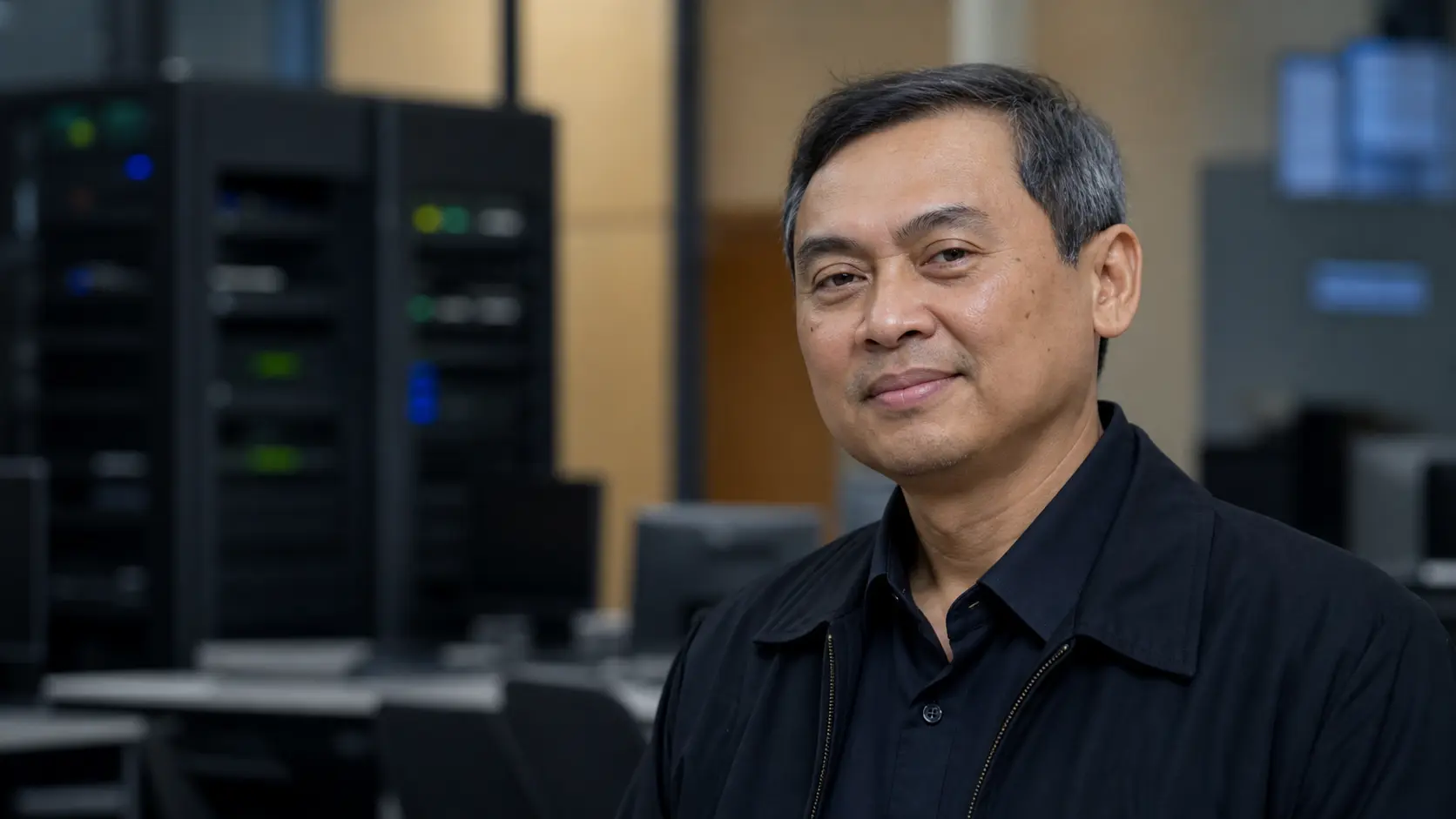
The image record around Suhardiman is unusually important because people coverage can fail when it uses generic technology imagery for a specific person. The available portrait leads are public but rights-sensitive. ResearchGate provides a named profile image tied to Bandung Institute of Technology. DataTempo has a named archive image from 2012 identifying Basuki Suhardiman in an ITB information-resource context, but archive-photo rights should not be assumed. ITB event coverage can provide institutional context, though it is not a clean individual portrait source.
For a published editorial image, the right direction is a public-photo-grounded portrait rather than a generic network scene. The final image should show Suhardiman as the profiled person and place him in a setting related to ITB, research networking or domain governance. It should not show random cables, an Indonesian skyline or a stock image of servers. Generic imagery would weaken the article because the whole point of the profile is person-specific institutional memory.
The portrait policy also reinforces the article's attribution discipline. A person-specific image should not imply more than the article proves. A suitable background might evoke a university network operations room, research-computing dashboards or domain-governance infrastructure without readable fake text, logos or invented claims. The image should preserve identity from public reference material while avoiding direct reuse of a rights-restricted photo unless permission exists.
This may sound like a production detail, but it belongs in the same governance logic. Internet-infrastructure articles often treat people as interchangeable symbols of networks. That is a mistake. If the article is about Suhardiman, the image should be about Suhardiman. If the article is about institutional boundaries, the image should not make him look like the sole commander of Indonesia's internet. Visual framing can overstate power as easily as prose can.
The current status should therefore be clear: the public record provides reference leads for identity grounding, but image generation and rights clearance are separate steps. Until a specific editorial portrait is produced and checked, the article should not rely on a generic substitute. In this case, the image task is not an afterthought. It is part of making the profile specific, accurate and respectful of the evidence.
The same rule applies to captions and alt text. They should name Suhardiman and describe the visual as an editorial portrait grounded in public reference material and relevant to ITB or internet-governance infrastructure. They should not claim a title that the article does not verify.
What readers should watch next
The first watchpoint is current formal role. If future public material verifies a present ITB, DSTI, IDREN, PANDI or ISOC Jakarta title, the profile can be updated with more precise current language. Until then, the article should preserve the historical wording. This is not merely a copy-editing issue. Current-title precision affects how readers interpret authority and accountability.
The second watchpoint is IDREN continuity. Regional material places Suhardiman in IDREN/INHERENT update contexts, but the larger question is how Indonesia's research-and-education network continues to serve institutions, applications and regional collaboration. Readers should watch for public updates on membership, services, routing, international links, research applications, security practice and governance. The value of a research network is not the acronym. It is whether researchers and universities can rely on it.
The third watchpoint is PANDI representation. PANDI material ties Suhardiman to member and academic-representation contexts, with older governance coverage adding supervisory-board history. The important question is how .id governance balances academic, technical, commercial and public interests. A registry's legitimacy depends on more than efficient registration. It depends on credible representation and public trust.
The fourth watchpoint is e-science and computing capability. High-performance computing, grid computing, OpenStack and weather modelling appear in the public record around Indonesian research infrastructure. Those terms should be read as operating commitments, not decorative technical language. The test is whether institutions can support real research workloads with reliable networks, compute resources, skills and continuity.
The fifth watchpoint is succession and institutional memory. People who appear across many infrastructure surfaces can help systems remain coherent, but systems should not depend on one person. ITB, IDREN, PANDI and regional forums are healthier when knowledge is distributed, documentation is current and younger operators can inherit responsibility. Suhardiman's profile matters partly because it raises that issue. A good public infrastructure system can use experienced people without becoming fragile around them.
The sixth watchpoint is public documentation. Much of this article depends on public records that are useful but incomplete. Better public documentation from universities, research networks and governance bodies would make future coverage more precise. It would also help partners, students, operators and policymakers understand how the system works. Transparency is not only a media convenience. It is an infrastructure asset.
Why the profile matters
Basuki Suhardiman matters because his public record makes a specific kind of Indonesian internet work visible. It is not the high-traffic commercial internet. It is not the consumer mobile market. It is not a single policy office. It is the quieter institutional layer where a university network, a higher-education autonomous system, research-network updates, scientific-computing activity, domain-governance membership and internet-community roles overlap.
The evidence is narrow, but the pattern is meaningful. APNIC records connect him to BANDUNG-NET and INHERENT. ITB sources place him in information-resource and information-systems leadership contexts. TEIN, Asi@Connect, ASGC and APAN material connect him to IDREN/INHERENT and e-science discussion. PANDI sources and media coverage connect him to .id governance participation. ISOC Jakarta adds current community context. ResearchGate and DataTempo provide identity and portrait leads with rights caveats. No single item is the whole story. Together, they show institutional memory.
That memory matters because internet infrastructure is often described through organizations while being sustained by people who know how those organizations connect. Suhardiman's public trail shows those connections without requiring invention. It shows how campus networks become part of higher-education infrastructure, how research networks explain themselves in regional forums, how e-science gives networks a practical purpose, and how academic participation can enter domain-name governance.
The lesson is not that Suhardiman alone built Indonesia's academic internet. That would be inaccurate and unfair to ITB, PANDI, IDREN, INHERENT, APAN, TEIN, ASGC and the many people who worked around those systems. The lesson is that named individuals can reveal the operating seams of public infrastructure when their records cross enough institutional boundaries. In this case, the boundaries run through Bandung, national research networking, Asia-Pacific collaboration and the .id governance environment.
For Sofia Ren people coverage, that is enough. A strong infrastructure profile does not need private scenes, imagined motives or inflated language. It needs a clear public record, a disciplined attribution boundary and a reason the subject helps readers understand a system. Basuki Suhardiman provides that reason. His public record is a map of how Indonesia's academic internet became visible across registries, universities, regional technical forums and domain governance, and why that visibility still matters.