
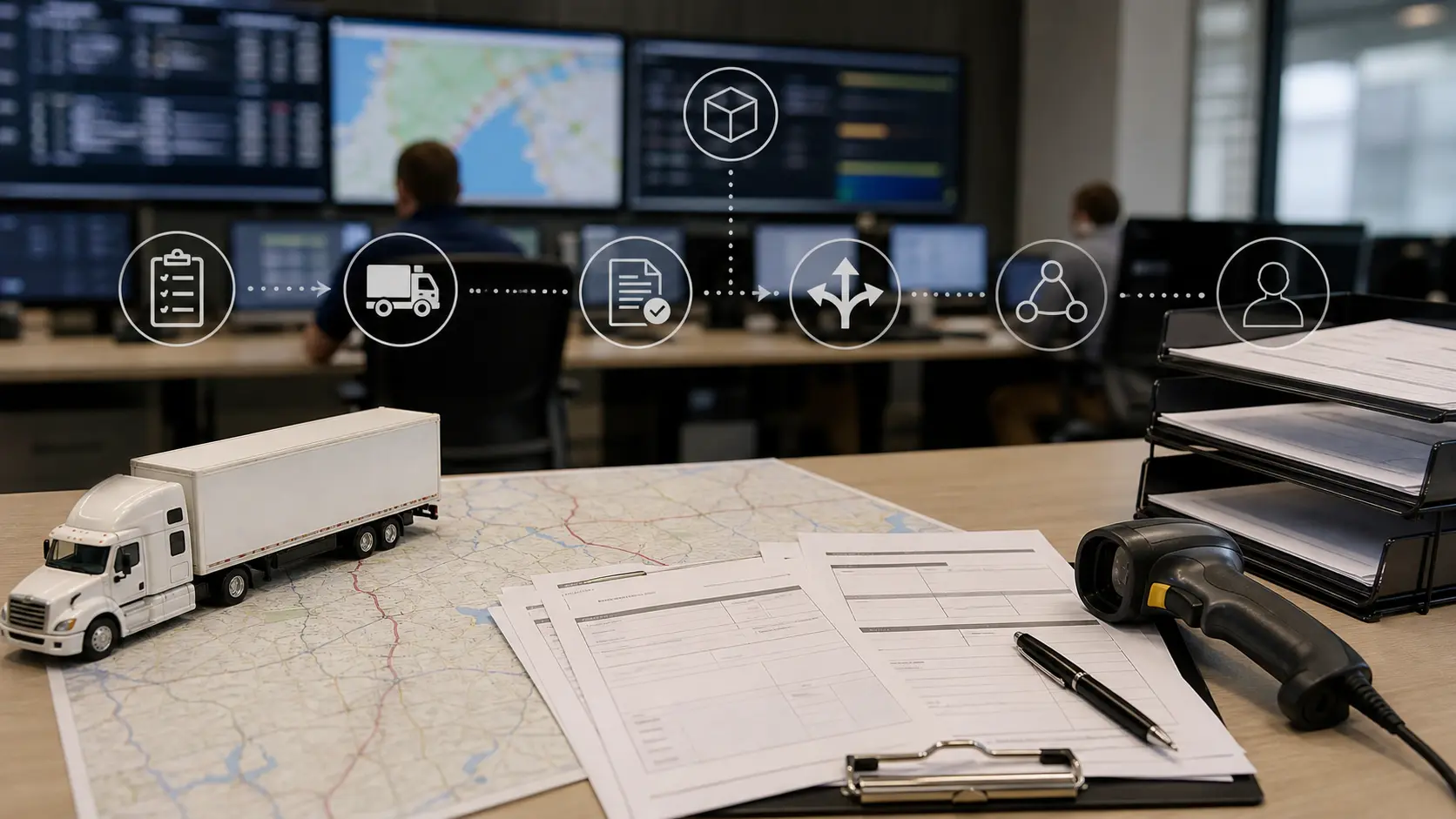
Summary
- Aurora Software sits in the practical middle of transportation management: the value case is not a clever dispatch screen, but whether an accepted freight record keeps the same operational and financial truth as it moves through dispatch, carrier communication, exception handling, delivery proof, billing, settlement and reporting.
- The public evidence supports a real transportation-software boundary around dispatch, rating, accounting, customer portals, driver records, EDI and integrations, but it does not prove that every customer achieves clean state alignment without configuration work, local discipline and support capacity.
- The most important risks are ordinary ones: stale load status, bad rates, driver assignment conflicts, EDI mismatch, billing errors, tax or mileage gaps, informal dispatch workarounds, integration outages and delays in support when a back-office process is already under pressure.
- Aurora is commercially interesting where a trucking company or broker can retire duplicate entry and enforce one freight record; it is weaker where the buyer expects software alone to repair messy tariffs, inconsistent dispatch habits, poorly governed integrations or old accounting cleanup.
The Freight Record Is The Test
Transportation software is often sold through screens: a dispatch board, a customer portal, a rating page, a driver mobile workflow, a billing queue, a document image, a settlement report. Screens matter because operators need to work fast. But for a trucking company, freight broker or logistics operator, the deeper test is whether one accepted freight record remains coherent after every ordinary exception that touches it.
An accepted freight record is more than a load number. It begins when a shipment or order is captured with a customer, origin, destination, equipment requirement, rate, accessorial terms, appointment window and operational promise. It becomes live when dispatch accepts responsibility for moving it. It becomes expensive when a driver, truck, carrier, trailer, document package, EDI message, GPS feed, status update, fuel-tax data point or invoice line starts depending on it. It becomes dangerous when one part of the company believes the record is true and another part quietly works around it.
This is why Aurora Software's product category deserves a sober reading. Public product profiles describe a transportation management system for trucking and logistics companies, with modules or capabilities around dispatch, rating, invoicing, accounting, EDI, customer communication, driver settlement, document handling, mobile work and integrations. That is a meaningful boundary. It is also a hard one. A system that touches so many back-office and front-line functions is not merely a scheduling tool.
It becomes the place where a business decides what the freight promise is, who owns the move, what the customer can see, what the driver is owed, what the carrier can bill, what the broker can defend, and what the accounting team books.
The article's central question is therefore practical: can Aurora Software help keep dispatch, driver, customer, billing and compliance state aligned across routine freight exceptions? A perfect answer is not available from public materials. There is no open sandbox showing a shipment moving through live customer tenders, driver communication, EDI status, delivery proof, rating, settlement and general-ledger posting. There is no public benchmark that measures error rates before and after implementation. But enough public evidence exists to frame the due-diligence problem.
Aurora appears to compete in the small-to-mid-market TMS and trucking-operations layer, where buyers often want integrated dispatch and accounting without the cost or complexity of a very large enterprise platform. That market rewards usable breadth. It also punishes any weakness in data governance, configuration, support and disciplined adoption.
The right way to judge Aurora is not to ask whether it has dispatch features. It is to ask what happens after a dispatcher accepts a freight record at 8:15 a.m., the pickup appointment slips at 10:40, the customer sends an EDI update at noon, the driver changes equipment at 2:00, detention starts at 3:30, a scanned proof of delivery arrives the next morning, the invoice needs an accessorial, and the back office has to settle the driver while keeping tax, mileage and customer-billing data intact. That sequence is ordinary. It is also where transportation software earns or loses its fee.
What Aurora Appears To Sell
Aurora Software's public footprint points to a conventional but broad transportation-software business. The company is associated with Aurora Software, Aurora Transportation Software and the NOVA product name in software-marketplace pages. The described use cases include dispatch management, freight billing, accounting, customer portals, EDI, carrier and driver communication, driver settlements, automatic rating, document imaging, GPS or telematics integration and related operations work.
The vendor's own website positions the business around transportation software and includes menu categories that match trucking administration rather than generic enterprise planning.
That matters because the company boundary is easy to confuse. "Aurora" is a crowded software and transportation name. It can refer to autonomous trucking technology, unrelated agricultural software, astronomy software, database products or other services. The Aurora at issue here is the transportation management and trucking-operations software provider. Its relevant problem is not autonomous vehicle control or cloud database performance. It is the handling of freight, dispatch, accounting and operational records in a logistics office.
The public product boundary is also broader than a dispatch board. Marketplace and product pages describe a system intended to manage loads, accounts receivable, accounts payable, general ledger, EDI, customer access, settlements and operational records. That breadth is commercially attractive because many transportation companies still operate across fragmented spreadsheets, accounting packages, emailed rate confirmations, separate telematics portals, customer portals and document repositories. Every handoff is a chance to lose state.
If a TMS can make the accepted freight record the shared object across those handoffs, the software can remove real cost.
The same breadth raises the implementation burden. A buyer cannot evaluate Aurora as if it were a light calendar application. Dispatch rules, tariff logic, accessorial policies, customer-specific billing instructions, carrier communication practices, driver-pay formulas, document requirements, account codes and EDI mappings are all local to the operator. If Aurora is implemented around the wrong local truth, the software may accelerate mistakes. If it is implemented around clean local truth, it can reduce duplicate entry and force exceptions into visible queues.
The product evidence suggests a vendor built for transportation teams that want an integrated operating system rather than a loose collection of tools. Public review pages also show users referring to support, customization and practical trucking workflows. Those comments are useful but not conclusive. Reviews are self-selected, often shaped by implementation context, and rarely disclose the full complexity of the user's network, volume, integration footprint or accounting process.
They do, however, support the idea that Aurora is used in the type of trucking and logistics office where a freight record must travel from the dispatch desk into receivables, payables and customer communication.
The most defensible reading is that Aurora sells an operations-and-accounting spine for transportation companies. That is more valuable than a single-function dispatch tool when the buyer's pain is duplicate entry and misaligned billing. It is also more fragile than a single-function tool because the spine has to connect to the rest of the company without becoming a bottleneck.
The State Alignment Problem
The accepted freight record has several layers of state. Operational state says whether the load is tendered, accepted, assigned, picked up, in transit, delayed, delivered, rejected, reconsigned, short, damaged, cancelled or ready to invoice. Resource state says which driver, carrier, truck, trailer, terminal or dispatcher owns the move at a specific moment. Financial state says what the customer agreed to pay, what accessorials apply, what a contractor or driver should receive, whether fuel surcharge logic is correct, whether a credit limit or billing hold applies, and whether the general ledger can trust the final posting.
Compliance and audit state says which documents, mileage data, duty-status records, tax data or customer-required confirmations can support the move after the fact.
A transportation system creates value when those state layers move together. A late pickup should not remain invisible to customer service. A driver reassignment should not leave a stale settlement obligation. A customer rate change should not create an invoice that contradicts the signed rate confirmation. A delivered load should not sit unbilled because proof of delivery is in a separate email folder. A shipment-status message should not tell a customer that freight is delivered while the internal record still waits for a document scan. A fuel or mileage gap should not become visible only at the quarter-end tax process.
Public EDI references make this state problem concrete. A motor-carrier load tender, a shipment-status message and a freight invoice are different messages with different meanings. In daily operations, they need to line up. The tender expresses the work being offered or accepted. The status message reports movement and exceptions. The invoice monetizes the final move. If the system cannot reconcile those messages with the dispatch record and the billing record, automation becomes cosmetic. Staff still have to open the load, check email, compare documents, amend rates and explain mismatches to customers or carriers.
Aurora's relevance comes from its apparent attempt to put those functions in one transportation software environment. A module list can sound routine, but the combination matters. Dispatch alone cannot guarantee billing truth. Accounting alone cannot see every field exception. A customer portal alone cannot fix a stale internal status. EDI alone cannot protect against a bad rate table. A driver mobile workflow alone cannot resolve a general-ledger mapping problem. The accepted freight record cuts across all of them.
The practical challenge is that a TMS does not eliminate judgment. It changes where judgment is applied. A dispatcher must still decide whether an assignment is feasible. A billing clerk must still understand a customer contract. A manager must still decide whether a detention charge is worth pursuing. An administrator must still maintain rates, users, equipment records and integrations. The software should reduce rote reconciliation and make exceptions visible. It should not be mistaken for an autonomous control system.
For Aurora, that means the product should be evaluated around exception closure. Can staff see which accepted loads are missing documents? Can they tell which delivered loads are blocked from invoice and why? Can they trace a customer-visible status back to an internal load event? Can they prevent two users from making conflicting driver or equipment assignments? Can they lock rating fields at the right point while still allowing controlled exceptions? Can they audit who changed a rate, a status, a pay item or a bill-to address? These are the questions that decide whether state alignment is real.
Why Dispatch Convenience Is Not Enough
A dispatch board is the most visible transportation-management screen, so it often dominates the sales conversation. It can show trucks, loads, lanes, statuses and assignments. It can make a chaotic morning feel manageable. But dispatch convenience is not the same as freight-record integrity. A team can love a dispatch screen and still lose money through unbilled accessorials, stale EDI status, manual re-entry into accounting, inconsistent driver pay, missing documents or weak exception follow-up.
The economics of trucking and brokerage make that distinction important. Many operators run on thin margins. A few invoice errors, missed detention items, late billing cycles or avoidable customer disputes can consume the value of software savings. Conversely, a modest reduction in duplicate entry and manual follow-up can justify a system if it reduces days-to-bill, keeps dispatchers from overcommitting capacity, and gives managers earlier visibility into unprofitable or delayed moves.
Aurora's likely buyer is not judging whether software can produce a pretty board. The buyer is asking whether staff can do the same work with fewer handoffs and fewer mistakes. That includes the morning board, the afternoon exception queue, the day-after-delivery document chase and the month-end accounting close. It also includes the uncomfortable cases where the software forces a company to confront weak internal rules. If customer rates are stored in outdated spreadsheets, a TMS implementation will expose the mess. If dispatchers rely on informal messages outside the system, the accepted freight record will remain incomplete.
If accounting codes are not mapped cleanly, billing automation can create a new review burden.
Dispatch convenience can even hide risk. A flexible screen that lets staff move loads quickly may encourage workarounds unless permissions, required fields and exception states are configured carefully. A dispatcher who can change a rate without review may solve a customer-service problem but create a billing dispute. A user who can mark a load delivered without proof may improve a board view while delaying cash collection later. A system that accepts incomplete driver, truck or customer records may speed up entry but weaken settlement, tax or compliance reporting.
None of this is a criticism of dispatch software as a category. It is the reason the accepted freight record is a better unit of analysis. Dispatch is the first visible stress point. Billing, settlement, customer communication and compliance are where the stress becomes financial.
The stronger case for Aurora is that it appears to combine dispatch with back-office modules. If those modules share the same underlying freight record, they can reduce the gap between operational activity and financial truth. The weaker case is that public materials do not demonstrate, in a reproducible way, how the system handles every exception across every module. Buyers should therefore run their own scenario-driven evaluations rather than treat feature availability as proof of operational reliability.
Integration Is Where Value And Maintenance Meet
Transportation software rarely operates alone. A trucking company may have telematics, electronic logging devices, fuel-card feeds, customer portals, EDI connections, accounting exports, document imaging, payroll or settlement processes, maintenance systems and carrier communication tools. A freight broker may depend on customer tenders, carrier onboarding, insurance checks, tracking links, rating data, email, payment systems and claims documents. Each connection promises less manual work. Each connection also creates a maintenance obligation.
Aurora's public product descriptions and marketplace profiles point to integrations, EDI, GPS or telematics connections, customer access and data handling as part of the product universe. That is necessary in this category. The accepted freight record cannot stay aligned if important updates live permanently outside the system. But integration quality is not proven by the existence of an integration label. It is proven by how mappings are maintained, how failures are surfaced, how retries work, how partial data is treated, and whether staff can understand what happened without calling a specialist for every exception.
EDI is the cleanest example. A customer may send a tender, expect shipment status, and require an invoice in a specific format. If a field is mapped incorrectly, if a status code is missing, if a customer changes requirements, or if a message fails silently, the business problem is not "an EDI issue" in the abstract. It is a freight record whose external and internal versions have diverged. The dispatcher may think the load is accepted. The customer may not have a valid confirmation. The billing team may not know which reference number to use. The cash-collection team may discover the defect weeks later.
Telematics and ELD data create similar risks. Driver and vehicle data can support visibility, hours-of-service compliance and operational timing, but those data streams are not the same as business truth. A GPS ping does not prove that a customer accepts delivery. An electronic log does not decide whether a detention charge is billable. A mileage feed may support reporting but still need review for tax or jurisdictional treatment. Software has to bring those signals into the freight record without pretending that raw data resolves every commercial question.
Customer portals are another integration surface. A portal can reduce calls and emails by giving customers access to shipment status, documents or invoices. It can also expose stale or incomplete data faster. If the internal record is not updated quickly, the portal becomes a public view of operational drift. For Aurora buyers, the portal question should therefore be tied to internal discipline: what must be true before a status or document appears to a customer, and who owns correction when it is wrong?
The maintenance burden should be treated as part of the software cost. Rates change. Customers change reference-number rules. EDI mappings need updates. Drivers join and leave. Equipment records age. Account codes change. Insurance, permits, tax processes and document retention expectations evolve. The buyer needs someone responsible for configuration health. That person may sit inside operations, accounting, IT or administration, but the role cannot be absent. Otherwise the system slowly becomes a formal shell around informal work.
Aurora can be valuable in this environment if it reduces the number of places staff must check and if support can respond to transport-specific issues. Public reviews that praise support and customization are encouraging, but they should be read as directional evidence rather than a universal guarantee. Implementation context matters. A customer with clean master data, patient training and a manageable integration footprint may have a different experience from a customer trying to migrate years of inconsistent rates and documents under time pressure.
Supervision Cost Does Not Disappear
Automation in freight operations rarely removes supervision. It moves supervision from repeated typing toward exception control, master-data care and process enforcement. That shift is still valuable, but it is not free.
A dispatch team using an integrated TMS has to supervise load acceptance, appointment changes, driver assignments, capacity conflicts, status freshness and handoffs between shifts. A billing team has to supervise rate accuracy, accessorial capture, document completeness, invoice holds, customer-specific rules and dispute patterns. An administrator has to supervise customer records, user permissions, equipment records, integration mappings, rate tables and reporting definitions. A manager has to supervise whether the software reflects actual work or merely records a sanitized version after the fact.
The accepted freight record is useful precisely because it reveals where supervision is needed. If many loads are delivered but not billed, the problem may be document capture, customer rules, billing staffing or dispatch completion discipline. If many EDI status messages fail, the problem may be mappings, customer formats, user timing or missing required fields. If driver settlements regularly need manual correction, the problem may be pay-rule complexity, load-entry habits, accessorial capture or contract maintenance. The software can show the queue. It cannot decide the operating policy by itself.
This is where buyers sometimes overstate the software case. Fewer manual dispatch and billing errors can absolutely exceed subscription, support and training costs. But the savings are realized only when the organization changes behavior. If dispatchers continue to track important events in text messages or personal spreadsheets, the central record remains partial. If accounting continues to correct invoices outside the system without feeding the cause back into configuration, the same defects recur. If managers accept incomplete data because the board looks cleaner, the system becomes a reporting convenience rather than a control layer.
Supervision cost is also uneven across company size. A small carrier may benefit from a system that brings dispatch and billing together, but the same company may have fewer dedicated administrators to maintain rules. A larger broker may have more staff but a harder integration footprint. A specialized hauler may need rating and document logic that a generic demo does not show. A mixed fleet and brokerage operation may need clear boundaries between owned-truck dispatch, third-party carrier work, customer billing and settlement. The more the business model deviates from simple truckload moves, the more implementation detail matters.
Aurora's market position appears to sit in the practical transportation-operations tier rather than the highly abstract enterprise-suite tier. That can be an advantage. Transportation teams often prefer software shaped around dispatch and back-office work they recognize. But practical software still needs governance. A familiar screen can encourage adoption; it cannot guarantee consistent data.
Failure Modes That Decide The Outcome
The most important Aurora failure modes are not exotic. They are the everyday defects that transportation offices already know.
The first is stale load status. A load may be dispatched but not updated after pickup, delayed without a customer-visible reason, delivered without document completion, or left in a status that blocks billing. Stale status causes duplicate calls, missed customer expectations and weak exception reporting. If Aurora is configured well, status workflows and exception queues should reduce this problem. If users treat status updates as optional, software will only display the stale state more neatly.
The second is a bad rate. A load may be accepted with an outdated customer rate, a missing fuel surcharge, a wrong accessorial, a lane-specific exception or a manually negotiated change that is not preserved. Bad rates damage margin and create disputes. A TMS can centralize rating logic and make review easier, but rate tables and customer rules require maintenance. Automatic rating is only as reliable as the commercial data behind it.
The third is driver or equipment assignment conflict. A dispatcher may assign the wrong driver, overcommit equipment, miss hours-of-service constraints, or fail to reflect a change after a breakdown or swap. Integrations with driver, truck and status data can help, but they do not replace dispatch judgment. The system has to make conflicts visible and prevent obvious double-booking where configured; supervisors still need to resolve the commercial consequence.
The fourth is EDI mismatch. Tenders, status messages and invoices need to agree with the internal freight record and with customer requirements. A mismatch can create silent operational risk or visible billing rejection. Because EDI formats are structured and customer-specific, this is a configuration and maintenance problem as much as a software feature problem.
The fifth is a billing error. Delivered freight that is not billed quickly delays cash. Incorrect invoices invite disputes. Missing documents slow receivables. A billing module can help only if proof, rate, customer terms and completion status feed into one queue. If invoice review remains a manual scavenger hunt across email and spreadsheets, the system has not captured the real process.
The sixth is a fuel-tax or mileage data gap. Operators need reliable records for reporting and audit work, and those records often depend on systems beyond dispatch. Software can store or import data, but it cannot infer every missing jurisdictional detail after the fact. Buyers should ask how mileage, fuel, driver, equipment and trip data are captured, reviewed and retained.
The seventh is the dispatch workaround. Every transportation office develops informal methods under pressure. A workaround may be rational in the moment: a phone call, a note, a text, a quick spreadsheet. The risk appears later when the accepted freight record does not include the decision. Software value depends on whether the system makes the formal path fast enough and strict enough that workarounds are exceptional, visible and corrected.
The eighth is integration outage. If a customer tender feed, EDI connection, telematics feed, document flow or portal fails, the business must know quickly. Silent failure is worse than manual work because staff may trust an incomplete record. Buyers should ask how Aurora surfaces failed imports, failed exports, duplicate messages, partial updates and stale feeds.
The ninth is support delay. Transportation operations do not stop because a mapping, rate, document queue or billing rule is broken. If support is slow during a critical issue, staff will create manual paths. Those paths may solve the immediate problem but weaken the central record. Public reviews that mention support positively are relevant here, but a buyer should still check support hours, escalation process, configuration responsibility and the vendor's experience with similar operating models.
These failure modes show why the accepted freight record is the right standard. A feature list says the system can touch dispatch, billing, EDI and accounting. A freight-record scenario shows whether those features behave as one operating process.
Product Boundaries And Customer Results
Aurora should not be credited with outcomes that public evidence does not prove. A marketplace listing can show that a feature exists. A customer review can show that at least one user found the product useful. A vendor page can describe a module. None of those sources proves that a buyer will reduce headcount, eliminate billing errors, pass every audit, integrate every customer, or make dispatch decisions without supervision.
The product boundary is still meaningful. Aurora appears to offer software that can handle many of the objects that matter in transportation operations: loads, customers, drivers, equipment, rates, invoices, settlements, documents and electronic communication. A buyer currently managing these objects across separate tools may find value in consolidation. The strongest customer-result claim that can be made from public evidence is not "Aurora guarantees clean freight operations." It is "Aurora addresses the areas where clean freight operations usually break."
That distinction matters. A TMS can provide structure, but it cannot make a weak customer contract clear. It can store rates, but it cannot decide whether a dispatcher should accept a low-margin load. It can support EDI, but it cannot prevent every customer-specific requirement from changing. It can integrate documents, but it cannot make a driver capture a proof of delivery at the right time unless the operating process enforces it. It can connect billing and dispatch, but it cannot eliminate the need for review when a load has unusual terms.
The public review evidence is best read through this boundary. Positive comments about ease of use, customization and support suggest that Aurora can fit real transportation offices. Critical or cautious comments, where present, should remind buyers that implementation details and system performance matter. The absence of a large public benchmark is also important. Without standardized before-and-after data, the economic case has to be built locally from a company's own error rates, billing cycle, manual-entry workload, integration needs and support costs.
For a buyer, this means the evaluation should start with three to five ugly freight records, not a clean demo. Pick a load that had a rate dispute. Pick one with a missed accessorial. Pick one with an EDI problem. Pick one with a driver or equipment swap. Pick one that was delivered but billed late because a document was missing. Ask how those records would have moved through Aurora from initial order to invoice and settlement. Ask which actions are blocked, which are merely warned, which are audited, which are visible to customers, and which require manual review.
If Aurora handles those scenarios with clear queues, auditability and limited duplicate entry, the product deserves serious consideration. If the scenarios require the same informal checking as before, the buyer is only purchasing a nicer screen around the same risk.
Unit Economics
The commercial question is whether fewer manual dispatch and billing errors exceed software fees, data cleanup, implementation, training, integration and support costs. That question has no universal answer because transportation operations vary widely. The right calculation is local.
Start with labor. How many hours do dispatchers, billing clerks, customer-service staff and managers spend re-entering load information, checking rate confirmations, chasing documents, correcting invoices, responding to status requests, reconciling EDI exceptions and manually compiling reports? Some of this work is necessary supervision. Some is waste caused by fragmented systems. Aurora's economic value depends on reducing the waste without hiding the necessary supervision.
Then measure cash timing. If delivered loads wait days for billing because documents, rates or statuses are incomplete, a better workflow can improve working capital. That does not require heroic automation. A cleaner delivered-not-billed queue can be valuable. But the benefit appears only if the system receives proof of delivery, rating data and completion status in time. Otherwise the queue is just a new name for old missing information.
Next measure billing leakage. Missed accessorials, wrong fuel surcharge logic, incorrect customer terms and manual invoice errors can be expensive. A TMS with maintained rate rules and controlled invoice review can reduce leakage. But the company has to know its contracts and keep them current. Software cannot recover charges that no one configured or documented.
Then measure integration savings. EDI and portal automation can reduce calls and emails, but only if mappings and status rules are stable. A company with a few simple customers may not need heavy integration. A company with many demanding shipper connections may need it badly. The cost of building and maintaining those connections should be compared with the labor and dispute cost of manual communication.
Data cleanup belongs in the calculation. Implementing an integrated TMS often exposes duplicate customers, inconsistent lane names, stale equipment records, old rates, weak document practices and unclear accounting mappings. Cleaning that data may be one of the most expensive parts of the project. It may also be where a large share of the eventual benefit comes from. Buyers should not treat cleanup as a one-time annoyance outside the business case. It is part of converting informal operations into a durable freight-record system.
Training and support also belong in the calculation. Dispatchers and billing staff need to understand not only which buttons to press, but why a field matters downstream. If a dispatcher skips a reference number, billing may suffer. If a billing clerk changes an invoice without correcting a rate rule, the next load may fail the same way. If a manager allows off-system work, reporting becomes less trustworthy. Training should therefore be process-based, not only screen-based.
Finally, consider lock-in. Once a TMS holds customers, rates, history, documents, accounting mappings, EDI settings and user habits, switching becomes costly. That is not automatically bad. A system that becomes the operating spine is supposed to be sticky. But buyers should understand export options, data ownership, report access, integration portability and the cost of changing workflows later. The more successful the system becomes, the more important those exit and continuity questions become.
Aurora's value case is strongest when a buyer has enough repetitive freight movement, billing complexity and customer communication volume to make consolidation meaningful, but not so much bespoke enterprise complexity that the project becomes a custom systems-integration program. Its value case is weakest when the operator has low volume, simple billing, minimal customer integration, or a culture that will not keep the central record current.
Realistic Substitutes
Aurora is not the only way to manage freight operations, and a fair assessment has to name the substitutes.
The first substitute is spreadsheets plus accounting software. Many small operators begin there because the cost is low and flexibility is high. This can work for very small volumes or simple lanes. It breaks down when multiple people need the same freight truth, when customer communication becomes frequent, when documents multiply, when billing rules vary, or when managers need timely exception reporting. The hidden cost is duplicate entry and local knowledge trapped in individual staff.
The second substitute is a modern cloud TMS aimed at brokers or carriers. These products may offer faster onboarding, cleaner user interfaces, broad integrations or marketplace-style ecosystems. They may be attractive for teams that want lighter administration and standardized workflows. The tradeoff is fit. A cloud-first product may not match a company's accounting, settlement, document or legacy workflow requirements as closely as a transportation-specific system with long operational depth.
The third substitute is a larger enterprise transportation or supply-chain suite. This can make sense for complex networks, large shippers, multi-region operations and companies with dedicated IT and process teams. The tradeoff is cost, implementation time and change-management burden. A mid-sized trucking company may not need that weight if its core problem is dispatch-to-billing alignment.
The fourth substitute is a set of best-of-breed tools: separate dispatch, EDI, document management, telematics, accounting and customer-visibility products. This can produce strong individual capabilities. It also increases integration and ownership complexity. The accepted freight record has to live somewhere. If no single system owns it, staff become the integration layer.
The fifth substitute is managed service or outsourced back-office work. A company may choose to keep lighter software and rely on people to reconcile billing, documents and customer communication. This can work where labor is available, process knowledge is concentrated and volume is manageable. It becomes risky when key people leave or when customers demand faster digital communication.
Against those substitutes, Aurora's likely advantage is integrated transportation-office breadth. Its likely challenge is proving that the breadth operates cleanly in a buyer's actual workflow. The decision is not "Aurora or no automation." It is "which system should own the accepted freight record, and what supervision will still be required?"
What Buyers Should Ask
A buyer evaluating Aurora should ask for a scenario walkthrough, not a generic feature tour.
Begin with order entry. Which fields are required before a freight record can be accepted? How are customer terms, rates, equipment needs and reference numbers validated? Can staff distinguish a quoted load from an accepted load? Can the system prevent accidental billing from a draft or incomplete record?
Move to dispatch. How are driver, carrier, truck and trailer assignments controlled? What happens when capacity changes? Can dispatchers see conflicts, missing documents, appointment changes and late statuses in one place? Are changes audited? Can permissions separate routine updates from financial changes?
Move to customer communication. If a customer receives EDI updates or portal visibility, what status events are exposed and when? Can staff see whether an outgoing message succeeded? How are failed messages retried? Can customer-specific reference fields be enforced?
Move to documents. How does proof of delivery enter the record? Can delivered loads be blocked from invoicing until required documents exist? How are scanned or imaged documents matched to the right load? What happens when a document is unreadable or attached to the wrong record?
Move to billing. How are rates, fuel surcharge, accessorials and taxes applied? What requires review? Can billing staff see why an invoice is blocked? Can invoice corrections feed back into rate maintenance? Are changed financial fields auditable?
Move to settlement and accounting. How are driver or contractor payments calculated? How are deductions, advances, accessorials and special pay items handled? How do receivables, payables and general-ledger postings connect to the freight record? Can accounting reverse or correct without losing the operational history?
Move to integration health. Where can administrators see failed imports, failed exports, stale feeds and unmapped customer messages? Are alerts understandable to operations staff, or only to technical support? How are customer mapping changes handled? What is the escalation path during a business-critical issue?
Move to reporting. Can managers see delivered-not-billed, accepted-not-dispatched, dispatched-not-picked-up, missing-POD, EDI-failed, rate-exception and invoice-dispute queues? Can they drill from a report into the original freight record? Can they identify recurring root causes rather than only count late or missing items?
Finally, ask about exit and continuity. How can the company export customer, load, rate, document and accounting history? What happens if an integration is retired? How are backups, access controls and user permissions handled? What support is available during migration, month-end, customer onboarding and EDI changes?
These questions are not hostile. They are the normal diligence required when software becomes the system of record for freight work. Aurora may answer many of them well in a live evaluation. Public materials simply do not remove the need to ask.
Verdict
Aurora Software belongs in the category of transportation systems that can matter because they touch the freight record where value is created and lost. The company is not best understood as a generic software vendor or a simple dispatch-board provider. Its relevant promise is that trucking and logistics teams can bring order entry, dispatch, customer communication, rating, billing, settlement, accounting and related records closer to one operational truth.
That promise is credible at the category level and supported by the product boundary described in public materials. It is not fully proven at the individual buyer level. The hard work sits in configuration, local data cleanup, integration maintenance, support responsiveness and user discipline. A company with inconsistent rates, informal dispatch habits or weak document capture will not be rescued by feature breadth alone. A company willing to govern the accepted freight record may get real leverage from an integrated transportation system.
The buying judgment should therefore be conditional. Aurora looks most compelling for operators whose main pain is the gap between dispatch activity and billing truth, especially where duplicate entry, document chasing, EDI exceptions and customer-status work consume staff time. It looks less compelling for buyers seeking a plug-and-play fix for messy commercial rules or for teams unwilling to make the TMS the place where freight decisions are recorded.
The accepted freight record is a demanding standard, but it is the right one. Freight software earns its keep when the load that was accepted in the morning is still the same accountable, billable, auditable record after the exceptions arrive. That is where Aurora should be tested, priced and judged.