
Summary
- Asyst EOOD is an active Montana company, not just a historical route label. A current Bulgarian business-register index identifies UIC
111015442, Montana headquarters, Plamen Yonkov Antonov as manager and sole owner, and a company record updated in January 2026. The RIPE RDAP record for AS57912 names the same company and Montana address. This identity match is strong; it does not disclose the present subscriber count, retail plans or complete asset boundary. - The physical-network case is real but dated and incomplete. A 2008 Communications Regulation Commission register recorded Asyst's cable data network and broadband service in the city of Montana. A 2012 municipal council record concerned rights to run branches of Asyst's optical telecommunications network across municipal properties. A later municipal property record preserves an Asyst right of passage, while 2023 planning material still listed the company among infrastructure operators asked for project conditions. None of these documents supplies a current coverage map, protected-ring drawing or pole-and-duct inventory.
- AS57912 was fully visible to the IPv4 collectors in a 10 July 2026 RIPEstat routing-status snapshot, originating six
/24routes and 1,536 IPv4 addresses. RIPEstat's neighbour view observed four upstream-facing adjacencies: Evolink, A1 Bulgaria, Rimex and Telehouse. That is meaningful logical diversity, but BGP cannot show whether the circuits share one Montana aggregation point, one long-haul cable, one duct, one facility or one power supply. - The address portfolio has signs of continued operation. Four
91.236.144.0/24through91.236.147.0/24routes sit inside an Asyst-assigned block;82.119.87.0/24was registered for Asyst in Evolink space in December 2022; and77.76.12.0/24received an Asyst registration in November 2023. All six routes were visible in July 2026 and returned valid origin status in RIPEstat. Yet 1,536 routed addresses are neither 1,536 subscribers nor a capacity figure, and no IPv6 route was visible. - The final network evidence grade is Medium. The operator, local cable/fibre history, active routing, route-origin protection, four logical upstreams, 2022 network-technician recruitment and 2025-2026 local training activity are supported. Public evidence does not verify present retail coverage, installed or spare bandwidth, physical path diversity, backup-power runtime, ring protection, spare equipment, field-crew depth, repair service levels, outage history or failover under load.
A small operator with a specific Montana identity
The first risk in interpreting Asyst's public record is mistaken identity. Variations of “Assist” are common business names, and Montana is both a Bulgarian city and the name of a US state. The useful anchor is the Bulgarian company number. A current commercial-profile page tied to the Bulgarian register identifies Asyst EOOD under UIC 111015442, gives its address as 9 Lyuben Karavelov Street in Montana, and names Plamen Yonkov Antonov as manager and sole owner. The page records a last update on 2 January 2026 and describes the company as active. A second Bulgarian corporate-data profile reports the same UIC, legal form, address, manager and ownership.
That company evidence aligns with internet-number records rather than merely resembling them. The RIPE record for AS57912 names Asyst EOOD, carries the Montana address and telephone number, and identifies the autonomous system as ASYST-AS. RIPE records its registration on 13 March 2012. The organisation entry was changed in May 2026, although the autonomous-system policy itself was last changed in 2018. Matching name, address and company number across corporate, municipal and RIPE material makes the operating identity unusually clear for a very small network.
The ownership boundary is clearer on paper than the physical one. The corporate profiles say Antonov owns and manages the legal company. RIPE names an Asyst organisation and an administrative and technical contact at the same address. There is no reliable public evidence of a parent company, current subsidiary or transfer of AS57912 to another operator. Nor is there evidence that every cable, cabinet, server, address block or upstream circuit used by the service is owned outright by Asyst. A regional ISP can own some access plant while leasing ducts, poles, dark fibre, transmission, rack space or provider-assigned addresses.
The public documents do not allocate those responsibilities asset by asset.
The company's public economic footprint is thin. Papagal's profile reports revenue of BGN 119,000 for 2021 and one employee in that year, compared with higher historical headcounts. Those are secondary figures drawn from public records, and they are old enough to demand caution. They do not count an owner working in the business, contractors, temporary staff, outsourced call handling or later hires. They also do not reveal how much revenue came from broadband rather than computer services or other permitted activities. Still, the figures are material because they show why labour and spares cannot be assumed abundant.
The strongest present-tense conclusion is therefore modest: Asyst EOOD remains an active Bulgarian company associated with an active autonomous system and a live company domain. That supports treating it as an operating regional network. It does not support a claim that the company serves all of Montana Province, operates globally, maintains a large workforce or offers every service once recorded in older directories. The relevant geography is the city of Montana and the surrounding evidence points, not the global reach of the internet routes it buys.
The physical evidence begins with cable and fibre rights
The access network appears in public records before the autonomous system does. The Bulgarian Communications Regulation Commission's 2008 temporary register listed Asyst EOOD as having notified a cable data-transmission network, data-transmission services and broadband internet access in the city of Montana. The document gave 9 May 2008 as the notification date and 20 May 2008 as the proposed start of activity. It is historical regulatory evidence, not a current licence extract, but it fixes the original service and geography: local cable broadband, not a worldwide carrier or a purely virtual hosting company.
By 2012, the description had become more physical. A Montana municipal council protocol discussed granting rights to route branches of an optical cable telecommunications network for Asyst EOOD across several municipal parcels. The listed servitudes were small, which is consistent with branch crossings rather than ownership of broad corridors. The record does not say whether every branch was built, lit or remains in service. It does establish that the operator's network plan required civil rights over real property and that optical cable was part of the design.
A later municipal property document records Asyst's UIC alongside a right-of-passage contract dated 26 November 2012. The same municipal material describes multi-family residential buildings on the relevant property. That does not prove that those buildings are Asyst customers today. It does show how a neighbourhood broadband network becomes embedded in property rights, building approaches and the practical constraints of occupied urban sites.
The more recent signal is indirect but useful. A 2024 municipal planning item, discussing a development plan, says material was sent for data and conditions to infrastructure operators including Asyst, Net-Surf.Net, A1 Bulgaria and the Bulgarian Telecommunications Company. The text also refers to utility opinions from 2023. Being consulted does not prove the extent, condition or ownership of Asyst plant at the site. It does indicate that the municipality still treated the company as potentially relevant to underground or overhead infrastructure planning.
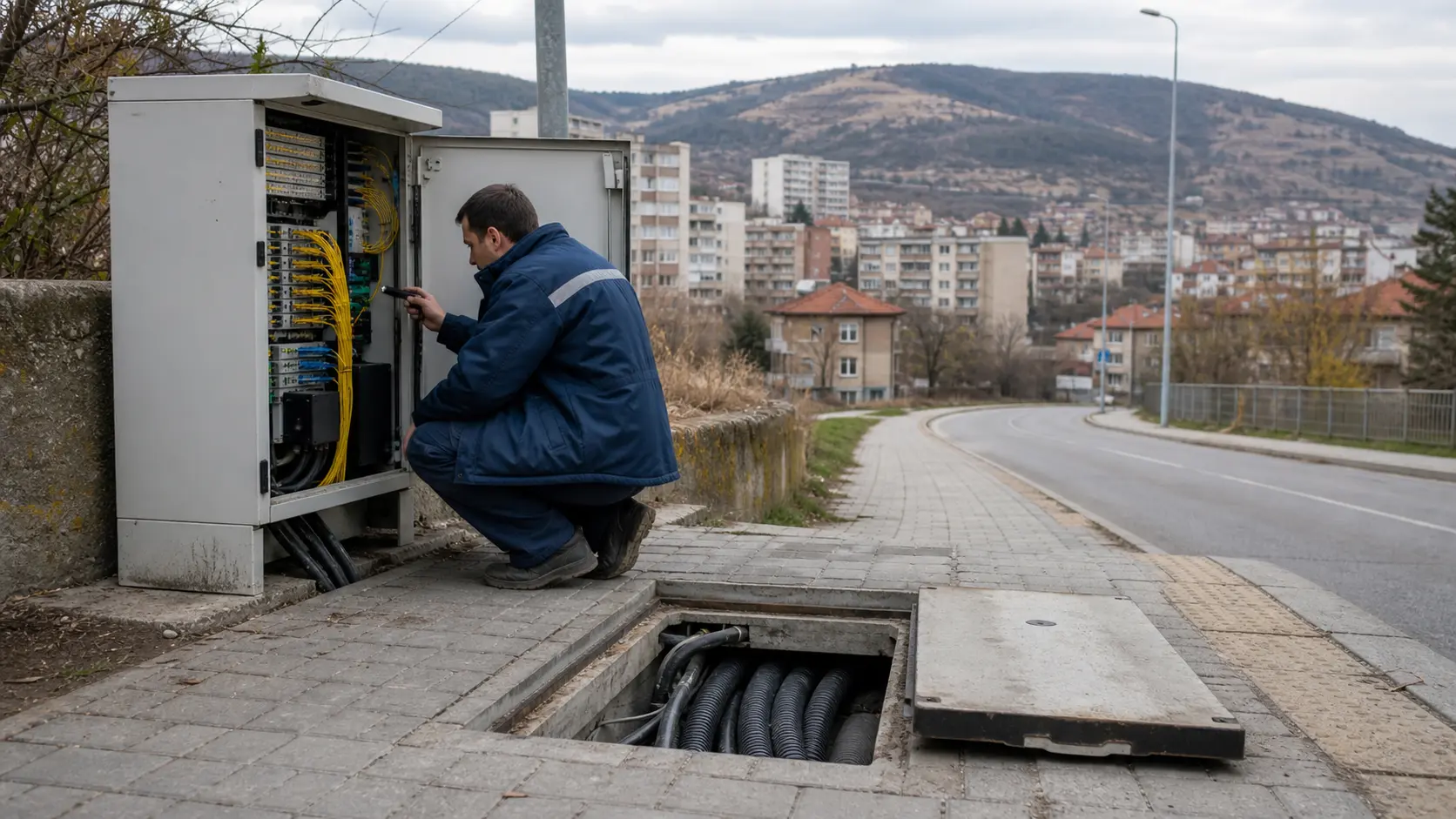
Those documents define the access asset more reliably than a generic “regional ISP” label. The core is a local cable and optical network with building and parcel crossings. It must connect customer premises to an aggregation point, then to AS57912's routers and upstream transport. Each stage has different ownership and failure modes. The drop inside a building may depend on landlord access. A feeder may use a municipal corridor. Active switches need power. Long-haul connectivity may be leased from one or more national carriers.
Customer routers and optical terminals sit beyond the operator's direct control once installed in homes and businesses.
What is missing is just as important. There is no current public coverage checker, street list, fibre map, cabinet inventory, pole inventory, tower register, splitter plan or diagram of protected rings. No source identifies an Asyst central office, secondary node or remote point of presence by verified facility. The company's domain resolves inside AS57912, but a web server does not locate the access headend. Internet geolocation services place some Asyst addresses in Montana and others around Vratsa; those labels may reflect routing, database inference or customer use and cannot be converted into a service-area map.
The correct physical conclusion is therefore bounded. Asyst has a documented history of cable broadband and optical branches in Montana, and recent municipal treatment is consistent with continuing infrastructure relevance. The evidence does not show whether today's network is fibre to the home, fibre to the building with copper Ethernet inside, a mixture of legacy LAN and fibre, or something else at each address. It cannot support a claim of universal city coverage or a protected fibre ring.
AS57912 is live, but an active route is not an active repair crew
Routing gives the freshest public evidence. A 10 July 2026 RIPEstat overview marked AS57912 as announced and identified its holder as Asyst EOOD. The same day's routing-status view showed all 327 displayed IPv4 RIS peers seeing the network, six IPv4 prefixes and 1,536 announced addresses. No IPv6 announcement was visible to the 321 displayed IPv6 peers. The earliest route in that view was first seen in March 2012, immediately after the ASN was assigned.
The six routes are not one uniform allocation. RIPEstat's announced-prefix list shows 91.236.144.0/24, 91.236.145.0/24, 91.236.146.0/24, 91.236.147.0/24, 82.119.87.0/24 and 77.76.12.0/24. The first four sit inside the Asyst-Net 91.236.144.0/22 assignment, registered in March 2012. The aggregate /22 is not announced as one route; its four component /24s are.
The other two prefixes help show continued network administration. The RIPE record for 82.119.87.0/24 names Asyst but retains Evolink administrative and technical contacts, with a registration date in December 2022. The record for 77.76.12.0/24 likewise names Asyst and records a November 2023 registration. Both are now originated by AS57912. These entries are stronger evidence of activity than an untouched 2012 ASN record because they show newer address arrangements that made it into global routing.
They also demonstrate a boundary that readers should not miss. The 91.236.144.0/22 block is recorded with Asyst and RIPE end-user maintainers. The 82.119.87.0/24 range sits within Evolink address space and uses Evolink contacts. The 77.76.12.0/24 record uses a different maintainer. An address can be delegated to Asyst for use and announced by AS57912 without Asyst owning the larger allocation or the transmission carrying it. Address control, route origination, physical fibre and commercial transit are different things.
RPKI improves the route's security posture. RIPEstat reports valid origin status for 77.76.12.0/24, 82.119.87.0/24, and each of the four Asyst-Net routes, including 91.236.144.0/24 and 91.236.147.0/24. That means a route-origin authorisation covers AS57912's announcement under the displayed validation rules. It does not encrypt traffic, prevent congestion, keep a fibre intact or guarantee that every upstream filters invalid routes.
Nor do the 1,536 addresses measure customers. A home may receive a shared public address behind carrier-grade translation, a dynamic address, or more than one address over time. Business and infrastructure uses can consume many addresses. Some addresses may be reserved, idle or used for servers and network equipment. The number is best treated as a routable IPv4 footprint. Installed port capacity, lit fibre strands, active subscriber lines and usable busy-hour bandwidth remain undisclosed.
The absence of visible IPv6 deserves attention without melodrama. It may reflect a genuine lack of customer IPv6, a deployment that is not globally announced, or an observation boundary. It does not mean the IPv4 service is failing. But it leaves the operator dependent on scarce IPv4 resources and whatever address-sharing practices it uses. A current IPv6 plan, customer deployment percentage and route-origin policy would help clarify whether the network is modernising beyond its six IPv4 routes.
Four upstream names are a starting point, not proof of four exits
The resilience case gains its strongest support from AS-path observations. RIPEstat's ASN-neighbours result saw four unique networks on the upstream-facing side of AS57912 on 10 July 2026: AS8262, AS8717, AS38932 and AS57344. Registry and operator records identify those as Evolink, A1 Bulgaria, Rimex and Telehouse. IPinfo's AS57912 profile independently lists the same four as upstreams.
Four upstream adjacencies are better evidence of routing options than one. If one provider withdraws a route, AS57912 may continue announcing through others. The six prefixes can also use different policies. A current RIPEstat BGP-state view for 77.76.12.0/24 shows many collector paths ending AS57344 AS57912, consistent with Telehouse carrying that route. The equivalent 91.236.144.0/24 view includes paths through Evolink and A1 Bulgaria. This prefix-level variation indicates active traffic-engineering choices rather than six identical announcements.
The limit is physical invisibility. Two BGP sessions can run across the same fibre. Four providers can meet at the same Sofia facility and reach Montana over one wholesale backhaul. Separate carrier names can still share a bridge, railway crossing, road duct, pole line, building entrance or local aggregation router. They can also depend on one utility feed. A route collector sees the sequence of autonomous-system numbers, not the civil route beneath them.
The provider locations sharpen the question. Evolink, A1 Bulgaria and Telehouse have major operations in Sofia; Rimex is registered in Vratsa. Asyst is headquartered in Montana. A resilient design would need more than different upstream brands at the far end. It would need physically diverse tails from Asyst's Montana core, independent points of entry, separate aggregation equipment where practical, and enough capacity on each surviving path to carry the load after a failure. Public sources verify none of those conditions.
The registry policy is also stale relative to observed routing. RIPEstat's routing-consistency comparison shows the old AS57912 policy naming AS8262, AS39220 and AS8390, while 2026 BGP observations include AS8262 plus AS57344, AS38932 and AS8717. The latter three are not in the displayed registered import policy, and the old AS39220 and AS8390 relationships were not seen. This mismatch does not make the live routes suspect. It shows why a 2018 policy record should not be treated as a current supplier list.
No public PeeringDB profile was returned for AS57912. That may mean the network has not created a profile, not that it has no interconnection. The observed relationships look provider-facing, and no downstream AS was visible in the current neighbour classification. There is no reliable evidence of Asyst's own public exchange port, private peering contract or colocation footprint. Peering and transit remain central because upstream choices shape the network, but the available evidence supports transit diversity more strongly than direct settlement-free peering.
The best resilience statement is conditional. AS57912 has four current logical upstream paths and appears to steer different prefixes through different providers. That can protect against a provider-specific routing failure. It cannot be credited as four physically independent exits until route surveys, circuit identifiers, handoff facilities and failover tests demonstrate separation.
Installed address space does not reveal usable customer capacity
Regional networks often publish speed tiers and coverage claims. Asyst's current public site applies a country-based access restriction, even though the domain resolves to AS57912 and presents a current certificate, so it does not provide a universally accessible basis for a 2026 tariff table. Search listings and historical directories associate the brand with internet and computer services, but they are not sufficient to reproduce a current package table. This article therefore does not state retail speeds, prices or service-level promises.
That absence matters because route capacity and access capacity are separate. A /24 route can carry almost no traffic or many gigabits. Six routes do not reveal the bandwidth of the uplinks, the size of aggregation switches, oversubscription, optical split ratios, congestion policy or the amount of reserve capacity. RIPE collectors can continue seeing every prefix while customers experience packet loss, high latency or severe contention. Conversely, a small address footprint can support a capable network when addresses are reused efficiently.
The Bulgarian regulator's 2024 annual report provides the market context without filling the company-specific gap. It says 62.4% of Bulgarian fixed-internet subscribers used fibre-based access at the end of 2024, while fixed access over mobile networks had risen to 20.4%. The three largest fixed providers held 73.4% of subscribers, leaving 26.6% to all other undertakings. Asyst competes inside that residual group, where local knowledge and existing building access can matter but scale economies favour larger operators.
The national trend raises the standard customers expect. The same regulator report says 62.9% of fixed-broadband subscribers used international download rates from 100 to 999.99 Mbps and the share at or above 1,000 Mbps had doubled. Those figures do not describe Asyst's offers. They show the competitive pressure on any local cable or fibre network: old switches, copper segments, congested backhaul and manual support processes become more visible as national speeds rise.
Installed capacity should therefore be divided into at least five categories. Address space is the 1,536 IPv4 addresses globally originated by AS57912. Routing capacity is the set of sessions and provider paths that can carry those routes. Transport capacity is the bandwidth from Montana to upstream handoffs. Access capacity is what feeders, switches and customer drops can deliver. Usable customer capacity is the lowest available capacity across that chain during the busy hour, after redundancy reserves and failure conditions are considered. Only the first two categories are partly visible.
Spare capacity is especially important during failure. An alternate upstream may be healthy but too small to absorb traffic from the failed path. A backup link may have a lower committed rate, or policy may keep some prefixes on a preferred provider. Failover can also expose access-side bottlenecks if traffic shifts between routers or aggregation nodes. Without utilisation graphs, committed rates, port speeds and a controlled failover test, four upstreams cannot be translated into four times the capacity or even full single-failure capacity.
The correct downgrade is not that Asyst lacks capacity. It is that public evidence cannot quantify it. Six stable, fully visible routes indicate that the network reaches the internet. Recent provider-assigned address blocks suggest continued operation. They do not reveal whether the service meets advertised speeds, whether busy-hour headroom is adequate, or whether the remaining links can carry customers when one provider or fibre route fails.
Local support labour is part of the network
Fibre does not repair itself. A regional operator must receive reports, distinguish customer-equipment faults from network faults, reach buildings and roadside routes, locate damage, obtain access, splice cable, replace optics or switches, restore configuration and confirm service. The time between alarm and repair depends on people as much as topology.
Asyst left one useful labour signal in 2022. A Montana job advertisement sought a computer-network support technician for full-time permanent work. It asked for knowledge of computer networks and the internet, a driving licence, teamwork and computer skills. The listing does not disclose on-call arrangements, salary, headcount, whether the vacancy was filled or whether the duties included fibre splicing. It does show that local network maintenance and mobility were recognised labour needs.
The second signal comes from education rather than recruitment. A page published in November 2025 and modified in April 2026 by Montana's Hristo Botev vocational high school says students in computer technology and computer networks undertake practical work in partner companies including Asyst. The school's partner page, modified in January 2026, also names Asyst as a site for specialist and production practice in computer technology. This does not make students an outage-response workforce. It does show that Asyst remains connected to the local technical-skills base.
The company-size evidence is weaker and older. Papagal reports one employee in 2021, after larger historical counts. That number could omit the owner and contractors; it could also have changed materially in five years. It should not be used to claim a one-person network operation today. But it makes a reasonable resilience question unavoidable: how are after-hours monitoring, field response and simultaneous incidents staffed, and which work is contracted out?
Small teams can be highly effective. A local engineer may know every cabinet and building custodian, carry the right spare parts and avoid the dispatch layers of a national provider. The same concentration creates key-person risk. Illness, leave, a difficult splice, a locked technical room or two faults at opposite ends of the service area can extend restoration. Outsourcing can add skills and surge capacity, but only if contracts, travel times and access rights work during the incident.
Public sources disclose no 24-hour support number, network operations centre, duty roster, repair target, mean time to restore or escalation process that can be verified as current. There is no spare-equipment list or evidence of stocked optical modules, power supplies, switches, fibre closures and customer devices. The existence of a technician vacancy and training links supports the “Local support labour” topic; it does not prove current depth or performance.
For customers, that uncertainty changes how a service should be assessed. A low monthly price may still be excellent value when local support is responsive and the business can tolerate short interruptions. A clinic, payment terminal, remote worker or industrial process needs more: a documented repair window, an independent backup path and clarity about which faults fall on the customer's equipment. The labour question is not a criticism of a small operator. It is part of the capacity customers are buying.
Six failure paths behind one monthly connection
An access cut comes first. The municipal fibre-rights evidence places optical branches across real parcels. A construction crew, road project, building renovation, falling branch or poorly documented excavation can damage a feeder or customer drop. If the network is a tree, one cut can isolate everything beyond it. If it is a ring with working protection, traffic may reverse direction. No public topology drawing establishes which condition applies. Four upstreams do nothing for customers separated from the core by one cut feeder.
Local power can preserve routes while ending service. Routers, aggregation switches, optical line equipment, wireless links if any, and customer devices require electricity. A central site may have batteries or a generator; a small building cabinet may have less protection. Customer routers and optical terminals usually fail when the premises lose power even if the provider remains healthy. Public material gives no battery runtime, generator coverage, fuel plan or dual-feed claim. The right conclusion is unknown protection, not no protection.
An upstream loss tests both policy and civil diversity. Current routes show Evolink, A1 Bulgaria, Rimex and Telehouse adjacent to AS57912. A provider outage or BGP-session failure should be survivable if Asyst announces the affected prefixes elsewhere and if the other circuits are healthy. A backhoe cutting a shared Montana-Sofia transport route could remove several providers at once. Only physical circuit records and a controlled failover can distinguish these cases.
Congestion can leave every route visible. The six /24s might remain globally reachable while a customer experiences an unusable connection. Saturated upstreams, aggregation links, access switches or wireless segments can produce latency and packet loss without a route withdrawal. No public utilisation data, port capacity or performance history is available. The recent IPinfo traceroute into AS57912 is a useful sign of reachability, not a service-level measurement for Montana customers.
Field-repair scarcity compounds other faults. A cut requires locating the damage, securing access, travelling to the site, preparing fibre and testing the repair. A failed switch needs the correct spare and configuration. A storm or power event can generate many tickets at once. The 2022 technician advertisement and current school partnership show attention to skills, but not the number of qualified people available at 02:00 or during simultaneous incidents.
Customer-premises equipment creates the final boundary. A failing router, damaged drop cable, weak Wi-Fi signal, bad power supply or misconfigured device can resemble an operator outage. Without current terms, it is unclear which equipment Asyst owns, what it replaces, or whether business customers can buy managed failover. Diagnosis time is part of restoration even when the fault lies inside the premises.
These paths affect different groups differently. Residential users lose communication, entertainment, remote work and access to online services. Small businesses can lose card payments, cloud applications, voice systems and customer contact. Schools and public offices may depend on online administration, although public records do not prove that a named institution buys Asyst connectivity. Other autonomous systems are not shown downstream of AS57912, so there is no evidence for a separate wholesale downstream network population.
The affected base is best described as Asyst's own access and hosted users, not an invented list of organisations.
What four upstreams would need to prove
Logical diversity becomes credible resilience when it survives a set of practical tests. The first is path mapping. Each circuit should be associated with a handoff location, provider, capacity, local entrance, long-haul route and known shared-risk segment. The result does not need to disclose sensitive coordinates publicly. Customers making critical decisions need a defensible statement about whether two services share the same street duct, pole line or building entry.
The second is prefix behaviour. Asyst's routes do not all appear to use the same provider. That can be deliberate traffic engineering, but every prefix should have an alternate announcement that works as intended. A test should remove one session at a time, observe convergence, confirm that route-origin authorisations remain valid and measure packet loss. It should also check whether address-specific services depend on a particular provider-assigned block in ways that complicate failover.
The third is capacity under failure. Alternate links must carry normal traffic plus the displaced load. A circuit that is diverse but undersized protects route visibility more than user experience. Busy-hour utilisation, committed rates, burst limits and aggregation headroom determine whether failover is graceful. These figures are not public, so full redundancy cannot be inferred.
The fourth is local topology. A protected access ring should be demonstrated by as-built records and tested protection switching, not inferred from the word “fibre.” Building approaches and neighbourhood feeders deserve the same attention as national transit. If a large group of customers shares one unprotected branch, upstream diversity cannot reduce that local common-mode risk.
The fifth is power. Each critical node should have measured load, battery runtime, alarm monitoring and a plan for prolonged outages. Generator claims require fuel and maintenance evidence. Customer guidance should distinguish network survival from the need to power a home or business router. No Asyst-specific power evidence is public, so this remains a priority question rather than a negative finding.
The sixth is repair readiness. A regional network needs tested contact escalation, current route maps, access arrangements, splicing equipment, configured switch spares, replacement power supplies and people authorised to act. The relevant measure is not simply employee count. It is time to detect, dispatch, gain access, repair and validate under realistic conditions, including two simultaneous failures.
If those tests are passed, Asyst's four observed upstreams could be a strong base for a resilient small network. Until then, they are four logical relationships with unknown shared physical dependencies. That distinction is the main analytical value of AS57912's public record.
The economics reward density and punish uncertainty
Regional ISP economics begin at the building. Dense apartment blocks can spread feeder, switch, power and support costs across many accounts. Sparse streets and outlying homes require longer drops and more travel. Existing rights of passage can protect an incumbent's economics because a new entrant must negotiate access and construct a parallel route. The same installed base can become costly when old building cabling or active equipment needs replacement.
Asyst's corporate figures are too old and incomplete for margin analysis, but they illustrate scale. Papagal's 2021 revenue and employee data describe a very small company in national terms. Bulgaria's 2024 fixed-broadband market, by contrast, had 2.643 million subscribers, with Vivacom and A1 alone controlling 69.3% of fixed-access subscriptions. A local provider has to buy equipment and upstream service in a market where larger rivals can distribute costs across millions of lines and bundle mobile, television and fixed access.
Local operators retain advantages. They can focus capital on a compact area, use existing property access, make address-specific decisions quickly and build trust through direct support. Asyst's long municipal record and school partnership fit that model. Yet every spare switch, backup circuit and standby technician must be funded by a smaller customer base. Resilience has an opportunity cost that may not be visible in the headline monthly price.
This is why installed and usable capacity must be kept separate. Purchasing a second transit service does not finish the job if both tails share one route. Buying batteries does not ensure runtime if they are old or unmonitored. Training students strengthens the future labour pool but does not staff tonight's duty roster. A small network can make excellent choices on each point; public evidence simply does not show the choices.
The market context also creates a strategic decision. As national providers expand fibre and fixed mobile access, Asyst can compete on local service, specialised business support, price or coverage in addresses where larger networks are less responsive. Each strategy changes the dependency surface. Premium support requires labour. Low prices require tight utilisation. Wider geographic reach requires more plant and travel. Business services require stronger restoration promises. No current public tariff or strategy statement is available to determine which balance Asyst has chosen.
Customers should therefore ask for operational facts rather than infer quality from company size. A small provider may have a shorter repair chain than a national carrier. A large carrier may have more spares but slower local dispatch. The useful questions are measured availability, physical route separation, backup power, repair times and escalation. The public record gives enough to justify asking, not enough to answer on Asyst's behalf.
What unofficial and indirect signals can and cannot prove
Independent network-data pages corroborate the operator's existence. IPinfo lists six IPv4 ranges, four upstreams, no IPv6 space and recent reachability measurements. Its May 2026 example traceroute from Sofia reached an address in AS57912 through A1 Bulgaria, and several addresses responded to ping. IPLocate also identifies the ASN, six prefixes and four upstreams. These are useful cross-checks on the registry and RIPE observations.
Their limitations are substantial. A ping response says one address answered one kind of probe. It does not measure availability for a household behind another access node. A traceroute exposes one direction at one time and may not reveal the return path or physical route. Geolocation can place addresses in Montana, Vratsa or a nearby municipality without proving where the subscriber or router sits. Third-party “upstream” labels are inferred from observed paths, not contracts.
One current address-information page classifies an AS57912 address as fixed-line ISP use and places it in Montana Province, using IPinfo data updated weekly. This supports the interpretation of an end-user access network more than a pure enterprise route would. It cannot prove the customer's identity, service package, outage rate or exact location. Reports attached to individual addresses should not be converted into conclusions about network quality.
The company website itself is another bounded signal. It resolves inside Asyst's address space and accepted HTTPS with a certificate issued in May 2026, but applies a geographic access block. That indicates maintained web infrastructure more strongly than it indicates a universally accessible sales channel. The absence of accessible tariffs may result from the block, a site design choice or service strategy. It is not evidence that retail service has ended.
The most persuasive indirect operating signal is the combination rather than any one page: active company status, a recently changed RIPE organisation record, six globally visible routes, address registrations from 2022 and 2023, current domain infrastructure, municipal planning references, a network-support vacancy and a 2025-2026 school partnership. Taken together, these facts support treating Asyst as an operating network despite its sparse public footprint. They do not justify rating resilience above Medium.
What would settle the remaining questions
The first missing item is a current retail and coverage statement. It should identify the municipalities or streets served, access technologies, advertised and typical speeds, installation boundary, customer equipment, support hours and repair commitments. A regulator entry current to 2026 would also confirm which public electronic communications services Asyst still declares.
The second is an asset and route description. A simple current diagram could distinguish owned access fibre, leased transport, provider handoffs, aggregation sites and customer drops. It should mark protected rings, unprotected spurs and shared-risk segments without exposing security-sensitive detail. This would turn the 2012 fibre-rights record into a current operating picture.
The third is a redundancy test. Evidence should show that each of the six prefixes remains reachable when Evolink, A1 Bulgaria, Rimex or Telehouse is withdrawn in turn; how quickly routes converge; and whether the surviving capacity carries peak load. A physical-path review should establish which provider circuits actually leave Montana independently.
The fourth is power and repair evidence. Node-by-node battery runtime, generator coverage, alarm monitoring, spare inventory, duty staffing and measured restoration times would address the dominant local failure paths. A current technician roster need not be public, but enterprise customers should be able to understand escalation and field-response coverage.
The fifth is modernisation evidence. An IPv6 plan, customer deployment, current route-policy record and up-to-date interconnection profile would reduce reliance on old registry text. The present mismatch between 2018 policy and 2026 observed neighbours is manageable operationally, but clearer documentation would improve confidence and incident coordination.
Until those facts appear, the assessment should remain exact about what is known. Asyst EOOD is a real Montana company with a documented local cable and fibre history and an active autonomous system. Its six IPv4 routes are globally visible and validly authorised. Four upstream-facing networks provide logical options. Local training and recruitment signals show that technical labour is part of the operating structure. The unknowns are the safety margin: physical diversity, capacity under failure, power, spares and restoration.
The bill buys a chain, not a route announcement
For an Asyst customer, AS57912 is only one link in the service. The monthly bill pays for a chain that begins at a router or optical terminal, crosses a building or street access path, reaches powered local equipment, traverses a Montana aggregation and then hands traffic to one of several upstreams. The route collectors see the final handoff clearly. Public documents show fragments of the earlier chain. Neither view alone proves resilience.
The encouraging facts are concrete. Asyst's identity is consistent across company, municipal and RIPE records. Optical network branches were important enough to require municipal rights. The city still treated Asyst as an infrastructure stakeholder in recent planning material. Two additional address blocks were registered in 2022 and 2023. All six routes were visible in July 2026, all sampled origins were valid, and four upstream-facing paths were observed.
The downgrade is equally concrete. No public source shows a current protected ring, separate civil exits, backup-power duration, upstream port sizes, busy-hour reserve, spare-stock policy, crew depth or repair performance. The company-site access block prevents a reliable reading of current tariffs and service terms from outside its allowed geography. Older financial and staffing figures cannot be projected into 2026 as if nothing changed.
That leaves Asyst with a Medium network evidence grade: enough evidence to call it an operating regional ISP, not enough to call its local access and recovery design resilient. The difference matters. BGP can keep a prefix on the global internet while one Montana building, street or neighbourhood remains offline. Four upstreams can reduce provider risk while sharing one local path. A fibre right can endure in property records while the live route, power and repair arrangements evolve.
The practical watchpoints are therefore straightforward: changes in the six originated prefixes; loss or addition of the four observed upstreams; a first visible IPv6 route; updated regulator service entries; current coverage and tariff pages; municipal works affecting fibre corridors; and evidence of field staffing, spares, power and failover tests. Those signals would show whether Asyst's local bill is buying a robust chain or merely several impressive names at its far end.