
Summary
- Scale AI should be judged by the accepted data or evaluation unit: a task, row, label, review result or model-assessment record that a buyer can trust enough to train on, evaluate against, export, audit and reuse.
- Scale's public product surface has the right primitives for that job: projects, tasks, batches, taxonomies, callbacks, audit states, reviewer separation, dashboards, traces, storage integrations and secure deployment options. Those primitives make quality governable, but they do not make it automatic.
- The hardest risks are not branding risks. They are ambiguous instructions, low reviewer agreement, benchmark leakage, weak provenance, storage permission mistakes, data-locality constraints, stale evaluation sets, overfitting to the test, rework loops and the cost of keeping humans and automated judges aligned.
- Buyers should compare Scale against manual review, in-house data operations, model-provider tools, open-source evaluation stacks and doing less of the task by measuring cost per accepted unit, rework rate, reviewer disagreement, provenance completeness, security configuration, marginal model improvement and the switching cost of leaving.
The accepted unit is the product
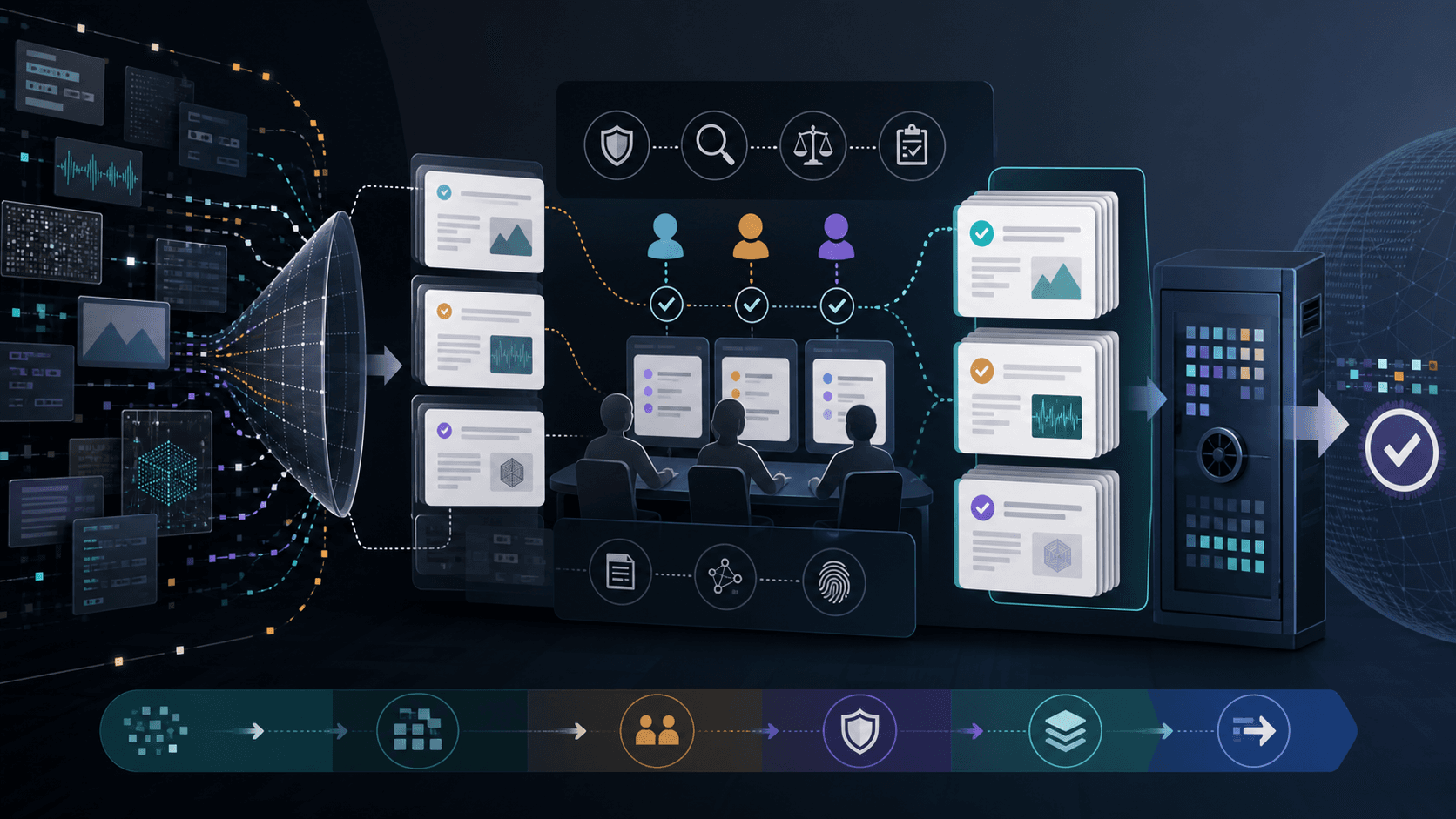
Scale AI sits in the least theatrical part of the AI stack. Its work is upstream of the model demo and downstream of the raw data dump. It is the place where an image, document, conversation, code answer, reasoning trace, safety scenario or operational record becomes something a model team can train on or evaluate against. The public story often makes this sound like a scale problem: more annotators, more labels, more tasks, more enterprise and government demand. The production story is narrower and harder. A buyer needs a unit of evidence that can be accepted.
An accepted unit is not merely a label. It is a record with a reason to exist, an instruction set, a taxonomy, a reviewer path, a provenance trail, an exportable result and enough context for another team to understand why it should influence a model. In Scale's task documentation, a task is the individual unit of work mapped to a piece of data to be labeled. In its key concepts documentation, projects organize tasks, batches group tasks and completed tasks produce structured responses. That is the right denominator for judging Scale because it is small enough to inspect and large enough to matter when repeated millions of times.
The same logic applies to evaluation. A model score is only as useful as the examples, rubrics, reviewers and sampling rules that produced it. Scale's model-developer evaluation page frames the problem as a shortage of high-quality, trustworthy evaluation datasets and consistency in reporting, while warning about risks such as misinformation, privacy, bias, cyber misuse and dangerous-substance content.
That product claim is important because it names the buyer's real problem: not whether a model can beat a benchmark once, but whether an organization can keep evaluating the right behavior without leaking the answers, training to the test or losing rater consistency over time.
This is why the useful question is not whether Scale has data operations, whether it has a large contributor network or whether a customer has used it. The useful question is whether Scale helps a buyer turn uncertainty into accepted evidence at a lower total cost than the alternatives. A raw example may be ambiguous. A policy may change. Two reviewers may disagree. A model may improve on the easy cases while failing the edge cases that matter. An automated judge may become a source of bias rather than a shortcut. A storage permission may be convenient during upload and dangerous during export.
A batch may look complete while the next team cannot reproduce the basis for acceptance.
The accepted unit also separates three layers that are usually blended together. Model capability is what the customer's model can do. Product reliability is whether Scale's tools, reviewers, APIs, dashboards and deployment choices can process evidence predictably. Customer production outcome is whether the buyer's real task improves after supervision, integration, review, exception handling, storage, security and switching costs are included. Scale can supply the second layer and influence the third. It does not own every customer model result.
That boundary is important for the existing Scale AI directory entity. Scale AI is the company being assessed here, along with Scale-operated surfaces such as Data Engine, Generative AI Data Engine, Scale Evaluation, GenAI Platform and Donovan. The article is not a judgment on every model trained with Scale data, every government program that names Scale, every customer application that sits on top of a model provider or every labor-market claim made about data work. Those may be relevant to buyer trust, but they are not the core technical denominator.
The core denominator is the accepted training or evaluation data unit. If that unit is reliable, Scale can become infrastructure. If it is not, Scale becomes expensive task routing.
Scale sells a repeat loop, not a finished model
Scale's strongest public product story is a loop. The Data Engine page frames the cycle as collecting, curating and annotating data, then training and evaluating models, then repeating. The Generative AI Data Engine page extends that story into tailored datasets, subject-matter expert review, RLHF, model evaluation, red-teaming and safety work. The loop matters because useful model development rarely ends with one dataset. A model fails in a new way, a buyer adds a new policy, an edge case appears in production, a regulator asks for evidence, a customer segment changes, or a model provider releases a new version. Then the data and evaluation process has to move again.
For buyers, this repeat loop is both the reason to consider Scale and the reason to be careful. A one-off labeling project can be managed like a services engagement. A repeat loop becomes operating infrastructure. Once a buyer's model team depends on a vendor for taxonomies, review processes, contributor pools, evaluation dashboards, red-team cases, storage integrations and exports, the vendor is no longer just filling a backlog. It is shaping what the buyer's organization counts as evidence.
Scale's documentation has real machinery behind that claim. Projects are tied to a use case and instructions. The project-management documentation says tasks in a project should share the same instructions and that significant instruction changes should create a new project. That is a small but important constraint. It recognizes that instruction drift changes the meaning of a label. If a team edits the definition of a harmful answer, a valid tax document, a lane marking, a clinically relevant symptom or a successful tool call halfway through a dataset, the resulting examples may no longer be comparable. A new project boundary can preserve meaning.
Batches add another operating layer. The batches API lets teams create batches inside projects, set callbacks, retrieve status and count tasks grouped by state. It also notes that prioritization affects tasks not yet started and does not guarantee completion order. That caveat is useful because production buyers often assume that a vendor queue behaves like an internal job scheduler. It may not. If an urgent set of examples is needed to diagnose a live model failure, the buyer has to know what priority can and cannot promise.
Callbacks make the unit operational. The callback documentation describes JSON results sent to buyer endpoints, retry behavior if no successful response is returned and events for task completion, audit status changes and recalled tasks. A callback is not a glamorous feature, but it is the difference between a web-console project and a system that can plug into a buyer's release process. If a completed task arrives with the right status, response and review state, the model team can trigger downstream validation, export, training or review. If callbacks fail silently or are not authenticated and monitored correctly, accepted units can get lost between teams.
Scale's commercial argument therefore depends on the loop being cheaper and more trustworthy than the buyer's alternatives. The alternatives are not imaginary. A large AI lab can build its own data operation. An enterprise can hire domain reviewers and run a lighter internal process. A cloud or model provider can offer evaluation tools close to the model API. Open-source evaluation frameworks can cover part of the task. A team can reduce the amount of work by narrowing the product, choosing a smaller model, avoiding high-risk automation or using human approval for fewer actions.
Scale wins only when its loop produces better accepted units per dollar and per week than those alternatives.
The buyer should resist the temptation to measure the loop by volume alone. More tasks completed is not the same as more useful evidence. If the wrong taxonomy is used, the output is precise waste. If reviewers disagree but the disagreement is hidden, the result is false confidence. If edge cases are under-sampled, the model may improve on average while failing the very situations that justify the project. If an evaluation set becomes familiar to the model-development team, the score can improve while real-world behavior does not. Volume is useful only when acceptance is meaningful.
Human agreement is the scarce resource
The hardest part of Scale's product is not moving data through an API. It is aligning humans and models around contested judgment. Many training and evaluation tasks are easy only in examples. A reviewer can identify a stop sign in a clear image, but model failures usually accumulate in the margins: occlusion, sensor noise, sarcasm, local context, ambiguous intent, low-resource language, policy conflicts, partial documents, mixed safety signals or examples where the right answer depends on a customer's internal rule.
The more economically valuable the model behavior, the more likely the evidence requires judgment rather than transcription.
Scale's public documentation shows that it understands review as a multi-step process. In its GenAI Platform labeling evaluation documentation, human annotators can work on assigned tasks, labels are saved, uncertain items can be skipped and tasks can be flagged for review with comments. In the auditing documentation, evaluation processes can have two audit levels, and the labeler, first auditor and second auditor must be different people. Auditors can approve, request revision or fix the task.
Those design choices matter. Reviewer separation reduces the risk that one person's misunderstanding becomes the final answer. Flagging uncertain tasks gives reviewers a path to preserve ambiguity rather than forcing every example into a false binary. Revision requests create a record that the first pass was not accepted. Metrics for contributors and auditors can help identify whether one reviewer is unusually lenient, unusually strict or inconsistent. These are not sufficient by themselves, but they are the right kinds of primitives.
The buyer still has to ask whether the primitives are used well. A two-level audit process can become a rubber stamp if reviewers are rushed, undertrained or optimizing for throughput. Contributor metrics can encourage superficial agreement if the target is too narrow. A skip option can protect quality, or it can become a way to avoid hard cases. A second auditor can improve judgment, or it can add cost without changing the outcome if the rubric is bad. The product surface can support quality; it cannot define the customer's truth.
This is why acceptance criteria have to be written before volume grows. Buyers should define what counts as agreement, what kinds of disagreement are acceptable, which examples require escalation, what evidence a reviewer must provide, how often gold-standard or expert-reviewed examples are inserted, when a taxonomy is revised and how old labels are migrated when policy changes. They should measure not only final acceptance rate, but first-pass rejection, revision frequency, inter-reviewer disagreement, skipped-task categories, time to resolve disputed examples and model impact after the accepted units are used.
Scale's Fixless Audits documentation is useful here because it treats feedback as structured data rather than just a comment. It documents feedback scope, severity, state, accepted or rejected outcomes and quality-score calculation rules. Its Pro Quality documentation shows approve, change and reject paths and reports review totals, task-level outcomes and reviewer-related information. That does not tell a buyer the resulting labels are good. It tells the buyer where to demand evidence.
The danger is false consensus. If a task is easy, reviewers agree. If a rubric is vague, reviewers may also agree because they infer the same shortcut from examples rather than applying the intended rule. If a buyer trains a model on that output, the model may learn the shortcut. Later, when the task moves into a new region, customer segment, document type or policy context, the shortcut breaks. A good data process therefore needs disagreement. It needs the system to surface where judgment is uncertain and where the rubric does not travel.
Scale's value rises when it makes disagreement visible, resolves it consistently and preserves the reason. Its value falls when it turns disagreement into a throughput problem.
Evaluation cannot be reduced to a leaderboard
Model evaluation is where Scale's buyer trust problem becomes most explicit. A training dataset can be inspected task by task, but an evaluation system becomes an authority inside the organization. It tells teams which model is better, whether a release is acceptable, whether a guardrail works, whether a red-team issue is fixed and whether a product can move from trial to production. If that authority is weak, the organization can confidently deploy the wrong behavior.
Scale's Evaluation for Model Developers product page identifies two problems that buyers should take seriously: trustworthy evaluation datasets and consistency. It also emphasizes proprietary evaluation sets and targeted evaluations. That is a sound direction because public benchmarks are often too generic or too exposed to answer a buyer's question. A bank evaluating customer-service answers, a defense user evaluating planning support, a media company evaluating summarization, and a software company evaluating code-assistant behavior do not need the same acceptance set. They need tasks that represent the failures they actually fear.
Academic evaluation work points in the same direction. Stanford's HELM project argues for evaluating language models across multiple dimensions such as accuracy, calibration, robustness, fairness, bias, toxicity and efficiency. That matters for Scale because a single score can hide the tradeoff that decides whether a model should be used. A model can be more accurate on average and less safe on a narrow class of high-risk requests. It can be efficient and poorly calibrated. It can perform well in English and poorly in a local language. It can avoid offensive content and still give unqualified advice. A serious evaluation system has to preserve those dimensions rather than collapsing them into a procurement-friendly number.
There is also the contamination problem. Research on benchmark contamination, including the ACL Anthology paper on data contamination in modern LLM benchmarks, shows why overlap between training material and evaluation material can make performance look better than it is. The risk is not limited to public benchmarks. A private buyer can contaminate its own evaluation set by using the same examples for tuning, instruction iteration, reviewer training and release approval. The more a team optimizes against a fixed evaluation set, the more the set can stop measuring general capability and start measuring familiarity.
Scale's GenAI Platform documentation shows several tools that can help if the buyer uses them with discipline. The next-generation evaluation overview describes evaluations as data rows and tasks, with reusable datasets and asynchronous results. The auto evaluation documentation describes model-based guided decoding that can return reasons and scores. The evaluation dashboards documentation describes monitoring metrics through tables, charts, histograms, scatter plots, time series and aggregation queries. The tracing overview describes spans and traces that capture inputs, outputs, IDs, timing, metadata, status and type.
Together, those pieces can support a serious evaluation process. They can let a buyer assemble rows, run human and automated tasks, inspect traces, monitor trends and compare releases. But they also create new responsibilities. Automated judges need their own validation. Dashboards need sampling rules. Traces may contain sensitive data. Reusable datasets need versioning and contamination controls. Time-series improvement can reflect a real product gain, a changed sample, a different judge, a cleaned-up instruction pattern or a shift in the user population. The dashboard is not the truth; it is an instrument that has to be calibrated.
The useful buyer question is therefore not, "Can Scale run evaluations?" It can. The useful question is, "Can Scale help us prove that the evaluation still means what we think it means?" That proof requires held-out examples, reviewer calibration, fresh adversarial cases, explicit policy versions, reason capture, contamination checks, confidence intervals where practical and a release rule that prevents teams from optimizing only for the displayed score.
Evaluation is valuable when it creates friction at the right moment. It should slow a release when hallucination, privacy, safety, bias, legal, domain-specific or customer-context failures appear. It should identify the failure class that needs more data. It should distinguish between a model improvement, a configuration workaround and a measurement artifact. If Scale's evaluation surface does that, it is a buyer-trust product. If it merely gives a score, it is a prettier benchmark.
Provenance and storage are quality controls
Data provenance is often treated as a compliance topic, but in a training and evaluation system it is a quality topic first. A model team needs to know where an example came from, which version of an instruction applied, who or what reviewed it, what data was attached, what result was exported and whether the record can be reused for the next model. If those facts are missing, the team can still train a model, but it cannot explain why the evidence should be trusted.
Scale's docs expose several provenance surfaces. Task metadata and tags can carry buyer-side context. Batches can segment work by project, timing or operational grouping. Callback payloads can carry completion and review changes into the buyer's system. Traces in the GenAI Platform can preserve inputs, outputs and status for units of work. Workflows can import from traces, CSV files, databases and cloud storage, call models or application services, join ground truth, run judge tasks, export as evaluations and schedule repeated runs, according to Scale's workflows introduction and evaluation workflow guide.
These are the foundations of a useful record. They let a buyer reconstruct how an example moved from raw source to accepted output. They also make it possible to separate evidence generated by a human, evidence generated by an automated judge, evidence imported from a buyer system and evidence inferred from a model run. That distinction matters because not all evidence should have the same authority. A human expert's rejection of a medical answer is not equivalent to a cheap model judge score. A trace of a customer-specific tool call is not equivalent to a generic benchmark row.
A red-team case written after an incident may deserve more weight than a routine validation example.
Storage and access controls shape whether that record can be trusted. Scale's public documentation shows practical integration choices. The AWS S3 documentation recommends delegated IAM access with an external ID and warns about confused-deputy risk in certain cross-account patterns. The Google Cloud Storage documentation similarly warns about guessed URL risks in cross-project access patterns. The Azure Blob Storage documentation notes that unlinking a connection in Scale does not revoke Azure permissions. These are not abstract legal footnotes. They are operational facts that decide whether a buyer knows who can still read the underlying data.
The secure result URL documentation is especially important. It says some segmentation, video and lidar results are uploaded by default to public S3 result URLs with UUIDs, while authenticated result URLs can be enabled by contacting support. That does not mean a buyer should panic, and it does not prove a bad deployment. It means result delivery is a configuration issue that belongs in the acceptance plan. If the data is sensitive, the buyer should know whether results require authentication, how long links remain usable, where entities are stored, how access is logged and whether downstream teams copy results into less controlled locations.
Data locality and sovereignty add another layer. Scale's public surfaces include government and secure-deployment claims, including Donovan's positioning around classified, air-gapped and FedRAMP High contexts. The FedRAMP Marketplace lists Scale AI Data Platform as FedRAMP Certified, Class D High, with certification date September 9, 2024. That is significant for public-sector buyers because it shows an authorization path for a defined product. It does not automatically solve every locality, classification, mission, export-control or customer-data requirement.
The right conclusion is that provenance and storage are part of the product, not after-the-fact controls. If a buyer cannot trace an accepted data unit back to its source, policy version, reviewer path and result location, the unit is fragile. It may still be useful for a quick experiment, but it is not strong enough to govern a model release or support a serious audit.
Reliability is visible in limits, callbacks and incidents
Reliability for Scale should be measured at two levels. The first is the reliability of the product surface: APIs, task state, callbacks, dashboards, storage access, identity and product availability. The second is the reliability of the produced evidence: labels, evaluation results, reviewer decisions and traces. Both matter, and they can fail independently. A stable API can deliver weak labels. A strong reviewer process can be blocked by a service outage or broken callback.
The public API documentation gives buyers enough detail to start a reliability checklist. The authentication documentation separates live and test modes and notes that live tasks are completed by humans and incur charges, while test mode can return incorrect test responses. That is a reminder that integration tests are not quality tests. A buyer can validate API wiring in a test environment, but it cannot infer human data quality from test responses. Live validation requires a controlled sample and budget.
Technical limits matter too. The technical limits documentation lists limits such as task creation request rates, metadata size, attribute count, file-upload metadata, attachment size and browser-support guidance. These are not disqualifying constraints. Every platform has limits. The point is that they should be counted before a buyer commits a high-volume process. A data operation that depends on rich metadata, large attachments or rapid task submission needs to design around those constraints rather than discovering them in production.
Error handling is another accepted-unit issue. The errors documentation covers attachment failures, authentication errors, payment errors, missing resources, idempotency conflicts, rate limits and server errors. The callbacks documentation says callback retries can continue for up to 20 attempts over 24 hours if a successful response is not received. Buyers should turn those facts into controls: dead-letter handling, replay procedures, duplicate detection, callback authentication, alerting, delayed export handling and reconciliation between Scale's task state and the buyer's system.
Scale's public status page adds a useful but incomplete operating signal. On July 11, 2026, the status summary endpoint reported all systems operational across components including API, Platform, Web Application, Document AI, Nucleus, Spellbook, Catalog Forge, Catalog Explorer and Donovan. The public incidents endpoint returned a history of resolved incidents, including degraded performance in January 2025, Nucleus degraded performance in March 2024, a Donovan web application outage in November 2023 and earlier platform or application issues.
That history should neither be exaggerated nor ignored. A status page is vendor-operated and often sparse. It does not provide a full service-level dataset, root-cause analysis or customer-specific impact. But it does prove that the product surface has had public incidents and that buyers should design around delay, degradation and component-specific outage. For a data or evaluation operation, downtime can have a second-order effect: model releases wait, review queues back up, incident triage lacks fresh examples and a team may deploy a model without the intended evaluation pass.
Buyers should define reliability at the accepted-unit level. How many submitted tasks reach a terminal state? How many accepted units are delivered to the buyer's system without manual reconciliation? How often do callbacks fail or require replay? How often are attachment errors caused by buyer storage permissions? How quickly can a rejected task be corrected? How much review work is delayed by platform issues? How many evaluation runs are invalidated by missing traces or changed judge configuration? These are better questions than whether the marketing page says the platform is enterprise-ready.
Scale's opportunity is that its primitives are explicit enough for this measurement. Its risk is that buyers may mistake the existence of primitives for a guarantee of outcome.
Customer stories and government awards are demand signals, not acceptance proof
Scale has visible demand signals. Its homepage says it works with leading AI labs, enterprises and governments. Its product pages describe work for data, evaluation and AI applications. Its TIME customer story describes TIME AI features such as summaries, voice, translation and chat, with fine-tuning, red-teaming, guardrails, monitoring and thousands of attack vectors. The Defense Innovation Unit announced Thunderforge, a prototype effort involving Scale AI for AI-powered decision support in operational and theater planning. Scale also announced that the Department of Defense Chief Digital and Artificial Intelligence Office expanded an enterprise agreement to a $500 million ceiling, covering areas such as computer vision, decision support and data operations.
These are meaningful market signals. They show that buyers with serious needs are willing to evaluate or use Scale. They also show why the accepted-unit lens is necessary. A customer story is not an independent return-on-investment study. A government prototype is not proof of final mission success. A contract ceiling is not the same as consumed value. A customer logo cannot tell a different buyer whether a taxonomy was good, reviewers agreed, data stayed within required boundaries, red-team findings changed the model, or the evaluation set predicted production behavior.
The same caution applies to defense and public-sector evidence. Public-sector adoption raises the stakes because the accepted unit may influence decision support, intelligence workflows, operational planning or mission software. Scale's Donovan page emphasizes test, evaluation, monitoring, guardrails, traceability, model agnosticism and secure deployment options. Those are the right categories for public-sector buyers to care about. But the more consequential the use, the more conservative the evidence standard should be. A model-backed suggestion in a mission context should not be accepted because a dashboard is neat. It should be accepted because the reference, retrieval context, model output, review path, failure handling and human authority are all clear.
Commercial buyers face the same pattern at lower stakes. A media company can use generative AI to summarize articles or answer reader questions. A software company can use evaluations to compare coding assistants. A financial institution can review document extraction. A retailer can train a recommendation or fraud model. In each case, the buyer should ask: What is the accepted unit? Who reviewed it? What did the reviewer see? How are mistakes found? What happens when policy changes? Which examples are held out? How do we know the model improved because the data improved?
Scale's customer evidence is strongest when used as a map of possible use cases. It is weakest when used as proof that any specific buyer will see the same outcome. The buyer's task, data, risk tolerance, reviewer pool, security environment and release process decide whether the outcome travels.
This is especially important because many AI procurement decisions are made under pressure. Executives want visible adoption. Product teams want to move fast. Model teams want better data. Security teams want controls. Finance teams want to know whether the spend creates measurable model improvement. The accepted-unit denominator gives all of them a shared language. It shifts the discussion from "Who else uses Scale?" to "What exactly are we accepting, and what evidence makes it acceptable?"
The Meta investment made neutrality a product issue
Corporate structure usually belongs outside a technical evaluation, but in Scale's case it intersects with buyer trust. In June 2025, Scale announced a Meta investment valuing the company at more than $29 billion, with Alexandr Wang joining Meta while remaining on Scale's board, Jason Droege becoming interim CEO and Meta holding a minority equity position. Scale said it remained independent and would continue safeguarding customer data. Soon after, TechCrunch, citing Reuters and company responses, reported concerns that some major customers were reassessing relationships after Meta's investment.
The technical issue is not whether every reported customer reaction happened exactly as described. The buyer issue is simpler: Scale handles sensitive model-development evidence. An AI lab, enterprise or government customer may submit data that reveals model weaknesses, product direction, safety failures, evaluation rubrics, private instruction patterns, domain-specific edge cases, customer data or future release priorities. Even if the contractual protections are strong, the perception of neutrality matters because the submitted data can be strategically sensitive.
Scale's answer has to be operational, not rhetorical. Buyers should look for contractual data-use boundaries, access controls, segregation, audit rights, retention rules, storage location, reviewer access policy, subcontractor handling, export procedures, incident notification, deletion process and clear commitments around competitive information. They should also examine how Scale handles customer-specific evaluation sets. If a buyer's private evaluation set is the crown jewel, it should not be casually reused, exposed to competitors or used to improve a generalized service without explicit permission.
This does not mean the Meta investment makes Scale unusable. Many enterprise vendors serve competitors while maintaining data boundaries. Cloud providers host rivals. Software vendors analyze sensitive customer data under contractual restrictions. Defense contractors support multiple programs. The question is whether Scale can make the boundary credible enough for buyers whose data and evaluations reveal model strategy.
The accepted-unit lens helps again. For each unit, a buyer should know what data entered Scale, who or what processed it, which model or reviewer saw it, where the result was stored, what metadata attached to it and whether it can be deleted, exported or isolated. If that record is strong, corporate neutrality concerns can be managed through contracts and controls. If the record is weak, trust depends on assurances.
In AI, assurances are not enough. The artifacts are too valuable.
The economics are marginal, not magical
Scale's commercial question is whether better data and evaluation outcomes exceed the costs of annotation labor, expert review, security setup, integration, rework, vendor dependence and marginal model improvement. That sentence is deliberately unromantic because data quality does not create value by itself. It creates value only when it changes a model, product or decision enough to justify the cost.
The most common mistake is to compare Scale's unit price with an internal hourly rate or with a simplistic model-provider evaluation feature. That misses the whole cost stack. A buyer pays for project design, taxonomy writing, sample selection, storage integration, security review, legal review, model-team time, reviewer calibration, audit design, rework, export, monitoring, dashboard interpretation and the downstream experiment that proves whether the accepted units improved the model. If the model improvement is small, expensive evidence can still be a poor investment.
The second mistake is to treat human review as a fixed cost. Human review becomes more expensive as the task becomes more ambiguous, more sensitive, more domain-specific or more multilingual. A general reviewer can classify obvious content. A domain expert may be needed for medical, legal, defense, network, code, finance or safety tasks. Scale's GenAI Data Engine positioning around subject-matter experts is commercially attractive for exactly that reason, but expert review changes the economics. The buyer should measure cost per accepted expert-reviewed unit, not just cost per submitted task.
The third mistake is to ignore rework. Rework is not only rejected tasks. It includes unclear instructions, taxonomy changes, reviewer retraining, storage permission fixes, callback reconciliation, evaluation-set refresh, contamination investigation, duplicated labels, stale examples and model experiments that fail to benefit from the new data. Scale's review and audit primitives can surface rework if buyers instrument them. If they do not, rework becomes invisible margin erosion.
The right economic metric is marginal model or product improvement per accepted unit. For training data, the buyer should compare model behavior before and after adding accepted examples, preferably by failure class. Did hallucinations fall for the target category? Did extraction accuracy improve on hard documents? Did a vision model handle the edge condition better? Did a policy model make fewer unsafe approvals? Did the model improve on held-out examples that were not used to tune the process? If not, the accepted units may be well-formed but strategically low value.
For evaluation, the metric is different. A good evaluation system may not improve the model directly. It can prevent a bad release, find a failure early, shorten debugging time, reveal model regressions, support governance or make a risky use case unacceptable before it causes harm. That value is real but harder to count. Buyers should track avoided release incidents, time to identify failure class, number of release-blocking findings, reduction in manual review per release, confidence in model comparisons and whether the evaluation predicts observed production issues.
Scale's value proposition is strongest where the buyer has repeated, high-stakes evidence needs and no appetite to build the full data operation alone. Frontier model developers, enterprise AI teams and government users fit that profile because they need a steady supply of trusted examples, evaluation rubrics, red-team cases and review artifacts. The value proposition is weaker where the task is simple, one-off, low-risk, easily handled by internal reviewers or not connected to a measurable model decision.
Doing less of the task is a legitimate alternative. If a model application cannot be evaluated well enough, the answer may be to narrow the product, keep human approval, avoid automation in a sensitive segment or delay deployment. Scale competes not only with other vendors, but with restraint.
What buyers should measure before they scale
A buyer evaluating Scale should begin with a small, representative acceptance plan. The plan should not ask, "Can Scale process our data?" It should ask, "Can Scale produce accepted units that change a model decision or release decision in a way we can verify?" That plan needs a denominator, a sample, a baseline and a failure taxonomy.
For data work, the buyer should define the unit type: image label, document extraction, safety classification, code answer review, reasoning-trace judgment, preference pair, red-team case, retrieval-grounded answer, tool-call evaluation or expert correction. It should define the source data, instruction version, taxonomy, reviewer qualifications, escalation path and export format. It should include known hard cases and examples where the correct answer is intentionally ambiguous. If every trial example is easy, the test is mostly integration theater.
The first metric is first-pass acceptance. How many submitted units are accepted without correction? The second is disagreement. How often do reviewers differ, and on which categories? The third is rework. How many units require changed instructions, revised labels or additional expert review? The fourth is provenance completeness. Can the buyer reconstruct source, instruction version, reviewer path, result and export destination for each accepted unit? The fifth is model impact. Does adding or using the accepted unit improve the target behavior on a held-out set?
For evaluation work, the buyer should measure stability and predictiveness. If the same model is evaluated twice under the same conditions, how much does the score move? If reviewers change, does the result hold? If an automated judge is used, how often does it agree with expert human review on hard cases? Does the evaluation catch known historical failures? Does it identify new failures that production logs later confirm? Does it remain useful after the model team has seen some of the examples, or does it become a training target?
For security and data governance, the buyer should review the storage and result path before any sensitive data is submitted. Which cloud storage permissions are granted? Who can revoke them? Are result URLs authenticated? Where are traces stored? What is retained after export? Are callback endpoints authenticated and logged? Are API keys separated by environment? Are reviewer and auditor roles limited to the right data? Do public-sector or regulated deployments require FedRAMP-authorized surfaces, air-gapped environments, region restrictions or customer-managed keys?
For reliability, the buyer should instrument the path from submission to downstream use. Task submitted is not task accepted. Task accepted is not task consumed by the training or evaluation process. Training or evaluation consumed is not product improvement. Each handoff should have reconciliation. Callback failures, delayed batches, attachment errors, audit-status changes and rejected tasks should be visible. Status-page incidents should have buyer-side playbooks: what pauses, what retries, what falls back and what release decisions wait.
For vendor dependence, the buyer should design an exit test. Can accepted units be exported in a useful format? Can the taxonomy be recreated elsewhere? Can reviewer comments and audit states travel? Are private evaluation sets portable? Are workflow definitions and dashboards replaceable? Can the buyer run a reduced internal process if Scale is unavailable or strategically unsuitable? Switching cost is not a reason to avoid a vendor, but it should be known before dependence grows.
These measurements are not anti-Scale. They are the conditions under which Scale can prove its value. A buyer that does this work may discover that Scale is significantly better than internal operations or scattered tooling. It may also discover that a narrow in-house review process is enough. Either result is better than buying volume without acceptance.
The verdict
Scale AI is one of the most important companies in the AI evidence layer because the industry has learned that models are limited by data quality, evaluation quality and the discipline of review. Its public product surfaces show serious machinery: task and batch APIs, taxonomies, callbacks, audits, reviewer separation, evaluation rows, dashboards, traces, workflow orchestration, cloud-storage integrations, secure-deployment claims and public-sector authorization signals. Those are the right building blocks for a company trying to turn uncertain data into accepted training and evaluation units.
The building blocks do not settle the question. The hard work is not the existence of tasks. It is whether the task means the same thing after thousands of examples, several reviewers, policy changes, storage handoffs, model iterations and release decisions. It is whether an evaluation set remains fresh and uncontaminated. It is whether automated judges help rather than laundering model bias into a score. It is whether private data and private evaluation logic stay within the buyer's intended boundary. It is whether the marginal improvement in model behavior is worth the cost of the evidence operation.
Scale's market signals are strong. AI labs, enterprises and public-sector buyers have reasons to want an external system for data and evaluation work. FedRAMP authorization and defense-facing product claims make Scale relevant in environments where buyer trust is not optional. The Meta investment and customer-reaction reporting make neutrality and data boundaries more important, not less. Customer stories and contract announcements should increase scrutiny, not replace it.
The best case for Scale is not that every customer should outsource data work to the largest visible vendor. The best case is that modern AI teams need a repeatable way to manufacture trustworthy evidence, and Scale has assembled many of the product primitives required to do it. The best criticism is that evidence quality is local. It depends on the buyer's instructions, reviewers, data, edge cases, security choices and release discipline. No vendor can make a weak acceptance process strong by processing it at scale.
So the buyer's decision should be concrete. Pick the model behavior that matters. Define the accepted unit. Run a representative sample. Measure reviewer agreement, provenance, rework, contamination risk, security configuration and model impact. Compare Scale against internal review, model-provider tools, open-source evaluation stacks and a narrower product scope. Then scale the process only if the accepted unit survives.
Scale AI's real product is trust in the unit of data that a model team is willing to use. That trust is expensive, fragile and measurable. It is also exactly where the next phase of AI competition will be decided.