
Summary
- Ori Global Edge should be judged less by AI-cloud ambition and more by whether the Radiant AI Cloud can keep a workload's capacity, location, access, scheduling, monitoring, billing and support state coherent as demand changes.
- The public record supports a real service surface across GPU virtual machines, serverless Kubernetes, inference endpoints, object storage, support handling and facility-certification lists, while leaving uncertainty around named customers, actual utilization, facility-level capacity and handoff between the Ori service surface and Radiant's larger infrastructure plan.
The real unit of value is an accepted workload
AI infrastructure companies are often described through the largest nouns available: factories, sovereign clouds, national capacity, utility-scale compute and global GPU fleets. Ori Global Edge deserves a narrower test. The service is valuable when an AI builder, enterprise platform team, sovereign buyer or operator can move from a compute request to an accepted workload with the operational facts still attached.
That means the buyer knows which capacity is being used, where it is running, who can access it, how it is scheduled, how it is monitored, what it costs while active or idle, what happens when it fails and which party owns the next support step.
That is the lens that separates usable AI infrastructure from AI-infrastructure ambition. A cloud page can list GPUs. A platform page can promise orchestration. A sovereign page can talk about control. None of those claims settles whether a repeated workload can be placed, observed, billed and recovered without a human team reconstructing state across consoles, tickets, spreadsheets and vendor emails. In AI infrastructure, the record around the workload is not clerical detail. It is the operating surface.
Ori's public service surface, now presented through Radiant after the merger signal, gives enough evidence to examine that operating surface. Radiant presents itself as a vertically integrated AI infrastructure company that brings capital, power, data-centre development, GPU compute and software together. Its documentation describes a cloud platform with GPU virtual machines, serverless Kubernetes, bare-metal supercomputer services, inference endpoints, fine-tuning, model registry, volumes and S3-compatible object storage. Its support material describes tickets, affected resource identifiers, reproduction steps, logs and response tiers.
Its billing pages describe per-minute charging for virtual machines and Kubernetes resources. Its data-centre certification page lists public cloud hosting locations and security or compliance certifications. Those are concrete components.
The question is whether those components close the loop. Ori Global Edge is not being tested here as a generic cloud provider. It is being tested by the accepted AI-infrastructure workload record: the point at which a customer can say that a requested training, fine-tuning, inference or platform job has become a governed piece of compute, with its constraints visible enough to run again, troubleshoot and price. When capacity and demand change, the record must change with them. If it does not, the customer gets GPU access but not operational control.
The identity boundary matters
There is a naming trap around Ori. The relevant service boundary is the existing Ori Global Edge directory entity, the ori.co service entrance that now resolves into Radiant's public material, and the UK company record that shows Ori Industries 1 Limited becoming Radiant Infrastructure 1 Limited in May 2026. Radiant's own terms identify Ori Industries 1 Ltd trading as Radiant as the company behind the Radiant AI Cloud user agreement.
Companies House records list Radiant Infrastructure 1 Limited as an active private limited company incorporated in October 2018, previously named Ori Industries 1 Limited, with a London registered office and a business classification for other information technology service activities.
That boundary is different from unrelated Ori brands and from a dissolved UK company named Ori Industries Ltd, which Companies House lists separately with a 2019 dissolution. It is also different from customer workloads, upstream data-centre operators, GPU suppliers and the broader Brookfield infrastructure program. The public cloud surface may be operated under Radiant, but the directory subject remains Ori Global Edge and the service history around ori.co. The analysis should not treat every Radiant claim as proof of what Ori already delivered, nor should it detach Ori from the Radiant platform that now carries its product.
The merger is central to the commercial question. Radiant's press release says the company merged with Ori Industries to combine Ori's distributed AI infrastructure platform with Radiant's global infrastructure capabilities. Independent coverage from Data Center Dynamics and Tech.eu reported the same basic transaction in February 2026. Those reports framed Ori as the software and AI cloud layer and Radiant as the capital, power and physical infrastructure vehicle. That creates a useful operating hypothesis: Ori's value is not only in owning compute.
It is in making compute usable as a repeatable service layer on top of power, facilities, accelerated hardware and network fabric.
The risk is that a larger infrastructure story can blur the accepted workload. A customer buying an on-demand GPU instance, a managed Kubernetes service or an inference endpoint does not experience the whole capital stack. The customer experiences placement, login, quota, drivers, images, data movement, model deployment, billing, support and recovery. If those items are clear, Radiant's scale story may add supply assurance. If they are unclear, the scale story becomes background noise.
What the public service surface actually shows
The public documentation supports a real cloud service surface rather than a purely speculative infrastructure page. Radiant AI Cloud documentation describes virtual machines for AI and machine-learning workloads, including multiple GPU types, fractional GPU configurations, per-minute billing and suspend, resume and restart actions. It describes serverless Kubernetes as a managed environment in which nodes are automatically managed and customers use a familiar Kubernetes experience. It lists GPU types for Kubernetes including H100-class, H200-class, L40S and L4 options.
It describes inference endpoints as a way to deploy machine-learning models as scalable API endpoints, with pre-trained models available and custom models described as coming later. It describes object storage as S3-compatible and globally available, with versioning.
That is enough to infer the basic work path. A team chooses a workload shape, selects a compute service, attaches access and identity, places data, launches the job, watches its behavior, pays for the resources consumed and asks support for help when the state does not match expectations. The service surface is not only raw GPU rental. It includes the control layers that determine whether AI work is repeatable.
The platform also exposes several types of abstraction, each with a different risk profile. A GPU virtual machine gives the customer flexibility and a familiar server model, but it leaves more responsibility for drivers, software state, resource cleanup and security posture. Serverless Kubernetes removes node management from the customer, but it makes orchestration correctness and quota transparency more important. Inference endpoints simplify serving, but they require clarity about model choice, location, scaling behavior, endpoint isolation and billing.
Object storage is necessary for datasets, model weights and artifacts, but it creates questions about data locality, egress, versioning and retention.
Radiant's marketing pages push beyond the docs. They describe AI Cloud, sovereign solutions and strategic infrastructure. The strongest public product claim is integration: the idea that software, accelerated compute, land, power and capital can be designed as one system instead of procured separately. That is the right problem to attack, because AI infrastructure fails when one layer is ready and another is not. GPUs without power are stranded. Power without network and cooling is not compute. Compute without scheduling and access control is not a service.
A model registry without deployment rights is a catalog, not an operating platform.
The public material does not, however, prove the hardest operational facts. It does not publish a live inventory by location, utilization level, customer acceptance history, incident record, support resolution history or facility-specific capacity map. It does not name a broad set of paying customers for the cloud surface. It makes strong claims about scale and integration, but the accepted-workload test must stay grounded in what a customer can verify during procurement, onboarding and operation.
The accepted workload record
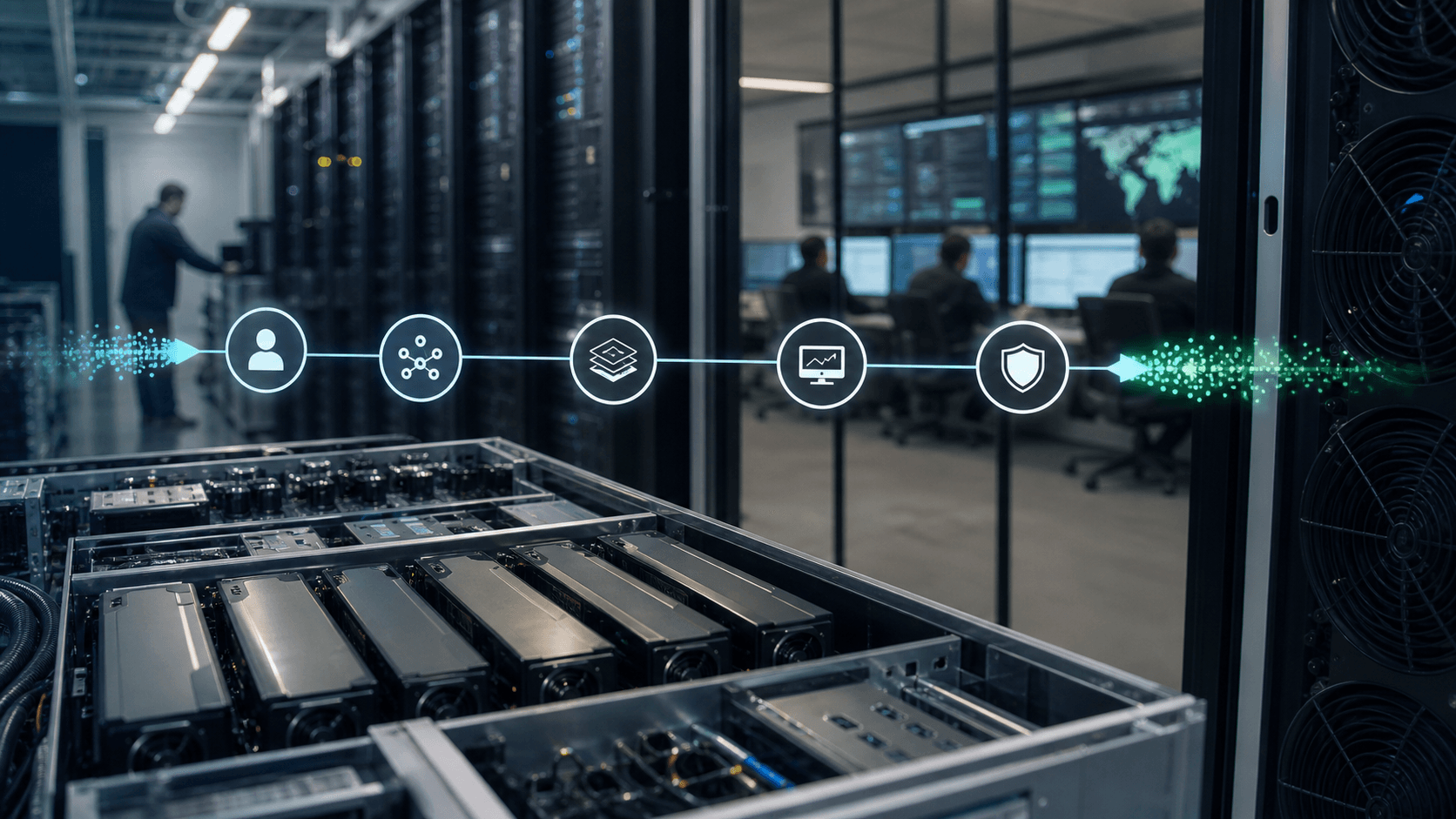
An accepted AI-infrastructure workload record has seven practical parts.
First is capacity. The buyer needs to know what GPU class, quantity and configuration were actually accepted. A promise of GPU availability is not enough. The record should distinguish a quoted configuration from a reserved one, a reserved one from an active one, and an active one from a healthy one. In AI work, a small mismatch can invalidate the run. A training job sized for one accelerator class may not behave the same on another. An inference endpoint may meet a functional need while missing a latency or residency requirement. A Kubernetes pod may be accepted by the control plane but wait for a resource that is not actually available.
Second is location. Radiant's certification page lists public cloud hosting data-centre locations in several countries, including London, Frankfurt, Singapore, Tokyo, Sydney, Canadian and US locations, with SOC 2 or ISO 27001 status indicated for many. That is useful, but a workload record needs more than a location list. It needs the specific region or facility boundary that applies to the workload, the policy that keeps data and control where the buyer expects, and a clear warning when capacity can only be met by changing location.
Third is access. Radiant's documentation includes role, two-factor authentication and SSH-key surfaces. Access state is not a side issue. AI infrastructure frequently handles proprietary models, regulated datasets, credentials, training artifacts and private application logic. If access drifts after launch, the customer may retain compute but lose control. The accepted record should show which organization, user, role, key and support actor can touch the resource.
Fourth is orchestration. The platform describes managed Kubernetes, virtual machines, supercomputer services, inference endpoints and model-related services. Those choices create different scheduling semantics. A managed Kubernetes service should make node provisioning and scaling easier for the user, but the accepted record still needs pod placement, node selector, quota and failure state. A virtual machine is easier to reason about at the server level but can increase manual cleanup and configuration burden. An inference endpoint simplifies the application interface but can hide the state that matters when capacity is constrained.
Fifth is monitoring. The public docs show support expectations and resource identifiers, but they do not publish a complete observability contract. A buyer needs to know which metrics are visible to the customer, which events are visible only to the provider, and how failures are correlated across VM, cluster, endpoint, storage and facility layers. Without that, monitoring becomes a blind spot. The customer may see a slow job while the provider sees capacity contention, network pressure, storage delay or facility maintenance.
Sixth is cost. Radiant docs describe per-minute charging for virtual machines and Kubernetes resources, with details for billable VM states and granular Kubernetes components such as GPU, vCPU, memory and load balancer resources. Those details matter because AI teams run experiments, pause jobs, relaunch failed runs and hold data between attempts. An accepted workload record should preserve active, suspended, idle and deleted states with enough billing evidence to prevent surprise.
Seventh is recovery. Support material asks customers to provide affected resources, reproduction steps, logs or screenshots, and it sets response targets by severity. That is a start. Recovery becomes real when a failed workload can be reconstructed from the record instead of from memory. A support team should not need to guess which VM, cluster, endpoint, dataset, model version, region, key, quota and billable state were involved. The customer's supervision cost depends on that evidence.
Capability is not the same as reliability
Ori Global Edge's public surface is strongest on capability. It shows GPU instances, managed Kubernetes, endpoints, object storage and a broader Radiant story around AI factories. Capability answers whether the platform can offer the classes of service an AI team expects. Reliability asks whether those services keep their promises under repeated use.
The difference is important. A platform can support H100-class GPUs and still fail a customer if the requested capacity is not available in the expected location. It can expose Kubernetes and still fail if node selection, quota and resource accounting are unclear. It can provide an inference endpoint and still fail if model placement or scaling behavior is opaque. It can bill by the minute and still fail if suspended, idle or failed states are not visible. It can list data-centre certifications and still fail if the customer cannot map a workload to the certified boundary that matters.
Reliability also depends on what happens when demand changes. AI workloads are not static web servers with predictable baselines. Teams burst during training, hold capacity for release windows, pause experiments, move data to new regions, resize inference endpoints, test model variants and shift from exploration to deployment. A service provider earns trust when those changes preserve state. If a customer has to relitigate access, quotas, region, billing and support context on every change, the cloud has not reduced operational work. It has moved it.
This is where Radiant's integrated-infrastructure thesis is commercially relevant. Hyperscale clouds can offer enormous service catalogs and mature enterprise controls. Specialist GPU clouds can offer faster access to scarce accelerators. Direct colocation can offer physical control. Self-managed clusters can offer maximum customization. Ori and Radiant need to beat those substitutes not by sounding larger, but by reducing the procurement and deployment work that sits between a business need and a running AI workload.
That is a hard commercial promise. The buyer is not only comparing hourly GPU prices. The buyer is comparing the cost of finding capacity, validating location, checking power and facility credibility, wiring identity and access, integrating storage, proving compliance, scheduling jobs, monitoring failures, controlling idle spend and managing support handoff. If integrated AI infrastructure removes enough of that work, it has a reason to exist. If it leaves the same work to the customer, it becomes another GPU supply option in a crowded field.
Repeated task behavior is where the model is tested
The accepted record is most useful when the same task repeats. Consider a platform team that fine-tunes a model weekly, serves it through an endpoint, stores weights in object storage and periodically moves larger experiments to Kubernetes or bare metal. The first run proves that the service can be made to work. The fifth run proves whether the service has become an operating model.
On each run, capacity has to be checked again. A GPU type that was available last week may be scarce this week. A fractional instance may be enough for development but not for a release run. A Kubernetes pod may need a specific accelerator type or memory shape. If the platform surfaces those constraints early, the team can plan. If it surfaces them after deployment attempts fail, the team pays in engineering time.
Location has to be checked again. The public service surface talks about global availability and lists several hosting locations. For a customer with sovereignty or latency constraints, it is not enough to know that the platform has locations globally. The repeated task must preserve where data rests, where models run, where logs are stored and where the control plane acts. A change in region can be a compliance event, not just a scheduling detail.
Access has to be checked again. Teams add users, rotate keys, change roles and involve support. Managed infrastructure reduces some setup burden, but it also creates shared responsibility. The provider must make access behavior predictable, and the customer must supervise credentials, organizations and roles. Two-factor authentication and support portals are useful only if they are part of the same evidence chain as the compute.
Cost has to be checked again. Per-minute billing is attractive for experiments and burst work, but it gives customers a new discipline: terminate what should be terminated, suspend what should be suspended, and understand which states remain billable. The docs' distinction between active, suspended and storage-billed states points in the right direction. The commercial value comes when those states are clear enough for finance and engineering to agree on what happened.
Recovery has to be checked again. If a cluster creation fails, an endpoint cannot access a model, a VM is unreachable or a storage operation breaks a run, the record must allow the support conversation to start from facts. The support page's request for affected resource identifiers, reproduction steps and logs is the correct shape. The remaining question is whether the platform automatically preserves enough of that context for repeated AI work, or whether the customer has to assemble it manually each time.
Deployment conditions are not only software conditions
AI infrastructure is unusually physical for a cloud category. The software layer matters, but the bottlenecks often sit underneath it: electrical capacity, cooling, networking, hardware supply, facility readiness, interconnection timing and operations staffing. Radiant's public strategy leans directly into this problem by emphasizing powered land, data-centre development, capital and NVIDIA-based infrastructure. That is the right terrain. It is also the terrain where public claims need caution.
The broader market context supports the concern. The International Energy Agency expects data-centre electricity consumption to grow sharply by 2030, with AI a major driver. Uptime Institute's 2025 survey materials point to worsening power constraints, rising costs, staffing challenges and AI density demands. NVIDIA's DSX reference design material frames AI factories as full-stack systems that include compute, networking and storage rather than only accelerators. These sources do not prove that Radiant can solve the problem for any particular customer, but they explain why a vertically integrated pitch exists.
For Ori Global Edge, the key deployment condition is coherence between the cloud surface and the facility surface. If a customer buys an on-demand GPU VM, the customer may not need to understand every power contract. But if the same customer grows into a sovereign deployment, a long-term enterprise cluster or a regulated inference estate, facility facts become commercial facts. Power availability, cooling density, network fabric, region selection and operating handoff all affect whether the workload can be accepted and repeated.
The data-centre certification page is a useful public artifact because it shows that Radiant wants customers to think about facility compliance. It lists several hosting locations and indicates SOC 2 or ISO 27001 status for many. The limitation is that certification lists are not capacity maps. They do not show how many GPUs are available, how much power is reserved, how liquid cooling is configured, which workloads are isolated, or how maintenance windows are handled. A buyer still needs facility-level answers during procurement.
The same is true for sovereign claims. Radiant's sovereign-solutions page emphasizes domestic control, policy enforcement, data boundaries and control-plane operation within national limits. Those are valid requirements for sovereign buyers. The accepted-workload test asks whether those requirements are translated into enforceable deployment conditions. Does the customer know which operators can access the system? Can the control layer run within the boundary? Can the workload run during external connectivity disruption? Can capability be transferred to national operators? Those are not marketing questions. They are acceptance criteria.
Unit economics depend on avoided coordination work
The cleanest public economic signal is billing granularity. Radiant's virtual-machine docs describe per-minute billing based on GPU resources, while Kubernetes billing describes resource-based charges for pods and related components. Per-minute billing can help teams avoid long-lived idle spend. Fractional GPUs can help experiments avoid oversized instances. Suspend and resume can help manage burn. Serverless Kubernetes can reduce the work of managing nodes. Object storage versioning can reduce the risk of accidental overwrites.
But AI-infrastructure economics are not only line-item pricing. The larger economic question is whether integrated infrastructure reduces coordination work enough to beat substitutes. Hyperscale GPUs may be attractive because procurement, identity, billing and enterprise controls are already familiar. Direct colocation may be attractive when the buyer wants physical certainty and long-lived capacity. Specialist GPU clouds may be attractive when they can provide scarce accelerators quickly. Self-managed clusters may be attractive when a team has unusual networking, scheduling or software needs and enough talent to operate them.
Ori and Radiant need to win where those options are costly in hidden ways. If a hyperscale path makes capacity procurement slow or expensive, integrated AI infrastructure can compete. If direct colocation gives control but forces the buyer to build a platform team, managed AI cloud can compete. If a specialist GPU cloud offers capacity but leaves data, model, access and support state fragmented, a more complete platform can compete. If self-managed clusters create staffing and maintenance drag, a managed service can compete.
The public evidence does not support a specific savings percentage or customer return. That matters. A serious buyer should treat any broad cost claim as a hypothesis until it is tied to a workload profile: GPU type, runtime, utilization, storage, data movement, support needs, region, term length and failure rate. The economic value of an accepted workload record is that it makes those comparisons possible. Without it, the buyer compares slogans and list prices instead of operating cost.
The supervision cost is especially important. AI teams often pay highly skilled engineers to do non-model work: check quota, chase capacity, debug drivers, manage cluster nodes, collect logs, clean up idle resources, move data, track endpoint versions and explain bills. Serverless Kubernetes and managed endpoints can reduce some of that labor. They can also create new labor if the customer cannot see what the provider abstracts away. The right metric is not how many controls the provider hides. It is how much repeated work the customer no longer has to supervise.
Upstream dependencies shape the handoff
Ori Global Edge's public technical dependency chain includes GPU and accelerated-compute supply, data-centre power and cooling, cloud orchestration, MLOps services, identity and access controls, scheduling, networking, storage and support. Radiant's post-merger story adds Brookfield capital and infrastructure development, plus NVIDIA-based reference designs and cloud-partner positioning. Each dependency can strengthen the service. Each can also create a handoff problem.
Hardware supply is the obvious dependency. A cloud can document support for H100, H200, L40S and L4 classes, but customer value depends on actual availability in the requested shape and location. Accelerators also have platform dependencies: drivers, images, networking, storage and scheduler behavior. A GPU that exists but cannot be consumed through the customer's preferred service is not accepted capacity.
Facility readiness is the second dependency. AI clusters are dense, power-hungry and cooling-sensitive. Radiant's public pages argue that power and land control can shorten deployment and improve economics. That argument fits the market problem, but the customer still needs evidence at the project level. Which facility is ready? Which power source is contracted? Which cooling design applies? Which network fabric is installed? Which maintenance and incident processes govern the site?
Software orchestration is the third dependency. Ori's apparent contribution to Radiant is the AI cloud software layer: GPU instances, managed Kubernetes, endpoints, storage and related MLOps services. The software layer must translate physical and hardware capacity into usable tenant capacity. When it works, the customer sees a coherent service. When it fails, the customer may face the worst version of cloud complexity: abstract enough to obscure root cause, but not abstract enough to remove responsibility.
Support is the fourth dependency. Radiant's support docs show a conventional and necessary pattern: submit a case, include affected resource identifiers, describe the issue, provide steps and attach logs or screenshots when helpful. That process is only as good as the shared evidence around the workload. For complex AI jobs, support can cross VM state, Kubernetes state, storage state, model state, facility state and billing state. If the handoff is slow, the customer pays through delayed releases and engineering interruption.
The merger increases the importance of clean handoff. Ori's legacy cloud customers may care about on-demand capacity and rapid deployment. Radiant's target sovereign, enterprise and telecom buyers may care about long contracts, domestic operation and facility accountability. Those are adjacent but not identical motions. The same platform has to serve quick cloud consumption and infrastructure-scale acceptance without confusing the buyer about who owns what.
Market evidence is real but incomplete
The public market evidence shows attention and credibility, not a complete customer record. Radiant's own press release announced the Ori merger in February 2026. Data Center Dynamics reported that Brookfield-owned Radiant merged with UK-based AI cloud provider Ori Industries and that the Ori Global AI Cloud would continue as an on-demand GPU-as-a-service operation. Tech.eu framed the transaction as a combination of Ori's distributed AI infrastructure platform with Radiant's global infrastructure capabilities.
Companies House records show the legal-name change from Ori Industries 1 Limited to Radiant Infrastructure 1 Limited a few months later.
That is enough to establish that the company sits in the active AI-infrastructure market and that its service is being carried forward under Radiant. It is not enough to establish deployment quality. The public materials do not provide a detailed customer case library, measured workload outcomes, support-history statistics, utilization data, named sovereign contracts or verified facility-level capacity. Some third-party profile material names sample sectors and customers, but the evidence is not strong enough to build an article around those as proven customer deployments.
The absence of named customer evidence is not fatal. Many infrastructure buyers avoid public disclosure, especially where AI capacity, sovereignty or model operations are strategic. But it changes the tone of the assessment. The strongest conclusion is not that Ori and Radiant have already solved AI infrastructure. It is that the public service surface addresses the right operating problem and that the burden of proof now sits in accepted workload evidence.
That burden is practical. A buyer should ask for a sample accepted-workload record, a region and capacity map, a support escalation example, a billing-state example, a recovery scenario, a data-residency explanation and a service-boundary map that distinguishes customer duties from provider duties. If the provider can show those items, the integrated-infrastructure claim becomes operational. If it cannot, the buyer should treat the offering as capacity access with unresolved coordination risk.
The known failure modes are concrete
Capacity mismatch is the first failure mode. The customer asks for one class of compute and receives another, or the accepted service cannot preserve the requested count, memory shape, interconnect expectation or region. In AI work, that mismatch can change runtime behavior, cost and scheduling. The fix is not a broader product page. It is capacity truth at acceptance.
GPU availability gap is the second. The docs can list GPU types, but the platform must show whether the relevant type is actually available when the workload needs it. A waiting workload is not only delayed. It may force a team to change model size, batch size, deployment schedule or provider. Availability gaps should be visible early enough for planning rather than discovered through failed launches.
Location ambiguity is the third. A globally available entity store or compute platform can be an advantage, but only if the customer knows where the workload and its data actually sit. For sovereign and regulated buyers, ambiguity is a blocker. For latency-sensitive inference, ambiguity is a performance and user-experience risk. The record should make region and residency explicit.
Orchestration failure is the fourth. Managed Kubernetes and endpoints reduce customer burden only when the scheduling and scaling layer behaves predictably. Failed cluster creation, stuck pods, unclear node selectors, quota surprises or endpoint placement issues can consume the very labor that the managed platform is supposed to remove. Good orchestration makes constraints visible; poor orchestration turns them into late-stage errors.
Power and facility constraint is the fifth. AI capacity can be limited by electrical service, cooling, interconnection, density and maintenance even when hardware demand is clear. Radiant's strategy addresses this directly, but customers still need project-level evidence. A facility-level constraint should not appear to the customer as a mysterious cloud failure.
Access drift is the sixth. Organizations change, keys rotate, roles expand, contractors join, support actors intervene and security settings evolve. If access state drifts away from the workload record, the customer can lose control without losing compute. Two-factor authentication, role management and support controls need to be part of the same operating evidence as resources.
Cost surprise is the seventh. Per-minute billing is clear in principle but can become unclear in practice when jobs pause, fail, suspend, hold storage, retain load balancers or relaunch repeatedly. The customer needs billable-state evidence that maps to the operational state the engineering team sees. Otherwise the finance conversation becomes a forensic exercise.
Monitoring blind spot is the eighth. AI workloads span compute, storage, network, model, scheduler and facility layers. If the customer sees only application symptoms and the provider sees only platform metrics, both sides can be partly blind. The accepted workload record should define what is observable, by whom, and how support joins the views.
Support escalation delay is the ninth. The support docs ask for the right evidence, but delay still happens when evidence is missing, severity is unclear or ownership crosses service layers. The fastest support path is the one where the affected resource, state transition, logs, region, billing status and recent changes are already attached to the case.
Labour impact is a shift, not simple removal
The labour story around Ori Global Edge should be handled carefully. Managed AI infrastructure can reduce the need for customers to operate every node, tune every cluster, build every storage integration and maintain every serving surface. That is the promise of GPU virtual machines with preconfigured elements, serverless Kubernetes, endpoints, model services and object storage. For smaller AI teams, the reduction in setup work can be material. For larger enterprises, the reduction can show up as faster procurement and fewer handoffs between platform, security, infrastructure and finance teams.
But labour is not removed. It is shifted. The customer still needs people to define workload requirements, choose regions, set access policy, understand data sensitivity, monitor cost, validate performance, review support evidence and compare substitutes. The provider takes on node management, service operation and parts of the platform stack, but the customer takes on vendor-supervision work. If the provider's records are clean, that supervision work is lighter. If the records are messy, it can be heavier than running a smaller self-managed environment.
The labour impact also differs by buyer type. A startup may value fast access to GPUs and simple endpoint deployment. A sovereign buyer may value domestic control, capability transfer and a long-term operating model. A telecom provider may value facility, network and service reliability. An enterprise platform team may value identity integration, billing clarity and repeatability. The same cloud feature can create different labour effects across those buyers.
This is why the accepted workload is the better unit of analysis than a provider profile. It forces the buyer to ask what work disappears, what work moves to the provider, what work remains with the customer and what work becomes shared. Ori Global Edge's value increases when the repeated customer tasks become simpler without making accountability vague.
What would make the case stronger
Several pieces of public evidence would make Ori Global Edge easier to judge. A current region-by-service matrix would help buyers understand where virtual machines, Kubernetes, endpoints and storage are available. A live or near-live capacity-status model would help separate listed GPU types from available GPU types. A workload acceptance example would show how capacity, location, access, orchestration, monitoring, billing and recovery are recorded together. A service-boundary document would show which failures belong to the customer, the platform, the facility, the network or the hardware supplier.
Customer evidence would also help. Named case studies are not always possible in AI infrastructure, but even anonymized workload patterns would improve the public record if they avoided inflated claims and focused on operational facts. For example: how a regulated inference deployment handled residency, how a Kubernetes training job handled quota and recovery, how object storage versioning protected model artifacts, or how a support case moved from customer symptom to platform fix. The evidence does not need to reveal sensitive model details. It needs to show that the operating record survives real use.
Financial evidence would help too, but only if tied to workload shape. Generic savings claims are weak because AI workloads vary so widely. A useful comparison would show the assumptions: GPU type, utilization, runtime, storage, location, support needs, data movement, idle time and engineering labour. Integrated infrastructure can have better economics when it removes coordination and idle capacity. It can also be expensive if the buyer pays for abstraction while still supervising every layer.
The remaining uncertainty is therefore not whether Ori Global Edge has a public AI cloud surface. It does. The uncertainty is whether that surface consistently converts demand into accepted compute with a complete record. That is the difference between a service catalog and an operating model.
The verdict
Ori Global Edge's strongest public claim is not that it can offer GPUs. The market has many routes to GPUs, even if scarcity and location make them difficult. Its stronger claim is that, through Radiant, AI compute can be tied to a broader system of software, powered land, capital, facility planning, data-centre operations and support. That is the right claim for the moment because AI infrastructure is constrained by coordination as much as by silicon.
The claim remains to be proven at the workload level. The public evidence shows a meaningful platform surface: GPU virtual machines, managed Kubernetes, inference endpoints, object storage, billing states, support process, data-centre certification lists and the legal transition from Ori Industries 1 Limited into Radiant Infrastructure 1 Limited. It also shows a market event: the Ori-to-Radiant merger and the continuation of the Ori Global AI Cloud as part of the Radiant AI Cloud story. What it does not show is enough customer and operational evidence to treat scale, performance, utilization or support outcomes as established facts.
That makes the correct assessment neither dismissal nor enthusiasm. Ori Global Edge should be watched as an operating-record company. If Radiant can keep capacity truth, location, access, orchestration, monitoring, cost and recovery coherent as customer demand changes, the service has a credible answer to hyperscale GPUs, direct colocation, specialist GPU clouds and self-managed clusters.
If it cannot, the integrated story will not save the buyer from the familiar AI-infrastructure failure modes: capacity mismatch, availability gaps, location ambiguity, orchestration failure, facility constraint, access drift, cost surprise, monitoring blind spots and slow support handoff.
The practical test is simple to state and difficult to pass. Give the platform a serious AI workload. Change the demand. Change the location requirement. Pause and resume it. Move from experiment to serving. Ask support to diagnose a failure. Audit the bill. Then see whether the same record still explains what happened. That is where Ori Global Edge's value will be decided.