
Summary
- Bell Canada is still a national connectivity account, but its 2026 investment case is less about announcing faster peaks and more about proving that fibre, 5G spectrum, call-centre modernization, field repair, wholesale compliance and enterprise security can work as one operating system.
- The most material tension is between scale and access. CRTC decisions now require Bell and other large telephone companies to make wholesale fibre access workable, while also giving new fibre builds a five-year head start. That framework turns Bell's fibre economics into a public bargaining point, not just a private capex plan.
- Mobile and broadband pricing pressure makes raw subscriber growth harder to read. The useful indicators are postpaid churn, ARPU, bundle discounting, wholesale uptake, complaint volumes, outage duration, business continuity contracts and whether capex shifts from coverage claims into repeatable repair capacity.
- Bell's enterprise push through Bell Business Markets, Bell Cyber, Ateko and Bell AI Fabric creates a higher-value route beyond consumer bandwidth, but it also raises the public standard: government and regulated-industry customers will judge Bell by resilience, data residency, cyber operations and support discipline.
The public record behind this assessment includes BCE's annual and quarterly materials, regulator decisions, consumer complaint data and market-price reporting: https://www.bce.ca/cs-assets/2025-bce-integrated-annual-report.pdf-blt14a3fcac20d37443; https://www.bce.ca/cs-assets/2025-bce-annual-financial-report.pdf-blt5d552f866d8a58a3; https://www.bce.ca/cs-assets/2026-q1-release.pdf-blt89bc5413ea2f754c; https://www.bce.ca/cs-assets/2026-q1-shareholder-report.pdf-blt38df62655d99475d; https://www.bce.ca/investors/financial-reports/annual-documents; https://crtc.gc.ca/eng/archive/2023/2023-358.htm; https://crtc.gc.ca/eng/archive/2024/2024-180.htm; https://crtc.gc.ca/eng/archive/2015/2015-326.htm; https://crtc.gc.ca/eng/archive/2023/2023-53.htm; https://www.ccts-cprst.ca/reports/annual-reports/2023-2024-annual-report/; https://www150.statcan.gc.ca/n1/daily-quotidien/240521/dq240521a-eng.htm; https://www.marketwatch.com/story/canada-s-wireless-price-war-intensifies-as-new-national-telecom-pushes-deeper-talking-markets-8a3a9b6f; https://apnews.com/article/d02a5dbf200e86e333c227dbceecac68; https://crtc.gc.ca/eng/publications/reports/policymonitoring/.
Those records do not point to a single verdict. They show a carrier with strong assets and rising obligations: filings document capital reallocation and enterprise ambitions; regulator decisions document why wholesale fibre access became a public remedy; complaint data shows where billing and support still shape trust; market-price evidence shows why mobile revenue cannot be assumed to rise with data demand. The useful reading is therefore cumulative. Bell is not being asked only to build faster networks. It is being asked to make faster networks understandable, repairable, fairly accessible and resilient enough for households, competitors and public institutions that rely on them.
Bell Canada's 2026 coverage claim begins with a promise that sounds simple: faster wireless, deeper fibre and more secure enterprise infrastructure. In the first quarter of 2026, BCE said Bell had introduced 5G+ Advanced in the Greater Toronto and Hamilton Area, with expansion underway in Niagara, using new spectrum deployments and a 5G standalone core to advertise theoretical peak download speeds of up to 4.3 gigabits per second. It also reported nearly 50,000 residential fibre-to-the-home net additions including Ziply Fiber, almost 17,000 postpaid mobile phone net additions, and a first-time disclosure that Bell Business Markets revenue rose 9.7 percent as AI-powered solutions revenue more than doubled.
Those figures matter, but they do not settle the question. A national carrier can win speed awards and still lose trust when a repair takes too long, a support call loops through too many transfers, a fibre tariff changes the economics of regional providers, or a public agency needs a service that keeps working under pressure. Bell's scale gives it purchasing power, engineering depth, spectrum holdings, brand distribution and enterprise access. It also creates an obligation: if the same company sells household broadband, mobile coverage, wholesale capacity, media bundles, cyber services, call-centre modernization and sovereign compute, then the public does not experience Bell as a set of product lines. It experiences Bell as an account of continuity.
That account is now under pressure from several directions at once. The Canadian Radio-television and Telecommunications Commission has changed the ground rules for wholesale fibre access. Wireless pricing has been pressured by Quebecor's wider national challenge after the Freedom Mobile transfer that accompanied the Rogers-Shaw transaction. Customer complaint data across the Canadian telecom and TV sector has made billing, support and service failures a visible market signal. Bell has cut jobs, sold or reshaped assets, bought Ziply Fiber in the United States, and framed its enterprise future around Canadian-controlled AI and cybersecurity infrastructure. Each move can be defended on its own terms. Together, they ask whether Bell can convert a large installed base into a more reliable and less brittle national service layer.
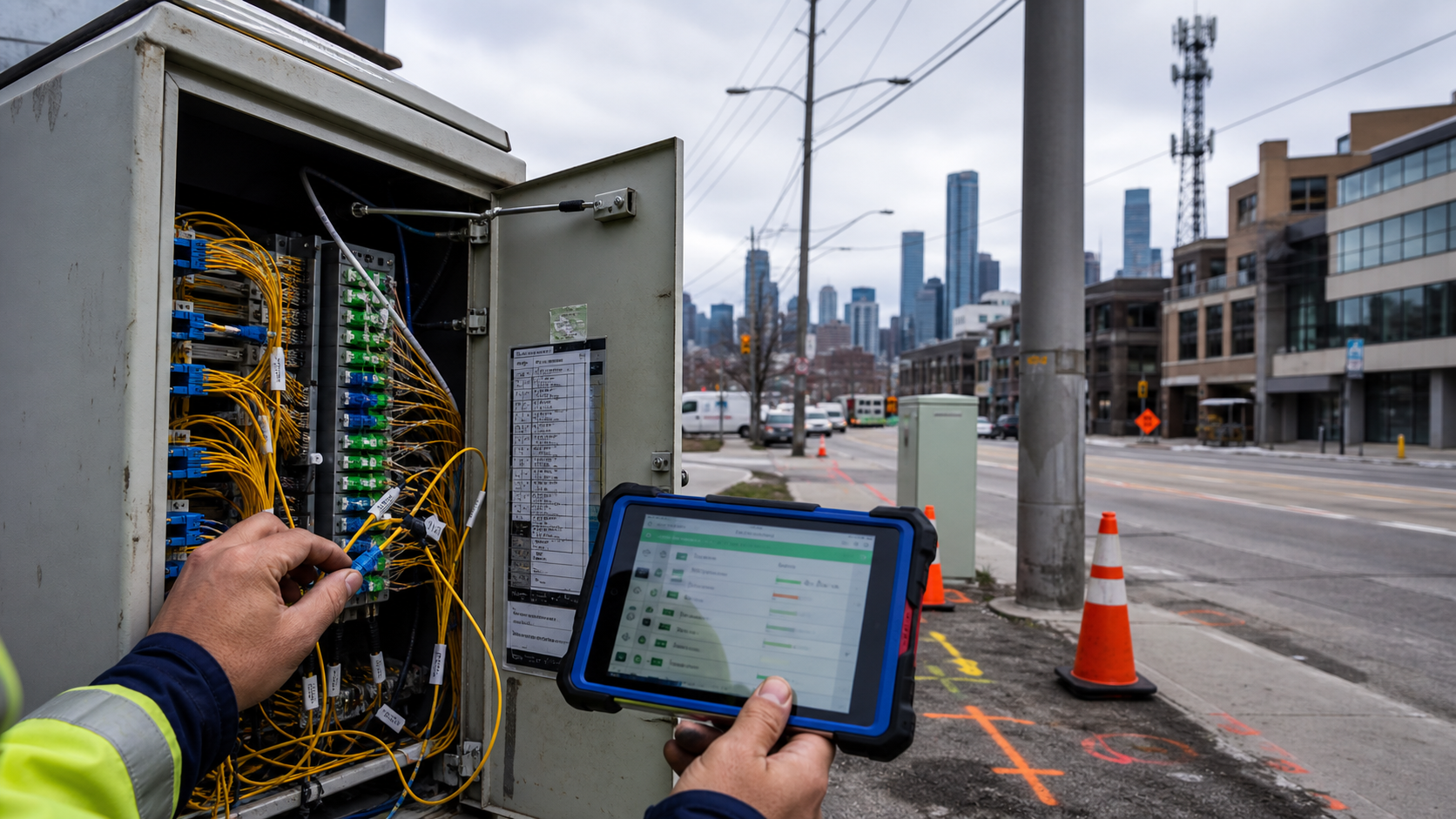
That is why Bell Canada should not be judged by bandwidth alone. Bandwidth is the easiest part of the story to advertise and the hardest part to translate into durable value. A household can have gigabit access and still care most about the next truck roll. A regional ISP can sell a fibre service only if the wholesale input is priced and provisioned in a way that leaves room to compete. A bank, hospital, university or provincial agency can buy secure connectivity only if the provider can support it during an incident, not just during a sales cycle. Bell's real account is therefore a repair account: the cost, speed and credibility with which a national network operator fixes the services that it has become large enough to sell.
What Bell Canada is now
Bell Canada is the historic core of BCE, but the relevant public shape is broader than a legacy telephone company. BCE's 2025 integrated annual report describes Bell as Canada's largest communications company by total revenue and total combined customer connections. The group reports through Bell Communication and Technology Services Canada, Bell Communication and Technology Services U.S., and Bell Media. Bell CTS Canada includes national wireless services, Bell Pure Fibre Internet, Fibe TV, enterprise communications, cybersecurity, AI infrastructure, service integration and wholesale services. Bell CTS U.S. reflects the acquisition of Ziply Fiber, which expanded the company's fibre exposure into the U.S. Pacific Northwest. Bell Media supplies the video, audio, sports, streaming and advertising side of the bundle.
This structure matters because Bell's strategic problem is no longer the narrow problem of defending a copper local-exchange footprint. It is a portfolio problem. Wireless needs spectrum and densification. Fibre needs neighbourhood construction, customer installation, backhaul, maintenance and wholesale compliance. Enterprise services need cyber credibility, data centres, software integration and support teams that can speak to regulated buyers. Media needs content costs, streaming growth and distribution leverage. Consumer bundles try to tie those pieces together, but bundling can also make accountability harder when customers are not sure which part of the account failed.
BCE's own 2025 language points to that operating mix. It says Bell conducts more than 240 million customer interactions each year. It highlights Bell Pure Fibre and Bell 5G awards, more than 31,200 hours of original Bell Media content, and $651 million invested in capital expenditures on research and development activities. It says the company is pursuing four priorities: put the customer first, deliver the best fibre and wireless networks, lead in enterprise with AI-powered solutions, and build a digital media and content powerhouse. Those priorities are coherent, but they are also easy to recite. The harder test is whether they reinforce each other under stress.
The first stress point is customer support. A carrier with hundreds of millions of annual interactions cannot treat the contact centre as a back-office cost. Support is where a billing dispute becomes churn, where an outage becomes reputational damage, and where a commercial account decides whether network quality is matched by operating quality. Bell's Q1 2026 announcement that it won a federal contact-centre modernization contract is therefore more strategically revealing than a headline speed claim. It suggests that Bell wants to sell the same support and AI-enabled service infrastructure to public agencies that it needs to improve for its own customers.
The second stress point is wholesale. Bell sells directly to consumers and businesses, but it also owns facilities that competitors need. In Ontario and Quebec, where Bell's historical footprint is deepest, the question of wholesale fibre access has become a proxy for the whole Canadian broadband bargain. The CRTC found in 2023 that independent wholesale-based competitors had lost 40 percent of their customers nationally even as the overall market grew, and that their decline was most acute in Ontario and Quebec. It ordered temporary access to large telephone-company fibre networks in those provinces. In 2024 it extended the framework, requiring Bell Canada, SaskTel and TELUS to provide competitors with workable wholesale access to fibre networks no later than February 13, 2025, while exempting new fibre builds from wholesale access until August 2029.
That combination is the policy centre of gravity for Bell. The regulator is trying to preserve investment incentives while reopening a pathway for competitors. Bell is trying to protect the economics of fibre spending while responding to a market where consumers and policymakers want more choice and lower prices. Neither side can solve the problem with slogans. If wholesale rates are too low, network owners will say they cannot justify new construction. If rates, terms or systems are unworkable, competitors become ornamental and consumers are left with fewer practical choices. Bell's account therefore includes the hidden plumbing of wholesale orders, provisioning intervals, fault escalation and tariff design.
The coverage claim and its limits
Coverage is the visible proof point. Bell's first-quarter 2026 release presented 5G+ Advanced as its fastest and most advanced wireless network yet, built on new spectrum deployments and standalone 5G core capability. That is a meaningful technical step. Standalone 5G is more than a radio upgrade because it supports lower latency, network slicing potential and a cleaner path to enterprise and industrial use cases than non-standalone 5G riding on a 4G core. Mid-band spectrum in the 3500 MHz and 3800 MHz ranges gives operators capacity that low-band spectrum cannot provide on its own. For consumers, the result is marketed as speed. For enterprises and public services, the more relevant claim is that capacity can be allocated, secured and maintained for specific uses.
But spectrum is not free optionality. Canada's mid-band auctions put a price on the next generation of wireless capacity before any carrier can monetize it. The 3500 MHz auction raised almost $9 billion nationally in 2021. The later 3800 MHz process added more than $2 billion of national auction proceeds. Bell, Rogers, TELUS, Quebecor and other operators did not buy spectrum as a trophy. They bought a scarce input that must be converted into site upgrades, radios, backhaul, power, core-network capability, device compatibility and customer revenue. That is why mobile ARPU and churn are not minor metrics. They show whether the network account can earn back the capital tied up in licences and deployment.
The Canadian wireless market has been working against easy payback. A 2024 market-price war followed Quebecor's expansion through Freedom Mobile, and Statistics Canada data cited in market coverage showed cellular service prices down sharply from the prior year and dramatically lower than in 2019. Bell and its rivals responded with promotions, retention offers and bundled value. That helps households in the short run, especially in a country that has long worried about telecom affordability. It also narrows the space in which carriers can convert network investments into rising revenue per user.
BCE's own Q1 2026 explanation points to this tension. Bell CTS Canada service revenue fell 1.2 percent year over year, with the company citing ongoing declines in legacy voice, data and TV, greater acquisition, retention and bundle discounts on residential services, and lower mobile phone blended ARPU. At the same time, the company reported better postpaid mobile net additions than the prior year. The combination says a lot. Bell can still acquire customers, but the price of keeping and winning them has risen. A net-add number is therefore not enough. The question is whether new and retained customers carry healthy ARPU, low churn and low support cost.
This is where the coverage claim turns into a repair obligation. The stronger the advertised network, the less patience customers have for routine failures. A national 5G+ promise creates an expectation not only that downtown users get faster peaks, but that commuters, small businesses, public-sector workers and rural customers have a reasonable path to functioning service. Bell does not need to cover every square kilometre with the same capacity to be credible. It does need to be clear about where capacity exists, how fast it is expanding, how outages are communicated, how priority services are restored, and how support teams handle the gap between a marketing map and a user's lived service.
Fibre economics now belong to the public debate
Fibre is Bell's strongest fixed-line story and its most contested regulatory asset. The company can argue that fibre-to-the-home is the best long-term answer to bandwidth demand, copper decline and home-service reliability. It can also argue that investors need confidence before it expands fibre into less dense areas. Those claims are not empty. Fibre construction is expensive, disruptive and local. It requires permits, crews, civil works, electronics, customer installations, neighbourhood power and ongoing maintenance. When a carrier builds the last mile, it carries costs that are not visible in a retail price comparison.
The CRTC nevertheless concluded that the old wholesale framework was failing. In the 2023 decision on temporary access, it said independent wholesale-based competitors had declined even as total Internet subscriptions rose. It emphasized that higher-speed demand was growing and that competitors lacked a practical way to sell service over incumbent telephone-company fibre networks. It also noted that 60 percent of premises passed by incumbent telephone companies had access to fibre-to-the-premises, compared with less than 5 percent for cable-company premises at that time. The decision directed large incumbent telephone companies to provide workable wholesale access to fibre networks in Ontario and Quebec within six months, making fibre-enabled services available to competitors for more than five million households.
The 2024 policy moved from temporary access to a broader framework. It requires large telephone companies to provide competitors with workable wholesale access to fibre, but gives new fibre deployed after the decision a temporary shield from wholesale access until August 2029. That head start is the compromise. It acknowledges that a household cannot benefit from fibre competition if no one first builds fibre, while also rejecting the idea that a national fibre network can remain entirely closed once it becomes the platform for mass-market broadband.
For Bell, the direct business implication is that fibre value now has two clocks. The first is the investment clock: how quickly capital can be deployed, customers connected and revenue recovered. The second is the regulatory clock: when and how wholesale obligations attach to the network. A management team focused only on the first clock will resist obligations as an investment penalty. A regulator focused only on the second will risk weakening the build case in areas where density is poor. The practical answer is not a single rate but a functioning service regime. Competitors need ordering systems, service levels, provisioning intervals, migration processes and repair escalation that do not turn wholesale into a paper right. Bell needs rates and rules that do not convert every new build into an immediate margin transfer.
The regional ISP economics are especially sensitive. Smaller providers compete on local service, specialized plans, community trust and niche support. They cannot usually replicate Bell's access network. They also cannot survive if the wholesale input leaves no room for marketing, billing, support, bad debt, transport, equipment and profit. The decline of independent ISP subscribers is therefore not just a statistic about market share. It is a warning about how quickly a wholesale market can hollow out when network technology shifts from copper and cable access to fibre access without a workable transition.
Bell's acquisition history complicates the narrative. The Canadian market has seen several independent or competitive providers absorbed by incumbents, including Bell's acquisition of Distributel. From Bell's perspective, buying a competitor can add customers, brands, systems and wholesale experience. From a policy perspective, every such deal raises the question of whether the independent layer is shrinking faster than wholesale reform can restore it. That is why the 2024 CRTC framework restricts incumbent use of mandated wholesale services inside their own traditional wireline territories while allowing out-of-territory use. The regulator wants large operators to compete where they are challengers, not use wholesale dependence as a substitute for upgrading their own historical networks.
The customer signal is a market signal
Customer complaints are not the same as audited network metrics, but they are market signals. They reveal where a service promise becomes expensive for the user. The Commission for Complaints for Telecom-television Services reported a 38 percent increase in complaints in its 2023-2024 annual report, with billing-related issues rising sharply and accounting for more than 17,000 issues. The specific distribution of complaints varies by provider, product and subscriber base, but the sector-wide signal is clear: price changes, credits, refunds, service expectations and support handling have become part of the competitive battlefield.
For Bell, complaint risk is magnified by bundling. A single customer may have mobile service, fibre Internet, TV, streaming, home phone, device financing and promotional discounts tied together. Bundles can reduce churn because leaving becomes more inconvenient. They can also produce opaque bills and support friction. If a promotional credit expires, a modem fails, a mobile plan changes and a streaming subscription is attached to the account, the customer's problem is not one isolated line item. It is the difficulty of understanding the account. In that setting, a carrier's scale is useful only if it makes resolution faster.
Bell's 240 million annual customer interactions are therefore a strategic asset and a strategic liability. If AI-enabled support tools correctly identify the issue, route customers to the right technician, prevent repeat calls and clarify billing, they can lower cost while improving service. If automation becomes a gate that keeps customers away from empowered human support, it can worsen churn and regulatory attention. The difference is measurable. Useful indicators include repeat-contact rates, time to repair, complaint escalation rates, credit handling, outage notification accuracy, appointment keeping and the share of calls resolved without a later correction.
This is also where labour decisions show up in the customer experience. BCE announced 4,800 job cuts in 2024, and union reporting cited roughly 800 Unifor members affected, most in telecom. The company has framed workforce changes around efficiency, simplification and the need to adapt to market and regulatory pressure. Those arguments may be financially rational, particularly if legacy products are declining and automation can remove avoidable work. But a network company cannot cut its way to trust. Field repair, installation quality, call-centre knowledge and escalation discipline are operating capabilities, not simply costs.
The labour issue should be assessed with care. More headcount is not automatically better service, and every large carrier has to modernize processes that were built for older networks. Fibre should reduce some maintenance burdens compared with copper. Digital self-service can solve simple requests faster. AI-enabled tools can help support staff find account context and technical answers. But if workforce reductions remove experienced field and support knowledge faster than systems improve, customers feel the gap. The public result is not an abstract labour debate. It is missed appointments, repeat truck rolls, unresolved credits, slow outage restoration and businesses that cannot get a clear answer during incidents.
Enterprise continuity is the high-value test
Bell's strongest growth story may be enterprise continuity rather than consumer speed. In Q1 2026, BCE disclosed Bell Business Markets revenue growth of 9.7 percent and AI-powered solutions revenue growth of 113 percent. The company tied that growth to Ateko, Bell Cyber and Bell AI Fabric. It also announced a federal contact-centre modernization contract, a Saskatchewan partnership for a planned 300 MW AI data centre near Regina, a Hypertec partnership for sovereign AI infrastructure, a Coveo partnership for Canadian-hosted AI solutions, and cybersecurity talent work with the McKenna Institute at the University of New Brunswick.
These announcements are not just technology branding. They signal a shift in what Bell wants to sell to large organizations. The traditional enterprise telecom account sold voice, data, private networks, managed connectivity and mobile fleets. The new account sells secure cloud, cyber operations, automation, Canadian data residency, AI infrastructure, contact-centre transformation and the connectivity that makes those services usable. For federal and provincial agencies, hospitals, financial institutions, universities and regulated industries, Bell is trying to position itself as a trusted Canadian infrastructure provider at a time when data sovereignty and cyber resilience are board-level concerns.
The upside is clear. Enterprise services can be stickier than consumer wireless plans. They can carry higher value if Bell provides integration, managed security, service-level commitments and compute capacity rather than raw connectivity. They also make use of assets Bell already has: fibre routes, wireless coverage, data centres, customer relationships and experience operating regulated infrastructure. If Bell can turn those assets into credible, Canadian-controlled platforms, it can reduce dependence on promotional consumer pricing and media-cycle volatility.
The risk is that enterprise continuity raises the proof standard. A public-sector contact-centre contract does not merely ask whether Bell can host software. It asks whether the system remains secure, available, compliant and responsive when citizens need unemployment support, tax guidance, immigration answers, emergency information or health-related service access. A sovereign AI infrastructure pitch does not merely ask whether Bell can announce megawatts. It asks whether power, cooling, network redundancy, data governance, cyber monitoring and procurement discipline can survive scrutiny. Bell Cyber must be judged not by the attractiveness of the security market, but by incident response capability, talent depth and the ability to support customers whose operations cannot pause.
That is why enterprise continuity links back to the consumer repair account. The same operating culture that handles household repairs shapes enterprise trust. A company that struggles to explain a bill or dispatch a repair loses credibility when it asks a government department to trust it with a mission-critical modernization program. Conversely, if Bell can use enterprise-grade tooling to improve consumer support, the whole account becomes stronger. The strongest version of the Bell thesis is that scale creates shared operating leverage: the systems built for government and enterprise make household support better, and the field discipline required for household broadband keeps enterprise promises grounded.
Security changes what coverage means
Telecom spectrum and security are now part of the same judgement. A mobile network is not merely a radio-access asset when enterprises want private wireless, governments want secure contact centres, utilities want resilient field connectivity, and public agencies want Canadian-hosted infrastructure. The value of coverage changes when the buyer is not just streaming video or checking email, but coordinating operations, authenticating staff, protecting citizen data or keeping a remote site connected during a disruption. Bell's 5G standalone core, mid-band spectrum and enterprise cyber push should therefore be read together.
The technical promise is that better spectrum depth and a cleaner 5G core can support more predictable capacity, lower latency and more specialized enterprise services. In practice, that promise depends on integration. A mining site, port, hospital campus, utility yard, logistics facility or government campus does not buy a 5G claim in isolation. It needs devices, identity management, coverage design, application support, traffic policies, cyber monitoring, backup paths and a contract that states what happens when service degrades. Bell has the pieces to compete for that work, but the market will separate providers that can run operational systems from providers that only sell connectivity language.
Bell's agreement to sell its Bell Mobility land mobile radio network services business to Motorola Solutions Canada Networks for $675 million, subject to approvals and closing conditions, is relevant to that security account. Land mobile radio is closely associated with public safety, utility and enterprise dispatch communications. Selling that business can simplify Bell's focus and unlock capital, while keeping Motorola as a delivery partner. It can also narrow Bell's direct role in one class of mission-critical communications. The effect depends on execution: customers will care less about the transaction label than whether support, migration, service continuity and responsibility remain clear.
Security also raises the cost of weak repair. A residential outage is harmful; an enterprise or public-sector outage can become a governance event. If a contact-centre modernization platform fails, citizens may lose access to essential services. If a cyber service misses escalation, an incident can spread. If a private wireless deployment has unclear ownership between network, devices and applications, restoration can stall while vendors argue. That is why Bell's enterprise strategy has to be measured with operational evidence: incident response time, contractual service levels, cyber staffing, audit readiness, data-residency controls, redundancy design and the frequency with which customers renew after the first contract term.
The same logic applies to consumer trust. Security incidents, fraud controls, SIM-swap prevention, account authentication and privacy handling are part of the national network account. A carrier that sells critical infrastructure cannot treat account security as a customer-service sideline. For households and small businesses, the account is often the authentication path for banking, government services, work tools and emergency contact. For Bell, improving security is not separate from improving support. It is the support surface with the highest stakes.
The pricing equation is more fragile than it looks
Bell's public value proposition often sounds like a premium network argument: pay for better coverage, better fibre, better bundles and better support. That argument can work in Canada because reliability has economic value. Households working from home, small businesses using cloud software, students, caregivers and public-sector employees do not experience connectivity as discretionary. The weakness in the argument is that a premium price requires a premium operating experience. When billing surprises, service calls or outages accumulate, the premium becomes a target.
Wireless price pressure makes this equation fragile. If market prices fall, Bell must choose how much margin to defend and how much share to protect. Defending margin can cost subscriber growth. Defending share can pressure ARPU. Bundles can soften the choice by adding perceived value, but only if customers understand what they are buying and can change plans without punishment. A bundle that makes service easier is an asset. A bundle that makes the bill harder to understand is a complaint generator.
Wholesale pricing adds another layer. Retail prices cannot be assessed without looking at wholesale inputs, because competitors need enough margin to create discipline in the market. If wholesale rates are too high, retail competition thins and Bell faces less pressure to improve price and service. If wholesale rates are too low, Bell and other network owners will argue that the business case for new fibre weakens. The CRTC's framework tries to balance that by setting cost-based rates and creating a new-fibre head start. The practical test will be whether consumers see more credible offers without seeing future builds stall.
Capex, spectrum and support costs then complete the equation. Mid-band spectrum creates capacity but also demands return. Fibre improves the product but raises upfront construction and installation costs. Customer support can lower churn but requires training and systems. Cyber and AI infrastructure can lift enterprise revenue but brings power, cooling, security and procurement risk. Bell's management has to allocate capital across all of these needs while reducing debt pressure and satisfying shareholders. The public should watch where the company chooses to spend when trade-offs become unavoidable.
That is why raw bandwidth is the wrong final measure. The better question is whether each dollar of customer spending buys a more dependable account. A faster download test is useful, but it does not price the avoided outage, the clear bill, the faster installation, the functioning wholesale order, the cyber escalation, the rural backhaul improvement or the public-service call that connects on the first try. Bell's premium case survives only if customers can see those less visible forms of value.
Broadband competition and the regional bargain
Canada's broadband geography makes simple competition claims difficult. Dense urban neighbourhoods can support multiple facilities-based networks, especially where cable and fibre overlap. Smaller towns, exurbs, rural roads, Indigenous communities and northern areas face different economics. Construction costs rise as density falls. Weather, distance, terrain and power availability matter. Satellite service can be essential where terrestrial economics break, but it raises its own questions about subsidies, sovereignty, latency, local support and long-term affordability.
Bell sits in the middle of this geography. In central Canada and Atlantic Canada, it is a historic wireline incumbent. Through wireless, it is national. Through enterprise services, it serves accounts that may span multiple regions. Through past northern exposure and sector lobbying, it has been part of debates over remote connectivity and subsidy eligibility. The 2025 public dispute involving Starlink, Bell and Northwestel over northern subsidy access showed that remote broadband is no longer a side issue. Satellite providers can challenge the economics of terrestrial incumbents, while incumbents argue that remote service obligations and local infrastructure cannot be judged only by headline monthly prices.
The public interest is not served by assuming either side is always right. Satellite service can bring real choice to remote households and businesses that have had too little of it. Terrestrial fibre, microwave and fixed wireless can provide local resilience, lower latency, community employment and stronger integration with emergency and public services. Subsidy rules should therefore ask what combination of technologies best improves availability, reliability, affordability and continuity. Bell's role is to show where its scale improves that outcome, not simply where it protects an incumbent position.
Regional ISPs remain part of the same bargain. They often know local markets better than national carriers, but they need access inputs and fair rules to compete. Wholesale fibre access is not a gift to smaller providers; it is a policy attempt to make market power contestable where access facilities are not economically duplicable. Bell can legitimately argue that wholesale access must not destroy investment incentives. It cannot reasonably argue that fibre competition should exist only where competitors can rebuild the last mile from scratch. The CRTC's five-year head start for new fibre is a clear attempt to balance those realities.
The key watchpoint is wholesale uptake. If competitors use Bell fibre at meaningful scale, launch differentiated offers and retain customers, the framework will look more credible. If uptake is thin because rates, systems, installation processes or repair handling are too difficult, then the policy will have changed legal access without changing market access. Bell's public reputation will be shaped by that difference. Wholesale customers are not just competitors. They are also stress tests of Bell's ability to operate a platform fairly.
There is a further regional test in how Bell handles markets where cable, fibre, fixed wireless and satellite overlap unevenly. In dense urban areas, the customer may have a choice between Bell fibre, cable Internet, wireless substitution and wholesale-based offers. In rural or edge markets, the practical choice can narrow quickly. A public fibre policy that works in Toronto or Montreal may not automatically work in northern Ontario, Atlantic communities, Manitoba edge markets or Indigenous and remote regions. Bell does not control all of those territories in the same way, but it does influence the national standard for what a large carrier should disclose about coverage, construction priorities, outage handling and wholesale behaviour.
The regional bargain also affects business customers. A logistics company with warehouses across provinces, a retailer with stores in small towns, a public agency with regional offices or a health network with rural clinics needs consistency across mixed infrastructure. Bell can win those accounts by being the coordinator that makes uneven geography feel manageable. It can lose trust if the national sales promise hides local service gaps. The repair obligation is therefore geographic. It asks whether Bell can make a national account work in places where the network is not uniformly modern.
Capital spending is a discipline, not a slogan
Capital expenditure is where Bell's claims become costly. BCE reported Q1 2026 capital expenditures of $841 million, up 15.4 percent from the prior year, with capital intensity of 13.6 percent. The company said the increase reflected $156 million of U.S. capital investment focused on Ziply Fiber's fibre-to-the-premise expansion, as well as investments to support Bell AI Fabric facilities, partly offset by lower spending on FTTP footprint expansion in Canada. That detail is material. It says Bell is not simply spending more everywhere. It is reallocating capital across Canadian fibre, U.S. fibre and AI infrastructure.
That reallocation is defensible if it produces higher-return growth and a stronger balance sheet. The Ziply acquisition gives BCE a fibre platform outside Canada and a path to North American fibre scale. Bell AI Fabric could attach compute and enterprise services to connectivity rather than leaving Bell exposed to commodity bandwidth. Lower Canadian FTTP expansion may be prudent if regulatory terms, build economics or competitive conditions make certain projects less attractive. But a lower Canadian FTTP footprint expansion rate also creates a public question: will Bell's Canadian network obligation keep pace with the company's North American and enterprise ambitions?
The answer depends on repair, maintenance and upgrade evidence. A carrier can slow footprint expansion while improving service quality inside the footprint. It can also overemphasize new strategic platforms while allowing older service areas to decline. Bell's Q1 2026 report noted ongoing legacy voice, data and TV declines, copper-area Internet losses and a retail residential network access service base that continued to shrink. Those declines are not surprising. The question is how gracefully customers are migrated, whether copper areas are left with acceptable service during transition, and whether wholesale and retail fibre installs happen fast enough to prevent a two-tier experience.
Capex should also be read alongside churn and ARPU. BCE's 2025 annual report reported mobile phone blended churn of 1.56 percent for 2025, down 0.11 percentage points from 2024, and postpaid churn of 1.22 percent, also down 0.11 percentage points. That improvement suggests retention efforts and service quality were not collapsing in aggregate. But churn can be held down by discounts, bundles and friction as well as satisfaction. ARPU pressure in Q1 2026 warns that retention came with a price. The healthier version of the story is falling churn with stable or improving ARPU, lower complaints and lower service cost. The weaker version is falling churn purchased through discounts while support complexity rises.
For investors, this is a return-on-capital question. For customers, it is a service question. For regulators, it is a public-interest question. Bell has to satisfy all three. A network that earns too little will eventually underinvest. A network that earns comfortably while support deteriorates will invite regulation and churn. A network that keeps investing but cannot explain its pricing will lose political legitimacy. Bell's capital discipline therefore cannot be judged by the capex line alone. It must be judged by the visible outcomes of that spending: fibre availability, repair intervals, wholesale functionality, mobile capacity, outage resilience, enterprise contract renewal and customer support performance.
Bundles, media and the hidden subsidy question
Bell Media is not the centre of Bell Canada's network account, but it affects the economics of the bundle. BCE reported Crave subscriptions up 25 percent to 4.74 million in Q1 2026, and Bell Media digital revenue growth tied to streaming and sports direct-to-consumer activity. Media gives Bell content leverage, advertising inventory and a way to package households around more than connectivity. It can make a broadband or mobile offer feel richer without reducing the sticker price as directly as a plan discount.
The problem is that media also carries structural pressure. Traditional broadcast and radio assets have faced advertising shifts, cord-cutting and high content costs. Bell's 2024 layoffs and radio station divestitures reflected those pressures. If media weakens, telecom cash flow can appear to support content obligations. If media strengthens through streaming, it can support bundles and reduce churn. The strategic question is whether Bell Media is a differentiated asset that strengthens connectivity economics, or a volatile line of business that complicates an already capital-heavy network account.
For the customer, the bundle question is more practical. A household may keep Bell because Internet, wireless, TV, Crave, sports and discounts are tied together. That can be rational if the bundle is transparent and reliable. It becomes problematic if bundling makes price comparison difficult or if support teams struggle to resolve cross-product issues. In a price-sensitive wireless and broadband market, bundles can conceal the true price of each service. Regulators and consumer advocates will keep watching whether bundled discounts improve affordability or merely create switching friction.
Bell's enterprise bundle is different but related. Connectivity, cyber, AI infrastructure and contact-centre modernization can be sold together because large organizations want fewer vendors and clearer accountability. That bundle can be valuable if Bell truly owns the outcome. It can be risky if responsibility is spread across partners, subcontractors and platforms in ways that make failure resolution slow. Public-sector buyers should demand service-level clarity, incident reporting, data governance terms and exit paths. Bell should welcome that discipline if it wants to be treated as strategic infrastructure rather than a commodity carrier.
What would change the judgement
The case for Bell Canada improves if several signals move together. The first is ARPU stabilization without a churn spike. If Bell can reduce promotional intensity while keeping postpaid churn low, the market will see evidence that network quality, bundles and service improvements have real value. The second is complaint improvement. A decline in billing, support and service complaints would be a strong sign that customer-first investments are working. The third is wholesale functionality. Competitors need to show that Bell fibre access can support real retail offers with acceptable installation, repair and margin economics.
The fourth is capex clarity. Bell should make it easy to distinguish maintenance, Canadian fibre expansion, wireless capacity, U.S. fibre, enterprise data-centre investment and media-related spending. Investors can tolerate reallocation if they understand the return logic. Policymakers can tolerate investment protection if they see continued Canadian builds and service improvements. Customers can tolerate network transitions if they get reliable service during the migration.
The fifth is enterprise proof. Bell Business Markets growth is promising, but the durable signal is contract renewal, referenceable public-sector outcomes, cyber incident performance, data-centre delivery discipline and customer adoption beyond early announcements. A 300 MW data-centre plan near Regina, sovereign AI partnerships and federal contact-centre modernization work are not small claims. They need execution evidence over years.
The sixth is outage and repair transparency. Canada has learned from sector-wide failures that communications networks are critical infrastructure. Bell should be judged by the speed and clarity with which it communicates outages, restores priority services, credits affected customers and hardens weak points. The future network account will not be won only by the carrier with the fastest lab speeds. It will be won by the carrier that customers, competitors and public agencies trust when something breaks.
Bottom line
Bell Canada remains one of the most consequential communications companies in Canada because its network account touches households, small businesses, regional ISPs, public agencies, media distribution, enterprise security and national infrastructure policy. Its scale is real. Its fibre and wireless assets are real. Its enterprise push is more credible than a generic technology pivot because it is built on connectivity, cyber operations, data-centre plans and existing government and business relationships.
But scale no longer gives Bell the benefit of the doubt. It creates a higher obligation. A national carrier that advertises 5G+ Advanced, fibre leadership and sovereign AI infrastructure must also prove that support, repair, wholesale access and affordability are improving. A company that wants public-sector continuity contracts must show continuity in its own service culture. A company that argues wholesale rules threaten investment must show where protected investment becomes actual Canadian network improvement. A company that uses automation to cut costs must show customers that automation resolves problems rather than hides them.
The judgement on Bell Canada should therefore be conditional. The constructive case is that Bell turns its national scale into a disciplined operating platform: fibre where the economics work, fair wholesale access where regulation requires it, mid-band spectrum converted into useful mobile capacity, enterprise services grounded in Canadian security needs, and customer support that makes a large account feel easier rather than harder. The negative case is that Bell uses scale defensively: slower Canadian fibre expansion, more opaque bundles, wholesale friction, promotional ARPU pressure, and support systems that leave customers carrying the cost of complexity.
The repair obligation is the difference. Bell does not need to be the cheapest provider in every market or the fastest network in every location to matter. It needs to make its scale legible as reliability. If it can do that, Bell Canada's national account remains a valuable infrastructure asset. If it cannot, the same scale that once signaled strength will keep attracting regulatory pressure, competitor resentment and customer churn.