
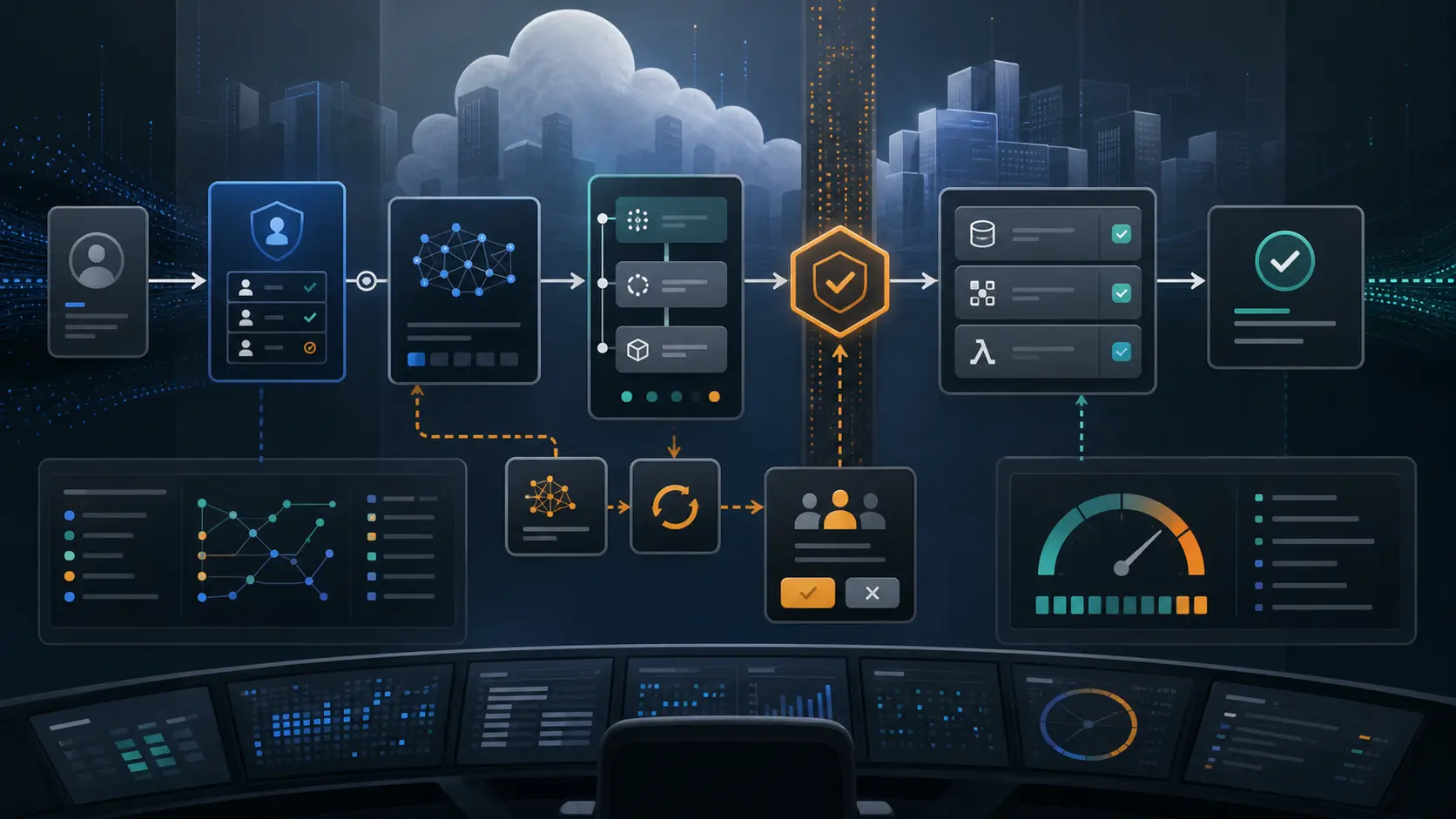
Summary
- AWS is not tested by the breadth of its AI menu alone. For enterprise teams using Amazon Bedrock, Lambda, Step Functions, IAM, CloudWatch and related services, the decisive unit is an accepted action: a model-backed request that invokes the right tools, respects permissions, leaves enough evidence, handles failure and is good enough for a human or downstream system to accept.
- The strongest AWS case is integration. Bedrock brings managed foundation-model access, retrieval, guardrails, invocation logging and evaluation features into the same cloud estate that already runs compute, identity, storage and operations. That reduces some undifferentiated plumbing, but it does not remove the customer's burden to define authority, test exception paths, review outputs and measure cost.
- The main failure modes are ordinary cloud and automation problems made less forgiving by model uncertainty: IAM mismatch, quota exhaustion, Lambda throttling, Step Functions partial execution, stale retrieval, incomplete logging, retry loops, runaway spend, unclear fallback behavior and reviewer overload.
- The commercial question is not whether AWS can host the system. It is whether managed AI workflow gains exceed platform fees, model charges, observability cost, integration labor, lock-in, duplicated resilience work and human review time when counted per accepted action.
The accepted action is the denominator
The first mistake in assessing AWS for enterprise AI work is to count model calls. A model call is too small and too flattering a unit. It can succeed while the business task fails. A response can be fluent and still be unusable because the wrong customer record was selected, the tool lacked permission, the downstream system rejected the update, the reviewer could not see the evidence, or the action created more exception handling than the manual process it replaced.
The better denominator is an accepted action. An accepted action is not merely a generated answer. It is the full path from request to usable result: the model receives the right context, selects or supports the right step, a tool runs with the right authority, the result is logged, the cost is attributable, the failure path is recoverable, and the human or system that consumes the result can accept it under a defined standard. This is a stricter measure, but it is the one that determines whether automation changes work.
AWS is well positioned for this test because its AI services sit inside a mature cloud operating environment. Amazon Bedrock provides managed access to foundation models and related capabilities. IAM defines identity and permissions. Lambda and Step Functions can execute and coordinate work. CloudWatch and CloudTrail can record operational and audit evidence. S3, databases, queues and event services can hold data and connect systems. For a company already committed to AWS, that breadth is a real advantage over a direct model API bolted onto a separate operating stack.
The same breadth creates the central risk. A model-backed workflow is not one product. It is a chain of model behavior, cloud permissions, orchestration, retrieval, review, monitoring, billing and customer-specific policy. Each layer can appear healthy while the accepted action fails. The model can answer, but IAM can deny the tool. IAM can allow the tool, but the state machine can fail after a partial update. The state machine can retry, but the retry can duplicate work if idempotency was not designed. Logging can exist, but not be enabled for the endpoint used.
A human reviewer can approve, but only by spending so much time that the automation economics disappear.
That is why AWS should be judged less like a feature catalogue and more like an operating surface. Its value lies in making many required controls available in one cloud estate. Its weakness, for buyers, is that availability is not the same as coherence. Customers still have to turn the services into a governed path that produces accepted actions repeatedly. The economic case should count accepted outputs, rejected outputs, escalations, exceptions, rollbacks, duplicate runs, reviewer minutes, log retention, evaluation work and the cost of keeping a fallback route alive.
This article is about Amazon Web Services as the AWS cloud entity and AWS-operated AI and cloud workflow services. It is not about Amazon retail, Amazon Robotics, individual regional AWS subsidiaries or the product quality of a customer's own application. AWS can supply model access and the cloud machinery around it. The customer still owns the operating definition of "accepted."
AWS brings model choice into the cloud control plane
Amazon Bedrock gives AWS a strong starting point because it makes foundation-model choice a managed cloud capability rather than a separate vendor integration. The current Bedrock documentation describes a fully managed service with access to more than 100 foundation models from multiple providers and API patterns that include Converse, Invoke, Responses and Chat Completions style calls. The importance is not only the number of models. It is that a customer can place model selection, application code, identity, data storage, logging and billing inside the same cloud operating model.
That matters when teams move beyond experimentation. In a demonstration, the model is often the star. In repeated work, the model is only one component. A team needs to decide which model is allowed for which task, which data can be sent to it, which user or service identity is paying for the call, which output requires review, which result can trigger a tool, and which evidence must be stored. Bedrock helps because these choices can be connected to AWS accounts, Regions, IAM roles, service quotas, CloudWatch Logs, S3 buckets and cost tools.
The platform also offers retrieval and grounding features. Bedrock Knowledge Bases can connect proprietary information to generated responses, use retrieval augmented generation, support managed and customer-managed approaches, include citations and apply document-level permission filtering for selected connectors. This is important because many enterprise actions are not open-ended reasoning problems. They depend on the current contract clause, ticket history, runbook, policy, price list, customer permission or inventory record. A model that cannot reliably see the right evidence should not be trusted to drive a real action.
Still, retrieval is not a magic layer. A knowledge base is only as good as the data source, parsing, indexing, permission mapping, update cadence, ranking and citation discipline behind it. If the wrong document is indexed, the old policy is still present, the permission filter is misaligned, or the citation is ignored during review, AWS has not solved acceptance. It has supplied a retrieval path that the customer must govern.
Guardrails create another important boundary. Bedrock Guardrails can apply content filters, denied topics, word filters, sensitive information filters, contextual grounding checks and Automated Reasoning checks. They can be used during inference or through a separate ApplyGuardrail API. That gives teams a way to define safety and compliance controls outside ordinary application code. It also gives procurement and risk teams something more concrete to inspect than a statement that the model was "told" to behave.
The limitation is equally important. Guardrails are controls, not proof that every accepted action is correct. Content filters can block categories of undesirable text. Sensitive information filters can mask or block detected private information. Grounding checks can help detect unsupported output. Automated Reasoning checks can validate content against logical rules. But the business still has to define the rule, choose what happens on a failed check, decide whether a human review is required, and measure whether the resulting path accepts enough good work while catching enough bad work.
In other words, Bedrock can reduce model and control-plane assembly cost. It cannot by itself settle the acceptance standard. That standard lives in the customer's task definition: which model-backed action is allowed, under what authority, with what evidence, at what cost and with what fallback when confidence is low.
Orchestration is where fluency becomes liability
The workflow problem begins when a system is allowed to do more than answer. Bedrock's orchestration documentation describes a model-driven sequence that can combine instructions, action groups, Lambda functions, knowledge bases, conversation history, traces and repeated steps. The system can interpret a request, select an action or retrieval path, invoke a Lambda function or return control, observe the result and continue until a final response or more information is needed.
That is powerful because it moves AI from text generation toward operational work. It is risky for the same reason. A model-backed system that can choose among tools must be evaluated on tool selection, parameter quality, permission boundaries, retry behavior and result handling. A wrong answer in a chat window is a defect. A wrong tool call can create a ticket, change a record, disclose data, trigger a payment, open access or waste cloud spend.
AWS has the pieces to constrain this. Lambda can isolate executable work into functions. Step Functions can make multi-step coordination explicit. IAM can scope which role can call which service. Bedrock logging and CloudTrail can create evidence trails. Guardrails and policy layers can block selected categories of unsafe behavior. This is better than letting a model call arbitrary internal APIs from an ungoverned script.
But the customer has to design the contract between model output and executable action. It is not enough to say that a Lambda function exists. The function must validate input, check idempotency, handle partial failure, return a structured result, and expose errors that the orchestrator can understand. It is not enough to add Step Functions. The state machine must distinguish retriable errors from terminal ones, know when to compensate, preserve evidence and avoid duplicate side effects. It is not enough to rely on IAM.
The role must match the intended authority and must not become a broad service account that turns model uncertainty into cloud authority.
Step Functions documentation is useful precisely because it is not romantic. It says states can fail because of definition issues, Lambda exceptions and transient issues, and that when a state reports an error, the default behavior is to fail the whole state machine execution. Retry and Catch fields can handle selected errors, but runtime errors, data limit problems, timeouts and nested execution behavior require explicit design. That is the kind of mundane reliability detail that determines whether a model-backed action becomes accepted work or an exception pile.
Lambda adds its own operating boundary. AWS documentation explains that Lambda scales by provisioning execution environments until account concurrency limits are reached, with a default regional account concurrency of 1,000 concurrent executions. That is a generous default for many workloads and an obvious bottleneck for others. In a bursty AI workflow, a model can generate many requests faster than downstream tools, quotas or databases can absorb them. The failure may appear as throttling, latency, partial completion or rising cost rather than as a clean model error.
The repeatable answer is to treat every tool call as a contract. Define allowed inputs. Validate them again outside the model. Make actions idempotent. Place destructive or expensive operations behind explicit approval. Separate read, propose and execute permissions. Record the request, decision, tool result and reviewer action. Decide in advance which failures are retried, which are escalated and which are abandoned. AWS supplies many of the services needed to implement this. The discipline still belongs to the customer.
Permission design is part of model reliability
For accepted AI workflow, IAM is not back-office plumbing. It is part of the reliability surface. A model-backed system that cannot do enough will fail harmlessly or create manual work. A system that can do too much can turn a bad interpretation into an unauthorized or damaging action. The useful zone is narrow: enough authority to complete the accepted task, not enough authority to improvise beyond it.
AWS IAM policy evaluation makes this a formal problem. AWS documentation explains that a request is authenticated, its context is processed, and applicable policies are evaluated. Identity and resource policies can combine by union in same-account cases, while permission boundaries and organizational controls narrow the effective permission set. Explicit deny overrides allow. That gives AWS customers a mature authorization language, but it also means the final authority can be the product of several policy layers that are hard for an application team to reason about casually.
The model should never be the source of authority. It can propose an action, prepare parameters or summarize evidence. The authority should come from IAM, application policy, human approval and business rules outside the model's reasoning. This is especially important for workflows that touch account provisioning, network configuration, database patching, billing changes, security exceptions, support refunds, customer data or compliance classifications.
One practical pattern is to separate roles by phase. A reading phase can retrieve records and evidence. A drafting phase can prepare a proposed action. A validation phase can check schema, policy and cost. An execution phase can run only a narrow tool under a narrow role. A review phase can decide whether the result is accepted. If a workflow needs broader authority, it should require a stronger review path and clearer logs.
This pattern costs money and time. It increases role count, policy review, test burden and exception handling. It can also slow adoption because a quick demonstration works with a broad role while the live version needs a narrow role. But the cost is not optional if the result is meant to be accepted work. A broad role may make the first demo impressive and the first audit uncomfortable.
AWS's advantage is that many enterprises already have IAM governance, account structures, service control policies, resource tagging and CloudTrail practices. A team building on AWS can reuse that institutional muscle. Its disadvantage is that AI workflows can expose how uneven that muscle is. A company with messy roles, weak tagging, unclear owners and inconsistent account boundaries will not become governed merely because Bedrock sits beside IAM.
The supervision cost therefore includes security architecture. Someone must decide which tasks are safe for automatic execution, which require approval, which are read-only, which need dual control and which must remain manual. Someone must inspect permissions after service changes. Someone must test that a denied action fails safely and that an allowed action does not exceed the business intent. These hours belong in the cost per accepted action.
Observability is available, but not automatic proof
The second major AWS advantage is evidence. Bedrock model invocation logging can collect request data, response data and metadata for supported calls in an account and Region, with CloudWatch Logs and S3 as destinations. The documentation says logging is disabled by default. It also notes coverage limits, including that calls through some endpoints are not currently captured by model invocation logging. The log entry format can include account, Region, request ID, operation, model ID, identity, metadata and token counts.
This is valuable because model-backed work needs after-the-fact inspection. A team must be able to ask who initiated a request, which model was used, what evidence was supplied, what came back, how many tokens were consumed, what tool was called, what result was returned and why a reviewer accepted or rejected it. Without that record, the system becomes hard to improve and harder to trust.
Yet logging exists in layers. CloudTrail can record API activity and selected data events. CloudWatch can hold logs, metrics and alarms. S3 can hold larger records. Application logs can capture business decisions. Review systems can capture acceptance and rejection. A complete story requires these records to line up. If model invocation logs are enabled but tool calls are not correlated, the reviewer can see the answer but not the action. If CloudTrail records the API call but not the business reason, the audit shows that something happened but not whether it was justified.
If logs are retained for too short a period, the evidence vanishes before a quarterly review.
Observability also changes cost. CloudWatch pricing depends on logs, metrics, alarms, synthetic checks, dashboards and other usage. Bedrock pricing depends on model provider, modality and tier. Additional services add their own charges. A careful team can use this evidence efficiently. A careless team can record too little to supervise or so much that observation becomes a major cost center. The right number is not universal. A customer-support triage suggestion, a security exception, a financial classification and a cloud-account change do not need the same log detail or retention.
The accepted-action denominator helps here. Instead of asking whether logging is "on," the team should ask what evidence is needed to accept one action and to investigate a disputed one. That evidence should include the request, data references, model and version where available, tool parameters, permission context, validation results, reviewer identity, final action and downstream confirmation. Then logging and storage can be designed backward from the acceptance standard.
AWS's newer evaluation and observability capabilities point in the right direction by recognizing that live model-driven work needs traces, quality signals and ongoing assessment. The buyer should still treat these as inputs to governance, not as an automatic acceptance mechanism. An evaluation score is useful only if the test set represents the task, the metric matches business harm, the threshold is enforced and failures trigger review or redesign.
There is a cultural trap in observability-heavy automation. Teams can mistake visibility for control. A beautiful trace of a bad action is still a bad action. A dashboard of low review latency may hide high reviewer fatigue. A token-cost chart may show model spend while ignoring the expensive engineer who fixes exceptions. AWS can make visibility easier. It does not decide which visibility matters.
Quotas and retries define the real capacity
AI workflow capacity is not the maximum number of model tokens an account can submit. It is the capacity of the whole path: model requests, retrieval, tool execution, state transitions, database writes, human review and fallback. AWS documentation makes clear that Bedrock quotas are account, endpoint, model and Region specific, and that model inference is controlled by token usage. The general reference lists many per-model, per-Region quotas, some adjustable and some not. The practical lesson is simple: capacity planning must be done for the chosen model, endpoint, Region and account, not for AWS in the abstract.
This matters because repeated AI work often has burst patterns. A new batch of support tickets, compliance reviews, code changes, sales requests or cloud operations can arrive at once. If every request expands into retrieval, model calls, tool calls, validation checks and review events, a modest business backlog can create a large technical burst. The first symptom may be queueing, throttling, partial completion or cost acceleration.
Step Functions and Lambda add additional quota surfaces. Step Functions has quotas for request size, open executions, Map Runs, HTTP Task duration, state transitions and API throttling. Lambda has concurrency limits and function-level controls. These are not obstacles in themselves; they are how managed services preserve service behavior. But the system designer must decide what happens when the limit is reached. Does the work wait? Does it fail? Is it retried? Is a human notified? Are duplicate actions prevented? Does the customer see a delayed result or a wrong result?
Retries are especially dangerous in model-backed workflows because the repeated step may not be harmless. Retrying a read is usually simple. Retrying a write, patch, ticket update, account creation, policy change or refund can duplicate side effects unless the action is idempotent. Retrying a model call can produce a different output unless the downstream contract normalizes the result. Retrying a failed validation can waste money if the input is structurally wrong. Retrying after a quota failure can create a self-amplifying queue.
AWS gives teams the components to manage this: Step Functions retry and catch logic, queues, dead-letter paths, Lambda destinations, idempotency keys in application code, CloudWatch alarms and cost tools. The burden is to write the operating rules. A live system should know which failures are transient, which are terminal, which require human review and which should stop immediately to avoid cost or harm. It should also record failed attempts as part of the denominator. A workflow that produces 10,000 model calls and 6,000 accepted actions is not a 10,000-action system. The 4,000 misses explain the real economics.
Quota planning also affects vendor choice. A company might find that one model is cheaper per token but slower under its quota, while another is more expensive but reduces retries or review time. A direct model API might be simpler for one narrow task. A cloud-native stack might be better when the task already depends on AWS data and IAM. The right answer is workload-specific. AWS's scale is a reason to evaluate it seriously, not a reason to skip capacity tests.
Review is the hidden cost center
The commercial case for AWS AI workflows is often framed as engineering acceleration. That is reasonable. AWS-published customer material says Thomson Reuters used Bedrock to expand model access inside its Open Arena platform and reduced model deployment time from days or weeks to minutes or hours for development teams. Another AWS-published Thomson Reuters account describes platform engineering automation with human validation for sensitive operations and reports selected outcomes such as a 15-fold productivity gain and a 70% automation rate at first launch.
These examples are useful because they show enterprise use beyond a demo. They also reveal the part that should not be overlooked: human validation did not disappear. In the platform-engineering case, sensitive operations still required approval, audit trails and compliance alignment. That is what serious adoption looks like. The machine can standardize and accelerate work, but the organization still decides when a person must accept the risk.
Review cost has several forms. There is first-pass review, where a person checks whether the model-backed result can be accepted. There is exception review, where missing context, failed tools or uncertain outputs need a specialist. There is policy review, where security or compliance teams inspect the rules. There is incident review, where bad outcomes are traced back to root causes. There is drift review, where changes in data, models, AWS services or business rules require retesting. These costs can be smaller than manual execution, but they are rarely zero.
The buyer should measure reviewer minutes per accepted action, not just automation rate. A system that automates 70% of requests may be excellent if the remaining 30% are cleanly routed and quick to review. It may be poor if every accepted action needs a senior engineer to read a long trace. Likewise, a system that rejects many actions may be valuable if it prevents harm, but expensive if the rejections are caused by weak retrieval, unclear instructions or overly broad filters.
AWS's control-plane integration can reduce review burden by making evidence easier to gather. Model invocation logs can show identity and token counts. CloudTrail can show API activity. Guardrails can produce signals about blocked or grounded output. Step Functions can show state transitions. IAM can show role boundaries. Knowledge Bases can include citations. But the reviewer still needs a concise acceptance view. Raw logs scattered across services are evidence, not judgment.
The best review design separates routine acceptance from true escalation. For low-risk actions, the system might show the source record, proposed change, validation checks and rollback path. For medium-risk actions, it might require approval by the resource owner. For high-risk actions, it might only prepare a recommendation. The cost of that design belongs in the AWS business case. So does the cost of training reviewers to understand model uncertainty, cloud permissions and business policy.
This is where alternatives matter. Manual work has high labor cost but sometimes low integration cost. Incumbent SaaS may have narrower features but more opinionated review screens. A direct model API may reduce cloud lock-in but increase logging and permission work. An in-house build may fit the task perfectly but carry maintenance burden. AWS wins when its integrated control plane reduces enough plumbing and supervision to improve the accepted-action cost. It loses when the organization pays for a broad stack but still rebuilds the crucial review layer by hand.
Pricing should be read as a stack, not a line item
Bedrock pricing is not a single number. AWS presents pricing by model provider, modality and service tier, with options such as standard, flex, priority and reserved tiers and additional feature-specific charges. The newer Bedrock runtime and control services also use consumption-based pricing. CloudWatch, S3, Step Functions, Lambda, CloudTrail event handling, data transfer, storage and evaluation work can all contribute. The result is a stack cost, not a model cost.
This is not a criticism unique to AWS. Any serious AI workflow has hidden cost. A direct model API still needs logs, queues, review tools, authentication, data retrieval, retries and incident handling. An open source stack still needs compute, operations and support. A manual process still needs people. AWS's advantage is that many components are already available and familiar to cloud teams. Its risk is that the convenience of adding services can make the total price hard to see until traffic grows.
Cost per accepted action should include at least six buckets. The first is model inference: input tokens, output tokens, modality, model choice and tier. The second is execution: Lambda duration and concurrency, Step Functions transitions, queueing, storage and data movement. The third is retrieval and context: indexing, embedding, re-ranking, data connectors, vector stores and permissions. The fourth is observability: logs, metrics, traces, alarms, dashboards, S3 retention and analysis. The fifth is governance: guardrails, evaluations, policy checks, human review and audit.
The sixth is resilience: duplicated checks, fallback models, retry queues, disaster plans and migration options.
The denominator should be accepted actions, not requests. Suppose a team submits 100,000 requests. If 70,000 become accepted actions, 20,000 require manual rework and 10,000 fail or are abandoned, the real cost is not the model bill divided by 100,000. It is the full stack cost plus rework divided by 70,000, with the failures understood as defects. If the accepted action replaces expensive expert work, that may still be attractive. If it replaces a cheap existing SaaS task, it may not.
AWS's financial scale gives it strong incentives and resources. Amazon reported AWS segment sales of $128.7 billion for 2025 and $37.6 billion for the first quarter of 2026, with Q1 AWS operating income of $14.2 billion. That scale helps explain why AWS can invest across model access, chips, orchestration, governance, observability and enterprise support. It also means AWS is a strategic platform vendor, not a neutral utility. Customers should expect strong integration benefits and meaningful lock-in pressure.
Lock-in is not automatically bad. If the accepted-action cost is lower on AWS because the data, identity, operations and developers are already there, then staying inside AWS may be rational. But the buyer should know what would be hard to move: IAM policies, Step Functions definitions, Lambda functions, Bedrock-specific logging, knowledge base configuration, guardrail rules, evaluation data, CloudWatch dashboards and operational runbooks. A credible exit plan does not need to be cheap. It needs to be understood.
Customer evidence is promising but selected
AWS's customer evidence supports the claim that enterprises are moving real work onto its AI stack. Thomson Reuters is a strong example because it is a sophisticated information and workflow company, not a novelty use case. AWS says Thomson Reuters used Bedrock to broaden access to models, support experimentation and build Checkpoint Edge with CoCounsel, a tax research generative AI application with inline citations. The case suggests that Bedrock can help a large organization make model access safer and more repeatable.
The platform-engineering example is even closer to the accepted-action frame. AWS's January 2026 blog says Thomson Reuters moved repetitive operational activities toward an AI-powered self-service hub, covering areas such as cloud account provisioning, database patching, network configuration and architecture review. It reports human validation for sensitive operations and audit history for governance. It also reports productivity and automation outcomes. Those claims are vendor-published and should not be treated as independent proof, but they are directionally relevant.
PwC's Automated Reasoning work with AWS shows another adoption pattern. The AWS-published account describes Bedrock Guardrails Automated Reasoning checks applied to EU AI Act classification, regulated content orchestration and utility outage decision support. The important point is not the marketing language around mathematical certainty. It is that high-stakes AI adoption is being framed around formalized rules, auditable artifacts and expert human judgment, not just freer text generation.
These examples show why AWS is credible. Large professional-service, information and platform-engineering teams are using the stack for tasks where evidence, policy and review matter. They also show why buyers should be cautious. The public evidence is selected by AWS and its partners. It does not disclose full cost, failed attempts, reviewer time, rejected outputs, support burden, model changes, quota constraints, security exceptions or long-run maintenance. It is proof of serious use, not proof of universal economics.
The right procurement question is therefore not "Do other enterprises use AWS for AI?" They do. The question is "Can our task be defined, governed and measured well enough that AWS's managed stack improves the accepted-action cost?" A company with clean data, strong IAM, mature cloud operations and clear review rules may get strong leverage. A company with unclear ownership, stale documents and manual exception culture may simply automate confusion.
The realistic alternatives keep AWS honest
AWS should be compared with several substitutes, not just with doing nothing. One alternative is manual work. Manual work is slow and expensive, but it can be flexible, accountable and easy to pause. If the task volume is low or the risk is high, manual review with better checklists may beat a complex AI workflow.
Another alternative is incumbent SaaS. Many enterprise systems already automate support triage, IT service management, compliance review, data extraction or cloud operations inside a narrower product. A specialized SaaS may provide a better review interface and fewer integration choices. It may also be less flexible and harder to align with AWS-native data and permissions.
A third alternative is a direct model provider. This can simplify model access and sometimes improve model features or pricing. But the customer then has to build or buy more of the surrounding control plane: identity, tool execution, logging, retrieval, evaluation, queueing, cost attribution and review. For a company already deep in AWS, that separate stack may be an avoidable burden. For a company trying to avoid cloud concentration, it may be worth it.
A fourth alternative is open source orchestration and self-managed infrastructure. This can reduce vendor lock-in and increase customization. It can also create a durable maintenance obligation. The team must keep frameworks, connectors, security patches, observability, test harnesses and scaling behavior current. For a narrow, strategic workload with strong engineering ownership, this may be sensible. For a broad enterprise platform, it can become a hidden product line.
The final alternative is doing less. Not every task should become a model-backed action. Some work should remain a search result, a draft, a recommendation or a dashboard. The closer a workflow gets to changing systems of record, spending money, granting access or communicating externally, the stronger the acceptance bar should be. AWS's broad stack can tempt teams to connect everything. Good governance asks which actions deserve automation at all.
These alternatives clarify AWS's best fit. AWS is strongest when the task already depends on AWS-hosted data, IAM, event handling, serverless execution, logs and cloud engineering teams; when the accepted-action standard can be encoded in policy and review; and when the business volume justifies investing in a governed path. AWS is weaker when the task is narrow, the data is outside AWS, the organization lacks cloud governance, the review screen must be highly specialized, or the buyer needs deep portability more than integrated control.
What to watch
The first watchpoint is audit completeness. Bedrock model invocation logging is documented, but it is disabled by default and has endpoint-specific coverage limits. CloudTrail can record important activity, but selected runtime data events require configuration. A buyer should verify that the actual path records enough evidence for disputed actions, cost attribution and incident review.
The second is permission drift. IAM roles, service control policies, resource policies and permission boundaries can change independently of the model-backed application. A workflow that was safe last quarter may become overpowered or underpowered after an account restructuring, service migration or emergency exception. Permission tests should be part of release and review, not a one-time launch step.
The third is quota behavior. Bedrock, Lambda and Step Functions quotas are real design inputs. The team should know how the system behaves when model tokens, concurrent executions, state transitions, HTTP tasks, downstream APIs or review queues saturate. Backpressure is a feature. Silent queue growth and runaway retries are defects.
The fourth is reviewer fatigue. The system should make acceptance easier, not turn experts into log readers. Measure minutes per accepted action, escalation rate, rejection reasons, repeated failure categories and reviewer disagreement. If reviewers are approving by habit because the queue is too long, the apparent automation rate is not a safety signal.
The fifth is cost allocation. Bedrock's documentation now emphasizes token counting and cost attribution patterns, and invocation logs can expose identity and token usage for supported paths. That data should feed team-level cost review. If model spend, observability spend and review labor cannot be tied to accepted actions, the business case is still speculative.
The sixth is fallback. A credible workflow needs a plan for model unavailability, quota throttling, retrieval failure, policy uncertainty, reviewer backlog and downstream rejection. The fallback may be a smaller model, a manual queue, a delayed response, a read-only answer or a full stop. What matters is that the fallback is designed before the failure, not improvised during it.
AWS is a serious platform for accepted AI workflow because it combines model access with the cloud controls enterprises already use. That is a material advantage. It can reduce integration work, make evidence easier to preserve and give cloud teams a familiar way to enforce permissions and operate services. But the system is only as strong as the acceptance chain around it.
The disciplined buying question is therefore narrow and practical. For this specific task, can AWS help produce more accepted actions at lower total cost than manual work, incumbent software, a direct model provider, an open source stack or doing less? Count the model, the tools, the permissions, the logs, the quotas, the retries, the review and the failures. If the answer is still yes, AWS is not just hosting AI. It is helping turn model-backed work into accepted work.