
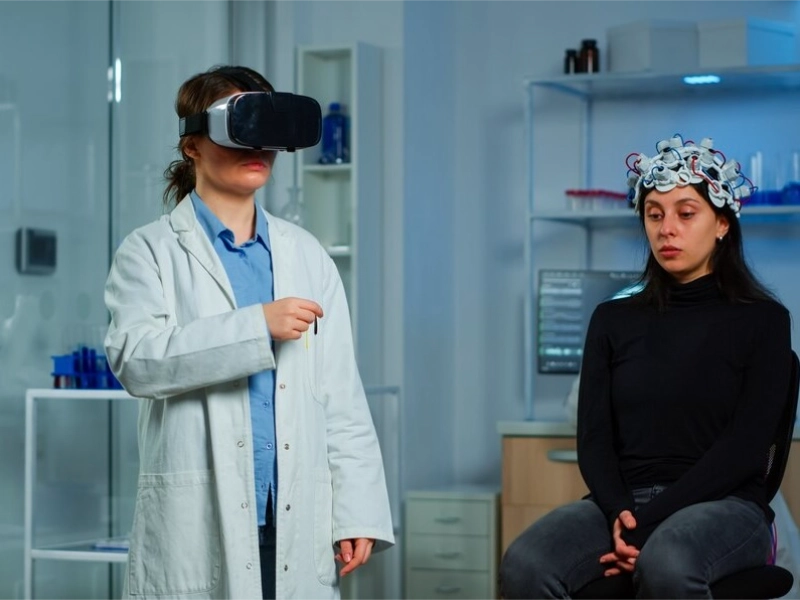
- AR and VR offer realistic medical simulations, enhancing skills without patient risk through lifelike virtual environments.
- AR and VR aid in treating conditions like phobias, PTSD, and chronic pain through immersive virtual experiences.
- AR and VR provide interactive 3D medical image visualisations, improving understanding and communication between healthcare professionals and patients.
Augmented reality (AR) and virtual reality (VR) technologies are changing the healthcare industry, offering technology services that enhance medical training, patient care, and therapeutic interventions. From immersive simulations for medical professionals to therapeutic applications for patients, AR and VR are changing the way healthcare is delivered and experienced.
Defining augmented reality (AR) and virtual reality (VR)
VR provides users with a completely digital experience, immersing them in simulated environments that can be visually and audibly convincing. This immersion is often facilitated through the use of specialised equipment such as VR headsets or goggles, which block out the physical world and replace it with a computer-generated reality. Users can explore and interact with these virtual environments in real-time, creating a sense of presence and immersion. From a medical perspective, VR encompasses a wide range of applications, including diagnostic imaging, surgical simulation, patient education, and therapeutic interventions. According to an FDA executive summary from July 2022, VR is defined as “a set of technologies that can be applied in various ways to diagnose and treat several clinical conditions, with different levels of success.”
On the other hand, AR enhances real-world experiences by overlaying digital imagery onto the user’s view of the physical environment. Unlike VR, which immerses users in entirely digital environments, AR supplements the real world with virtual elements, such as images, text, or 3D models. AR technology typically relies on devices equipped with cameras or displays, such as smartphones, tablets, or AR glasses, to superimpose digital content onto the user’s surroundings in real-time. In healthcare, AR has proven to be particularly valuable for enhancing visualisation, improving procedural accuracy, and facilitating medical education.
By providing contextual information and guidance directly within the user’s field of view, AR enables healthcare professionals to make informed decisions and perform complex procedures with greater precision.
Also read: AR vs VR: What’s the difference?
AR and VR technology in healthcare
Mental health: One of the most prominent applications of AR/VR in healthcare is in mental health. These technologies are being widely used to conduct exposure therapy for individuals suffering from conditions such as post-traumatic stress disorder (PTSD) and phobias. By creating immersive virtual environments where patients can safely confront their fears, AR/VR therapy offers a highly effective treatment option with fewer limitations compared to traditional methods. Research has shown that VR exposure therapy can be beneficial not only for PTSD and phobias but also for conditions like psychosis, autism spectrum disorder, attention deficit hyperactivity disorder (ADHD), eating disorders, and schizophrenia spectrum disorder.
Neurological disorders: AR and VR technologies are also making significant strides in the treatment of neurological disorders. For stroke rehabilitation, which often requires extensive therapy sessions and access to specialised facilities, AR/VR offers a solution by providing rehabilitation assistance that can be accessed remotely. These technologies enable patients to engage in rehabilitation exercises from the comfort of their homes, overcoming barriers related to facility or therapist availability. Additionally, AR/VR serves as a valuable diagnostic tool for assessing cognitive functions, providing a rapid and accurate means of evaluating cognitive impairment, memory, and eye movement. This not only streamlines the diagnostic process but also alleviates the burden on neurologists and enhances patient care.
Also read: How is digital transformation changing the healthcare industry?
Pain management: Chronic pain management presents a significant challenge for healthcare providers, often necessitating the use of opioid medications with their associated risks of addiction and adverse side effects. AR/VR technology offers a non-pharmacological approach to pain management by providing immersive experiences that distract and relax patients, thereby reducing pain perception. From fibromyalgia and phantom limb syndrome to surgical procedures and labor, VR-based pain management therapy has demonstrated promising results in alleviating chronic pain and improving patient outcomes. Studies have shown that VR therapy outcomes are comparable to those of traditional physical rehabilitation approaches and medication options, making it a valuable addition to the pain management toolkit.
Pediatric healthcare: In the pediatric healthcare space, AR and VR technologies are being used to address a wide range of needs, from managing pain and anxiety to enhancing upper extremity function and providing mental healthcare. These technologies offer a child-friendly and engaging approach to healthcare delivery, helping to alleviate fears and anxieties associated with medical procedures. VR has been particularly effective in pediatric oncology, where it is used to provide distraction during painful procedures and to offer therapeutic interventions for patients undergoing cancer treatment. Additionally, AR/VR has shown promise in the treatment of amblyopia, or lazy eye, by providing interactive visual stimuli to improve visual acuity and binocular vision.
Also read: Is XR the future of healthcare? Surgery, mental health, and brain rehab say yes
Surgery: AR and VR integration in surgical settings have transformed the way surgeons plan and perform procedures. These technologies offer advanced visualisation tools that enable surgeons to accurately identify anatomical structures, plan surgical approaches, and simulate procedures before entering the operating room. By providing a realistic and interactive environment, AR/VR technology enhances surgical preparedness, reduces procedure times, and improves patient outcomes. Moreover, these technologies have significant implications for surgical education and training, offering realistic simulations that allow trainees to practice procedures in a risk-free environment. From pre-operative planning to intraoperative guidance and post-operative care, AR/VR technologies are changing the surgical landscape and setting new standards for precision and safety.