
- APNIC hosts workshops and presentations on network automation and DDoS mitigation.
- Event explores global trends in IPv6 and RPKI deployment.
What happened: APNIC highlights key internet issues at INNOG 8 and IISPC 2025
INNOG 8, held from 23 to 28 May 2025 in Delhi, India, was an important event for network operators, Internet Service Providers (ISPs), and tech professionals. It took place alongside the 2nd India ISP Conclave (IISPC 2025) as part of a larger gathering focused on internet infrastructure, security, and development. The event featured a mix of workshops and conferences, allowing experts to discuss the state of the internet and the challenges India faces. APNIC supported the event, contributing to discussions and workshops on a range of topics, including network automation and security.
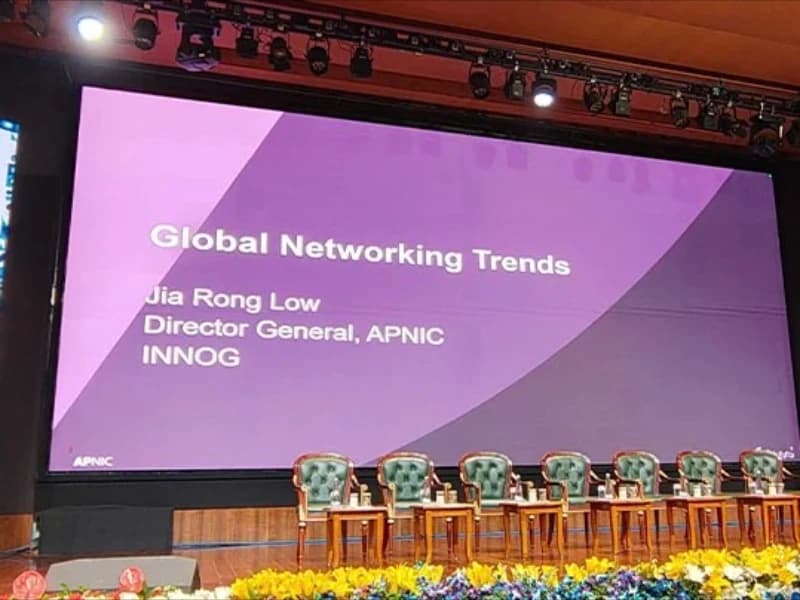
During the event, Dave Phelan and Sourav Satpathy from APNIC led a four-day workshop on Network Automation for 28 entities. This workshop covered ways to improve network efficiency through automation. Jia Rong Low, another key speaker, presented global trends in IPv6 and RPKI deployment, showing how these technologies are growing worldwide. Geoff Huston, who presented remotely, focused on the performance of Starlink protocols and how satellite internet can impact network performance. Phelan also gave a talk on the ‘State of DDoS in India’ and discussed strategies to protect networks from these kinds of attacks.
Additionally, Jia Rong Low participated in a panel discussion on ‘ICP-2 RIR Governance’, focusing on how internet governance works in India. APNIC staff also interacted with attendees at their booth, answering questions about APNIC services and helping with RPKI and transfers.
Also read: APNIC updates on resource audit at APRICOT 2025
Also read: Registration opens for APNIC 60 in Da Nang this September
Why it’s important
The event shed light on key challenges in India’s internet infrastructure. Topics like IPv6 adoption, RPKI deployment, and DDoS attacks are crucial for the future of the internet in the region. While there is growing interest in these technologies, the question remains whether India will be able to keep up with the global pace of development. APNIC’s workshops provided valuable insights, but the impact of these initiatives is yet to be seen. Will the adoption of IPv6 and RPKI be fast enough to meet the rising demand for internet security and reliability?
The discussion about Starlink protocols raised another important point. Satellite internet can help expand connectivity in remote areas, but it also comes with challenges. How well will satellite-based internet integrate with existing infrastructure in India? Will it create more problems than it solves, especially in terms of cost and maintenance? These are important questions that still need to be answered as India looks to improve its internet infrastructure.