
Summary
- The paid unit is a cross-border auto-parts order, availability and fulfilment account. Amayama's public surface turns a part number into a sequence of catalogue matching, supplier confirmation, payment, warehouse intake, freight choice, customs exposure and post-delivery risk, rather than a simple retail basket (https://www.amayama.com/en and https://www.amayama.com/en/txt.help/how-to-buy).
- The economics are strongest when a buyer needs a specific genuine part for a Japanese or Japan-market vehicle and cannot rely on a local counter. Amayama says it supplies new OEM parts, uses catalogues and manager help, contacts suppliers and manufacturers, and ships from Japan, the UAE, Australia, New Zealand and a newly described Latvia hub (https://www.amayama.com/en/txt.about-us).
- The same public pages show why the account is fragile. Availability is checked after inquiry, displayed availability may not be real-time, quotes expire, suppliers can cancel, freight and customs are buyer-side exposures, and returns for wrong choices or convenience are limited (https://www.amayama.com/en/txt.help, https://www.amayama.com/en/txt.help/faq, and https://www.amayama.com/en/txt.help/warranty-and-returns).
- Russia-facing evidence sharpens the friction. The Russian homepage says Amayama can supply needed parts and take card, PayPal or other payments where available, while the Russian about page says the company has ceased to exist and sales are not functioning; the Russian delivery calculator still lists Vladivostok as a possible warehouse origin (https://www.amayama.com/ru, https://www.amayama.com/ru/txt.about-us, and https://www.amayama.com/ru/delivery-calculator).
- The public judgment is conditional. Amayama's order account can beat dealer counters, local used-parts yards and general marketplaces when catalogue accuracy and supply reach matter more than speed. It weakens when sanctions, freight suspension, payment friction, customs thresholds, unavailable parts or expensive returns make the repair wait longer than the buyer can absorb.
The buyer is purchasing certainty, not a cheap part
The opening scene is ordinary. A buyer has a vehicle that is still economically worth saving, but only if one part can be found with confidence. It may be a body moulding for a Japan-market wagon, a discontinued trim piece for an old Nissan, a sensor that local distributors do not stock, a Toyota gasket whose number changed after a model revision, or a small bracket whose absence keeps a larger repair unfinished. The buyer searches by part number, frame number, VIN, diagram or description. The screen may show a low price. That price is only the first signal.
The real purchase is certainty. The buyer needs to know whether the catalogue has identified the right part, whether the seller can still obtain it, whether a supplier will confirm it after payment or before payment, whether the item can be packed with the rest of the order, whether the freight route accepts the size and contents, whether the destination customs office treats it as a private parcel or something more burdensome, whether a delayed repair will cost more than the discount, and whether a wrong part can be returned without making the saving meaningless.
Amayama's public website is built around this tension. The English homepage advertises genuine spare parts, worldwide delivery and a row of manufacturer catalogues for Toyota, Nissan, Lexus, Infiniti, Mitsubishi, Honda, Mazda, Subaru, Suzuki, BMW and Mercedes-Benz (https://www.amayama.com/en). It also describes how the order path works in plain commercial terms: the customer creates an order, suppliers and manufacturers are contacted, Amayama receives items at its warehouse, the order is shipped, and delivery follows. That is not the economics of a shelf retailer. It is the economics of a parts-finding and fulfilment account.
The distinction matters because catalogue retailing is easy to misunderstand. A buyer may compare a listed Amayama price with a local dealer price and conclude that the saving is the business model. But the saving only survives if the part is correct and deliverable. A cheaper item that arrives too late for a booked repair bay, or cannot clear customs, or turns out to be the wrong revision, is not cheap. It is working capital trapped in a parcel. The useful question is not whether Amayama lists low prices. It is whether the whole account lowers the total cost of making the vehicle usable again.
Amayama's own help pages make that account visible. The general help page says an order starts with a customer inquiry, a sales manager checks availability, a quote is sent, payment is received, and the order is then sent to the manufacturer or fulfilled from Amayama's own stock (https://www.amayama.com/en/txt.help). The same page says customers can use Amayama's online parts catalogues or ask representatives to find exact part numbers. It also says order handling can take one to three days from the original inquiry. The commercial promise is therefore not instant possession. It is organised uncertainty.
That promise is valuable in markets where the local dealer counter is weak. If a vehicle was imported used, sold in a different market specification, or kept long after the normal stocking cycle, a domestic parts counter may struggle to identify the exact item. A local marketplace seller may have a cheaper part but no reliable diagram, no official part number, no ability to consolidate obscure items and no clear warranty path. A repair shop may be able to call contacts, but the buyer then pays for the shop's time and accepts whatever substitutes are available. Amayama's account competes by making the search legible.
The same promise has a hard boundary. It does not remove the buyer's obligation to know what the car needs. It does not guarantee that a legacy part still exists. It does not make freight or customs disappear. It does not turn every disputed order into a seller-funded return. The account is most useful when the buyer understands that the listed price is an invitation to test availability, not a guarantee that the part is already sitting in a local bin.
Amayama is an order account more than a storefront
Amayama's company page says Amayama Trading Co., Ltd was established on November 1, 2004 and supplies new OEM parts for cars made by Japanese automakers, with a specialization in Japanese domestic market models exported around the world (https://www.amayama.com/en/txt.about-us). The page identifies a Japan base in Ibaraki-shi, Osaka; a Niigata warehouse; an Australian branch trading as Amayama Australia Pty Ltd; a UAE branch trading as Dekada Trading FZE in Sharjah; a New Zealand operation; and a Latvia hub launched on March 26, 2026 under TAKUMI TRADE SIA. Those details matter because a cross-border parts account is a geography business. The part may be small, but the order relies on physical nodes.
The geography tells the buyer what Amayama is trying to sell. It is not simply a website listing parts. It is a distributed procurement and consolidation surface. Japan matters for JDM supply and maker links. The UAE matters because Amayama says the branch can supply general part numbers for Japanese and Korean cars and specializes in left-hand-drive parts for North America and Europe when Japan cannot supply them. Australia and New Zealand matter where local stock and tax-inclusive pricing can simplify domestic orders.
Latvia matters because the page describes a European hub intended to support sourcing, consolidation and distribution for EU markets.
For a Russian or Russia-adjacent buyer, the geography is more complicated. The English delivery calculator lists origin options including Japan, UAE, Australia, Vladivostok and Latvia (https://www.amayama.com/en/delivery-calculator). The Russian calculator also lists Japan, the UAE, Australia, Vladivostok and Latvia as possible origins (https://www.amayama.com/ru/delivery-calculator). That does not prove that every origin is active for every order. It does show that Amayama's public order surface has historically been built around multiple hubs, including a Russia-facing logistics reference.
The Russian pages create an important evidence limit. The Russian homepage remains a customer-facing page, telling users that Amayama can supply needed parts, that buyers may search by part number, use partner catalogues, submit a request when part numbers are unclear, and pay by card, PayPal or other methods where available (https://www.amayama.com/ru). But the Russian about page says, in Russian, that at the current moment the company has ceased to exist and sales are not functioning (https://www.amayama.com/ru/txt.about-us). That statement should restrain any claim that the Russia-facing legal or sales structure is currently operating normally.
The article's entity name, Amayama Auto, Ltd., should therefore be understood through the order account rather than as proof of a fully visible, active Russian retail business. The strongest public evidence is the Amayama global and Russian-language order surface; the weakest public evidence is the current corporate status and operating state of the Russia-specific entity. The economic question remains valid because the public pages still expose the mechanics that a buyer in or around Russia would have to price: part identification, supplier availability, freight routing, payment currency, customs and returns.
That is why the paid unit should stay central. A generic retailer profile would ask whether Amayama has a large catalogue, competitive prices and good reviews. A useful account-level profile asks whether a specific order survives the frictions between catalogue, supplier, warehouse, carrier, border and buyer. The difference is not cosmetic. In obscure parts supply, the buyer's cost comes from the weakest leg of the chain.
Catalogue accuracy is the first economic control
The first control in the account is not freight. It is the number. Amayama's how-to-buy page divides buyers into those who have a part number and those who do not (https://www.amayama.com/en/txt.help/how-to-buy). If the buyer has the part number, the page describes searching, reviewing the part page, checking photos where available, looking at shipping periods, choosing a price offer based on need, stock quantity and timing, and sending the order for manager approval where required. If the buyer does not know the part number, the page points the customer to VIN or frame-number catalogues and then back into Amayama's site.
That structure reveals the first economic service. The buyer is renting catalogue confidence. For many vehicles, especially Japanese domestic models, frame numbers and market variants matter. A part can look almost identical across trims but fail because the mounting point, sensor connector, left-hand or right-hand orientation, paint code, year split or engine variant differs. A repair shop can lose hours discovering that mistake after the parcel arrives. The catalogue step is therefore a risk filter.
Amayama's public catalogue coverage supports this point. Its Toyota catalogue page spans model years from 1966 to 2026 and lists a long set of Toyota models, including Japan-market and export-market names that often confuse local buyers (https://www.amayama.com/en/catalogs/toyota). Its help page also points buyers to EPC-Data, a partner catalogue surface for Toyota, Nissan, Mitsubishi, Honda, Lexus, Hyundai and Kia searches by frame or VIN (https://www.epc-data.com/). The value is not that every diagram is perfect. The value is that the buyer can move from vehicle identity to part-number hypothesis before committing money.
The account still leaves responsibility with the buyer. The warranty and returns page says the seller does not accept returns or refunds for convenience, wrong specifications chosen by the customer, change of mind or no longer needing the product, except where required by law (https://www.amayama.com/en/txt.help/warranty-and-returns). The Russian returns page is even more direct in buyer-risk language, stating that manufacturers and Amayama do not accept returns, exchanges or reimbursement for parts mistakenly purchased due to the customer's fault and that the customer must verify ordered part numbers before approval and payment (https://www.amayama.com/ru/txt.help/warranty-and-returns).
This is rational from the seller's perspective. A rare part ordered from a manufacturer or supplier may not be resalable in the seller's normal flow. Returning it across borders can cost more than the part. The seller cannot absorb every buyer-side compatibility mistake and still offer low cross-border prices. But it also means that catalogue accuracy is not a nice-to-have. It is the buyer's first economic defence.
The public review record reinforces the same point. ProductReview.com.au shows a mixed but generally positive market signal: a 4.2 rating from 64 reviews at the time accessed, with many buyers praising hard-to-find genuine parts, packaging, communication, diagram usefulness and long-term use, while negative reviews complain about delay, slow follow-up or unavailable parts after waiting (https://www.productreview.com.au/listings/amayama-trading). Reviews are opinions, not audited performance data. They are useful because they describe the same risk bundle Amayama's own terms describe: the service can work well when it finds the right part and communicates timing, but the pain is high when availability or delivery drifts.
The buyer should therefore treat the first click as a diligence event. Does the part number match the vehicle by frame or VIN? Is the diagram reliable? Is the local mechanic willing to install this exact part? Is there any chance that a market-specific variant changes fitment? Can the buyer tolerate a no-convenience-return rule? A low price is not a discount if the buyer is guessing.
Availability is a live claim with stale edges
The second control is availability. Amayama is unusually candid on this point. The help page says availability must be checked after an enquiry and that parts for cars less than ten years old often have a good chance of being available, while parts for older cars become progressively depleted once production stops (https://www.amayama.com/en/txt.help). It also says availability shown in search results is not real-time and may differ once payment has been made and the order has been sent to the supplier. The FAQ adds that supplier limits, production stoppages and manufacturer updates can lead to cancellations, and that Amayama can update its database only after manufacturers or suppliers inform it of changes, often when a customer requests the part (https://www.amayama.com/en/txt.help/faq).
This is the core of the order account. The buyer sees a part number and a probability-like availability signal, but the seller's actual asset is a relationship with suppliers and manufacturers who can confirm or deny the item. The seller's capital is not only inventory. It is access, communication and the ability to turn a catalogue claim into a fulfilled parcel.
The economics resemble a small options market. A buyer pays or prepares to pay for the option to test whether a supplier still has a part at a quoted price. The quote page, according to Amayama's help, typically includes quantity, description, price, availability and shipping charges, and quotes are valid for 14 days (https://www.amayama.com/en/txt.help). That validity window matters. A rare part may disappear between inquiry and payment; a supplier may revise price; a warehouse may need to split the order; the buyer may need a second availability check after the quote expires.
Availability risk is not a failure of cross-border retailing. It is the reason the account exists. A local dealer counter may be faster if it has direct manufacturer access and local stock. But for older imports, the dealer may say the part is no longer available, may not recognize the frame number, or may price the part as a special order. A marketplace seller may list the part but lack authority to confirm it. Amayama's advantage is that it makes the uncertainty explicit and gives the buyer a path to test it.
The disadvantage is waiting. Every availability check consumes time. The how-to-buy page says regular orders may need manager approval and acceptance can take one to five working days (https://www.amayama.com/en/txt.help/how-to-buy). The help page says initial handling can take one to three days. Those are not long periods in global supply, but they are long for a car stuck on a lift or a repair bay booked for a narrow slot. The buyer must price delay before celebrating the listed part price.
The strongest account is a planned repair. The buyer has time to identify the part, check availability, accept a quote, wait for supplier intake and schedule the mechanic after tracking is firm. The weakest account is an urgent repair where the vehicle earns income, the mechanic's slot is scarce, or the buyer's alternative transport is costly. In that case, a more expensive local substitute can be cheaper in total because it reduces waiting uncertainty.
Freight turns the parcel into a risk transfer
Once the part is found, the account changes character. The buyer is no longer testing catalogue and supplier claims. The buyer is transferring a physical item across carriers and borders. Amayama's shipping pages make that transfer clear. The English delivery calculator asks for item value, currency, weight, box or dimensions, origin warehouse and destination, and says calculated shipping charges are approximate and may not contain all available methods (https://www.amayama.com/en/delivery-calculator). It also says package weight is added during checkout and that customers should contact Amayama when no method appears.
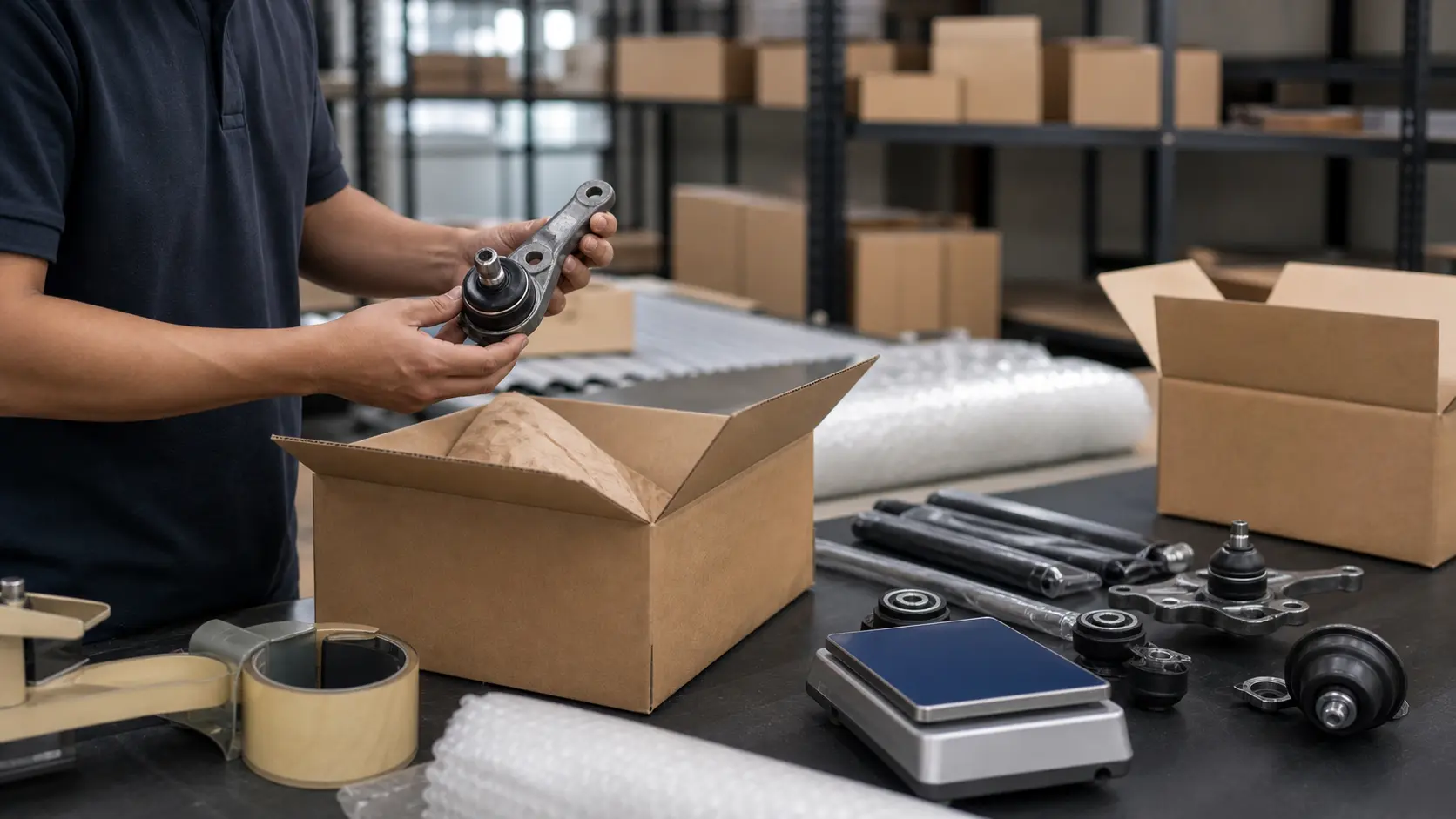
The international shipping page says EMS is a popular international parcel service, that EMS parcel weight is generally around 30 kilograms with country variation, and that some items cannot be sent by EMS, including oversized parts, flammables, liquids, explosives, pressured gases and large body parts (https://www.amayama.com/en/txt.help/international-shipping). It adds that shock absorbers can be shipped by FedEx and that customers should ask managers if unsure whether a part can be shipped. These details matter because many auto parts are awkward even when cheap. A bumper, glass panel, airbag, fuel tube or large shock absorber is not just a SKU. It is a freight problem.
Freight converts a small price difference into a larger delivered-cost equation. The buyer pays for part value, packaging weight, dimensional weight, origin choice, carrier choice, delivery speed, tracking quality and the risk that a local delivery partner or customs office slows the parcel after the international leg. Amayama's FAQ states that the company works with local postal services and courier companies and is not involved with local delivery in the destination country; once a parcel has left Japan or the UAE, buyers must contact the local postal service or contractor if the order is delayed or held by customs (https://www.amayama.com/en/txt.help/faq). That is a transfer of control.
The transfer is economically fair only if the buyer understands it. A seller can pack and hand over a parcel correctly, yet the buyer can still experience a delay. Tracking can lag. A local carrier can fail to call. Customs can request documents. Weather, postal capacity, sanctions routing and carrier suspensions can alter delivery estimates. The buyer who compares only part prices misses the control handoff.
Freight also changes the value of consolidation. If a buyer needs several small parts, the account can be attractive because shipping one parcel may be cheaper than paying local dealer markups on each item. But consolidation can also slow delivery if one part waits on supplier confirmation while others sit ready. A buyer with one urgent item and five optional items should ask whether a split shipment makes economic sense. The cheapest freight line can be expensive when it delays the part that unlocks the repair.
This is why the article's unit includes the fulfilment account. The value is not only in buying parts. It is in arranging a sensible parcel. The seller's public pages show that the order account contains manager approval, warehouse intake, carrier choice, customs disclaimers and return limits. Each leg can preserve or destroy the saving.
Customs shifts hidden cost to the buyer
Customs is the point where the buyer discovers whether the order was genuinely cheap. Amayama's international shipping page states that Amayama is not responsible for import taxes, duties or other charges under the destination country's laws, that the customer is responsible for complying with and paying local import taxes or customs charges, and that Amayama will not refund unexpected shipping charges, customs fees or orders returned because customs officials reject them (https://www.amayama.com/en/txt.help/international-shipping). The help page repeats the same substance in the shipping section (https://www.amayama.com/en/txt.help).
For Russia, the Russian international shipping page gives the buyer a threshold frame: private parcels are described around a 200 euro and 31 kilogram limit, with duty on the excess at 15% or no less than 2 euros per kilogram over the weight threshold (https://www.amayama.com/ru/txt.help/international-shipping). The TKS customs information page gives similar guidance for parcels to Russia, explaining that parcels under 200 euros and 31 kilograms avoid customs payments, while excess value or weight can trigger the same 15% or 2-euro-per-kilogram calculation, and that payment is made in roubles at the central bank rate (https://www.tks.ru/nat/0020000001/).
Those thresholds are not a mere tax footnote. They change order design. A buyer may split an order to keep parcels below a threshold, but splitting can increase freight and introduce multiple points of delay. A buyer may combine parts to save freight, but the combined parcel can exceed the duty-free threshold and create customs charges. A buyer may understate value, but customs can challenge declared value and delay release. A buyer may treat the order as private use, but repeated or homogeneous parts can invite questions about commercial use.
The customs problem is sharper for auto parts because repairs often combine cheap and expensive items. A gasket may be low value; a control module, lamp assembly, body panel or compressor may cross the threshold. Weight and size do not track value cleanly. A bulky but low-value part can trigger freight expense or parcel restrictions. A small but high-value part can trigger duty and fraud scrutiny. The buyer's delivered cost must include the border rule, not just the listed price.
Customs also affects returns. If a wrong or defective part moves back across a border, the buyer may face return postage, documentation, timing and possible disputes over whether taxes can be recovered. Amayama's warranty page allows approved returns or replacements for defective, damaged or incorrectly delivered products, but it also says customers must contact Amayama within 14 days, provide order number, problem description and clear photographs or videos, and wait for instructions before returning goods (https://www.amayama.com/en/txt.help/warranty-and-returns). That is sensible, but it is not frictionless.
The economic lesson is that customs is part of the purchase, even when the seller does not charge it. A buyer who budgets only for the website invoice is underpricing the account. The order becomes rational when the buyer can see the whole delivered cost: part, freight, tax, duty, customs time, mechanic delay and return risk.
Sanctions turn fulfilment into compliance sorting
Russia-related sanctions do not need to ban every ordinary car part to change the economics of the order. They raise the cost of checking, routing, payment and carrier acceptance. The EU sanctions page describes a broad sanctions regime covering finance, trade, transport, technology, services and anti-circumvention measures, including export restrictions on goods and technology that could enhance Russia's defence and security sectors, transport restrictions, financial restrictions and trade bans in defined categories (https://www.consilium.europa.eu/en/policies/sanctions-against-russia/). A small buyer looking for a repair part does not experience that regime as legal theory. It appears as unavailable payment channels, blocked destinations, extra questions, carrier limits and supplier caution.
Amayama's own international shipping page states that parcels addressed to Crimea and Sevastopol cannot be paid and shipped (https://www.amayama.com/en/txt.help/international-shipping). That specific notice shows how geopolitical controls enter the order account at checkout. The buyer does not need to be a sanctioned entity for the account to feel sanctions pressure. The route, destination, carrier, payment provider or part category can be enough to make the seller refuse, delay or ask for clarification.
The Russian page adds another kind of pressure. Its about page says the company has ceased to exist and sales are not functioning (https://www.amayama.com/ru/txt.about-us). That does not explain every Russia-facing order condition, and it should not be stretched beyond the public wording. It does show that Russia-facing continuity is impaired on the page that should normally reassure local buyers. The delivery calculator's continuing Vladivostok origin reference sits beside that caution, creating a mixed public signal: the order surface remembers Russia, but the Russian business-facing page warns that normal sales are not operating.
Sanctions also alter the meaning of substitute routes. A buyer may think that moving the order through the UAE, Latvia, Japan, a marketplace seller or a forwarding address solves the problem. It may simply move the compliance burden. A seller with a public brand and payment relationships must avoid sanctioned destinations, prohibited goods, suspicious end uses and blocked counterparties. A carrier must avoid restricted areas and restricted items. A payment provider must screen parties and jurisdictions. A buyer's freight workaround can make the account slower, not faster.
This is why the article treats sanctions as pressure rather than as a blanket claim that Amayama cannot serve any Russian buyer. Public pages do not support a precise map of all allowed and refused routes. They do support a lower-confidence but economically important conclusion: Russia-adjacent orders carry higher coordination cost than ordinary cross-border orders. The buyer pays for that cost in time, limited payment choice, possible routing changes, stricter documentation and a higher chance that the seller cancels or refuses a route.
The risk can be manageable for non-sensitive, personal-use parts shipped to permitted destinations through available carriers. It becomes serious when the part is hard to classify, the buyer cannot document personal use, the destination is restricted, the payment path is impaired, or the item resembles a category that suppliers or carriers prefer not to handle. In such cases, the order account is no longer a simple purchase. It is a compliance-sorted fulfilment attempt.
Currency mismatch is a hidden margin account
The order account is also a currency account. Amayama's help page says PayPal converts currencies during payment and shows the buyer the local-currency amount and the conversion to Japanese yen (https://www.amayama.com/en/txt.help). The terms page says payment in full is due within thirty days of the original quote offer, that credit and debit cards via PayPal, bank deposits and telegraphic wire transfers are accepted methods, and that insufficient bank transfer payments may be refunded at the customer's expense with a USD 50 charge in connection with cancellation if required (https://www.amayama.com/en/txt.terms-of-use). The delivery calculator lists multiple currencies, including AUD, CAD, JPY, NZD, SGD, AED, RUB, GBP, USD and EUR (https://www.amayama.com/en/delivery-calculator).
Those details show why the buyer's visible price is unstable. A part may be quoted from a Japanese supplier, paid through a wallet or card scheme, shipped from the UAE or Japan, declared at a customs value, and compared by the buyer against a local dealer price in roubles, euros, pounds or dollars. Each leg can use a different rate, fee or timing. The buyer sees one order; the account contains multiple currency conversions.
The mismatch matters most when the buyer operates on a repair budget with little slack. A small exchange-rate move may not matter on a cheap clip. It matters on a control module, lamp assembly, air-conditioning compressor or set of parts ordered before a long trip. It matters more if the buyer must pay extra freight after quote, settle a customs duty in local currency, or accept a refund at a different rate from the original payment. The listed part price is a snapshot; the delivered cost is a time series.
Currency also affects seller behaviour. A seller that buys from suppliers in yen or another currency and charges customers through PayPal, cards or bank transfers must protect itself against underpayment, delayed payment and rate movement. That explains quote validity periods and payment conditions. A 14-day quote validity window is not only an availability rule. It is also a price-risk limit when suppliers and currencies move.
For Russia-facing buyers, currency mismatch is entangled with sanctions and payment access. The Russian homepage says customers can pay by card, PayPal or other methods where available (https://www.amayama.com/ru). The phrase "where available" carries economic weight. A payment method that works in one jurisdiction, for one warehouse and one currency may fail elsewhere. Even when payment succeeds, the exchange rate and fees can change the comparison with a local substitute.
The buyer should therefore treat currency as part of the order account, not as a back-office detail. The right comparison is not Amayama part price versus local part price. It is Amayama part price plus conversion spread, payment fee, freight, customs, delay cost and return risk versus the local alternative's price and certainty. Once that comparison is made, some Amayama orders still look attractive. Others do not.
Returns are insurance with a narrow trigger
Returns sit at the end of the account, but they should be priced at the beginning. Amayama's warranty and returns page gives a 12-month international manufacturer warranty for parts that fail under normal operating conditions, subject to conditions including certified installation and documentation (https://www.amayama.com/en/txt.help/warranty-and-returns). It also says defect claims should be made as soon as discovered and before installation where visible, and that parts installed despite a known defect can forfeit the claim path. For defective or incorrect products, customers must contact Amayama within 14 days after delivery, provide evidence and wait for instructions before return.
This is a narrow insurance product, not a broad satisfaction guarantee. It covers defects, shipping damage and incorrect products delivered by the seller where the customer did not cause the discrepancy. It does not cover changed mind, wrong specification chosen by the customer, no longer needing the part, labour or installation costs, improper installation, compatibility mistakes or indirect economic loss. That allocation is normal for cross-border parts, but it makes the order account unforgiving.
The returnless refund option described on the English page is economically interesting. Amayama says it may, at its discretion, offer a full or partial refund without requiring return to Japan where a defective, damaged or incorrect product qualifies and return shipping would be impractical or disproportionate, for example where the order amount is low or return shipping exceeds product value (https://www.amayama.com/en/txt.help/warranty-and-returns). That acknowledges a basic fact of cross-border commerce: sometimes the rational answer is not to move the part again.
The buyer cannot rely on that option as a right. It is discretionary. The account still requires evidence, communication and seller approval. A buyer who needs the car back on the road may not be made whole by a refund if the mechanic's time was lost, the vehicle remained unusable, or the replacement part must be ordered again. Returns reduce some financial loss but do not erase time loss.
The Russian returns page makes the buyer's verification burden especially clear. It says parts mistakenly bought due to the customer's fault are not returned or exchanged, and that the customer must carefully check the order before payment (https://www.amayama.com/ru/txt.help/warranty-and-returns). For the economics of the order account, this is the central warning. The buyer's first investment is not money. It is care in identification.
This return structure explains why Amayama can be attractive and risky at the same time. A specialist seller can find obscure genuine parts at prices below local counters, but it cannot insure every compatibility mistake across borders. The buyer gains access but accepts responsibility. The account works when buyer diligence and seller fulfilment both hold.
Substitutes discipline every part of the account
The first substitute is the local dealer counter. It may be expensive, but it can reduce catalogue ambiguity, localize warranty, simplify payment and avoid customs. It is strongest when the vehicle is officially supported in the market and the part is still in the distributor network. It is weakest for grey-market imports, old JDM variants and parts the local dealer does not recognize. Amayama's account wins only when its catalogue reach and supplier access offset the dealer's certainty advantage.
The second substitute is a marketplace seller. A marketplace may offer speed, local stock and buyer protection. It may also carry counterfeit risk, used-part ambiguity, poor diagram support, weak fitment data and sellers who list inventory they do not actually control. For commodity filters, bulbs, belts and common consumables, marketplaces can be better. For obscure genuine parts, Amayama's manager-assisted catalogue and supplier access can be stronger.
The third substitute is a used-parts yard or breaker. This can be the cheapest solution when the part is a body, interior or discontinued component and the buyer accepts wear. It is also a compatibility gamble. Used parts may have hidden damage, missing clips, different revisions or no warranty. In Russia and other markets with many Japanese imports, breakers can be deep sources of practical supply. Amayama competes where the buyer wants new genuine parts, traceable part numbers and a cleaner warranty path.
The fourth substitute is a specialist online rival. PartSouq advertises genuine catalogues, worldwide shipping, many currencies, 201,411 satisfied clients, 190 countries shipped and 17 million parts in its database (https://partsouq.com/). MegaZip advertises more than 10 million original genuine parts, authorized dealer supply from Japan and the UAE, delivery to more than 210 countries, and a Trustpilot-based review signal (https://www.megazip.net/). These rivals show that Amayama is not alone. Buyers can compare catalogue coverage, warehouse origins, freight estimates, payment options, communication speed and return rules.
The fifth substitute is a broad regional auto-parts platform. AUTODOC UK, for example, presents a mass catalogue with millions of parts, vehicle selection, product categories, reviews, discounts and visible aftermarket alternatives (https://www.autodoc.co.uk/). That type of platform can be better for common European-market parts, branded aftermarket replacements and fast regional supply. It may be weaker for JDM-specific parts where frame-number matching and Japanese supplier access matter more.
The sixth substitute is delaying the repair. This is often the buyer's real alternative. If the vehicle is not essential, waiting for a better part, searching breakers or postponing a cosmetic repair can be rational. If the vehicle earns income or anchors daily mobility, delay becomes expensive. The order account must therefore be judged against the value of time. A part that arrives in six weeks may be acceptable for a restoration project and disastrous for a working van.
These substitutes discipline Amayama's pricing. Amayama does not have to be fastest or cheapest in every category. It has to be useful where the buyer values genuine part identification, hard-to-find supply and cross-border fulfilment more than immediate local possession. The account fails when the substitute can deliver comparable certainty with less border risk.
Market signals show trust and pain together
Public review signals should be handled carefully. They are not audited order data, and they often overrepresent strong emotions. ProductReview.com.au nevertheless gives a useful market window because the themes align with Amayama's own terms. Positive reviewers praise hard-to-find parts, correct fitment, packaging, communication, lower prices than dealer counters, and repeated use over years. Negative reviewers complain about delays, poor follow-up, order cancellation after availability disappointment, PayPal dispute tension and long waits (https://www.productreview.com.au/listings/amayama-trading).
That split is exactly what the economic model predicts. The buyer is happy when the account turns uncertainty into a correct parcel. The buyer is angry when the account makes uncertainty visible only after money and time have been committed. In a domestic shop, a delay may mean choosing another supplier. In a cross-border order, delay can mean a mechanic booking lost, a vehicle immobilized, money tied up, customs uncertainty ahead and return options constrained.
Reviews also show why communication is part of the product. A buyer can tolerate waiting if the expected dates are credible and the order status is updated. Amayama's help page says customers can track order progress through the account system and receive updates when the order changes (https://www.amayama.com/en/txt.help). The how-to-buy page says customers receive notifications each time an order changes (https://www.amayama.com/en/txt.help/how-to-buy). That status layer is not administrative decoration. It is how the seller protects trust during a waiting period.
The risk is that status updates cannot fix unavailable parts. The FAQ says part numbers can be cancelled because suppliers have limits, production can stop and data can become stale (https://www.amayama.com/en/txt.help/faq). If the main part in an order is cancelled, the FAQ says full cancellation may be possible case by case, depending on whether remaining parts can be cancelled at the supplier and how important the issue is for the customer. That is a reasonable but discretionary rule. It also means the buyer should structure orders around priority. If one part is essential and the rest are optional, the buyer should not let optional items trap the account.
Market signals from rivals confirm that this is a category-wide issue, not only an Amayama issue. MegaZip's own public page surfaces customer comments around delays, added shipping costs, customs invoices and support response, alongside positive comments about genuine parts and help (https://www.megazip.net/). PartSouq emphasizes catalogue convenience, supplier networks, availability and shipment timing (https://partsouq.com/). Specialist parts retail is an uncertainty-management business. Every seller in the category must convert catalogue data into a delivered item.
The buyer's rational stance is neither blind trust nor blanket suspicion. It is order design. Use frame or VIN data. Ask before ordering if the part is large, sensitive, restricted or unclear. Avoid building an urgent repair around a low-probability legacy part. Separate essential and optional items where needed. Compare delivered cost, not part price. Preserve screenshots and messages for warranty or dispute evidence. Inspect before installation. That is not paranoia. It is the buyer's share of the account.
Why the Amayama account still matters
Despite the frictions, Amayama's order account matters because the global car fleet is not aligned with local parts shelves. Vehicles move between markets; owners keep them longer than distributors expect; right-hand-drive and Japan-market variants circulate; hobbyists restore models whose dealer support has faded; small repair shops serve mixed fleets; and owners of older cars often face a choice between waiting, improvising or overpaying. A cross-border parts account can keep a vehicle useful when local supply is thin.
The company's public pages describe a genuine specialization. Amayama says it supplies new OEM parts for Japanese automakers and has direct contact with Japanese automakers, while the homepage shows latest shipments to countries such as Cyprus, Lithuania and Hong Kong on the access date (https://www.amayama.com/en and https://www.amayama.com/en/txt.about-us). The page language is broad, but the operating logic is specific: find exact Japanese and related OEM parts, confirm supply, receive at warehouse, pack and ship worldwide.
The Russia or cross-border dimension adds significance because sanctions-era commerce is not cleanly separated into allowed and forbidden everyday life. A private buyer may need a harmless part to maintain an old car. Yet the order passes through payment providers, carriers, customs offices, compliance screening and seller policies shaped by a broader sanctions environment. The result is not necessarily a ban. It is friction: fewer routes, more caution, higher documentation needs, slower communication and more cases where the seller may decline.
That friction is economically meaningful for small buyers. A large fleet operator can hire customs brokers, build stock buffers, negotiate with suppliers and manage compliance. A household or small repair shop cannot. It relies on the seller's order account to absorb complexity. When that account works, it converts a global supply chain into a manageable parcel. When it fails, the buyer is exposed to every hidden layer at once.
The final evaluation is therefore balanced. Amayama's public surface gives buyers a real service: catalogue depth, supplier reach, multiple warehouses, manager assistance, global shipping and a return path for defined defects or seller-side errors. It also exposes the limits: stale availability, quote windows, supplier cancellation, customs charges, shipping restrictions, narrow returns, buyer-side compatibility risk, currency conversion and Russia-specific uncertainty. The value is not a promise that every part will arrive quickly. It is a paid attempt to make a difficult part order tractable.
Proof gaps: economics
The public record does not show Amayama Auto, Ltd.'s revenue, margin, average order value, cancellation rate, refund rate, warehouse cost, supplier discount structure, freight margin, payment-fee burden or Russia-specific order volume. It does not show how much of the delivered price is part cost, handling margin, currency spread, freight pass-through or support labour. It also does not show whether the Vladivostok reference in the calculator corresponds to active order capacity, legacy configuration or limited cases.
The strongest economic evidence is indirect: Amayama's own pages describe the quote, availability, payment, freight, customs and return allocation; customer reviews describe price and timing tradeoffs; competitor pages show a crowded specialist-parts category; and customs and sanctions pages show external frictions that buyers must price. The account thesis is therefore strong as a model of the paid unit, but weak as a measurement of Amayama's actual margins.
Proof gaps: reliability
The public pages do not provide audited delivery performance, on-time rates, warehouse stock levels, supplier fill rates, average approval time, average time from payment to dispatch, carrier failure rates, customs hold rates, complaint resolution time or country-by-country service availability. Customer reviews give useful signals, but they are not representative data. The Russian about page says sales are not functioning, while other Russia-facing surfaces still describe ordering and delivery features; public evidence does not reconcile that tension.
The reliability judgment should therefore stay conditional. Amayama appears useful when buyer diligence, supplier availability, warehouse intake, carrier acceptance and destination customs all align. It appears vulnerable when any one of those legs fails. The article can identify the reliability exposures, but it cannot quantify their frequency from public information.
Proof gaps: retention
The public record does not show repeat-order rates, cohort retention, buyer geography, dealer-versus-consumer split, repair-shop dependence, Russia-specific customer retention, account dormancy, lifetime value or how many buyers return after a cancellation or delayed shipment. ProductReview.com.au contains individual comments from repeat customers and dissatisfied buyers, but those comments cannot establish retention.
The retention thesis is that buyers return when Amayama solves catalogue and supply problems that local substitutes cannot solve, and leave when waiting time, customs cost, payment friction or poor communication overwhelms the saving. That is an economically plausible claim, not a proven statistic. Better proof would require order-level retention data, country-level delivery outcomes, cancellation reasons, support response metrics and repeat purchasing by part category.