
Institution Profiling / Case File

OpenAI partners on Korean AI data centres

OpenAI partners on Korean AI data centres is tracked as a internet infrastructure institution within the internet infrastructure ecosystem.

OpenAI partners on Korean AI data centres

Sources

Public references used for this article.

External references will appear here after editorial citation review.

CategoryInstitution

OpenAI partners on Korean AI data centres is tracked as a internet infrastructure institution within the internet infrastructure ecosystem.

RegionAsia Pacific

OpenAI partners on Korean AI data centres has public-source relevance to network operations, governance, dependency mapping, or market structure.

Signal FocusGovernance

OpenAI partners on Korean AI data centres has public-source relevance to network operations, governance, dependency mapping, or market structure.

Content TypePROFILE

OpenAI partners on Korean AI data centres is tracked as a internet infrastructure institution within the internet infrastructure ecosystem.

Primary DomainGovernance

Public-source signals support medium-impact monitoring for infrastructure visibility and dependency analysis.

ImpactMedium

Public-source signals support medium-impact monitoring for infrastructure visibility and dependency analysis.

Confidence?Confidence Grade
0.90–1.00AHigh — direct sources
0.75–0.89A/BStrong
0.55–0.74B/CMedium
0.35–0.54C/DWeak–medium
0.10–0.34DWeak signal
0.00–0.09DInternal monitoring
Limited confidence (80%)

Several public sources

  • OpenAI is collaborating with Samsung SDS and SK Telecom on AI data centre initiatives in South Korea
  • The move reflects rising regional demand for AI-ready infrastructure and sovereign compute capacity

What happened: Aligning AI with local infrastructure

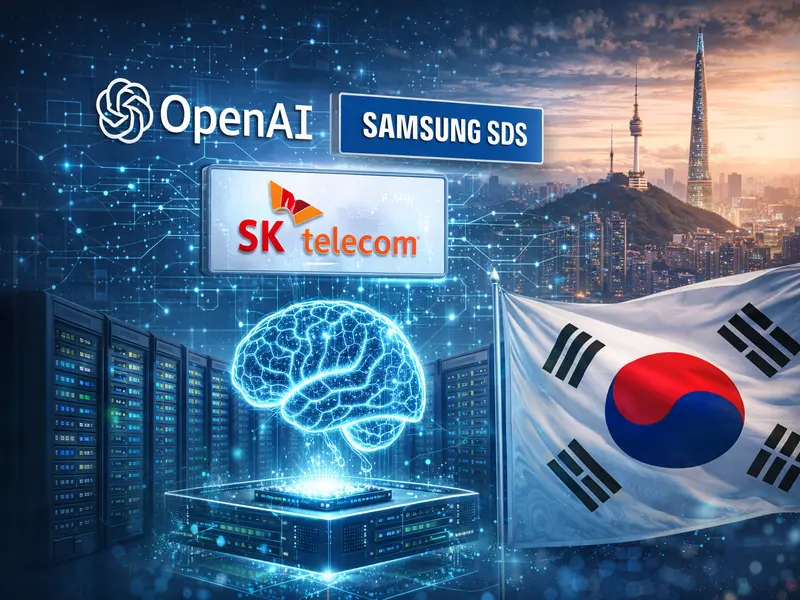
OpenAI is working with Samsung SDS and SK Telecom to advance AI-focused data centre capabilities in South Korea, according to Capacity Media.

Samsung SDS is the IT services arm of Samsung Group, specialising in cloud, logistics and enterprise systems integration, while SK Telecom is the country’s largest mobile operator and an active investor in AI services and infrastructure. The collaboration centres on building or upgrading facilities capable of supporting high-performance AI workloads, including large language models and enterprise AI applications. See also: FCC backs fibre builders with permit limits.

According to the report, the initiative aims to combine OpenAI’s software and model expertise with local data centre capacity and telecoms infrastructure. The focus is on enabling scalable AI services within South Korea, reducing latency and meeting data sovereignty expectations. See also: Ofcom exposes UK rail mobile coverage gap.

The announcement comes as governments and enterprises across Asia-Pacific seek greater control over AI infrastructure, rather than relying exclusively on overseas hyperscale regions. South Korea, with its advanced digital economy and strong semiconductor ecosystem, is positioning itself as a regional AI hub. See also: Robert Neuwirth.

Also Read: Indosat, Nokia & NVIDIA open AI‑RAN centre in Indonesia
Also Read: Indosat, Cisco and Nvidia open AI hub in Indonisia

Why it’s important

AI workloads are reshaping data centre economics. Training and inference for large models require significant compute density, power and cooling capacity, pushing operators to rethink facility design. By linking with established Korean players, OpenAI gains proximity to both enterprise customers and network infrastructure. See also: EU rewrites AI infrastructure sovereignty rules.

For Samsung SDS and SK Telecom, the partnership enhances their credentials in AI infrastructure at a time when competition among regional cloud and data centre providers is intensifying. From a financial perspective, AI-ready facilities can command premium pricing, but they also require heavy upfront investment in power and specialised hardware. See also: EU squeezes US satellite operators from spectrum.

The move also reflects a broader trend towards localisation. As regulatory scrutiny over data governance grows, aligning global AI platforms with domestic infrastructure operators can ease compliance concerns and improve service performance. See also: FCC mandates licences for US undersea cable landings.

If successful, the collaboration could strengthen South Korea’s position in the regional AI race, tying together telecoms networks, enterprise IT services and cutting-edge AI development in a single ecosystem. See also: US closes offshore AI chip loophole.

Domain of operation

OpenAI partners on Korean AI data centres is profiled by BTW Media because published evidence links it to internet infrastructure, governance, operational dependencies, or market visibility.

  • Public role: OpenAI partners on Korean AI data centres is framed by openai partners on korean ai data centres is tracked as a internet infrastructure institution within the internet infrastructure ecosystem. and public governance context. Evidence basis: OpenAI partners on Korean AI data centres article record; OpenAI partners on Korean AI data centres article record
  • Operating surface: Governance and Asia Pacific provide the public context for this institution profile. Evidence basis: OpenAI partners on Korean AI data centres article record; OpenAI partners on Korean AI data centres article record

Timeline

  1. OpenAI partners on Korean AI data centres public profile updated

    Public coverage records OpenAI partners on Korean AI data centres as a subject for role, operating context, and evidence review.

At A Glance

  • Name: OpenAI partners on Korean AI data centres
  • Type: Internet infrastructure institution
  • Base: Asia Pacific
  • Profile focus: Institution

What It Does

  • Public records support monitoring of its role, services, and key relationships.

Why it matters

  • Public-source signals support medium-impact monitoring for infrastructure visibility and dependency analysis.
  • Operational criticality: Medium
  • Time Horizon: Next quarter

What To Watch

  • Monitoring focuses on verified service continuity, governance changes, and relationship signals.
NowMedium priority

Track verified source updates, role changes, and current public evidence.

QuarterMedium policy sensitivity

Public-source signals support medium-impact monitoring for infrastructure visibility and dependency analysis.

YearNext quarter outlook

Longer-term relevance depends on verified operating, policy, and relationship changes.

Member Briefing

Deeper Profile Context

Sign in to unlock the full profile briefing and source notes.

Only for Strategic Circle

Strategic Circle

Open to all readers. Unlock profile briefings after joining and signing in.

Join Strategic Circle

Only for Leadership Alliance

Leadership Alliance

For qualified IP-asset owners and management; sign in to unlock alliance briefings.

Join Leadership Alliance

Public View

The public read of OpenAI partners on Korean AI data centres is limited to visible role, operating context, and relationship evidence.

Watchpoints

  • New public role, affiliation, product, policy, or market disclosures.
  • Verified relationship changes involving named organizations or people.

Caveats

  • Private or unverified claims are excluded from this public view.

FAQ

Why is OpenAI partners on Korean AI data centres included?

OpenAI partners on Korean AI data centres has public evidence that makes the institution relevant to BTW's coverage of digital infrastructure, governance, or markets.

What is public about this profile?

The public layer covers visible role, operating context, linked organizations, and evidence-backed watchpoints.

What should readers watch next?

Readers should watch for source-backed role changes, new partnerships, regulatory exposure, operating expansion, or evidence that changes the public assessment.

BackAll Companies