

- SEA-HAZEMON is a low-cost real-time monitoring of haze air quality disasters in rural communities in Thailand and southeast asia.
- Adisorn Lertsinsrubtavee believes that community drives comprise two parts: local authorities + villagers or volunteers.
Adisorn Lertsinsrubtavee has given a presentation on the SEA-HAZEMON Project at IETF 119. The SEA-HAZEMON Project is a real-time air quality monitoring and forest fire detection platform.
Forest fires are an often unsung and misunderstood part of rural life around the world. But since the 1970s, people have been studying and researching fire, trying to bring in early detection and warnings.
The means of forest fire detection cannot adapt to the increasingly complex situation of forest fire prevention.
And the information level of forest fire prevention is low, with communication coverage capacity limited public evidence. The existing fire prevention communication coverage rate in the forest area of Thailand is only 70%, with a large blind area and satellite communication and mobile communication strategies weak.
With forest fire early warning and monitoring systems imperfect (and early warning accuracy is not high) one compamny has set out to improve this area.
SEA-HAZEMON project
According to greenpeace data, Thailand’s largest source of partoculate matter in the air in the first half of 2017 was open burning, about 54 percent, followed by industry, which accounted for 17% of PM2.5 emissions. Transportation and Logistics accounted for about 13%. Household and electricity generating accounted for about the same amount, 7% and 9% respectively.
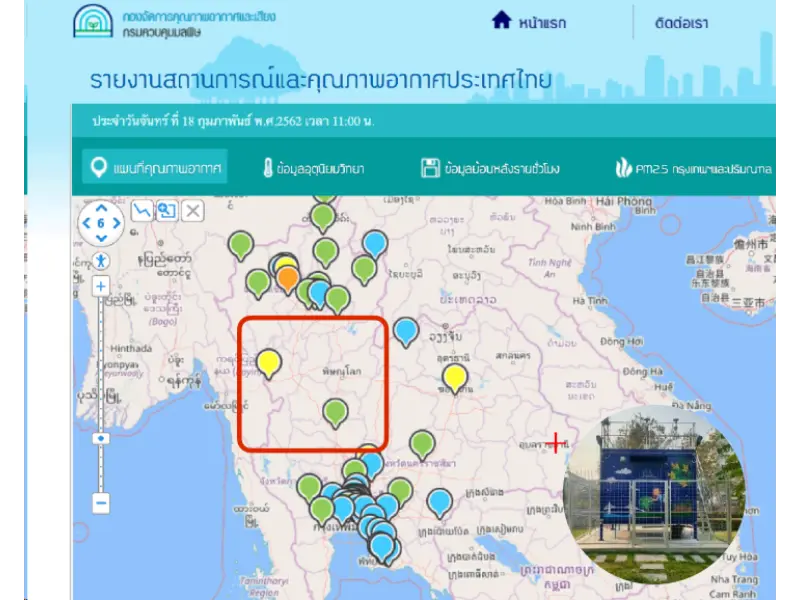
What is the current problem?
For one thing, air quality stations that lack real-time air pollution reports (AQI, PM2.5, CO2, etc.). Also Station is very costly (Millions THB)! So, let us look into SEA-HAZEMON, it’s a low-cost real-time monitoring of haze air quality disasters in rural communities in Thailand and Southeast Asia. The leaders of this project are Dr. Mongkol Ekpanyapong, Professor of intERLab/SET, AIT and Giovanni and Paul, LIP6, UPMC, France.
Also read: IETF 119 officially kicks off in Brisbane
IoT Community
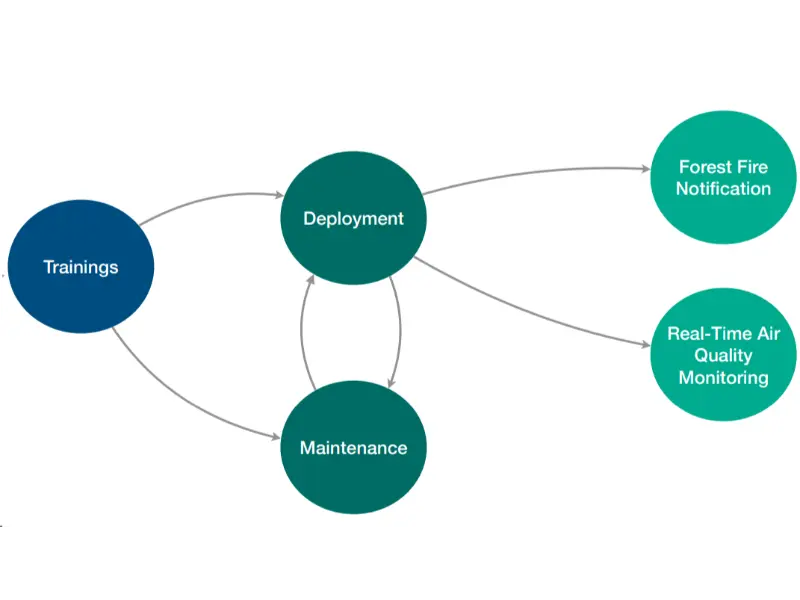
Adisorn Lertsinsrubtavee explained Testing & Calibrating Sensor in Laboratory and Testing & Calibrating Sensor in ambient to the audience The environment is different, IoT Community Model. Adisorn Lertsinsrubtavee believes that Community Driven is two parts: Local Authorities, like Forest Fire, Municipality and Villagers or Volunteers.
This is a simple, easy to understand model:
During the meeting, he gave several examples:
- Doi Chang PaPae Community-8 air quality sensors and one weather station were deployed in Doi Chang Pa Pae, Lamphoon province, Thailand (900 – 1280 m above sea level).
- Mae Ping Community
- Ban Tak Community-8 micro-sensors, 2 weather stations and 5 micro-sensors+ computation
- GRAB Riders Community- assessing daily PM2.5 exposure over a 7-Month period (Nov 23 – May 24) and investigating potential adverse effects of long-term exposure
On-Going Research on IoT, PM2.5 and Forest Fire
This is what Adisorn mentioned:
- Developing Forest Fire Detection Model
- Identify Burned Periods and Factors
- Forest Fire Detection Model
- Forest Fire Alert:Notified messages were sent to Forest Fire authority