
Policy continuity, legitimacy, and accountability signals across internet governance institutions.
Governance
Governance
Internet governance intelligence tracks institutions, policy processes, standards activity, registry operations, accountability disputes, and implementation signals that affect internet infrastructure. BTW.
RIR WatchdogCase FileNumber Resource SocietyICANNIETFHistory of InternetNOGs

RIR Watchdog, Case File, NRS, ICANN, IETF, History of Internet, and NOG sessions.
Coverage prioritizes implementation evidence and institutional behavior over declarative positions.
Latest Coverage
Latest from Governance
7,360 articles

Number Resource Society
Filed as a Registry: The RIR Governance Document Version 2 Status Report in the Public Record
A document title, a Colombian legal domicile, a registry service listing and a role statement naming RIPE NCC sit in one row of the public record, next to that row's own instruction to verify all four. Four links decide what such an entry can support — and this review holds one…

Number Resource Society
Carsten Schiefner's Author Line: What a RIPE Proposal Page Records, and Where It Stops
RIPE policy proposal 2014-01 carries exactly one personal name — an author — beside a publication date, an accepted state and a document number. Reading those fields as three separate records is the difference between documented authorship and an invented decision.

History
Tuvalu Set a July Internet Target. The IP Link Worked by October, 1999
A national deadline and an engineer’s dated network tests mark different stages: the plan targeted July; the international IP path was reported operating by mid-October.

Story
A RIPE NCC Vote on 2026 Surplus Also Sets the Deficit Path
The October General Meeting resolution is framed around a forecast surplus, but its two branches also decide where a 2026 deficit would land. Members are choosing a rule for either result before the year’s accounts are final.

Story
APNIC’s 2027 Fee Table Meets an Unsettled LDC Exit Date
For small network operators, the question is not merely what APNIC charges after a country leaves the least developed country category. It is which official date changes the discount, and what happens when that date is still before the United Nations General Assembly.

History
In 1993, 83 Local Registries Assigned Europe’s Internet Addresses
Europe’s early address system split the work: the RIPE NCC delegated blocks and supported 83 ISP-run local registries, while a separate database recorded networks, routes, domains and contacts.

CASE FILE
PeeringDB Search Can Now Hand Its Filters to the API
PeeringDB has shortened the walk from a browser search to a reusable query. The gain is operational: a team can carry its selection logic into a script, while the result still needs checking against the people and systems that make an interconnection real.

LACNOG
LACNIC 46 Shows Two Numbers. It Does Not Explain the Gap
During LACNIC 46–LACNOG 2026, the event system published 1,215 registered entities and a separate attendees view totalling 706. The page gives neither a definition for “attendees” nor a visible data-as-of time, so the difference cannot responsibly be called an attendance rate.

History
A 64-kbps Satellite Link Did Not Mean Internet at Home: Maldives, 1996–2006
A satellite link brought the Maldives onto the Internet in 1996. A decade later, the census still measured a different question: whether a household had access, and how unevenly that access was distributed between Malé and the atolls.

Story
ARIN’s Proposal to Retire an IPv6 Property Clause Puts the RSA in Focus
ARIN’s RSA makes registry services subject to both the agreement and published policies. A compliance review of an IPv6 block therefore has to read both; ARIN-2026-3 would remove the policy sentence without amending the RSA.

History
RPC Services Moved. The Mapper Told Clients Where: Portmapper in RFC 1057
A server could start an RPC service on a port chosen at run time, but a client still needed somewhere stable to ask for it. RFC 1057 put that rendezvous on port 111: the service registered its program, version and transport, then the client looked up the resulting port. The map…

Story
RIPE’s Proposed Abuse Ladder Needs an Auditable Exit
RIPE policy proposal 2026-02 puts a concrete sequence around infrastructure-level network abuse: a qualifying report, a measured threshold, formal notice, a cure period and administrative restrictions. The least settled part may be the point at which that sequence runs in…

History
RIP Called Sixteen “Unreachable”: The Small Metric That Needed Rules, 1988
At 4 p.m., a branch employee presses “submit” on an order and gets no connection. In this hypothetical network, every link is up, but RIP is the only route source and the path needs more than 15 hops; the gateway has no usable route to advertise. The work stops because the map…

Story
A Fresh RIPEstat Query Can Still Return Older Data
RIPE NCC’s 20 October status notice says data freshness varies by RIPEstat API endpoint. One official Looking Glass response makes the distinction tangible: a request at 18:04:43 UTC returned a latest observation stamped 12:13:37 UTC.

CASE FILE
ICO reprimands expose a gap between public data and account control
An old test account linked to a Welsh public-service data system remained in the picture for more than twelve years. The ICO’s account of the ransomware incident points to a basic governance question: who checks that a supplier-created credential is still needed, and who can…

Story
RIPE NCC members will vote on putting the CEO on the Board
RIPE NCC members will decide whether the seven elected non-executives and the chief executive should sit on one Board under amended Articles of Association.
History
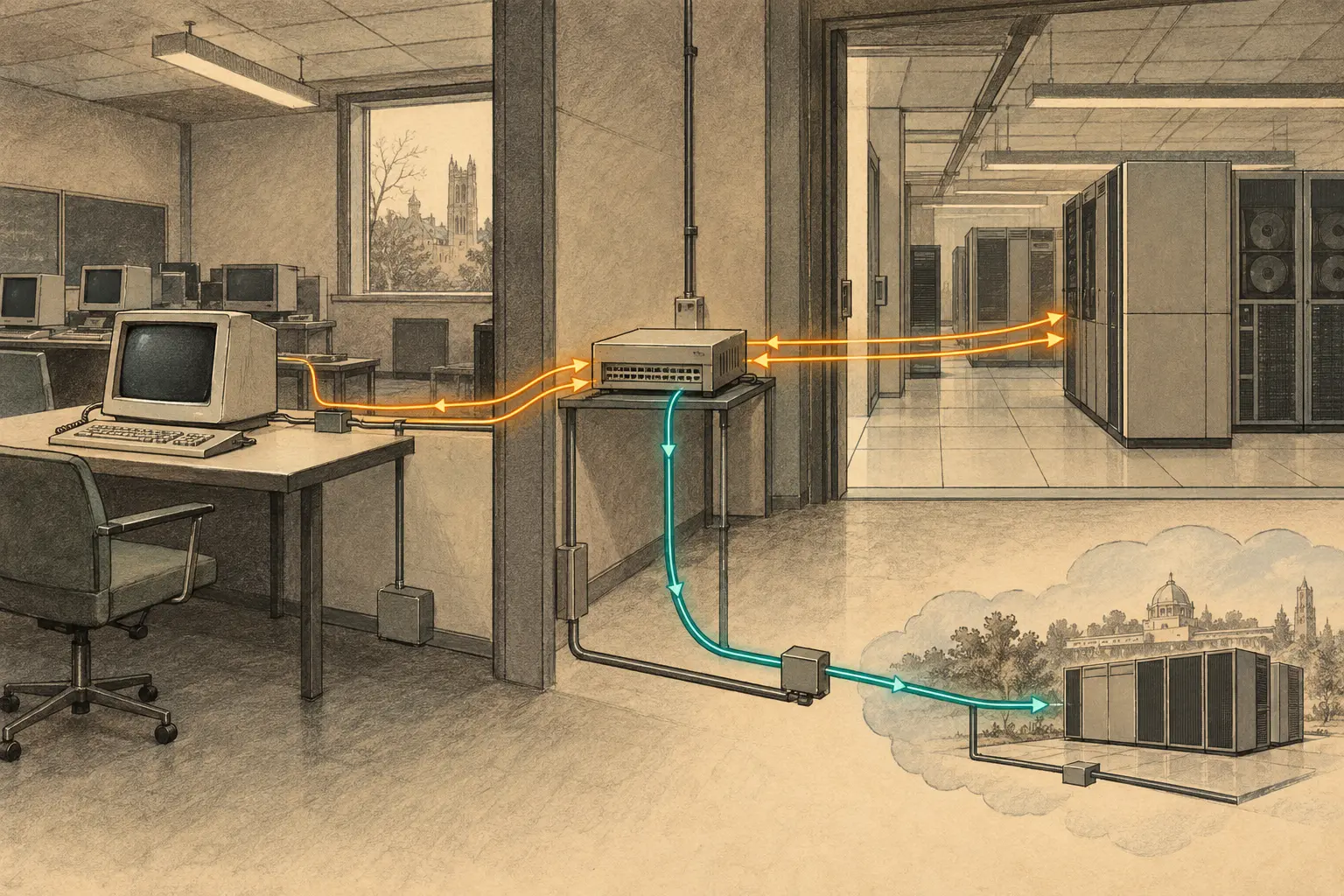
The BOOTP “Gateway” Wasn’t the Client’s Gateway: What giaddr Meant, 1985–93
A diskless computer had to ask for help before it knew its own Internet address. BOOTP let a nearby relay carry that request to a distant boot server, but its field named `giaddr` was easy to mistake for the client’s ordinary router.

ICANN
ICANN's NomCom doubles applications as review time stays tight
Applications for nine ICANN leadership positions are expected to open in late December. The 2026 NomCom report gives the coming cycle a concrete question: 223 people completed applications, more than twice the previous year's total, and the chair says background and skills…

History
The WELL Ran Usenet and E-Mail Before Its Internet Link, 1985–92
The WELL’s own history places Usenet and worldwide e-mail exchange in 1985, years before it dates a separate Internet connection to January 1992. The distinction shows how an online community could be networked without yet offering the Internet access later users expected.

History
ARPANET Carried Batch Jobs to an IBM 360: UCLA’s NETRJS Service, 1977
A user could send a deck of card images across the network, let UCLA’s computer center run the batch, sign off and return later for the printout. NETRJS made that round trip a service, not merely a connection.
Session Map
Governance Branch
RIR Watchdog
Five regional sessions tracking allocation policy, board legitimacy, and institutional continuity.
Open RIR WatchdogCase File
Long-cycle governance dossiers with legal, election, and institutional stress analysis.
Open Case FileNumber Resource Society
Membership, charter, and resource-governance intelligence from the NRS ecosystem.
Open NRS SessionICANN
DNS coordination, accountability frameworks, and global multi-stakeholder process dynamics.
Open ICANN SessionIETF
Protocol standardization trajectory and interoperability risk under fragmented policy conditions.
Open IETF SessionHistory of Internet
Long-cycle infrastructure history used for governance interpretation and structural forecasting.
Open History SessionNOGs
Operator-level implementation intelligence from APRICOT plus regional and national NOG ecosystems.
Open NOGs Session