
Summary
- What it says: WIFI TELEKOM is a credible local access operator in Turkey's Tekirdag corridor, but the economics are unforgiving: it sells mostly lira-denominated household and small-business connectivity while much of the cost stack behind wireless radios, routers, fiber electronics, towers, e
- Main topic: Regional ISP economics; Currency mismatch in infrastructure; SME service continuity; Network-resource evidence
- Context: Regional ISP
The judgement: a useful local operator in a bad cost currency
WIFI TELEKOM should not be judged like a national fiber champion. It is better understood as a local access operator whose commercial purpose is to make broadband appear at addresses where the dominant fixed network, national mobile substitutes, or large national ISPs do not yet give the customer the right mix of availability, installation speed, support and price. Its official site presents the company as a Corlu-centered ISP serving Tekirdag and nearby districts with wireless, "infrastructure-free" access, fiber, VDSL, Metro Ethernet, radio link and backup internet services (https://wifi.net.tr/). That service menu is exactly what one would expect from a regional provider trying to live between two worlds: mass-market broadband on one side and bespoke industrial connectivity on the other.
The economic problem is that the two worlds do not pay the same way. Residential users compare monthly prices in Turkish lira and often choose the cheapest service that works well enough for video, school, messaging, remote work and household devices. Small businesses and factories may pay more, but they still price continuity against national carriers, incumbent wholesale access, mobile routers, Starlink-like satellite expectations, and the option of waiting for fiber. WIFI TELEKOM's supplier base is less local than its customer base. Outdoor radios, routers, fiber optics, switches, tower gear, test equipment, spare devices and datacenter interconnect are sold in markets that follow dollars or euros. Even where a distributor invoices in lira, replacement cost is exposed to foreign exchange. The mismatch is visible in Turkey's macro data: annual CPI was 32.61 percent in May 2026 on the Central Bank of the Republic of Turkey's inflation page (https://tcmb.gov.tr/wps/wcm/connect/EN/TCMB%2BEN/Main%2BMenu/Statistics/Inflation%2BData), while the OECD series carried by FRED put the average USD exchange rate at 45.42247 lira in May 2026 (https://fred.stlouisfed.org/series/CCUSMA02TRM618N). That is not background noise for a WISP; it is the operating environment.
The useful conclusion is therefore not "small local ISP versus big carrier." It is "local wireless substitution under imported-cost pressure." WIFI TELEKOM matters because it appears to serve addresses where waiting for conventional infrastructure is costly. It is risky because the very tactics that make it useful, including fast field installation, rooftop receivers, radio links, local support and custom business links, require equipment, maintenance and skilled labor that can become expensive faster than a household tariff can be repriced.
Identity, trading name and licensing reconciliation
The trading name is WIFI TELEKOM, presented on the public website as "Wifi Telekom" and in legal or routing records as "Wifi Telekom Bilisim Sanayi ve Ticaret A.S." The company footer gives the operating company name, tax number, MERSIS number and KEP address, and places the business at Muhittin Mah. Cetin Emec Bulvari, Seyfi Atun Apt. No: 58-60/A, Corlu, Tekirdag (https://wifi.net.tr/). The 2026 customer contract also identifies Wifi Telekom Bilisim San. Tic. A.S. at Muhittin Mah. Cetin Emec Bul. No:58-60A, Corlu/Tekirdag, with tax number 8110537654 and MERSIS number 0811053765400011 (https://www.wifi.net.tr/docs/wifi-telekom-musteri-sozlesmesi.pdf). RIPE's organisation record uses the ASCII legal form "Wifi Telekom Bilisim Sanayi ve Ticaret A.S," country TR, org type LIR, registration number 16345 and the same Corlu address pattern (https://rest.db.ripe.net/ripe/organisation/ORG-WTBS1-RIPE.json).
The name reconciliation matters because public Turkish sources often vary in spelling, capitalization and suffix. Chamber and trade-association references help bridge the variants. The Corlu Chamber of Commerce directory lists "Wifi Telekom Bilisim Sanayi ve Ticaret Anonim Sirketi" and says the company was formed in 2015, completed BTK ISP licenses and completed wholesale-level agreements with Turk Telekom (https://rehber.corlutso.org.tr/main.asp?firma_id=5678&sayfa=firmadetay). The Access Providers Association member list includes "WIFI TELEKOM BILISIM SANAYI VE TICARET ANONIM SIRKETI" with a 09.05.2016 date (https://www.esb.org.tr/en/our-members/3/). These are not full financial disclosures, but together they support the basic identity: the public brand points to a Turkish corporate ISP, not merely a reseller page or marketing shell.
WIFI TELEKOM's own pages repeatedly describe it as a BTK-authorized ISP and put "BTK Yetkili ISS" in the trust block across pages such as the homepage, infrastructure page and corporate services page (https://wifi.net.tr/, https://wifi.net.tr/altyapimiz, https://wifi.net.tr/kurumsal-internet-hizmetleri). The proper way to use that claim is cautious. It supports a licensed-service reading when combined with the chamber, association and RIPE records. It does not by itself disclose subscriber count, revenue, audited accounts, spectrum arrangements, wholesale contracts or exact service availability at every address.
What the public offer actually sells
The public consumer offer is a mixture of fixed wireless and fixed-line access. WIFI TELEKOM's homepage says wireless tariffs are contract-free and prepaid, while fiber and VDSL tariffs are billed, and it describes all listed packages as "real unlimited" (https://wifi.net.tr/). The wireless ladder is low by national fiber standards but clear by local-substitution standards: Wifi Super 8 is shown at 8 Mbps download and 4 Mbps upload, Wifi Pro 12 at 12/5 Mbps, Wifi Ultra 16 at 16/5 Mbps, and Wifi Ultra Plus 20 at 20/6 Mbps, with the homepage showing promotional monthly prices of TRY 549.90, TRY 649.90, TRY 769.90 and TRY 919.90 respectively (https://wifi.net.tr/). The separate tariff page repeats the same product family and adds fiber/VDSL packages, including VDSL/DSL 16, Fiber/VDSL 50 and Ultra Fiber 200 at listed promotional monthly prices of TRY 699.90, TRY 799.90 and TRY 1,149.90 respectively (https://wifi.net.tr/bireysel-internet-tarifeleri).
This is not a speed-leadership posture. It is a coverage and convenience posture. A 20 Mbps fixed-wireless package is not meant to beat a 500 Mbps or 1 Gbps national fiber package where clean fiber is already in the apartment. It is meant to win when the customer has no suitable port, lives in a summer-home area, faces slow activation, needs temporary or prepaid service, or wants a local team that can put a receiver on a roof and make the connection work. The site explains the mechanics in plain language: wireless internet is not simply home Wi-Fi shared over distance; WIFI TELEKOM says the connection is carried from a WIFI TELEKOM access point to the address through a dedicated outdoor receiver, then handed inside to a modem/router for normal home Wi-Fi use (https://wifi.net.tr/).
That operational description is important because it explains both the value and the fragility. Fixed wireless removes trenching, port scarcity and some last-mile copper limitations. It also introduces line-of-sight checks, mounting work, outdoor equipment failure, weather exposure, interference, customer-side power dependence and support calls when the home Wi-Fi layer is confused with the outdoor link. WIFI TELEKOM's own speed-test page tells customers that real speed can vary by infrastructure type, distance, equipment quality and network congestion, and it asks users to test by cable, close other applications and repeat tests at different times (https://wifi.net.tr/wifi-telekom-hiz-testi). The legal speed-information page similarly says tariff speeds are maximum values and can vary with distance, line quality, congestion and user equipment (https://wifitelekom.com/yasal/hizmet-kalitesi).
The customer proposition is therefore more honest than many generic ISP advertisements: the company is not promising that every address becomes fiber. It is selling address-by-address selection among wireless, fiber, VDSL and corporate access. The address-query page defaults to Tekirdag and says it checks Telekom plus wireless availability, with quick district choices including Corlu, Cerkezkoy, Ergene, Kapakli, Marmaraereglisi, Saray, Malkara and Suleymanpasa (https://wifi.net.tr/altyapi-sorgula). That is a regional footprint, not a national one.
Network evidence: more than a brochure, less than a disclosed network map
The strongest public evidence that WIFI TELEKOM is a real operator is not its marketing language. It is the network and registration trail. RIPE lists ORG-WTBS1-RIPE as Wifi Telekom Bilisim Sanayi ve Ticaret A.S, a local internet registry with address and phone details in Corlu (https://rest.db.ripe.net/ripe/organisation/ORG-WTBS1-RIPE.json). RIPE aut-num records connect AS205893 and AS209007 to the same organisation and describe them as Wifi Telekom/wifi.net.tr (https://rest.db.ripe.net/ripe/aut-num/AS205893.json and https://rest.db.ripe.net/ripe/aut-num/AS209007.json). BGP.tools presents AS205893 as active, registered in May 2017, and tied to the website https://www.wifi.net.tr/ (https://bgp.tools/as/205893). IPinfo summarizes AS205893 as an ISP in Turkey with 1,024 IPv4 addresses, a very large IPv6 allocation count, RPKI-valid IPv4 ranges and upstream visibility through TurkNet (https://ipinfo.io/AS205893).
These records should not be exaggerated. An ASN does not prove service quality, retail subscriber count or profitability. It does, however, change the analysis from "local marketing reseller" to "operator with its own routing identity and address resources." That is particularly relevant for corporate and radio-link services, because business customers care about static addressing, routing control, upstream diversity and response time when links fail. WIFI TELEKOM's infrastructure page uses the language of NOC, POP points, tower and radio-link network, fiber/Metro Ethernet, static IP, scalable links and backup planning (https://wifi.net.tr/altyapimiz). The corporate page sells Metro Ethernet, corporate radio link and Metro Ethernet migration, with features such as symmetric speed, static IP support, low latency, SLA approach and backup line options (https://wifi.net.tr/kurumsal-internet-hizmetleri).
The public record also shows a dual character. AS205893 appears as the core direct operator identity. AS209007, also tied to the same RIPE organisation, is presented on IPIP with six IPv4 prefixes, including some ranges whose descriptions belong to Alanyanet, Feniks, Daniel Eriksson Teknik AB, WIFI TELEKOM itself and Veganet, alongside upstream references including Turk Telekom, TurkNet and Veganet (https://whois.ipip.net/AS209007). The clean reading is not that all those names are WIFI TELEKOM customers in a commercial sense; routing databases can reflect assignments, legacy arrangements, downstreams, hosted prefixes, customers, peers or administrative relationships. The important point is that WIFI TELEKOM has a real technical footprint and interacts with a wider set of Turkish and international network resources.
That wider set is also a source of dependency. If an operator is small enough that one visible upstream dominates current public scans, but large enough to maintain radio access, POPs and business customers, it must manage upstream resilience actively. IPinfo's AS205893 page says there is one peer and one upstream visible for that ASN, TurkNet Iletisim Hizmetleri A.S. (https://ipinfo.io/AS205893). RIPE import policy records list more possible upstream or peering relationships for AS205893, including AS174, AS12735, AS9121, AS15924, AS34984 and others (https://rest.db.ripe.net/ripe/aut-num/AS205893.json). The difference between routing policy and observed path diversity is a risk signal, not a verdict. What matters commercially is whether customers experience continuity when one route, tower, power feed or wholesale interface fails.
Pricing logic: wireless as a local substitute, not a cheap fiber clone
The tariff ladder makes sense only if the product is understood as substitution. WIFI TELEKOM's 8-20 Mbps wireless products are priced in the same monthly range as many national fixed-line offers but carry much lower headline speed. At first glance, that looks weak. TurkNet's tariff page shows 100 Mbps VAE/fiber products at TRY 699.90 and Gigafiber 1000 at TRY 949.90 as of a June 2026 tariff period (https://www.turk.net/tarifelerimiz, and the specific 1000 Mbps page at https://www.turk.net/1000-mbps-internet). Turk Telekom's public campaign page showed 100 Mbps 12-month online pricing at TRY 1,145 per month and 500/1000 Mbps introductory 18-month offers with lower first-six-month prices but higher later-month prices (https://bireysel.turktelekom.com.tr/evde-internet/yeni-musteri-kampanyalari). Superonline's fiber campaign page showed a 100 Mbps package at TRY 900 for the first six months and TRY 1,000 for the following six months (https://www.superonline.net/ev-interneti/fiber-internet). Vodafone's home internet page showed a 1000 Mbps fiber product at TRY 1,499 per month with modem included and 12-month price guarantee language (https://www.vodafone.com.tr/net/ev-internet-paketi-fiyatlari).
Against those comparables, a TRY 919.90 20 Mbps fixed-wireless package is not a bargain if clean national fiber is available. It is rational if the alternative is no installation, poor copper, long waits, seasonal use, an address outside fiber buildout, or a business site that needs a backup path. WIFI TELEKOM's own copy leans into that logic. It calls wireless a way to serve areas with limited or no infrastructure, says installation can be fast, and highlights address suitability, signal checks and outdoor receiver installation (https://wifi.net.tr/). It also has a dedicated summer-home page for Yeniceiftlik, Marmaraereglisi and Tekirdag-area summer addresses, where each address must be checked for wireless, fiber or VDSL suitability (https://wifi.net.tr/yazlik-internet).
The pricing risk is that customers often compare by megabit even when the real constraint is availability. National fiber advertising pushes 100 Mbps, 500 Mbps and 1 Gbps into the consumer's mental benchmark. Mobile fixed-wireless substitutes, especially 4.5G and 5G routers, add another comparison. The U.S. International Trade Administration's 2026 Turkey ICT guide says Turkey planned 5G public availability from April 2026 after a 2025 auction, and it identifies fixed wireless access as one of the expected 5G use cases, especially in underserved or geographically challenging areas (https://www.trade.gov/country-commercial-guides/turkey-information-and-communication-technology). That means WIFI TELEKOM's fixed-wireless household products face both wired and wireless substitutes.
The defense is service specificity. A national mobile router can be simple, but it may not offer stable public addressing, predictable latency, rooftop line-of-sight engineering, local installation, or a technician who understands a particular Corlu street and nearby access point. A national fiber plan can be fast, but only if the building actually has the facility, the port is available and activation works. WIFI TELEKOM's economic lane is the gap between advertised national availability and practical address-level availability.
The narrower that gap becomes, the more WIFI TELEKOM must move the profit mix toward business links, backup links and specialized local support.
The imported-equipment cost base
The hardest economic lens is also the most important one for the company: lira customers versus imported equipment. Turkey has domestic technology ambitions, but telecom access networks remain tied to foreign-origin equipment and global component pricing. The 2026 U.S. Commercial Service ICT guide says Nokia, Ericsson and Huawei are the main network providers in Turkey, while Cisco, Nokia, Ericsson and Siemens are main GSM switch and base-station suppliers, and ZTE, Nokia, Alcatel, Siemens, Ericsson and NEC supply much fixed-line switching and traditional telecom equipment (https://www.trade.gov/country-commercial-guides/turkey-information-and-communication-technology). That is national-market context, not proof of WIFI TELEKOM's vendor list. But it accurately describes the procurement reality a regional ISP faces: the local invoice may be in TRY, but the upstream supply chain is not purely local.
For a radio-link ISP, the exposed items are mundane and repeated. Customer premises equipment includes outdoor receivers, brackets, cables, power supplies, routers and sometimes replacement modems. Access sites need radios, sector antennas, switching, backup power, enclosure work, lightning protection, tower leases or rooftop rights, alignment tools and labor. Fiber and Metro Ethernet customers add optical modules, switches, routers, SFPs, cabinets, patching, test gear and spares. The customer contract defines "equipment" broadly as the products, cables, devices and equipment needed to provide services, and the application form includes connection choices such as Fiber, VDSL, WiFi, Radio Link and Metro Ethernet (https://www.wifi.net.tr/docs/wifi-telekom-musteri-sozlesmesi.pdf). That legal language maps directly to capital stock and replacement obligations.
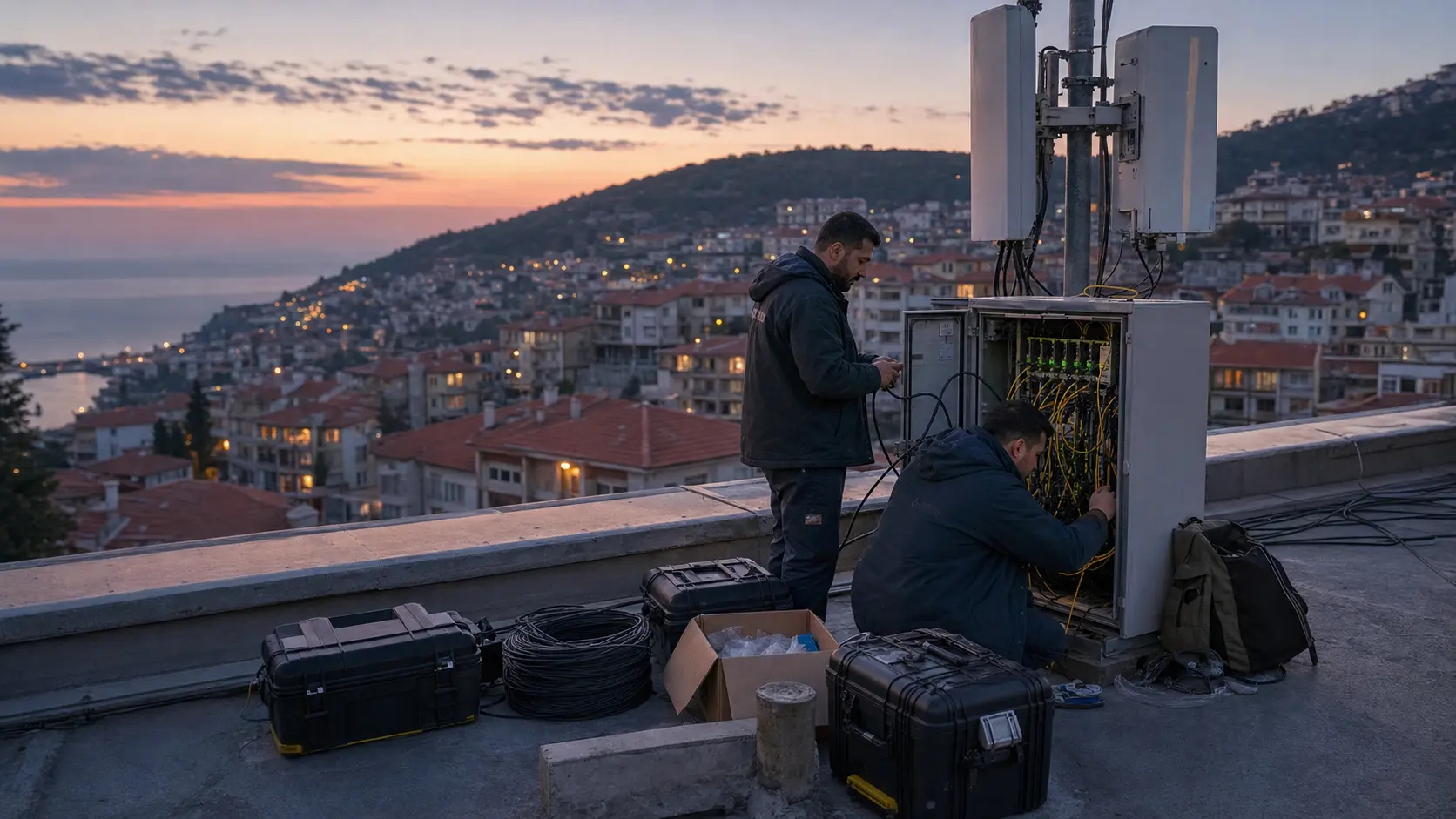
WIFI TELEKOM's own operating pages indicate that it touches the customer premise rather than merely sending a SIM card. The homepage says a small outdoor receiving device is mounted at a suitable point and the connection is handed to a modem/router inside the home (https://wifi.net.tr/). The infrastructure page says tower, POP, fiber, Metro Ethernet and radio-link components are planned together, and that field discovery, project design, planned installation, monitoring and later changes are part of the corporate process (https://wifi.net.tr/altyapimiz). Every one of those steps involves labor and parts.
Inflation and financing make this more severe. TCMB's June 2026 MPC summary put TRY commercial loan rates, excluding overdrafts and credit cards, at 50.5 percent as of the week ending June 5, and general-purpose loan rates at 64.1 percent (https://tcmb.gov.tr/wps/wcm/connect/EN/TCMB%2BEN/Main%2BMenu/Announcements/Press%2BReleases/2026/ANO2026-24). A local ISP buying replacement radios or expanding a tower site cannot treat working capital as free. If the company pre-installs equipment for a customer on a prepaid or monthly plan, it is effectively financing that customer's connection until installation cost is recovered. If the lira weakens before replacement stock is bought, the next receiver, switch or router costs more in local-currency terms. If customer churn rises, the payback period breaks.
This is why WIFI TELEKOM's prepaid wireless stance is economically logical. Prepayment reduces receivables risk. Contract-free packages reduce the need to promise long future service at a fixed old price. But the tradeoff is customer retention risk: without a long commitment, a user can leave when national fiber arrives or when a mobile operator discounts a router plan. The operator then must recover equipment, refurbish it, redeploy it, or accept loss. The business is therefore about installation discipline as much as monthly tariff levels.
Cash conversion and the truck-roll problem
The most revealing cost item in a local wireless ISP is often not the radio itself; it is the truck roll. WIFI TELEKOM's public model requires address checks, signal suitability checks, outside receiver placement, cable routing, modem/router handoff and later fault handling (https://wifi.net.tr/). A wireless customer who pays TRY 549.90 or TRY 649.90 per month can look attractive if the installation is simple, the receiver stays in service for years and support is mostly remote. The same customer can become unprofitable if the first visit needs a roof survey, the second visit corrects alignment, the third visit replaces a power adapter, and a later visit recovers equipment after churn.
This is why address qualification is not just an engineering step; it is a financial control. The homepage says signal suitability is checked before installation and that unsuitable locations receive alternative suggestions (https://wifi.net.tr/). The contract says wireless customers may need roof permission and access, and that failure to provide necessary conditions can leave responsibility with the subscriber (https://www.wifi.net.tr/docs/wifi-telekom-musteri-sozlesmesi.pdf). That language protects the operator because the customer premise is part of the production chain. In a fiber-only business, much of the hardest civil work is upstream of the retail activation. In a fixed-wireless business, the last meters can still require a technician, a ladder, safe access, power, cable routing and customer cooperation.
The cash-conversion question is therefore simple: how many clean monthly payments does a new link need before the installation has paid back? Public sources do not disclose WIFI TELEKOM's receiver cost, installation labor cost, churn, recovery rate or average customer life. But the public tariff table lets us see why the answer matters. A 12 Mbps prepaid line at TRY 649.90 per month has less room for repeat field work than a corporate radio link sold to a factory with static IP, backup design and SLA expectations (https://wifi.net.tr/bireysel-internet-tarifeleri and https://wifi.net.tr/kurumsal-internet-hizmetleri). Every avoidable truck roll pushes the residential wireless product closer to break-even. Every well-priced business link helps carry the field team that makes the residential footprint possible.
Turkey's interest-rate environment makes payback speed more important. The TCMB's June 2026 summary put TRY commercial loan rates around 50.5 percent as of the week ending June 5 (https://tcmb.gov.tr/wps/wcm/connect/EN/TCMB%2BEN/Main%2BMenu/Announcements/Press%2BReleases/2026/ANO2026-24). At that cost of money, holding spare radios, routers and switches is expensive, but not holding them can make outages longer and customer churn higher. The better operators in this niche are not merely the ones with the cheapest packages. They are the ones that convert installations into long-lived, low-touch accounts and reserve field capacity for faults that genuinely need local hands.
Upstream dependency and the wholesale layer
WIFI TELEKOM's independence should not be overstated. The Corlu chamber directory says the company completed wholesale-level agreements with Turk Telekom after obtaining ISP licenses (https://rehber.corlutso.org.tr/main.asp?firma_id=5678&sayfa=firmadetay). The customer contract defines an infrastructure provider as Turk Telekomunikasyon A.S. and other authorized infrastructure operators unless otherwise specified (https://www.wifi.net.tr/docs/wifi-telekom-musteri-sozlesmesi.pdf). The public address-query page says it checks "Telekom + wireless" for Tekirdag (https://wifi.net.tr/altyapi-sorgula). The routing record shows upstream and import-policy relationships with carriers such as TurkNet and Turk Telekom-related ASNs depending on ASN and source (https://ipinfo.io/AS205893, https://whois.ipip.net/AS209007, https://rest.db.ripe.net/ripe/aut-num/AS205893.json).
This is normal for a regional ISP. It is not a criticism that WIFI TELEKOM depends on larger operators for some upstream or access components. The national fixed network is structurally concentrated. The U.S. Commercial Service guide says Turk Telekom dominates fiber infrastructure, operating roughly 78 percent of the network, around 450,000 km, under a concession that was extended to 2050 with a large investment plan (https://www.trade.gov/country-commercial-guides/turkey-information-and-communication-technology). The Ministry of Transport and Infrastructure said Turkey had 97.4 million broadband subscribers in Q2 2025, including 20.7 million fixed and 76.6 million mobile subscribers, and that fiber length had risen to about 637,000 km, up 10.6 percent year over year (https://www.uab.gov.tr/haberler/konusma-trafigi-155-bin-yila-denk-geldi). Local challengers live inside that national structure.
The strategic question is how much bargaining power WIFI TELEKOM has. If it can buy wholesale access, upstream transit and interconnect at predictable cost while using wireless to reach customers faster than national carriers, it has a defensible niche. If upstream price, port scarcity, national carrier promotions or regulatory changes squeeze it, the niche narrows. If the company can place POPs near industrial customers, keep backhaul resilient and use radio links for backup or rapid deployment, it can charge for continuity rather than just megabits. That is the higher-quality business.
The public evidence points to both possibilities. Corporate pages emphasize Metro Ethernet, radio link, static IP, backup internet and 100+ references across industry, automotive, healthcare, education, public and energy categories (https://wifi.net.tr/kurumsal-internet-hizmetleri). The same site also sells low-speed prepaid home wireless. If the revenue mix leans too far toward low-ARPU households, upstream and support costs may outrun price. If it leans toward industrial and municipal dependency, the operator can justify field teams, monitoring and redundancy.
Customer dependency: households, summer homes and industrial sites
WIFI TELEKOM's customer dependency surface is unusually tangible because the company serves local places rather than abstract national demand. The homepage lists service regions including Corlu, Ergene, Cerkezkoy, Kapakli, Saray, Velimese, Ulas, Marmaracik, Yeniceiftlik and Yenice (https://wifi.net.tr/). It later adds Marmaraereglisi, Muratli and Tekirdag OSB surroundings in a broader service-region section, while warning that availability depends on address, location, line of sight and infrastructure result (https://wifi.net.tr/). The infrastructure page names Corlu, Ergene, Cerkezkoy, Kapakli and Marmaraereglisi as areas where local field teams support businesses (https://wifi.net.tr/altyapimiz).
Those locations matter economically. Tekirdag is not just a residential broadband market; it includes industrial zones, logistics corridors, manufacturers, workshops, dealerships, healthcare sites, schools, municipal offices and coastal/summer-home demand. WIFI TELEKOM's corporate page claims 100+ corporate customers and organizes references into industrial and manufacturing, automotive and fuel, chemical/plastic/textile, public, health and education groups (https://wifi.net.tr/kurumsal-internet-hizmetleri). Those names and counts are company claims, not independently audited reference checks, but they indicate the type of customer the company wants the market to see.
The dependency is reciprocal. A household that uses a 12 Mbps or 16 Mbps wireless plan may depend on the service for school, messaging, television streaming and payments, but it can switch when a better fixed-line plan arrives. A factory, workshop, hospital or school has a different problem: downtime interrupts production systems, card payments, cloud software, cameras, call systems and supplier coordination. For those customers, the value of a local operator is fast response, backup design and a person who can explain whether the issue is inside cabling, rooftop equipment, backhaul, upstream transit or the customer's router.
WIFI TELEKOM's public pages know this. The corporate page sells not just speed but "yerel destek," local support; "hizli kurulum," quick installation; 7/24 support; and an SLA approach (https://wifi.net.tr/kurumsal-internet-hizmetleri). The infrastructure page frames operations as NOC, alarm tracking, support records and field coordination (https://wifi.net.tr/altyapimiz). The consumer speed-test and service-quality pages tell users speed can vary and instruct them how to test before calling support (https://wifi.net.tr/wifi-telekom-hiz-testi, https://wifitelekom.com/yasal/hizmet-kalitesi). That customer-education layer is not glamorous, but it reduces unnecessary truck rolls if it works.
The main weakness is scale. Local service can be excellent at small scale and fragile during simultaneous outages. One tower issue, regional power interruption, upstream impairment, weather event, or staffing gap can affect many customers. The same localness that makes WIFI TELEKOM responsive also means customers may expect immediate human answers in the evening. Unofficial complaint posts should not be treated as established outage statistics, but they show the expectation: a Sikayetvar complaint from June 17, 2025 described an evening internet interruption and difficulty reaching support after 19:00 (https://www.sikayetvar.com/wifi-telekom-corlu/aksam-saatlerinde-internet-kesintisi-ve-musteri-hizmetlerine-ulasilamiyor). That is one customer's account, not verified performance data. It is still a useful signal because access customers value the support channel almost as much as the nominal speed.
Competition: national carriers, national challengers and fixed-wireless substitutes
WIFI TELEKOM competes against at least four types of provider. The first is the incumbent and its retail arm: Turk Telekom. The second is large mobile/fiber groups such as Turkcell Superonline and Vodafone. The third is national challenger ISPs such as TurkNet, especially where VAE or Gigafiber is available. The fourth is substitution: mobile routers, 4.5G/5G fixed wireless, satellite expectations, and local WISPs with similar radio economics.
The price comparison is not flattering if judged by megabit. TurkNet's June 2026 tariff table showed 100 Mbps products at TRY 699.90 and Gigafiber 1000 at TRY 949.90 (https://www.turk.net/tarifelerimiz). Turk Telekom's page showed national fiber and internet promotions, including 100 Mbps at TRY 1,145 monthly under a 12-month online campaign and higher-speed 500/1000 Mbps first-six-month prices under 18-month campaigns (https://bireysel.turktelekom.com.tr/evde-internet/yeni-musteri-kampanyalari). Superonline's fiber campaign showed 100 Mbps with TV-related bundle language at TRY 900 for six months and TRY 1,000 for the following six months (https://www.superonline.net/ev-interneti/fiber-internet). Vodafone showed 1000 Mbps fiber at TRY 1,499 with modem included (https://www.vodafone.com.tr/net/ev-internet-paketi-fiyatlari). WIFI TELEKOM's wireless 20 Mbps at TRY 919.90 and 16 Mbps at TRY 769.90 are therefore not competing on raw speed.
That is not automatically fatal. The coverage and installation market is not the same as the speed-comparison market. A provider that can install a rooftop receiver at an address where no fiber plan is available can charge for availability. A company that can provide a backup radio link to a factory that already has fiber can charge for resilience. A summer-home customer who wants seasonal practicality may value prepaid wireless more than a national long commitment. WIFI TELEKOM's summer-home page directly targets Yeniçiftlik, Marmaraereglisi and Tekirdag-area addresses (https://wifi.net.tr/yazlik-internet).
The risk is that national carriers are not standing still. The Ministry of Transport's Q2 2025 review said the highest year-on-year increase in broadband subscriber type was fixed wireless at 36.6 percent, followed by fiber-to-the-home at 24 percent (https://www.uab.gov.tr/haberler/konusma-trafigi-155-bin-yila-denk-geldi). That means demand is moving in both of WIFI TELEKOM's lanes: fixed wireless and fiber. If large carriers improve fixed-wireless offers with 5G routers, WIFI TELEKOM faces a substitute in its no-infrastructure market. If fiber buildout improves in Tekirdag districts, WIFI TELEKOM faces speed pressure in existing home accounts. The strongest countermeasure is to use local knowledge to serve addresses and businesses that national campaigns still underserve.
There is also a trust dimension. National carriers can advertise big discounts, but customers often dislike call-center loops and slow fault ownership. Local ISPs can win by being reachable. That is why WIFI TELEKOM's employment signals matter: the career page says it accepts applications across field technical support, customer service/call center, sales, corporate sales, network/system support, accounting, internships and general applications (https://wifi.net.tr/is-basvuru-formu). This does not prove headcount, but it shows the operating functions the company considers necessary. A local ISP that underinvests in these functions becomes just a slower version of a national provider. A local ISP that invests well can defend a premium in hard-to-serve places.
Regulatory and macroeconomic risk
WIFI TELEKOM's regulatory risk is the ordinary risk of a Turkish electronic communications provider, not a unique scandal. It operates in a regulated sector, advertises BTK authorization, uses safe-internet language, refers users to BTK complaint paths and includes BTK-related service-quality obligations in its legal pages (https://wifitelekom.com/yasal/hizmet-kalitesi). The customer contract says services are subject to relevant authorization documents and regulations, and defines BTK as the relevant authority (https://www.wifi.net.tr/docs/wifi-telekom-musteri-sozlesmesi.pdf). Safe Internet service is presented as an optional, free family/child profile under BTK regulation (https://wifi.net.tr/guvenli-internet).
The more important regulatory economics are structural. Turk Telekom's fiber dominance and extended concession shape wholesale and access options for all alternative providers. The U.S. Commercial Service guide says Turk Telekom operates roughly 78 percent of Turkey's fiber network and that the concession was extended to 2050 with a $17 billion investment plan and a payment commitment beginning in 2026 (https://www.trade.gov/country-commercial-guides/turkey-information-and-communication-technology). If that investment expands fiber in Tekirdag quickly, customers may gain better options but WIFI TELEKOM's wireless substitution margin may narrow. If wholesale access or last-mile coordination remains difficult, WIFI TELEKOM's local radio model stays relevant.
Macroeconomics cut through every strategic choice. Inflation at 32.61 percent in May 2026 means labor, rent, energy, transport, site maintenance and customer acquisition costs keep moving (https://tcmb.gov.tr/wps/wcm/connect/EN/TCMB%2BEN/Main%2BMenu/Statistics/Inflation%2BData). High commercial loan rates make expansion expensive (https://tcmb.gov.tr/wps/wcm/connect/EN/TCMB%2BEN/Main%2BMenu/Announcements/Press%2BReleases/2026/ANO2026-24). The high lira-per-dollar level increases the local-currency cost of replacement gear (https://fred.stlouisfed.org/series/CCUSMA02TRM618N). A WISP can defer some capital spending, but it cannot avoid replacing failed outdoor devices, upgrading congested radios, buying switches or paying for fuel and field labor.
This creates a difficult pricing problem. Raise tariffs too slowly, and margins disappear. Raise tariffs too quickly, and households churn to national providers or mobile substitutes. Hold prices for prepaid goodwill, and the company finances inflation itself. Tie everything to short-term prices, and customers lose confidence. The best defense is segmentation: low-speed wireless for addresses that truly need it, premium corporate radio link and Metro Ethernet for businesses that value uptime, and backup services where a second path has measurable value.
Unofficial signals: useful, but not facts
Unofficial sources are valuable only if kept in their lane. They do not prove network quality, financial health or customer satisfaction at scale. They do reveal what people notice, complain about or advertise when formal disclosures are thin.
The positive signal is that older forum chatter recognized WIFI TELEKOM as a Tekirdag-area provider with unlimited low-speed packages. An Ekşi Sözlük entry from 2017 described WIFI TELEKOM as serving only the Tekirdag region at that time and offering 10 Mbit packages without a fair-use quota at comparatively reasonable prices, while later entries include more mixed remarks such as internet being unavailable on a Sunday (https://eksisozluk.com/wifi-telekom--5335947). That is not a survey, but it reinforces the company's long-standing identity as a local wireless-style ISP rather than a recent SEO creation.
Complaint portals show the other side. A January 2024 Sikayetvar post complained of slow speeds and unsatisfactory technical support (https://www.sikayetvar.com/wifi-telekom-corlu). The June 2025 Sikayetvar post cited above complained about an evening outage and unreachable support (https://www.sikayetvar.com/wifi-telekom-corlu/aksam-saatlerinde-internet-kesintisi-ve-musteri-hizmetlerine-ulasilamiyor). These posts are one-sided accounts. They should not be quoted as verified incident data. They are relevant because they identify the pressure points that any local wireless ISP must manage: evening congestion, support responsiveness and customer perception when the service fails outside office hours.
Job and employee traces are another signal. The WIFI TELEKOM career page lists field, support, sales, corporate sales and network/system support application categories (https://wifi.net.tr/is-basvuru-formu). A LinkedIn post by a person describing work in corporate internet solutions said WIFI TELEKOM had served Corlu and surrounding businesses for more than 10 years with infrastructure-independent radio-link service (https://tr.linkedin.com/posts/halim-yi%C4%9Fit-3b8166364_wifi-telekom-olarak-10-y%C4%B1l%C4%B1-a%C5%9Fk%C4%B1n-s%C3%BCredir-activity-7326186597555527680-3WUk). Another LinkedIn post described coverage expansion around Velimese OSB, Ergene OSB, Marmaracik OSB, Turkgucu OSB and Corlu (https://tr.linkedin.com/posts/halim-yi%C4%9Fit-3b8166364_wifi-telekom-olarak-kapsama-alan%C4%B1m%C4%B1z%C4%B1-geni%C5%9Fletiyoruz-activity-7332684858890088448-KWRP). LinkedIn posts are not audited network maps. They are consistent with the company's corporate-service posture and industrial-zone emphasis.
The clean analytical takeaway is that the unofficial signals match the public model. Users discuss availability, slowdowns and support. Employees and pages discuss radio links, industrial coverage and local service. That pattern is exactly what one would expect from a regional WISP moving upmarket into business continuity.
What would change the judgement
Several facts would materially improve the view of WIFI TELEKOM. The first would be verified subscriber and revenue mix by consumer wireless, fiber/VDSL, Metro Ethernet, radio link and backup lines. If corporate and backup services are a meaningful share of margin, the company is more resilient than its consumer tariff table suggests. If low-speed residential wireless dominates revenue, it is much more exposed to national fiber and mobile-router substitution.
The second would be real upstream diversity evidence. Public routing records show real network identity and possible policy diversity, but current public observation can still look concentrated. A documented mix of upstreams, physically diverse paths and backup transit would make the corporate SLA message more convincing. The third would be tower/POP density and utilization. A WISP with dense, well-loaded access points can spread cost; one with sparse sites and long truck rolls cannot.
The fourth would be churn and installation-payback data. The economics of prepaid, contract-free wireless depend on how long customers stay after outdoor equipment is installed. If the equipment is recovered and redeployed efficiently, churn is manageable. If devices are lost, damaged or stuck at low-tenure customers, the business leaks capital.
The fifth would be customer-service performance data, especially evening and weekend response. The public service-quality page says individual subscribers have a 95 percent service-continuity commitment and corporate subscribers can have special SLA contracts (https://wifitelekom.com/yasal/hizmet-kalitesi). Actual restoration performance, ticket response time and outage communication would be more important than the statement itself.
The sixth would be procurement currency terms. If WIFI TELEKOM has distributor credit, local inventory, reusable equipment policies and disciplined spare-parts management, it can absorb exchange-rate volatility better than a smaller WISP buying reactively. If it buys replacement gear only after failures, dollar-linked shocks will hit service and margin together.
Until those facts are available, the judgement remains balanced but firm: WIFI TELEKOM is a legitimate regional ISP with a real service niche in Tekirdag's address-level broadband gaps and business-continuity needs, but the model is structurally squeezed by hard-currency inputs, expensive local financing, national carrier speed benchmarks and the operational burden of supporting outdoor wireless at household prices.
Evidence register
Official company identity and offer: WIFI TELEKOM homepage, service regions, wireless/fiber tariff ladder, address-based service logic and legal footer at https://wifi.net.tr/; individual tariff page at https://wifi.net.tr/bireysel-internet-tarifeleri; address-query page at https://wifi.net.tr/altyapi-sorgula; summer-home page at https://wifi.net.tr/yazlik-internet; infrastructure page at https://wifi.net.tr/altyapimiz; corporate services page at https://wifi.net.tr/kurumsal-internet-hizmetleri; speed-test guidance at https://wifi.net.tr/wifi-telekom-hiz-testi; service-quality page at https://wifitelekom.com/yasal/hizmet-kalitesi; 2026 contract PDF at https://www.wifi.net.tr/docs/wifi-telekom-musteri-sozlesmesi.pdf.
Legal and industry reconciliation: RIPE organisation record for ORG-WTBS1-RIPE at https://rest.db.ripe.net/ripe/organisation/ORG-WTBS1-RIPE.json; Corlu Chamber directory at https://rehber.corlutso.org.tr/main.asp?firma_id=5678&sayfa=firmadetay; Access Providers Association member list at https://www.esb.org.tr/en/our-members/3/.
Network evidence: RIPE aut-num records at https://rest.db.ripe.net/ripe/aut-num/AS205893.json and https://rest.db.ripe.net/ripe/aut-num/AS209007.json; BGP.tools AS205893 page at https://bgp.tools/as/205893; IPinfo AS205893 page at https://ipinfo.io/AS205893; IPIP AS209007 page at https://whois.ipip.net/AS209007.
Turkey market and macro context: TCMB CPI table at https://tcmb.gov.tr/wps/wcm/connect/EN/TCMB%2BEN/Main%2BMenu/Statistics/Inflation%2BData; TCMB June 2026 MPC summary at https://tcmb.gov.tr/wps/wcm/connect/EN/TCMB%2BEN/Main%2BMenu/Announcements/Press%2BReleases/2026/ANO2026-24; FRED/OECD USD exchange-rate series for Turkey at https://fred.stlouisfed.org/series/CCUSMA02TRM618N; Turkish Ministry of Transport Q2 2025 broadband and fiber review at https://www.uab.gov.tr/haberler/konusma-trafigi-155-bin-yila-denk-geldi; U.S. Commercial Service Turkey ICT guide at https://www.trade.gov/country-commercial-guides/turkey-information-and-communication-technology.
Competition and market alternatives: Turk Telekom home internet campaigns at https://bireysel.turktelekom.com.tr/evde-internet/yeni-musteri-kampanyalari; TurkNet tariffs at https://www.turk.net/tarifelerimiz and 1000 Mbps page at https://www.turk.net/1000-mbps-internet; Superonline fiber page at https://www.superonline.net/ev-interneti/fiber-internet; Vodafone home internet page at https://www.vodafone.com.tr/net/ev-internet-paketi-fiyatlari.
Unofficial and semi-public signals used cautiously: Sikayetvar WIFI TELEKOM page at https://www.sikayetvar.com/wifi-telekom-corlu; specific June 2025 complaint at https://www.sikayetvar.com/wifi-telekom-corlu/aksam-saatlerinde-internet-kesintisi-ve-musteri-hizmetlerine-ulasilamiyor; Ekşi Sözlük topic at https://eksisozluk.com/wifi-telekom--5335947; WIFI TELEKOM career page at https://wifi.net.tr/is-basvuru-formu; LinkedIn corporate-radio post at https://tr.linkedin.com/posts/halim-yi%C4%9Fit-3b8166364_wifi-telekom-olarak-10-y%C4%B1l%C4%B1-a%C5%9Fk%C4%B1n-s%C3%BCredir-activity-7326186597555527680-3WUk; LinkedIn industrial-zone coverage post at https://tr.linkedin.com/posts/halim-yi%C4%9Fit-3b8166364_wifi-telekom-olarak-kapsama-alan%C4%B1m%C4%B1z%C4%B1-geni%C5%9Fletiyoruz-activity-7332684858890088448-KWRP.