
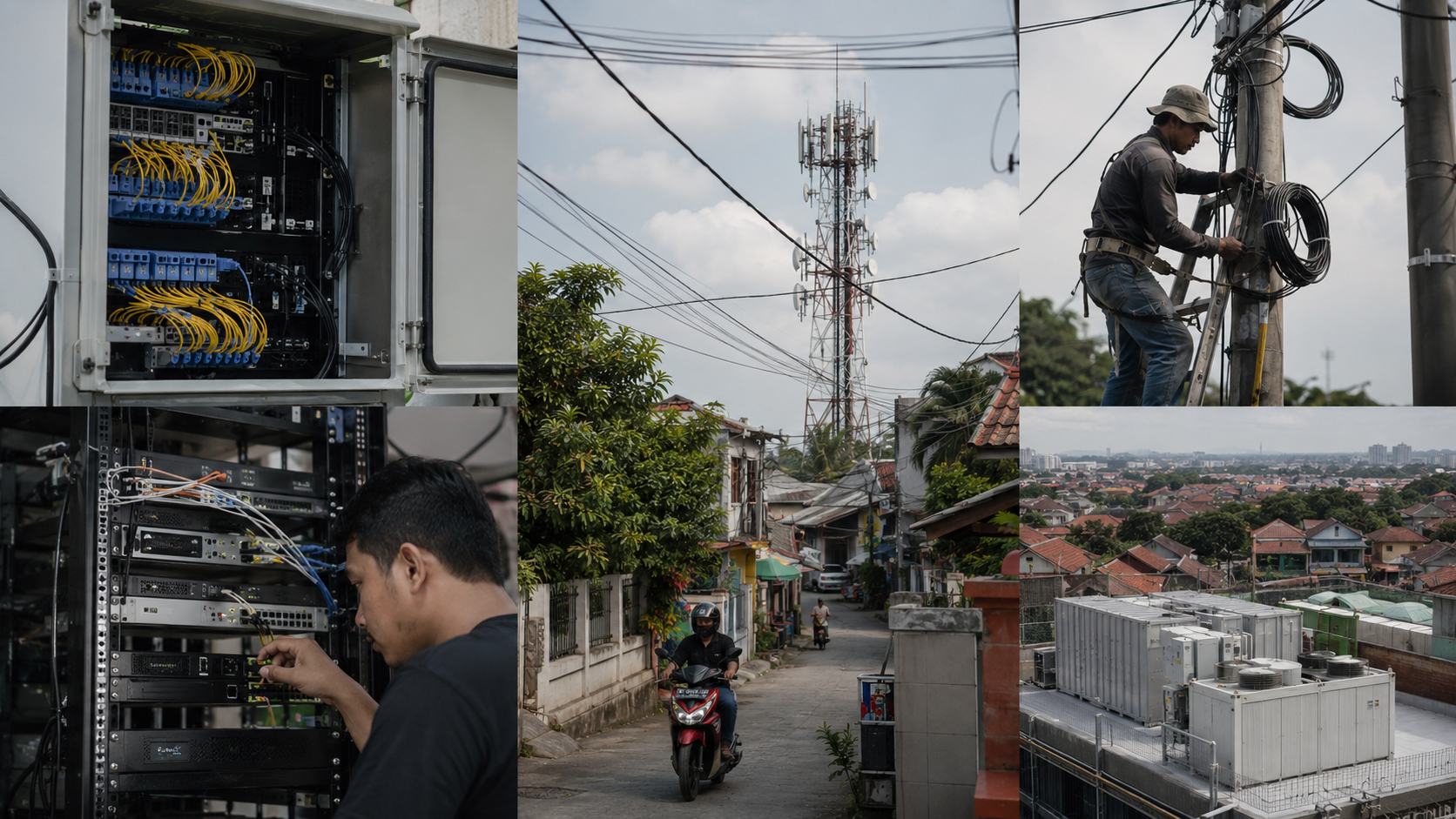
The question is not whether Widara Media Informasi is a “real” Indonesian internet company. The public record is already enough to answer that. PT Widara Media Informasi appears in APJII/IDNIC member records as an ISP, its consumer brand appears as WMiNET, its PeeringDB profile ties it to AS140464 and the aliases WMiNET and RaflessNet, and live routing databases show it originating its own IPv4 and IPv6 space from Indonesia. The harder question is economic: can a small Indonesian edge operator convert neighbourhood density, cheap operating craft, upstream buying, exchange participation and local trust into defensible margin, or does the same density simply invite every fibre builder, WISP, reseller and ex-employee with a MikroTik box to compete the margin away?
Widara is interesting because it sits exactly where Indonesian fixed broadband economics become awkward. It is not Telkom Indonesia. It is not a national consumer brand showing up in Opensignal’s major-ISP comparisons. It is the more common but less visible creature: a licensed local ISP with its own ASN, modest public address holdings, IX ports in Jakarta, a home/SOHO/dedicated product ladder, old RTRWNet roots, and a public story centred on Panongan, Tangerang, Banten. The company’s official site says WMiNET began from a warnet business in 2017, moved into RTRWNet, and became PT Widara Media Informasi as an internet provider serving households, MSMEs, schools, offices and companies. That origin story matters more than the marketing language around it. In Indonesian access markets, the jump from warnet to RT/RW network to licensed ISP is often the jump from retail hustle to infrastructural obligation.
The answer, in brief, is that Widara can plausibly earn margin from density, but the margin is not the prize that a spreadsheet would suggest if it only counted subscribers and Mbps. The real margin, if it exists, comes from lowering the cost of the last 200 metres, answering WhatsApp messages faster than a national call centre, knowing which pole, alley, village official and building caretaker matter, and buying enough upstream and peering to make popular traffic cheap. Those advantages are real. They are also perishable. The same local knowledge that lets a network grow cheaply can walk out the door with a technician, a reseller, a neighbourhood captain or a small competing ISP. The same dense customer cluster that improves payback attracts overbuild. The same IX port that lowers transit cost is available to other serious operators. The same “unlimited, no FUP” language that sells well to households can become a capacity liability when streaming, gaming and short-form video run ahead of oversubscription math.
The company at the edge of the routing table
The public identity is unusually clear for a small local ISP. The official WMiNET site identifies the service as PT Widara Media Informasi’s internet product and says it offers broadband, SOHO, dedicated internet and IT solutions. Its head office is listed at Jl. Raya Peusar–Sempur, No.279, Desa Peusar, Kecamatan Panongan, Kabupaten Tangerang, Banten 15710, with a WhatsApp/mobile contact and support email. The same site shows association logos for APJII, APJATEL and IDNIC, though the APJATEL claim is the company’s own page rather than an independently fetched membership listing in the public trail reviewed here.
APJII’s member directory gives the older or parallel identity layer. It lists PT WIDARA MEDIA INFORMASI, registration number 790, brand name RAFLESSNET, membership type “Keanggotaan Penyelenggara,” licensing type ISP, domain WMI.NET.ID, and an office address at Graha Pesona Blok W.22 No.33, Mekar Bakti, Panongan, Kabupaten Tangerang, Banten 15710. PeeringDB’s organization page separately lists PT Widara Media Informasi, long name “Widara Media Network,” alias RaflessNet, and an address at Jl. Widara Raya Graha Pesona Blok W.22 No.33, Kelurahan Mekarbakti, Panongan, Tangerang. This is not a contradiction so much as a local-operator fingerprint: the registry address, old brand, new office, trading brand and network brand do not collapse into one polished corporate identity. They map a business that appears to have grown through place, not through a national branding agency.
The legal-permission picture is less clean but directionally supportive. APJII’s official directory is enough to establish that Widara is treated in the Indonesian internet association ecosystem as an ISP member and IP-resource user. Public mirrors of Komdigi/Dittel telecom lists add two claims: that PT Widara Media Informasi appears under access internet service provider licensing with number 766/TEL.02.02/2020 dated 24 November 2020, and that it appears in a later network-operator list for “Jaringan Tetap Lokal Berbasis Packet Switched” with a 2025 entry. Because those are Scribd-hosted mirrors rather than a clean regulator page fetched directly, they should not be treated like audited filings. They do, however, fit the rest of the record: APJII membership, ASN allocation, consumer tariffs, and a local press account of the company presenting itself as an ISP and data-communication systems operator.
The network evidence is the hard spine. BGP tools identify AS140464 as PT Widara Media Informasi, website wmi.net.id, country Indonesia, active, allocated under APNIC, network type “eyeball,” originating two IPv4 prefixes and one IPv6 prefix. The advertised IPv4 blocks are 103.153.134.0/24 and 103.153.135.0/24; the IPv6 block is 2406:4540::/32. BGP.tools showed two upstreams, PT Parsaoran Global Datatrans AS138840 and PT Mitra Visioner Pratama AS147094, and 16 peers; Hurricane Electric’s BGP Toolkit showed similar originated-prefix data, RPKI-valid origin status, 512 originated IPv4 addresses, and four listed internet exchanges.
That is small, but not casual. A two-/24 IPv4 footprint is not the address base of a large national access network. It does imply carrier-grade NAT or careful address assignment for any meaningful household base. But an IPv6 /32, valid RPKI, visible IX presence and multiple upstreams are the signs of an operator that has moved beyond buying a single retail pipe and reselling Wi-Fi from a rooftop. The public routing table says Widara has the basic economic machinery of an autonomous edge ISP: its own number resources, its own BGP policy, its own peering choices, and enough public identity that other networks can decide whether to exchange traffic with it.
PeeringDB completes the picture. Widara’s PeeringDB network page lists ASN 140464, aliases WMiNET/RaflessNet, network type “Cable/DSL/ISP,” geographic scope Asia Pacific, traffic levels of 10–20Gbps, traffic ratios “mostly inbound,” and an open peering policy. It lists operational connections at BIX Jakarta and IIX-Jakarta at 10G each, plus JKT-IX and OpenIXP/NiCE at 1G each, and it places the network in the Datacenter APJII-Cyber facility in Jakarta Selatan. For a local eyeball network, “mostly inbound” is exactly what one would expect: households and small businesses download far more content than they upload. The more local and cacheable that inbound traffic becomes, the more value IX participation can create.
What Widara sells, and what the prices imply
WMiNET’s retail offer is simple. The home broadband ladder is 30 Mbps at Rp200,000 per month, 50 Mbps at Rp300,000, and 75 Mbps at Rp400,000, with “kuota tanpa batas,” no FUP, free installation, and flat monthly pricing. The SOHO ladder is materially higher: 30 Mbps at Rp500,000 per month, 50 Mbps at Rp750,000, and 100 Mbps at Rp1,000,000, each with priority 24/7 service and a Rp500,000 installation fee, with prices stated before 11% VAT. Dedicated internet is sold as an enterprise product with 1:1 symmetric bandwidth, higher SLA, scalable infrastructure, dedicated support and an account manager.
The ladder is economically revealing. The household plans are not premium corporate prices. They are mass-market fixed-broadband prices for a local network trying to look dependable without pricing itself out of the neighbourhood. The SOHO plans, by contrast, are a margin story. A warung with a point-of-sale device, a small office, a school admin room, a CCTV-heavy shop or a local enterprise branch may pay more for priority repair than for theoretical peak speed. That is where local ISPs can sometimes outperform larger competitors: not by being cheaper on raw Mbps, but by turning an outage into a visit, a phone call, a technician’s scooter and a known face.
The dedicated product matters even if only a minority of customers buy it. It lets Widara price discriminate. A household user paying Rp200,000 for “unlimited” broadband is a different risk pool from a school, office or SME paying for symmetry, SLA and account management. In a dense local network, that mix can make the economics work. Households fill the base. SOHO customers lift ARPU. Dedicated links and IT services create project revenue and relationships. The official page’s services—broadband, SOHO, dedicated internet and IT consulting/installation/managed network work—are not four unrelated products. They are the standard bundle for a neighbourhood access operator trying to be both utility and local IT department.
The skeptical view is that the pricing ladder can also hide fragility. “Unlimited” and “no FUP” are attractive claims in a market trained to dislike quota anxiety, but they do not repeal capacity economics. If a local operator sells 30–75 Mbps household access into a dense cluster, margin depends on oversubscription, cache hit rates, time-of-day usage, upstream cost, maintenance cost and churn. If too many users stream at the same time, the edge operator either buys more capacity, tolerates congestion, or loses trust. The website says stable and responsive service; the routing and PeeringDB record show serious interconnection work; the public evidence does not show whether the access network holds up under evening load.
The geography is the moat, until it is the battlefield
Widara’s geography is not an incidental address. Panongan, Peusar, Mekar Bakti, Graha Pesona, Citra Raya, Tangerang and Banten recur across the record. APJII and PeeringDB point to Graha Pesona/Mekar Bakti. The WMiNET site points to a head office in Desa Peusar, Panongan. A local press article reported that PT Widara Media Informasi inaugurated a new office in Desa Peusar, Kecamatan Panongan, Kabupaten Tangerang, on 3 November 2025, framing the opening as a commitment to stable and affordable internet for nearby residents. The same article quoted village-level enthusiasm about Wi-Fi access and quoted Widara representative Memed Sumaedi saying the office was meant to bring service closer to the community.
That localness is the business model. In fixed broadband, geography determines nearly everything before marketing starts. A customer 40 metres from a pole is not the same as a customer 400 metres away. A cluster of paying households along one lane is not the same as scattered homes across rice fields, industrial roads and housing estates. A landlord who allows cable entry changes payback. A village official who objects to messy cable runs can change churn and capex. A school, CCTV project or SOHO customer beside existing plant can lift economics. The public record does not give Widara’s drop lengths or take-up rates, but it says enough to locate the commercial game: this is a Tangerang edge-density problem, not an abstract Indonesian broadband story.
The local press account is especially useful because it contains a negative clue. Memed Sumaedi reportedly invited other ISPs to form an association to organize “semrawut” cable installations that residents had complained about. That sentence is small but economically dense. It says the market is not empty. It says multiple providers are present or expected. It says infrastructure clutter has become a social and political problem. It says the scarce asset may not be a router, an IP block or a website, but permission to keep cables in place without becoming the target of neighbourhood frustration.
APJATEL’s sector-level commentary points in the same direction. Its public material describes Indonesian telecom-network operators dealing with costly infrastructure, regional permit frictions, exclusive control of areas or buildings, and the need for shared ducts and poles. That is not Widara-specific evidence, but it explains why a Panongan operator’s commercial life can be dominated by non-obvious assets: duct access, pole access, building access, cross-connects, permission, and the ability to avoid being seen as the company making the street uglier. In a dense market, civility around cables becomes part of the margin stack.
The RaflessNet inheritance and the MikroTik operating style
The name trail runs through RaflessNet. APJII lists Widara’s brand as RAFLESSNET. PeeringDB says Widara is also known as WMiNET and RaflessNet. A still-live Rafles Internet site—spelled with one “s” in the domain but using “RaflessNet” language in places—lists an address at Graha Pesona Blok W 22 No 33, Citra Raya Cikupa Tangerang, a phone number matching the Memed Sumaedi contact found in APNIC/WHOIS records, and services including internet, CCTV, tower, SMS gateway, school applications, managed service and MikroTik training. It also describes wireless and fibre internet connected into tower POPs and points of presence, serving Tangerang, Serang, Jasinga, Tenjo, Rangkas Bitung and nearby areas.
That site should not be overread as a current product catalogue for WMiNET. It looks like a legacy artifact from the Rafles/Rafless operating world. But it is commercially important because it matches the official WMiNET history: warnet in 2017, then RTRWNet, then a formal ISP. It also describes exactly the toolchain and service mix associated with Indonesian small-ISP formation: wireless links, fibre where possible, tower POPs, CCTV, school systems, managed service, and MikroTik training. That is not the polished FTTH language of a national consumer ISP. It is the grammar of field engineering.
“MikroTik-style” in this context is not merely a brand of router. It is an operating philosophy: low-cost routers, practical routing knowledge, local installers, quick reconfiguration, PPPoE or hotspot-style subscriber control, WhatsApp support, cash discipline, and the habit of solving problems with configuration and ladders before solving them with large capex. The advantage is speed and cost. A small team can light up a cluster, adjust packages, move a radio, replace a router, talk to the village office, and add a reseller faster than a national operator can move a regional work order through layers of process.
The weakness is the same as the strength. Operations built on craft are harder to institutionalize. If the network design is in two people’s heads, key-person risk is real. If the access network grew from opportunistic rooftops and poles, documentation may lag reality. If customer goodwill depends on a known technician, churn may rise when that technician leaves or starts his own network. If old wireless segments remain in the topology while the website promises “Fiber Network,” the customer experience may vary by neighbourhood in ways the public tariff page does not reveal. The record proves a credible local evolution; it does not prove a fully standardized plant.
Upstream buying, peering and the cost of Indonesian traffic
The routing table is where Widara’s economics become more than retail pricing. BGP.tools showed AS140464 with two upstream providers: PT Parsaoran Global Datatrans AS138840 and PT Mitra Visioner Pratama AS147094. It also showed 16 peers and exchange participation at IIX-Jakarta, BIX Jakarta, OpenIXP/NiCE and JKT-IX. Hurricane Electric similarly showed four internet exchanges and RPKI-valid originated routes. PeeringDB’s record adds the advertised port sizes: 10G at BIX Jakarta, 10G at IIX-Jakarta, 1G at JKT-IX and 1G at OpenIXP/NiCE.
For an eyeball ISP, peering has two economic jobs. The first is cost avoidance: traffic exchanged locally is traffic not bought as full transit. The second is quality: packets for domestic networks, caches, content platforms and nearby peers can stay in Jakarta rather than hairpinning through expensive or distant routes. APJII’s own FAQ explains the point of IIX in plain language: it is a place to unite ISP-operated networks so traffic does not need to go through foreign transit paths and then return to Indonesian networks. That sentence is basically the edge-ISP margin formula.
PeeringDB’s “mostly inbound” ratio reinforces the interpretation. Widara’s customers are likely consuming content from elsewhere: video, social media, games, app updates, cloud services, enterprise SaaS, school platforms and ordinary web traffic. Every bit of inbound traffic that can be delivered via an exchange, cache or cheaper regional route improves the economics of an unlimited household plan. A 30 Mbps home plan sold at Rp200,000 is more attractive if much of the evening demand comes through efficient domestic interconnection rather than expensive blended transit.
But this advantage is not proprietary. Other APJII members can connect to IIX. Other licensed operators can join exchanges. Other local ISPs can learn BGP, acquire upstream, and copy open peering policies. Peering lowers the cost floor for serious operators; it does not protect Widara from another serious operator. The more IX participation spreads, the more competition moves back to the last mile, customer acquisition, support, local permission and capital discipline.
The upstream supplier issue is sharper. Two upstreams are better than one, but the live BGP record does not show a sprawling transit portfolio. If either upstream changes pricing, suffers operational trouble, imposes contract limits or becomes congested, Widara’s retail promise is exposed. If a competitor buys better upstream at lower unit cost, Widara’s price umbrella narrows. If Widara’s exchange traffic grows faster than its access ARPU, it must add capacity before customers fully pay for it. Interconnection helps margin only when it is coupled with disciplined traffic engineering and enough customer density to amortize ports, routers, cross-connects and staff.
A Scribd-hosted WMINet maintenance notice adds one vivid operational clue. The notice, dated 19 May 2025, announced urgent maintenance on 21 May 2025 with around four hours of downtime for a “Replace Router Core” activity at IDCS Gedung Cyber 1, with the impact described as link down during the work and a 7x24 support hotline. Because this is a Scribd-hosted copy rather than a notice fetched from WMiNET’s own site, it should be handled carefully. Still, if genuine, it shows the prosaic reality behind the public BGP graph: core routers are replaced, downtime windows exist, and a local ISP’s reputation can hinge on whether such work is communicated and completed cleanly.
The reseller layer hiding below the ASN
The cleanest reseller/downstream clue is ROSINET. Its website says ROSINET was established in May 2021, later formalized as PT Rosi Digital Indonesia in February 2024, and partnered with PT Widara Media Informasi, AS140464, to improve service performance and quality. The site says it is “supported by WMINet (ASN140464),” describes service registration through WhatsApp, sales or partners, says the model is monthly prepaid, and explains that unpaid access goes offline automatically. It also ties the offer to village and RT/RW digital infrastructure, including CCTV, websites and local administrative applications.
That is exactly where a local licensed ISP can earn wholesale margin. A neighbourhood reseller may have customers, local trust and installers but lack an ASN, IP resources, legal comfort, upstream buying, IX presence, billing discipline or NOC depth. Widara can supply the backbone and legitimacy. The reseller supplies local acquisition and first-touch support. If the arrangement works, Widara earns volume without building every relationship itself. If it works too well, the reseller eventually becomes a competitor, negotiates harder, multi-homes to another supplier, or seeks its own license and ASN.
The ROSINET page also says something about cash risk. Prepaid monthly service, automatic suspension for non-payment and no late penalties sound customer-friendly, but they are also working-capital controls. Local broadband operators do not have the luxury of carrying large receivables from hundreds of small households. Prepaid access reduces bad debt and support conflict. It also makes churn easier. A customer who stops paying simply disappears from the revenue base. In that kind of market, the operator’s economic asset is not a contract term; it is habit, convenience and trust.
The reseller model also complicates any attempt to read APNIC Labs or BGP traffic as subscribers. APNIC Labs’ public AS-population pages have indexed AS140464 with estimated user counts in the low-to-mid tens of thousands in recent measurement windows, including a late-June 2026 search result showing about 13,559 users. Earlier indexed values around 6,291, 8,849 and 11,260 appear in prior APNIC Labs search snippets from 2024–2025. These are not paid subscriber counts. They are measurement estimates affected by sampling, NAT, device mix, ad measurements and routing. But they are directionally consistent with a network bigger than a hobby WISP and smaller than a national operator.
This is one of the central puzzles. If Widara’s measured user population includes direct WMiNET customers plus reseller-served users plus NAT’d household devices, revenue per measured user could vary wildly. One wholesale Mbps customer can represent many end users. One public IPv4 address can hide many paying households. One reseller can concentrate churn risk. Without contracts or subscriber disclosures, the public record can prove network seriousness but not unit economics.
The Indonesian density trap
Indonesia gives fixed-broadband operators two opposite truths at once. Demand is huge and still growing. Competition is brutal and getting denser. APJII’s 2026 survey, reported by Antara, put Indonesian internet penetration at 81.7%, or about 235.3 million people out of a population of 287.3 million. Java’s penetration was reported at 85.95%, with Java contributing 58.24% of users. APJII also reported fixed-broadband subscribers/users at about 99.5 million people, with growth over the prior year.
A superficial investor reading would say this is a wonderful market: more users, more fixed broadband, more streaming, more cloud, more schools, more small businesses, more digital administration. The operator reading is more anxious. A March 2025 AEI article summarizing an APJII discussion said the number of ISPs in Indonesia had risen to 1,270 by February 2025, from 600 in 2021 and 300 before the pandemic. It also described intense price competition, declining industry revenue despite more ISPs, more than 800 ISPs on Java, stacked infrastructure, denser poles and repeated excavation caused by lack of coordination.
That is the density trap. Density reduces last-mile cost when one operator fills a street. Density destroys margin when four operators chase the same street. Density makes a local office valuable when customers need fast repair. Density makes customer acquisition expensive when every competitor can put a flyer, WhatsApp blast or sales agent in the same housing cluster. Density supports peering and traffic scale. Density overloads poles, upsets residents and invites municipal cleanup.
Banten is not an empty frontier. Opensignal’s November 2025 fixed-broadband report compared major Indonesian ISPs, including Biznet Home, CBN, Icon Plus, IndiHome, Indosat HiFi, MyRepublic, Oxygen.id and XL Home. In Banten, the report listed major-provider performance scores for consistent quality, download speed, upload speed and reliability; Widara is not one of the major ISPs in that comparison, but the presence of national and regional brands in the province is the relevant point. A local Panongan ISP is not selling into a monopoly landscape. It is selling into a province where large networks already contest the middle-class fixed-broadband customer.
The consequence is that Widara’s best market is probably not “Banten” in a broad sense. It is particular roads, clusters, estates, villages, schools, shops and reseller territories where it can be earlier, more responsive, cheaper to deploy or more trusted. The company’s public office opening in Peusar should be read in that light. A new office is not just signage. It is a claim of proximity. In a market where customers can compare national brands on price and speed, proximity becomes the local operator’s counterweight.
Trust as a working asset
Trust in this market is not soft sentiment. It is an operating asset with cash consequences. A household that pays monthly for local broadband is making a small repeated bet: that the connection will work tonight, that someone will answer when it fails, that the cable will not be cut and left hanging, that the provider will not disappear, and that the package will not silently degrade. In a neighbourhood ISP model, the person who collects payment, installs the drop, answers WhatsApp, visits the house and knows the RT/RW hierarchy is part of the product.
WMiNET’s official site leans heavily on responsiveness: stable connections, professional technical support, 24/7 technical support, priority service for SOHO, and dedicated support/account management for enterprise customers. ROSINET’s FAQ shows the same retail culture from the reseller side: registration through WhatsApp, sales and partners; customer service and technicians for problems; prepaid monthly billing; suspension if unpaid; and temporary subscription leave. These are not just service details. They are the customer-retention machinery of small broadband.
There is little robust public complaint volume tied specifically to WMiNET in the sources reviewed. That absence should not be turned into proof of high satisfaction. Small Indonesian ISPs may have complaint traffic inside WhatsApp groups, Facebook comments, village forums or private chats that search engines do not index well. The public trail did surface maintenance colour, local cable complaints about the broader ISP environment, and ROSINET’s explicit customer-service process. The commercial interpretation is therefore cautious: trust appears central to the model, but public evidence cannot quantify churn, outage frequency or net promoter behaviour.
Job and labour breadcrumbs point in the same direction, though they are thin. Public LinkedIn snippets and Scribd job/application material refer to network engineer or technician work involving PT Widara Media Informasi, troubleshooting connectivity and checking network devices. These snippets are not reliable enough to reconstruct headcount, payroll or organizational maturity. They do, however, fit the operating model: field technicians and network troubleshooters are the human capex of a local ISP.
A small 2023 indexed journal article about an automated billing notification system at PT Widara Media Informasi is another semi-public clue. The search result’s abstract says the system was implemented to improve operational efficiency at the ISP. This is not proof of a sophisticated billing stack or enterprise-grade OSS/BSS. It does suggest that billing automation was a live operational concern. In prepaid, local broadband, that is exactly where small process improvements can matter: fewer missed reminders, fewer disputes, less manual chasing, faster suspension/reactivation, and lower back-office friction.
What the scarce asset really is
A naive reading of Widara’s public evidence would say the scarce assets are the ASN, the /23 of IPv4, the IPv6 /32, the IX ports and the ISP license. Those matter. They are not enough. ASN140464 gives Widara routing autonomy. The IPv4 addresses give it some scarce numbering resource. The IPv6 allocation future-proofs addressing. IX ports lower traffic cost and improve quality. APJII membership gives ecosystem standing. But none of these, individually, is a monopoly asset.
The scarce asset is the bundle. Widara’s economic value, if the business earns attractive returns, is probably in the combination of local plant, customer relationships, operating routines, reseller ties, exchange participation, supplier contracts, and permissions. The company can charge households Rp200,000–Rp400,000 per month only if installation is cheap enough, utilization is managed, and customers stay long enough to repay the drop and support cost. It can charge SOHO customers Rp500,000–Rp1,000,000 per month only if they believe priority support is real. It can sell dedicated service only if its upstream and core network can meet expectations. It can wholesale to ROSINET-like partners only if those partners trust its backbone more than alternatives.
That bundle has an economic shape familiar from other local utilities. At low density, the operator loses money because every drop and repair is too expensive. At moderate density, the operator earns margin because fixed costs are shared and local support scales. At excessive competitive density, the operator loses margin again because price falls, churn rises, duplicate plant clutters the street, and customer acquisition costs grow. Widara’s puzzle is where its Panongan clusters sit on that curve.
The public signs are mixed. On the positive side, the company has formal network resources, multiple exchanges, clear retail packages, local office presence, reseller evidence, and old technical roots. On the negative side, it operates in Java, where APJII-related commentary says ISP density is severe; it competes in Banten, where major brands are already measured; it appears to rely on a small number of upstreams; it has very limited public IPv4 space; and public records do not disclose subscriber retention, capex, debt, pole permissions or supplier pricing.
Regulation and ownership: the blank spaces that matter
Ownership remains one of the least visible parts of the public record. The recurring individual name is Memed Sumaedi. APNIC/WHOIS contact data for Widara’s IPv6 allocation lists Memed Sumaedi as a person contact with the memed@wmi.net.id email; the local press account names Memed Sumaedi as a Widara representative at the Peusar office opening; the legacy Rafles Internet site lists a matching mobile number at the Graha Pesona address. That suggests continuity of technical or operating leadership. It does not establish beneficial ownership, shareholder control, debt guarantees, related-party suppliers or investor backing.
This matters because small ISP economics can be transformed by ownership context. A founder-operated local ISP with low debt and self-built plant can survive on margins that would not interest a private-equity-backed consolidator. A reseller-backed ISP can show traffic growth but little end-customer control. A company with related-party upstream, tower, construction or billing arrangements can shift margin out of the ISP entity. A local operator with informal access permissions can be profitable until a municipality regularizes poles, ducts and aerial cables. None of that is visible in the public network-resource evidence.
Regulation cuts both ways. Formal ISP status and possible fixed-local packet-switched network permission raise Widara above the greyest RT/RW resale layer. That can make it a credible partner for resellers, schools, offices and village projects. It can also bring compliance costs, reporting obligations, tax, universal-service charges, abuse handling and pressure to clean up infrastructure. The public mirrors of Komdigi lists, APJII/IDNIC records and WMiNET’s own association claims all point toward formalization. Formalization is commercially valuable only if it lets Widara win better customers, lower upstream costs or secure infrastructure rights that informal operators cannot match.
The abuse-risk angle is also worth noting. A small eyeball ISP with limited IPv4 space, CGNAT and reseller channels must manage spam, botnet, copyright, fraud and proxy abuse complaints. The APNIC/WHOIS record lists abuse contact information at noc@wmi.net.id and an IRT object. That is good hygiene. It does not prove abuse handling quality. Economically, poor abuse handling can raise upstream friction, damage peering relationships and consume staff time; good abuse handling is invisible until it fails.
Can competitors erode the margin?
Yes. The easiest way to erode Widara’s margin is not to attack its ASN or IX ports. It is to overbuild the profitable clusters. A national or regional fibre operator can enter a housing estate with stronger marketing, larger backbone capacity and promotional pricing. A local WISP can undercut households with lower support costs. A reseller can switch suppliers. A technician can start a new RT/RW network. A building owner can grant exclusivity to another provider. A village can demand cable cleanup. A road project can force relocation. A pole owner can change terms. These are not theoretical risks in Indonesian ISP markets; the APJII-related industry commentary explicitly describes fierce competition, price declines, stacked infrastructure and pole/cable density.
But competitors cannot erase all local advantage instantly. If Widara already has drops in place, customers paying monthly, a known technician, a functioning WhatsApp support habit, and a nearby office, a competitor must offer either lower price, better speed, better reliability, or better social trust. That takes time. In low-income or mixed-income neighbourhoods, installation cost and switching hassle matter. In SOHO accounts, downtime risk matters. For resellers, the cost of changing upstream includes reconfiguration, customer complaints and relationship uncertainty.
The more Widara’s network is fibre-rich and documented, the stronger the defence. The more it remains a patchwork of old wireless, ad hoc fibre, under-documented tower POPs and individual relationships, the weaker the defence. The public evidence cannot determine which is true. The current WMiNET site emphasizes “Fiber Network” and scalable infrastructure; the older Rafles material emphasizes combined wireless and fibre into tower POPs. Those facts can coexist, especially if the company has been migrating from wireless-heavy RTRW roots toward more fibre access. The commercial value depends on how far that migration has gone.
The public record’s verdict
Widara Media Informasi looks like a credible local Indonesian edge ISP, not a paper network. The strongest evidence is not its marketing site; it is the convergence of APJII membership, AS140464 routing, originated prefixes, RPKI validity, PeeringDB exchange entries, an open peering policy, local press, reseller references and legacy Rafless/Rafles continuity. The network appears small but real, locally rooted but connected into Jakarta exchange infrastructure, consumer-facing but also trying to sell SOHO, dedicated and IT solutions.
The business can turn density into margin when the density is proprietary in practice: clusters where Widara has plant, permission, trust and low support distance. Upstream buying and IX participation can improve gross margin by lowering the delivered cost of popular traffic. MikroTik-style operating craft can keep capex and repair cost low. Reseller partnerships can extend reach without building every retail relationship. SOHO and dedicated products can lift ARPU above household broadband. The company’s formal ISP identity can help it sit above informal resellers and win partners who need legitimacy.
The same evidence does not support a heroic moat. Widara is in a crowded Java/Banten market where ISP numbers have exploded and major brands already operate. The address space is modest. The upstream set is limited. Public customer-satisfaction evidence is sparse. The company’s financials, subscriber base, churn, capex, debt, ownership and supplier pricing are not public in the reviewed trail. The old RaflessNet/RTRWNet lineage is commercially attractive because it shows local operating muscle; it is commercially worrying because such networks can be hard to standardize and easy for insiders to replicate.
So the clean answer is conditional. Widara can earn margin if it behaves less like a commodity bandwidth reseller and more like a dense local utility: own the customer relationship, keep the plant close, peer aggressively, buy upstream well, automate billing, manage abuse, standardize field operations, use resellers without becoming hostage to them, and maintain enough village-level legitimacy to survive cable politics. It cannot rely on density alone. In Indonesian edge broadband, density is both the source of operating leverage and the invitation to be copied.
Evidence ledger
- WMiNET official website URL: https://wmi.net.id/ Source type: Company website. What it supports: WMiNET is PT Widara Media Informasi’s internet service; the company says it serves households, MSMEs, schools, offices and companies; it gives the warnet-to-RTRWNet origin story, retail packages, SOHO packages, dedicated internet claims and Peusar head-office contact. What it does not prove: Subscriber count, real speed, outage rate, profitability, fibre coverage, or whether every advertised support/SLA claim is met. Why it matters economically: It shows the retail price ladder and the company’s attempt to segment households, SOHO and enterprise customers.
- APJII / IDNIC member listing URL: https://www.apjii.or.id/anggota/idnic?legality=&name=&page=81 Source type: Indonesian internet association and number-resource ecosystem directory. What it supports: PT Widara Media Informasi is listed with registration number 790, brand RAFLESSNET, ISP licensing type, WMI.NET.ID domain and Panongan/Tangerang address. What it does not prove: Current beneficial ownership, financial health, service quality or full regulatory status. Why it matters economically: It anchors the company as a formal ISP participant rather than merely an informal neighbourhood reseller.
- BGP.tools AS140464 page URL: https://bgp.tools/as/140464 Source type: Live routing and BGP intelligence database. What it supports: AS140464 is associated with PT Widara Media Informasi; it originates two IPv4 /24s and one IPv6 /32; BGP.tools shows upstreams, peers, exchange addresses and RPKI-valid prefixes. What it does not prove: Contracted capacity, actual traffic volume at all times, subscriber count, or access-network topology. Why it matters economically: It proves routing autonomy and shows the raw ingredients of upstream-cost management and interconnection strategy.
- Hurricane Electric BGP Toolkit for AS140464 URL: https://bgp.he.net/AS140464 Source type: Public BGP/WHOIS view. What it supports: The same originated prefixes, Indonesian country attribution, exchange list and RPKI-valid status; it also surfaces APNIC WHOIS aut-num details. What it does not prove: Whether every listed peer is commercially material or whether older WHOIS import/export objects reflect current live upstream use. Why it matters economically: It provides an independent routing cross-check.
- PeeringDB network page for Widara Media Informasi URL: https://www.peeringdb.com/net/30095 Source type: Peering and interconnection database. What it supports: Widara’s aliases WMiNET/RaflessNet, network type Cable/DSL/ISP, 10–20Gbps traffic level, mostly inbound traffic ratio, open peering policy, IX ports at BIX, IIX-Jakarta, JKT-IX and OpenIXP/NiCE, and APJII-Cyber facility presence. What it does not prove: Actual customer experience, full transit costs, or utilization during peak hours. Why it matters economically: It shows how the network can lower traffic costs and improve latency through domestic interconnection.
- APNIC / IPIP WHOIS for 2406:4540::/32 URL: https://whois.ipip.net/AS140464/2406%3A4540%3A%3A/32 Source type: Number-resource registry / WHOIS mirror. What it supports: IPv6 allocation to PT Widara Media Informasi, WMINET-ID netname, abuse/NOC contacts, address data and Memed Sumaedi contact information. What it does not prove: Clean abuse handling in practice or who owns the company. Why it matters economically: Abuse contacts and portable resources are part of the cost of operating as a real ISP.
- APJII homepage and IIX FAQ URL: https://www.apjii.or.id/ Source type: Industry association official page. What it supports: APJII describes IIX as a way to unite ISP-operated networks so Indonesian traffic need not travel out through foreign transit and return to Indonesia; it also lists APJII member/IP-user scale. What it does not prove: Widara’s individual traffic savings or cache mix. Why it matters economically: It explains why IX participation can become margin for an edge ISP.
- ROSINET / PT Rosi Digital Indonesia website URL: https://www.rosinetworks.co.id/ Source type: Partner/reseller website. What it supports: ROSINET says it partnered with PT Widara Media Informasi AS140464 in February 2024 and is supported by WMINet; it also describes prepaid monthly service, WhatsApp/customer-service onboarding and village/RT/RW digital infrastructure. What it does not prove: Contract economics, revenue share, number of reseller customers, or exclusivity. Why it matters economically: It shows a plausible wholesale/reseller route to scale and the cash discipline of prepaid access.
- Rafles Internet legacy site URL: https://www.rafles-internet.com/ Source type: Legacy/related operating website. What it supports: Rafless/Rafles branding, Graha Pesona address, matching contact trail, wireless/fibre/tower POP language, and MikroTik training/service ecosystem. What it does not prove: Current WMiNET topology, current product availability, or corporate continuity beyond matching public clues. Why it matters economically: It explains the local technical heritage behind the current ISP.
- Serangtimur local press article on Peusar office opening URL: https://www.serangtimur.co.id/2025/11/pt-widara-media-informasi-resmikan.html Source type: Local-language press. What it supports: New Peusar office opening on 3 November 2025; local positioning as ISP/data-communication systems operator; Memed Sumaedi comments about closer service and organizing messy ISP cable installation. What it does not prove: Revenue, subscriber count or independent service quality. Why it matters economically: It shows neighbourhood trust, cable politics and local presence as commercial assets.
- Scribd-hosted WMINet urgent maintenance notice URL: https://id.scribd.com/document/876045410/Surat-Maintenance Source type: Informal public document mirror. What it supports: A purported WMINet notice for urgent maintenance on 21 May 2025, four-hour downtime, core-router replacement at IDCS Gedung Cyber 1, and hotline support. What it does not prove: Authenticity beyond the public copy, normal outage frequency, or long-term reliability. Why it matters economically: It illustrates operational resilience risk and the reality of core-network maintenance.
- Antara report on APJII 2026 internet survey URL: https://www.antaranews.com/berita/5576225/survei-apjii-penetrasi-internet-di-indonesia-2026-capai-817-persen Source type: National news report on APJII survey. What it supports: Indonesian internet penetration of 81.7% in 2026, Java’s high penetration and contribution, and fixed-broadband user/subscriber scale. What it does not prove: Widara’s addressable market share or local take-up. Why it matters economically: It frames demand: large and growing, but increasingly mature in Java.
- AEI article summarizing APJII industry discussion URL: https://aei.or.id/en/press-release/challenges-and-opportunities-for-internet-infrastructure-in-indonesia Source type: Industry commentary / press release. What it supports: ISP count rising to 1,270 by February 2025, intense price competition, more than 800 ISPs on Java, falling rates, stacked infrastructure and consolidation arguments. What it does not prove: Widara’s direct competitor count in Panongan or its actual margins. Why it matters economically: It is the clearest public statement of the density trap.
- Opensignal Indonesia Fixed Broadband Experience, November 2025 URL: https://insights.opensignal.com/reports/2025/11/indonesia/fixed-broadband-experience Source type: Network-experience measurement report. What it supports: Major fixed-broadband brands measured in Indonesia and Banten performance data across consistency, speed and reliability. What it does not prove: WMiNET’s performance; WMiNET is not one of the named major ISPs in the cited comparison. Why it matters economically: It shows that Banten fixed broadband is contested by larger providers, limiting local monopoly assumptions.
- APNIC Labs AS-population pages / indexed snippets URL: https://stats.labs.apnic.net/cgi-bin/aspop?c=ID Source type: Measurement estimate. What it supports: AS140464 appears in APNIC Labs Indonesian AS-population estimates, with recent indexed values around the low-to-mid tens of thousands of users. What it does not prove: Paid subscribers, households, ARPU, revenue or direct customers. Why it matters economically: It gives a noisy scale clue consistent with a real local access network.
- BIN: Bulletin of Informatics article snippets on automated billing notifications URL: https://ojs.jurnalmahasiswa.com/index.php/bin/article/view/4/5 Source type: Small academic/student-journal article listing. What it supports: A 2023 indexed article describes implementing an automated billing notification system at PT Widara Media Informasi to improve ISP operational efficiency. What it does not prove: Current billing platform, payment collection performance or back-office maturity. Why it matters economically: Billing automation is small-ISP margin plumbing: it reduces manual chasing and improves cash discipline.
The facts that would reprice the line
The commercial view would change quickly with five missing facts. First, real subscriber numbers split between direct retail, SOHO, dedicated and reseller users. Second, monthly churn and average revenue per account. Third, the physical access map: fibre versus wireless, owned plant versus borrowed poles, and average drop cost. Fourth, upstream and IX economics, including peak utilization and transit price. Fifth, proof of durable local permissions—village, building, pole, duct or estate access—that competitors cannot easily copy.
Without those, Widara should be valued as a credible, locally embedded edge ISP with real routing infrastructure and plausible density margin, but not as a protected infrastructure monopoly. Its moat is not the ASN. It is the neighbourhood system around the ASN.