
Summary
- K and D UNISAT -TV LLC is best read as a Bulgarian regional cable television and fixed Internet operator with Stara Zagora identity, Krumovgrad service signals, public consumer contracts, RIPE NCC LIR status, ASN AS49040 and visible IPv4 routing. That is stronger evidence than a directory-only listing, but it does not prove high subscriber density, premium pricing or attractive margin.
- The company documents point to a practical access business: radio and television programme distribution, fixed Internet through cable/LAN/modem arrangements, RLAN, HomePNA over coax, G.hn, LAN FTTH and GPON FTTH, plus operator-provided customer equipment. Reliability therefore depends on field labour, customer-premises devices, coax/fibre maintenance, upstream routing and local support discipline.
- Published speed tiers are modest by 2026 competitive standards, with home plans described at 10/10, 20/10 and 30/15 Mbps and business plans at 50/20 and 80/40 Mbps. Those speeds can serve basic local needs, but they make pricing power difficult when larger fixed-mobile-TV groups can sell faster bundles and mobile substitutes.
- RIPE, RIPEstat, bgp.tools and Hurricane Electric data show AS49040 as active, with 24 visible IPv4 prefixes and no IPv6 prefixes in the checked records. Several upstream or peer signals point to Global Communication Net, Telehouse, Link+, SiS Net, NOVATEL and A1 Bulgaria, so network control is real but not vertically independent.
- The decisive missing evidence is commercial rather than technical. Public sources do not disclose subscriber count, ARPU, churn, gross margin, repair call volume, customer concentration, rights costs, field response economics or the mix between households, business users and TV-only accounts.
- The judgment would improve if the company showed dense local take-up, disciplined pricing, low fault rates in practice, repeatable installation economics, broad customer distribution, resilient upstream contracts, IPv6 readiness and cash conversion strong enough to fund equipment refresh without underpricing support.
The outage bill is the first buyer test
The first buyer test is not whether Internet access is useful. It is whether a local customer believes that paying K and D UNISAT -TV LLC is cheaper than the failure the customer wants to avoid. For a household, that failure may be a parent unable to work remotely, a student losing a video lesson, a television evening interrupted, or a payment app frozen when an urgent bill has to be made. For a small shop, guesthouse, office or local service firm, the same failure becomes more commercial: card payments stop, customer calls are missed, booking systems are unavailable, and staff spend the morning waiting for the connection to return.
That fear is a real demand source for any regional ISP. The harder part is converting it into margin. A local operator has to promise reliability before it knows how often the customer will need help, how old the building wiring is, how much travel time a field call will consume, whether a modem will fail, whether a neighbour will damage a cable, whether an upstream issue will look like the local operator's fault, or whether a customer will compare every monthly bill with a national bundle promotion. Reliability has value to the buyer, but it also transfers downside to the operator.
K and D UNISAT -TV LLC has enough public evidence to treat the company as an actual operating subject rather than a mere registry entry. Its own site presents it under the Bulgarian name К&Г Унисат ТВ; the contact page identifies К И Г Унисат-Тв ООД, EIK 123022262, Bulgaria, a management address in Stara Zagora, phone contacts, a named contact person and managers. The RIPE NCC member page lists the English legal name K and D UNISAT -TV LLC, a Stara Zagora address, contact email and Bulgaria as the serviced area. RIPE Database records align the same registration number, address, LIR status and organisation handle.
The demand question remains open because public documents reveal the service promise but not the paid customer base. The individual contract form and general terms show a local cable telecommunications network used for television and Internet access. The quality report provides service-quality parameters. Routing records show an active ASN. These facts establish capability. They do not disclose how many customers pay, what they pay, how long they stay, how often they need service, or whether the resulting revenue is enough to fund maintenance and renewal.
That is why the economic article must begin with the avoided failure and then ask who pays for the avoidance.
The company boundary is a local cable and Internet operator
The operating boundary is local fixed access and television distribution, not a national cloud, mobile or enterprise platform. The company contact page gives the legal identity as К И Г Унисат-Тв ООД, EIK 123022262, country Bulgaria, with a Stara Zagora address in the Kazanski district. It gives telephone numbers, the email [email protected], a correspondence address in the same Stara Zagora block, and identifies Gospodin Atanasov Zhelev as contact person. It also lists Gospodin Atanasov Zhelev and Dinyo Koychev Orozov as managers. RIPE repeats the Stara Zagora address, uses the English legal name K and D UNISAT -TV LLC, gives the same registration number and classifies the organisation as an LIR.
The contract form sharpens the geography. It names К и Г УНИСАТ-ТВ and lists a Stara Zagora area telephone number and a Krumovgrad area telephone number. That does not prove the exact current footprint of every active line, but it is meaningful local evidence. The business is framed around a cable telecommunications network, not a remote software subscription. The customer contracts for programme distribution and Internet access at an address. The operator provides or accounts for customer equipment. The customer pays a monthly fee and an activation fee when applicable. The service relationship is physical, recurring and local.
This boundary matters because the economics of a small fixed operator differ from the economics of a pure reseller. A reseller can sometimes avoid the heaviest network cost by selling a third-party service. A software provider can spread product development across large numbers of users. A dense cable or fibre operator can spread plant and field labour across many subscribers in the same buildings or streets.
A sparse cable and Internet operator faces the opposite risk: each extra customer may require a visit, a modem, a drop, a coax or fibre repair, a support call, a billing interaction and a regulatory obligation before the monthly fee has recovered the installation work.
K and D UNISAT -TV LLC therefore sits in an economically demanding middle ground. The RIPE and BGP evidence shows more technical control than a simple neighbourhood reseller. The company documents show customer-facing telecommunications services and a public network interface. But the product set is still local access, television and support, not a high-margin platform with near-zero incremental delivery cost. The most valuable asset may be local accountability: customers know whom to call, and the provider knows the buildings, wiring and recurring fault patterns.
The problem is that local accountability is produced by people and truck rolls, not only by IP addresses.
The contract points to cable television, fixed Internet and customer equipment
The individual contract is the clearest public description of the paid unit. It is a contract for services through a cable telecommunications network. The first service line is distribution of radio and television programmes and supplementary information. The second is Internet access, described as access to the global Internet through LAN cable or modem, under technical conditions described in an appendix. The contract also includes equipment delivered to the customer for use and safekeeping, with fields for device type, quantity and unit price.
Those details show a business that is more operationally exposed than the simple phrase "Internet provider" suggests. Television distribution means the operator is not only moving packets. It has channel line-up, rights and consumer-expectation obligations. The company "About us" page lists copyright agreements with Profon and Musicautor and then lists distributed television channels and channel groups. The formatting is imperfect, but the economic signal is clear: television is part of the local proposition, and programme distribution requires commercial and compliance work beyond broadband transport.
Customer equipment is equally important. The contract says the customer receives devices owned by the operator for use and responsible safekeeping. The general conditions and appendices describe HomePNA over Coax 3.1, G.hn, LAN FTTH and GPON FTTH access. They mention free provision of HomePNA or G.hn modems from Sendtek Taiwan, free GPON ONU equipment from DASAN Networks, and an Ethernet RJ45 10/100Base-T interface for LAN FTTH. A shop page also offers a Mercusys router at 35 Bulgarian leva.
These are not huge capital items individually, but they matter in aggregate because every device can fail, become obsolete, be damaged, need replacement or create customer confusion.
The contract structure gives the operator some protection. The template includes activation and monthly fees, one- or two-year terms, renewal mechanics, one-month termination for indefinite contracts and penalties based on monthly subscription fees in some early-termination or non-performance cases. That kind of contract logic can improve cash recovery if customers stay long enough. It cannot by itself make the unit economics attractive. The public template leaves actual price fields blank.
There is no visible tariff table that shows whether a home 30/15 Mbps user pays enough to cover support, whether business users pay a premium, or whether television bundles carry enough margin after rights and maintenance costs.
The practical conclusion is that K and D UNISAT -TV LLC sells a local service bundle in which the operator absorbs complexity. That complexity can justify customer trust and retention. It can also become a margin sink if the bundle is priced like a commodity while delivered like a bespoke local utility.
Speed tiers reveal a practical but exposed network promise
The published speed tiers are important because they reveal both the customer promise and its competitive vulnerability. The contract appendix and open-Internet information describe home Internet options at 10 Mbps download/10 Mbps upload, 20/10 Mbps and 30/15 Mbps. Business options are shown at 50/20 Mbps and 80/40 Mbps. The documents also map these speeds across RLAN, HomePNA over coax, G.hn, LAN FTTH and GPON FTTH, with some technologies supporting only the lower residential tiers and others extending to business tiers.
In isolation, those speeds can be serviceable. Many households can handle messaging, browsing, video streaming at moderate quality and basic remote work on a stable 30/15 Mbps connection. A small business with limited cloud use may value predictable support more than headline speed. A local operator can win when the customer cares less about a national advertising claim and more about whether someone answers the phone, knows the building and can repair a line.
The vulnerability is that speed has become a comparison point even when customers do not use all of it. Bulgaria's 2025 Digital Decade fact page says the country has a well-developed connectivity infrastructure and is gradually bridging geographical divides in high-speed access. That national context changes the buyer's reference price. If households see fibre, 5G home Internet, mobile data and TV bundles from larger brands, a modest local speed tier has to compete on reliability, convenience, local support or price. If it competes only on price, the reliability proposition may not pay.
The quality-parameter document tries to define reliability in operational terms. For 2023 it reports parameters for initial connection to the network, access-line fault rate, fault repair, billing complaints, latency, jitter and packet loss. It references ETSI and ITU-T standards and gives numerical indicators, including a two-day connection or repair measure in relevant rows, a very low access-line fault ratio and zero packet-loss figure in the table. These disclosures are useful because they show the operator is reporting quality under a regulated framework.
They are not the same as a customer-level SLA with audited sample size, fault count and compensation economics.
The speed tiers therefore create a narrow strategic path. K and D UNISAT -TV LLC can be attractive if customers value a stable practical connection, television continuity and accessible local support. It is less attractive if buyers judge the company by headline megabits alone. A regional operator selling 10 to 80 Mbps tiers in a market moving toward fibre and fixed-mobile bundles must prove that reliability, service familiarity and local repair speed are enough to defend price.
Registry records show real network control, not guaranteed pricing power
The network-resource evidence is materially stronger than a simple company website. RIPE Database records identify ORG-KADU1-RIPE as K and D UNISAT -TV LLC, country BG, registration number 123022262 and organisation type LIR. The organisation object was created in January 2018 and last modified in May 2026. The related aut-num record identifies AS49040, as-name KiG-Unisat-TV, assigned in March 2009 and linked to the same organisation. That means the company is part of the formal Internet number-resource system and not merely a retail brand sitting behind an anonymous upstream.
The routing evidence is also active. RIPEstat's AS overview for AS49040 showed the ASN as announced at the checked query time on 13 July 2026. RIPEstat's announced-prefixes data returned 24 IPv4 prefixes over the window from 29 June 2026 to 13 July 2026. bgp.tools likewise listed 24 originated IPv4 prefixes, zero IPv6 prefixes and an "eyeball" network type. Hurricane Electric's BGP Toolkit also showed 24 originated and announced IPv4 prefixes, zero IPv6 prefixes, 24 RPKI-valid originated IPv4 prefixes and six observed IPv4 peers.
Those are real control signals. They support an article about a regional ISP rather than an article that treats the company as only a television shop. The route objects include many prefixes described as K&G-Unisat-TV Ltd. and a 185.242.88.0/22 allocation under the BG-KIG-UNISAT-TV-20180118 netname. The RIPE inetnum records also show assigned PA blocks with the KiG-Unisat-TV netname, mostly maintained through Global Communication Net-related maintainers, with one newer record maintained through NOVATEL-MNT.
The caution is equally important. Number resources and announced prefixes do not answer the economic question. A /24 can be announced and still have low utilisation. A routed block can support customer access but not prove that the customers pay enough. The absence of visible IPv6 in the checked third-party records may not hurt today's household sale, but it raises a future-readiness question for a company whose economics depend on staying technically credible. Some route descriptions point to Link+ Ltd or Rodopi Cable Ltd rather than a clean single-name resource story, and several upstream or peer sources are large Bulgarian networks.
That reinforces the distinction between network participation and full independence.
AS49040 therefore improves the reliability story but does not settle it. It shows that K and D UNISAT -TV LLC has operational presence in public routing. It does not show churn, ARPU, repair cost, customer concentration or gross margin. For valuation, the route table is evidence of capability, not evidence of pricing power.
Wholesale and upstream dependence shape the margin
Regional ISPs rarely operate in isolation. K and D UNISAT -TV LLC's public routing records show several dependence points. The AS49040 aut-num object includes import and export policy entries involving AS12615, AS39401 and AS8717. bgp.tools and Hurricane Electric list observed upstreams or peers including Global Communication Net, Telehouse EAD, Link+ Ltd, SiS Net 05, NOVATEL and A1 Bulgaria. The RIPE organisation object lists maintainer references including MNT-UNISAT, GCN-LIR-MNT and NOVATEL-MNT. Many inetnum records tied to the organisation are maintained by LIR-GCN-MNT, and one 95.158.136.0/24 record is maintained by NOVATEL-MNT.
That dependence can be good. Multiple upstream or peer relationships can make a small network more resilient than a single-homed retail access provider. It can provide capacity options, better routing and some bargaining flexibility. It also suggests that the operator has enough technical competence to manage BGP relationships, route objects and RPKI-valid announcements. For a local access provider, that is a meaningful differentiator when customers want stability rather than only a cheaper modem.
The margin problem is that upstream resilience has to be bought or earned. Transit, transport, colocation, cross-connects, peering ports, support relationships and IP administration all carry cost. A large national operator can spread those costs across millions of customers and product lines. A local operator has to recover them from a much smaller base. If customers pay mainly for low-speed household access, upstream diversity may protect service quality while weakening unit economics. If business users pay a premium for availability, the same diversity can support value creation.
The public sources do not disclose which side dominates. We know AS49040 is active and has multiple upstream or peer signals. We know the company offers business tiers up to 80/40 Mbps in the documents. We do not know whether the business customer base is material, whether contracts include higher-support tiers, whether uptime commitments are priced separately, or whether upstream redundancy is a cost absorbed into commodity household subscriptions.
This is where the reliability proposition can fail economically even when the network is real. The customer sees one service. The operator pays for many dependencies: local plant, customer devices, television rights, support staff, routing administration, upstream networks and regulatory reporting. If competition forces the monthly price down, the operator carries the downside of every dependency while capturing only a modest access fee. Wholesale dependence is not a flaw by itself. It becomes a flaw when it is invisible to the customer and unrecovered in price.
Low density turns reliability into field labour
For a local cable and fibre operator, density is the hidden profit engine. A dense building or street lets the operator install several customers with the same plant, support visits and local knowledge. A sparse footprint does the opposite. Each new connection may require travel, inspection, cable work, signal testing, customer education, billing setup and future support. If a customer churns early, the operator can lose the economics before the monthly fee has paid back the visit and equipment.
The company documents show why field labour is central. The contract involves an address-level service over a cable telecommunications network. The general conditions place obligations around service activation, interruption, fault reporting, customer equipment and normal network operation. One clause says the operator should remove faults caused by external reasons and restore the network to normal operation within 72 hours after those external causes cease. Another area of the terms defines short-term or temporary deviations from agreed Internet quality.
The technical-interface document describes RJ45 Ethernet/IP/DHCP access for Internet service and SCART interface information for television equipment. These are physical networks and customer-premises interfaces, not only back-office records.
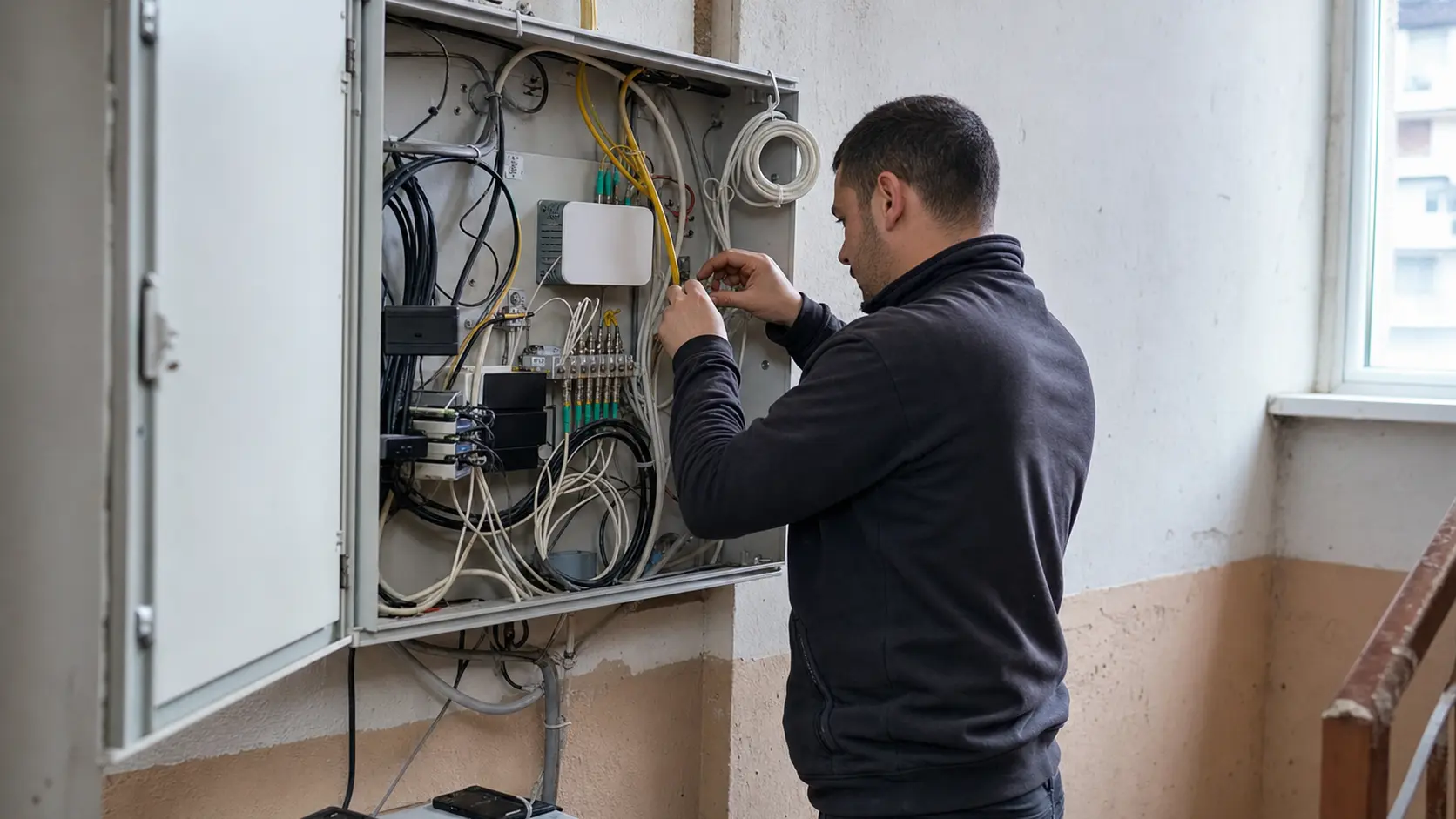
Every physical interface creates a potential labour event. Coaxial equipment ages. Connectors corrode or loosen. Power supplies fail. Customer routers are misconfigured. GPON ONUs need replacement. Apartment-building cabinets become crowded. Weather, building renovation and informal wiring can create faults outside the operator's direct control. A local operator can often solve these problems faster than a remote national call centre because it knows the buildings and local contractors. But that local advantage is a labour expense before it is a brand asset.
Low density is especially dangerous when speed tiers are modest. If the operator charges a premium, customers ask why the headline speeds are not higher. If the operator discounts, it needs more customers per kilometre, cabinet, technician and support line. If it bundles television, it adds rights and equipment complexity. If it serves two local areas, such as Stara Zagora and Krumovgrad signals in the contract, travel and staffing may become harder to absorb unless there is enough paid density in each area.
The public evidence does not disclose route density. That missing evidence is not a weakness in the research; it is a central economic conclusion. The company can have an active ASN, a legitimate LIR record, published quality disclosures and real local contracts, yet still fail to make reliability pay if the number of paying lines per service area is too low.
Pricing opacity is part of the judgment
The assignment's core question cannot be answered without pricing, and the public pricing evidence is thin. The individual contract form includes fields for monthly fees for television service, Internet service, combined television and Internet service, hotels or administrative buildings, public places and activation. Those fields are blank in the template. The shop page shows a Mercusys router at 35 Bulgarian leva, which is useful as a customer-equipment signal but not as a service-price schedule. The public documents show tiers and obligations, not the tariff ladder that would reveal margin.
That absence matters. In a regional ISP, the same 30 Mbps household connection can be attractive or unattractive depending on price, installation recovery, churn and support load. A cheap connection in a dense apartment block may be profitable if installation is quick and faults are rare. A higher-priced connection in a dispersed area may still be unattractive if truck rolls are frequent. Business tiers can create better economics if they come with higher monthly fees and clearer service boundaries. They can destroy economics if business customers demand priority support while paying household-like prices.
The contract includes some mechanisms to protect the operator. A one- or two-year term can reduce early churn. A three-month subscription penalty in certain cases can help recover discounts or equipment. A move to an indefinite contract after expiry, with one month's notice, can preserve a customer relationship without forcing a new sale. Equipment-return obligations protect against losing devices. But all of these protections depend on the base price being right. A poorly priced contract merely locks in a poor return.
The absence of visible customer numbers is just as important. We do not know how many subscribers buy television only, Internet only or bundles. We do not know the household/business split. We do not know whether Krumovgrad is a meaningful second area or a legacy contact line. We do not know whether business 80/40 Mbps tiers are widely purchased or simply available. We do not know whether TV rights are a customer-retention tool or a margin contributor. We do not know bad-debt exposure, seasonal patterns or how many support calls each active line generates.
The correct conclusion is therefore conditional. K and D UNISAT -TV LLC's reliability proposition may be valuable. The public record does not yet show that customers pay enough for it. Missing price and customer evidence is not filler around the analysis; it is the decisive gap between a credible operating footprint and an investable economic claim.
Television rights and local bundles add revenue but also obligations
Television can help a regional ISP defend customer relationships. A household that buys Internet and television together may be less likely to churn than a household that buys a standalone access line. A local cable operator can bundle familiar channels, practical support and one monthly relationship. For some customers, especially in apartment blocks or smaller towns, the television component may be the reason to keep the local provider even if larger brands advertise faster Internet.
K and D UNISAT -TV LLC's public documents support that bundle thesis. The individual contract includes radio and television programme distribution as the first service category. The general terms describe data transmission, radio and television distribution, Internet access and other services through a public telecommunications network. The "About us" page references copyright agreements with Profon and Musicautor and lists distributed channel groups and broadcasters. The interface document includes a television equipment interface section, including SCART details.
These are old-fashioned clues, but they are economically useful: the company is not only selling an IP pipe.
The downside is that television is not free margin. Programme distribution brings rights administration, channel negotiations, customer expectations around picture quality, set-up work and complaints when a channel changes. It can also limit strategic flexibility. A pure broadband operator can focus capex and support around connectivity. A television bundle requires the operator to manage a content relationship even as younger households migrate toward streaming, mobile video and platform subscriptions.
A local TV bundle can retain older or more traditional customers, but it can also tie the operator to a product category where national groups and over-the-top services have scale advantages.
United Group's public operations page illustrates the scale problem on the other side. It describes Vivacom as a Bulgarian provider of next-generation telecom services with mobile and fixed services, ultra-fast Internet, interactive TV and smart solutions for residential and business customers. e& PPF Telecom Group says it is active in Bulgaria, Hungary, Serbia and Slovakia, with 12.2 million mobile subscribers, 1.1 million fixed broadband users, 2.4 billion euros of revenue and 9,100 employees as of 31 December 2025. Against groups of that size, a local bundle has to be more than a smaller version of the national product.
It has to be locally relevant, reliably supported and priced to reflect actual cost.
Television can therefore make K and D UNISAT -TV LLC stickier. It can also make it more exposed. The economic result depends on whether bundled customers produce lower churn and higher lifetime value, or whether they merely add channel and support obligations to a low-priced Internet account.
Competition comes from national bundles and mobile substitutes
The competitive threat is not only another small ISP in the same building. It is the buyer's realistic alternative. In Bulgaria, that alternative increasingly includes national fixed-mobile groups, larger fibre footprints, mobile data, 5G home Internet, satellite or streaming substitutes for television, and business connectivity from operators with deeper procurement power. The European Commission's 2025 Digital Decade fact page describes Bulgaria as having well-developed connectivity infrastructure, while also noting gaps in SME digital uptake, digital skills and cybersecurity preparedness.
That combination creates both demand and pressure: more users need reliable service, but better national infrastructure gives them more ways to buy it.
For K and D UNISAT -TV LLC, this means the local proposition has to be precise. It cannot simply say "Internet and TV" if a national operator can sell Internet, television, mobile and handset financing in one bundle. It cannot simply say "business access" if larger operators can offer corporate connectivity, cloud services and national account management. It cannot rely only on having an ASN if customers care about monthly price, fast installation and visible support. Network resources are meaningful to BTW readers and technical buyers, but most households buy outcomes rather than registry participation.
Mobile substitutes are particularly important at the lower speed tiers. A household comparing a 10/10 or 20/10 Mbps fixed connection with a mobile data plan may accept the mobile option if it is easy, fast enough and bundled with voice. Fixed wireless or 5G home services can put pressure on a local cable operator where building wiring is old or installation is inconvenient. The local operator's response cannot be only more discounting. Discounting may win a customer but damage the economics of the support promise.
The best defence is local service quality that national operators find hard to match. A small provider can know which stairwell cabinet fails, which landlord grants access, which coax segment is noisy, which business needs morning support and which recurring customer problem can be solved before it becomes a formal complaint. That knowledge has economic value when it lowers repair time and improves retention. It loses value when it becomes unpaid labour.
Competition therefore pushes the article toward a disciplined judgment. K and D UNISAT -TV LLC may be strategically relevant in its local areas. It may not have pricing power unless customers demonstrably value local accountability enough to pay for it. The substitute price is set by larger operators and mobile alternatives, while the operator's cost is set by physical service work.
Regulation and compliance turn small scale into overhead
Small telecom operators do not escape regulation because they are local. K and D UNISAT -TV LLC publishes a set of documents that show the compliance surface: general conditions for end users, individual contract forms, acceptable-use policy, privacy policy, technical-interface information, service-quality parameters, open-Internet information under Regulation (EU) 2015/2120, and a Digital Services Act contact document under Regulation (EU) 2022/2065. The company also points customers to the Bulgarian Commission for Consumer Protection and the Communications Regulation Commission for certain complaints.
Each document is sensible in isolation. Customers should know contract terms, service speeds, interface requirements, complaint channels and open-Internet rights. The acceptable-use policy says the policy aims to support responsible use of the network and prevent conduct that worsens or obstructs usability, while preserving security, reliability and privacy of systems and network. The open-Internet information says the company does not apply traffic-management measures, does not limit volume, speed or another quality parameter of the service, and says other provided services do not affect Internet access.
The DSA contact document gives Bulgaria, Stara Zagora, the company name, email and telephone for a single contact point.
The economic issue is not whether compliance is legitimate. It is whether a small operator can absorb the fixed cost of maintaining compliance, responding to complaints, updating documents, handling privacy obligations and preserving service records across a small base. Larger operators have legal, regulatory, security and reporting teams. A regional operator may spread the same category of work across far fewer employees and customers. Even when outside advisers prepare documents, the business still has to implement them in billing, support and network operations.
Compliance also affects the reliability promise. If a customer complains about recurring speed shortfalls, the operator needs records, support handling and technical evidence. If traffic management is restricted or publicly disclaimed, congestion has to be solved through capacity and engineering rather than opaque throttling. If customer equipment is operator-owned, device handling, returns and replacement become part of the controlled process. If television distribution includes rights obligations, content compliance sits beside network compliance.
This fixed overhead does not mean the company is weak. In fact, the public document set shows more operational maturity than many small local providers display. But it strengthens the core thesis: reliability may be valuable and still not pay if the fixed cost of proving, documenting and supporting it is spread over too few customers.
Unofficial signals are useful only at the edge
Unofficial market signals can help frame the business, but they cannot carry the conclusion. The strongest non-company technical signals are third-party BGP views. bgp.tools classifies AS49040 as an active RIPE-allocated eyeball network, lists 24 IPv4 originated prefixes and identifies six upstreams. Hurricane Electric corroborates 24 originated and announced IPv4 prefixes, zero IPv6 prefixes, 24 RPKI-valid originated IPv4 prefixes and six observed IPv4 peers. These are useful because they are external observations of Internet routing, not company advertising.
Even those signals have limits. BGP visibility changes. Prefix counts do not equal subscribers. An eyeball classification does not reveal ARPU. RPKI validity is good hygiene, not customer satisfaction. Upstream counts can support resilience, but they also indicate dependence. The route descriptions that mention Link+ Ltd, Rodopi Cable Ltd or Gospodin Zhelev around certain prefixes should be treated as historical or registry context, not as a simple ownership map. Technical records are evidence, not identity.
Other informal signals are weaker. The company site design, channel list formatting, shop page and old interface references suggest a practical local operator rather than a polished national brand. That can be positive if customers value local continuity. It can be negative if the market increasingly expects digital self-service, high-speed fibre packages and modern customer portals. But none of these visual or formatting cues proves service quality, financial health or customer satisfaction.
The article therefore uses unofficial signals only at the edge. It does not treat routing tools as audited financial data. It does not treat a shop page as proof of equipment margin. It does not infer customer count from the presence of a Krumovgrad phone number. It does not turn a television channel list into a rights-cost estimate. The market-signal role is narrower: confirm that the company has visible operating traces, then state the facts that remain missing.
That discipline is essential because the public evidence could tempt two opposite overstatements. One overstatement would say that active AS49040 and 24 prefixes prove a valuable regional network. The other would say that modest speed tiers and limited public pricing prove a weak operator. Neither is justified. The correct reading is that the company has a credible local access footprint and an unresolved return profile. The missing evidence is where the judgment lives.
The facts that would change the judgment
The current judgment is cautious. K and D UNISAT -TV LLC has a real local operating boundary, formal resource-holder evidence, an active routing footprint and public telecommunications documents. It also faces a demanding economic test: low customer density, support labour, upstream dependence, equipment obligations, television rights, regulatory overhead and faster substitutes can consume the value of reliability before it becomes profit.
The facts that would improve the judgment are concrete. First, subscriber density by service area would matter. If the company has high penetration in specific apartment blocks, neighbourhoods or towns, its field labour and plant costs may be spread efficiently. Second, product mix would matter. A meaningful share of business customers paying for higher tiers, static addressing, faster response or managed support would make the 80/40 Mbps business tier more valuable than a nominal option. Third, churn and average contract life would matter.
Long customer life can make modest access prices acceptable if installation and device costs are recovered over years.
Fourth, repair economics would matter. Published quality parameters are a start, but investors would need fault counts, average restoration time, repeat-fault rates, truck rolls per subscriber, equipment replacement rates and the split between customer-caused, building-caused, access-network and upstream incidents. Fifth, upstream contracts would matter. Multi-homing is valuable if priced well and resilient; it is expensive if the customer base is too small. Sixth, TV economics would matter: channel rights costs, TV attach rate, churn reduction and whether television customers also buy broadband.
The facts that would weaken the judgment are equally concrete. Low take-up across dispersed service areas would make every repair more expensive. High churn would prevent contract terms from recovering installation work. A customer base concentrated in low-speed household plans would limit pricing power. Frequent device replacement or poor building wiring would turn local accountability into unpaid support. Dependence on a few upstreams or content suppliers at unfavourable prices would reduce bargaining power. No credible IPv6 plan would raise the future cost of technical catch-up.
The final answer is therefore not that reliability lacks value. The answer is that public evidence does not yet show that reliability pays. K and D UNISAT -TV LLC appears to solve a real customer problem: practical access and television continuity in local Bulgarian service areas. The unresolved question is whether enough customers pay enough before the operator carries the fixed network, support and compliance costs. Until price, customer density, churn, repair load and margin evidence are visible, the reliability proposition remains credible as service and unproven as value creation.