
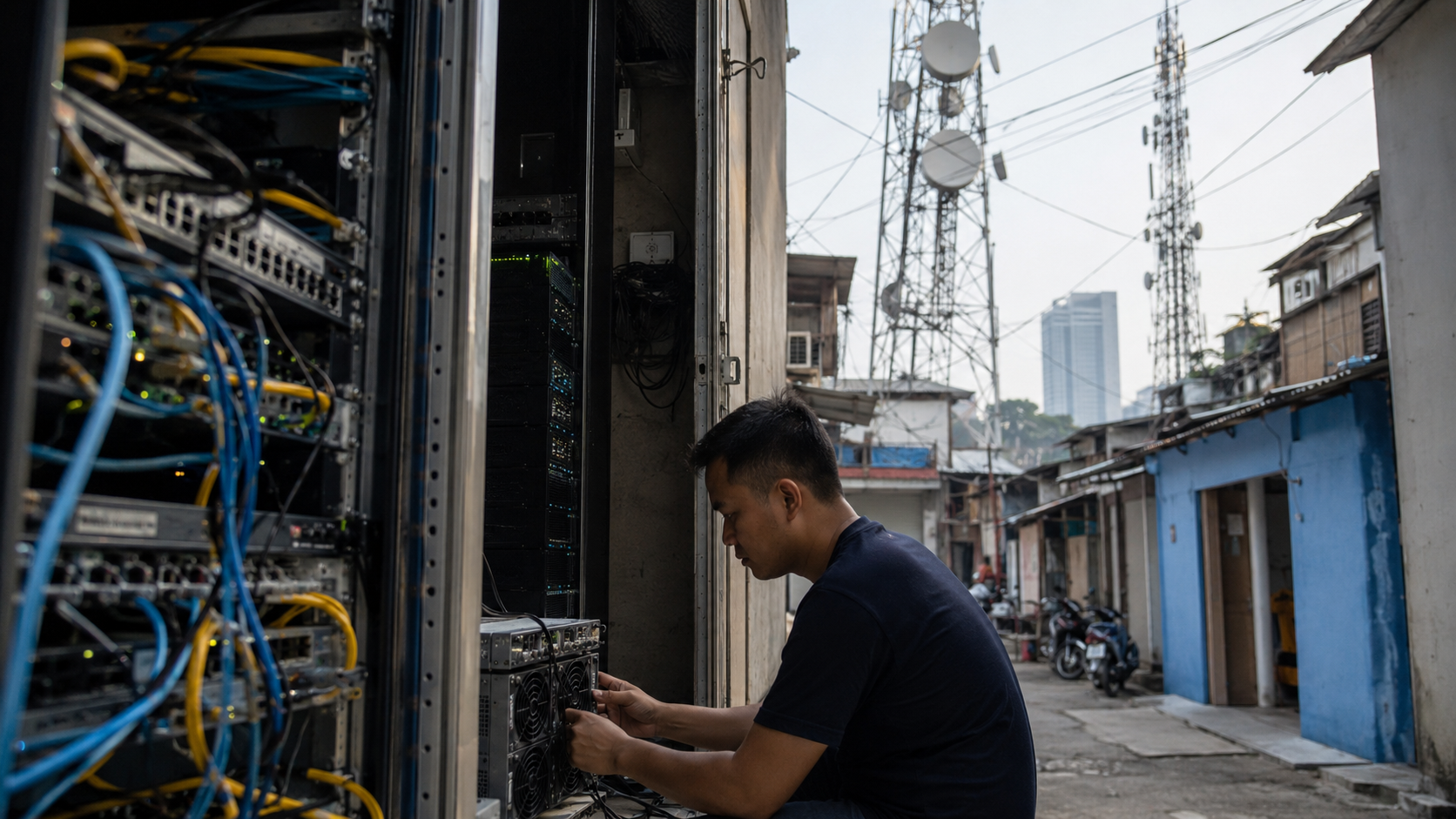
The company is smaller than the story it tells WebSlice is not best understood as a standalone global cloud company. The public record points instead to a brand and legal structure sitting inside a larger New Zealand hosting group that has spent years rearranging brands, customer segments, and infrastructure wrappers. The New Zealand company most directly matching the brief, WEBSLICE 2017 LIMITED, is a registered NZ limited company incorporated on 28 February 2017. Its annual return was filed on 8 May 2026, its registered and service address is 12 Walls Road, Penrose, Auckland, and its ultimate holding company is SITETECH SOLUTIONS LIMITED. That matters because it immediately relocates the analysis from startup mythology to owner economics: WebSlice is part of a privately held family of hosting brands, not an independent hyperscale challenger.
The shareholding chain is unusually revealing for a private infrastructure business. WEBSLICE 2017 LIMITED is wholly owned by Webslice International Pte. Ltd.; SITETECH SOLUTIONS LIMITED is owned 45% by Nathan Russ, 45% by Quintin Russ, and 10% by an employee share trust. SiteTech’s public-company metadata lists trading names including SiteHost and MyHost. In plain English: WebSlice is one operating face in a founder-controlled hosting group, not a free-floating brand. That ownership pattern usually implies patience, operational conservatism, and less pressure to “buy growth” at uneconomic rates, but it also implies a smaller capital base than large venture-backed cloud platforms.
The international legal face is also public enough to matter. WEBSLICE INTERNATIONAL PTE. LTD. appears in Singapore company directories as a live exempt private company incorporated on 20 October 2017, with principal activity “hosting services by non-data centres,” and only USD 2,000 of paid-up capital shown in the directory data. Its address at Suntec Tower One is a high-density registered-office style address, which is common and not inherently suspicious, but it does indicate that the Singapore vehicle looks more like a regulatory and contracting shell than a capital-heavy operating headquarters. Economically, that is entirely consistent with a boutique provider using Singapore as a domain-registry and international contracting base rather than as the locus of a large local workforce or owned infrastructure footprint.
The strongest single clue about what that Singapore entity is for comes from domain-registry records. ICANN’s accredited registrar list includes Webslice International Pte. Ltd. as registrar 4020, and IANA’s registrar ID list also shows Webslice International as accredited. SiteHost itself explains the logic: when it began directly registering international domains, it “chose our new international face, Webslice, to go through ICANN accreditation,” adding that SiteHost and Webslice are “the same team” with “the same owners.” This is one of the essay’s key facts. The scarce asset here is not just compute or rack space. It is also regulatory permission and systems integration: direct registrar status can shave supplier layers out of the domain business, lower unit costs, improve control over transfers and renewals, and add a subtle trust signal for developers who dislike opaque resellers.
The corporate history also makes clear that “WebSlice” has already been split into at least two economic stories. In March 2017, SiteTech Group announced it had acquired WebSlice Limited, describing it as a New Zealand hosting provider active in cloud servers, dedicated servers, and shared hosting. In August 2021, MyHost announced that it was merging MyHost and WebSliceNZ, explicitly saying the brands were part of a family including MyHost, WebSliceNZ, SiteHost, and Domains Direct, all run and supported by the same team on the same infrastructure. In other words, the old domestic value-hosting and cPanel-era WebSlice was folded into the group’s mass-market/New Zealand retail layer, while webslice.com re-emerged later as the group’s international developer-facing brand. That is not mere rebranding trivia. It is evidence of segmentation strategy: keep the commodity retail business somewhere else, and try to rebuild margin under a fresher brand with a more technical pitch.
The present marketing makes that pivot explicit. The new webslice.com says the company started in New Zealand in 2004, calls itself the “largest locally-owned hosting company there,” says its container platform dates from 2016, says Webslice Containers launched in 2024, and says Webslice Serverless launched in 2025. It also says it is now running “in a range of global locations” and hosting over 16,000 websites. As always with marketing numbers, these should be read as claims, not audited disclosures. But the directional story is clear enough: the group is trying to move from generic hosting into a higher-value layer where the customer buys a managed developer workflow, not merely a cheap virtual machine.
There is one more registry wrinkle worth noting because it tempers melodrama. The New Zealand Gazette contains notices of intention to remove WEBSLICE 2017 LIMITED in both 2019 and again in May 2026. But CompanyHub, drawing from Companies Office data, still shows the company as Registered with an annual return filed in May 2026. The safest interpretation is not hidden collapse, but registry housekeeping noise that was later resolved or objected to. Economically, it means the public record does not support a distress thesis by itself. It does, however, show how small private infrastructure firms can look messier in public filings than their customer-facing brands imply.
So the first answer to the core question is already visible. WebSlice’s defensible niche, if it has one, does not begin with “our hardware.” It begins with brand architecture, owner continuity, domain permissions, and customer segmentation. The group appears to know that commodity hosting is structurally ugly. Its public moves suggest it has been trying to climb away from that ugliness by reserving the Webslice brand for more opinionated developer infrastructure, while leaving lower-end mass hosting under MyHost and broader enterprise/private-cloud work under SiteHost. Whether that works depends on whether support, routing reputation, and operational judgment are sufficiently scarce to overcome the fact that much of the underlying infrastructure is rented rather than sovereign.
Support is the product If one strips away the cloud vocabulary, WebSlice is selling two things. First, a container platform: dedicated server resources sliced into multiple isolated environments, each using one of many pre-built images. Second, a serverless PHP platform: usage-priced, AWS-backed hosting intended to remove the learning curve of assembling raw serverless infrastructure. The official comparison table is useful because it is unusually honest about what customers are actually buying. Containers are “Server + containers (Webslice infrastructure)” with fixed monthly pricing. Serverless is “Serverless functions (AWS + Webslice),” with each website priced from $1 per month, each database at $3.50 per month, and the rest usage-based. That framing already tells you where gross margin pressure lives: the serverless layer rides AWS cost curves, while the container layer rides whatever margin the group can extract from supplier contracts and operational density.
The containers side is priced like a classic boutique hosting offer, not like a high-margin enterprise platform. Current package pricing starts at $10/month for 1GB RAM and rises to $82/month for 8GB, with automatic backups and free SSL included. On paper that looks attractive. In economic terms it looks tight. Entry-level infrastructure at those prices does not support lavish hand-holding unless utilization is high, support is heavily templated, or the real margin comes from attached services. WebSlice’s own product design strongly suggests the third explanation. The true money feature is not the base server. It is the add-on layer called Support & Management, priced at $50/month plus $2.50 per container or website for Business, and $350/month plus $5 per container or website for Premium. Those tiers add 24/7 monitoring and incident response, application support, live chat or phone access, and productivity tools such as one-click restore, scheduled image updates, and clone/overwrite workflows. That is where boutique hosting tries to stop being a commodity.
This matters because support labour is both a cost and a moat. The official careers page says there are about 50 staff, mostly in Auckland, with “some team members scattered around NZ and the globe.” The same page says the company competes with “cost-cutters and hyperscale behemoths by putting customer service first.” That line reads like branding copy, but it is also an operating thesis. A boutique provider cannot beat AWS, Azure, or DigitalOcean on raw cost of capital or geographic spread. It can only win if customers value not having to become infrastructure specialists, and if the provider can answer ugly questions quickly enough to reduce agency downtime and owner anxiety. That is why the support layer is not an accessory. It is the product that tries to recover margin from low-margin compute.
The customer-facing language is built around exactly that proposition. Webslice says it is for “busy developers,” advertises “Developer-friendly,” “Worldwide locations,” “24/7 expert support,” and markets the platforms around productivity rather than benchmark theatre. The homepage quote from Cactuslab is revealing in a way vendor testimonials rarely are: the value described is not raw speed but peace of mind, especially not needing to wake up for hardware or environment problems. That is textbook boutique-infrastructure economics. Customers pay to outsource operational vigilance. The more costly the downtime of a developer or agency owner, the more room there is to charge above commodity VPS rates.
Public customer chatter broadly supports the support-first reading, though with the usual caveats that reviews are noisy and often selection-biased. Recent Trustpilot reviews for SiteHost and MyHost heavily emphasise fast responses, competent technical help, and fair pricing. A 2025 MyHost review praised how a billing query was quickly explained and resolved; another said support understood the issue “instantly”; several recent SiteHost reviews describe unusually fast, helpful responses and easy setup. Older local forum chatter around WebSlice itself also leans in the same direction: Geekzone users recommended webslice.co.nz in 2012 and 2014 when discussing reliable New Zealand hosting, and one 2013 comment said WebSlice was “quite good,” adding that outages were “occasional” but still within the 99.9% uptime range. None of this proves superior economics, but it does suggest that customer support has been the group’s enduring reputation asset across brands.
There is also a useful negative datapoint. Website Planet’s 2019 review of the old WebSlice retail offering said support was helpful and price was competitive, but page-load times were among the worst the reviewer had seen for a New Zealand-based host. The specific measurements are dated and methodologically thin, but the pattern is instructive: even when compute performance was questioned, support was one of the few positives. That fits the thesis that WebSlice’s long-run differentiation was never premium global edge performance; it was human support and local operator accountability.
A sharper point emerges when one compares the legal text to the current marketing. Webslice’s current homepage sells “24/7 expert support,” and Support & Management is explicitly pitched as round-the-clock monitoring and incident response. But the publicly posted terms and conditions still say “The Webslice Support Team is available 8am to 5pm, Monday to Friday,” with escalated technical requests normally sent by email or console. The discrepancy is too large to ignore. There are two plausible readings. The generous reading is segmentation: everyone gets standard platform support during business hours, while 24/7 operational response is reserved for managed tiers. The less generous reading is documentation lag, with old legal language surviving under a new international brand. Either way, it is economically meaningful. A boutique host trading on trust cannot afford too many seams between what product pages imply and what terms pages still say.
This is where the margin arithmetic becomes visible. Low-end compute prices attract customers; support and management tiers defend margin; documentation coherence sustains trust. If support quality slips, or if customers conclude that the managed layer is just a thin wrapper around rented cloud primitives, the model collapses back toward commodity VPS economics. But if the support team reliably prevents nights, weekends, and launches from becoming client emergencies, then the economics change. A one-person agency with ten websites may not be buying ten containers. It may be buying the right to stop caring about patching, backups, caching, restore workflows, and first-response triage. That is a different product category, even when it sits on ordinary rented infrastructure.
The network is borrowed The strongest challenge to any claim of a defensible moat is that WebSlice’s global footprint appears to be largely borrowed. The company’s own materials say the original New Zealand business has its own data centre on premises, runs gear elsewhere in Auckland and Sydney, and has “some products running in Linode data centres around the world.” Meanwhile, Webslice Serverless documentation says the platform is “built on AWS infrastructure in combination with our own in-house infrastructure,” while the current serverless regions page lists only Oregon and Sydney. On the containers side, the official locations page lists London, Frankfurt, California, Singapore, and Sydney. That is a sensible architecture for a boutique host expanding internationally without building a sovereign global network; it is also exactly the kind of architecture that limits moat strength because a great deal of its reach depends on supplier relationships rather than owned global fabric.
The BGP evidence pushes in the same direction. AS132919, registered as WEBSLICELIMITED-AS-AP, exists in current routing directories and is still associated with WebSlice Limited in a number of public databases. Cloudflare Radar shows it as an ASN from the same organization as SiteHost’s other ASNs; bgp.tools identifies it with MAINT-SITEHOST-NZ metadata. But the broader public signal is weak: current Webslice products do not appear to be sold around this ASN as a live global routing brand, and the active network story in New Zealand is much more clearly attached to AS45179 SITEHOST-AS-AP. SiteHost’s ASN is visible on PeeringDB as operational at AKL-IX and MegaIX Auckland, and bgp.tools shows it peering with other networks and using three upstream carriers. The operational implication is simple. The group’s New Zealand network identity is real. But the new international Webslice brand is not obviously expanding via its own globally visible autonomous network. It is expanding by abstraction over other people’s facilities and cloud.
That distinction matters because routing reputation is one of the hidden currencies of hosting. A host running its own active network, peering openly, and controlling transit policy can sometimes deliver better local latency, better troubleshooting, and more reliable handling of weird pathologies. SiteHost makes exactly this kind of promise on its international hosting page, noting that AS45179 has an open peering policy and peers publicly on AKL-IX and Megaport-IX. But Webslice’s international proposition is different. Its current product pages emphasise convenience, platform control, regions, and deployment flows instead of routing prowess. That is rational. When much of your footprint is supplier-mediated, the honest moat is not route engineering. It is packaging, support, and customer education.
Seen this way, “global” needs translation. In hyperscale marketing, global often means private backbone, owned edge architecture, and direct control over a huge share of the request path. In boutique-hosting marketing, global often means the ability to place workloads in a handful of regions through upstream partners and manage them through one console. Webslice belongs to the second camp. There is nothing wrong with that. Many customers do not need sovereign networking. But it does mean the company’s cost base and service quality are substantially conditioned by suppliers—Linode/Akamai on the container side, AWS on the serverless side, plus upstream transit and mitigation providers closer to the New Zealand core. That supplier dependence narrows strategic freedom.
It also changes how to read the product split. Containers are fixed-price and look like an evolved hosting product: a cleaner, image-based version of what old virtual server and managed-container providers have long sold. Serverless is a utility-billed wrapper around AWS primitives, designed to remove billing complexity, direct AWS exposure, and deployment friction for PHP-heavy workloads. Webslice’s own serverless copy repeatedly stresses that customers do not need an AWS account and do not need to deal with AWS complexity. That is valuable, but it is valuable in the way a clever abstraction layer is valuable. The company is not selling scarce raw capacity. It is selling translated cloud complexity.
One can see why the company leans into this. For a large part of the PHP agency market, especially in WordPress, Craft, Statamic, Silverstripe, and similar ecosystems, the pain is not obtaining CPU credits. The pain is stitching together deployment, SSL, backups, CDN, database behavior, cost controls, and support pathways without becoming a part-time cloud engineer. Webslice’s own documentation is full of precisely these workflow affordances: direct Git deployment, drag-and-drop deploys, cloning and overwriting containers, automatic updates, cache control, one-click restore in managed tiers, metrics, spend limits, concurrency controls, and regional selection. Economically, this is less a compute business than a workflow-rental business. It borrows global infrastructure and tries to own the experience between the developer and that infrastructure.
The question, then, is whether that experience can resist imitation. The answer is mixed. Some things are harder to copy than they look. A small, responsive team with accumulated playbooks across domains, Linux hosting, containers, and abuse handling can create real switching costs for agencies who hate migration risk. But many things are easy to copy in principle. Supplier-backed containers in five regions are not scarce. PHP-friendly serverless layers on AWS are not scarce. ICANN accreditation is scarce in a licensing sense, but not rare enough to stop competition. The defensible part, if any, must therefore live in the boring middle: support responsiveness, billing trust, migration competence, and operational judgment tied to a specific customer type.
This is why the network evidence is more enlightening than any product slogan. It shows a company whose local New Zealand infrastructure roots are real, but whose international ambitions are being carried by upstreams and cloud suppliers. That combination can absolutely support a good business. It is common among smart midsized hosts. But it is not the architecture of a structurally unassailable platform. It is the architecture of a business that must keep earning trust every month because the hard assets underneath are, in important ways, substitutable.
Abuse eats the gross margin The most interesting public evidence about this business is not on its pricing pages. It is in its abuse, bot, and outage material. Hosting margin is often discussed as if it were a simple spread between server cost and selling price. In practice, especially for boutique providers, margin is what remains after dealing with abuse, false positives, fraud, DDoS mitigation, customer blame allocation, and reputational contamination. SiteHost’s public operating notes are unusually candid about this, and because Webslice is publicly described as the same team and same owners, they are the best guide to how the group thinks about risk.
The key document is the group’s May 2026 DDoS incident report. SiteHost said the attack was the largest in its 22-year history. The attacker first created an account, delivered a Monero ransom demand, and then launched a network-wide attack hitting effectively every address on the network. The report says the traffic volumes were not individually insurmountable but collectively overwhelmed a number of SiteHost’s and its upstream providers’ safeguards. Through the day, the team coordinated with transit providers, engaged scrubbing services, dropped peering sessions contributing large volumes of international unfiltered traffic via local IXPs, rerouted Sydney transit through Auckland, and brought additional scrubbing capacity online further upstream. There is no better public evidence for supplier dependence than this. When the attack got serious, the decisive battle was not inside a self-contained private network. It was across the seams between host, upstreams, scrubbing partners, and Cloudflare paths.
From a commercial standpoint, this is expensive reality. DDoS defence is not free. Emergency engineering time is not free. False positives are not free. Nor is customer reassurance. The incident report describes specific trade-offs between keeping the network protected and accepting a “high false positive rate,” manual per-customer workarounds for sites affected by Cloudflare path issues, and hours of customer-specific mitigation. This is what boutique-hosting margin gets consumed by. A cheap VPS provider can shrug and tell customers to buy Cloudflare or cope. A premium-support provider is expected to absorb the triage burden. That is strategically useful if customers reward it. It is margin poison if they do not.
The 2023 Azure bot essay is even more economically revealing because it turns abuse handling into a pricing-power problem. SiteHost described blocking or rate-limiting huge Azure IP ranges because a bot kept appearing from new Azure addresses and disappearing after a handful of requests. Quintin Russ’ framing is blunt: hyperscalers are, in effect, “putting their reputation up for sale” by making rapidly shifting cloud-originating IPs available on very short billing cycles. He argues that when thousands of different actors can use the same addressing reputation over short windows, trust in IP reputation decays. That is not just a technical complaint. It is a commercial argument about the externalization of abuse costs from hyperscalers onto smaller hosts. WebSlice’s niche pitch depends on being easier and cleaner than raw cloud. Yet raw cloud makes abuse fluid, hard to attribute, and operationally costly for the smaller provider downstream.
This is where routing reputation, abuse handling, and customer support become the same economic problem. The Azure bot piece says SiteHost ended up blocking huge prefixes, then whitelisting legitimate victims, then moving to hard rate limits because Microsoft abuse engagement was effectively a “black hole.” It also says customers behind Cloudflare and other WAFs were not sufficiently protected from this particular behavior. The lesson is not that WebSlice has uniquely strong anti-abuse magic. It is that abuse triage has become a labour-intensive differentiator. A boutique host can win customers by being willing to make judgement calls that hyperscalers and generic CDNs will not make quickly. But every one of those judgement calls is expensive and politically awkward. Block too little and the infrastructure degrades. Block too much and legitimate traffic gets punished.
The group’s acceptable-use and terms material confirms that it takes a relatively interventionist approach. SiteHost’s AUP tells complainants to use abuse@sitehost.co.nz, prohibits a long list of software and behaviours, reserves the right to stop activity harmful to performance or reputation, and explicitly says excessive resource consumption, spam, phishing, and various kinds of negligent activity may result in suspension. The terms say prohibited activity can lead to deactivation without prior notice and that customers are not credited for suspension time. That can sound harsh, but harshness is often part of boutique-hosting survival. If the provider does not reserve broad discretion, it cannot protect shared reputation or keep support queues sane.
Historical uptime chatter shows the same pattern in a less dramatic register. The MyHost/WebSlice resolved-status archive contains years of maintenance notices for router replacements, urgent network maintenance to address stability issues and reduce DDoS impact, VPS node maintenance, cloud platform upgrades, file system checks, migrations to new storage architecture, and performance/stability work on named nodes. One 2014 notice explicitly said router software upgrades were being performed to address stability issues and reduce the impact of DDoS attacks over the prior 24–48 hours. A 2017 notice described urgent router replacement to address stability issues. These are not scandalous by hosting standards. But they are reminders that boutique hosts live in a world where network incidents, hardware maintenance, and abuse mitigation are not edge cases. They are part of normal gross-margin attrition.
This has direct implications for WebSlice’s product strategy. A provider that still sells bare-metal-style cheap infrastructure without enough anti-abuse friction will attract some of the worst demand in the market: throwaway projects, suspicious signups, bulk email abuse, reckless crawlers, and customers who consume engineering time while paying almost nothing. The public evidence suggests the group knows this. The old WebSliceNZ retail layer was folded into MyHost. The new Webslice.com brand is shaped around agencies, developers, managed services, and serverless spend controls. That looks less like taste and more like risk selection. The company appears to be trying to choose customer cohorts whose support load is economically survivable.
Put differently, abuse handling is not a compliance appendix. It is a hidden cost-of-goods line. Every boutique host must decide whether to chase volume or to ration access. WebSlice’s current anti-abuse posture suggests rationing: focus on developers and agencies, require payment credentials up front, keep strong rights to suspend, and monetise the customers who want proactive support. That does not eliminate abuse risk. But it is how a small provider tries not to become a commodity VPS trap.
Billing is a trust contract The most underrated part of WebSlice’s current model is its payment design. Serverless infrastructure has a well-known psychological problem: many customers are not scared of technology, but they are scared of surprise invoices. WebSlice has clearly designed around that fear. The provisioning documentation says a valid credit card is required to create a Webslice account. Billing runs monthly in USD; invoices are due within seven days; cards are charged automatically seven days after invoicing. New accounts require a $5 card verification charge, which becomes account credit and is matched with $5 bonus credit, for a total of $10 starting credit. The separate “Card Verification & Credit” page states directly that this exists to protect the platform from fraud and abuse. In other words, the payment flow does two jobs at once. It screens risky signups and reframes the friction as onboarding credit.
This is commercially intelligent. Payment friction is normally treated as a conversion tax. In a small hosting business it is also an abuse filter. A hobbyist who balks at a card requirement may not be worth much economically. A fraudster who wants free trial capacity is actively dangerous. WebSlice has chosen to accept some conversion loss in exchange for lower fraud and abuse exposure. For a provider with managed operational commitments, that is usually the right trade. Free or no-card trials are a luxury of larger platforms with more fully automated guardrails or deeper tolerance for waste. Boutique providers with human-heavy support do not have that luxury.
The more interesting trust feature is the spend-limit system on Serverless. WebSlice says, correctly, that bill-shock protection is important because serverless scales on demand and therefore creates risk from traffic spikes, misconfiguration, malicious traffic, or development mistakes. Customers can set a monthly team-wide spend limit; at 80% usage administrators receive an email warning, and at approximately 100% the team is automatically paused, with websites and databases paused but not deleted. That is a strong commercial signal. WebSlice is trying to convert a scary cloud behavior into a bounded hosting experience. It is, in effect, securitising monthly anxiety.
That feature also speaks to the essay’s core question. Resource scarcity in boutique hosting is not only about CPU or IPv4. It is also about customer trust capacity. A provider that can convincingly promise “you will not wake up to an AWS-style runaway bill” has created a real, if narrow, niche. Many agencies and smaller dev shops dislike variable cloud invoices not because they cannot understand them, but because their own clients hate unpredictable pass-through costs. A host that packages elasticity with hard commercial guardrails can charge for simplicity. The fact that WebSlice talks so explicitly about DDoS, misconfiguration, and malicious traffic as bill-risk drivers suggests the team understands the overlap between abuse economics and invoice psychology.
This matters even more when set against competitors. Laravel Cloud’s official pricing now starts at $5/month plus usage, with monthly usage credits included in paid plans. Laravel Vapor charges $39/month before AWS cloud costs. Upsun advertises a free trial with no credit card required. Fortrabbit still sells the appeal of modular pricing and low-entry plans. Against that field, WebSlice’s pitch is not “we are free” or “we are the official host of framework X.” It is that it is a simpler, PHP-friendly, agency-oriented platform with low baseline pricing and explicit caps against runaway cost. That is not a universal moat, but it is a coherent one.
The domain side deepens the trust-contract story. Webslice.com says domains are in private beta and that the company is an ICANN-accredited registrar. SiteHost previously explained that the international registrar entity is Webslice International and that switching registrar would mean WHOIS data showing that name. Registrar accreditation is not glamorous, but in a hosting group it matters economically in three ways. It can lower vendor dependency, improve margin on international domains by removing intermediary reseller layers, and bundle hosting with domain control in ways that reduce customer churn. A customer with domains, DNS, email, and managed hosting inside one competent provider is harder to dislodge than a customer renting a single cheap VPS.
Yet the same billing design also reveals the limits of the niche. Everything is in USD, even though the group’s roots and a large chunk of its operational base are in New Zealand. Cards are required. The free-credit program is anti-abuse-minded, not consumer-friendly. The platform is not optimized for the broadest possible top-of-funnel. It is optimized for customers who will tolerate some friction in exchange for competence and bounded risk. That is exactly the type of customer a boutique host should want. But it also means the ceiling on mass-market growth is lower than it would be for a frictionless commodity host.
This is where the model becomes commercially literate rather than romantic. Payment flows are part of cost accounting. The card requirement reduces fraud and probably lowers support waste from unserious signups. The spend limit lowers the chance of catastrophic customer anger. The registrar capability adds a sticky ancillary revenue line. The management tiers pull customers upward. None of this is glamorous. All of it is the actual arithmetic of surviving as a boutique cloud infrastructure provider in the age of abundant generic compute.
The niche is real but narrow So is WebSlice building a defensible niche, or merely dressing up a commodity VPS business? The public evidence supports a guarded answer: both are possible, but the company appears to understand the difference and is consciously steering toward the niche side. The strongest evidence for that is structural, not rhetorical. The old retail WebSliceNZ business was merged into MyHost. The current Webslice.com brand is aimed at agencies and developers, sells containers and serverless rather than generic shared hosting, monetises management heavily, uses explicit anti-abuse payment friction, and presents itself as an easier layer over AWS and globally distributed container servers. This is not how a company behaves if its only ambition is to win the cheapest-VPS lottery.
The scarcity it is trying to build around is also intelligible. It is not scarce silicon. It is not extraordinary proprietary networking. It is not unique access to AWS. The scarce asset is operator judgement packaged for a specific customer type: agencies and developers who want multiple environments, heterogeneous stacks, strong support, practical anti-abuse controls, and less billing ambiguity than raw hyperscaler tooling. For that segment, WebSlice may genuinely be more substitutable with a senior sysadmin or a good managed host than with a cheap cloud VM. That is the right comparison set.
There are real strengths in that position. Founder control can support long-term service quality rather than quarterly optics. The group’s local New Zealand credibility is established across SiteHost and MyHost. Customer commentary consistently praises support. The company has real registry permissions on the domain side. It has enough scale to talk about thousands of customers, thousands of websites, a 50-person team, and multiple operating brands, but not so much scale that customers disappear into hyperscaler indifference. In hosting, that middle ground can be valuable. Many agencies do not want the smallest provider. They do not want the largest, either. They want the one that still answers the phone and understands weird stack problems.
But the narrowness matters. The supplier dependence is obvious. Global container locations appear to sit on external facilities. Serverless is AWS-backed. New Zealand routing strength is more clearly attached to SiteHost’s active ASN than to WebSlice as a globally visible network brand. Abuse and DDoS response depend on upstreams, scrubbers, and the behavior of giant clouds and CDNs. Compliance language also appears uneven: SiteHost’s compliance page is detailed and names ISO 27001, SOC 2, NZISM, CSA STAR and more, while Webslice’s own compliance page is much thinner and names only PCI DSS and GDPR in public detail. Even allowing for shared-team realities, that asymmetry tells you WebSlice is still a newer international wrapper, not yet a fully mature institutional infrastructure identity.
The trust seams are the most important risk. The support-hour inconsistency between legal terms and marketing is one example. Another is the difference between broad “global” framing and the fairly modest list of currently documented regions, especially on Serverless. A third is that the public record gives no direct visibility into financial durability: no audited revenue, no churn data, no gross-margin split between base infrastructure and management services, no supplier-commitment disclosure, and no clear customer-concentration picture. When available public evidence is this incomplete, a boutique host’s valuation lives or dies on reputation. Reputation is powerful, but it is also fragile.
Still, the commodity-trap thesis should not be overstated. A true commodity VPS trap usually has a recognizable smell: no meaningful payment friction, little operational commentary, bargain-basement positioning, weak abuse posture, little evidence of premium support, and no ancillary permissions or brand segmentation. WebSlice does not smell like that. It smells like a company that has already lived through commodity hosting once, moved that part of the portfolio elsewhere, and is now trying to sell a stricter, more support-heavy, more workflow-centric product to customers who can justify paying for it. That is a meaningful strategic difference.
My own commercial reading, based on the public record, is therefore sceptical but not cynical. WebSlice probably can support a defensible niche if it keeps doing three things well at once: first, maintaining support quality that customers can actually feel; second, keeping abuse and billing shocks low enough that agencies trust it with client fleets; third, resisting the temptation to slide down-market in pursuit of volume. The risk is not that the company has no niche. The risk is that the niche is expensive to defend and easy to blur. Once a boutique host starts filling cheap seats with customers whose revenue does not cover support and abuse externalities, the arithmetic turns vicious very quickly.
What the record cannot settle The public record is strong enough to map the business model, but not strong enough to settle the investment case. There is no public financial statement showing revenue mix, gross margin, capex intensity, or the ratio of managed-service revenue to plain infrastructure revenue. There is no public decomposition of how many of the claimed websites or customers sit in MyHost versus SiteHost versus Webslice.com. There is no public utilization data for container servers, no disclosure of Linode/Akamai or AWS purchasing terms, and no way to infer whether the group is earning software-like contribution margins on management or merely cross-subsidising support with founder patience. Those unanswered questions are not a flaw in the research so much as a structural limit of analysing a private hosting group from public evidence alone.
The network-resource evidence is also informative but incomplete. AS132919’s continuing public presence shows historical network identity, but it does not prove how economically important that ASN is to the current Webslice.com proposition. Likewise, visible peering and transit references tell us a lot about the group’s New Zealand network seriousness, but not enough about the exact customer experience in each “global” container location or about the full chain of dependence under serverless regions. Even the useful incident reports stop short of naming all suppliers or quantifying their role. That is understandable operationally, but it limits precision.
There is also a category problem around trust signals. Support reviews for SiteHost and MyHost are strong, and local forums consistently describe the group as reputable. But reviews do not tell us who left because of price, who left because of platform limits, or how many customers are sticky because of genuine operational excellence versus domain-and-email convenience. Similarly, Webslice’s own customer quotes and claims of 16,000 websites and high satisfaction are useful signals, but they remain unaudited marketing statements. For a private infrastructure provider, that means the research can identify the shape of the niche much more confidently than the size of its economic rent.
That said, the missing facts do not erase the broad conclusion. They mostly determine whether the commercial view should be “good niche business,” “solid but ordinary operator,” or “quietly excellent compounder.” The public record is enough to reject two simplistic views. It is not a pure commodity host with no differentiation. And it is not a sovereign global cloud with hard-to-copy infrastructure advantage. It sits in the harder middle: a boutique operator trying to turn service quality, domain control, anti-abuse rigor, and workflow convenience into enough pricing power to outrun the low-margin gravity of hosting.
Evidence ledger Companies Office data via CompanyHub for WEBSLICE 2017 LIMITED — URL: https://www.companyhub.nz/companyDetails.cfm?nzbn=9429045987861 — Source type: company-registry aggregation citing New Zealand Companies Office. Supports: the NZ company’s incorporation date, status, annual return timing, address, ultimate holding company, and ownership by Webslice International Pte. Ltd. Does not prove: operating revenue, active headcount, or that the NZ entity itself is the daily contracting counterparty for every Webslice customer. Why it matters economically: it anchors the analysis in the actual legal shell behind the brand and shows that WebSlice is part of a controlled group rather than an independent infrastructure startup.
Companies Office data via CompanyHub for SITETECH SOLUTIONS LIMITED — URL: https://www.companyhub.nz/companyDetails.cfm?nzbn=9429034402382 — Source type: company-registry aggregation citing New Zealand Companies Office. Supports: founder ownership by Nathan and Quintin Russ, the employee share trust, and the trading names SiteHost and MyHost. Does not prove: consolidated financial performance or board-level strategy. Why it matters economically: it shows a founder-controlled hosting group with incentive continuity and clarifies that WebSlice sits inside a broader brand portfolio.
Singapore company directories for WEBSLICE INTERNATIONAL PTE. LTD. — URL: https://www.companies.sg/business/201730032D/WEBSLICE-INTERNATIONAL-PTE-LTD- and https://www.sgpbusiness.com/company/Webslice-International-Pte-Ltd — Source type: Singapore registry aggregators. Supports: incorporation date, live status, non-data-centre hosting activity, registered office style address, and small paid-up capital as presented in directory records. Does not prove: whether the Singapore entity houses substantial operations or merely acts as a registrar/contracting vehicle. Why it matters economically: it suggests Webslice International is a lightweight regulatory and commercial wrapper rather than a capital-heavy operating centre.
ICANN registrar records and IANA registrar IDs — URL: https://www.icann.org/en/contracted-parties/accredited-registrars/list-of-accredited-registrars, https://www.iana.org/assignments/registrar-ids, and https://www.internic.net/registrars.csv — Source type: official regulator/standards records. Supports: Webslice International Pte. Ltd.’s status as ICANN-accredited registrar 4020 and public support contact details. Does not prove: domain-market share or profitability of registrar operations. Why it matters economically: registrar accreditation is a real permission asset that can reduce supplier dependence and add churn-reducing domain control.
SiteHost post announcing the acquisition of WebSlice Ltd — URL: https://sitehost.nz/blog/press-release-sitetech-group-acquires-webslice-ltd — Source type: official company blog/press release. Supports: the 2017 acquisition date, the fact that WebSlice was acquired as an existing hosting provider, and the group’s stated intention to broaden product offering and customer reach. Does not prove: purchase price economics or post-acquisition integration cost. Why it matters economically: it is the hinge between old WebSliceNZ and the current brand architecture.
MyHost post on merging MyHost and WebSliceNZ — URL: https://myhost.nz/blog/introducing-the-new-myhost — Source type: official company blog. Supports: the 2021 merger of MyHost and WebSliceNZ, the claim that the brands shared infrastructure and support teams, and the logic of system consolidation. Does not prove: exactly how many customers migrated or what churn accompanied the merger. Why it matters economically: it shows the group moving lower-end domestic hosting into a separate retail brand while freeing the Webslice name for a new positioning.
Webslice.com About and product pages — URL: https://webslice.com/about, https://webslice.com/, https://webslice.com/containers, https://webslice.com/serverless — Source type: official company website. Supports: the brand’s current positioning around developers and agencies, the 2024 containers launch framing, the 2025 serverless launch framing, claimed website counts, package pricing, support-tier pricing, and the broad product split between containers and serverless. Does not prove: audited customer counts, realized uptime, or gross margin. Why it matters economically: this is the clearest public statement of what WebSlice now thinks it is selling.
Webslice billing and anti-abuse documentation — URL: https://docs.webslice.com/teams-billing/billing/, https://docs.webslice.com/teams-billing/credit/, https://docs.webslice.com/teams-billing/shock-protection/ — Source type: official documentation. Supports: monthly USD billing, card requirement, $5 verification charge plus matched credit, the explicit anti-fraud/anti-abuse rationale, and serverless spend-limit mechanics. Does not prove: actual fraud rates or how many prospects this friction deters. Why it matters economically: payment design is part of unit economics in hosting because it affects abuse load, invoice trust, and support burden.
Webslice documentation on regions and supplier architecture — URL: https://docs.webslice.com/serverless/regions/, https://docs.webslice.com/containers/servers/locations/, and https://docs.webslice.com/serverless/overview/ — Source type: official documentation. Supports: serverless regions limited to Oregon and Sydney, container locations in London/Frankfurt/California/Singapore/Sydney, and the statement that serverless is built on AWS plus in-house infrastructure. Does not prove: the full supplier chain, commercial terms with AWS or Linode/Akamai, or performance by region. Why it matters economically: it shows that the “global” footprint is real in customer terms but substantially supplier-mediated.
SiteHost careers and about pages — URL: https://sitehost.nz/about/careers and https://sitehost.nz/about — Source type: official company pages. Supports: the rough team size of about 50, the existence of the group’s own data centre plus gear in Auckland and Sydney, the use of Linode data centres for some products, and the company’s own articulation that it competes on customer service against hyperscalers and cost-cutters. Does not prove: exact staffing devoted to WebSlice rather than sister brands. Why it matters economically: it gives scale context and underlines that support intensity, not sheer infrastructure ownership, is central to the business model.
BGP and interconnection records — URL: https://bgp.tools/as/132919, https://radar.cloudflare.com/quality/as132919, https://bgp.tools/as/45179, https://www.peeringdb.com/net/6663, https://radar.cloudflare.com/routing/as45179 — Source type: public routing observatories and interconnection database. Supports: the existence of legacy WebSlice ASN 132919, its linkage to SiteHost maintenance metadata, and the more clearly active role of SiteHost’s AS45179 in peering and route origination. Does not prove: the precise role of ASN 132919 in current Webslice.com delivery or exact customer traffic volumes. Why it matters economically: it distinguishes between local network seriousness and global supplier-mediated expansion.
SiteHost DDoS and Azure-bot incident writing — URL: https://sitehost.nz/blog/ddos-incident-report-may-2026 and https://sitehost.nz/blog/azure-bot-blocked — Source type: official technical incident reports/blog posts. Supports: extensive evidence about the group’s abuse handling, dependence on upstream providers and scrubbing services, the operational cost of false positives, and management’s view that hyperscaler IP reputation is becoming harder to trust. Does not prove: that WebSlice itself had the same incidents or that customers universally agree with the mitigation choices. Why it matters economically: these pieces reveal the hidden cost structure of boutique hosting better than any marketing page does.
Historical WebSlice status archive — URL: https://myhost-clients.com/serverstatus.php?view=resolved — Source type: semi-public status archive. Supports: years of notices about router replacement, VPS node maintenance, DDoS-related maintenance, storage architecture moves, and platform upgrades affecting old WebSlice services. Does not prove: total unplanned downtime or comparative reliability versus peers. Why it matters economically: it is rare longitudinal evidence that small-host operations are maintenance-heavy and that uptime reputation has to be continuously re-earned.
Customer and forum signals — URL: https://www.trustpilot.com/review/sitehost.nz, https://www.trustpilot.com/review/myhost.nz, and Geekzone threads indexed at https://www.geekzone.co.nz/forums.asp?forumid=86&topicid=100550 and https://www.geekzone.co.nz/forums.asp?forumid=86&topicid=131051 — Source type: reviews and user forums. Supports: long-running local perception that the group is responsive and support-led, plus some acknowledgement of occasional outages in historical WebSlice discussions. Does not prove: representative satisfaction across the whole customer base. Why it matters economically: in a private hosting business with sparse financial disclosure, persistent support reputation is one of the few external indicators tied to churn and pricing power.
Facts that would reprice the view The facts most likely to change the commercial judgment are not decorative details. They are the few hidden variables that determine whether WebSlice is a real niche operator or merely a well-spoken reseller.
If public evidence showed that a large share of Webslice.com revenue comes from high-attach managed services, premium support tiers, and sticky domain-plus-hosting bundles, the case for a defensible niche would strengthen materially. If, by contrast, the revenue mix turned out to be dominated by low-end container plans with weak support attach and heavy abuse overhead, the business would look much closer to a commodity VPS trap.
If the company disclosed that it had meaningful customer concentration in agencies running fleets of sites, that could cut both ways. A concentrated agency customer base can raise switching costs and reduce acquisition expense. It can also magnify churn risk if a few large partners leave. The public record does not settle that today.
If future evidence showed deeper sovereign infrastructure control—for example, a much more visibly active WebSlice network footprint, owned international backbone assets, or reduced dependence on AWS and third-party facilities—the moat story would strengthen. If anything, current evidence points the other way: operational strength is local and real, but the global story is still mostly packaged supplier capacity.
And if support reputation were to crack—through slower responses, visible outages without credible postmortems, or widening gaps between product promises and legal terms—the thesis would reprice downward very quickly. This business appears to live or die on the proposition that a busy developer can outsource worry. Once that proposition weakens, the premium disappears and the bare arithmetic of rented infrastructure comes back into view.