
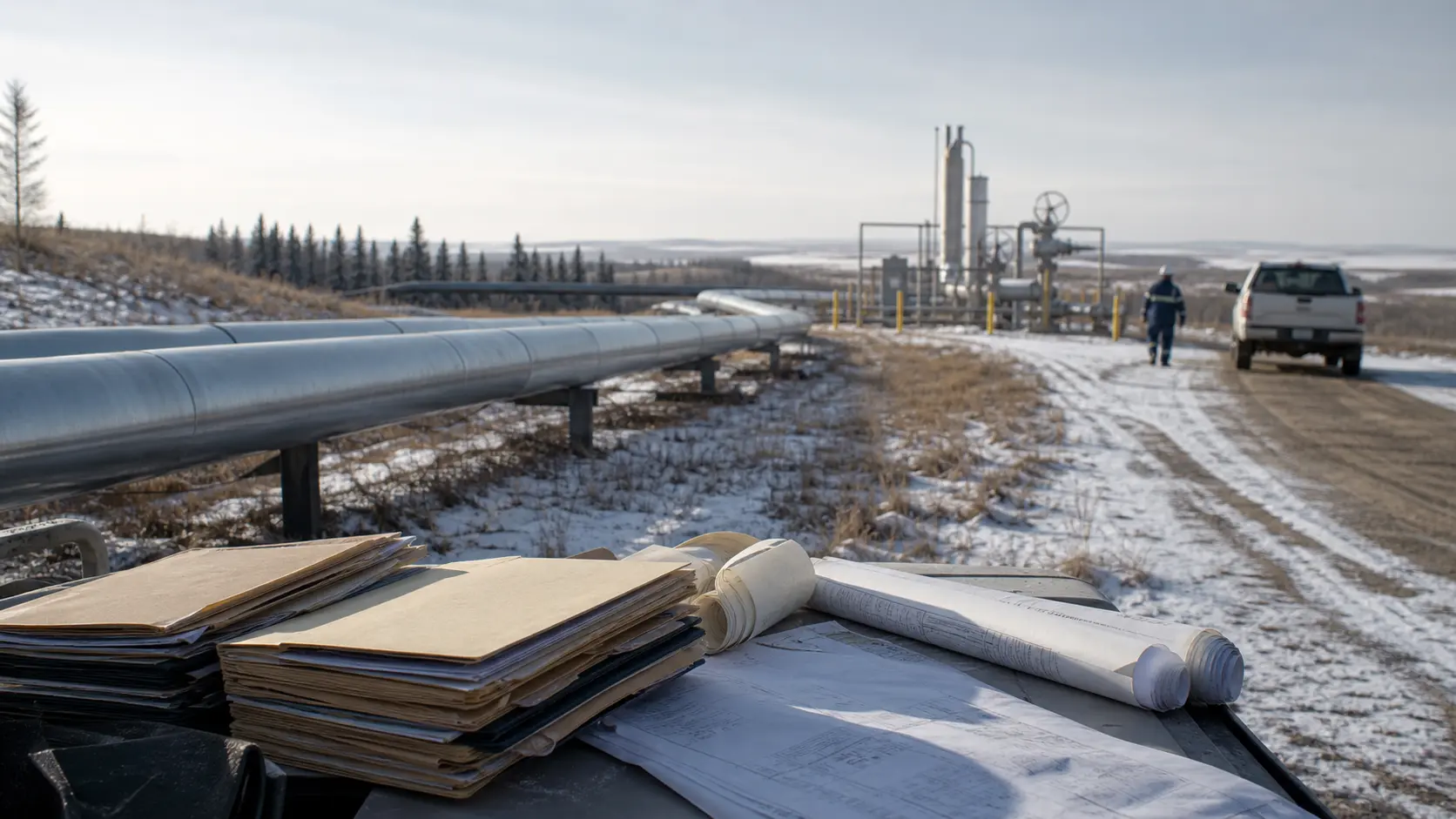
Summary
- TransCanada Pipelines Ltd. should be read as a legacy legal and operating boundary inside a much larger TC Energy infrastructure estate, not as proof that the old name maps cleanly to every current service outcome.
- The public evidence is strongest around regulated asset identity, Canadian Mainline history, tariff authority, route maps, CER profiles, and the 2014 Otterburne rupture report; it is weakest around private operational architecture, customer workflows, control-system design, and real-time data quality.
- The technology lesson is an entity-resolution problem at infrastructure scale: regulators, investors, shippers, emergency planners, and readers need one coherent record that survives name changes, holding-company structures, route reversals, toll settlements, incidents, and spinoffs.
Why the name is the first control surface
TransCanada Pipelines Ltd. looks, at first glance, like a stale company record. The public brand most readers know is TC Energy. The old TransCanada name was publicly de-emphasized when the company announced in 2019 that TransCanada Corporation would become TC Energy Corporation, a change presented as a better reflection of a North American energy infrastructure business spanning pipelines, power generation and energy storage.
A separate official history page adds another layer: in 2003, the public holding-company structure was changed so that TC Energy Corporation, then TransCanada Corporation, became the parent company of TransCanada PipeLines Limited. The same page says the change was legal and structural, while employees and day-to-day operations continued through TransCanada PipeLines Limited.
That history makes the directory entry useful, but also dangerous if it is read without context. The company name still appears in official and commercial places. Customer Express pages carry a 2026 copyright notice for TransCanada PipeLines Limited. The Canadian Mainline tariff page says TransCanada PipeLines Limited must file its tariff and amendments with the Canada Energy Regulator, and that the CER-filed documents are the conclusive official version if the website disagrees.
The Canada Energy Regulator's Canadian Mainline profile identifies the CER-regulated company for the pipeline as TransCanada PipeLines Limited and identifies TC Energy Corporation as parent company. In other words, the old name is not just an obsolete brand. It is a legal, regulatory, financial and operating reference that still matters.
The problem is that the name does not answer the operational question by itself. A directory row can say "TransCanada Pipelines Ltd." and "Company" with high confidence. It can say the record is connected to other infrastructure services. It cannot, by itself, prove which assets are active under that legal person, which systems are controlled through which operating unit, which contracts use which party name, which emergency process depends on which database, or which public metrics are current. The article therefore has to keep two ideas in view at once. The entity is real enough to preserve.
The entity is not enough to infer current service performance.
For technology-company coverage, that boundary is the story. Many data-infrastructure companies sell software that stores, transforms, retrieves, evaluates, or serves data for operational decisions. TransCanada Pipelines Ltd. is different: the "system" is an accumulated asset record around pipelines, compressor stations, tariffs, route maps, market connections, control data, incident reports, and corporate accountability. The value of that record is not a dashboard feature.
It is whether the right party can be identified when a regulator asks for a filing, when a shipper checks tariff authority, when a dispatcher reads operating status, when an incident report reconstructs pressure and valve state, or when a public reader tries to separate the Canadian Mainline from adjacent systems, former brands, and post-spinoff assets.
That is why this company belongs in a data-infrastructure frame despite being an energy infrastructure operator rather than a cloud service. The relevant data product is the continuity of the asset identity. If the identity is wrong, later data can look precise while pointing at the wrong owner, route, settlement, pipeline, or legal party. If the identity is right but the supporting public record is thin, readers still need a caveat. They need to know what can be verified from official sources, what is only a brand or registry signal, and what remains inside private operating systems.
What the public record can establish
The strongest public evidence begins with the Canadian Mainline. TC Energy's own Canadian Mainline page says the line carries natural gas from the Western Canadian Sedimentary Basin to markets in the Prairies, Eastern Canada, the Midwestern United States, and the Northeastern United States. The same page describes the system as more than 14,000 kilometres long and says it is governed by Canada Energy Regulator rules.
The CER profile gives the regulatory version of that identity: the TC Canadian Mainline extends from the Alberta-Saskatchewan border across Saskatchewan, Manitoba and Ontario, and through part of Quebec; it commenced operations in 1958; and its CER-regulated company is TransCanada PipeLines Limited.
That pairing is important. A company page tells a customer-facing infrastructure story. A regulator profile fixes the asset in a public oversight system. The two do not have to use exactly the same measurements or descriptive emphasis to be valuable. The company page is useful for service scope, maps and customer links. The CER page is useful for regulated ownership, history, route, market context, and official profile status.
Together they support a narrower claim than a marketing summary would: TransCanada PipeLines Limited remains a relevant regulatory identity for the Canadian Mainline, and the Canadian Mainline remains a major long-distance gas transmission asset linking western Canadian supply to eastern Canadian and U.S. markets.
The public record also shows why asset identity changes over time. The CER profile says the Mainline historically moved western Canadian gas east, but that growing Appalachian Basin production changed Canadian market dynamics starting in the late 2000s. Some eastern export points were modified to import U.S. natural gas. Niagara has imported gas since 2012 and Chippawa since 2015, according to that profile. This is not just a market footnote. It is a data-quality problem. A static "pipeline from west to east" description is no longer enough.
The same physical corridor can carry different market meanings as supply basins, border flows, storage hubs and downstream demand change.
Customer Express adds another layer. Its Canadian Mainline system map page points users to printed map sets and says comments on tariff and tolls documentation go to named TC Energy contacts or Mainline Rates. The tariff page says the CER-filed tariff is the official version if there is a discrepancy. That makes Customer Express a useful public workflow surface, but not the ultimate legal record. Any data system that copies tariff information from the website without preserving the CER authority caveat risks creating a neat but legally weak record.
TC Energy's reports-and-filings page confirms that reports for TransCanada PipeLines Limited remain part of the investor record and points readers to shareholder materials. The SEC-hosted 2025 Annual Information Form for TC Energy gives additional context around the continuing business, including financial and operational performance, risks around outages and asset utilization, pipeline integrity and reliability, capital costs, regulatory outcomes, and broader market conditions. It also records recent business developments in natural gas pipelines, including NGTL expansion work and U.S. pipeline projects.
The AIF is not a technical architecture document, but it is a useful market and governance source because it shows the categories management treats as material: reliability, outages, regulation, market demand, capital allocation, and performance of pipeline, power and storage assets.
The South Bow spinoff page shows another reason legacy identity records matter. TC Energy says South Bow legally separated on October 1, 2024, creating an independent public company for liquids pipelines while TC Energy continued with natural gas, natural gas storage, and power and energy solutions. That separation does not erase the historical TransCanada record. It increases the burden on readers and systems to distinguish natural gas assets, former liquids assets, current parent-company disclosure, and legacy legal names.
A data record that simply sees "TransCanada" and treats all pipeline history as one current operating basket will mislead.
The public record therefore supports a careful article, not a broad product verdict. It can establish that TransCanada PipeLines Limited is still a meaningful name in official pipeline and tariff contexts. It can establish the Mainline's regulated identity, route, operating history and market shifts. It can establish that TC Energy's natural gas network is large, that NGTL and other systems connect to the Mainline, and that corporate restructuring and spinoffs change the way evidence must be interpreted.
It cannot establish the private design of TC Energy's operational databases, SCADA systems, internal access controls, shipper portals, incident-response tools, or data-governance practices.
The asset record is the infrastructure product
The technology question for this company is not whether TransCanada Pipelines Ltd. offers a modern analytics platform. The question is whether the public and regulated asset record remains coherent enough for repeated operational decisions. That includes commercial decisions by shippers, regulatory decisions by the CER, public-safety decisions by emergency planners, investment decisions by analysts, and editorial decisions by a directory trying to connect a legacy company name to current infrastructure evidence.
In a software company, a database schema might define customers, accounts, regions, products and events. In a pipeline company, the equivalent objects are pipelines, laterals, compressor stations, valves, delivery points, receipt points, storage interconnects, tariffs, toll settlements, safety reports, regulatory folders and emergency contacts. Some of those objects are physical, some are legal, some are commercial, and some are operational. They age at different speeds.
Pipe installed in the 1950s can still be in service, while a tariff settlement may cover a six-year commercial period and an investor presentation may be replaced every quarter.
That creates a failure path familiar to anyone who operates data infrastructure. Stale records create wrong routing. Broken lineage hides which source is authoritative. Permission leakage exposes more than a user needs. Retries and partial state can leave a workflow believing an update succeeded when only one record changed. Cost overruns appear when manual reconciliation becomes the only way to answer basic questions. In the TransCanada case, the analogue is not a failed ETL job in a warehouse.
It is a public or internal record that cannot explain whether "TransCanada Pipelines Ltd.", "TransCanada PipeLines Limited", "TransCanada Corporation", "TC Energy Corporation", "TC Canadian Mainline", "Canadian Mainline", "NGTL", "TQM" and "South Bow" refer to the same party, an affiliate, a parent, a former brand, a specific asset, or a separated business.
The company-facing sources show some of that complexity. TC Energy's home page describes a natural gas pipeline network of about 94,000 kilometres and says its infrastructure transports about 30 percent of North American natural gas consumption. Customer Express describes TC Energy Corporation as having a large natural gas system and also describes storage capacity. The natural gas operations page lists several systems, including ANR, Bison, Northern Border, Canadian Mainline and Coastal GasLink.
The NGTL page says NGTL spans more than 24,000 kilometres and connects growing supply in northeast British Columbia and Alberta, including links to the Canadian Mainline, Foothills and third-party pipelines. The Trans Quebec & Maritimes page says TQM is jointly owned by subsidiaries of Energir and TC Energy, operated by TC Energy, and supplies residential, commercial and industrial customers in Quebec and downstream markets.
Those statements are not interchangeable. Some describe TC Energy at group level. Some describe wholly owned or partially owned systems. Some describe a pipeline regulated by the CER. Some describe joint ownership and operation. Some describe routes and physical length. Some describe service reach. A good asset record must preserve these distinctions. If it collapses them into one "TransCanada" bucket, it will overstate what the legacy company name proves. If it splits them too aggressively, it may lose the continuity needed to understand how the Mainline connects into a broader gas transmission estate.
This is entity resolution with public consequences. In ordinary commercial data, a duplicated customer record might cause billing annoyance or reporting noise. In infrastructure data, a duplicated or stale entity record can distort risk assessment. A regulator may need to know which company is responsible for a filing. A landowner may need to find the right emergency number. A market analyst may need to separate natural gas pipeline economics from liquids pipeline spinoff effects. A local distribution company may need tariff certainty rather than brand history.
A public directory may need to link a legacy entity to one or more articles without pretending the article itself is the object.
The article therefore treats the asset record as a control surface. It matters because infrastructure accountability depends on repeatable answers to basic questions: what is the asset, who is the regulated company, which parent owns it, which routes and interconnects are covered, which tariff is official, which incident reports apply, which public documents are current, and which claims are only marketing or investor shorthand. The more mature the infrastructure, the more likely those answers depend on records created across several decades, not one modern product page.
The Canadian Mainline record shows a mature data problem
The Canadian Mainline is the clearest place to see this problem because the public evidence is relatively rich. TC Energy's page gives a commercial and operational summary. The CER profile gives a regulatory summary. Customer Express gives customer-facing maps, tariff information and emergency contacts. The 2021-2026 Mainline settlement announcement gives a commercial framework. The Transportation Safety Board report gives incident reconstruction. Each source is useful; none is complete by itself.
The Mainline settlement is a good example of why a record has to retain commercial time. TC Energy announced in December 2019 that it had reached a long-term toll settlement with customers on the Canadian Mainline. The agreement covered January 2021 through December 2026, set an equity return of 10.1 percent on 40 percent deemed common equity, set tolls for separate Mainline segments, included a reduction for the western portion from Empress to Emerson, and added mechanisms for cost efficiencies, revenues and pricing flexibility.
TC Energy's Canadian Mainline page later notes that the Mainline operates under fixed tolls negotiated in the 2021-2026 settlement, ending December 31, 2026.
For a data system, that is a time-bounded commercial state. It cannot be treated as permanent. A record built in 2024 may correctly say the settlement is current. The same record in 2027 needs a new status. If the source is copied once and never revalidated, the page may look accurate while its commercial meaning expires. That is the same pattern that breaks cloud cost dashboards, compliance registers and contract repositories: the data is not false because it was invented; it becomes false because it was left alive after its validity window.
The Mainline's physical and market history creates a second data problem. The CER profile says the pipeline entered service in 1958 and was built to transport gas produced primarily in Alberta and British Columbia. It also says that eastern export points were modified as Appalachian Basin production changed flows. The profile lists connections to Dawn, Iroquois, TQM, Great Lakes and other systems. This means the record cannot be only a straight route description. It must capture flow direction, interconnects, storage, downstream markets and historical change.
Route maps add a third problem. Customer Express map pages are useful for human review, but they are not a substitute for structured regulatory data. Maps can show corridors and connections, but they are often published as printable artifacts. If a user wants to compare them against CER map data, route attributes, settlement terms, emergency contacts and tariff language, the work becomes manual unless the organization has a disciplined internal asset model. The public evidence does not reveal TC Energy's internal model. It does reveal why such a model is necessary.
The tariff authority caveat is the fourth problem. Customer Express says every effort has been made to ensure website accuracy, but the CER-filed tariff is conclusive in the event of a discrepancy. That sentence is easy to overlook. It is also the kind of sentence that keeps a data workflow honest. The website is a convenience layer. The regulator filing is the authority layer. A mature system would preserve that lineage in every downstream view: source, date, authority, last checked, affected segment, and status. Without that, a shipper-facing or public-facing copy can drift from the legal version.
The fifth problem is vocabulary. The public sources use "TC Canadian Mainline", "Canadian Mainline", "TransCanada PipeLines Limited", "TCPL", "TC Energy Corporation" and related pipeline names. A reader can make sense of that with effort. A database cannot rely on effort. It needs canonical identifiers, alias tables, parent-child relationships, effective dates and source-specific labels. That is what makes this a technology story: the old name is not a curiosity. It is an identifier whose correct handling determines whether the rest of the record is usable.
NGTL and TQM widen the operating surface
The assignment asks for a legacy-entity boundary analysis rather than a simple company profile, and the surrounding systems show why. NGTL is a TC Energy natural gas system, not the Canadian Mainline, but its public profile is closely relevant because it receives and moves western Canadian supply that can connect to the Mainline and export markets. TC Energy's NGTL page says the system spans more than 24,000 kilometres and connects supply in Alberta and northeastern British Columbia with the Canadian Mainline, Foothills and third-party pipelines.
The CER's NGTL profile says NGTL added facilities to increase capacity and relieve bottlenecks, and it describes expansion projects, capital costs, pipeline loops, compressor additions and capacity increases.
For this article, NGTL is not evidence that TransCanada Pipelines Ltd. operates every related system under one unchanged legal boundary. It is evidence that the Mainline record lives inside a network of connected systems whose operational and commercial state changes over time. A technical reader should care about that distinction. If an article or database treats NGTL as proof of a Mainline service outcome, it will overreach. If it ignores NGTL entirely, it will miss how supply, capacity and market access affect the Mainline's role.
TQM creates a similar lesson on the downstream side. TC Energy's TQM page says the Trans Quebec & Maritimes system has operated since 1982, is equally owned by subsidiaries of Energir and TC Energy, is operated by TC Energy, includes delivery points, compressor stations and storage interconnections, and is regulated by the CER for transportation tolls and facilities. That sentence alone contains several relationship types: ownership, operation, interconnection, customer supply, regulator oversight and physical assets. A flat "related company" field cannot represent it well.
From a data-infrastructure perspective, these systems show why legacy pipeline records need relationship discipline. A relationship can be "owned by", "operated by", "regulated by", "interconnects with", "supplies", "receives from", "files tariff with" or "has settlement approved by". Those are not decorative differences. They decide what can be inferred. Operation does not always equal ownership. Parent company does not always equal regulated company. Interconnection does not mean control. A route connection does not prove a commercial service.
A public map does not prove current physical flow at a given point.
This is also where the article must avoid overclaiming on technology. Public sources identify SCADA in the Transportation Safety Board report for the 2014 rupture, but they do not disclose the current control architecture for TC Energy's Canadian natural gas systems. They do not reveal data retention policies, historian configuration, alarm-management logic, access-control architecture, network segmentation, or internal incident tooling. It would be improper to fill those gaps with generic pipeline assumptions.
The correct conclusion is narrower: the public record proves that supervisory control data was part of at least one incident reconstruction, and the scale and regulatory context make control data central to accountability, but public sources do not permit a product-style assessment of TC Energy's control systems.
That limitation matters commercially. In a software procurement review, a buyer might ask whether storage, compute, migration cost, lock-in and data-quality labour beat the current stack. Here the comparable question is whether the asset-record system reduces reconciliation labour for regulators, customers and internal teams. Does the record make it easy to distinguish parent, subsidiary, pipeline, segment, tariff, settlement and incident? Does it preserve source authority? Does it flag stale pages? Does it connect maps to structured assets?
Does it identify which public claim came from a company page, a CER profile, a regulatory filing, an investor disclosure or an accident report? The public record lets an outside reader ask those questions. It does not let the reader grade TC Energy's internal answer.
Incident evidence shows why lineage is not optional
The Transportation Safety Board of Canada's report on the January 25, 2014 Otterburne rupture is the strongest public test-evidence source in this pack because it reconstructs a real operating event under the TransCanada PipeLines Limited name. The report says a natural gas rupture and ignition occurred on Line 400-1 at Mainline Valve Site 402 near Otterburne, Manitoba. It describes a crater, debris, a fire lasting about 12 hours, evacuation of five nearby residences, closure of Provincial Highway 303, no injuries, and temporary loss of natural gas service to nine rural communities for about 80 hours.
It also says the Mainline system had been operating normally before the occurrence and cites daily average SCADA data for operating pressure.
This is not evidence for a current incident rate or a current safety score. It is evidence of the kind of data an accountability record must preserve. The report connects legal party, line number, valve site, location, operating pressure, maximum operating pressure, flow status, closed valves, weather, emergency measures, affected communities, restoration timing and investigation purpose. Any one of those facts can drift if records are separated from their source. A generic "pipeline rupture" entry without line, valve, company, pressure context and restoration evidence would be far less useful.
The report is also useful because it separates operational state from simplistic assumptions. The gas had not been flowing through Line 400-1 since January 5, 2014 because of lack of customer demand, but static pressurized gas was present between closed valves. That is an important lesson for public infrastructure data. A line can be "not flowing" and still contain energy. A route can be inactive in a commercial sense at a moment while still requiring safety accountability. A map can look dormant while the operating condition remains material.
The emergency response details show another data requirement. The report says adjacent lines were shut down, assessed and returned to service, and that compressed natural gas was trucked to local hospitals and emergency shelters. That sequence is not just a human-interest detail. It shows why incident data has to connect operating decisions to community continuity. The public need is not merely to know that a rupture occurred. It is to know which communities were affected, how long service was interrupted, what temporary measures were used, and when normal delivery resumed.
For entity resolution, the TSB report is especially valuable because it names TransCanada PipeLines Limited in the title and body. It anchors the legacy name to a specific regulated operating event, not just a corporate history. That does not mean the current company should be judged only by a 2014 incident. It means a record that drops the TransCanada PipeLines Limited name as "old branding" loses safety-relevant history. Conversely, a record that treats the old name as if nothing changed after 2014 ignores restructuring, current TC Energy disclosures, the South Bow spinoff, and later regulatory updates.
The report's use of SCADA data also clarifies what can and cannot be said about technical systems. It is fair to say that supervisory control data formed part of the investigation record. It is not fair to infer the design, vendor, cybersecurity posture or current architecture of TC Energy's SCADA environment from that report. The evidence stops at the report's facts. The public article should stop there too.
What cannot be established from the open record
The evidence pack is useful, but it is not a lab test. No private shipper account, customer portal, control room system, operational historian, incident-management system, access-control directory, GIS database, document-management repository, or internal API was tested. No employee or customer interview was conducted for this article. No claim is made about live query latency, live pipeline control, current alarm response, current cybersecurity controls, private data quality checks, or actual storage and compute costs. The public sources do not support those claims.
The identity record is also uneven. The BTW directory page for TransCanada Pipelines Ltd. is thin. It preserves the display name, legal name, legal type and company category, but its public geography and infrastructure-service fields are not enough to support operational claims. That is why the article relies on official TC Energy pages, CER profiles, Customer Express, SEC filings and the TSB report rather than treating the directory row as substantive evidence.
There is also a spelling and naming issue. The assignment uses "TransCanada Pipelines Ltd." The regulator and official sources frequently use "TransCanada PipeLines Limited" or "TCPL." The article preserves the assigned directory title while using the official forms where the source does. That is not cosmetic. A strict data system would store these as aliases or label variants with source provenance, not silently normalize them into one string. Silent normalization makes search easier but can damage legal accuracy.
Market evidence is also bounded. TC Energy's investor pages and AIF show the company presenting itself as a long-life infrastructure operator with a large natural gas portfolio, material capital programs, and risks around outages, regulation, market conditions, reliability and asset performance. Those are market signals, not proof of service quality for a particular shipper or community. AIF risk language is designed for securities disclosure. It is valuable because it identifies risk categories management considers relevant, but it is not an independent operational audit.
Independent evidence is thinner than official evidence in this pass. Global Energy Monitor provides a useful secondary summary of the Canadian Mainline's location, history and the Otterburne incident, but the stronger facts in this article come from CER, TSB and TC Energy sources. That means the article should not pretend to have a broad independent technical benchmark. It should say the available open record is strongest for identity, regulation and historical incidents, and weakest for private architecture and customer outcomes.
Finally, the public record does not answer the commercial question in the way a software buyer might want. It cannot tell whether a new data stack would reduce storage, compute, migration, lock-in and data-quality labour versus TC Energy's current internal systems. It can only show where that labour would appear: corporate-name reconciliation, asset alias management, regulatory-source lineage, map-to-asset matching, tariff version control, incident evidence retention, interconnect modelling, and public-facing caveat management.
The practical test: can a record survive a rename, a reversal and a rupture?
A useful way to judge the TransCanada Pipelines Ltd. record is to ask whether it survives three stresses: rename, reversal and rupture.
The rename stress is obvious. The public brand became TC Energy, while TransCanada PipeLines Limited remained a relevant legal and regulatory entity. A robust record must preserve both without treating one as an error. It should know that TC Energy Corporation is the parent-company frame for investors and many current pages, while TransCanada PipeLines Limited appears in tariff and regulatory contexts. It should preserve the 2003 holding-company change and the 2019 name-change announcement as separate events.
It should also reflect that the 2024 South Bow spinoff changed the current scope of TC Energy's liquids and natural gas businesses without deleting the older TransCanada history.
The reversal stress comes from market flows. The Mainline was built to move western Canadian gas east, but CER notes that Appalachian production changed market dynamics and that some eastern points became import points. A robust record must be able to represent historical design and current market function at the same time. It should not freeze the system in its 1958 purpose. It should not collapse direction, interconnect and market into a single static field. It should support effective dates, route segments and flow status when evidence exists.
The rupture stress comes from Otterburne. A robust record must preserve line, valve, location, pressure, flow, emergency actions, community impact and source authority. It must also separate an incident investigation from a general performance rating. A public article can learn from the 2014 rupture without using it as a substitute for current operational testing. The test is whether the historical incident remains linked to the correct entity and asset, not whether it becomes a rhetorical shortcut.
These three stresses reveal the core technology requirement: the record must be governed. It needs versioning, source provenance, alias control, relationship types, expiration dates, regulatory authority markers and uncertainty labels. It needs to distinguish internal convenience pages from official filings. It needs to keep old names searchable without letting them overwrite current context. It needs to surface caveats to readers rather than bury them in notes.
That is also the useful editorial position for BTW's directory. The directory should preserve TransCanada Pipelines Ltd. as an entity because the name still appears in official and operating contexts. But the article should not turn the directory entity into a broad directory profile, a relationship graph, or a claim that every TC Energy asset belongs to the legacy row. The article is a supplement: it explains why the record matters, what public evidence supports it, and where the evidence ends.
Where the data work would sit
If an infrastructure team were trying to turn this public evidence into a maintained record, the work would not begin with generative prose. It would begin with a source model. Each claim would need a source URL, source type, date checked, authority level, affected asset, effective period, and confidence. The Canadian Mainline page would be a company source. The CER profile would be a regulatory source. The Customer Express tariff page would be a customer-facing source with an explicit official-version caveat. The TSB report would be an investigation source. The AIF would be a securities-disclosure source.
The South Bow page would be a corporate-structure source.
The entity model would need a canonical company row for the directory identity, aliases for TransCanada PipeLines Limited and TCPL, links to TC Energy Corporation as parent context, and careful boundaries around systems such as Canadian Mainline, NGTL and TQM. It should not create durable relationship or event edges merely because an article mentions them. It should record candidate relationships with provenance and send them through a directory workflow if they need to become canonical.
The asset model would need route and system identifiers, not just names. "Canadian Mainline" should not be a free-text phrase scattered across pages. It should be an asset with route description, regulator profile, source links, related map pages, tariff surface, settlement context and incident links. NGTL and TQM should be separate systems with their own ownership and operation facts. Interconnects should be relationships with types, not prose decorations.
The commercial model would need temporal fields. The 2021-2026 Mainline settlement has a beginning and end. Tariff documents can be amended. Quarterly and annual reports change. Spinoff effects have dates. A data record that does not track time will either become stale or overwrite history. The right design is not to choose one truth forever; it is to let a user ask what was true at a given date and what source supported it.
The control and safety model would need even stricter caveats. Public evidence can record that SCADA data appeared in the TSB report for the 2014 rupture. It cannot describe current control architecture. Public evidence can record emergency contacts from Customer Express. It cannot prove current internal incident-response workflows. Public evidence can record official report findings and service interruption details. It cannot compute live reliability metrics. Any system that blurs those boundaries would produce confident but unsafe intelligence.
This is where data-quality labour shows up. Someone has to reconcile names, validate sources, update expired settlements, check that maps still resolve, distinguish company copy from regulator filings, and keep incident evidence attached to the right asset. Automation can help, but only if it is governed by source-aware rules. A large language model can summarize evidence, but it should not be allowed to turn a thin source into a definitive operating claim. For this company, the public value lies in disciplined uncertainty, not in filling gaps.
Why the legacy record still matters
It would be tempting to dismiss TransCanada Pipelines Ltd. as a historical shell and write only about TC Energy. That would be simpler, but it would lose useful accountability. The legacy name still appears in official tariff context, regulator profiles and incident records. It is part of the chain that links a modern infrastructure group to a specific regulated pipeline history. Removing it from a directory would make search cleaner at the cost of historical and legal resolution.
It would also be tempting to do the opposite and treat TransCanada Pipelines Ltd. as the active face of everything in TC Energy's current natural gas business. That would be inaccurate. The public sources show a broader parent company, multiple systems, joint ownership cases, a separated liquids business and changing market flows. The legacy entity is an important boundary, not a universal owner label.
The balanced reading is more useful. TransCanada Pipelines Ltd. is a durable record key. It helps readers connect the Canadian Mainline's regulatory identity, Customer Express tariff language, corporate restructuring, and incident history. Its value is strongest when it is attached to source-backed claims and uncertainty labels. Its value is weakest when it is used as shorthand for private systems that outsiders cannot inspect.
For technology readers, the lesson extends beyond pipelines. Critical infrastructure depends on records that outlive products, rebrands and management cycles. Names change. Parent companies restructure. Assets are spun off. Routes reverse. Settlements expire. Incidents reveal hidden dependencies. Regulators keep official files while companies publish convenience layers. The organizations that manage this well do not merely store documents; they maintain identity, lineage and authority.
That is the technology-company angle for TransCanada Pipelines Ltd. The "product" under review is not an app. It is the reliability of a public and regulated memory. The open evidence says that memory is substantial enough to preserve, but not complete enough to overstate. A high-quality record should tell readers why the legacy name matters, where TC Energy's current structure changes the interpretation, which assets are actually evidenced, and which operational claims remain unavailable without private access.
The final answer, then, is deliberately constrained. TransCanada Pipelines Ltd. matters because legacy infrastructure accountability depends on names that still bind filings, tariffs, maps and incident records together. It should not be inflated into a product benchmark or a live systems audit. The evidence supports a strong entity-boundary article, not a private-architecture verdict. That distinction is the difference between useful intelligence and a tidy but misleading company profile.