
Summary
- APNIC's published record for its 2001 Executive Council election separated 210 valid ballots from eight late, four ambiguous and two blank ballots. Officials said the rejected ballots would not alter the winners, yet volunteers still recommended clearer deadlines, markings and handling rules.
- Outcome materiality and institutional materiality are different tests. A rejection can be too small to change a seat while still exposing avoidable language, interface, credential, timing or assistance failures.
- Digital voting does not abolish invalidity. It often moves failure earlier, into abandoned logins, expired credentials, unsupported devices, incomplete submissions and help requests that never become certified ballots.
- Registries should publish a privacy-preserving invalidity taxonomy, channel and denominator, cure rules, assistance logs, trend comparisons and a response plan. The objective is not to make every attempted mark count, but to make every exclusion explainable.
The ballots that disappeared from the result
Election reports train readers to look upward. The eye goes to the winner, the vote total and the margin. Beneath those lines sits a smaller category that is commonly treated as residue: invalid, blank, late, ambiguous, rejected or not counted. If the number is below the winning margin, the institution often considers the question finished. The rejected ballots could not have changed the declared result, so they are said to have had no effect.
That conclusion answers one question and evades another. It may establish that the same people would have won under a stated arithmetic assumption. It does not establish that voters understood the ballot, that deadlines were usable across the service region, that credentials reached the right representatives, that accessibility needs were met, or that administrators applied validation rules consistently. A spoiled ballot is an outcome variable. It records contact between an elector and a rule that prevented the attempted vote from becoming part of the result.
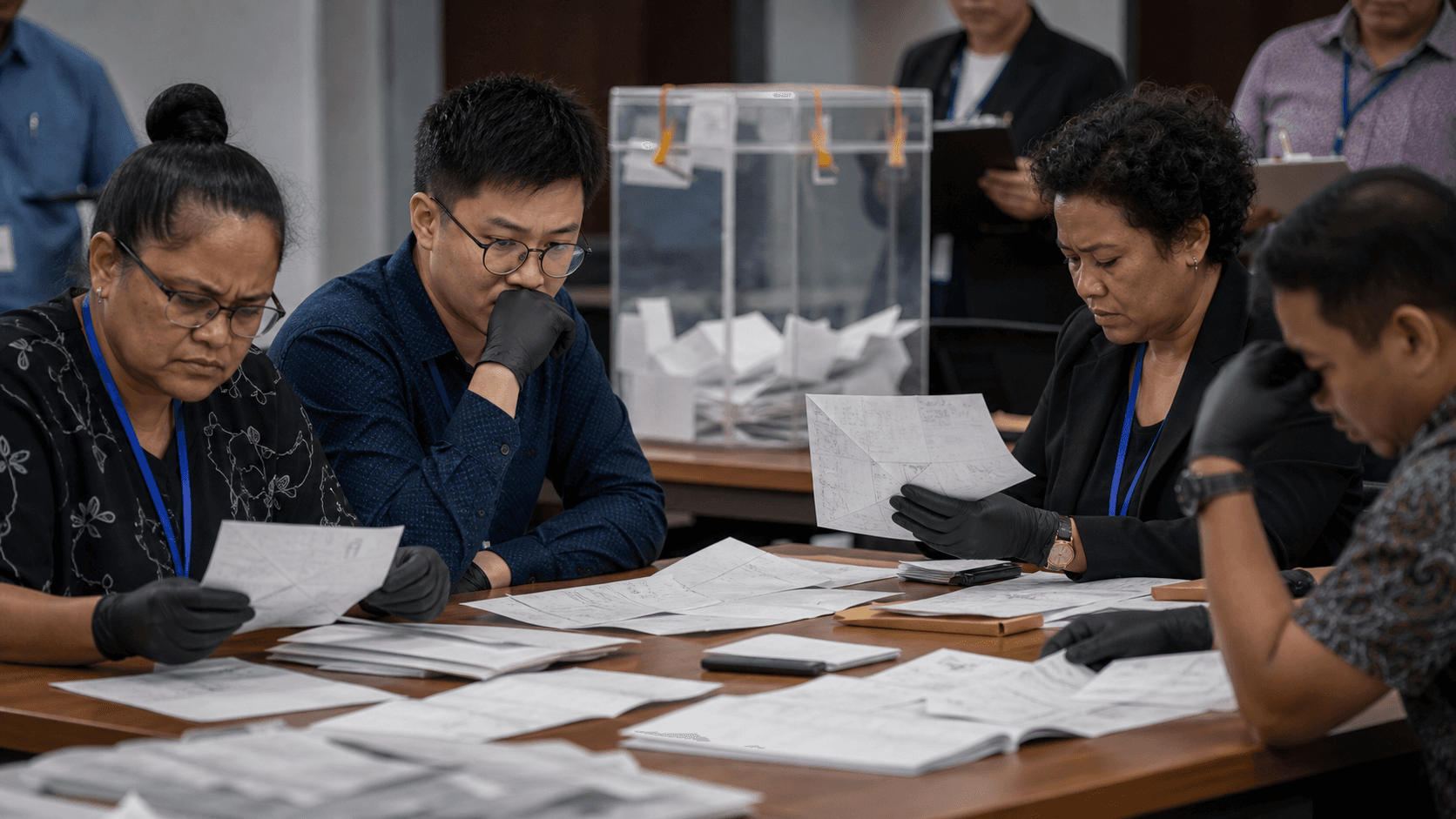
The clearest historical example is unusually modest. The minutes of APNIC's 2001 member meeting report 210 valid ballots, eight late ballots, four ambiguous ballots and two blank ballots in the Executive Council election. The record says the excluded ballots would not have altered the overall result. It then records recommendations from volunteers: additional marks should invalidate a ballot, the deadline should appear on the ballot and ballot box, late votes needed a clear policy, and volunteers should join the process from its beginning.
Those recommendations are more important than the comfortable margin. They show election workers reading rejection as evidence about design. Eight people reached the election but missed its temporal rule. Four produced marks that officials could not confidently translate into choices. Two submitted nothing that could be counted. None of those facts proves exclusion or incompetence. Together, they identify questions that a result table alone cannot answer.
A spoiled ballot is a decision, not a natural entity
Ballots do not spoil themselves. An institution defines the conditions under which a mark, ranking, credential or submission becomes invalid. Some conditions are essential. A person cannot select more candidates than the number of seats where the voting rule prohibits it. An unauthenticated submission cannot safely enter a secret count. A paper without an official validation mark may be indistinguishable from an unauthorised copy. A vote cast after a published close cannot normally be accepted without changing the election for everyone.
Yet each exclusion still contains a human decision. Someone chose the wording of the instructions, the number of permitted selections, the visual arrangement, the deadline, the time zone, the authentication method and the consequence of an error. Someone decided whether a voter could correct a ballot before final submission. Someone set the evidentiary standard for a damaged paper or interrupted session. The invalid category is therefore not a neutral fact found in nature. It is the result of applying institutional rules to human behaviour.
APNIC's earlier procedure presentation made that construction visible. It listed a paper ballot as invalid if no boxes were marked, more than four boxes were marked, the marking was ambiguous, or the paper lacked a validation stamp. These reasons should not be collapsed. Marking five names is an overvote. Drawing an unclear line is an interpretation problem. Leaving the page blank may be intentional abstention, confusion or protest. Missing a stamp may be voter error, official error or a custody problem, depending on who controlled validation.
The remedy follows the cause. Better instructions may reduce overvotes. A ballot design that makes the maximum selections visually obvious may prevent ambiguity. A formal abstention option can distinguish deliberate non-choice from accidental blankness. A validation stamp controlled by officials requires reconciliation of issued and stamped papers, not a lecture to voters. If an institution reports only “fourteen invalid,” it destroys the information needed to choose among those responses.
Outcome materiality is not institutional materiality
Election adjudication properly asks whether a defect could affect the result. Without a materiality threshold, trivial mistakes can become tools for endless challenge. If fourteen rejected ballots exist and the smallest decisive margin is hundreds of votes, a demand to reverse the winners requires more than speculation. Arithmetic protects stability and respects valid voters whose choices should not be discarded casually.
But institutional review needs a second threshold. A defect is institutionally material when it reveals a recurring, unequal or preventable barrier, even if it is not outcome-determinative in the present contest. One inaccessible entrance matters even when the excluded voter could not change the result. A credential message sent only in one language matters even if affected members happened to support losing candidates. A deadline that predictably fails in particular time zones matters even in a landslide.
This distinction prevents two opposite errors. The first is catastrophism: treating every invalid vote as proof that an election is illegitimate. Rejection can be proper, evenly applied and unavoidable. The second is complacency: treating a safe margin as proof that the process worked. A large margin can coexist with systematic friction. Indeed, a dominant candidate can conceal process weakness because no single error appears capable of changing the winner.
An election report should therefore state both findings. It may say that excluded ballots were fewer than the relevant margin and could not alter the declared seats under the applicable count. It should separately say whether the pattern requires correction before the next election. The first statement protects the result. The second protects the institution. Combining them into “no impact” falsely implies that governance has nothing left to learn.
Late ballots measure the institution's clock
Late ballots look like the easiest category. A deadline is a deadline; accepting votes afterward treats punctual voters and candidates unfairly. That principle is sound, but the count of late attempts still measures the quality of the institution's clock. The relevant inquiry is not whether officials should secretly extend voting for friends. It is whether the announced close was unambiguous, consistently displayed and operationally reachable.
Regional registries serve territories spanning many time zones and working cultures. A date without a zone is defective. A zone abbreviation may be unfamiliar or ambiguous. A meeting-local deadline can fall in the night for remote members. Daylight-saving changes can surprise voters far from the meeting city. Communications may use one time while the voting platform displays another. None of this entitles a person to vote indefinitely. It does make late-attempt data a test of whether the rules were designed for the electorate the institution claims to serve.
Timing also begins before the close. A voter may receive credentials late because the member's designated contact was stale. A replacement request may wait through office hours in another region. A system may be unavailable near the deadline, or an identity check may require documents that cannot be obtained over a weekend. The final timestamp records lateness but not its cause. A serious review reconstructs the sequence: notice sent, credential delivered, first login, support request, response and attempted submission.
The 2001 APNIC volunteers understood the importance of visible time. Their recommendations included placing the deadline prominently on the ballot box and establishing a clear policy for late votes. That is not softness toward rules. It is the discipline required to enforce them fairly. A deadline earns legitimacy when a reasonable eligible voter can discover it, convert it and act before it expires.
Ambiguity is often designed into the page
Officials sometimes speak of an ambiguous ballot as though the voter introduced ambiguity into an otherwise perfect instrument. The page may tell a different story. Candidate names can be crowded. Selection boxes can sit between lines. Instructions can use legal language unfamiliar to network engineers. A preferential ballot can fail to explain whether repeated rankings, skipped ranks or a single marked preference remain valid. A multi-seat election can fail to distinguish “up to four” from “exactly four.”
Good ballot design does not remove judgment, but it reduces the situations in which officials must infer intent. The maximum number of choices should be stated where choices are made, not only in a separate guide. Spacing should make each mark belong unmistakably to one candidate. A review screen should identify an overvote before submission without showing how to vote. A paper correction method should be announced in advance. Accessibility testing should include screen readers, keyboard navigation, colour contrast and zoom.
Language is part of this design even where an organisation has an official operating language. An official language may govern the authoritative text; it does not prevent plain-language explanations or carefully labelled translations. The voting act often involves people who use English professionally but do not parse election idiom daily. “Rank in order of preference,” “select no more than,” “abstention,” and “spoilt” can carry technical consequences not obvious from conversational fluency.
An ambiguity audit should use actual rejected patterns stripped of identifying information. If many voters made the same extra mark, officials should suspect the page before blaming individuals. If ambiguity clusters around one translated instruction or device layout, the remedy is targeted. If every rejection is unique and rare, the current design may be reasonable. Evidence allows the institution to distinguish those cases.
Blankness has more than one meaning
A blank ballot is easy to count and difficult to interpret. It may express rejection of every candidate. It may be an intentional act of abstention designed to register presence without preference. It may result from a voter believing that opening or submitting the page was enough. It may be a technical failure in which selections were not saved. On paper, a blank may even reflect an official issuing a ballot that was never privately marked but later entered the box accidentally.
Institutions should not assign motives they cannot observe. Calling all blanks protest votes romanticises error; calling all of them mistakes erases dissent. The design can create better evidence. A separate “abstain” or “none of the candidates” option, where compatible with the counting rule, lets voters make non-choice explicit. A confirmation screen can warn that no selection has been recorded and permit either return or intentional blank submission. The final report can then separate explicit abstentions from ballots containing no valid preference.
That separation matters for legitimacy. A high abstention count may signal dissatisfaction with the slate, not confusion about the interface. It can inform nomination reform without changing who won. A high accidental-blank rate may point to a broken submission sequence. In a digital system, the distinction must be implemented without linking identities to choices. Aggregate event counts and independent testing can show whether empty submissions occurred while preserving secrecy.
Blankness also tests whether election reporting values voter intent beyond winner selection. Corporate elections often treat abstention as nothing because it does not help a candidate. Yet a member who appears, authenticates and deliberately declines every option has supplied governance information. A mature institution records that signal without exaggerating it into a veto.
The validation failure may belong to the official
Some invalidity categories are presented as defects in the ballot but originate in administration. APNIC's historical paper rule treated absence of a validation stamp as invalid. That may be necessary to prevent duplication. It also creates a control whose failure can disenfranchise a voter even when the voter follows every visible instruction. The central question becomes who applied the stamp, how issuance was logged and whether a missing mark could be cured before the ballot entered the anonymous count.
The same problem appears digitally. A credential can be generated incorrectly, sent to an obsolete address, attached to the wrong voting contact or rejected after a membership record changes. An authentication service can time out after choices are made. A browser can display success before the server commits the submission. The person experiences a vote; the election database experiences no valid ballot. Calling the result “invalid voter action” would misdescribe the event.
Administrative invalidity demands reconciliation. The institution should know how many voting rights existed, how many credentials were issued, how many were delivered, how many were activated, how many final submissions were accepted and how many support cases alleged a missing vote. These totals need not expose identities or candidate choices. They should be tested by an independent person with access to event logs and membership records.
Cure rules must be written before the contest. If an unstamped paper is identified before entry into the box, can officials verify issuance and validate it in front of observers? If a credential fails before the deadline, can a replacement be issued while cancelling the first? If the system reports no final submission, can a voter try again? Predetermined answers reduce the temptation to help allies and obstruct opponents.
Digital voting hides the spoiled ballot upstream
Electronic interfaces can prevent classic paper errors. A system can block too many selections, require confirmation and reject an incomplete ranking before it is cast. The certified tally may then report zero invalid ballots. That is an achievement, but it does not mean every eligible attempt succeeded. Digital invalidity often moves from the ballot box to the path leading to it.
A member may never receive the email. A security filter may quarantine it. Two codes may arrive through channels the voter cannot reconcile. A mobile browser may fail to populate a field. The RIPE NCC's November 2023 General Meeting transcript illustrates the practical detail required: voters were told they would receive two messages, use two codes, check spam, and copy a code manually if a mobile Safari field did not populate. Those instructions are evidence of attentive support. They also show how many opportunities exist for a valid elector to disappear before the count.
The useful digital categories include undelivered credentials, failed authentication, locked accounts, abandoned sessions, prevented overvotes, attempted submissions after close, server errors, duplicate-credential cancellations and support cases unresolved by the deadline. These events are not votes and should never reveal selections. They are participation evidence. A zero-invalid certified tally without these surrounding measures can be less informative than an old paper count that openly listed blanks and ambiguities.
Privacy is manageable. Administrators can publish aggregates, rates and trends, suppress tiny geographic cells, and have an independent reviewer inspect detailed logs under confidentiality. The objective is not surveillance of hesitant voters. It is to discover whether the technology converted eligible intent into accepted ballots reliably.
The denominator determines the story
An invalidity rate is meaningless without a denominator. Four ambiguous ballots out of 224 papers presented tell one story. Four out of thousands of eligible organisations tell another. Four among twenty attempted paper voters at an otherwise online election tell a third. Institutions should state whether the denominator is ballots issued, submissions received, authenticated sessions, registered voters, voting rights or eligible member organisations.
Weighted voting complicates the picture. One rejected paper may carry several votes. Counting papers measures people at the ballot box; counting voting rights measures potential effect on the result. Both can matter. A report should say whether “invalid ballots” refers to physical or digital instruments, member representatives, or weighted votes. Otherwise a small number can conceal concentrated institutional weight.
The denominator should also follow the failure stage. Credential-delivery failure is measured against credentials sent. Login failure is measured against attempted logins or registered voters, not certified ballots. Prevented overvotes are measured against ballot sessions reaching the selection page. Late submissions are measured against submission attempts around the close. Mixing stages produces a reassuring percentage with no operational meaning.
Comparisons across years require stable definitions. The shift from paper to online voting can make invalid ballots appear to vanish because the interface blocks them, while failed access rises outside the reported total. A trend line should annotate technology, rule and membership changes. Improvement means fewer preventable failures across the entire voting journey, not merely a cleaner final table.
Distribution can reveal unequal burden
Aggregate rejection may be low while burden is concentrated. If every ambiguous ballot came from one language group, one device type or one meeting location, the institution has a problem invisible in the total. If late attempts cluster in a distant time zone, the close may have been formally uniform and practically unequal. If credential failures fall mainly on small members with infrequently maintained contacts, the electoral system may privilege organisations with dedicated governance staff.
Distribution analysis must be careful. A regional registry should not publish tiny cells that identify how a member tried to vote. It should not infer ethnicity or political preference from names. It should not link support requests to candidate choices. Useful dimensions can often be measured safely: channel, broad time-zone band, interface language, device family, membership class and whether the voter used assistance. An independent reviewer can test finer patterns and publish only findings that protect confidentiality.
Unequal burden is not established by difference alone. A higher mobile failure rate may reflect an unsupported browser, but it could also reflect users abandoning sessions for unrelated reasons. A language correlation may be confounded by channel or timing. The correct response is investigation and testing, not accusation. Repeated disparities, controlled usability trials and consistent support records strengthen the inference.
This is where rejected ballots become accountability evidence. They tell the board where equal formal rights did not produce equal usable opportunity. The remedy may be translation, contact verification, longer notice, a different platform or additional support hours. None requires changing a valid result retrospectively. All can make the next election more representative.
Assistance can help without compromising secrecy
Election assistance is often treated with suspicion because a helper might see or influence a vote. That risk is real, especially where staff control membership data or candidates have close relationships with voters. The answer is not to leave confused electors alone. It is to separate procedural assistance from choice and to record assistance in a way that can be audited.
Support staff can explain deadlines, credential use, maximum selections and how to confirm submission. They should not recommend candidates, ask how a person voted or remotely control the selection screen. Standard answers should be available to every voter. Material clarifications discovered through one support case should be published promptly to all entities. Calls or tickets should record category, time and resolution without recording preference.
Where disability requires a person to receive help marking a ballot, the institution needs a stronger protocol: voter-selected assistance where lawful, confidentiality obligations, two-person official assistance where necessary, and a record that assistance occurred without preserving the vote. Digital accessibility should reduce the need for this intervention through screen-reader testing and keyboard operation.
Assistance records are another upstream invalidity measure. A surge of questions about the same instruction is evidence even if every caller eventually votes successfully. It warns that the ballot depended on private explanation. A surge of unresolved credential cases near the close may justify extending support availability, though not necessarily the election itself. Publishing aggregate categories converts help work into institutional learning.
Cure must come before exclusion where possible
Not every defect can be cured. Once an anonymous overvote enters a sealed count, officials may be unable to identify the voter without breaching secrecy. A late submission cannot simply be moved backward in time. A fraudulent credential should not be repaired as though it were a typo. Still, many failures can be corrected before final casting if rules create a safe opportunity.
Digital ballots can warn about too many selections and let voters revise. Paper voters can request a replacement after surrendering a damaged ballot, with issuance totals reconciled. Credential errors can be fixed after identity and authority checks, while the old credential is cancelled. A voter whose designated-contact record changed can receive a replacement if the change was completed before a published cutoff. Cure protects participation without relaxing the substantive rule.
The boundary must be public. Officials should state which defects are curable, who decides, what evidence is needed and when cure closes. They should also report aggregate cure counts. A high successful-cure rate can show good support, but it may reveal a confusing design that repeatedly requires rescue. A high denial rate may indicate strict necessary controls or inconsistent administration. Reasons matter.
Candidates and observers need assurance that cure is evenly available. They do not need voter identities. An independent reviewer can sample cases, compare response times and confirm that similarly situated voters received the same treatment. This is especially important when staff know member representatives personally. Informality is valuable in technical communities, but personal familiarity must not become the hidden rule for saving a ballot.
The audit record should survive the declaration
Institutions often preserve the tally and destroy the surrounding evidence quickly in the name of secrecy. Ballot secrecy is essential, but indiscriminate deletion prevents review of failure. The retention plan should distinguish choices from operational records. Anonymous ballots may require sealed preservation for a contest period. Credential and event logs may be retained under controlled access. Support categories, rule versions and interface screenshots can be preserved without identifying votes.
The election report should state the retention period and the event that authorises destruction. A pending dispute should pause destruction of relevant material. Hashes or signed exports can establish that records were not altered during review. Access should require named roles and produce a log. These controls protect voters and officials: later accusations can be tested against a stable record rather than memory.
The public report need not expose security details. It should provide counts by rejection reason, the rule applied, the relationship to decisive margins, known technical incidents, assistance volumes, cures, complaints and planned changes. If officials cannot publish a dimension because it would identify voters, they can explain the limitation and let an independent reviewer attest to the analysis.
Historical continuity matters. APNIC's 2001 minutes remain valuable because they recorded categories and recommendations. Future researchers can see not only who won but what election workers learned. A modern system capable of collecting far richer event data should not leave a thinner public memory.
What invalidity cannot prove
Invalid-ballot analysis is powerful precisely because its limits can be stated. A high rejection rate does not by itself prove voter suppression. People make mistakes, arrive late and intentionally submit blank ballots. A low rate does not prove accessibility; discouraged members may never attempt to vote. A disparity does not identify motive. A cluster does not show which candidate would have benefited if the votes counted.
Nor should administrators use diagnostic data to reconstruct secret preferences. If an invalid paper contains an apparent choice, analysis can classify the marking problem without aggregating support for candidates. Publishing “most ambiguous ballots favoured X” would create incentives for partisan disputes and might expose small groups. The governance question is why intent could not be converted reliably, not whom the institution should retroactively favour.
Materiality remains essential to remedies affecting results. If excluded votes could exceed a margin and valid intent can be established under the rules, adjudicators may need a recount, partial rerun or other intervention. If they cannot affect the outcome, the result can stand while reform proceeds. The two-track conclusion is neither evasive nor contradictory.
Finally, invalidity statistics should not become performance targets that encourage concealment. A team rewarded for reaching zero may redefine failed attempts away. A platform may prevent invalid submissions while losing eligible voters at login. The best objective is explainable conversion: every material loss between eligibility and counted ballot is classified, reviewed and reduced where feasible.
A minimum public invalidity statement
Every registry election should publish a compact invalidity statement with the result. It should begin with the voting channels, the number of eligible organisations and voting rights, the number registered, credentials issued, authenticated entities, accepted ballots and votes counted. It should define each denominator rather than presenting a single turnout percentage as a complete account.
The statement should classify excluded or incomplete attempts: late, blank, overvote, ambiguous, unauthenticated, duplicate, missing validation, platform failure, abandoned before submission and other. It should separate errors prevented and cured before casting from submissions excluded after casting. It should say which categories could theoretically affect the smallest decisive margin, without revealing preferences.
It should describe assistance: number of requests, major topics, median response time, unresolved cases at close and any public clarification issued. It should identify significant differences by channel or other privacy-safe dimension. It should disclose complaints and the authority that resolved them. An independent reviewer should confirm access to the detailed record and state any scope limitation.
Most importantly, it should assign action. A confusing instruction gets an owner and revision date. A credential-delivery problem prompts member-contact verification. A late cluster prompts review of notice and time-zone display. If no change is planned, the institution should explain why the exclusion was unavoidable and proportionate. Evidence without response becomes ritual transparency.
Compare cohorts without turning them into suspects
The strongest invalidity analysis follows cohorts across the voting journey, but that power needs restraint. A registry can ask whether newly admitted members encounter more credential problems than established members, whether organisations with one-person teams use support more often than large operators, and whether remote entities abandon sessions at a different rate from meeting attendees. These are design questions. They should not become dossiers about which members are politically reliable or technically competent.
The safe method starts with a declared purpose and the least detailed data capable of answering it. Analysts can replace organisation names with random identifiers, group countries into broad time bands, and suppress cells small enough to expose an individual. Election administrators who know voter identities should not receive candidate-choice data. People studying interface events should not be able to infer preferences. Any linkage used for equality testing should expire after review, while aggregate findings and remedial decisions remain.
Baseline comparison is equally important. New-member failure may look high because established members have learned a poor interface through repetition. That is not proof that the design is good. A usability test with first-time entities can reveal whether experience is compensating for needless complexity. Conversely, a small cohort can produce a dramatic percentage from one incident, so reports should publish counts alongside rates and avoid theatrical conclusions.
Institutions should invite affected groups to interpret findings without asking how they voted. A member association, accessibility specialist or regional network group may explain why a time or instruction creates friction. Their account is evidence, not an automatic verdict. Administrators should record alternative explanations and the test chosen to distinguish them. The result is better than either secrecy or public blame: a documented inquiry that uses differences to improve access while refusing to stigmatise the people who encountered the barrier.
Procurement is part of ballot legitimacy
Many digital failures are fixed, or entrenched, before an election opens. The contract with the voting provider determines which event logs exist, how quickly credentials can be replaced, which browsers are supported, whether accessibility has been tested, how an interrupted submission is reconciled and what evidence can be exported after a dispute. A board cannot outsource these governance choices by purchasing a reputable product.
Procurement should begin with electoral questions rather than a feature list. Can the provider distinguish a saved selection from a cast ballot? Can it prove that a final confirmation reached the server? Does it record a prevented overvote without recording the choices involved? Can independent reviewers inspect relevant code, configuration or attestations? What happens when the identity service works but the ballot service fails? How are clocks synchronised, and which timestamp controls at the deadline?
The service agreement should require prompt incident notice, preservation during a challenge and usable aggregate exports. It should prohibit secondary use of voter behaviour. It should define support responsibilities so a member is not passed between registry staff and vendor staff as the close approaches. It should also provide a realistic test environment in which representatives using older devices, assistive technologies and restrictive corporate networks can complete the entire journey.
Price matters, but a cheap platform that reports only accepted votes can make failure unauditable. Conversely, collecting every possible event creates privacy and security risk. The right contract specifies a narrow evidence set tied to known questions, protected by access controls and deletion dates. Election legitimacy then rests not on the vendor's brand or a claim of encryption, but on the institution's ability to explain what happened to eligible attempts from credential issuance to certified count.
Read the floor, not only the podium
The winner stands on the podium, but the institution is visible on the floor around it: the crossed-out paper, the expired code, the unanswered support request and the person who reached the ballot too late. These fragments are not an argument to distrust every election. They are the ordinary evidence from which trustworthy elections are built.
APNIC's old record offers a durable lesson. Fourteen excluded papers did not change the outcome. Officials could have stopped there. Instead, the minutes preserved categories and volunteers proposed specific improvements. The election remained valid, and the rejected ballots still mattered. That is institutional maturity: defending the result only as far as the arithmetic supports, while accepting what the process reveals about itself.
Regional registry elections allocate authority over organisations whose records and services support real networks. Their electorates are technical, geographically dispersed and organisationally complex. A small usability defect can fall repeatedly on the same kinds of members. A strict deadline can be fair only when the institution has made time legible. A secure credential can protect the ballot only when eligible representatives can actually use it.
The spoiled ballot should therefore leave two traces. One belongs in the count, where rules determine whether it can contribute to a result. The other belongs in governance, where its cause informs the next design. Erasing the second trace because the first did not change the winner wastes evidence that voters supplied at their own cost.
That evidence also belongs to future voters, who should be able to see whether a known weakness was corrected, tolerated for a stated reason, or allowed to recur without explanation.
An election should not promise that every attempted action becomes a valid vote. It should promise that exclusion is based on a clear prior rule, applied consistently, open to cure where safety allows, preserved for review and translated into learning. Once that promise is met, an invalid ballot is no longer rubbish at the edge of democracy. It is a test result from the institution itself.