
Summary
- Limited Company "SiNT" has enough substance to be analysed as a real regional fixed-line operator: its own site describes Internet, cable TV, digital TV, local telephony, business access and VLAN services in Achinsk and Achinsk district, while RIPE and PeeringDB records connect the company to AS44347 and a regional exchange footprint.
- The economic downside is concentrated in local access economics. SiNT can defend value if its 17,000-plus reported subscriber base remains dense, bundled and low-churn, but its pricing, field support, equipment replacement and upstream exposure leave limited room for a shock in procurement cost or customer losses.
Who carries the downside when a local network thins out
The first question is not whether Limited Company "SiNT" has an autonomous system number, published prefixes or a peering profile. Those records matter, but they do not pay technicians, replace access switches or keep apartment-building drops profitable. The first question is who owns the downside when a regional fixed-line network loses density. In SiNT's case, the answer appears to be the local operator. Upstream carriers can sell capacity to many buyers. National mobile and fixed-line operators can allocate capital across regions. A household can move to a mobile bundle, a national broadband plan or a lower-speed option.
The local access operator is left with cabinets, drops, customer support, billing, content bundles, license obligations and a city-sized market.
That is why SiNT should be analysed from the edge inward. The company is not just an entry in a routing table. It sells residential Internet, cable television, interactive television and local telephony; it lists business Internet, telephony, video surveillance and VLAN rental; it runs an address-check service; and it posts notices when network or television work affects customers. Those facts point to an operator with retail obligations. The revenue is recurring and local. The cost is physical and recurring too.
The economic spread sits between what households and small businesses in Achinsk will pay every month and what it costs to keep the local access plant reliable.
The downside becomes sharper because access networks are fixed-cost businesses masquerading as subscription businesses. A 40 Mbps household plan at 500 rubles per month and a 300 Mbps plan at 890 rubles per month look like simple tariffs. In practice, each ruble must support shared transport, premises access, support staff, billing, payment friction, customer drops, spare equipment, electricity, licenses, content carriage and periodic renewal of active electronics. A dense apartment building can make that arithmetic attractive.
A thinner street, a private-house extension or a customer segment with rising arrears can make the same price list much less forgiving.
The right way to read SiNT, therefore, is not as a growth story until proven otherwise. It is a retention and replacement story. If the company can hold a dense local base, sell bundles and avoid excessive truck rolls, its network can produce steady cash. If customers drift away, if equipment prices rise faster than tariffs, or if upstream terms worsen, the owner of the local plant absorbs the loss before any route object or peering membership offers relief.
What SiNT actually operates in Achinsk
SiNT's operating boundary is unusually clear for a small regional provider. The RIPE NCC member page lists Limited Company "SiNT" at 1 microdistrict, structure 55a-2, Achinsk, in the Russian Federation, with a public phone and contact email. The company's own site uses the Russian name ООО "СиНТ" and describes itself as a universal telecom operator for Internet and cable TV in Achinsk and Achinsk district. Its about page says the company was created on 21 May 2002 and that more than 17,000 subscribers came to use its communication services over time.
That subscriber figure is important, but it should not be handled lazily. The site does not disclose whether the number means active accounts, historical accounts, service lines, households, or a mix of Internet, TV and telephone subscribers. It is still economically meaningful. Achinsk is roughly a 100,000-person city, and even a conservative reading of 17,000-plus customer relationships suggests that SiNT is not a token license holder. The company has a local customer base large enough to make field density and brand familiarity plausible. It is also small enough that customer losses would be felt quickly.
The service menu is broader than a single broadband plan. Residential pages list Internet, cable TV, interactive digital TV, local telephony and bundled Internet-plus-TV plans. Business pages list access tiers, local numbers, higher-speed individual quotes, video surveillance and VLAN rental. The address-check page shows service availability by building, including cable TV, digital interactive TV, local phone, video surveillance and VLAN rental. That building-level presentation is exactly what one would expect from a fixed-line access operator with plant in some locations and not others.
The licenses page reinforces the operating boundary. SiNT says it holds licenses for telematic communication services, cable broadcasting, local telephone service, data transmission excluding voice, and data transmission for voice. That set matches the public product menu. It does not prove financial strength, but it does reduce identity risk. The company is not presenting itself as a cloud platform, a registry, a transit-only carrier or a content company. The core business is local telecom access and adjacent services.
The site also reveals a legacy of local differentiation. SiNT says it built its own fibre-optic network, used certified equipment and provided service to customers. It claims to have been the first provider in Krasnoyarsk Krai to implement IPTV and the first in Achinsk to launch the mySiNT city file-exchange network at 100 Mbps. Those are historical claims, not a current valuation by themselves. Their economic relevance is that SiNT's brand was built around local access innovation before high-speed broadband became a commodity. That legacy can help retention, but it does not remove the need to fund today's replacement cycle.
Recurring revenue is visible, but pricing power is narrow
The residential tariff page is the clearest window into SiNT's revenue mechanics. The current Internet plans are listed as effective from 1 November 2025. The live mass-market ladder includes 40 Mbps for 500 rubles per month, 100 Mbps for 650 rubles, 200 Mbps for 760 rubles and 300 Mbps for 890 rubles. There is also a 2 Mbps minimum plan at 300 rubles and archived plans at lower speeds. The structure is typical of a regional access provider: a low entry tier to preserve affordability, mid-tier plans that do most of the volume work, and a higher tier that monetises heavier households without jumping into premium urban pricing.
That price ladder tells a useful economic story. Moving a customer from 40 Mbps at 500 rubles to 100 Mbps at 650 rubles adds only 150 rubles per month. Moving from 100 Mbps to 200 Mbps adds 110 rubles. The tariff design encourages customers to climb into higher bandwidth without a dramatic monthly bill shock. For a network with enough capacity, that can lift average revenue while reducing churn. For a network facing congestion or equipment aging, the same design can compress value because customers consume more capacity without paying proportionately more.
Bundles matter more than the headline Internet price. SiNT lists Internet plus digital TV at 750 rubles per month for 150 Mbps and more than 130 TV channels on supported equipment and smart TVs. It also lists Internet plus cable TV at 750 rubles per month for 150 Mbps, more than 115 digital channels and more than 70 analogue channels. A customer who might otherwise pay 650 rubles for 100 Mbps can be steered into a higher-feeling household package. The incremental value is not just bandwidth; it is a combined home-communications relationship that is harder to displace than a bare Internet line.
The cable and telephony pages show the other side of that value. Cable TV is listed at 260 rubles per month for 50 TV channels, with installation and in-apartment work priced separately. Residential local telephony is listed at 270 rubles per month, with setup work that includes UTP cable, an internal static IP address, a phone gateway and a demonstration of IP telephony. Those are small recurring amounts. Their main value is not that they transform revenue per household; it is that they keep SiNT embedded in household infrastructure and give the operator more reasons to remain the default provider.
The weakness is that pricing power looks bounded. A regional household can compare SiNT's fixed-line tariff with mobile data, national operator bundles, cheaper low-speed options or doing without a TV product. Raising a 500-ruble entry plan too aggressively risks customer loss. Keeping prices low protects retention but leaves the operator more exposed to equipment inflation, staff costs and upstream charges. The company can create value by bundling and by reducing churn, not by assuming customers will absorb unlimited tariff increases.
Density is the asset, and Achinsk is the ceiling
SiNT's best economic asset is density. Achinsk is large enough to support a local broadband operator but not large enough to allow endless expansion inside the same brand promise. The company's site repeatedly centres Achinsk and Achinsk district. The RIPE and PeeringDB records point to Achinsk as the operating home. The public address checker lists individual buildings and service availability rather than making a broad national claim. That is a strong sign that the access plant is local, granular and path-dependent.
Density creates two forms of value. The first is route efficiency for field work. If many customers sit in the same microdistricts, apartment blocks and streets, a technician can resolve faults and installations without wasting the day in travel. The second is shared infrastructure utilisation. A cabinet, access switch, coax segment, fibre route or building entry point becomes more profitable as more households and businesses use it. SiNT's reported 17,000-plus subscriber base would be significant if it is concentrated across accessible buildings rather than scattered thinly across rural extensions.
The address-check page illustrates why this matters. It lists specific addresses such as 3rd Privokzalny buildings and shows different service availability flags: cable TV, digital interactive TV, local phone, video surveillance and VLAN rental are not all universally available in the same way. This is not a weakness by itself. It is how local access networks work. It does mean, however, that growth is not just a marketing exercise. New customers require plant, permissions, drops, active ports and enough nearby demand to justify work.
Achinsk also limits the upside. A city around the 100,000-person range does not give a regional provider the same optionality as a national operator. Once the economically attractive apartment blocks and business sites are served, incremental expansion can become less dense and more expensive. Private-house builds and district coverage can help, but only if take-up is high enough to pay for civil work, customer equipment and support. The local brand may be strong; the local market is still finite.
This makes churn the most dangerous variable. A small access operator can survive low headline growth if the base remains loyal and if the asset is largely depreciated. It struggles when churn removes the customers that made earlier capital spending rational. The physical plant stays. The service obligation stays. The revenue walks away. SiNT's economic defence is therefore not merely winning new sign-ups; it is keeping enough households and small businesses on enough services to preserve the density behind the network.
Bundles protect retention but add service obligations
The attractive part of SiNT's bundle strategy is obvious. Internet plus TV at 750 rubles per month is easy for a household to understand. It offers a single provider, a familiar bill and a visible entertainment benefit. The company also supports multiple payment channels: website payment, customer account card payment, Sberbank Online, bank transfer, SMS payment with a commission, and office or partner-location payment. The more routine the monthly relationship becomes, the less likely a customer is to switch casually.
But bundles are not free revenue. Cable TV brings content expectations, signal quality expectations and in-home wiring issues. Interactive digital TV brings decoders, supported equipment, multicast handling and customer education. The digital TV page lists setup work, STB decoder installation and a 4,800-ruble decoder price. The cable TV page lists coaxial installation, repeated channel setup, repair work, cable charged by the metre and reconnection terms after non-payment. Those details are economically useful because they show where hidden labour sits.
Support obligations show the same pattern. SiNT's support form asks customers to identify whether the issue is Internet, cable TV or telephony, then provide name, address and problem description. The site lists working hours and a callback form. These are normal customer-service features, but they convert bundle complexity into operating cost. A customer who pays 750 rubles for a bundle may generate questions about TV channels, indoor wiring, router performance, IPTV compatibility, speed tests, payment posting and phone service. The margin depends on how often those questions become a visit.
The fee-change notice from September 2025 is a useful signal. SiNT told physical-person subscribers that from 1 November 2025 the monthly cable TV fee would be 260 rubles and local telephone service would be 270 rubles, and that Internet tariff changes would also be introduced. That notice shows management is willing to adjust pricing. It also shows the adjustment is measured. The operator is not repricing like a monopoly with unlimited room; it is nudging tariffs in a market where customer reaction matters.
The right conclusion is that bundles create defensive value, not automatic growth value. They can lift retention and average revenue if the network is stable and support is efficient. They can dilute returns if every additional service brings more equipment, more fault domains and more field labour than the incremental rubles justify. SiNT's bundle economics therefore depend on boring execution: clean installs, low repeat faults, good payment posting, disciplined equipment choices and careful withdrawal from unprofitable edge cases.
Business customers help, but they do not change the scale problem
SiNT's business tariffs are more economically interesting than the residential ladder because they show the company trying to monetise reliability and local enterprise relationships. The business page lists Mini+ at 10 Mbps for 1,690 rubles per month, Business Start at 15 Mbps for 2,050 rubles, Basic+ at 20 Mbps for 2,900 rubles, Office+ at 30 Mbps for 4,100 rubles and Company+ at 50 Mbps for 7,250 rubles. It also says higher-speed access from 50 Mbps up to 1 Gbps is priced individually depending on speed, equipment, connection conditions and service settings.
Those prices are not comparable to household broadband because business service includes different expectations. A shop, office, clinic, warehouse or municipal site may value a local technician, static addressing, telephony, VLAN connectivity or faster restoration more than raw consumer Mbps. SiNT's business page also lists city-number service, video surveillance and VLAN rental. The VLAN descriptions say the company can connect territorially remote customer network segments or separate computers into one protected corporate network in Achinsk and Achinsk district.
This is the clearest path to value creation beyond household access. Business customers can tolerate higher monthly fees if the service reduces their own operating friction. A 50 Mbps business line at 7,250 rubles contributes much more gross revenue than a 300 Mbps household line at 890 rubles. Even a small number of sticky local business accounts can improve the economics of a route or node. They can also justify keeping staff and spares that support the residential base.
The limitation is that local business demand is still local. Achinsk is not Moscow, Saint Petersburg or a national data-centre market. SiNT does not show evidence of a large enterprise cloud, wholesale backbone or managed-services platform. Its business offer looks like a regional access and local-connectivity offer, which is exactly where it should compete. That offer can be profitable, but it cannot fully offset a broad residential churn shock unless the business base is larger and more contracted than the public pages reveal.
The individually quoted 1 Gbps option is worth reading carefully. It is a useful commercial tool, not proof that high-capacity demand is deep. The company says cost depends on speed, equipment, connection conditions and individual settings, and that monthly fees are charged for each IP address issued to the subscriber. That is rational pricing. It means SiNT is avoiding a fixed public price for expensive edge cases. Management seems to understand that custom access can destroy margin if it is sold like a mass-market tariff.
Network evidence shows reach, not independence
The network-resource evidence is real and should be used precisely. RIPEstat identifies AS44347 as announced and held as SINT-AS Limited Company "SiNT". The RIPE Database aut-num record for AS44347 lists the organisation ORG-LC18-RIPE and shows the autonomous system as assigned. The RIPE organisation record lists Limited Company "SiNT", country RU, a Russian registration number, LIR status, the Achinsk address, phone, fax and email. RIPE prefix records link 188.65.48.0/21, 46.43.192.0/18 and 185.14.32.0/22 to ORG-LC18-RIPE as allocated provider-aggregatable space.
RIPEstat announced-prefix data saw nine IPv4 prefixes in the observation window, including the broader 46.43.192.0/18, 188.65.48.0/21 and 185.14.32.0/22 blocks and more-specific announcements. Its routing-status data observed 19,456 IPv4 addresses, no visible IPv6 prefix announcements at the query time, and 31 observed neighbours. That does not mean SiNT has 19,456 customers. It means the visible IPv4 address space originated by AS44347 was large enough to support a meaningful access network and related services.
PeeringDB adds a useful operational layer. The SiNT network record lists AS44347, identifies the network type as Cable/DSL/ISP, describes scope as regional, lists 8 IPv4 prefixes and one IPv6 prefix in the self-reported profile, and describes traffic as 5-10 Gbps and mostly inbound. It lists exchange presences including KRS-IX, GNM-IX, Sibir-IX, W-IX, RED-IX, MegaFon-IX, MSK-IX Moscow and SFO-IX. Several exchange entries are route-server peers, with port speeds ranging from 1 Gbps to 10 Gbps depending on the exchange record.
That is a credible regional interconnection footprint. It tells readers that SiNT is not merely reselling a national operator's consumer product under a website. It has its own AS, public address resources and multiple exchange presences. But the evidence should not be romanticised. Peering presence lowers cost and improves reach for some traffic, yet it does not make a regional access operator independent of national upstreams, transport routes, exchange availability or equipment replacement. The network record is a source of operating leverage and exposure at the same time.
The most important discipline is not turning AS44347 into the subject. The subject is Limited Company "SiNT". The AS, prefixes and exchange records are evidence about how that company reaches the Internet. They do not prove revenue, margin, subscriber quality, ownership strength or service-level performance. They make the local fixed-line story more credible; they do not answer the investment question by themselves.
Upstream dependence sits beside exchange reach
SiNT's upstream exposure is visible in two ways. The RIPE aut-num import and export lines list multiple counterparties from which AS44347 accepts routes or to which it announces its network, including AS31133, the MegaFon AS, as well as other networks and route-server style counterparts. RIPEstat neighbour data also observed AS12389, PJSC Rostelecom, and AS31133, PJSC MegaFon, as high-power left-side neighbours at the query time. This is not a contract disclosure, but it is enough to say that major national networks matter to SiNT's reach.
That matters economically because upstream resilience is not free. An operator with multiple exchange presences can reduce dependence on any single path for some traffic, improve latency to common destinations and bargain better than a single-homed reseller. Yet a regional access network still needs reliable upstream paths, transport to exchanges and operational coordination when routes change or faults occur. If a national carrier changes pricing, capacity terms, maintenance windows or traffic engineering, SiNT's customer experience can be affected even though the local brand takes the support call.
The relationship with MegaFon is especially worth treating carefully. PeeringDB lists a MegaFon-IX presence for SiNT, and the RIPE aut-num record lists AS31133 in policy lines. That does not mean MegaFon controls SiNT or that SiNT depends only on MegaFon. It means the MegaFon network sits in the observable interconnection environment. The economic question is therefore well framed: a regional operator can have exchange reach while still being exposed to national upstream economics.
Rostelecom is different but equally relevant. RIPEstat observed AS12389 as a major neighbour. Rostelecom's role in Russian fixed-line infrastructure makes it a natural reference point for any regional operator. Again, the evidence is adjacency, not a commercial agreement. The business implication is that SiNT's local advantage is customer proximity, not control over every layer of the network stack. If the local customer blames SiNT for performance, but a major external path shapes that performance, the smaller operator carries reputational risk without having full control.
This is why exchange diversity should be valued as risk mitigation rather than a moat by itself. MSK-IX, Sibir-IX, GNM-IX and other exchange entries can help SiNT route traffic efficiently and avoid paying transit for every bit. They also require operational skill, route discipline and hardware that must be maintained. For a national carrier, interconnection operations are a shared central function. For a regional operator, the same competence is a smaller-team burden. The return depends on whether savings and service quality exceed the cost of sustaining that competence.
Field support turns cheap plans into fixed obligations
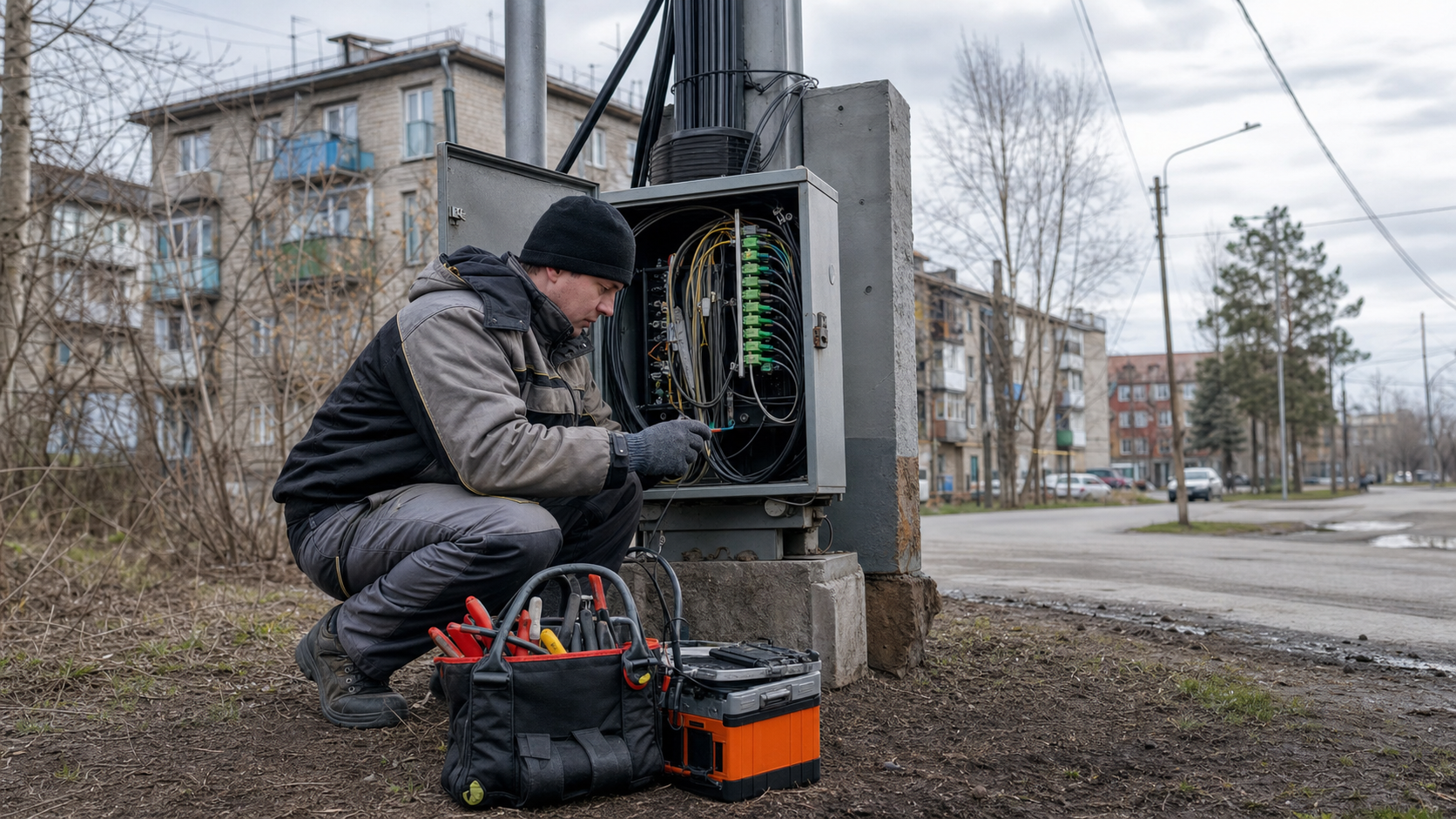
The physical side of SiNT's economics is written into its tariff pages. Cable TV installation includes coaxial RG-6 from the operator's equipment to the apartment in standard-layout buildings and channel setup through automatic TV search. Digital TV setup includes UTP cat.5 cable, an internal static IP address, STB decoder installation and a demonstration of the equipment. Telephony setup includes UTP cable, an internal static IP address, installation of a phone gateway and a demonstration of IP telephony. These are not abstract services; they are small field projects.
The company prices pieces of that work. Cable within the apartment is 85 rubles per metre. Digital TV cable work is also priced by the metre. Cable TV damage repair is listed at 500 rubles plus work cost, repeat TV setup at 350 rubles, and suspension at 120 rubles per month. Residential telephony suspension is also 120 rubles per month. These details show management trying to separate recurring service fees from labour and materials. That is a good sign. It also shows how thin the margin can become if work is underpriced or repeated.
The debt language on the cable TV page is another operating signal. SiNT says that if debt exceeds two months, the operator demounts the line to the apartment, and reconnection after line removal requires full debt repayment and payment for new connection work. This is not just a collection policy; it is a capital-protection policy. A local operator cannot afford to leave scarce ports, drops and support time tied to non-paying customers. But strict enforcement can create churn, customer dissatisfaction and reputational friction.
Maintenance notices make the obligation visible. A November 2025 notice warned subscribers of unplanned network maintenance between 01:00 and 06:00 with possible Internet interruptions for some customers. An April 2026 notice warned of preventive television work from 02:00 to 11:00 on channels 1 through 20. These notices are ordinary for a network operator, but they remind investors that service quality is produced every night, not just sold once at signup. The local brand absorbs the burden of explaining downtime.
The support challenge also grows with service breadth. A pure fibre broadband provider can focus on access, routers and upstream performance. SiNT must handle Internet, cable TV, digital TV and telephony, plus business services. Some of that breadth protects retention. Some of it multiplies fault sources. The company can create value if it standardises equipment, trains technicians well and keeps address-level records accurate. It destroys value if too many low-ruble services require bespoke fixes.
Sanctions make replacement cycles harder to underwrite
Sanctions do not need to target SiNT directly to matter. The relevant issue is the replacement market for telecom equipment, semiconductors, optics, routers, switches, customer devices and software support. The U.S. Bureau of Industry and Security's 2022 Russia measures explicitly included controls on semiconductors, computers, telecommunications and information-security equipment, among other items. The Council of the EU describes sanctions against Russia that target technology, defence, trade and services, and lists entities in IT and telecoms among sanctioned categories.
The practical result is a more complicated procurement environment for Russian network operators.
The vendor-exit backdrop reinforces that point. Nokia announced in 2022 that it would exit the Russian market, and news coverage of its later results described the company nearing completion of that exit, including ceasing sales of equipment and software and moving research-and-development activity out of Russia. Even if SiNT never depended materially on Nokia, the broader market changed. Equipment that once had direct vendor channels, support contracts or predictable spares can become more expensive, slower, substituted, refurbished or routed through intermediaries.
For a regional access operator, the economic damage is not necessarily sudden. It appears through longer replacement cycles, more expensive spares, narrower vendor choice, more reliance on existing equipment and more careful triage of upgrades. That can be manageable if the network is mature and stable. It becomes dangerous when customers demand higher speeds, TV services require more reliable multicast delivery, business clients need better resilience, or older active electronics reach end-of-life together.
The tariff pages show why this pressure matters. SiNT is offering 200 Mbps and 300 Mbps residential plans at modest prices and business service up to individual 1 Gbps quotes. Customers experience those as speed products. The operator experiences them as capacity, CPE, aggregation, support and upstream engineering products. If replacement electronics cost more or arrive more slowly, the gap between what customers expect and what the operator can renew widens.
The risk is asymmetric. If equipment costs fall or supply improves, customers may not pay more; competitive pressure passes much of the benefit to the market. If equipment costs rise or supply worsens, SiNT cannot automatically reprice every household line without risking churn. The operator carries the downside because the physical network must keep working whether procurement is easy or hard. Sanctions therefore do not make SiNT uninvestable by themselves. They make discipline in capex timing, vendor diversity and spare-parts management central to the investment case.
Competition is not only another fibre line
SiNT competes against more than a neighbouring wireline provider. It competes against national fixed-line brands, mobile broadband, household budget pressure, content substitution and customer inertia. Rostelecom and MegaFon appear in the observable network environment; MTS, Beeline and other national brands shape customer expectations in Russia's broader telecom market. A regional provider does not need to lose every customer to a new fibre build to feel pressure. It only needs enough households to decide that mobile data, a national bundle or a cheaper plan is good enough.
Mobile substitution is imperfect, and that helps SiNT. Heavy home users, families, gamers, remote workers and TV households still value fixed-line stability. A bundled 150 Mbps Internet-plus-TV plan is harder to replace with a phone plan than a bare 40 Mbps access line. Local phone, cable TV, address-level availability and a nearby office also matter to older or less mobile-first customers. The question is how many customers are in those sticky segments and how many are price-sensitive single-service users.
National operators have advantages that SiNT cannot easily copy. They can spread marketing, procurement, billing systems, vendor relationships and core-network engineering over millions of subscribers. They can cross-subsidise with mobile, content, devices or enterprise contracts. They can absorb a weak micro-market longer than a local provider. SiNT's counter-advantage is local familiarity, building-level knowledge, a customer base accumulated since 2002 and the ability to solve practical access problems quickly if its field team is good.
The company also competes with doing nothing. A household that already has adequate Internet may delay upgrading. A customer with cable TV may cancel entertainment rather than switch. A small business may accept lower bandwidth if higher-speed access requires individual pricing. In that environment, customer retention is not just a sales function. It depends on whether SiNT can make the service feel reliable, convenient and fairly priced enough that switching is not worth the hassle.
The strongest competitive position would combine three traits: dense covered buildings, low fault rates and business accounts that value local service. The weakest would be scattered plant, low-end households that churn for small discounts, and expensive support obligations on TV or telephony. The public evidence points to a real local franchise, but it does not prove which mix dominates.
The judgment turns on retention, not route scale
SiNT's economic case is cautiously defensible but not expansive. The company has a real operating footprint, a multi-service local offer, public licenses, a long history, reported subscriber scale, RIPE number resources, AS44347, visible exchange presence and a tariff structure that can support recurring revenue. Those facts are enough to reject the idea that it is merely a shell around an ASN or a directory entry. The company appears to be a genuine Achinsk access operator.
The downside is equally clear. The market is geographically bounded. The best household tariffs are affordable rather than rich. Business service can help but is still local. Field support and in-home wiring create labour obligations. Exchange reach does not eliminate dependence on major upstream networks. Sanctions and vendor exits make equipment renewal harder to underwrite. The operator's upside comes from holding density and selling enough bundled value; its downside comes from any decline in that density while fixed obligations remain.
If the reported 17,000-plus subscribers are active, mostly recurring, geographically dense and increasingly bundled, SiNT can produce meaningful local cash flow even without high growth. A rough sensitivity explains the stakes. At 500 to 760 rubles per month, 17,000 main Internet-equivalent lines would imply 8.5 million to 12.9 million rubles of monthly gross access revenue before VAT treatment, discounts, non-payment, TV and phone mix, business lines and cost. That is not a valuation, but it shows why density matters. Losing even a few thousand sticky customers would remove revenue that the physical network still needs.
The facts that would change the judgment are specific. First, active subscriber counts by service and churn would show whether the 17,000-plus figure is current economic density or historical marketing language. Second, revenue mix between residential Internet, bundles, business access, TV and telephony would show whether average revenue is rising or merely being defended. Third, capex plans and equipment age would show whether the network is consuming past investment or approaching a costly renewal wall. Fourth, upstream contracts and traffic costs would show how exposed SiNT is to Rostelecom, MegaFon and exchange transport.
Fifth, fault-rate and truck-roll data would show whether service breadth is profitable or support-heavy.
Until those facts are available, the position is measured. SiNT is investable as a local infrastructure operator only if management treats strategy as resource allocation: keep dense buildings, price custom business work properly, avoid vanity expansion, standardise equipment, keep spares, and raise tariffs before maintenance debt becomes visible to customers. It is not investable as a route-scale story. The AS and prefixes confirm network substance, but the value sits in Achinsk households and businesses continuing to pay more than the local network costs to serve them.
What would change the downside owner
The downside would shift only if SiNT changed the allocation of risk. A long-term wholesale or transport contract with predictable pricing could reduce upstream exposure. A proven renewal plan with available spares and vendor alternatives could reduce equipment risk. A higher share of contracted business customers could reduce household churn sensitivity. A larger bundle share could make revenue stickier. Documented low fault rates could prove that TV and telephony add margin rather than support burden.
The opposite facts would weaken the case quickly. If the 17,000-plus subscriber number is stale, if most users sit on low-end tariffs, if churn is rising, if customer arrears are high, if private-house or district expansion is thin, or if key equipment is approaching replacement without secure supply, the economics deteriorate. A regional access operator can look stable until it must spend heavily; then the difference between accounting revenue and owner value becomes visible.
SiNT's public record shows a company that has survived long enough to deserve a serious read. It has local identity, product breadth and network evidence. The conclusion is not that the company lacks infrastructure. It is that infrastructure has a downside owner. In Achinsk, that owner is the local operator, and the value of Limited Company "SiNT" depends on whether its subscriber density and retention remain strong enough to pay for the next cycle of network renewal.