
Summary
- What it says: DanskNet A/S sits in a Danish broadband market that already looks rich in capacity.
- Main topic: Regional ISP economics; Local support labour
- Context: market / company research report / Denmark; Zealand; Holbæk
The outage is a wage bill before it is a technical fault
A small Danish firm does not experience a broadband outage as a network diagram. It experiences it as eight people looking at a frozen card terminal, a cloud accounting screen that will not load, a VoIP handset that has become a desk ornament and a customer waiting while somebody calls support. Statistics Denmark's labour-cost table puts the 2024 all-industry labour cost at DKK 402.77 per worked hour and the information-and-communication line at DKK 470.42 (https://www.statbank.dk/SAO01). Use the conservative all-industry figure and a two-hour outage for eight employees is already about DKK 6,444 of paid time at risk before lost sales, reputational nuisance or the manager's afternoon are counted. That is the proper opening number for DanskNet A/S, because the company is competing less on theoretical megabits than on whether that call, that dispatch and that handoff actually happen.
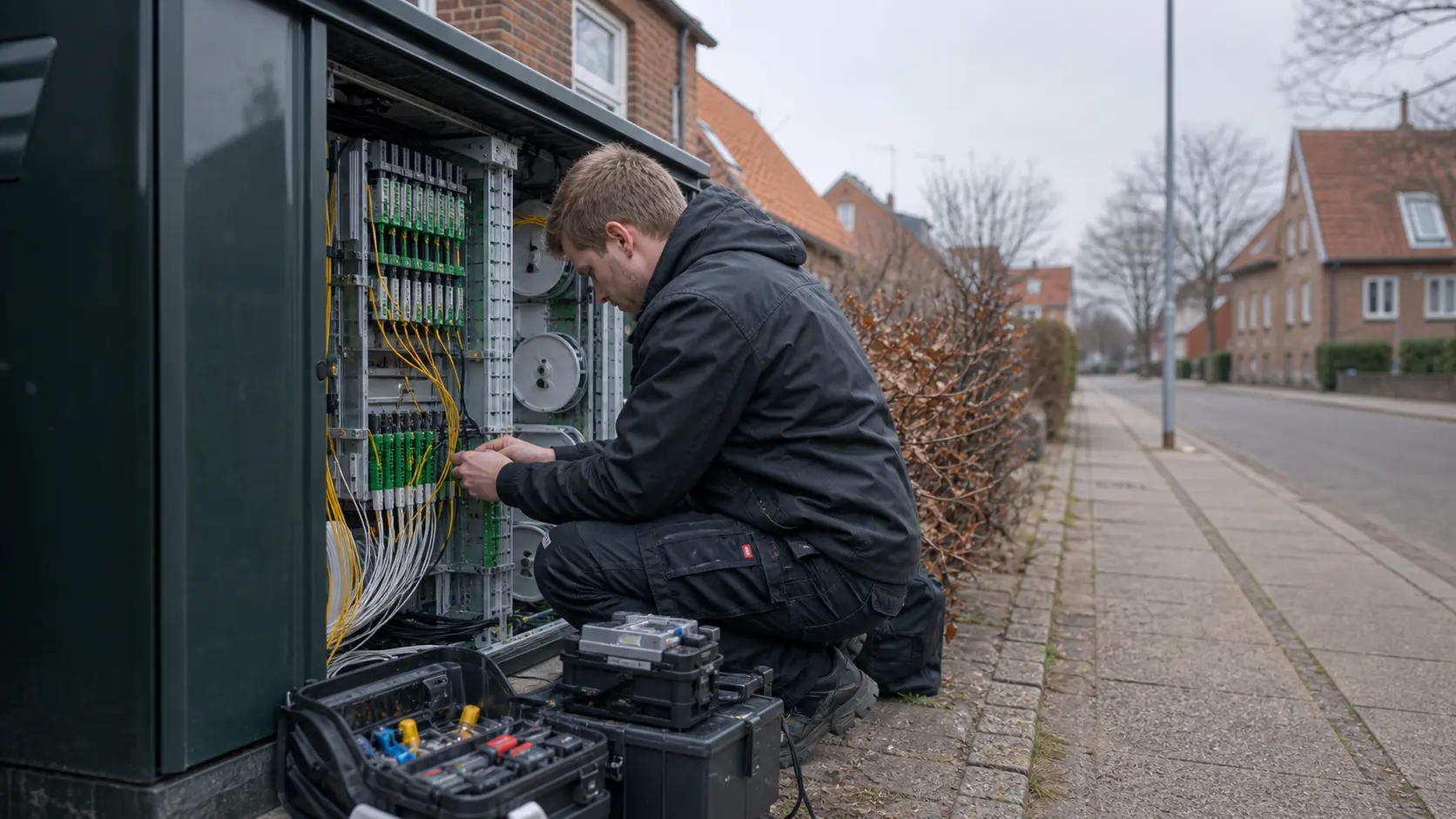
The company's own price list gives the second number. DanskNet charges DKK 1,295 for a technician visit to remedy an installation at the address, DKK 1,295 for a fault report caused by customer or handling error, and DKK 695 for an unsuccessful technician visit (https://dansknet.dk/pricesandfees). Those are not just fees. They are a window into the economics of the business. A remote support call is cheap if it clears the fault. A physical visit is expensive because somebody has to travel, inspect the customer premises equipment, touch a fibre box, test a copper line, identify whether a subcontracted access network has failed, and decide who pays. In a commodity broadband advert, the price is the monthly subscription. In the actual operating account, the price is often the truck roll.
This is why DanskNet is worth studying even though Denmark is not short of broadband. The public market record shows a country with 2.409m fixed internet subscriptions in 2025, private fibre subscriptions of 1.326m, business FTTx subscriptions of 121,542, and a median fixed-broadband downstream capacity of 587.4 Mbit/s, according to the Danish Agency for Digital Government's Telestatistik 2025 internet workbook (https://digst.dk/media/q1udm1ux/internet-dataark-2025.xlsx). Abundance changes the nature of competition. When many addresses can buy fast fibre from a national or regional name, a small provider must sell something narrower: trust that the service will be understandable, accountable and locally handled when the physical world interrupts the contract.
DanskNet's public materials are built around that promise. The broadband page sells access via the telephone socket up to 100/30 Mbit/s for DKK 249 per month with DKK 398 setup and a six-month minimum price of DKK 1,892, and fibre up to 1000/1000 Mbit/s from DKK 149 per month with setup from DKK 99 and a one-month minimum price of DKK 248 (https://dansknet.dk/bredband). The general fee table, however, lists fibre under "Fibernet - FBSA" from DKK 289 per month, which is a useful reminder that retail price presentation can differ by access platform, availability or campaign (https://dansknet.dk/pricesandfees). The commercial centre is not a single national tariff. It is a customer address, a technology choice and the cost of making that address work.
Identity: a small company with a long paper trail
DanskNet's legal identity is unusually well anchored for a small access provider. Its own footer gives DanskNet A/S at Springstrup 7, 4300 Holbæk, CVR 25945697, telephone 46 90 88 88 and customer-service email kundeservice@dansknet.dk (https://dansknet.dk/). The 2024 annual report filed through the Danish company-reporting system gives the same company, address, phone number and CVR, and identifies Henrik Hansen as director with Peter Pele Hansen, Henrik Hansen and Torben Balle on the board (https://regnskaber.cvrapi.dk/79654952/amNsb3VkczovLzAzLzE0L2I3LzdlLzg3LzJlYzctNGJjNi05OGEwLTVjYjY4OTM1MWUxNw.pdf). Ownr's public company profile records the company as an active A/S founded on 2 March 2001, with registered capital of DKK 500,000, the biname Dansk Net A/S and the purpose of doing business in broadband, data transmission and related IT activities (https://ownr.dk/companies/public-profile/25945697).
The corporate mirrors are consistent on ownership, though each should be read as an index over official registry material rather than a substitute for the registry itself. Ownr lists AH Group A/S as 100% legal owner and Henrik Hansen as the generated ultimate owner (https://ownr.dk/companies/public-profile/25945697). Proff likewise says DanskNet is part of a group with AH Group A/S as parent, names Henrik Hansen as managing director, and uses the CVR/Virk source line for official company information (https://www.proff.dk/firma/dansk-net-as/holb%C3%A6k/telekommunikation/GTNQ5MI01PE). The importance of that ownership evidence is modest but real. A customer, lender or acquirer is not looking at a branch of a national carrier. It is looking at a family-controlled or closely held local telecom company whose continuity depends on a small group of people and a parent balance sheet.
The 2024 annual report is more revealing than the corporate summary pages. Management says the company's essential activities comprise delivery of high-speed broadband connections, telephony and mobile broadband to private households and business customers in Denmark (https://regnskaber.cvrapi.dk/79654952/amNsb3VkczovLzAzLzE0L2I3LzdlLzg3LzJlYzctNGJjNi05OGEwLTVjYjY4OTM1MWUxNw.pdf). The income statement shows gross profit of DKK 2.652m, personnel costs of DKK 3.363m, depreciation and amortisation of DKK 1.231m, an operating result of minus DKK 1.942m and a final loss of DKK 1.488m in 2024. The balance sheet shows DKK 4.767m of production plant and machinery, DKK 1.321m of cash, DKK 8.253m of total assets, DKK 6.421m of equity, no security or pledges and DKK 1.966m of operating lease or rental commitments with one to 24 months remaining.
Those numbers make DanskNet neither a shell nor a scale platform. The asset base is tangible enough to suggest real equipment, infrastructure commitments and customer-service machinery. The employee note says the average number employed was eight in 2024, down from nine in 2023. That is the scale at which every repeated support problem matters. If gross profit is DKK 2.652m and personnel cost is DKK 3.363m, the business cannot casually absorb endless unbillable fault visits.
If equity is DKK 6.421m against assets of DKK 8.253m, the company has balance-sheet resilience, but that does not by itself fix a margin model that depends on labour-intensive local service. The economics are those of a small utility-like service business: recurring invoices, physical assets, modest staff and a harsh penalty for operational slack.
AS35158 is a route-control clue, not a scale claim
The network record gives DanskNet a second form of substance. RIPE RDAP records AS35158 as active, named DANSKNET, registered on 15 June 2005, with DanskNet A/S as the registrant organisation and contact address at Springstrup 7 in Holbæk (https://rdap.db.ripe.net/autnum/35158). RIPEstat's AS overview says AS35158 is announced and identifies the holder as "DANSKNET DanskNet A/S" (https://stat.ripe.net/data/as-overview/data.json?resource=AS35158). That matters because many small broadband sellers are purely retail brands over wholesale networks. An autonomous system does not prove ownership of the last mile, but it does show control of a public routing identity.
RIPEstat's announced-prefixes view currently sees five IPv4 routes for AS35158: 85.233.224.0/19, 92.243.224.0/19, 109.198.128.0/19, 109.198.144.0/20 and 213.140.64.0/19, visible in the 19 June to 3 July 2026 query window (https://stat.ripe.net/data/announced-prefixes/data.json?resource=AS35158). IP2Location's ASN page translates the same public routing picture into address arithmetic: 32,768 IPv4 addresses, no IPv6 ranges listed, and the same five netblocks, though it splits the 109.198 space into two /20 entries rather than the announced aggregate plus component view (https://www.ip2location.com/as35158). DanskNet's own fee table also sells fixed public IP and reverse DNS at DKK 19 per month plus DKK 49 setup (https://dansknet.dk/pricesandfees). That tiny add-on tells a larger story: static addressing and reverse DNS still matter to small businesses, self-hosted services, VPNs, camera systems and cautious IT contractors.
There are two caveats. First, all five RPKI validation checks run through RIPEstat returned "unknown" rather than valid for the announced prefixes at the time viewed, with no validating ROAs found (for example, https://stat.ripe.net/data/rpki-validation/data.json?resource=35158&prefix=85.233.224.0/19). That is not the same as invalid routing. It means the public route-origin assurance layer was not visible for those route-origin pairs in that validator output. In a world of route leaks and filtering by larger networks, it is a diligence question rather than a fatal finding. A buyer or large customer would ask whether route-origin authorisations exist elsewhere, whether they are planned, and how prefix filtering is handled.
Second, the interconnection footprint looks narrow. RIPEstat's neighbour view sees two left-side neighbours for AS35158: GlobalConnect A/S, AS31027, and TDC Holding A/S, AS3292 (https://stat.ripe.net/data/asn-neighbours/data.json?resource=AS35158). PeeringDB's network API records Dansk Net A/S as a Cable/DSL/ISP network with regional scope, mostly inbound traffic, open peering policy, no public exchange points, one facility, and no IPv6 support in the profile fields (https://www.peeringdb.com/api/net?asn=35158). The PeeringDB facility API places the network at GlobalConnect Taastrup 1, CPH1 (https://www.peeringdb.com/api/netfac?net_id=5235). This is not a sprawling metro-fibre peering machine. It is a small routed access provider with route control, upstream dependence and a Danish facility anchor.
Denmark's fixed market makes speed cheap and certainty valuable
The Danish market context is the reason this company is an economics story rather than a simple directory entry. Telestatistik 2025 records 2.409m fixed internet subscriptions, down from 2.547m in 2024 and 2.619m in 2023, while dedicated mobile-broadband subscriptions rose to 1.436m (https://digst.dk/media/q1udm1ux/internet-dataark-2025.xlsx). xDSL subscriptions fell sharply, from 209,567 in 2024 to 119,052 in 2025. Private fibre subscriptions rose from 1.263m to 1.326m, and business FTTx rose from 109,315 to 121,542. The copper tail is still large enough for DanskNet to advertise telephone-socket broadband, but it is no longer the future of the market.
The same workbook shows why simple speed claims are losing their drama. Median fixed downstream capacity rose to 587.4 Mbit/s in 2025 from 440.5 Mbit/s in 2024; median fixed upstream capacity rose to 347.4 Mbit/s from 245.1 Mbit/s (https://digst.dk/media/q1udm1ux/internet-dataark-2025.xlsx). Fibre's median downstream capacity is listed at 798.6 Mbit/s and median upstream at 769.7 Mbit/s. A provider promising 1000/1000 fibre is therefore not alone in the market. The speed tier is attractive, but it is not a moat. A moat has to come from availability at the address, installer coordination, a support culture, a stable billing relationship, public addressing, local reputation or some combination of those.
Competition is visible in the company sheet. Nuuday had 767,541 fixed broadband subscriptions and a 31.86% market share in 2025; Norlys Digital had 414,540 and 17.21%; Fibia had 229,910 and 9.54%; Hiper had 146,667 and 6.09%; Fastspeed had 137,881 and 5.72%; and the "Others" category held 610,154 subscriptions, or 25.32% (https://digst.dk/media/q1udm1ux/internet-dataark-2025.xlsx). DanskNet is not broken out as a major share holder. It belongs economically to the long tail, where hundreds of local networks, housing-association providers, resellers, specialist operators and business providers compete under the shadow of the big names.
That long tail is officially recognised. The Danish Agency for Digital Government's 2025 provider and group list says the statistics are based on reports from 161 providers of electronic communications networks and services, and it explicitly lists DanskNet among the providers included (https://digst.dk/media/f2lbwqjn/udbyderliste-og-koncerncer-2025.pdf). The same document states that electronic communications networks and services can generally be provided in Denmark without prior permission, registration or similar authorisation, which makes the market structurally open. Openness lowers entry barriers. It also means customers must do more trust work: who is responsible, who owns what, who can actually get a technician out, and who disappears into another supplier when the fault crosses an access boundary?
The product is a bundle of access, support and small options
DanskNet's current public storefront is simple. It sells broadband via the telephone socket up to 100/30 Mbit/s, fibre up to 1000/1000 Mbit/s and broadband telephony (https://dansknet.dk/bredband and https://dansknet.dk/telefoni). The broadband copy says connections have no usage limits. It also claims DanskNet is among the best-rated internet providers on Trustpilot and presents customer service as a point of pride. On the telephony page, DanskNet offers a zero-monthly-fee plan where usage is charged separately, a DKK 49 per month fixed-line calling plan, and a DKK 149 per month plan with unlimited Danish fixed and mobile calling, subject to separately charged special-rate numbers (https://dansknet.dk/telefoni).
The value of those products depends on customer type. For a household, a DKK 149 fibre headline is a low entry price if the address qualifies and the final access price does not move to the fee-table level. For a small business, the more interesting line items are static public IP, reverse DNS, number porting, installation, router choice, technician dispatch and support availability. DanskNet's support hours are weekdays, with Monday to Thursday 9:00-11:30 and 12:00-16:00, Friday 9:00-11:30 and 12:00-15:30, and weekend and holiday closure in the footer (https://dansknet.dk/). That is perfectly normal for a small retail ISP. It is also a boundary condition for business customers that expect incident handling outside office hours.
The pricing table is where the hidden cost structure appears. A standard fibre installation includes one external fibre box and two internal ones, with up to 30 digging metres included; extra digging is DKK 500 per metre; an internal splice box is DKK 1,825; a wireless router option is DKK 595; and a technician during setup is DKK 696 (https://dansknet.dk/pricesandfees). These are not abstract charges. They are the physical facts of fixed broadband: route from street to wall, wall to internal box, box to router, router to customer devices, and customer behaviour back to the support queue.
The same table makes payment and credit discipline visible. Card payment costs DKK 0 per month, BetalingsService DKK 9.75 per month, manual invoice or payment slip DKK 49 per month, a reminder fee DKK 100, broadband reopening DKK 495, subscription transfer DKK 95, and subscription suspension after the binding period DKK 69 per month plus DKK 99 setup (https://dansknet.dk/pricesandfees). A telecom company with small monthly invoices must automate collections. Manual billing can consume the margin on low-price fibre. A customer who pays late can become more expensive than the subscription is worth. This is why the boring lines in a fee table are often more candid than a marketing page.
Field work is the business model's hard edge
Access providers live or die at the edge of the network, where civil works, customer premises and wholesale handoffs meet. DanskNet's public price list names that edge in concrete Danish terms: external fibre box, internal boxes, digging metres, splice box, router, installation visit, failed visit and customer-handling fault (https://dansknet.dk/pricesandfees). A cheap fibre plan can be sold nationally on a website. The awkward job is deciding whether a fault sits in the router, the optical network terminal, the internal cable, the customer's device, the fibre drop, the street cabinet, the access wholesaler's network or the routed IP layer.
The field-operation mechanics are therefore central. A technician visit means booking a time, getting access to the premises, checking whether the customer has moved the router or damaged a cable, testing optical levels or copper quality, coordinating with a wholesale access provider if the failure is upstream of the premises, replacing CPE if necessary, and then closing the job without turning a DKK 249 monthly customer into a loss-making account. The economics are especially unforgiving when the customer is innocent but the repair crosses company boundaries.
If a district-heating dig cuts a fibre, the customer blames the internet provider, the civil-work contractor may be the physical cause, and the access-network owner may control the underground asset. DanskNet's value is partly the promise to navigate that mess.
Trustpilot is useful here as market signal rather than hard proof. DanskNet's public Trustpilot page showed a 4.5 score and 1,004 reviews when viewed, with 10 reviews in the past 12 months, a statement that the company had not invited reviews, 100% response to negative reviews and typical replies within 24 hours (https://dk.trustpilot.com/review/www.dansknet.dk). Recent positive reviews describe fast contact after a cut cable during district-heating work, same-day or next-day technician handling, and help restoring service after another provider mishandled a termination. A negative review complains of years of poor connection and repeated router restarts. The signal is mixed but commercially important: the positive market story is service recovery; the risk story is persistent trouble at a particular address.
No private company should be judged from reviews alone. Reviews are self-selecting, emotional and skewed toward delight or frustration. But for a small ISP, they reveal the exact moments when brand value is created or destroyed. National advertising tells customers a provider is cheap. A neighbour's story about whether the provider called back after a dig-up tells them whether the provider is safe. DanskNet's high public rating is therefore an asset, but not a permanent one. It has to be earned one incident at a time, and every unclosed ticket spends some of the same trust account.
A failure scenario: the heat-pipe cut
Imagine a small accounting office or dental clinic on Zealand running phones, bookings, payments and cloud files over a DanskNet connection. A district-heating crew opens the road, a fibre serving the property is damaged, and the office loses connectivity at 10:00 on a Tuesday. At eight employees and the all-industry labour-cost benchmark of DKK 402.77 per hour, two hours of degraded work is roughly DKK 6,444 before the clinic considers missed appointments, card-payment failure, customer frustration or management time (https://www.statbank.dk/SAO01). If the provider can identify the fault quickly, coordinate the field response and get a technician or access partner moving the same day, the customer experiences an expensive interruption but not a relationship break.
If the provider fails, the economics change. The lost two hours become a day. The owner buys a mobile router from a competitor, forwards calls, asks whether a national carrier has a better service-level promise, and searches fibre options at the address. The direct cost of the next technician visit is only one part of the damage. DanskNet's DKK 1,295 repair-visit charge is a rational protection against customer-caused faults, but it is also a reminder that physical fault handling is not free (https://dansknet.dk/pricesandfees). The larger loss is churn. A household may tolerate inconvenience if the price is good. A business whose payment terminal or booking calendar is offline starts calculating the value of redundancy.
This is where local trust becomes a product. A small ISP cannot promise that a road crew will never cut a line, that a wholesaler will never have a fault, or that a customer will never damage equipment. It can promise clarity: who is called, how fast the call is returned, whether the customer is told the likely cause, whether mobile backup is advised, whether the access-network owner is engaged, whether a site visit is booked honestly, and whether the customer is charged in a way that matches responsibility. DanskNet's visible pricing and review signals suggest the business understands that game.
The uncertainty is whether the operating model scales gracefully as fibre replaces copper and customer expectations rise.
Upstream dependence is manageable until it is not
AS35158's two observed upstream or left-side neighbours are GlobalConnect and TDC, according to RIPEstat and BGP tools visible through public records (https://stat.ripe.net/data/asn-neighbours/data.json?resource=AS35158 and https://bgp.tools/as/35158). PeeringDB places DanskNet at GlobalConnect Taastrup 1 and shows no public exchange points (https://www.peeringdb.com/api/netfac?net_id=5235). That does not mean the network is fragile. A small regional ISP often buys transit and access from larger carriers because building diverse national backbone capacity is uneconomic. But it does define the control surface. If GlobalConnect or TDC changes commercial terms, maintenance windows, filtering policy, access wholesale process or fault escalation, DanskNet is exposed.
The exposure is not just technical. It is bargaining. A company with 32,768 routed IPv4 addresses, no visible IPv6 routes, one PeeringDB facility and no public IX presence has some route autonomy but limited independence from suppliers. Its customers may experience DanskNet as the provider, yet many faults and route changes may depend on carrier infrastructure outside DanskNet's direct control. This is common in broadband. The commercial skill is making dependency invisible to the customer without pretending it does not exist internally. The customer buys one accountable party. The provider then manages the messy multi-party chain.
IPv6 is a special diligence point. PeeringDB lists no IPv6 support in the network profile; RIPEstat's current announced-prefixes output for AS35158 shows five IPv4 prefixes and no IPv6 prefixes; IP2Location likewise lists zero IPv6 addresses (https://www.peeringdb.com/api/net?asn=35158, https://stat.ripe.net/data/announced-prefixes/data.json?resource=AS35158 and https://www.ip2location.com/as35158). For many retail customers this is not an immediate purchasing barrier. Carrier-grade NAT, IPv4 scarcity, static IPv4 add-ons and legacy customer equipment are familiar facts of broadband life. For buyers, regulators or technically demanding customers, however, absence of visible IPv6 is a question about future readiness, address policy and whether the routed edge is being modernised.
RPKI has the same character. The route-origin validation checks returning unknown status for the major prefixes do not say DanskNet is unsafe. They say the modern route-assurance layer is not clearly present in those public outputs. In 2005, an ASN and IPv4 space were marks of seriousness. In 2026, the marks of seriousness include ROAs, filtering discipline, documented upstream diversity, incident handling and customer communication. DanskNet has the old signs of substance. The open question is how much of the newer route-hygiene stack is documented outside the public view.
Substitution: why a customer leaves
The customer-loss mechanics are straightforward. A price-sensitive household leaves DanskNet if a national fibre brand offers a lower monthly rate at the same address, if a campaign waives setup, or if a mobile broadband plan becomes good enough for the household's use. A business leaves for a different reason: the invoice may be higher, but the alternative must reduce operational uncertainty. Nuuday, Norlys, Fibia, Hiper and Fastspeed are not abstract rivals; Telestatistik shows them as large or visible fixed-broadband players with hundreds of thousands of subscriptions or market shares above 5% (https://digst.dk/media/q1udm1ux/internet-dataark-2025.xlsx). A small office comparing providers is comparing perceived response, not just download speed.
DanskNet can defend customers where it is faster to speak to, easier to understand and more willing to coordinate the local repair than a national call centre. It loses when that local advantage disappears. If a customer has to chase multiple times, if the answer is always that the fault belongs to another network, if a technician visit is charged in a way the customer sees as unfair, or if support is unavailable when the business most needs it, the customer has no reason to stay. The national market is too competitive for loyalty to survive bad incidents.
The company can also be squeezed by product substitution. Its DKK 0, DKK 49 and DKK 149 broadband-telephony packages make sense for customers who still value a fixed-line style service, number continuity and simple calling plans (https://dansknet.dk/telefoni). But small firms increasingly run voice through Microsoft Teams, cloud PBX vendors, mobile bundles or integrated national-carrier packages. DanskNet's telephony product is therefore an attachment to the broadband relationship, not a standalone moat. It is valuable when the provider already owns trust at the address. It is vulnerable when broadband churn breaks the relationship.
Static public IP and reverse DNS are similar. At DKK 19 per month they are small revenue items, but they identify customers with more technical needs: remote access, cameras, self-hosted systems, mail hygiene, VPN endpoints or legacy applications (https://dansknet.dk/pricesandfees). Those customers may be stickier if DanskNet's support understands them. They may also be less forgiving if routing, reverse DNS, CGNAT policy or fault escalation is opaque. The more technical the customer, the more the provider's AS-level competence matters.
What the financials imply about capacity to absorb shocks
DanskNet's 2024 loss should not be sensationalised. Small telecom companies often show accounting losses when depreciation, legacy infrastructure, customer equipment, staff costs and investment cycles move against a particular year. The annual report shows DKK 1.231m of depreciation and amortisation, DKK 4.767m of production plant and machinery and DKK 6.421m of equity (https://regnskaber.cvrapi.dk/79654952/amNsb3VkczovLzAzLzE0L2I3LzdlLzg3LzJlYzctNGJjNi05OGEwLTVjYjY4OTM1MWUxNw.pdf). That is not an empty balance sheet. It suggests an operator with assets and retained capital, not just a website.
The pressure point is operating leverage. With average employment of eight and personnel costs of DKK 3.363m, staff time is the main scarce resource. The whole business can be harmed by too many support escalations, poorly screened truck rolls, supplier faults that require manual customer handling, or migration waves from copper to fibre that require extra coordination without immediate gross-profit lift. A national carrier can spread those frictions across a much larger base. DanskNet cannot. It has to keep the queue clean.
Cash matters. The balance sheet shows DKK 1.321m in cash at year-end 2024, up from DKK 224,193 in 2023, and no security or pledges at the balance-sheet date (https://regnskaber.cvrapi.dk/79654952/amNsb3VkczovLzAzLzE0L2I3LzdlLzg3LzJlYzctNGJjNi05OGEwLTVjYjY4OTM1MWUxNw.pdf). That gives some room for working capital and incident handling. It does not by itself fund a large network build, a major acquisition or a deep price war. The more rational strategy is to avoid being dragged into pure scale competition and to preserve customers who value responsiveness, public addressing, continuity and known support people.
Regulatory and public-interest context
Denmark's telecom policy setting is pro-market and highly mapped. The Agency for Digital Government says annual broadband mapping is based on address-level data collected from operators, including technically possible speeds and supplied speeds by fixed broadband, and made available through Tjekditnet.dk (https://en.digst.dk/telecom/broadband/). The European Commission's country page says Denmark's digital connectivity strategy targets 100/30 Mbit/s coverage for all households and businesses by 2025 and 98% coverage by 1 Gbit/s download speeds by 2025, with market-based rollout and limited grants in weak-coverage areas (https://digital-strategy.ec.europa.eu/en/policies/digital-connectivity-denmark). This is the environment in which DanskNet has to justify itself.
The regulatory question is not whether a small provider should exist. In a mapped, privately driven market, small providers can add competitive pressure, local service and niche options. The question is whether they maintain consumer clarity and operational resilience while relying on larger upstream and access networks. DanskNet's public fee table is comparatively transparent. Its routing records are visible. Its corporate filings are available. Its public review profile is unusually strong for a small provider. Those facts all reduce opacity.
The missing information is also clear. Public evidence does not reveal subscriber count, churn, access-network mix by wholesale supplier, exact geographic concentration, service-level commitments for business customers, incident response statistics, IPv6 plan, RPKI plan, wholesale cost exposure or how many customers use static addressing and telephony. A regulator may not need all of that to supervise ordinary retail telecom service. A buyer, lender or large customer would.
What a buyer or lender would underwrite
A buyer would pay for a sticky customer base, clean recurring billing, owned or controlled IPv4 resources, documented access to upstream suppliers, support reputation, working provisioning systems and a customer book that can migrate from copper to fibre without mass churn. DanskNet has public evidence for some of those assets: a long-lived AS, 32,768 IPv4 addresses in public ASN summaries, five visible IPv4 routes, fee lines for public IP and reverse DNS, a high Trustpilot score, an audited balance sheet and a company history going back to 2001 (https://www.ip2location.com/as35158, https://stat.ripe.net/data/announced-prefixes/data.json?resource=AS35158 and https://regnskaber.cvrapi.dk/79654952/amNsb3VkczovLzAzLzE0L2I3LzdlLzg3LzJlYzctNGJjNi05OGEwLTVjYjY4OTM1MWUxNw.pdf).
The same buyer would discount missing proof. It would want subscriber cohorts by technology, gross margin by access network, fault rates, mean time to restore, support-ticket ageing, wholesale contracts, supplier concentration, the age of network equipment, customer-premises equipment liabilities, actual IPv4 transferability, route-origin security practice, business-customer concentration and any obligations to housing associations or local access partners.
It would also want to know why the 2024 accounts lost DKK 1.488m, what changed after year-end, and whether the loss reflects investment, shrinking copper economics, supplier pricing, staff cost, customer churn or a temporary commercial issue.
A lender would be narrower. It would underwrite cash conversion, recurring revenue, receivables, customer prepayments, lease commitments and asset collateral. The annual report says trade receivables were DKK 362,546, cash DKK 1.321m, short-term liabilities DKK 1.832m, and no pledges or security at year-end (https://regnskaber.cvrapi.dk/79654952/amNsb3VkczovLzAzLzE0L2I3LzdlLzg3LzJlYzctNGJjNi05OGEwLTVjYjY4OTM1MWUxNw.pdf). That is a credible starting point for a small company. The lender's anxiety would be operational rather than purely financial: can eight average employees maintain the customer promise, migrate legacy lines, handle supplier faults and avoid turning local service into a cost sink?
A large customer would ask a more practical question: who answers when we are offline? The answer would need to include support hours, escalation path, static IP and reverse DNS handling, business telephony continuity, mobile backup options, fault ownership across wholesale networks, and the conditions under which the DKK 1,295 visit fee is charged. If DanskNet can answer that clearly, its smallness is an asset. If it cannot, smallness becomes the risk.
Public evidence register
The public identity record is strongest in DanskNet's own footer and the audited annual report: Springstrup 7 in Holbæk, CVR 25945697, telephone 46 90 88 88, company purpose and management (https://dansknet.dk/ and https://regnskaber.cvrapi.dk/79654952/amNsb3VkczovLzAzLzE0L2I3LzdlLzg3LzJlYzctNGJjNi05OGEwLTVjYjY4OTM1MWUxNw.pdf). Ownr and Proff support the ownership and registry summary, including AH Group A/S as owner and Henrik Hansen's role, but they are treated here as registry mirrors rather than primary filings (https://ownr.dk/companies/public-profile/25945697 and https://www.proff.dk/firma/dansk-net-as/holb%C3%A6k/telekommunikation/GTNQ5MI01PE).
The product and unit-economics record comes from DanskNet's public pages: broadband via telephone socket and fibre, telephony packages, customer-service hours, fees for setup, technician visits, extra digging, splice boxes, static public IP, reverse DNS and payment methods (https://dansknet.dk/bredband, https://dansknet.dk/telefoni, https://dansknet.dk/pricesandfees and https://dansknet.dk/). These pages support the article's claim that the business is a bundle of access, field work, support and small technical options rather than only a speed tariff.
The network record comes from RIPE RDAP, RIPEstat, PeeringDB, IP2Location and BGP.tools: AS35158 is active, announced, associated with DanskNet A/S, visible with five IPv4 routes, two observed left-side neighbours, one PeeringDB facility at GlobalConnect Taastrup 1, no public exchange points in PeeringDB and no visible IPv6 route set (https://rdap.db.ripe.net/autnum/35158, https://stat.ripe.net/data/as-overview/data.json?resource=AS35158, https://stat.ripe.net/data/announced-prefixes/data.json?resource=AS35158, https://stat.ripe.net/data/asn-neighbours/data.json?resource=AS35158, https://www.peeringdb.com/api/net?asn=35158, https://www.peeringdb.com/api/netfac?net_id=5235, https://www.ip2location.com/as35158 and https://bgp.tools/as/35158).
The market context comes from Telestatistik 2025, the provider list, the Agency for Digital Government's broadband mapping page and the European Commission's Denmark connectivity page (https://digst.dk/media/q1udm1ux/internet-dataark-2025.xlsx, https://digst.dk/media/f2lbwqjn/udbyderliste-og-koncerncer-2025.pdf, https://en.digst.dk/telecom/broadband/ and https://digital-strategy.ec.europa.eu/en/policies/digital-connectivity-denmark). The outage-cost opening uses Statistics Denmark's SAO01 labour-cost table, queried for 2024 all-industry and information-and-communication total labour cost per worked hour (https://www.statbank.dk/SAO01).
The unofficial customer signal comes from Trustpilot and is used only as market chatter: a high score, review count, response behaviour and specific recent themes around technician response, cut cables and service recovery, balanced against negative complaints about persistent connection quality (https://dk.trustpilot.com/review/www.dansknet.dk). It is not treated as audited performance data.
The one fact that would change the judgement
The most important missing fact is not another logo, another plan price or another registry row. It is the composition and behaviour of the customer base by access technology: how many customers are on copper, fibre, wholesale fibre, business lines, static IP, telephony and mobile broadband; what gross margin each cohort produces; and how fast each cohort churns after faults. With that single dataset, DanskNet would stop being a small-company inference exercise and become a measurable local connectivity business.
If the customer base is sticky, fibre-heavy, low-churn and willing to pay for support, DanskNet's public record points to a defensible niche. A small operator with its own AS, address resources, transparent fees, strong local-service signals and a healthy equity cushion can survive in the long tail of a fast market. It does not need to beat Nuuday or Norlys at national scale. It needs to be the provider a customer trusts when the connection breaks.
If the base is shrinking, copper-heavy, price-sensitive and support-intensive, the same public facts read differently. The AS becomes a legacy operating surface, IPv4 becomes a valuable but finite asset, the strong reviews become harder to sustain, and technician visits become a recurring tax on gross profit. The 2024 loss would then look less like a temporary dip and more like the arithmetic of a small provider caught between national fibre prices and local service costs.
There is also a geography point that public data cannot fully settle. DanskNet's office, registry address, RDAP contact address and public customer-service identity all point back to Holbæk, but its own annual report describes customers across private households and businesses in Denmark rather than only one town (https://dansknet.dk/ and https://rdap.db.ripe.net/autnum/35158). That blend matters. A provider that is local in support but national in sales has to decide where personal service stops being scalable. The closer the customer is to the staff, the easier it is to turn knowledge of streets, contractors and access partners into trust. The farther the customer is from that operating centre, the more DanskNet has to behave like every other national reseller, and then price starts to dominate again.
The most cautious judgement sits between those cases. DanskNet is real, routed, locally anchored and publicly well regarded. It operates in a country where raw speed is already abundant and where customer trust is therefore one of the remaining ways for a small ISP to earn its keep. Its edge is not a secret technology. It is the ability to turn a DKK 1,295 truck roll, a cut fibre, a static IP request or a confused customer call into a reason to stay rather than a reason to shop. In Denmark's broadband market, that is not glamorous. It is the business.