
Summary
- What it says: Telebras and the public cost of keeping a sovereign backbone useful
- Main topic: Network-resource evidence
- Context: National Telecom
The utility that must arrive before demand
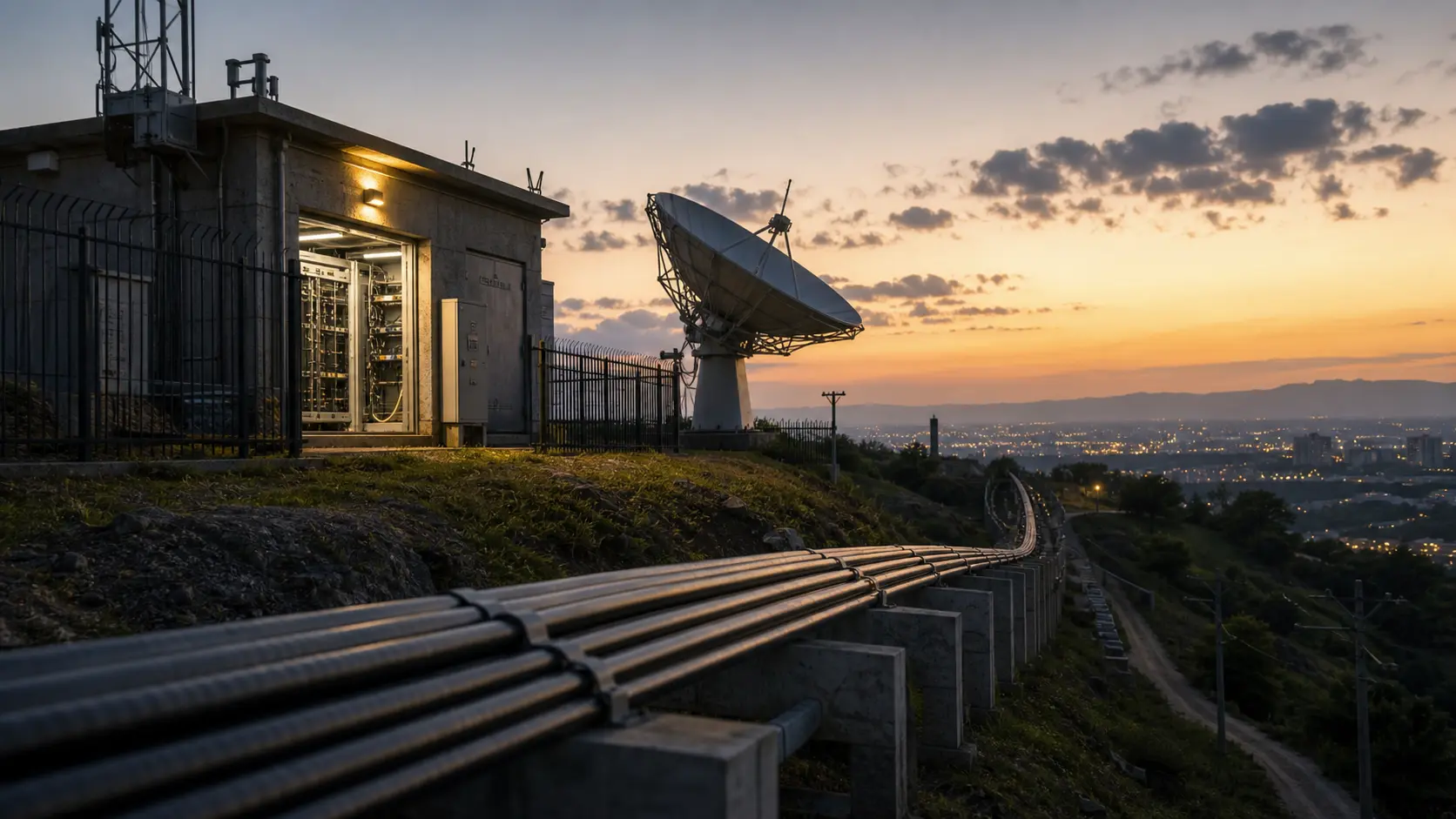
Telebras is easiest to misread if it is judged as a normal broadband operator. Its central economic problem is not whether it can win a household in Sao Paulo from Vivo, Claro, TIM, regional fiber challengers or a low-earth-orbit satellite reseller. It is whether Brazil wants a public communications balance sheet that keeps fiber, satellite capacity, operations centers, supplier contracts and field service available in places where private demand is too thin, too dispersed, too politically sensitive or too late to justify waiting. The company says on its own site that it offers satellite integration with coverage across the whole national territory and runs a fiber network of more than 30,000 km [https://www.telebras.com.br/]. Its 2025 management report says the terrestrial network directly covered 499 municipalities and indirectly reached another 1,420 through partner internet providers, while the SGDC satellite supported remote schools, health units, border posts, indigenous villages, emergency communications and defense-related traffic [https://www.telebras.com.br/wp-content/uploads/2026/03/01-Relatorio-da-Administracao-2025-RevA4.pdf]. That is not a retail growth story. It is an availability story with a cost base attached.
The cost equation is visible in Telebras' own first-quarter 2026 filing. Net revenue rose 17.9% year on year to R$134.9 million, but the network needed R$52.5 million of connection and transmission spending, R$51.3 million of third-party services, R$20.3 million of rentals, leases and insurance, and R$63.5 million of depreciation and amortization in the quarter. The company said the connection-cost increase came mainly from dedicated last-mile circuits needed to serve demand, while third-party services reflected maintenance and satellite-equipment installation, including supplier diversification beyond Viasat [https://www.telebras.com.br/wp-content/uploads/2026/05/ITR-Informacoes-Trimstrais-1-TRI-2026.pdf]. That is the mechanism the market often misses: the public backbone is useful because it reaches ahead of easy monetization, but each extra public endpoint still drags in last-mile purchases, satellite kits, maintenance partners, operations staff and asset wear.
The 2025 turnaround proves the same point from the other side. Telebras reported net operating revenue of R$491.0 million, up 18.5% from 2024, and net income of R$140.5 million after more than a decade of losses since its 2010 reactivation. The headline looked like a clean recovery. The mechanism was more conditional. Adjusted EBITDA reached R$373.2 million, but budget subsidies were R$406.9 million; without those subsidies, adjusted EBITDA would have been negative by R$33.7 million, according to the 2025 management report and the trade summary that followed the filing [https://convergenciadigital.com.br/governo/telebras-retoma-o-lucro-apos-mais-de-10-anos/]. In 1Q26, when subsidies fell to R$7.2 million from R$77.6 million a year earlier, EBITDA was negative by R$13.8 million and net loss reached R$89.5 million [https://www.telebras.com.br/wp-content/uploads/2026/05/ITR-Informacoes-Trimstrais-1-TRI-2026.pdf]. The same infrastructure that makes Telebras useful also makes it hard to run like a thin-margin private carrier.
The contract framework shows that the government understands the problem, at least formally. Telebras' 3Q25 filing says the company signed a five-year management contract with the Ministry of Communications on 5 September 2025 to implement a Sustainability and Economic-Financial Plan, move toward the regime of a non-dependent state company, set indicators and targets, and receive federal subsidy resources to cover the maintenance deficit of assets and installations needed for operational continuity [https://www.telebras.com.br/wp-content/uploads/2025/11/Arquivado-CVM-_3T25.pdf]. Its 2026-2030 strategic plan says the corporate plan and the sustainability plan are monitored together to combine long-term strategy, financial discipline and results management [https://www.telebras.com.br/wp-content/uploads/2026/01/PEI-Telebras-2026-2030_Versao-Resumida-Final-3.pdf]. The reform target is not abstract: it is an attempt to turn a subsidized availability machine into a public company whose public-service costs are named, monitored and gradually disciplined.
The first fact to hold, then, is that Telebras sells more than bandwidth. It sells state readiness. Its statute defines a mixed-capital, publicly listed company linked to the Ministry of Communications, controlled by the Union through at least 50% plus one voting share, with a mandate to implement the federal administration's private communications network, support public broadband policies for schools, hospitals, research centers and other public-interest points, provide infrastructure to private companies and subnational governments, and serve end users only where adequate broadband does not exist [https://www.telebras.com.br/wp-content/uploads/2024/01/ESTATUTO-SOCIAL-DA-TELEBRAS-consolidado.pdf]. Its investor page confirms that it is a listed mixed-economy company subject to CVM and B3 rules [https://www.telebras.com.br/investidores/], while its FAQ says its ordinary and preferred shares trade as TELB3 and TELB4 [https://www.telebras.com.br/acesso-a-informacao/perguntas-frequentes/participacao-no-mercado-de-acoes/]. The mandate and the share listing sit in tension: the shareholder can see public-company disclosure, but the economics are still shaped by a public-service buyer, a public budget cycle and a sovereign-network mission.
That is why the useful question is not whether Telebras should look like a pure private telco. It cannot. A private company builds where monetization is visible. Telebras is being asked to keep capacity ready before the revenue proof is complete: satellite gateways in a country-sized territory, a public backbone that can be used by government agencies and smaller providers, Wi-Fi and satellite programs for public sites, and a security layer for defense and administrative communications.
The public bill becomes defensible only if this readiness reduces the total cost of exclusion, emergency response, duplicative procurement and dependence on a small number of private networks. It becomes indefensible if budget transfers simply cover recurring inefficiency while private carriers could deliver the same availability under transparent contracts.
Identity: a state company with market disclosure, not a normal carrier
Telebras was created in 1972, privatized out of its old operating empire in the late 1990s, and revived for the broadband-policy era. That history matters because the present company still carries the political memory of the former national telecom holding, yet its current economic footprint is much narrower. Its investor relations page says the 1998 breakup reduced the company's asset base dramatically after the operating assets moved to other legal entities, and that Telebras did not distribute dividends from 1998 because it had accumulated losses [https://www.telebras.com.br/investidores/]. The modern Telebras is not a consumer incumbent with millions of mobile subscribers. It is a federal connectivity vehicle with a listed equity wrapper, a strategic satellite, a terrestrial backbone and public-sector customers.
The statute is explicit about the model. Telebras can provide infrastructure and support networks to private companies, states, municipalities and nonprofit entities, and it can connect final users only in places without adequate service. That clause keeps the company from becoming a blanket competitor to every private internet provider. It also gives the company a narrow but powerful economic role: it can become the wholesale, government and hard-to-serve layer that private networks either use, substitute around or lobby against. Anatel's definition of the Multimedia Communication Service, or SCM, describes a private-regime fixed telecom service that enables capacity transmission and internet connection through any means [https://informacoes.anatel.gov.br/legislacao/glossario-anatel?catid=19&faqid=964]. Telebras' revenue is mostly carried through that legal and service category, but the surrounding mandate is not a neutral private ISP mandate.
The governance arrangement is a double-edged instrument. Public ownership can protect continuity for schools, health posts, defense communications and remote regions. It can also create a soft budget problem when the company is allowed to survive without proving that each layer of its network has a reason to be inside Telebras rather than bought from the market. The contract of management signed in 2025 was meant to move the company toward the status of a non-dependent state company, with greater budget and financial autonomy. The Senate's summary of the late-2025 budget measures says the contract gave Telebras autonomy in the investment budget and moved it away from the fiscal and social-security budget, while laws opened R$53.0 million and R$600,000 in special credits for investment-program adjustments [https://www12.senado.leg.br/noticias/materias/2025/12/23/sancionadas-leis-que-liberam-recursos-para-a-telebras]. That is reform in form, but not yet proof of economic independence.
The first quarter of 2026 shows the distinction. The company remained heavily liquid on paper: the ITR showed cash and equivalents of R$738.3 million and financial investments of R$822.4 million at March 2026, with gross financial debt small by comparison. But operating performance was still sensitive to the recognition and timing of subsidies, installation charges, contract resets and the cost of serving remote demand. A balance sheet can be liquid while the operating model remains subsidized.
For Telebras, investor protection means showing that distinction clearly, not pretending the existence of public-policy revenue makes the company comparable with a consumer telecom group.
What Telebras sells when it is not selling a consumer brand
Telebras' service list sounds ordinary only at first glance: broadband connectivity, point-to-point links, managed VPN/MPLS, satellite access, Wi-Fi access points, SD-WAN and value-added services. The economic content is less ordinary. These services are typically sold into a public or enterprise context where the customer values reach, assurance, procurement compatibility and state custody more than consumer brand. The 2025 management report describes Wi-Fi Brasil as a service for the Ministry of Communications with up to 2,000 public access points integrated with GESAC, the federal electronic-government citizen-service connectivity program. It describes T3SAT as a high-speed satellite internet product for any locality in Brazilian territory, with a kit designed even for places without reliable electric power [https://www.telebras.com.br/wp-content/uploads/2026/03/01-Relatorio-da-Administracao-2025-RevA4.pdf]. Those are products, but they are also public administration tools.
In the 2025 revenue mix, the main line was SCM. The management report and subsequent coverage put SCM revenue at R$432.5 million, up 21.5% year on year, helped by new customers and contractual price adjustments, especially under GESAC. Satellite capacity leasing was R$36.5 million and stable, tied to capacity ceded to the Ministry of Defense. Other rentals, including optical cables, routers and satellite infrastructure associated with the Viasat arrangement, reached R$28.4 million. Value-added services rose to R$26.4 million, still small but strategically important because they signal an attempt to package services above raw connectivity. Revenue sharing fell to R$10.4 million as Viasat-linked pass-throughs declined [https://convergenciadigital.com.br/governo/telebras-retoma-o-lucro-apos-mais-de-10-anos/].
The first quarter of 2026 narrowed the lens. SCM generated R$116.2 million of gross revenue, value-added services R$11.2 million, satellite capacity leasing R$9.1 million, other rentals R$6.2 million and revenue sharing R$2.0 million. Telebras attributed the SCM increase to new customers and contract price resets, while the decline in Wi-Fi-related "other revenue" reflected fewer active GESAC points during the period [https://www.telebras.com.br/wp-content/uploads/2026/05/ITR-Informacoes-Trimstrais-1-TRI-2026.pdf]. The company is not dependent on one invoice, but the revenue pattern still shows a small number of public programs and public-administration customers setting the rhythm.
This matters for pricing. Telebras does not have a mass retail funnel where price can be changed weekly and churn read instantly. Its prices are embedded in procurement contracts, public programs, installation obligations and technical-service bundles. A 20 Mbps or 60 Mbps satellite point in a remote school is not priced like a household fiber plan in Brasilia. It includes equipment, installation, monitoring, field maintenance, backhaul and continuity obligations in a place where the alternative may not be an equivalent private fiber offer. That makes Telebras' unit economics harder to benchmark.
It also makes contract design the core commercial discipline: the public buyer must pay enough to cover the true cost of readiness, while Telebras must avoid turning every difficult location into an uncapped cost center.
Network evidence: fiber, satellite and internet reach
Telebras has enough visible infrastructure to justify serious attention. Its public website states more than 30,000 km of fiber and national satellite coverage [https://www.telebras.com.br/]. Its 2025 report says the terrestrial network maintained its potential coverage with direct and partner-mediated municipal reach, while the SGDC satellite continued to carry both civil Ka-band connectivity and military X-band strategic communications. The same report identifies operation centers in Brasilia and Rio de Janeiro, gateways in Campo Grande, Florianopolis, Salvador, Brasilia and Rio de Janeiro, and monitoring stations spread across the country [https://www.telebras.com.br/wp-content/uploads/2026/03/01-Relatorio-da-Administracao-2025-RevA4.pdf]. The Global Infrastructure Hub's SGDC case study frames the satellite as national coverage infrastructure with defense and remote-connectivity objectives [https://www.gihub.org/quality-infrastructure-database/case-studies/geostationary-satellite-for-defense-and-strategic-communications-sgdc/].
Internet-number evidence gives a second lens. LACNIC's public member directory records Telecomunicacoes Brasileiras S.A. - Telebras as a Brazilian company record [https://milacnic.lacnic.net/lacnic/asociados/publico?locale=EN]. PeeringDB records Telebras' network under AS53237 and shows participation at IX.br locations including Sao Paulo, Brasilia, Belem and Porto Alegre, with the Sao Paulo port listed at 4G and Brasilia and Porto Alegre at 60M in the PeeringDB data [https://www.peeringdb.com/net/6683]. Hurricane Electric's BGP toolkit identifies AS53237 as Brazilian, with 56 originated prefixes across IPv4 and IPv6 and presence at five internet exchanges [https://bgp.he.net/AS53237]. bgp.tools shows a larger live routing neighborhood, with many peers and upstream carriers [https://bgp.tools/as/53237], while CAIDA's AS Rank places Telebras within a real but not dominant global connectivity footprint [https://asrank.caida.org/asns/53237/as-core].
The network evidence should not be overstated. A registered network, prefixes and peering points are not proof of commercial depth by themselves. They are proof that the company has an operational routing presence and public internet-resource trail consistent with a national connectivity provider. The economic judgment comes from combining that with service revenue, contract details and cost behavior. The fiber network may be valuable because it can lower dependence on private backhaul in strategic routes.
It may also be under-monetized if the traffic base is too narrow or if the network's most important public uses are not priced to cover lifecycle cost.
Satellite evidence has the same two-sided character. SGDC makes sense as a sovereign coverage instrument because Brazil is continental, unevenly served and geopolitically sensitive at borders, indigenous territories, Amazon monitoring areas and defense facilities. But a geostationary system also carries fixed costs, equipment logistics, maintenance burden and technology-cycle risk. The 2025 GESAC renewal envisioned up to 28,000 satellite access points and faster service profiles than the prior contract, with 2025 installations rising from 11,604 in January to 12,703 in December. That is genuine rollout evidence.
It is not yet proof that the public network pays for itself without careful budget design.
Revenue logic: contracts before consumers
Telebras' revenue logic is contract-first. The company earns from connectivity services under SCM, satellite capacity to defense, rentals of fiber and infrastructure, Viasat-related revenue sharing, Wi-Fi services, value-added products and installation-related items such as the 2025 TIM swap-related installation revenue. In normal consumer telecom, the question is scale: how many subscribers, how much ARPU, how much churn, how much bundled content or mobile upsell.
In Telebras, the question is allocation: which public programs and institutional customers bear the cost of a network that exists partly so that the state does not have to build from zero during emergencies or procure every remote site as a one-off.
The 2025 management report makes the revenue improvement clear. It links SCM growth to contract readjustments and new customers, highlights stable satellite capacity revenue from the Ministry of Defense, and points to value-added services as an expansion area. The first quarter of 2026 adds a warning: revenue growth can be real and still insufficient. Net revenue of R$134.9 million was higher than a year earlier, but it was lower than the fourth quarter of 2025 because December had concentrated price readjustments, especially GESAC, and recognized installation fees under the TIM swap arrangement [https://www.telebras.com.br/wp-content/uploads/2026/05/ITR-Informacoes-Trimstrais-1-TRI-2026.pdf].
This shape produces uneven margins. Public-program contracts can look stable because the counterparty is the state. But they can also be lumpy because budget authorization, installation recognition, subsidy treatment and contract milestones do not follow a consumer billing calendar. In 2025, the budget support was large enough to turn the company profitable. In 1Q26, subsidies dropped to R$7.2 million from R$77.6 million in 1Q25 and R$234.4 million in 4Q25, leaving the operating base exposed. Telebras' own quarterly filing states that other operating income fell mainly because of lower budget subsidies and large fourth-quarter effects from contingent assets and pension surplus recognition [https://www.telebras.com.br/wp-content/uploads/2026/05/ITR-Informacoes-Trimstrais-1-TRI-2026.pdf].
The right pricing test is therefore not whether Telebras can post an accounting profit in a subsidy-rich year. It is whether each public contract pays an explicit service fee that matches the real cost of endpoint activation, satellite capacity, terrestrial backhaul, maintenance, field operations, customer support and network refresh. If the Ministry of Communications wants a remote school connected at a higher speed profile, that may be a sound public choice. But the price should reveal the choice. Hidden cross-subsidy makes management look better for one year and leaves the public with a harder bill later.
Cost base: the backbone is not free after it is built
The cost side is where the sovereign-backbone idea either becomes disciplined or collapses into permanent subsidy. Telebras' 1Q26 filing shows operating costs and expenses, excluding depreciation and amortization, of R$157.7 million, up 34.1% from 1Q25. Connection and transmission costs rose 45.6% to R$52.5 million, mainly from higher contracted dedicated-line last-mile circuits needed to serve expanding demand. Third-party services rose 35.6% to R$51.3 million, linked to maintenance and satellite equipment installation, with supplier diversification beyond Viasat. Personnel rose 13.0%, and rentals, leases and insurance rose 49.5%, partly because of new satellite operators [https://www.telebras.com.br/wp-content/uploads/2026/05/ITR-Informacoes-Trimstrais-1-TRI-2026.pdf].
These are not incidental expenses. They are the economic anatomy of a public network trying to cover a geography where owning a backbone is not the same as owning every last meter. Dedicated-line circuits, field service, satellite terminals and leases fill the gap between national availability and customer delivery. The more Telebras connects remote public sites, the more it may need last-mile purchases from other networks or specialized service partners. That can be rational: a public backbone should not rebuild every local access route if a private link already exists.
But it also means the company is exposed to wholesale prices, supplier service quality and the operational friction of coordinating multiple technologies.
Depreciation is the other burden. In 1Q26, depreciation and amortization were R$63.5 million even after falling from the year before because more assets had reached the end of their accounting useful life. The balance sheet still carried R$1.64 billion of property, plant and equipment at March 2026 and R$26.5 million of intangibles [https://www.telebras.com.br/wp-content/uploads/2026/05/ITR-Informacoes-Trimstrais-1-TRI-2026.pdf]. That is the public bill after construction: the assets must be maintained, refreshed, secured and sometimes replaced before political actors want to fund the next cycle.
The staff base is modest for the mission. Telebras ended 2025 with 485 employees, including 363 effective employees, after approvals to expand its authorized workforce. That does not imply inefficiency by itself. It means the company cannot perform national installation, satellite maintenance, cybersecurity, routing, public procurement and customer support alone. It must buy services. The quality of supplier contracts is therefore part of the company, not a back-office detail. If vendor contracts transfer risk well, Telebras can orchestrate a national platform with a leaner staff.
If they do not, the company becomes a public buyer of complexity.
Supplier dependence: Viasat, new satellite operators and terrestrial wholesalers
Telebras' supplier dependence is visible in both the old partnership and the new diversification. Viasat and Telebras announced federal audit-court approval for their SGDC-related contract in 2019, positioning Viasat to help deliver internet access across Brazil using SGDC capacity [https://investors.viasat.com/news-releases/news-release-details/viasat-and-telebras-announce-contract-approval-brazilian-federal]. The relationship created an important delivery channel, but the later financial disclosures show how dependence can be both useful and uncomfortable. In 2025, revenue sharing linked to Viasat fell. In 1Q26, Telebras said third-party service costs rose partly because satellite equipment installation expanded and the supplier base diversified beyond Viasat [https://www.telebras.com.br/wp-content/uploads/2026/05/ITR-Informacoes-Trimstrais-1-TRI-2026.pdf].
Diversification is strategically sensible. A sovereign-network company cannot be entirely sovereign if one private partner controls too much of the practical delivery stack. At the same time, diversifying satellite operators, installation firms and terrestrial access providers can raise short-term cost and coordination burden. The 1Q26 cost jump is a reminder that vendor independence is not free. Telebras may gain bargaining power and resilience, but it pays through integration, service-level management and duplicated operational learning.
The terrestrial network has a similar issue. Telebras owns and uses a national fiber backbone, but its first-quarter filing makes clear that last-mile dedicated circuits were a major reason connection and transmission costs rose. This is the correct problem for a national backbone operator to have: the backbone reaches regions and interconnection points, while the final route to an agency, school, health unit or village may still depend on a local carrier or dedicated circuit. It is also the margin problem.
If public contracts do not price the last mile correctly, higher demand can worsen earnings even while the company's social output improves.
The supplier question therefore has a commercial answer and a sovereignty answer. Commercially, Telebras must standardize vendor costs, demand measurable availability and avoid bespoke procurement that makes every new customer more expensive. Strategically, it must keep enough in-house competence to know when a supplier is substitutable, when a private network is more efficient, and when public ownership of the route is necessary. The worst outcome would be a public backbone that is politically justified by sovereignty but operationally dependent on a supplier chain it cannot discipline.
Customer dependence: the state is both anchor tenant and risk
Telebras' anchor customer is the Brazilian state in multiple forms: the Ministry of Communications, Ministry of Defense, federal agencies, public schools, health units, security bodies, border posts and programs such as GESAC, Wi-Fi Brasil and Aprender Conectado. This is economically powerful because public demand can justify network readiness before private demand appears. It is also dangerous because the same buyer controls budgets, policy design, subsidy recognition and sometimes the political timing of expansion.
The 2025 GESAC renewal illustrates the upside. The management report says the Ministry of Communications confirmed the contract renewal on 21 December 2023, with the goal of establishing up to 28,000 satellite access points in remote and vulnerable regions. It lists beneficiaries that include schools, health units, indigenous and quilombola communities, public security bodies, border posts, Amazon environmental monitoring programs and social-assistance centers. The service profiles improved materially, with speeds such as 20 Mbps, 30 Mbps, 40 Mbps, 40 Mbps with external Wi-Fi and 60 Mbps with external Wi-Fi, compared with the previous 20 Mbps ceiling [https://www.telebras.com.br/wp-content/uploads/2026/03/01-Relatorio-da-Administracao-2025-RevA4.pdf]. That is precisely the kind of demand private markets often underserve.
The downside is concentration. A revenue base dominated by public programs can become vulnerable to ministerial priorities, annual budgets, legal disputes, election cycles and changes in subsidy treatment. Telebras is not selling a disposable household bundle. It is embedded in public procurement. The Senate and Congress budget records show that Telebras' 2025 transition required formal budget action, including PLN 23/2025 for R$53.0 million and PLN 28/2025 for R$600,000 [https://www.congressonacional.leg.br/materias/pesquisa/-/materia/170917] [https://www.congressonacional.leg.br/materias/pesquisa/-/materia/170960]. That transparency is valuable. It also tells investors and policymakers that Telebras' autonomy is still negotiated through public finance.
The management challenge is to make the state a paying anchor tenant, not a vague guarantor. If ministries and agencies sign clear service contracts, Telebras can invest, contract suppliers and measure performance. If public policy is translated into late payments, underpriced obligations or episodic capital increases, Telebras will keep oscillating between social usefulness and accounting distress. The company should be judged less by the word "profit" in any single year and more by whether the public buyer is paying the full economic cost of the service it asks Telebras to keep available.
Competition and substitution: the private network is never absent
Brazil is not a blank map. Private carriers, regional fiber providers, neutral networks, satellite broadband providers and public-sector IT companies all constrain Telebras. In dense markets, private fiber and mobile networks have the scale advantage. In enterprise and government connectivity, carriers can bid for contracts. In remote connectivity, satellite alternatives have multiplied. In data center, cloud and managed-service demand, Serpro, Dataprev, global cloud vendors and telecom groups can all become substitute or partner depending on the contract.
This competition is healthy because it stops the public company from becoming the default answer to every connectivity problem. The statute itself limits Telebras' final-user role to locations without adequate service, and its broader function includes supporting private companies and subnational governments rather than replacing them [https://www.telebras.com.br/wp-content/uploads/2024/01/ESTATUTO-SOCIAL-DA-TELEBRAS-consolidado.pdf]. Anatel's outorga page reinforces the broader market structure: telecom service authorization is a regulated process, and service providers can seek collective-interest or restricted-interest authorizations through the agency [https://www.gov.br/anatel/pt-br/regulado/outorga]. Telebras operates inside this regulated market, not above it.
Private substitution is clearest in the last mile. Telebras' 1Q26 increase in EILD dedicated-line costs shows that even a public backbone operator must purchase connectivity where another provider owns the practical route. That can make Telebras a coordinator of private capacity rather than a substitute for it. The company may be most valuable when it aggregates public demand, sets security and continuity requirements, and combines its own fiber or satellite assets with private access. If it tries to own every route, it risks duplicating capital. If it buys everything, it risks becoming a procurement wrapper.
The satellite market adds another pressure. SGDC is strategic, but low-earth-orbit and medium-earth-orbit systems have changed expectations for latency, speed and rapid deployment. Telebras' move toward multiple satellite operators can be read as an admission that one geostationary asset is not enough for every public-service use. That is not a failure of SGDC. It is the reality of a changing satellite market. A sovereign backbone can include leased or partnered capacity if the state preserves procurement discipline, security rules and fallback rights.
Regulation, budget and geopolitics
Telebras' public role sits at the intersection of telecommunications regulation, public finance and national security. The statute links the company to the Ministry of Communications, defines public broadband support, permits receipt of federal fiscal and social-security budget resources for personnel and general costs under law, and preserves Union control of voting capital [https://www.telebras.com.br/wp-content/uploads/2024/01/ESTATUTO-SOCIAL-DA-TELEBRAS-consolidado.pdf]. The SGDC layer adds defense. The management report states that SGDC has a civil Ka-band payload and a military X-band payload, with operation centers and gateways designed for critical communications [https://www.telebras.com.br/wp-content/uploads/2026/03/01-Relatorio-da-Administracao-2025-RevA4.pdf].
That matters because the case for Telebras is not only rural inclusion. It is also resilience and state custody. A country the size of Brazil can reasonably want government connectivity that does not depend entirely on private commercial incentives, especially in border areas, Amazon monitoring, public security, defense and disasters. The policy question is how much of that resilience should be owned, how much should be leased, and how much should be procured competitively from private providers. Ownership is justified when the asset creates bargaining power, continuity or security that cannot be bought reliably.
Leasing is justified when technology cycles are fast or demand is uncertain.
The budget transition is the test. The 2025 contract of management and investment-budget credits were not a technical footnote. They were an attempt to let Telebras manage revenue and investment with more autonomy while still being monitored by the government. Trade coverage of the 1Q26 filing noted that the company remains classified as state-dependent until the transition is complete [https://telesintese.com.br/telebras-amplia-receita-mas-prejuizo-sobe-a-r-895-milhoes-no-1o-tri/]. That is the right skepticism. Legal autonomy does not equal commercial autonomy until recurring operations can fund the service level the state demands.
Geopolitically, Telebras also reflects a broader Latin American problem: national connectivity policy often depends on private capital, foreign equipment vendors, global satellite operators and domestic public finance at the same time. Brazil cannot wish those dependencies away. It can only choose where to keep public bargaining power. Telebras is one answer. The answer works if it reduces dependency risk without hiding costs. It fails if "sovereignty" becomes a word that prevents honest comparison with private alternatives.
Market signals: optimism, skepticism and speculative heat
The market around Telebras is noisy because the company combines a listed share, a state mandate, satellite assets, possible autonomy from the federal budget and recurring privatization or reorganization narratives. Retail boards and stock pages discuss TELB3 and TELB4 with themes such as Viasat, SGDC, GESAC, Wi-Fi Brasil, public contracts and the possibility of privatization or strategic change [https://br.advfn.com/forum/telb4/19623449/1103]. Those posts are not evidence of operational performance. They are evidence of what optionality speculators attach to the stock: a small listed float, a public asset base, and policy decisions that can change the perceived value quickly.
Market-data pages show the same thin-float character. Investing.com records TELB4 as a B3-listed preferred share and shows a 52-week range that can move sharply relative to the underlying operating scale [https://www.investing.com/equities/telecomunicacoes-brasileira-sa-pref]. Google Finance similarly displays limited trading volume and basic valuation data for the listed shares [https://www.google.com/finance/beta/quote/TELB4%3ABVMF]. The important signal is not any one price. It is that public policy news, subsidy treatment, contract announcements and speculation about autonomy can move sentiment faster than the operating company changes.
Trade press adds a more disciplined signal. Convergencia Digital's March 2026 coverage emphasized the return to profit but noted the role of public subsidies [https://convergenciadigital.com.br/governo/telebras-retoma-o-lucro-apos-mais-de-10-anos/]. TeleSintese's May 2026 coverage emphasized that 1Q26 revenue rose while costs, lower subsidies and negative EBITDA pressured the result [https://telesintese.com.br/telebras-amplia-receita-mas-prejuizo-sobe-a-r-895-milhoes-no-1o-tri/]. Those two readings are not contradictory. Together, they show the company at the edge of a real transition: more revenue, more services, more autonomy and still an operating model whose profitability depends on how public obligations are priced.
The best way to read unofficial chatter is as a volatility indicator. When market participants talk about SGDC, Viasat, GESAC and government-network projects, they are noticing genuine assets and policy levers. When that talk becomes a shortcut to guaranteed value, it becomes dangerous. Telebras' value is not a lottery ticket on a satellite, a privatization headline or a budget line. It is the present value of public contracts, network utility, cost discipline, supplier bargaining power and the state's willingness to pay transparently for hard-to-serve connectivity.
What would make the public infrastructure bill defensible
The public cost of Telebras is defensible if four tests are met. First, the state must define the service that only Telebras can provide or coordinate better than the private market. "Remote connectivity" is too broad. A specific school, border post, health unit, defense site, disaster-response route or Amazon monitoring location is concrete. If private carriers can serve the location at equivalent resilience and security, Telebras should either buy that capacity at a transparent price or step back. If private offers are absent, fragile or strategically unacceptable, Telebras has a reason to exist.
Second, contracts must price the full cost of availability. The 1Q26 filing shows why: revenue can rise while EILD, third-party services, satellite installation, leases and personnel costs rise faster [https://www.telebras.com.br/wp-content/uploads/2026/05/ITR-Informacoes-Trimstrais-1-TRI-2026.pdf]. A public buyer should not demand national reach and then measure Telebras as if it were serving dense urban fiber customers. But Telebras should not treat public mission as immunity from cost control. Each contract should expose endpoint cost, capacity cost, maintenance cost, service level, equipment refresh, subsidy and penalty. That is how social policy becomes auditable economics.
Third, Telebras must turn its backbone into leverage for others, not only a cost pool for itself. The company directly and indirectly covers many municipalities through partners, and its internet exchange and BGP presence show an operational network [https://www.peeringdb.com/net/6683] [https://bgp.he.net/AS53237]. The best version of Telebras is a wholesale and public-service platform that helps regional providers, agencies and public programs reach difficult locations with lower transaction cost. The worst version is a public carrier that duplicates private buildout in competitive areas while still depending on public transfers for the difficult ones.
Fourth, the transition to budget autonomy must be real. A one-year profit supported by R$406.9 million of subsidies does not settle the question. Nor does one weak quarter destroy the case. What matters is whether 2026 and 2027 contracts show recurring service revenue covering recurring service cost before extraordinary items. If subsidies remain necessary, they should be paid as explicit public-service compensation, not disguised as ordinary commercial margin. That distinction would make the infrastructure bill politically harder in the short term and economically cleaner in the long term.
The facts that would change the judgment
The judgment on Telebras should change if the company shows three consecutive things. One is a larger share of revenue from non-subsidy, contract-priced services that still serve public or wholesale needs. Value-added services are small now, but if they grow from roughly 5% of revenue toward a meaningful share without simply rebadging connectivity, they could improve margin and make the company less exposed to raw access costs. Another is supplier cost containment: if last-mile, satellite installation and maintenance costs stabilize while service points keep rising, the platform model is working.
A third is clear evidence that private carriers and public agencies are using Telebras' backbone because it lowers cost or improves resilience, not because procurement rules made it the default.
The judgment should also worsen under several conditions. If GESAC and similar programs expand points but each added point widens operating loss before subsidy, the model is underpriced. If supplier diversification keeps increasing cost without improving resilience, Telebras will be paying for optionality without receiving it. If the budget-autonomy transition leaves the company still dependent on episodic public transfers, the non-dependent label will have more legal than economic meaning.
If retail investor excitement becomes the main story while operating filings show recurring negative EBITDA without subsidies, the stock will be trading policy hope rather than company performance.
The most important outside fact would be a credible comparison with private alternatives. If a competitive tender for equivalent remote-school or border-post service, including uptime, security, monitoring and equipment replacement, showed private providers consistently cheaper, Telebras' role should narrow to procurement coordination and strategic fallback. If, instead, tenders show that private offers are patchy, expensive, insecure or unwilling to cover the same obligations, Telebras' public balance sheet looks more justified. The answer may differ by region and by use case.
A mature public company would welcome that comparison because it would clarify where it is genuinely needed.
Telebras is not a relic if it is treated as a disciplined public infrastructure company. It is a relic if it is treated as a symbolic state telecom whose losses can always be renamed as mission. The filings point both ways. The assets, programs and network records are real. The cost pressure and subsidy dependence are also real. The only serious judgment is conditional: Telebras deserves public support where it proves that sovereign availability lowers Brazil's total connectivity risk, and it deserves commercial pressure wherever private or regional networks can do the same work better.
The bottom line
Telebras is a public option in the original infrastructure sense: not a free service, not a market replacement, and not a normal retail operator. It is a way for Brazil to keep communications capacity available before private demand proves itself, especially where the state wants continuity, security and nationwide reach. Its fiber, satellite, public programs, listed disclosures and internet-resource footprint make it more substantial than a policy slogan. Its 2025 profit and 1Q26 loss show why the business cannot be celebrated or dismissed on one headline.
The company is useful because Brazil has places and public functions the private market will not serve on acceptable terms without an anchor buyer. It is risky because the same public buyer can hide weak pricing, slow hard restructuring and turn budget support into a habit. The fair bargain is explicit: Telebras should be paid for readiness where readiness is genuinely public infrastructure, and it should be forced to prove that each service line, supplier contract and access route earns its place. A sovereign backbone is worth public money only when it makes the country less fragile.
Telebras' task is to show, contract by contract, that it does.