
Summary
- What it says: SUPERNet II is not a conventional telecom company trying to win every address in East Texas.
- Main topic: Regional ISP economics; Network-resource evidence; Peering and transit; Institutional legitimacy
- Context: market / company research report / North America
The asset is the purchasing club, not the ASN
SUPERNet II is easiest to misread if it is treated as a small internet service provider whose value can be measured only by public BGP tables. On that view, the story looks thin. ARIN shows AS18981 registered to SUPERNet II in Mineola, Texas at https://rdap.arin.net/registry/autnum/18981, and its public number record includes 204.154.22.0/24 at https://rdap.arin.net/registry/ip/204.154.22.0. Public BGP data shows one IPv4 prefix, with no visible IPv6 origin. IPinfo and BGP.he show 256 IPv4 addresses, two observed network partners and a valid RPKI state at https://ipinfo.io/AS18981 and https://bgp.he.net/AS18981. There is no obvious PeeringDB organization record advertising a broad internet-exchange posture. That is not the profile of a carrier with a national backbone, a cloud interconnect business or a wholesale transit strategy.
But AS18981 is only the narrowest surface of the economic system. SUPERNet II is better understood as a rural institutional demand aggregator. Its job is to make a collection of East Texas school districts easier to connect, finance, administer and support than they would be as separate small buyers. The consortium gives its members a shared language for connectivity, a shared procurement vehicle, a shared online-course platform and a shared point of negotiation with suppliers. The routing number is a control surface, not the whole company.
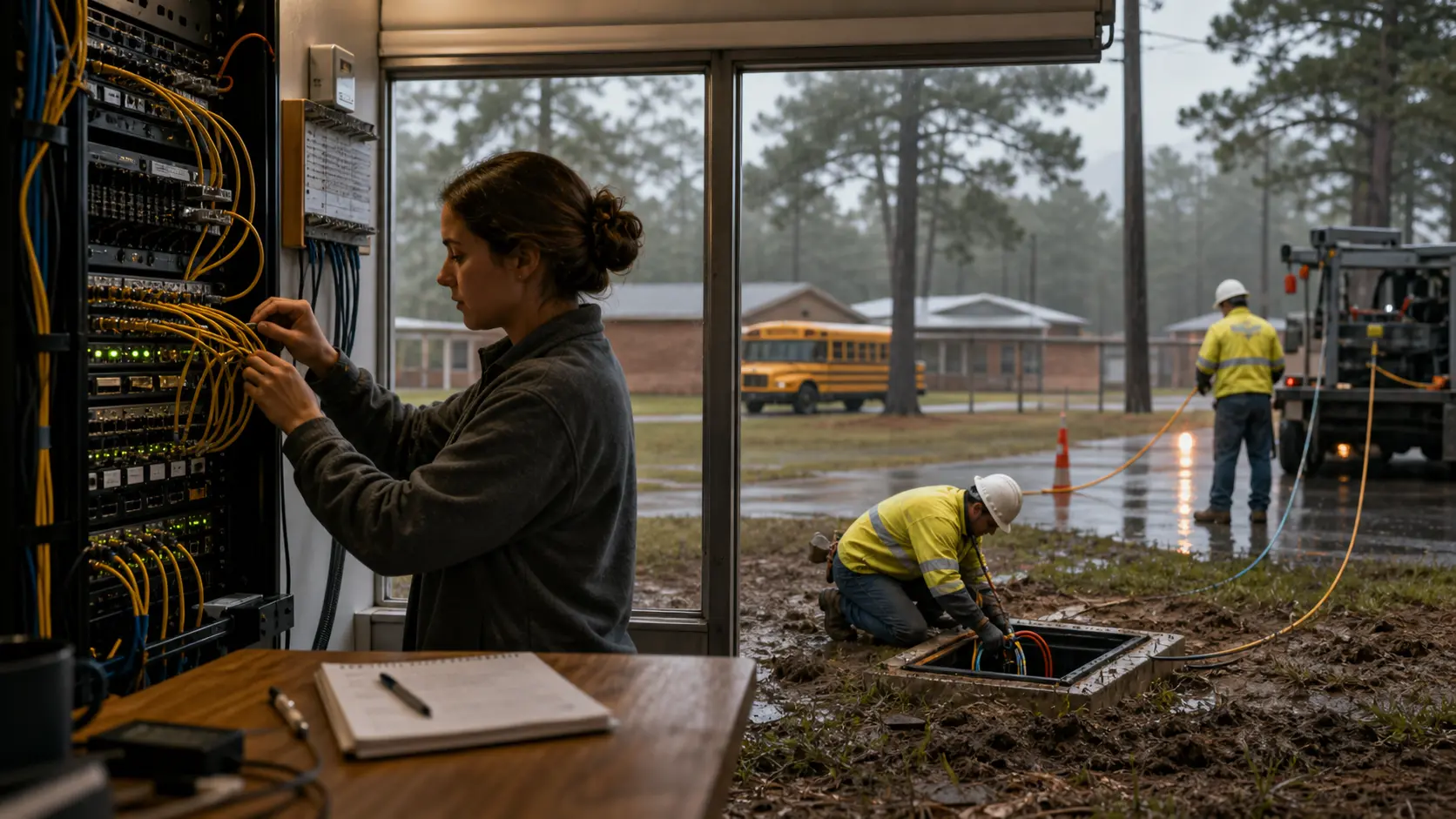
The public record points to a compact, practical operating model. An Etex Communications page for SUPER Net II says Etex was selected to build and connect a 280-mile buried fiber project reaching 16 school campuses across parts of six East Texas counties, and that page remains the clearest supplier-side description of the route at https://supernetii.etex.net/. The same page says the school districts first benefit from the route, and that businesses located near the route may later become eligible for Etex business-class fiber service. The University of Texas at Tyler Health Science Center says the original SUPERNet effort began in the 1990s when East Texas school districts lacked meaningful connectivity, then used higher-education partnership, alternative funding and combined buying power to reduce technology costs; that anniversary account is at https://www.uttyler.edu/about/news/announcements/uthsct-supernet-celebrate-25th-anniversary/. SUPERNet II extended that logic to another group of districts.
That structure matters because rural broadband economics are rarely about one heroic retail product. They are about anchor tenants. A school district is a valuable anchor because it buys every year, it has public funding visibility, it concentrates traffic at known buildings, it needs higher reliability than a residential customer, and it can justify special construction that private consumer demand alone might not support. When several districts buy together, the route becomes more bankable. When the route exists, other institutions and businesses near it become easier to serve.
SUPERNet II appears to sit exactly in that middle position: not the whole retail market, but the demand block that can make part of the market buildable.
The governing argument is therefore specific. SUPERNet II's value is not in scale for its own sake. Its value is in trust, aggregation and administrative fit. The consortium turns school needs into a form that Etex, E-rate administrators and district boards can finance. It converts rural distance into a shared project instead of a series of isolated circuits. It also creates concentration risk. The same model that makes the network efficient ties the schools to E-rate policy, to a small set of supplier relationships and to the ability of one consortium administration to keep member confidence.
Identity: an East Texas school compact with several public faces
SUPERNet II's public identity is fragmented but coherent when the pieces are placed together. ARIN's registry entry for AS18981 lists SUPERNet II at 1695 W Loop 564 in Mineola, Texas, with Patricia Maddox as a validated contact and William Woods as a technical contact. IPinfo points the AS to the website domain woisd.net, which fits the public school-administration pattern rather than a stand-alone commercial telecom brand. The SUPERNet web presence at sprnet.org describes the broader SUPERNet and SUPERNet II consortia as "Schools United to Provide Enhanced Resources Network" and lists school-district members rather than commercial customers.
The University of Texas at Tyler Health Science Center gives the institutional history. In a 2019 anniversary article, it described SUPERNet as a partnership that started in 1994, when East Texas rural districts had little or no internet access. The founding group used collaboration and combined buying power to reduce technology-service costs, and eventually built a virtual high-school course program. The same article separately lists SUPERNet II districts including Mineola, Quitman, Rusk, Waskom, Beckville, Brownsboro, Hughes Springs, Martin's Mill and Troup. The sprnet.org list adds Marshall to the SUPERNet II set. The precise membership shown in public pages varies by source and date, which is normal for a consortium that has operated across many years, but the region and buyer class are stable.
The Etex microsite adds the construction layer. It presents SUPER Net II as a project in which East Texas schools banded together more than 20 years ago to support systemic change, attract partnerships with industry and higher education, and use programs and assets collectively. It says Etex Communications was selected to build and connect the 280-mile buried fiber project, and that the network connects 16 school campuses across six counties. The page does not frame SUPERNet II as a mass-market ISP. It frames the project as rural school connectivity first, with business fiber expansion along the route second.
That matters for classification. SUPERNet II belongs in the regional-ISP universe because it has a routed AS, public IP resources, carrier dependencies and a network project. Yet its operating character is closer to a public-education consortium than to a private access provider. It is a buyer, coordinator and service platform as much as a seller. A normal ISP tries to maximize subscribers. SUPERNet II tries to make member districts cheaper and more capable to connect, then lets the supplier ecosystem capture adjacent commercial opportunity.
This hybrid identity explains why the public evidence can look inconsistent. One source emphasizes virtual-school services. Another emphasizes E-rate RFPs. Another shows BGP origin data. Another is an Etex sales page aimed at businesses near the route. These are not competing stories. They are different edges of one model. The consortium's administrative core sits in the school system. The transport layer sits with Etex and other carriers. The public internet identity sits in AS18981. The educational product sits in SUPERNet Virtual High School and the Texas Virtual School Network ecosystem.
The practical implication is that diligence should not ask only whether SUPERNet II is growing like a private broadband operator. The better questions are whether its member districts still see enough value to pool procurement, whether E-rate remains supportive, whether Etex continues to price and operate the route well, and whether the virtual-school services and connectivity services remain mutually reinforcing. SUPERNet II is durable if it remains the trusted buying club. It is fragile if it becomes only a small address block attached to someone else's transport.
Services: connectivity, courses and technical expertise in one bargain
SUPERNet II's service mix has two visible layers. The first is connectivity: wide-area network service, internet access, managed routers and the fiber infrastructure required to reach district facilities. The second is educational service: online courses, virtual high school operations and technical coordination. The business case is strongest where those layers reinforce each other.
The connectivity layer is documented through RFPs, E-rate funding records and supplier pages. A public SUPERNet RFP for internet bandwidth and associated connectivity services, available at https://publicdata.usac.org/SL/Prd/Form470/400437/190013881/SUPERNet%20Internet%20and%20Associated%20Connectivity%20Services%20RFP.pdf, described SUPERNet and SUPERNet II as two existing consortia working in coordination and cooperation. It asked for high-quality access to the internet backbone, strong peering to content providers and educational resources, robust infrastructure to Dallas internet and peering exchange points, scalable port services, district connectivity and managed routers. It referenced a network design with a managed router at The Vault data center in Tyler, district connections, WAN-provider cross connects and support for failover and resilience. The document stated that the service supported more than 40,000 users and an estimated 80,000 devices.
That is a serious institutional network specification. The buyer is not simply purchasing a cheap internet line. It is buying path diversity, cross connects, managed equipment, district handoffs, carrier coordination and room to grow. The requirement for high peering quality is especially important for schools. Educational traffic increasingly depends on cloud applications, video services, state testing platforms, learning-management systems and identity services. Poor routing can turn a nominally high-speed connection into an unreliable school day.
The consortium structure gives small districts access to a procurement standard they would be unlikely to write and enforce alone.
The education-services layer is just as important. SUPERNet Virtual High School appears in Texas Virtual School Network materials as a statewide course provider, including public provider pages such as https://txvsn.org/TXVSN-Providers. Public course listings show SUPERNet Consortium courses offered through White Oak ISD, with many 2025-2026 course entries priced at $325 on the TEA course-list page at https://tea4avcastro.tea.state.tx.us/virtualhybrid/virtual-course-list-statewide-cte-courses.html. sprnet.org pages describe registration processes, Moodle access, SUPERNet-issued student Google accounts and district-mediated enrollment. A Google Sites page for SUPERNet Virtual High School says the program is open free of charge to students in SUPERNet districts, with course costs paid through membership fees, while counselors in SUPERNet or SUPERNet II districts handle registration.
This makes the consortium more sticky than a circuit contract. A district that participates in SUPERNet II is not only buying bandwidth. It is buying a bundle of administrative convenience, course availability, technical expertise and peer relationships. The online-course element can be small in revenue terms compared with fiber construction, but it changes the member's perception of value. If a rural high school cannot staff a specialized class every semester, a consortium course option is not a luxury. It is part of how the district broadens curriculum without carrying a full local teacher cost for every subject.
The same point applies to technical expertise. The UT Tyler article frames the original SUPERNet effort as a way for rural districts to gain affordable internet access and technical support. That remains economically relevant. Small districts often do not have the staffing depth to manage carrier negotiations, router design, federal discount rules, cybersecurity controls, cloud platform changes and virtual-course administration at the same level as a larger urban district. A consortium does not eliminate that burden, but it spreads it. One skilled coordinator, one advisory board and one repeat procurement structure can serve multiple members.
There is a limit. SUPERNet II does not appear to be a broad commercial SaaS platform or a managed security provider. The public record does not show a large catalog of enterprise services sold outside the education base. Its strength is purpose-built scope. It knows the buyer, the funding mechanism and the region. That focus is why the model works. It is also why the model will not scale like a venture-backed software company. The relevant question is not whether SUPERNet II can become a national provider. It is whether it can remain the operating middle layer that rural districts cannot easily recreate on their own.
Network evidence: real fiber, deliberately small routing
The public routing record is compact. ARIN shows AS18981 as SUPERNET-II and assigns the organization a /24 network, 204.154.22.0/24. The route is visible in BGP data. RIPEstat's announced-prefixes data for AS18981 shows 204.154.22.0/24 announced during the late-June to early-July 2026 observation window at https://stat.ripe.net/data/announced-prefixes/data.json?resource=AS18981. BGP.he lists one originated IPv4 prefix, zero IPv6 prefixes and a valid RPKI status. IPinfo reports 256 IPv4 addresses, no IPv6, and peers or upstream visibility involving ETEX Communications and Optimum. IPIP's public AS page likewise shows a single IPv4 prefix and no IPv6 visibility at https://whois.ipip.net/AS18981.
This is not the footprint of a route-dense transit network. It looks like a controlled institutional edge: enough public address space and routing autonomy to manage a school consortium's internet identity, but not enough public evidence to suggest independent wholesale ambitions. The absence of a public PeeringDB profile through the PeeringDB API strengthens that reading; the AS18981 lookup at https://www.peeringdb.com/api/net?asn__in=18981 returned no public network record during this review. SUPERNet II does not appear to market itself as an exchange-facing network seeking settlement-free peering. It appears to use public routing to support a managed regional connectivity arrangement.
The resource chain also shows supplier dependence. The ARIN record for the more specific 204.154.22.0/24 names SUPERNet II, while the parent 204.154.16.0/21 record is associated with ETEX Communications. That does not make the SUPERNet II prefix fake. It shows that the address and routing arrangement is embedded in Etex's regional network context. IPinfo and BGP.he point to ETEX Communications and Optimum as the relevant public network relationships. E-rate records show Etex Communications, Etex Telephone Cooperative and Cebridge Telecom TX, LP in SUPERNet II funding lines.
Cebridge/Suddenlink/Optimum appears in the architecture as an upstream or WAN-related partner, while Etex appears as the primary construction and recurring service supplier.
The physical network evidence is more substantial than the BGP table alone suggests. Etex says the SUPER Net II project is a 280-mile buried fiber build connecting 16 school campuses across six counties. A Calix vendor release about the Etex deployment described a dedicated 160 Gbps connection, minimum gigabit connectivity to each school, and the ability to scale individual schools to 10 Gbps. Vendor language should be discounted because Calix had an interest in presenting the deployment positively, but the claims align with the RFP's emphasis on scalable 10GbE-capable ports, managed routing and institutional resilience.
The architecture also points to The Vault data center in Tyler as an important exchange point for the schools. The RFP referenced space, power and cross connects at The Vault, district links, managed routers and connections toward Dallas internet and peering exchange points. Tyler Vault publicly describes itself as a local public-edge data center in downtown Tyler offering business internet, network connectivity, equipment hosting, backup, disaster recovery and technical support. For rural school traffic, that kind of local aggregation point is economically meaningful.
It avoids sending every technical problem into a distant carrier call center and gives the consortium a defined place to terminate, interconnect and manage service.
The lack of visible IPv6 remains a weakness. Schools do not need to be fashionable network operators, but IPv6 absence is a long-term maturity signal. It may reflect only what is visible from public BGP sources, not what exists internally. Still, for a network that supports public institutions, a zero-visible-IPv6 posture means future application, security and address-planning work remains unfinished or at least unadvertised. It is not an immediate valuation killer, but it is a watchpoint.
The overall network read is therefore balanced. SUPERNet II has real public-number resources, a visible route, a valid RPKI state and physical-fiber evidence. It does not have a broad internet-exchange profile, many prefixes, visible IPv6, or a diversified transit story. That fits the consortium thesis. The infrastructure is real, but the moat is not an autonomous network empire. The moat is the relationship between the schools, the funding channel and the regional carrier that can build and operate the route.
Revenue logic: E-rate first, membership next, spillover after schools
SUPERNet II's economics start with E-rate. Public funding records show large one-time and recurring commitments tied to SUPERNet II service. The most important line is the 2021 special-construction funding record for Etex Communications. ESC Region 12's E-rate database lists a SUPERNet II funding request for "Fy21-22 Etex Special Construction" with Etex Communications as service provider, a one-time eligible cost of about $3.499 million, a 78% discount and a committed and disbursed amount of about $2.425 million; the public FRN page is https://erate.esc12.net/funding/frndetail?frn=2199061720. A second 2021 Etex non-recurring-cost line shows a $200,000 one-time eligible cost, also at a 78% discount, with about $112,055 committed and disbursed after adjustments.
Those numbers are the economic foundation. Rural fiber construction has high upfront cost and uncertain household density. A school consortium changes that equation by creating a known institutional route and by using E-rate support to absorb most of the eligible upfront cost. The supplier still needs to fund, build and maintain infrastructure, but the risk looks different when a large percentage of eligible construction is recoverable and the anchor customers are public entities.
Recurring service records show the ongoing run rate. ESC Region 12 FRN details list Etex monthly recurring service lines with annual charges around $119,340 and discount rates around 77% to 79% in recent years. For example, the FY23-24 Etex MRC record at https://erate.esc12.net/funding/frndetail?frn=2399004390 shows total monthly cost of $9,945, 12 months of service and about $93,085 committed at a 78% discount. The FY25-26 Etex MRC record at https://erate.esc12.net/funding/frndetail?frn=2599013892 shows the same $9,945 monthly figure, 12 months and about $94,279 committed at a 79% discount. Other lines show managed router service from Etex Telephone Cooperative at roughly $2,500 monthly annualized to $30,000 in earlier records, and a Cebridge/Optimum-related Tyler Vault line at $4,010 monthly annualized to $48,120 in FY24-25.
That means the visible eligible service stack is not huge by telecom standards, but it is meaningful for a rural school consortium. A rough public-record view puts core recurring eligible charges in the low hundreds of thousands of dollars per year before discount, with federal support covering a large majority of eligible cost. The local share then becomes manageable across member districts.
A Mineola ISD vendor check history shows a 2023-2024 payment to SUPERNet II of $45,457.82 for "Supernet II 2023-2024 Billing." That single district payment should not be generalized mechanically across every member, because district size, service share and billing arrangements can differ. But it confirms that member contributions exist and are material at the school-budget level.
The online-course layer adds another revenue and value logic. Public Texas Virtual School Network course listings show SUPERNet Consortium course prices of $325 for many 2025-2026 statewide CTE and other courses. SUPERNet member students may have course costs covered through membership fees, while non-member statewide enrollments appear in the broader TxVSN marketplace. The exact revenue retained by the consortium versus the district provider is not visible from public pages. Still, the public price gives a useful unit measure.
A course platform that can fill otherwise unavailable classes has high perceived value even if direct fee revenue is modest, because it substitutes for hiring, scheduling and curriculum coverage problems in small schools.
The third revenue logic is route spillover. Etex's SUPERNet II page says businesses near the route may become eligible for business-class fiber internet after schools are connected. That is not necessarily revenue for SUPERNet II itself. It may be revenue for Etex. But it is part of why the project can be economically rational for the supplier and the region. A school anchor route lowers the marginal cost of nearby business fiber. The public school demand creates the corridor; commercial customers improve the corridor's utilization.
If Etex captures most of that upside, SUPERNet II still benefits indirectly if supplier economics support better maintenance, upgrades and local goodwill.
The best revenue view is therefore triangular. E-rate reduces capital and recurring costs for eligible school services. Member fees cover local shares and educational-service administration. Supplier-side commercial spillover improves the economics of the route beyond the schools. SUPERNet II is strongest when all three work together. It is weakest if E-rate support narrows, member confidence weakens or Etex finds less commercial upside along the route than expected.
Cost base: rural distance does not disappear
The consortium model can lower unit cost, but it does not abolish rural cost. The public records show why. The 2021 special-construction figure of roughly $3.5 million in eligible one-time cost for Etex's SUPERNet II build is a reminder that rural fiber is capital intensive even for a targeted school route. Buried fiber requires make-ready work, engineering, permitting, boring, splicing, handholes, electronics, testing and project management. The Etex page says the project spans 280 miles, which is a long route for a modest number of campuses.
The network also carries recurring physical and operational costs. The RFP described space and power at The Vault, cross connects, managed routers, district terminations and support obligations. Those are not one-off purchases. Data center cabinets, power, cross connects, router licensing, optics, maintenance contracts, software support, security updates and staff time become part of the annual cost structure. Even when E-rate supports eligible portions, someone must manage the paperwork, prove eligibility, file forms, respond to audits and coordinate changes.
Supplier labor matters too. Etex's own materials emphasize local support, buried plant, no data caps and a rural fiber buildout across a large service area. That local operating model is valuable, but it is labor intensive. A rural carrier cannot maintain service only by scaling a website. It needs field technicians, bucket-truck or boring contractors, splicing teams, network engineers, dispatch, customer care and standby capability for storms, construction cuts and power events. Etex says it has more than 110 employees, which is meaningful local capacity but not infinite.
The most important hidden cost may be administrative continuity. School consortium networks survive through people who know the funding calendar, the districts, the vendors and the technology. Public contact pages list named coordinators, advisory-board presidents and school-district personnel. That is a strength while the individuals and institutions remain aligned. It is a risk if turnover creates knowledge loss. A commercial ISP can absorb some staff turnover through standardized operations. A consortium depends more heavily on relationships, recurring forms, board trust and institutional memory.
Power and physical resilience are another ordinary but real cost. Etex's customer-resource pages note that fiber voice service needs electric power at customer premises and that backup batteries are optional and limited. That page is written for retail customers, not specifically for SUPERNet II, but it is a useful reminder that buried fiber is only one part of resilience. School connectivity also depends on building power, local electronics, routers, Wi-Fi, batteries, generator policy and the carrier's own powered field equipment.
A school network can have a fiber path and still lose service if edge power, routing gear or a cross connect fails.
The economics also contain upgrade pressure. A minimum gigabit school connection may have been generous at deployment. It may become merely adequate as cloud testing, security video, software updates, student devices, AI tools and high-definition collaboration expand. The Calix release says the network can scale individual schools to 10Gbps. The RFP likewise sought scalable ports. That upgrade path is positive, but not free. Higher-speed optics, router capacity, cross-connect changes, transit commitments and school LAN upgrades can all push costs upward.
The fair judgement is that SUPERNet II likely improves cost per district compared with isolated procurement, but the savings are not magic. They come from shared administration, federal discounts, supplier route economics and repeat buying. If any of those weaken, the old rural cost problem returns quickly.
Supplier dependency: Etex makes the network bankable and concentrated
Etex is central to the SUPERNet II story. The official Etex SUPERNet II page says Etex was selected to build and connect the fiber project. E-rate records show Etex Communications as the special-construction and monthly recurring service provider. The address resources sit inside an Etex parent block. Public BGP data shows ETEX Communications as one of the relevant network partners. Etex's own business-fiber pages advertise custom business packages, up to 10Gbps, no caps, cellular backup options and monitoring or security add-ons. This is a deep dependency, not a casual vendor line.
That dependency has advantages. Etex is local. It has been part of Northeast Texas communications for decades, with roots in Etex Telephone Cooperative and a service footprint built around rural needs. Its public history says the cooperative was created to serve rural areas that large telcos did not prioritize, and that it now serves more than 12,600 members and customers across hundreds of square miles. For a school consortium, a regional cooperative carrier can be a better fit than a national provider selling standard circuits from far away. Local knowledge shortens repair loops and makes construction more politically legible.
Etex also has strategic incentive. The SUPERNet II route is not just a school contract. Etex tells local businesses near the route that they may become eligible for business-class fiber after the schools are connected. That gives Etex a reason to view the project as market development, not only as a paperwork-heavy public-sector account. The more adjacent business and institutional demand the route can support, the more attractive the long-term maintenance and upgrade economics become.
The concentration risk is equally clear. If Etex pricing becomes less favorable, if its capital plan changes, if labor shortages hit the region, or if the carrier faces competing buildout obligations, SUPERNet II has limited visible alternative capacity. The RFP and E-rate records show other carrier involvement, especially Cebridge/Optimum around Tyler Vault connectivity and public upstream visibility, but Etex is the build-and-operations anchor. The consortium can write RFPs and change providers over time, but a buried regional route is not as easy to rebid as commodity transit. Physical plant creates lock-in.
The dependency is also policy mediated. Etex's rural buildout is shaped by federal and state broadband programs beyond SUPERNet II. Community Networks reported in 2024 that Harrison County and Etex were partnering on broadband expansion using ARPA money, and Etex's Crowdfiber materials describe Universal Service Fund support, ACAM obligations and the cost of converting remaining copper customers to fiber. That larger subsidy and buildout environment can help SUPERNet II if it strengthens Etex's regional fiber footprint.
It can hurt SUPERNet II if it stretches Etex's crews, attention or capital across too many obligations at once.
Optimum/Cebridge is the second dependency. E-rate records list Cebridge Telecom TX, LP for a Tyler Vault line in FY24-25, and IPinfo shows AS19108 Optimum among AS18981's public network relationships. The older RFP referenced Suddenlink WAN-provider cross connects. This is useful because it gives the network a path beyond Etex's own backbone and into broader peering or internet connectivity. It is also a reminder that SUPERNet II's internet quality depends on commercial wholesale and data-center arrangements that sit outside the school consortium itself.
Supplier concentration does not make the project weak by default. Rural infrastructure almost always requires a lead builder. The risk is whether the consortium has enough governance and procurement discipline to keep the lead builder honest without destroying the relationship that made the route possible. That is a delicate balance. SUPERNet II's long history suggests it has managed that balance reasonably well. Future risk rises if contracts become opaque, if E-rate scrutiny increases, or if member districts begin to believe they can do better alone.
Customers: districts buy options they could not staff alone
The customer side of SUPERNet II is unusually legible because the buyers are public schools. Member districts include names such as Beckville, Brownsboro, Hughes Springs, Marshall, Martin's Mill, Mineola, Quitman, Rusk, Troup and Waskom in public consortium pages, alongside the older SUPERNet districts listed in UT Tyler and sprnet.org materials. These are not large urban systems with deep in-house network teams and extensive curriculum staffs. They are exactly the kind of institutions that benefit from shared technology infrastructure.
The first customer need is stable internet and WAN service. A modern district depends on cloud-hosted learning tools, gradebooks, student information systems, testing platforms, video, security systems, teacher collaboration, VoIP and administrative applications. The cost of downtime is not only lost productivity. It can disrupt testing windows, remote instruction, campus security and parent communication. Rural districts face this dependency with smaller local teams and fewer nearby carrier choices. SUPERNet II gives them a shared platform for buying better service than they could likely negotiate as isolated accounts.
The second need is curricular breadth. SUPERNet Virtual High School gives member districts access to courses that may be hard to staff locally. Public course lists and registration materials show a structured online-course program, Moodle usage, SUPERNet-issued student accounts and state virtual-school participation. A rural high school may have enough students to justify a local Algebra II teacher but not enough to justify every specialized elective or CTE course every semester. A shared virtual-school platform spreads that fixed instructional and administrative cost.
The third need is funding-rules capacity. E-rate is generous but paperwork heavy. Applicants must use Form 470 procurement, Form 471 funding requests, service eligibility rules, discount calculations, start dates, contract records, Form 486 service confirmations and possible post-commitment adjustments. The public FRN records for SUPERNet II show revisions, service dates, funding waves and discount rates. A single district can manage this, but a consortium that repeats the process each year can build expertise and reduce errors. That expertise is part of the product.
The customer dependency runs both ways. Districts depend on SUPERNet II for connectivity and course options. SUPERNet II depends on the districts for legitimacy and recurring demand. If enough districts leave, the model weakens. If too many districts underinvest in their campus LANs, device management or staff training, the consortium's network may be blamed for problems it does not control. If online-course quality declines, the value story becomes more narrowly about connectivity and easier to compare against carrier alternatives.
Public signs of member value are still positive. The longevity of the broader SUPERNet effort, the anniversary recognition from UT Tyler, E-rate records over multiple years, member-billing evidence from Mineola and ongoing TxVSN course listings all indicate continuity rather than a one-time grant project that disappeared after construction. The buyer set has enough institutional memory to keep the platform alive.
The customer story also has a ceiling. SUPERNet II is not addressing every East Texas household directly, and it should not be judged as if it were. Its primary customer is the public-school institution. The household benefit comes indirectly through student access, better district capabilities and possible Etex business or residential expansion along the route. That indirect benefit is real, but it is not the same as a universal last-mile consumer product.
Competition and substitution: circuits are easy to quote, trust is harder to copy
SUPERNet II competes with several substitutes. A district can buy service directly from a carrier. It can join a different regional consortium. It can use statewide procurement vehicles. It can move more applications to cloud services and reduce some private-WAN needs. It can use commercial online-course providers instead of SUPERNet Virtual High School. In some cases, it can rely on larger neighboring districts or regional service centers for technical support.
The direct carrier substitute is the most obvious. Etex, Optimum, AT&T, regional fiber builders, wireless providers and other telecom operators may be able to quote school circuits or internet access. In theory, competition should discipline price. In practice, rural route economics mean physical availability and construction cost still dominate. A carrier can quote a service that already passes a school much more cheaply than one requiring long new build. SUPERNet II's value is that it helped create a route and procurement history that individual districts did not have.
The consortium also competes against in-house district capability. A larger district may decide it can manage its own routers, E-rate filings, online courses and vendor contracts. That is a rational choice if scale is sufficient. For many smaller districts, however, the fixed costs are awkward. Hiring a strong network engineer, curriculum coordinator and funding-rules specialist for one district may cost more than the district can justify. Shared service is the better economic fit.
The online-course substitute is less capital intensive but still meaningful. Texas students can access courses through the Texas Virtual School Network from multiple providers. A district could use another provider if course quality, price or administration looked better. SUPERNet's advantage is local familiarity and membership integration. If the courses are already tied to consortium fees and district workflows, switching costs include more than the per-course price. The weakness is that course markets can change quickly.
A strong statewide provider, a vendor-backed curriculum suite or district-created online programs could pressure SUPERNet if its catalog or user experience falls behind.
The most important competitive moat is trust. Rural districts often operate through long relationships among superintendents, technology directors, business officers and board members. A consortium that has served the region since the 1990s has social capital. It knows how districts budget, how schools use service, which campuses have constraints, and how public board decisions are made. A new carrier cannot easily copy that with a sales deck. A new online-course vendor cannot easily copy that with a catalog.
Trust does not guarantee permanent economics. It must be refreshed with performance. If the network underperforms, if pricing looks stale, if E-rate paperwork causes trouble, or if online courses feel dated, members can begin asking whether loyalty is costing them. The consortium should therefore be judged on renewal evidence, public funding continuity, visible upgrade paths and member satisfaction signals rather than on the existence of a historical relationship alone.
The competitive environment around Etex's broader fiber footprint is also changing. Texas has seen federal and state broadband funding, including RDOF, ARPA and BEAD-related programs, aimed at rural buildout. That can introduce new middle-mile and last-mile assets into nearby counties. More fiber in the ground can eventually give schools alternatives. It can also strengthen the regional ecosystem that SUPERNet II uses. Competition is not purely negative. In rural broadband, a denser network map can make everyone easier to connect, provided anchor customers retain bargaining power.
Policy risk: E-rate is the operating weather
E-rate is the single most important policy dependency. USAC describes E-rate discounts as ranging from 20% to 90%, depending on poverty and rural status, and says schools and libraries can apply individually or as consortia to aggregate demand and negotiate lower prices at https://www.usac.org/e-rate/applicant-process/before-you-begin/. Eligible Category One services include data transmission, internet access and several fiber models, including leased lit fiber, leased dark fiber and self-provisioned broadband networks. USAC's fiber guidance treats special construction as the upfront, non-recurring cost of deploying new or upgraded network facilities at https://www.usac.org/e-rate/applicant-process/before-you-begin/fiber-summary-overview/.
That framework is exactly what makes SUPERNet II work. The public records show discount rates around 77% to 79% on major SUPERNet II funding lines, with federal support paying most of the eligible construction and recurring service cost. Without that support, member districts would face much higher local shares. Some might still buy service, but the route, speed and shared architecture could look very different.
The current policy environment deserves attention. In June 2026, the FCC adopted and released a notice seeking comment on the E-rate program, including questions about educational use, program integrity, screen time, consultant oversight, the lowest-corresponding-price rule and whether the program should be narrowed, reoriented or otherwise changed. The FCC notice at https://docs.fcc.gov/public/attachments/FCC-26-41A1.pdf said the FY2026 program cap is about $5.2 billion and estimated demand around $3.515 billion. A notice is not a final rule, and it would be wrong to treat it as an immediate funding cut. But for SUPERNet II, the direction of the review matters because the model is built around E-rate-supported connectivity.
The most direct risk would be a narrower interpretation of eligible services or tougher scrutiny of consortium arrangements, special construction, managed services or shared-use economics. SUPERNet II's public records look like ordinary E-rate school connectivity rather than an exotic arrangement, but any policy change that reduces reimbursement, delays approvals or increases audit burden would hit the consortium's administrative cost and member pricing.
The second risk is timing. Schools budget on fixed cycles. If E-rate funding commitments are delayed or revised, a district may face uncertainty even if the money eventually arrives. Public records already show revisions and appeals in the funding history. That is normal in E-rate, but it means cash-flow discipline matters. A consortium has to communicate clearly with members about what is committed, what is pending and what local share is likely.
The third risk is political framing. Broadband for schools has broad support, but debates around student screen time, cybersecurity, content filtering and educational outcomes can reshape how policymakers talk about connectivity. SUPERNet II's best defense is to show that the network supports core educational and administrative functions, not vague internet consumption. Its virtual-course history, district collaboration and rural access mission help here. The more the consortium can tie connectivity to concrete course access, testing, security, teacher resources and rural parity, the stronger its policy position.
E-rate risk is not a reason to discount SUPERNet II into irrelevance. The program has existed for decades because school connectivity is a public good. But when a business model depends so heavily on federal discounts, policy is not background noise. It is operating weather. A serious judgement on SUPERNet II has to track FCC proceedings, USAC eligibility guidance, discount-rate changes, special-construction rules and consortium procurement requirements as closely as it tracks BGP tables.
Operational risk: quiet networks fail in ordinary ways
There is no strong public evidence of chronic SUPERNet II service failure. That absence is meaningful but not conclusive. School networks often have support conversations in private channels, board packets, ticket systems and vendor calls rather than public social-media threads. A quiet public footprint can mean the service works well enough. It can also mean the relevant users do not complain publicly.
The ordinary risks are predictable. Fiber cuts remain a primary threat. Etex has publicly described retail-network outages caused by construction crews cutting multiple fibers, which is not specific to SUPERNet II but is typical of buried infrastructure. Buried plant reduces exposure to wind and ice compared with aerial lines, yet it increases vulnerability to excavation mistakes. Rural routes can also be long, making repair logistics slower if the cut is remote.
Power is another risk. A school may have a strong fiber connection but weak backup power for edge electronics. Data-center equipment may be protected, while campus routers, switches and Wi-Fi depend on local batteries or generators. Etex's retail battery-backup materials make clear that fiber services depend on electrical power and that batteries have limited scope. For school districts, resilience requires local planning beyond the carrier contract.
The network's public scale creates both simplicity and fragility. One visible /24 and two observed public network partners are easier to manage than a sprawling multi-homed network. They also give fewer public signs of route diversity. The RFP's references to Dallas peering, Tyler Vault and failover show that resilience was part of the design, but public BGP alone does not prove deep redundancy. A serious buyer would want current diagrams, service-level commitments, maintenance windows, outage history and failover test results.
Cybersecurity is another unavoidable risk. Public schools are frequent ransomware targets because they hold sensitive data and often have limited staff. SUPERNet II's connectivity role does not make it responsible for every district endpoint, but shared infrastructure can become a shared risk if identity, email, Moodle, routing or DNS controls are weak. The public course pages show SUPERNet-issued student Google accounts and Moodle access, which are normal educational tools but also attack surfaces. The consortium's technical value increasingly depends on security maturity, not just bandwidth.
The human operating model carries succession risk. Public pages name coordinators, principals and advisory-board presidents. Those people are assets. If they leave without strong documentation, relationships and procedures can weaken. The same is true inside Etex. A regional cooperative with local expertise is valuable partly because specific engineers and field teams know the territory. Retention and knowledge transfer matter.
The final operational risk is reputation through member experience. A district that experiences a bad online-course registration process, confusing billing, or a slow support response may generalize that frustration to the whole consortium. Because the model is built on trust, small administrative frictions can have economic consequences. The network can be technically sound and still lose member confidence if the human processes around it feel outdated.
Chatter and weak signals: the public footprint is quieter than the infrastructure
Market chatter around SUPERNet II itself is sparse. That is an important finding. There are public documents, registry records, course pages and funding records, but little consumer-style discussion. The visible online chatter is more about Etex retail service, district course administration and ordinary local broadband issues than about SUPERNet II as a branded network. There is no obvious public forum trail suggesting that SUPERNet II is a controversial or widely discussed provider.
Sparse chatter should not be confused with low importance. School networks are often invisible until they fail. Students and parents may know the online course platform, the school Wi-Fi or a local outage, but not the consortium name, AS number or vendor arrangement. District administrators may care deeply about the contract while the public never searches for it.
The limited retail chatter around Etex is mixed but not enough to drive a hard conclusion. Public review pages for Etex contain small samples and ordinary complaints about pricing or service. BBB records show a long-standing accredited business profile with an A+ rating, but BBB status is not a technical performance metric. Community-broadband coverage presents Etex as an active rural expansion partner in Harrison County. Etex's own materials emphasize local support and underground fiber. Taken together, the signals support the view of a real regional operator with normal rural-provider frictions, not a fly-by-night contractor.
The virtual-school public footprint is more concrete. TxVSN course pages, TEA course lists and SUPERNet registration pages show ongoing course administration. These are not rumors. They are live service signals. The course price points, provider listings and registration workflows show that SUPERNet's educational layer remains active, even if the public conversation is muted.
The absence of a PeeringDB profile and the small BGP footprint are also weak signals. They do not mean the network is poor. They mean the public internet-facing strategy is modest. SUPERNet II is not trying to impress network engineers with a peering fabric. It is trying to make school service work. That distinction should lower expectations for public network glamour while raising the importance of private service quality and member governance.
The best summary of the chatter is that SUPERNet II is a quiet infrastructure utility for a specific buyer group. Its risk is not headline scandal. Its risk is gradual loss of value if member districts stop believing the consortium gives them better economics, better service or better educational options than direct procurement.
What would change the judgement
Several facts would materially change this assessment.
The first would be evidence of diversified network autonomy. If SUPERNet II adds visible IPv6, additional originated prefixes, more transit providers, documented failover, a public PeeringDB profile or stronger route diversity, the network would look less like a thin institutional edge and more like a mature regional education network. That would improve resilience and bargaining power.
The second would be current member-retention data. The public pages show long-term continuity, but they do not provide a clean current roster, member-by-member billing, satisfaction data or renewal history. If several major districts have left or reduced participation, the trust thesis weakens. If membership has expanded or districts are increasing purchases, the thesis strengthens.
The third would be contract detail. Current service-level agreements, term lengths, termination rights, price escalators, upgrade pricing and ownership of constructed facilities would clarify how much lock-in exists. E-rate records show the funding side, not the full commercial relationship. A route can be economically powerful or economically restrictive depending on who owns what and how future upgrades are priced.
The fourth would be evidence of course-quality outcomes. Enrollment counts, completion rates, student satisfaction, pass rates, course fill rates and district substitution value would show whether SUPERNet Virtual High School remains a strategic asset or merely a legacy add-on. The online-course layer is part of the consortium's stickiness, but public price lists alone do not prove quality.
The fifth would be updated policy direction from the FCC and USAC. If the 2026 E-rate review leads to narrower eligibility, lower effective discounts, tougher consortium scrutiny or slower funding decisions, SUPERNet II's local share and administrative burden could rise. If the review preserves or strengthens school connectivity support, the model becomes more durable.
The sixth would be supplier-capacity evidence from Etex. Etex's regional expansion, ACAM obligations, grant projects and customer growth can either strengthen or stretch the company. Clear evidence that Etex is maintaining field capacity, upgrading backbone facilities and keeping school service levels high would support the positive case. Evidence of chronic outages, unresolved construction delays or financial strain would weaken it.
The seventh would be adjacent business uptake along the SUPERNet II route. If the school fiber route has materially expanded Etex business fiber penetration, the infrastructure has broader regional value and the supplier has more reason to maintain it. If business uptake is weak, the route may depend more narrowly on school funding.
Public evidence
The strongest identity evidence comes from the ARIN AS18981 record at https://rdap.arin.net/registry/autnum/18981, the SUPERNet II prefix record at https://rdap.arin.net/registry/ip/204.154.22.0, the Etex SUPER Net II page at https://supernetii.etex.net/, the UT Tyler Health Science Center anniversary article at https://www.uttyler.edu/about/news/announcements/uthsct-supernet-celebrate-25th-anniversary/ and the sprnet.org consortium pages. Together they support the view that SUPERNet II is a school-district consortium in East Texas, with public-number resources and a long institutional history.
The strongest network evidence comes from RIPEstat at https://stat.ripe.net/data/announced-prefixes/data.json?resource=AS18981, BGP.he at https://bgp.he.net/AS18981, IPinfo at https://ipinfo.io/AS18981, IPIP at https://whois.ipip.net/AS18981 and the public E-rate RFP at https://publicdata.usac.org/SL/Prd/Form470/400437/190013881/SUPERNet%20Internet%20and%20Associated%20Connectivity%20Services%20RFP.pdf. Those sources show the single visible /24, AS18981's active route, valid routing status, observed Etex and Optimum relationships, the Tyler Vault aggregation design and the older district-router architecture. PeeringDB's API result at https://www.peeringdb.com/api/net?asn__in=18981 is useful negative evidence: SUPERNet II does not present itself publicly as a peering-network participant.
The strongest financial evidence comes from ESC Region 12's E-rate FRN detail pages, especially the 2021 special-construction record at https://erate.esc12.net/funding/frndetail?frn=2199061720, the FY23-24 Etex recurring-service record at https://erate.esc12.net/funding/frndetail?frn=2399004390, the FY25-26 Etex recurring-service record at https://erate.esc12.net/funding/frndetail?frn=2599013892 and the Cebridge/Optimum-related Tyler Vault record at https://erate.esc12.net/funding/frndetail?frn=2499023929. These records show special construction, monthly recurring service, managed-router and Optimum/Cebridge-related lines, with discount rates in the high 70s and committed amounts that explain why a 280-mile school-fiber project can be financed. Mineola ISD's vendor check history at https://core-docs.s3.us-east-1.amazonaws.com/documents/asset/uploaded_file/1657/Mineola_ISD/3634658/2023-2024_Vendor_Check_History.pdf adds a public example of local member billing.
The strongest supplier evidence comes from Etex's own history page at https://www.etex.net/about/, Etex's business-fiber page at https://www.etex.net/business/internet/, Etex's Crowdfiber materials at https://etex.crowdfiber.com/, Community Networks reporting on Etex's Harrison County partnership at https://communitynetworks.org/content/harrison-county-texas-strikes-partnership-etex-telephone-cooperative and the Calix vendor release on the SUPERNet deployment at https://www.calix.com/press-release/2020/12/etex-becomes-the-catalyst-for-rural-learning-across-east-texas-w.html. These sources show a real regional carrier with cooperative roots, public pricing signals, rural-fiber obligations and clear commercial interest in the school route. They also carry bias where they are company or vendor sources, so they should be used for stated claims and not treated as independent proof of performance.
The strongest policy evidence comes from USAC's E-rate applicant guidance at https://www.usac.org/e-rate/applicant-process/before-you-begin/, USAC's fiber guidance at https://www.usac.org/e-rate/applicant-process/before-you-begin/fiber-summary-overview/ and the FCC's June 2026 E-rate review document at https://docs.fcc.gov/public/attachments/FCC-26-41A1.pdf. These sources show both the program mechanics that support SUPERNet II and the policy uncertainty that can change its economics.
Bottom line
SUPERNet II is a modest public internet actor and a more important rural broadband institution. Its visible AS is small, but its economic role is to coordinate demand that would otherwise be fragmented across East Texas school districts. The consortium converts school trust into a financeable fiber route, turns E-rate support into real construction and recurring service, and gives rural districts a shared platform for connectivity and virtual-course access.
The upside is resilience through aggregation. The schools get better buying power, better technical coordination and services they would struggle to build alone. Etex gets an anchor route with potential commercial spillover. The region gets fiber that is easier to extend because public institutions helped justify the build.
The downside is concentration. SUPERNet II depends heavily on E-rate, Etex, a small visible routing footprint, a limited set of public network partners and the continued trust of member districts. It does not have the diversification of a large ISP. It should not be valued or monitored as one.
For the next 12 to 24 months, the central watchpoints are E-rate policy, Etex performance, member retention, IPv6 and route diversity, virtual-school relevance and business uptake along the route. If those indicators move in the right direction, SUPERNet II remains a strong example of rural institutional broadband economics. If they move in the wrong direction, the consortium could become a historical procurement vehicle attached to a supplier-owned network rather than an active source of member leverage.