
Summary
- What it says: Stadtwerke Bruneck's broadband business is not just a small Italian ISP attached to a utility.
- Main topic: Regional ISP economics; Wholesale access economics; Operator consolidation; Data centre power and permitting
- Context: market / company research report / Italy; South Tyrol; Bruneck/Brunico
The EUR 74.99 gigabit line starts in a trench
The important number in Stadtwerke Bruneck's broadband story is not its autonomous system, although AS57469 matters later. It is EUR 74.99 including VAT for a symmetrical 1,000 Mbit/s speedy-B FIBER 1000 plan, available only on Stadtwerke Bruneck's own fibre network, with a EUR 152.50 activation charge including VAT and a standard router without Wi-Fi included in the base offer (https://www.stadtwerke.it/de/telekommunikation/preisliste-speedy-b-internet.html). The same price list shows symmetrical 100 Mbit/s, 250 Mbit/s and 500 Mbit/s offers at EUR 29.89, EUR 39.96 and EUR 49.96 a month including VAT, each with the same activation figure. That is a clean consumer ladder. It is also an infrastructure confession: the one-gigabit product is tied to the utility's own fibre, not simply to any route where the brand can take an order.
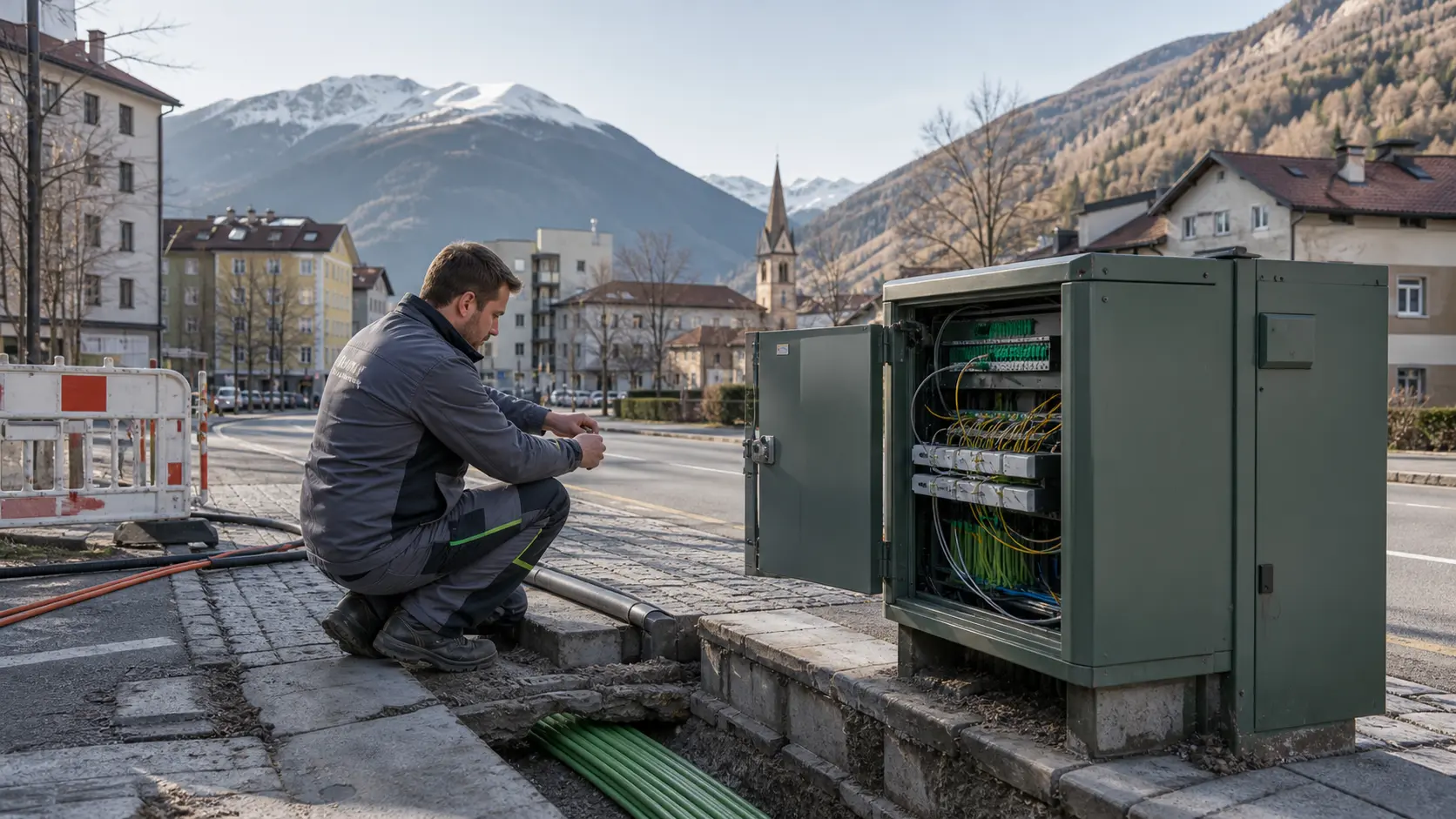
That distinction is the whole case. A conventional broadband story opens with a router, a speed claim or an exchange port. Stadtwerke Bruneck's story opens with the trench, because the utility says the fibre data network was built alongside the district-heating network, first for heat-station monitoring and automated meter reading and then for broadband services (https://www.stadtwerke.it/fileadmin/user_upload/stadtwerke/content/00_Allgemein/Zertifizierungen/EMAS_2024_Umwelt-und_Nachhaltigeitsbericht.pdf). The same report says the telecommunications business served 8,453 broadband customers in 2023, had 50 Gbit/s of available capacity and saw a 23.9 Gbit/s annual peak. In other words, this is not a website-only reseller. It is a municipal utility that turned civil works, heat infrastructure and local customer access into an operating broadband base.
The economics change because the first expensive act in fixed broadband is not always buying IP transit. It is getting from the street into the customer relationship without paying twice for ducts, permission, local trust and troubleshooting. Stadtwerke Bruneck begins with advantages that a pure fibre entrant would need years to assemble: power-distribution habits, water and wastewater knowledge, district-heating routes, public billing memory, an emergency-service culture and a town identity anchored at Nordring 19 in Bruneck (https://www.stadtwerke.it/de/stadtwerke-bruneck/transparente-gesellschaft/organisation.html). The company is legally and administratively presented as Stadtwerke Bruneck - Azienda Pubbliservizi Brunico, a commercially oriented public body under the leadership and coordination of the City of Bruneck. That ownership and service mix does not make the broadband business easy. It changes the capital question.
The evidence changes the investment decision from "can a small regional ISP sell gigabit?" to "how much broadband margin can a municipal utility earn when fibre rides streets, heating works and customer relationships it already had to manage?" The hard private-underwriting question is whether a route-contract and town-by-town cohort file can prove which subscribers sit on Stadtwerke-owned fibre, which sit on rented third-party fibre, which sit on Infranet wholesale transport, and how churn, support tickets, installation time and gross margin differ across those route types.
Without that file, the public story is strong but still underwritten from the outside.
A municipal utility is the parent product
Stadtwerke Bruneck is useful because the broadband arm cannot be understood apart from the parent utility. The public organisation page gives the identity, registered office, tax/VAT number, REA entry and governance form; the company footer also lists share capital of EUR 18,670,040 (https://www.stadtwerke.it/de/stadtwerke-bruneck/transparente-gesellschaft/organisation.html). The municipality's own page describes Stadtwerke Bruneck as a special enterprise of the City of Bruneck and explains its district-heating role, including heating plants serving Bruneck, Percha and Gais (https://www.comune.brunico.bz.it/de/Verwaltung/Einrichtungen/Stadtwerke_Bruneck). The utility's own historical page says it developed from a five-person electricity works into an efficient energy supplier over more than 100 years (https://www.stadtwerke.it/de/stadtwerke-bruneck/stadtwerke-bruneck.html).
That history matters commercially because broadband is a confidence product. Households pay for bandwidth, but they keep paying for continuity, repairability and the belief that the provider will still be reachable when the connection fails. A municipal utility enters that market with a different kind of memory from a promotional overbuilder. It has already asked residents to tolerate street works. It has already sent bills. It has already been associated with heat, water and electricity rather than only entertainment or data.
If that trust is operationally real, it lowers acquisition cost and raises the tolerance customers give the provider during installation and repair.
The scope is broad enough to matter. Stadtwerke Bruneck's 2020/2021 key-data page lists electricity distribution across about 90 square kilometres in Bruneck, Gais, Percha, Pfalzen and St. Lorenzen, with 15,625 electricity customers in 2021; water service to 14,781 people and 2,907 customers; wastewater infrastructure of 164 kilometres in operation; 56 staff at year end; and telecommunications customers rising from 5,988 in 2020 to 7,647 in 2021 (https://www.stadtwerke.it/de/stadtwerke-bruneck/eckdaten.html). Those figures are older than the 2023 sustainability data, but they show the platform. Broadband is one service inside a civic asset base, not a stand-alone punt on fibre demand.
The 2024 financial statements reinforce the point. Stadtwerke Bruneck reported EUR 59.49 million of revenue for 2024, EUR 8.99 million of net profit, EUR 179.63 million of total assets, EUR 40.25 million of liabilities and EUR 22.24 million of cash at year end (https://www.stadtwerke.it/fileadmin/user_upload/stadtwerke/content/00_Allgemein/Transparente_Verwaltung/11_Bilanzen/XBRL_EU-Bilanz_2024_Stadtwerke_Bruneck_-_dt.pdf). Those are whole-utility numbers, not broadband-segment accounts. The distinction is important. They do not prove that speedy-B is highly profitable. They do prove that the broadband service sits inside an asset-heavy, cash-generative public utility rather than inside a thin marketing shell.
The risk is the mirror image of that strength. A utility can subsidize patience, but it can also hide weak unit economics if the broadband business is not separately visible. If installation crews, customer support, billing systems, trenching plans and emergency response are shared across services, the economic question becomes allocation: how much of the true cost of winning and keeping a broadband customer is being carried by the telecom tariff, and how much is being absorbed by the parent utility's broader civic machine? Public filings do not answer that.
A buyer or lender would want the telecom profit-and-loss account, not just the parent balance sheet.
The product ladder is a map of network control
The current speedy-B product page says the service offers download and upload speeds up to a gigabit, transparent offers, minimal contract commitment and a direct local contact (https://www.stadtwerke.it/de/telekommunikation/glasfaser-internet.html). The price card makes the economics more concrete. A household can step from 100/100 to 250/250 for roughly EUR 10.07 more a month including VAT, then to 500/500 for another EUR 10, and then to 1,000/1,000 for another EUR 25.03, but the gigabit tier is explicitly limited to Stadtwerke Bruneck's own fibre network (https://www.stadtwerke.it/de/telekommunikation/preisliste-speedy-b-internet.html). That is not just product segmentation. It shows where the operator believes it has the physical and operational confidence to sell the top tier.
The availability page is the cleanest public evidence of route economics. It divides access into three technical/commercial situations: Stadtwerke Bruneck's own fibre network, rented fibre routes from third parties such as Infranet AG, electricity works, municipalities and others, and Infranet wholesale transport where the transport network is operated by Infranet and offered to providers on equal terms (https://www.stadtwerke.it/de/telekommunikation/verfuegbarkeit.html). In the first two cases Stadtwerke Bruneck says it uses its own network equipment for service delivery. In the wholesale case, the fibre routes and transport equipment are managed by Infranet.
That three-part description is unusually valuable. It says the same retail brand can sit on three different cost and control surfaces. Own fibre gives the best chance to control activation, equipment, repair time and capacity upgrades. Rented fibre preserves some service control but adds route-cost and contract-renewal exposure. Infranet wholesale can extend reach without installing every local transport element, but it also makes the retail experience dependent on another operator's transport performance, appointment cadence and wholesale terms. A subscriber may see one speedy-B bill.
The margin behind that bill may vary sharply by address.
The accessories price card supports the same reading. Wi-Fi routers and repeaters are priced separately: a FRITZ!Box 5530 at EUR 149.95 including VAT, a FRITZ!Box 5690 AON at EUR 189.95, a FRITZ!Box 5690 PRO at EUR 299.95 and repeaters at EUR 69.95 or EUR 129.95 (https://www.stadtwerke.it/de/telekommunikation/preisliste-speedy-b-internet.html). That matters because the product is symmetrical fibre, not "free Wi-Fi magic". By separating the router and Wi-Fi equipment from the access line, the utility protects some installation economics and avoids pretending that every home layout can be solved inside the monthly fee.
At first glance the activation charge looks modest beside the cost of civil works. EUR 152.50 including VAT will not pay for a difficult late connection if ducts are missing, handholes are blocked or a customer needs extra internal work. But that is exactly why the trench history matters. If the address was already reached by district-heating work or existing civic duct routes, the incremental activation economics can be much better than for a new entrant arriving after the street is closed. The price card is therefore not only a retail list. It is an invitation to ask where the connection becomes cheap enough for the monthly tariff to work.
The network is small but visible
Public routing evidence makes Stadtwerke Bruneck more than a local access story. PeeringDB lists the network as Stadtwerke Bruneck, also known as speedy-B Fiber, with ASN 57469, network type "Network Services", 16 IPv4 prefixes, one IPv6 prefix, regional geographic scope, 20-50 Gbps traffic level, mostly inbound traffic and an open peering policy (https://www.peeringdb.com/net/27408). RIPEstat's AS overview identifies AS57469 as SWB-APB-AS Azienda Pubbliservizi Brunico and marked it announced at the 3 July 2026 observation point (https://stat.ripe.net/data/as-overview/data.json?resource=AS57469). RIPE's RDAP record shows registration for AS57469 on 3 November 2011 and names Azienda Pubbliservizi Brunico as the registrant (https://rdap.db.ripe.net/autnum/57469).
Prefix visibility is consistent with a genuine regional network. RIPEstat's announced-prefixes view showed 16 prefixes over the 19 June 2026 to 3 July 2026 window, including 31.207.96.0/19, 159.48.16.0/20, 159.48.56.0/21, 185.177.32.0/22 and other IPv4 ranges (https://stat.ripe.net/data/announced-prefixes/data.json?resource=AS57469). BGP.tools presents the same broad picture: AS57469, registered to Azienda Pubbliservizi Brunico, with visible prefixes and upstream relationships including HALLAG Kommunal GmbH, KONVERTO, Retelit Digital Services and MYNET (https://bgp.tools/as/57469). These records do not prove paid contract terms, congestion, latency or service quality. They do show a real network control surface.
The South Tyrol interconnection layer is especially important. STIX says its Internet exchange node became operational on 1 January 2019 and that the first South Tyrolean peering partner connected was Stadtwerke Bruneck; the same page frames STIX as a way for local providers and institutions to exchange traffic faster, more directly and more independently (https://www.stix.bz/en/about-us/). The STIX IX-F member export lists Stadtwerke Bruneck as AS57469, a peering member since 12 March 2020, active on a 10G interface with IPv4 address 185.1.124.3 and IPv6 address 2001:7f8:cf::3 (https://manager.stix.bz/api/v4/member-export/ixf/1.0). Euro-IX's IXPDB page independently lists Stadtwerke Bruneck at the South Tyrolean Internet Exchange Point in Bolzano (https://ixpdb.euro-ix.net/en/explore/asn/57469/ixps/).
For a Bruneck household, most of that is invisible. The customer does not care whether a stream uses a local exchange route or upstream transit. But the economics care. Local exchange presence can reduce avoidable backhaul, keep regional traffic closer to home and improve resilience for local services if the operator maintains competent routing. It can also make the company a more serious peer for public institutions and local businesses that need reliable paths rather than only low monthly prices.
The caution is scale. A regional AS with 20-50 Gbps of traffic is not a national backbone. RIPEstat's neighbour view showed four observed neighbours at the latest available 3 July 2026 point: AS20811, AS31263, AS34347 and AS44512 (https://stat.ripe.net/data/asn-neighbours/data.json?resource=AS57469). That is enough for meaningful route diversity but not enough to ignore supplier terms. The underwriting question is not "does Stadtwerke Bruneck have a network?" It does. The question is how much of the customer promise depends on a few upstream and wholesale relationships that must stay technically and commercially healthy.
Open access turns civic advantage into a contest
South Tyrol is not a closed private kingdom for one provider. Infranet describes MAGS as an open infrastructure for any type of internet use and says it makes that infrastructure available to all internet providers on the free market so customers can choose the offer that suits them (https://www.infranet.bz.it/de/). The same page lists multiple providers, including Stadtwerke Bruneck, Brennercom, Dolomitinet, Konverto, Netikom, Profexional, Suedtirolnet, Telmekom and Vion. Open access changes the strategic meaning of Stadtwerke Bruneck's civic utility position: it may own or control important local routes, but the customer can still compare offers across a broader provider field where open infrastructure is present.
Municipal notices show how this works in practice. Ahrntal's fibre notice uses Stadtwerke Bruneck as an example for ordering, says the whole contract process can be handled by email with servicedesk@stadtwerke.it, and asks customers to send address, tax, bank, email and box-photo information for contract preparation (https://www.ahrntal.eu/de/Neuigkeiten/Bekanntmachungen/Glasfasernetz_Ahrntal_bis_St_Jakob). The same notice says Infranet charges EUR 100 plus VAT for each private fibre ordered and EUR 200 plus VAT for each company fibre ordered. That is not Stadtwerke Bruneck's own tariff, but it is a useful window into the way South Tyrol fibre adoption turns on administrative clarity, activation fees, and the customer's ability to navigate local infrastructure processes.
SEA, a local cooperative in St. Martin in Thurn, presents another route-to-market signal. Its fast-internet page says fibre offers can be obtained through Stadtwerke Bruneck or directly through SEA in collaboration with Stadtwerke Bruneck, while antenna connections can also be handled by SEA in collaboration with Stadtwerke Bruneck (https://www.sea.bz.it/de/schnelles-internet). Fraunhofer's WiBACK deployment page says Stadtwerke Bruneck installed 30 nodes, enabling internet to companies, hotels and hikers (https://www.wiback.org/en/wiback-deployments/stadtwerke-bruneck.html). The 2024 sustainability report adds that WiBACK was introduced for remote areas difficult to serve with fibre and describes the technology as a point-to-point wireless backhaul system that can link places over distances of more than 100 kilometres at up to 100 Mbps (https://www.stadtwerke.it/fileadmin/user_upload/stadtwerke/content/00_Allgemein/Zertifizierungen/EMAS_2024_Umwelt-und_Nachhaltigeitsbericht.pdf).
This is the shape of a mountainous regional access business. Fibre is the core product, but the edge cases are not all urban apartment buildings. Hotels, farms, public sites, remote hamlets and valley routes may need different access methods, different appointment habits and different expectations about repair time. The municipal-utility advantage is that Stadtwerke Bruneck knows the terrain as a service territory, not as a sales map. The open-access risk is that other providers can use shared infrastructure to attack customer segments where the local utility's service promise is weaker than its reputation.
Competition therefore is not only price. Suedtirolnet markets fibre internet, VoIP and fax-by-email in Bruneck, names a local partner in Toblach and invites customers to order fibre and VoIP (https://www.suedtirolnet.it/glasfaser-internet/bruneck). Infranet's provider list gives customers an even wider comparison set (https://www.infranet.bz.it/de/). If Stadtwerke Bruneck's product feels like a utility-grade local service, the company can defend a price with trust and local resolution. If it feels bureaucratic, slow or tied to confusing equipment rules, open access makes the customer more mobile.
The failure scenario is a route-type incident, not a headline outage
The most realistic failure scenario is not a spectacular cyberattack or a dramatic national internet failure. It is a route-type incident where the retail brand has to explain a fault whose root cause sits in one of the three access modes the company discloses: own fibre, rented third-party fibre or Infranet wholesale transport (https://www.stadtwerke.it/de/telekommunikation/verfuegbarkeit.html). Imagine a winter weekday in the Puster Valley. Several business customers lose stable service. A hotel has booking systems, payment terminals and VoIP calls failing. A household on a 500 Mbit/s plan sees repeated drops during remote work. A public-service office wants a repair time, not a topology lesson. The service desk sees calls from customers who all believe they bought speedy-B, but the route records show mixed underlying infrastructure.
In that moment, the municipal utility's strengths can become operational traps. The customer expects the city utility to know the street, the duct and the repair crew. If the fault is on Stadtwerke Bruneck's own fibre, that expectation may be fair. If the fault sits on a rented route or Infranet-managed transport, the provider still owns the relationship but may not own every repair lever. The Ahrntal notice already shows that customers are asked to provide photos of installed Infranet boxes for contract handling, which is a practical signal that the physical access layer is not always a simple end-to-end retail asset (https://www.ahrntal.eu/de/Neuigkeiten/Bekanntmachungen/Glasfasernetz_Ahrntal_bis_St_Jakob).
The commercial damage would not come only from downtime. It would come from confusion. A customer who understands that the provider is waiting for a third-party repair may tolerate the delay once. A customer who receives vague answers from a trusted utility will start comparing alternatives. Public forum chatter already shows that users notice these differences. One South Tyrol broadband forum discussion says a user was satisfied with Stadtwerke Bruneck speedy-B and notes that gigabit was directly available in the Stadtwerke network while not yet in the Infranet network at that time (https://www.breitband.bz.it/d/2687-speedtest-stadtwerke-bruneck). Another discussion asks whether, in Bruneck, choosing Stadtwerke Bruneck versus other providers made a technical difference and notes that other providers appeared to cover Bruneck (https://www.breitband.bz.it/d/2273-bruneck-nicht-mehr-exklusiv-stadtwerke). These are unofficial market signals, not established service facts. Their value is that they reveal the customer questions the operator must answer.
The support-load risk is amplified by the product's local promise. The official fibre page says customers have a direct local contact (https://www.stadtwerke.it/de/telekommunikation/glasfaser-internet.html). PeeringDB lists public NOC and sales/service desk contact information for AS57469 (https://www.peeringdb.com/net/27408). The public-service charter page references AGCOM quality rules for fixed internet access and call-centre contact quality (https://www.stadtwerke.it/de/telekommunikation/dienstleistungscharta.html). Those signals create a standard. In an incident, the provider is judged not by whether it owns an AS, but by whether the customer-facing service path converts complex route facts into a clear repair experience.
Regulation and transparency are part of the margin
The telecom business sits inside Italian communications regulation and public-utility disclosure. Stadtwerke Bruneck's tariff-transparency page says that, in accordance with AGCOM Resolution 252/16/CONS, the relevant information and offers are available and that currently subscribable offers are listed under the speedy-B price menu (https://www.stadtwerke.it/de/telekommunikation/tariftransparenz.html). Its service-charter page refers to AGCOM resolutions on service quality and the right of consumers to complete, comparable and simple information about fixed internet access (https://www.stadtwerke.it/de/telekommunikation/dienstleistungscharta.html). Its ConciliaWeb page says users must use AGCOM's ConciliaWeb platform for dispute-resolution applications under Resolution 296/18/CONS (https://www.stadtwerke.it/de/telekommunikation/concilia-web.html).
That is more than legal boilerplate. In a public utility, transparency is a cost and a moat. It raises documentation work, but it also reduces sales ambiguity. A household can see prices, activation charges, equipment costs, router options, tariff transparency and dispute routes without guessing. A small business can treat the provider as a regulated local service rather than a transient connectivity reseller. The same public character, however, makes mistakes more visible. If a fee is confusing, if a router rule feels restrictive, or if an outage message is sparse, the complaint has a civic tone as well as a consumer tone.
Forum discussion around router freedom illustrates that tension. A Breitband.bz thread asks whether Stadtwerke Bruneck FTTH involves router restrictions, discusses Genexis equipment and references AGCOM modem-freedom debate (https://www.breitband.bz.it/d/2052-routerfreiheit-stadtwerke-bruneck-ftth). The thread is not proof of a current contractual breach and should not be read as a finding. It is a market signal about what technically aware customers notice: ONT placement, bridge mode, credentials, media converters and whether the provider treats the home network as a controllable support boundary or a customer-owned environment.
The rational provider view is not obvious. Supporting unlimited customer equipment can increase fault calls and stretch a small team. Requiring or strongly steering standard equipment can simplify remote support, reduce installation variance and protect service metrics. But the more a provider frames itself as a local public utility, the more it has to explain such choices in plain commercial terms. Customers who pay for symmetrical fibre may accept a standard ONT. They are less likely to accept uncertainty about what they may connect behind it.
Stadtwerke Bruneck's own risk language also matters. The certifications and registration page says management works with risk management to identify, analyse, evaluate, monitor and control risks and opportunities (https://www.stadtwerke.it/de/stadtwerke-bruneck/zertifizierungen-registrierung.html). The 2024 sustainability report lists a telecommunications action to verify the security level through a penetration test, describing it as a controlled attack to identify weaknesses and derive measures (https://www.stadtwerke.it/fileadmin/user_upload/stadtwerke/content/00_Allgemein/Zertifizierungen/EMAS_2024_Umwelt-und_Nachhaltigeitsbericht.pdf). In a broadband utility, cyber and operational resilience are not separate from customer economics. A breach, prolonged fault or weak route-control process can turn a high-trust local brand into a high-liability public-service problem.
The revenue logic is credible, but not yet fully separable
Public evidence supports a credible revenue base. The 2024 sustainability report's 8,453 broadband customers and EUR 3.7 million of telecommunications revenue in 2023 imply a broad average of roughly EUR 438 per telecom customer per year, or about EUR 36.50 per month, before any interpretation of business mix, wholesale bandwidth sales, voice revenue, VAT, timing and tariff composition (https://www.stadtwerke.it/fileadmin/user_upload/stadtwerke/content/00_Allgemein/Zertifizierungen/EMAS_2024_Umwelt-und_Nachhaltigeitsbericht.pdf). That rough arithmetic is consistent with a base that includes lower-speed plans, older tariffs, wholesale or partner arrangements and customers outside the EUR 74.99 gigabit tier.
The same report says telecommunications revenue rose from EUR 3.5 million in 2022 to EUR 3.7 million in 2023, while total revenue fell from EUR 59.8 million to EUR 53.1 million over the same comparison table (https://www.stadtwerke.it/fileadmin/user_upload/stadtwerke/content/00_Allgemein/Zertifizierungen/EMAS_2024_Umwelt-und_Nachhaltigeitsbericht.pdf). That does not make telecom the main business. It makes telecom a growing, visible line inside a utility whose biggest revenue components remain electricity distribution and district heating. A broadband investor would like that: the telecom arm can grow without needing to carry the parent company.
Cost logic is harder. The report says telecommunications consumed 432,771 kWh and produced 4.60 tonnes of CO2 emissions in the relevant service line, while the broader company employed 59 people at the end of 2023 (https://www.stadtwerke.it/fileadmin/user_upload/stadtwerke/content/00_Allgemein/Zertifizierungen/EMAS_2024_Umwelt-und_Nachhaltigeitsbericht.pdf). The 2020/2021 key-data page showed payroll costs of EUR 4.34 million and staff costs at 10.6 percent of production costs in 2021 (https://www.stadtwerke.it/de/stadtwerke-bruneck/eckdaten.html). None of these figures isolates the telecom cost stack. They do show that broadband support lives inside a staff-constrained multi-utility operating model rather than inside an infinitely scalable software business.
The strongest margin claim is therefore not "Stadtwerke Bruneck has high broadband margins." The evidence does not prove that. The stronger and more defensible claim is that Stadtwerke Bruneck has structural chances to reduce three costs that often hurt regional fibre operators: civil-work duplication, customer acquisition and first-line trust. District-heating trenches and ducts can reduce incremental build cost. A known public utility can reduce sales friction. A service desk tied to local operations can reduce abandonment when a fault is fixed quickly.
Those advantages become real profit only if the operator keeps route contracts clean, support queues short and wholesale exposure priced correctly.
That is why the one-gigabit limitation matters again. The EUR 74.99 top product only on the utility's own fibre suggests management knows that not every route supports the same promise at the same cost (https://www.stadtwerke.it/de/telekommunikation/preisliste-speedy-b-internet.html). The next level of proof would be a town-by-town cohort showing subscriber count, plan mix, average revenue, activation delay, support tickets, fault cause, churn and gross margin by access type. That file would show whether the municipal-utility model is genuinely compounding or merely broadening the service perimeter.
What customers and competitors signal
Unofficial market signals should be handled with restraint. Broadband forums overrepresent technical users and annoyed edge cases. They are still useful for finding questions that formal tariff pages do not answer. On Breitband.bz, one Stadtwerke Bruneck speedtest discussion included a user reporting two speedy-B FIBER 500 contracts on a dual-WAN router and one FIBER 500 line, saying they were satisfied, while noting the distinction between gigabit availability on the Stadtwerke network and the Infranet network at the time (https://www.breitband.bz.it/d/2687-speedtest-stadtwerke-bruneck). A separate discussion on business-customer contracts asked whether Speedy-B contracts had different business terms and where to find them (https://www.breitband.bz.it/d/2921-stadtwerke-bruneck-upgrade-der-profile-angekuendigt). Those are not statistics. They are signals that sophisticated customers pay attention to dual-homing, route type, business terms and plan transparency.
The same forum tag page gathers discussions on Stadtwerke Bruneck, gigabit internet, coverage extension, router freedom and whether Bruneck remained exclusive to Stadtwerke (https://www.breitband.bz.it/t/stadtwerke-bruneck). That cluster is exactly what one would expect in a mature local fibre market. The questions are not "does fibre exist?" They are "who controls the route?", "which provider can serve this address?", "what equipment may I use?", "where is gigabit actually available?" and "what changes for business users?" A provider that answers those questions clearly can convert technical scrutiny into trust. A provider that leaves them fuzzy invites comparison shopping.
Competitors reinforce the point. Suedtirolnet sells fibre internet and VoIP in Bruneck, and Infranet's open provider list shows several regional alternatives (https://www.suedtirolnet.it/glasfaser-internet/bruneck and https://www.infranet.bz.it/de/). Stadtwerke Bruneck's defence is not that customers have no alternatives. It is that the utility can make its service feel more local, more physically accountable and more integrated with public infrastructure. The danger is that open-access rivals can copy the headline bandwidth while Stadtwerke Bruneck still carries the political and operational burden of being the hometown utility.
There is also a local-institution signal. In 2015, the South Tyrol provincial administration reported that Stadtwerke Bruneck had performed the physical fibre connection and line activation needed to connect local public entities to the data centre of the municipalities' association and the provincial administration in Bolzano, allowing faster, more stable connections and outsourced backup services (https://news.provinz.bz.it/de/news-archive/543004). That is not a current revenue disclosure, but it shows the service logic: the municipal utility's fibre work is useful not only for households but for public-sector continuity and local institutional services.
This customer mix matters for risk. Households may churn on price or frustration. Hotels, companies and public sites may demand reliability, repair windows, backup arrangements and contract clarity. Remote access nodes, WiBACK routes and open-access fibre may each carry different expectations. If Stadtwerke Bruneck can segment that service model well, the local utility brand can support a premium. If it treats every customer as the same retail access line, the most demanding customers will underwrite redundancy elsewhere.
The civic cost advantage has limits
The municipal-utility thesis can become too easy if it is reduced to "the ducts are already there." Ducts help only when they are in the right street, in usable condition, with enough space, clear documentation, workable access rights and a customer willing to buy. Stadtwerke Bruneck's own availability page is careful on this point: it does not present a single universal access mode, but distinguishes own fibre, rented fibre and Infranet wholesale transport (https://www.stadtwerke.it/de/telekommunikation/verfuegbarkeit.html). That distinction should discipline any valuation. The customer relationship may look uniform. The cost to connect, upgrade and repair the line may not.
The parent utility's capital base also creates competing demands. Electricity, heat, water and wastewater are not passive background businesses. The key-data page shows electricity distribution across multiple municipalities, water supply, wastewater infrastructure and material staffing needs (https://www.stadtwerke.it/de/stadtwerke-bruneck/eckdaten.html). The 2024 sustainability report says the company's main activity is supplying the population with electricity, water, heat and broadband services, and that investments were implemented according to investment planning (https://www.stadtwerke.it/fileadmin/user_upload/stadtwerke/content/00_Allgemein/Zertifizierungen/EMAS_2024_Umwelt-und_Nachhaltigeitsbericht.pdf). Broadband therefore competes for management attention with legally and politically essential services. A trench used for fibre is attractive precisely because the utility has other reasons to open or maintain the street; but the same shared asset base means telecom work must fit around safety, heat supply, water quality and electricity reliability.
There is a financing implication. A pure broadband company can choose to spend every incremental euro on subscribers, backhaul, marketing or network electronics. Stadtwerke Bruneck has broader obligations and broader resilience. The 2024 balance sheet is strong at the parent level, with EUR 179.63 million of total assets and EUR 22.24 million of cash, but those numbers are not a dedicated broadband war chest (https://www.stadtwerke.it/fileadmin/user_upload/stadtwerke/content/00_Allgemein/Transparente_Verwaltung/11_Bilanzen/XBRL_EU-Bilanz_2024_Stadtwerke_Bruneck_-_dt.pdf). A board deciding whether to upgrade a route, add redundancy or push gigabit deeper into rented-fibre territory has to weigh telecom upside against the other public-service investment needs of the utility.
Labour is another limit. Broadband margin often leaks through small operational moments: missed appointments, second truck visits, router swaps, unclear customer instructions, a ticket passed between wholesale and retail parties, or a customer who cannot distinguish a home Wi-Fi problem from a fibre fault. Stadtwerke Bruneck's local-service claim is valuable because it promises a direct contact (https://www.stadtwerke.it/de/telekommunikation/glasfaser-internet.html). But a direct contact is only profitable if the company can answer, triage and resolve without turning each subscription into a high-touch service burden. The 2024 sustainability report's staff and training material supports a serious operating culture, but it does not disclose telecom-specific ticket minutes, after-hours load or repeat-fault rates.
The open-access environment also limits pricing power. Infranet says the MAGS infrastructure is available to providers on the free market, creating provider choice (https://www.infranet.bz.it/de/). That means Stadtwerke Bruneck cannot simply harvest civic trust without staying competitive. If its price is much higher than alternatives, the customer will ask what the premium buys. If its price is close to alternatives, the company must earn margin through lower cost, better retention or better service mix. This is why the EUR 74.99 gigabit plan is only half the story. The other half is whether the company can keep enough customers on own-fibre routes, with low enough support cost, to justify the capital and staff attention.
The best version of the model is a loop: district-heating or utility works lower the cost of fibre reach; fibre adds broadband revenue and operational data; local service raises retention; STIX and AS57469 improve network control; the parent balance sheet supports patient infrastructure decisions; and the town remembers the provider as a utility rather than a commodity reseller. The weak version is a sprawl: the brand expands across mixed route types, each new address adds complexity, wholesale faults are hard to explain, technical customers compare alternatives, and shared staff absorb the work without segment-level clarity.
The public record leans toward the first version, but the second remains the main risk to price.
What a buyer or lender would demand
A lender, acquirer, large customer or regulator would pay for the parts of Stadtwerke Bruneck's broadband business that are visible and hard to copy: own fibre routes tied to district-heating civil works, 8,453 broadband customers, a disclosed growth path from 2012 to 2023, AS57469, STIX presence, local service contact, public utility trust and a parent company with material assets and cash (https://www.stadtwerke.it/fileadmin/user_upload/stadtwerke/content/00_Allgemein/Zertifizierungen/EMAS_2024_Umwelt-und_Nachhaltigeitsbericht.pdf; https://www.peeringdb.com/net/27408). They would discount any subscriber, revenue or route whose economics depend on rented fibre, Infranet wholesale transport, unclear equipment rules, slow third-party repair, ageing wireless backhaul or support queues that are not visible in public accounts.
The proof request would be specific. First, a route register showing each customer by own fibre, rented fibre, Infranet wholesale and WiBACK or partner access. Second, a contract pack for third-party routes, Infranet arrangements, upstreams and peering-related transport. Third, a monthly cohort file showing plan, activation date, churn, repair tickets, outage minutes, truck visits, router model, payment failures and gross margin by access type. Fourth, a capacity file linking the 50 Gbit/s available capacity and 23.9 Gbit/s peak to port costs, backhaul, upstream commitments and upgrade triggers.
Fifth, a public-institution and hotel customer concentration file. Without these documents, the public case is investable as a thesis but not fully priceable as an asset.
The most important single fact that would change the judgement is not a larger PeeringDB traffic range. It is the true margin split between Stadtwerke-owned fibre and non-owned routes. If own-fibre customers produce materially higher margin, lower churn and faster repair at scale, Stadtwerke Bruneck is a strong municipal fibre case. If non-owned routes are growing faster but carry weaker margin and more support friction, the business may be expanding reach while diluting the economic advantage that made the model attractive in the first place.
Public evidence register
The organisation and ownership trail is supported by the official organisation page and the municipality page, which establish Stadtwerke Bruneck / Azienda Pubbliservizi Brunico as a Bruneck public utility with registered office and municipal special-enterprise status (https://www.stadtwerke.it/de/stadtwerke-bruneck/transparente-gesellschaft/organisation.html and https://www.comune.brunico.bz.it/de/Verwaltung/Einrichtungen/Stadtwerke_Bruneck). The historical and service-scope trail is supported by the utility's own history page and key-data page, which show the evolution from electricity utility to multi-service provider and list electricity, water, wastewater, staff, investment and telecommunications customer indicators (https://www.stadtwerke.it/de/stadtwerke-bruneck/stadtwerke-bruneck.html and https://www.stadtwerke.it/de/stadtwerke-bruneck/eckdaten.html).
The broadband economics are supported by the speedy-B fibre page, price card and availability page, which show symmetrical speed tiers, the EUR 74.99 gigabit plan, activation charge, router prices, direct local contact language, own-fibre limitation for gigabit and the distinction among own fibre, rented fibre and Infranet wholesale transport (https://www.stadtwerke.it/de/telekommunikation/glasfaser-internet.html; https://www.stadtwerke.it/de/telekommunikation/preisliste-speedy-b-internet.html; https://www.stadtwerke.it/de/telekommunikation/verfuegbarkeit.html). The broader operating and financial scale is supported by the 2024 sustainability report and 2024 financial statements, which disclose 8,453 broadband customers in 2023, telecommunications revenue, capacity figures, energy use, the build alongside district heating, 2024 revenue, profit, assets, liabilities and cash (https://www.stadtwerke.it/fileadmin/user_upload/stadtwerke/content/00_Allgemein/Zertifizierungen/EMAS_2024_Umwelt-und_Nachhaltigeitsbericht.pdf and https://www.stadtwerke.it/fileadmin/user_upload/stadtwerke/content/00_Allgemein/Transparente_Verwaltung/11_Bilanzen/XBRL_EU-Bilanz_2024_Stadtwerke_Bruneck_-_dt.pdf).
The network evidence is supported by PeeringDB, RIPE RDAP, RIPEstat, BGP.tools, STIX, IX-F export and IXPDB, which establish AS57469, the speedy-B Fiber network identity, prefix visibility, observed upstreams, STIX membership and a 10G STIX connection in Bolzano (https://www.peeringdb.com/net/27408; https://rdap.db.ripe.net/autnum/57469; https://stat.ripe.net/data/as-overview/data.json?resource=AS57469; https://stat.ripe.net/data/announced-prefixes/data.json?resource=AS57469; https://bgp.tools/as/57469; https://www.stix.bz/en/about-us/; https://manager.stix.bz/api/v4/member-export/ixf/1.0; https://ixpdb.euro-ix.net/en/explore/asn/57469/ixps/). The market and customer-signal evidence is supported by Infranet, Ahrntal, SEA, Suedtirolnet, Fraunhofer WiBACK, South Tyrol provincial news and selected Breitband.bz discussions, all treated as context rather than audited service-quality proof (https://www.infranet.bz.it/de/; https://www.ahrntal.eu/de/Neuigkeiten/Bekanntmachungen/Glasfasernetz_Ahrntal_bis_St_Jakob; https://www.sea.bz.it/de/schnelles-internet; https://www.suedtirolnet.it/glasfaser-internet/bruneck; https://www.wiback.org/en/wiback-deployments/stadtwerke-bruneck.html; https://news.provinz.bz.it/de/news-archive/543004; https://www.breitband.bz.it/d/2687-speedtest-stadtwerke-bruneck; https://www.breitband.bz.it/d/2273-bruneck-nicht-mehr-exklusiv-stadtwerke; https://www.breitband.bz.it/d/2052-routerfreiheit-stadtwerke-bruneck-ftth).
The judgement
Stadtwerke Bruneck is most interesting where the civic utility and the broadband network overlap. Its public materials make a clear case that fibre was not bolted on as a marketing sideline. It was built from a real municipal infrastructure base: electricity, heat, water, wastewater, ducts, meters, customer service and local public obligations. The company has enough network identity to matter, enough public utility scale to be durable and enough product transparency to make the retail offer legible.
The investment risk is equally clear. Broadband customers do not pay for history. They pay for working service, clean activation, stable Wi-Fi, understandable equipment rules, fast repairs, fair prices and credible explanations when a route fails. Open-access South Tyrol gives them alternatives. Stadtwerke Bruneck's edge is not that it can shout "gigabit" louder than those alternatives. It is that it can turn the physical memory of the town into a lower-cost, stickier, more accountable fibre service.
The economics are strongest where the company owns the route, controls the equipment, resolves the fault and knows the customer before the first support call.
That makes Stadtwerke Bruneck a high-quality municipal-fibre case, but not a complete one. The public record supports identity, services, tariffs, customer scale, parent strength, AS57469, STIX presence, route-type distinctions, open-access competition, regulatory transparency and credible local demand. It does not disclose churn, margin by route, wholesale terms, support-ticket load, enterprise concentration or fault history.
Until those documents are available, the best judgement is disciplined optimism: Stadtwerke Bruneck has the ingredients for defensible South Tyrol broadband margin, but the proof sits in the route file and the support history, not in the speed tier alone.