
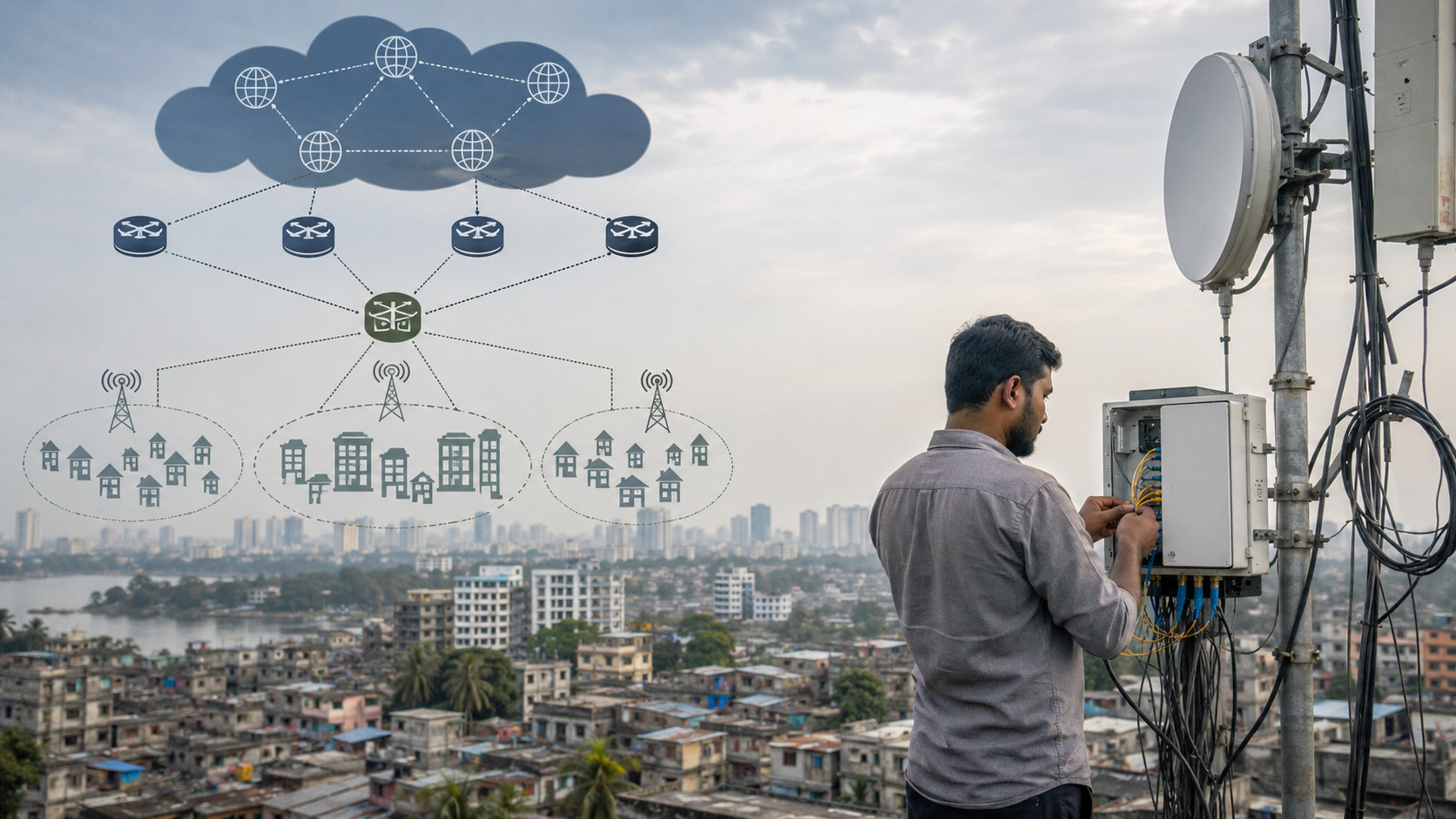
Speed Star Dot Net and the Microeconomics of Bangladesh’s Broadband Edge
Speed Star Dot Net is not important because it is large. It is important because it is small, visible, and positioned at the point where Bangladesh’s broadband economics become concrete. It owns or controls a registered autonomous system, announces a narrow portable address estate, sells low-ticket fixed broadband in a local Dhaka market, and appears publicly dependent on a concentrated upstream path. In that combination, the company illustrates a broader economic fact about small-network operators in Bangladesh: the retail ISP may own the customer relationship, but a large share of economic power sits above it, in the custody of address resources, domestic backhaul, international gateway access, content-cache reachability, licensing compliance, and route visibility.
The public record identifies the network as Speed Star Dot Net, operating AS149806. APNIC registry material ties the organization to ORG-SSDN2-AP and to the address KA-119/A, Kuril, Dhaka 1229, Bangladesh. Public BGP views show a small Bangladesh eyeball network with 512 IPv4 addresses originated across 103.186.216.0/23 and related /24s, plus IPv6 space under 2400:7520::/32, with valid RPKI-origin status in the observed sources. Its website, using the brand Speed Star.Net, sells local broadband packages from Tk 500 per month for 10 Mbps up to Tk 3,500 per month for 180 Mbps, advertising BDIX connectivity, Facebook and YouTube caching, optical fiber, shared and dedicated bandwidth, dedicated IP options, and 24-hour support.
The economic interpretation is sharper than a company profile. Speed Star Dot Net is an access-edge operator whose public assets are scarce but meaningful: an ASN, portable IP resources, a license trail, a local retail brand, and a route object visible to global collectors. These assets do not make the firm autonomous in the strong sense. They give it an option on autonomy. The public route table still shows a concentrated dependency surface, with Alfaz Network visible as the upstream path in major BGP views. Alfaz itself depends on larger providers, including Summit Communications, Level3 Carrier, and Rego Communications in the BGP.tools view. Speed Star therefore sits in a nested bargaining chain: local customers pay Speed Star; Speed Star depends on an upstream aggregator; the aggregator depends on larger domestic and international middle-mile suppliers; and the regulatory system governs which classes of operators may sell access, carry domestic transmission, and provide international connectivity.
The result is a useful case study in the economics of small-ASN custody. The ASN lets the operator announce its own prefixes, run RPKI, preserve address identity across upstream changes, and appear to customers and counterparties as a network rather than merely a reseller. But as long as the AS is single-homed or near-single-homed in visible routing, the real bargaining leverage remains limited. A local ISP with its own ASN can change upstreams more easily than a pure reseller can, but it may still face a wholesale market in which domestic backhaul, international connectivity, cable routes, and content-cache access are controlled by larger firms. In Bangladesh, this structural dependence has been reinforced by IIG and NTTN economics, and is now being recast under the 2025 licensing transition toward ICSP, NICSP, ANSP, and FTSP categories.
The identity problem: one operator, several names
The canonical registry identity is Speed Star Dot Net. APNIC records list ORG-SSDN2-AP as “Speed Star Dot Net,” an LIR in Bangladesh, with a Kuril address, phone number, and administrative email. The APNIC inet6num record for 2400:7520::/32 lists netname SPEEDSTARNET-BD, describes the holder as Speed Star Dot Net, marks the allocation as portable, and associates the lower and route maintainer with MAINT-SPEEDSTARNET-BD. Hurricane Electric’s rendering of the APNIC aut-num object identifies AS149806 as SPEEDSTARNET-AS-AP, with the description Speed Star Dot Net and country Bangladesh.
The operating identity is less tidy. The public website brands the company as Speed Star.Net. ISP Association of Bangladesh records use “Speed Star. Net,” list the website as www.speedstarbd.net, and show an Upazila/Thana ISP license number, trade license number, BIN, TIN, mobile number, and email address. The BTRC Upazila/Thana ISP list also records “Speed Star.Net” at Ka-119/1, Kuril, Vatara, Dhaka-1229, with the same license number as the ISPAB member profile.
This naming ambiguity is typical of small access providers in fragmented broadband markets. The economically relevant question is not whether every punctuation mark matches. It is whether the records point to the same operating asset. Here they do. The APNIC organization, BGP identity, ISPAB member record, BTRC license list, and website all converge on the Speed Star name, the Kuril/Vatara geography, the speedstarbd.net domain, and the same local ISP business. Minor variations such as “Dot Net,” “.Net,” and “. Net” should be treated as spelling and registry-format noise unless a corporate filing proves separate legal entities.
There is no public evidence in the reviewed sources that Speed Star Dot Net is a subsidiary of Coronet Corporation Limited, nor that Coronet is a successor owner. The user-supplied directory clues mentioning CORONET CORP LTD, Coronet Corporation Limited, and Asia Pacific Network Information Centre are economically meaningful, but they should not be overread. Coronet is a large Bangladesh IIG and IP transit operator with AS149765, substantial peering, and an official service portfolio aimed at service providers. Speed Star is a small AS149806 access network. The conservative interpretation is that both appear in the same Bangladesh routing and registry ecosystem. A direct commercial relationship is possible; a corporate-control relationship is not established by the public material reviewed here.
The active website adds another identity clue. It gives the company’s address as KA-119/A, Kuril, Vatara, Dhaka-1229, lists phone numbers +880 1724 808 454 and +880 1977 774 424, and uses info@speedstarbd.net. The footer states ©2022 Speed Star.Net and says the site is powered by Symbiosis ICT Solutions. That last line is a web-production signal, not ownership evidence. It does not establish Symbiosis as a parent, financier, or network operator.
The ownership record remains thin. ISPAB’s member profile says no director information is on file, and its member-list entry says no representative is on file. That does not mean the company lacks a controller; it means the publicly accessible association page does not disclose one. For infrastructure economics, this matters because beneficial ownership changes the bargaining model. An independent proprietor with a few thousand lines has one cost of capital and one risk profile. A local retail brand captive to a larger upstream has another. A reseller trading under an older brand has another. The registry trail proves network custody and operating identity; it does not prove ultimate control.
The service surface: cheap bandwidth, local trust, and engineered perception
Speed Star’s website sells what small urban access ISPs in Bangladesh commonly sell: residential and small-business fixed broadband packaged as speed tiers, with local content acceleration and support promises used to differentiate an otherwise commoditized connection. The headline claims are “trusted Internet Service Provider,” 99 percent uptime, and 24/7 support. The technical add-ons advertised are BDIX connectivity, Facebook and YouTube caching, dedicated IP, full duplex, and optical fiber. The marketing language emphasizes local performance and local support rather than national scale.
The price ladder is instructive. The listed monthly packages are 10 Mbps at Tk 500, 30 Mbps at Tk 600, 40 Mbps at Tk 700, 50 Mbps at Tk 800, 60 Mbps at Tk 1,000, 70 Mbps at Tk 1,200, 80 Mbps at Tk 1,500, 90 Mbps at Tk 1,800, 100 Mbps with IP at Tk 2,000, 130 Mbps with IP at Tk 2,500, 150 Mbps with IP at Tk 3,000, and 180 Mbps with IP at Tk 3,500. The higher packages include a real or dedicated IP proposition, while all advertised tiers include BDIX connectivity, FTP server access, and 24-hour availability.
This pricing reveals several mechanisms. First, headline speed is not priced linearly. The 10 Mbps package is Tk 50 per advertised Mbps, while the 30 Mbps package is Tk 20 per advertised Mbps and the 180 Mbps package is below Tk 20 per advertised Mbps. That does not imply the operator is buying wholesale bandwidth at those rates. Retail residential broadband is oversubscribed. The economic product is not committed international capacity; it is a probability distribution of usable throughput over time. The operator sells enough peak-hour experience to avoid churn, while relying on statistical multiplexing, local caches, BDIX traffic, and the fact that not all subscribers saturate their line simultaneously.
Second, the “Real IP” feature appears only at higher tiers on the public price table. That is a rational response to IPv4 scarcity. Public BGP views show Speed Star originating 512 IPv4 addresses. If the network has even a few thousand active users, public IPv4 addresses cannot be one-to-one customer identifiers. The likely operating model is carrier-grade NAT or other address-sharing for ordinary users, with public IPv4 monetized as a premium add-on for gamers, remote workers, CCTV users, small offices, and customers running reachable services. The evidence does not expose Speed Star’s NAT architecture, but the combination of 512 IPv4 addresses, consumer-ISP classification, and higher-tier real-IP packaging strongly points to IPv4 scarcity as a revenue-design constraint.
Third, BDIX and caching are not minor technical claims. They are economic instruments. A customer buying a low-cost local broadband line experiences value mainly through video, social platforms, gaming, messaging, and domestic content. If YouTube, Facebook, and local BDIX routes perform well, the customer may perceive the connection as fast even when international transit capacity is constrained. The operator can therefore defend retail satisfaction without buying enough expensive upstream capacity to support the full advertised speed to all international destinations at all times. In markets with low ARPU and intense local competition, cache hit ratios and domestic exchange performance are margin levers.
Fourth, the public testimonial language is local. One testimonial on the website says the provider is reliable “around Kuril.” That is a small phrase with economic significance. It suggests the competitive battlefield is not Bangladesh, not even Dhaka, but a neighborhood-level or building-cluster service territory. In such a market, brand trust comes from field repair times, payment flexibility, local technicians, building access, and whether the provider has already strung fiber into an apartment block.
Geography and layer: an access ISP, not a national carrier
The operating footprint visible in public records is concentrated around Kuril/Vatara in Dhaka. APNIC lists the organization’s address as KA-119/A, Kuril, Dhaka 1229. ISPAB lists Ka-119/1, Kuril, Vatara, Dhaka-1229. BTRC’s Upazila/Thana ISP list records the same neighborhood and license number. The website’s contact section uses the same address family.
The license category matters. ISPAB’s profile describes the BTRC license type as Upazila/Thana. BTRC’s public list is also an Upazila/Thana ISP list. In Bangladesh, this is not the same economic position as an international gateway, nationwide ISP, domestic transmission provider, or tower/fiber infrastructure company. It is a localized access-market authorization. It points to last-mile retail service, not ownership of a national middle-mile network.
At the network layer, BGP evidence supports the same conclusion. BGP.tools classifies AS149806 as an “Eyeball” network and lists one upstream, two peers, three IPv4-originated entries, and five IPv6-originated entries. Hurricane Electric shows eight total originated prefixes, all RPKI-valid in its view, and one observed BGP peer. IPinfo describes AS149806 as an ISP, classifies it as a consumer ISP, and notes no hosted domains in its dataset.
This is the profile of a local broadband edge. It originates customer-facing address space; it does not appear as a large transit provider; it does not host a visible ecosystem of domains; and it does not announce a broad inventory of routes. That does not mean the network is trivial. The last mile is the layer where retail cash is collected. But the technical footprint indicates that Speed Star’s value is more likely in customer relationships, local distribution, and address custody than in wholesale network scale.
The visible network: AS149806 as a small stub system
AS149806 was allocated in the APNIC region in April 2022 in the public BGP.tools and IPinfo views. The current public route evidence shows a narrow address estate: 103.186.216.0/23, its constituent /24s, and five IPv6 /48 announcements under 2400:7520::/32. APNIC’s inet6num object records 2400:7520::/32 as an allocated portable IPv6 block for Speed Star Dot Net. BGP.tools and Hurricane Electric both show RPKI validity for the visible originated routes.
The phrase “stub AS” is economically useful. A stub network primarily originates its own customer traffic and does not provide broad transit to others. IPinfo’s tags include “stub AS” and describe the network as having a pronounced day/night rhythm consistent with a consumer or eyeball network. BGP.tools calls it an eyeball network. Those observations align with the website’s residential and small-business broadband packages.
A 512-address IPv4 estate is small but valuable. In a mature IPv4-scarce market, 512 public IPv4 addresses can support customer NAT pools, public IP add-ons, infrastructure, management, and business customers. The direct accounting value of the addresses may be modest relative to a large carrier, but their option value is high for a local ISP: they support independent routing, make upstream substitution less disruptive, and allow the company to sell a differentiated “real IP” product. The IPv6 allocation is enormous in address count, but its immediate monetization is weaker because many customer devices, applications, and support processes still depend on IPv4 reachability. IPv6 helps future-proof the network and improve routing hygiene; IPv4 still drives scarcity pricing.
The valid RPKI signal is worth noting. Many small networks fail at route-object and RPKI hygiene because the operational payoff is indirect. Speed Star’s visible RPKI-valid status suggests that at least one competent administrator or upstream-support workflow has aligned the prefix origins with registry authorization. That reduces the probability of accidental route rejection by networks enforcing RPKI origin validation. It does not prove high-quality service, but it is a positive indicator of registry discipline.
The upstream signal is more constraining. BGP.tools lists Alfaz Network as the upstream of AS149806. Hurricane Electric’s peer table also shows AS132366 Alfaz Network as the observed IPv4 and IPv6 peer. Public route collectors are incomplete, and some private peering or domestic exchange arrangements may not be visible. Still, the public evidence supports a concentrated upstream structure. The company may have ASN custody, but it does not publicly exhibit the redundancy of a multi-homed regional ISP with several transit suppliers and extensive peering.
ASN custody is an option, not independence
An autonomous system number is often mistaken for network independence. Economically, it is better understood as a property right plus an option contract. It gives the operator the ability to originate prefixes, choose upstreams, publish route policy, build reputation, and move traffic without renumbering customers. Those are real advantages over a pure reseller using upstream-assigned addresses.
For Speed Star, the option value is visible. The company controls AS149806 and originates its own IPv4 and IPv6 resources. Its public prefixes are RPKI-valid. If an upstream contract became too expensive or unreliable, an operator with portable resources can, in principle, shift to another upstream or add a second one while retaining the same address identity. This makes the ISP less fragile than a reseller whose customers are numbered out of a wholesaler’s block.
But the option is not the same as exercise. To exercise ASN autonomy, the operator needs practical alternatives: fiber paths to another upstream, compatible handoff points, affordable ports, engineering capacity, routing policy, RPKI updates, billing terms, and regulatory permission. In a local access market, those frictions can be large. A second upstream may require new cross-connects, new domestic transmission, new equipment, minimum commits, and technical staff who can operate BGP during failures. The economic value of the ASN is therefore contingent on the market for upstream connectivity.
This is why Speed Star is a good example of “autonomy-in-waiting.” It has the registry assets that make autonomy possible. Yet the visible routing evidence shows dependence on Alfaz Network. The network has a passport, but not necessarily many roads out of town.
The same logic applies to portable IP space. Portable addresses improve bargaining power because customers and NAT pools do not have to be renumbered when the upstream changes. But if domestic backhaul and gateway access are scarce or expensive, portability only partly reduces lock-in. The larger bargaining issue is not the address block; it is the physical and commercial path to the rest of the internet.
Retail demand: why small fixed ISPs survive beside mobile giants
Bangladesh is an overwhelmingly mobile internet market by subscriber count, but fixed broadband occupies a different usage niche. AMTOB’s industry statistics, citing BTRC data, reported 119.12 million mobile internet subscribers and 14.95 million ISP plus PSTN internet subscribers at the end of May 2026, with total internet subscribers of 134.07 million. The same AMTOB page reported 188.60 million mobile subscribers. A Daily Star report on BTRC data said fixed broadband connections were stable and gradually expanding, with fixed connections at 1.48 crore in January 2026 after 1.46 crore from September to December 2025, even as mobile internet subscriptions declined over the preceding six months.
This matters because mobile and fixed are not perfect substitutes. Mobile data is personal, portable, and often capacity-constrained by radio conditions and package economics. Fixed broadband is household and premises-based. It supports shared video, work-from-home, gaming, CCTV, Wi-Fi calling, streaming boxes, and small office use. A local fixed ISP does not need to beat mobile on every dimension. It needs to provide a stable, cheap, unlimited or high-allowance home connection in buildings where its last-mile fiber is already present.
The Bangladesh fixed-broadband market also remains fragmented. A BTRC broadband connectivity report refers to 2,715 ISPs and notes ISP plus PSTN user growth from 12.49 million in October 2023 to 13.74 million in October 2024, with 173,845 km of fiber-optic deployment and total network bandwidth of 6,600 Gbps. The same report identifies nationwide, divisional, district, and upazila/thana concession types and references a 20 Mbps fixed-broadband minimum standard.
Fragmentation creates room for firms like Speed Star. A neighborhood ISP can win by being physically close, cheap, and responsive. It can know which building managers allow cable access, which poles are congested, which customers pay on time, and which households will tolerate brief outages if field staff answer the phone. That local knowledge is hard for national operators to replicate cheaply at the last few hundred meters.
But fragmentation also destroys pricing power. When there are many licensed ISPs and many informal or illegal operators, customers can compare simple monthly tariffs. A small access ISP cannot easily raise prices unless it offers superior reliability, real IP addresses, business support, or building-specific convenience. Speed Star’s package ladder sits within this competitive logic: low headline entry price, large speed steps, and premium IP features at higher tiers.
Revenue logic and margin pressure
The retail revenue model is simple: monthly subscription receipts, installation charges if any, premium tiers, real-IP add-ons, business lines, and perhaps small ancillary services such as router configuration or dedicated bandwidth. The economics below the revenue line are more complex.
Assume a purely illustrative scenario. If Speed Star had 1,000 paying lines at Tk 700 average monthly revenue, gross monthly revenue would be Tk 700,000. At 3,000 lines, it would be Tk 2.1 million. At 5,000 lines, it would be Tk 3.5 million. Those numbers are not reported company figures; they are scale markers. APNIC Labs customer-population estimates that appeared in search-result snippets placed Speed Star in the several-thousand-user range on sampled dates in 2025 and 2026, but APNIC Labs measurements are not the same as billable subscriptions and can be affected by ad-measurement bias, NAT, device distribution, and sample composition.
The cost stack starts with upstream capacity. For a local ISP, international transit and domestic backhaul are not the same as retail Mbps. A 100 Mbps residential customer does not require 100 Mbps of committed upstream capacity, but the ISP must buy enough peak bandwidth to keep congestion below the churn threshold. The operator also needs domestic reachability to BDIX and cache nodes. Local cache performance can substitute for some international transit, but only for content that is cacheable and locally served.
Then come physical access costs: fiber drops, splitters, ONUs, routers, splicing, power, pole or duct arrangements, rooftop access, building permissions, repair inventory, and transport from the local access network to the upstream handoff. Small operators often understate these costs because much of the work is operational rather than capitalized. A field technician’s scooter ride to fix a broken drop cable is not glamorous infrastructure spending, but it is one of the main determinants of churn.
Customer support is another margin line. The website advertises 24/7 support and instant support. In a local ISP, support is not merely a service promise; it is a retention mechanism. A customer may tolerate an outage if someone known answers the phone and fixes the line quickly. Conversely, repeated unresponsiveness converts a low-switching-cost broadband product into churn.
Licensing and tax costs are not negligible. ISPAB records list a BTRC license number, trade license, BIN, and TIN for Speed Star. The 2025 licensing transition raises the stakes because migration and renewal costs under new FTSP categories can be material for small operators. Draft FTSP guidelines show revenue sharing and social-obligation contributions, as well as application, acquisition, migration, annual, renewal, and bank-guarantee amounts. For a district FTSP, the table includes a BDT 10,000 application fee, BDT 200,000 acquisition fee, BDT 100,000 migration fee, BDT 100,000 annual fee, BDT 200,000 renewal fee, BDT 200,000 bank guarantee, 5.5 percent revenue sharing, and 1 percent social-obligation contribution. For a full FTSP, the listed amounts are substantially higher.
Those costs push the market toward minimum efficient scale. A one-neighborhood operator with low ARPU can survive if it has dense customers, cheap support, favorable upstream terms, and low bad debt. But the same operator becomes fragile if regulatory fixed costs rise, if upstream minimum commits increase, or if a larger competitor enters the same buildings with promotional pricing.
The retail tariff environment intensifies this squeeze. BTRC’s “One Country, One Rate” policy set headline fixed-broadband tariff bands in 2021, with reports describing Tk 500 per month for minimum 5 Mbps, Tk 700–1,000 for 10 Mbps depending on the report, and Tk 1,100–1,200 for 20 Mbps or above. The policy sought to reduce geographic price discrimination and protect consumers, but press reports also recorded operator complaints that IIG bandwidth prices and NTTN charges were high and that implementation remained uneven.
For a company like Speed Star, this creates a classic regulated-retail, less-regulated-wholesale problem. Retail prices are constrained by policy, competition, and customer expectations. Wholesale and middle-mile costs are shaped by supplier concentration, route geography, and contract terms. Margin is the residual. The local ISP owns the complaint relationship with the customer, but not all the inputs needed to control quality.
Upstream concentration and the middle-mile toll
The most economically important public fact about Speed Star’s routing is its visible upstream concentration. BGP.tools shows AS149806 with one upstream, Alfaz Network, and Hurricane Electric’s peer table also identifies Alfaz as the observed IPv4 and IPv6 peer. Alfaz Network itself is a Bangladesh AS with several upstreams visible in BGP.tools, including Summit Communications, Level3 Carrier, and Rego Communications, and it appears to have downstream relationships that include Speed Star.
This implies a layered dependency. Speed Star’s immediate commercial and operational relationship may be with Alfaz. Alfaz’s economics depend on larger upstream suppliers. Those larger suppliers depend on international capacity, domestic transmission, peering, content caches, and regulatory status. Every layer adds both service value and bargaining extraction.
Middle-mile providers have market power for five reasons. First, they aggregate demand across many small ISPs and can buy or peer at scales that a local ISP cannot. Second, they control physical handoff and domestic transport routes. Third, they have better access to content caches, IX ports, and international paths. Fourth, they can manage route policy, filtering, RPKI, and capacity engineering at professional scale. Fifth, regulatory rules historically gave particular license classes privileged roles in internet gateway and transmission functions.
Bangladesh’s IIG regime made this visible. A Financial Express report said thana and upazila-level ISPs were instructed to purchase bandwidth from IIG providers from July 1, with regulatory action threatened for non-compliance. The same report described complaints that IIG bandwidth prices were high, IIG availability was not uniform across the country, long cable routes raised costs, and IIGs were not themselves under the “one country, one rate” retail framework.
That is the structural squeeze. The customer sees Speed Star’s Tk 500 or Tk 800 package. Speed Star sees upstream invoices, backhaul constraints, power cuts, equipment failures, and regulatory costs. A middle-mile provider sees many Speed Stars, and can price based on the fact that the local ISP cannot easily tell all customers to wait while it rebuilds its upstream path.
The 2025 licensing reform changes the terminology but not necessarily the underlying economics. The Bangladesh Telecommunications Network and Licensing Policy 2025 says legacy ICX, IIG, and IGW licenses are to be phased out upon expiration. It introduces categories such as Access Network Service Provider, National Infrastructure Connectivity Service Provider, International Connectivity Service Provider, and Fixed Telecom Service Provider. The policy describes ANSPs as access-network entities, NICSPs as infrastructure and transmission providers, and ICSPs as international-connectivity providers. District FTSPs may provide internet and data services within a district and obtain international internet bandwidth from an ICSP or FTSP.
For a small ISP, the key question is not whether the supplier is called IIG or ICSP. The question is whether there are enough competing wholesale paths to discipline price and quality. If the reform increases contestability, small ISPs gain bargaining power. If it simply relabels the chokepoints while increasing compliance costs, consolidation pressure rises and middle-mile market power persists.
Coronet as a benchmark for middle-mile power
Coronet Corporation Limited is relevant because it shows the other side of the market. Its official site describes Coronet as an IIG and IP transit company in Bangladesh, offering MPLS, IPLC, Global Ethernet, dedicated internet access, and IP transit. Its PeeringDB profile identifies AS149765, says it operates as an IIG and as a nationwide retail ISP through another AS, reports 1–5 Tbps traffic, and describes extensive peering with CDN/content providers and international internet exchanges. Hurricane Electric’s page for AS149765 shows multiple internet exchanges, many observed BGP peers, and a route footprint far larger than Speed Star’s.
This contrast is the market structure in miniature. Speed Star has hundreds of IPv4 addresses, a local address, a small set of originated prefixes, and one visible upstream. Coronet advertises service-provider products, large traffic scale, extensive peering, and many observed peers. The small ISP sells to households and small businesses. The middle-mile provider sells to ISPs, mobile operators, and other service providers.
The commercial power difference follows from scale. Coronet-type operators can blend transit, peering, cache access, and domestic transport. They can manage large inbound content flows and negotiate with international carriers. They can offer service-level promises backed by multiple paths. Speed Star-type operators can offer customer intimacy and local installation speed, but they cannot easily reproduce the upstream supply chain.
This does not mean every small ISP is economically doomed. The access edge has its own moat: local customer acquisition, last-mile density, building relationships, fast repair, and trust. But it does mean the surplus is contested. When retail prices are low and middle-mile inputs are concentrated, the small ISP’s margin depends on operational discipline and favorable procurement. The middle-mile provider can capture a large share of infrastructure surplus because it controls scarce aggregation functions.
If Coronet appears beside Speed Star in directory or routing datasets, the analytically useful inference is ecosystem proximity. Both are Bangladesh APNIC-visible networks; one is a large provider of IIG/IP-transit services, the other a small local access network. That proximity is economically sufficient to matter even without evidence of ownership. It frames the bargaining environment in which Speed Star operates.
Route visibility: useful evidence with hard limits
BGP evidence is unusually valuable because it is hard to fake in the way marketing language can be faked. A network either originates prefixes visible to route collectors or it does not. Its ROAs are valid, invalid, or absent in observed validation systems. Its upstream paths are seen or not seen. For Speed Star, public BGP evidence proves that AS149806 is an active routed network, not merely a dormant company listing.
But route visibility is not financial visibility. It does not reveal subscriber count, revenue, churn, uptime, support quality, private peering, precise fiber routes, building penetration, bad debt, or supplier pricing. It also does not fully reveal domestic arrangements. A small ISP may have private BDIX connectivity, cache handoffs, or local transport relationships not visible in global route collector summaries. Conversely, a single visible upstream may understate operational relationships if traffic is exchanged privately.
The best use of BGP data is role classification. Speed Star looks like a consumer eyeball network because it originates a small address block, has no visible hosted-domain base in IPinfo’s dataset, advertises retail broadband packages, and shows consumer-network behavioral tags. It does not look like a hosting provider, large carrier, or content network.
The second use is dependency analysis. Public collectors show a concentrated upstream path through Alfaz Network. That does not prove there is no backup link of any kind, but it makes a robust multi-homed architecture unlikely in the public internet view. If Speed Star added a second visible upstream, particularly one not dependent on the same domestic supplier chain, the economics would change. Redundancy would improve uptime, bargaining leverage, and service quality for higher-value customers.
The third use is operational hygiene. Valid RPKI and coherent APNIC objects suggest the network’s registry state is maintained. That matters because Bangladesh’s small-ISP market includes many operators with weak formal systems. Registry discipline is a modest but real signal of professionalization.
The fourth use is scarcity inference. The 512 IPv4 address estate, combined with retail broadband packages and APNIC Labs user-population estimates in the thousands on sampled dates, suggests public IPv4 rationing and likely address sharing. This supports an economic reading of real-IP packages as a premium product. It does not establish exact CGNAT ratios or customer counts.
Customer churn: low formal switching costs, high local frictions
Broadband churn economics in a dense urban neighborhood are paradoxical. On paper, switching is easy. Many ISPs may operate in the same locality; advertised packages are comparable; entry-tier prices are low; and customers can call another provider. In practice, switching has frictions.
The first friction is physical. A household may already have a fiber drop, ONU, router configuration, and cable path from Speed Star. Changing providers may require a new drop, new installation appointment, new router settings, new payment relationship, and possible downtime. In apartment buildings, the available providers may be limited by rooftop access, building management, duct space, or informal arrangements.
The second friction is service trust. A customer who knows a local technician or has a direct phone number may hesitate to switch to a cheaper but less responsive provider. Speed Star’s public emphasis on 24/7 support and instant support is a direct response to this friction. In a low-price market, service recovery often matters more than brand advertising.
The third friction is application-specific. Customers with CCTV, gaming, remote access, small-office VPNs, or server-like needs may depend on a public IPv4 address or stable NAT behavior. Speed Star’s higher tiers that include an IP address can reduce churn among these users. Once a customer has configured devices around a real IP, switching has higher setup costs.
The fourth friction is perceived performance. If BDIX, YouTube, and Facebook work well, many customers will not investigate the international route table. They will judge the service by the applications they use most. Local caching and exchange connectivity can therefore reduce churn without requiring the operator to improve all destinations equally.
At the same time, buyer power remains real. Low-income and price-sensitive households can switch for small monthly savings. Students, renters, and small shops may churn when service fails repeatedly. Mobile data remains a substitute for light users, while larger national or regional ISPs can run promotions. The local ISP’s power is therefore narrow: it can retain customers through convenience and support, but it has limited ability to raise prices above neighborhood norms.
Regulation: the hidden fixed cost of legitimacy
The BTRC and ISPAB records indicate that Speed Star’s formal market position is that of a licensed local ISP, but the current status requires caution. ISPAB lists license number 14.32.0000.702.46.716.20.184 and says the license type is Upazila/Thana. BTRC’s Upazila/Thana ISP list, marked as of 18 December 2024, includes Speed Star.Net at the Kuril/Vatara address with the same license number and a validity date of 13 February 2024 in the parsed row.
This is not enough to conclude that Speed Star was unlicensed after that date. Public lists can be stale, renewal columns can be ambiguous, and an operator can remain listed while renewal or migration is in process. The active website, APNIC abuse-contact validation, and active BGP visibility all suggest continued operation. But the license-status ambiguity is economically important. A small ISP’s bargaining power with upstreams, landlords, enterprise customers, and regulators depends heavily on formal compliance.
The 2025 licensing framework increases the importance of scale. Existing ISP categories are being migrated toward new FTSP categories, and draft guidelines state that existing ISP and PSTN licensees must apply for migration to continue after expiry, with no financial incentive, subsidy, or waiver. The district FTSP category appears to be the more relevant pathway for an Upazila/Thana operator that wants to remain local, while a full FTSP license carries much larger fees and guarantees.
For Speed Star, the district FTSP economics are potentially material. A small operator with a few thousand customers can absorb a BDT 100,000 migration fee and BDT 100,000 annual fee more easily than a micro-operator with a few hundred lines, but the 5.5 percent revenue share and 1 percent social-obligation contribution are ongoing margin claims. The bank guarantee also ties up capital. These costs create a regulatory scale economy. They encourage consolidation, resale relationships, or absorption into larger operators.
The policy also changes vertical boundaries. The new framework distinguishes access, fixed telecom service, domestic infrastructure connectivity, and international connectivity. It allows district FTSP licensees to obtain international bandwidth from ICSPs or FTSPs and permits fixed telecom service providers to build their own last-mile connectivity, while NICSPs provide transmission infrastructure for leasing and sharing.
The likely effect is not a simple deregulation story. It may reduce legacy inefficiencies, but it can also increase compliance burdens and strengthen larger firms that can finance guarantees, revenue sharing, and network obligations. Small ISPs that lack dense customer bases may become acquisition targets or wholesale-dependent resellers. Operators with clean licenses, own ASN resources, and stable local customers will be better positioned.
Market power: who captures the surplus?
Speed Star’s case shows that broadband surplus is split among at least six actors: the retail ISP, the upstream aggregator, the domestic transmission provider, the international connectivity provider, content/cache ecosystems, and the regulator. The household pays one bill, but the revenue is economically pre-allocated by the cost structure.
The retail ISP captures value from customer acquisition and last-mile operations. It knows where customers are, installs the line, collects payment, answers the phone, and absorbs complaints. This is labor-intensive and locally embedded. Its advantage is proximity.
The upstream aggregator captures value from scale. It aggregates many retail networks, buys larger capacity, manages BGP, maintains upstream diversity, and can connect to content-rich paths. Alfaz Network’s visible role as Speed Star’s upstream illustrates this layer. It is smaller than a Coronet-type IIG, but it still sits above Speed Star in the dependency chain.
The large IIG, ICSP, or transit provider captures value from even greater scale and route optionality. Coronet’s public profile shows the economics of that layer: IP transit, dedicated internet access, MPLS, IPLC, Global Ethernet, extensive peering, and high traffic volumes. Such providers can sell reliability and reachability to many smaller networks.
Domestic infrastructure providers capture value from rights of way, fiber routes, ducts, poles, and backhaul. Even when international bandwidth becomes cheaper, the path from a neighborhood access network to a major aggregation point can remain expensive. Bangladesh press reports on IIG dependence recorded complaints about cable-route costs and NTTN charges.
Content and cache providers capture value indirectly. They reduce the ISP’s transit burden and improve customer experience, but they also shape traffic concentration. If a few platforms dominate peak traffic, cache placement and peering access become quasi-essential inputs. A local ISP advertising Facebook and YouTube caching is effectively telling customers that it has optimized for the dominant applications.
The regulator captures value and imposes constraints through licensing, revenue shares, social-obligation contributions, tariff policy, and enforcement. The intent may be universal service, consumer protection, and orderly market structure. The effect on small ISPs is a fixed-cost hurdle and a compliance filter.
Supplier power is strongest where alternatives are few and switching is operationally risky. Buyer power is strongest where products are commoditized and physical switching is easy. Speed Star sits between them. It faces customers with many options and suppliers with fewer options. That is why ASN custody matters: it is one of the few assets that can reduce supplier lock-in.
Abuse, security, and reputation signals
The public abuse footprint does not show a major adverse signal. Scamalytics’ ISP page for Speed Star Dot Net describes the network as low risk with a fraud score of zero in its dataset, while also warning that its visibility is limited and its statements are opinions based on observed web traffic. CleanTalk’s page for one Speed Star IP showed no current listing in its anti-spam or SpamFirewall databases for that IP, while also showing some ordinary network-level spam-rate and historical activity indicators. AbuseIPDB’s AS page identifies AS149806, Bangladesh, and the two IP ranges corresponding to the 512-address IPv4 block and IPv6 space.
These signals should be weighted lightly. Residential eyeball networks routinely produce scattered abuse reports because customers run infected devices, misconfigured routers, spamware, VPNs, torrents, or compromised phones. IPinfo tags Speed Star with BitTorrent and VPN-related signals as well as consumer-ISP behavior. That is not by itself a sign of a malicious provider. It is consistent with a small residential access network.
There was no credible public evidence in the reviewed material of a major outage, security breach, litigation event, procurement dispute, license cancellation, or systemic abuse problem involving Speed Star. Absence of evidence is not evidence of absence. Local service complaints may exist in Facebook groups, phone conversations, or neighborhood channels that are not indexed in durable public records. For a company of this size, reputation is likely hyperlocal and may not leave a searchable trace.
The stronger risk signal is operational concentration. A single visible upstream creates outage correlation. A regulatory renewal gap creates enforcement risk. A small address estate creates NAT and real-IP support complexity. Those are more economically important than the available abuse indicators.
Alternative hypotheses
The most likely hypothesis is that Speed Star Dot Net is an independent or locally controlled Dhaka access ISP with its own ASN, portable IP resources, and upstream dependence on Alfaz Network. The evidence supporting this is direct: APNIC registry records, ISPAB membership, BTRC license listing, active website, and active BGP originations.
A second hypothesis is that Speed Star is a trade-name or proprietor-led operation whose formal legal wrapper is less visible than its network identity. This is common in small ISP markets. The evidence does not disclose directors or a corporate register filing, and the naming varies across sources. Economically, this would mean management depth and financing capacity may depend on a small number of individuals rather than an institutional balance sheet.
A third hypothesis is that Speed Star is operationally captive to an upstream or middle-mile provider, even if not legally owned by one. This would occur if the company’s upstream contract, address administration, billing support, or field operations were effectively controlled by a larger partner. The visible single-upstream relationship makes commercial dependence plausible, but it does not prove captivity. Economically, captivity would reduce Speed Star’s independent bargaining power and convert part of its business into a local customer-acquisition channel for the upstream ecosystem.
A fourth hypothesis is that the public BTRC license record is stale or incomplete relative to current operations. The BTRC list as of December 2024 includes Speed Star with a validity date in February 2024, while other records show continued website and BGP activity. This could reflect renewal lag, list-maintenance issues, migration status, or a compliance problem. Economically, a clean renewal or migration would support continuity; a genuine lapse would increase shutdown, disconnection, and acquisition risk.
A fifth hypothesis is that Coronet or another larger provider is a direct counterparty. Coronet’s public IIG/IP-transit role and large peering footprint make it a plausible market participant around small ISPs, but the reviewed sources do not establish a direct relationship with Speed Star. If a direct Coronet relationship were proven, the economic interpretation would depend on its form. Transit supply would be ordinary wholesale dependence; reseller control would imply reduced independence; acquisition would change the company from a stand-alone micro-ISP into a retail edge of a larger network.
What the evidence proves, suggests, and leaves unresolved
The evidence proves that Speed Star Dot Net is the APNIC-registered identity associated with AS149806 and ORG-SSDN2-AP. It proves that the network originates a small IPv4 and IPv6 footprint visible in BGP, with RPKI-valid routes in the reviewed public views. It proves that the operating brand speedstarbd.net advertises local broadband packages, BDIX connectivity, caching, fiber, support, and real-IP features. It proves that ISPAB and BTRC records tie a Speed Star.Net local ISP identity to Kuril/Vatara, Dhaka, and to a specific Upazila/Thana ISP license number.
The evidence suggests that Speed Star is a small local fixed-broadband access operator serving residential and small-business users. It suggests customer scale in the low-thousands rather than hundreds of thousands, though public measurement estimates should not be converted mechanically into subscribers. It suggests likely IPv4 address sharing, because the public IPv4 estate is only 512 addresses while the service surface is a consumer broadband network. It suggests material upstream bargaining exposure, because public collectors show a concentrated relationship through Alfaz Network.
The evidence leaves unresolved the company’s beneficial ownership, financing, management, exact subscriber count, ARPU, churn, debt, supplier contracts, current license renewal or migration status, direct BDIX or cache topology, customer complaint history, fiber footprint, and any direct commercial relationship with Coronet. Those unresolved facts are not decorative. Each would change the economics.
If ownership is local and independent, the key risk is supplier dependence and regulatory fixed cost. If ownership is upstream-linked, the key question becomes whether Speed Star is a margin-bearing retail business or a customer-acquisition appendage. If subscriber count is closer to 500 than 5,000, license migration costs could be severe. If it is closer to 5,000 dense lines, the business may have a defensible local cash base. If the company has a second private upstream not visible in public collectors, outage and bargaining risks are lower than the public route table implies. If the BTRC license is not current, the risk profile changes immediately.
Infrastructure economics in one small network
Speed Star Dot Net reveals that Bangladesh’s small-ISP economics are not reducible to bandwidth resale. The local ISP combines five functions: it is a neighborhood sales organization, a last-mile repair company, a billing collector, a scarce-address steward, and a buyer of middle-mile reachability. Its competitive advantage is local density. Its vulnerability is upstream dependence.
ASN custody gives the company a formal network identity. That identity has option value because it can survive upstream changes and support real-IP monetization. But ASN custody does not eliminate market power above the ISP. If the operator has only one practical upstream path, the supplier can still capture much of the surplus. If retail tariffs are constrained and customers are price-sensitive, the ISP cannot pass through every upstream cost increase. If regulatory migration adds fixed costs, small scale becomes a liability.
The company also shows why route visibility both matters and misleads. Public BGP data can identify the network’s role, address scarcity, upstream concentration, and route hygiene. It cannot tell whether the field technician arrives in 20 minutes, whether customers pay on time, whether building managers favor one ISP, or whether the upstream contract is punitive. Infrastructure intelligence must therefore combine route data with licensing, tariffs, market structure, and local service evidence.
The most important conclusion is that middle-mile providers hold disproportionate market power because they sell the scarce input that converts local access into internet service. A small ISP can own the customer relationship but still lack control over quality and cost. In that sense, Speed Star is not just a company. It is a measurement point in the political economy of Bangladesh broadband: local retail competition below, concentrated routing and transmission dependencies above, and regulatory transition pressing from the side.
Evidence ledger
- APNIC/RDAP starting record for AS149806, Speed Star Dot Net, entity handle ORG-SSDN2-AP: https://rdap.org/autnum/149806. This is the target-identification anchor supplied for the report; APNIC WHOIS renderings provide the corroborating registry fields used above.
- APNIC WHOIS, inet6num 2400:7520::/32, SPEEDSTARNET-BD, Speed Star Dot Net, ORG-SSDN2-AP, KA-119/A, Kuril, Dhaka 1229, allocated portable IPv6 space, validated abuse contact: https://wq.apnic.net/apnic-bin/whois.pl?object_type=inet6num&searchtext=2400%3A7520%3A%3A%2F32.
- APNIC WHOIS, organization object ORG-SSDN2-AP, Speed Star Dot Net, Bangladesh LIR identity, phone and email fields: https://wq.apnic.net/apnic-bin/whois.pl?form_type=advanced&searchtext=ORG-SSDN2-AP.
- Hurricane Electric BGP Toolkit, AS149806, Speed Star Dot Net, APNIC aut-num rendering, originated prefixes, RPKI status, observed peer Alfaz Network: https://bgp.he.net/AS149806.
- BGP.tools, AS149806, Speed Star Dot Net, active Bangladesh eyeball network, upstream Alfaz Network, originated prefixes and RPKI-valid status: https://bgp.tools/as/149806.
- IPinfo, AS149806, Speed Star Dot Net, Bangladesh ISP, 512 IPv4 addresses, consumer-ISP and stub-AS signals: https://ipinfo.io/AS149806.
- Official Speed Star.Net website, service claims, BDIX connectivity, caching, dedicated IP, fiber, package ladder, contact details: https://www.speedstarbd.net/.
- ISP Association of Bangladesh member profile for Speed Star. Net, membership A-332, BTRC Upazila/Thana license number, establishment date, trade license, BIN, TIN, website and contact data: https://ispab.org/member/speed-star-net.
- ISP Association of Bangladesh members-list entry for Speed Star. Net, license category and Kuril/Vatara address: https://ispab.org/members/S?page=5.
- BTRC Upazila/Thana ISP license list as of 18 December 2024, including Speed Star.Net at Ka-119/1, Kuril, Vatara, Dhaka-1229, license number 14.32.0000.702.46.716.20.184: https://objectstorage.ap-dcc-gazipur-1.oraclecloud15.com/n/idjz6hji0u8v/b/btrc-prod/o/static%2Fuploaded%2Flicense%2FISP%28Upazila_Thana%29%20License%20List%20as%20on%2018-12-2024%20%281%29%20%281%29%20%281%29_29e9f4bf494145f5bfee76bd1a384ddc.pdf.
- BGP.tools, AS132366 Alfaz Network, visible upstreams, peers, downstream relationship context including Speed Star: https://bgp.tools/as/132366.
- Hurricane Electric BGP Toolkit, AS132366 Alfaz Network, RPKI and peer observations: https://bgp.he.net/AS132366.
- Coronet Corporation Limited official site, IIG and IP transit service descriptions: https://coronetbdiig.com/.
- PeeringDB, Coronet Corporation Limited, AS149765, network type, traffic scale, peering policy, IIG and nationwide retail ISP description: https://www.peeringdb.com/net/32178.
- Hurricane Electric BGP Toolkit, AS149765 Coronet Corporation Limited, internet exchanges, prefixes, peers, and route footprint: https://bgp.he.net/AS149765.
- APNIC Labs Bangladesh customer-population estimates by AS, including sampled Speed Star and Coronet estimates; useful as directional measurement, not subscriber accounting: https://stats.labs.apnic.net/cgi-bin/aspop?c=BD&d=07%2F08%2F2025 and related date views.
- AMTOB industry statistics citing BTRC data, May 2026 mobile, mobile-internet, ISP plus PSTN, and total internet subscriber counts: https://www.amtob.org.bd/home/industrystatics.
- Daily Star, internet subscriber base and fixed-broadband stability, January 2026 BTRC subscriber figures: https://www.thedailystar.net/business/economy/news/internet-subscriber-base-shrinks-70-lakh-6-months-4128611.
- BTRC Broadband Connectivity Report, ISP concession types, fixed-broadband minimum speed standard, ISP count, fiber deployment and fixed-broadband growth context: https://objectstorage.ap-dcc-gazipur-1.oraclecloud15.com/n/idjz6hji0u8v/b/btrc-prod/o/report%2F2553c9a48743467faaa8b420c2e6ecb5.pdf.
- Daily Star, “One Country, One Rate” broadband tariff framework and BTRC tariff bands: https://www.thedailystar.net/toggle/news/one-country-one-rate-internet-flat-rate-across-the-country-soon-2105929.
- The Business Standard, rural broadband users, tariff implementation, illegal ISP concerns, and operator complaints about IIG and NTTN costs: https://www.tbsnews.net/bangladesh/telecom/broadband-internet-rural-users-still-pay-higher-get-lesser-speed-277135.
- Financial Express, BTRC direction requiring zonal or thana/upazila ISPs to buy bandwidth from IIG providers and industry complaints about cost and quality: https://thefinancialexpress.com.bd/home/zonal-isps-have-to-buy-bandwidth-from-iig-service-providers-1650680035.
- Bangladesh Telecommunications Network and Licensing Policy 2025, phase-out of legacy IIG/IGW/ICX categories and introduction of ANSP, ICSP, NICSP, and related categories: https://objectstorage.ap-dcc-gazipur-1.oraclecloud15.com/n/idjz6hji0u8v/b/btrc-prod/o/notice%2Fdc545fba9f8b4a39851a4f3290f5573c.pdf.
- Draft Regulatory and Licensing Guidelines for Fixed Telecom Service Provider, migration rules, renewal conditions, fees, bank guarantees, revenue sharing and social-obligation contributions: https://objectstorage.ap-dcc-gazipur-1.oraclecloud15.com/n/idjz6hji0u8v/b/btrc-prod/o/notice%2Fed7fe810835b43a8ac5243cfd782bfce.pdf.
- Scamalytics, Speed Star Dot Net ISP risk page, low-risk fraud score with explicit limitation caveat: https://scamalytics.com/ip/isp/speed-star-dot-net.
- CleanTalk, sample Speed Star IP and network-level anti-spam reputation signals: https://cleantalk.org/blacklists/103.186.216.92.
- AbuseIPDB, AS149806 page, IP range identification and Bangladesh AS context: https://www.abuseipdb.com/check/AS149806.
- Hurricane Electric country page for Bangladesh networks, useful as a comparative routing directory for Bangladesh ASNs including small access networks and larger providers: https://bgp.he.net/country/BD.
Watchpoints
The first watchpoint is license migration. Confirmation that Speed Star has renewed, migrated, or been reclassified under a District FTSP or other new license category would materially reduce regulatory ambiguity. Failure to migrate would raise the probability of upstream disconnection, enforcement action, forced resale, or absorption by a larger operator.
The second watchpoint is visible upstream diversification. A second independent upstream in BGP, especially one not dependent on the same domestic aggregation chain, would change the company’s economics by improving uptime, reducing supplier lock-in, and giving Speed Star more credible procurement leverage.
The third watchpoint is a change in the Alfaz relationship. If AS149806 disappears from Alfaz’s downstream view, if Alfaz changes its own upstream mix, or if Speed Star moves to a larger IIG or ICSP such as a Coronet-type provider, the middle-mile cost and reliability model should be re-estimated.
The fourth watchpoint is RPKI and prefix stability. A withdrawn route, invalid ROA, new IPv4 allocation, additional IPv6 deaggregation, or change in origin AS would signal a material operational or control event. New address resources would also alter the economics of real-IP monetization.
The fifth watchpoint is evidence of subscriber density. APNIC Labs population estimates, local advertising intensity, package changes, installation hiring, payment-agent expansion, or neighborhood customer comments can reveal whether the operator is a dense local cash-flow business or a thin reseller with limited scale.
The sixth watchpoint is real-IP pricing. Any change in packages that makes public IPv4 cheaper, scarcer, or separately charged would indicate changing address pressure, customer mix, or upstream provisioning. IPv4 scarcity is one of the few levers through which a small ISP can create premium ARPU.
The seventh watchpoint is FTSP, ICSP, and NICSP implementation. If the new licensing regime increases wholesale competition, Speed Star-type operators gain bargaining power. If it raises fixed costs without increasing supplier contestability, consolidation pressure will rise.
The eighth watchpoint is service-quality evidence. Repeated local outage complaints, slow repair reports, payment disputes, or support failures would matter more than generic abuse telemetry, because churn in a neighborhood ISP is driven by lived service quality.
The ninth watchpoint is acquisition or control disclosure. Any filing, association update, domain transfer, upstream-branded package, or address change linking Speed Star to a larger ISP, IIG, or infrastructure provider would transform the analysis from independent local-ISP economics to retail-edge consolidation economics.
The tenth watchpoint is fixed-wireless and mobile substitution in Kuril/Vatara. If 5G fixed wireless, improved mobile packages, or alternative fiber entrants become materially better or cheaper in the same buildings, Speed Star’s local switching frictions will weaken and its dependence on service quality will increase.