
The economic core
SONATEL is best understood not as a simple Senegalese telecom operator, but as a rent-bearing infrastructure system whose earnings are generated by three stacked layers of advantage: inherited fixed-network and spectrum position in Senegal, mass-market mobile and Orange Money scale across five West African countries, and a deep operating link to Orange that lowers execution risk while also extracting value through brand, know-how, and group-service arrangements. The result is a business that still behaves like an incumbent utility in cash generation, but increasingly has to defend those cash flows in a more contested, more regulated, and more technologically open market than the monopoly era that created it.
The numbers explain why SONATEL remains one of the most important listed infrastructure franchises in francophone Africa. In 2025 the group reported consolidated revenue of XOF 1,923.1 billion, EBITDAaL of XOF 921.2 billion, net income of XOF 413.6 billion, free cash flow of XOF 422.5 billion, and capex of XOF 288.6 billion. On June 29, 2026, BRVM data showed SONATEL trading at XOF 28,300 per share with a market capitalization of XOF 2.83 trillion, roughly 16% of the regional exchange’s equity capitalization. Set against 2025 earnings and free cash flow, that implies an earnings yield of about 14.6% and a free-cash-flow yield of roughly 14.9%, which is unusually high for an operator that still compounds revenue and EBITDA at high single digits.
That valuation is not irrationally cheap so much as rationally discounted. SONATEL sits in a part of the world where telecom cash flows are taxed by sovereign risk, regulatory unpredictability, FX translation, energy shocks, labor politics, and the persistent possibility that a market-leading incumbent becomes the main target when governments want cheaper connectivity or greater territorial coverage. The investment question is therefore not whether SONATEL is profitable. It plainly is. The real question is whether its “incumbent rent” is durable enough to keep financing both dividend extraction and network modernization without an eventual reset in returns.
The answer, on current evidence, is that SONATEL remains a high-quality cash machine, but one whose quality depends less on legal monopoly than on executional breadth: mobile scale, fiber densification, rural coverage obligations, Orange-platform leverage, international bandwidth control, and the ability to be indispensable both to households and to the state. That combination is stronger than many investors assume, but it is also more politically exposed than headline margins suggest.
The inherited franchise
SONATEL’s history matters economically because the company’s present advantage was not built from scratch in a competitive market; it was inherited from a state-built position and then capitalized through privatization. On its own history page, SONATEL dates its creation to 1985, notes the rollout of mobile technology in Senegal in 1996, and records the key turning point in 1997–1998: privatization, France Télécom’s entry into the capital, and the company’s listing on the BRVM. That sequence is the origin of SONATEL’s modern franchise. It converted a national telecom apparatus into a partly privatized, partly state-linked, publicly traded incumbent with superior rights-of-way, installed base, institutional relationships, and a head start in every major access layer.
Even today, the company’s public identity still bears that hybrid structure. SONATEL’s own shareholder-material page frames the business as a capital-market issuer while preserving the history of “privatisation et rentrée en bourse.” Its contact and investor pages locate the company in Dakar, Senegal, at Voie de Dégagement Nord, cited Keur Gorgui, and present it as both a public company and the national Orange platform. AFRINIC’s membership data separately records “SONATEL Societe Nationale Des Telecommunications Du Senegal” as a Senegal-based LIR dating back to December 21, 1999, classified as an Internet service provider. Those records do not by themselves prove HQ law or full beneficial ownership, but they do validate the identity anchor: this is the Senegal telecom incumbent, not a namesake.
The shareholder base captures the political economy better than any slogan. SONATEL’s 2025 annual report shows a capital structure of 42% Orange MEA, 27% State of Senegal, 16% institutions and funds, 7% grand public, and 8% SONATEL employees. That mix is not cosmetic. It means SONATEL must serve four masters at once: Orange wants strategic control and economic extraction; the Senegalese state wants sovereignty, tax revenue, territorial coverage, and political stability; minority investors want dividends and valuation support; and employees want a share of a rent pool that visibly exists. For a telecom operator, that is a remarkably explicit map of who the cash flows must satisfy.
This ownership structure also explains why SONATEL behaves less like a deregulated telco and more like a quasi-public utility with a private operator’s capital discipline. The state is large enough to matter, but not large enough to run the company; Orange is dominant enough to shape operating standards, but not dominant enough to fully depoliticize the franchise. The economic consequence is durable strategic coherence at the network level, combined with recurring tension around prices, labor, and public-interest obligations. In other words, SONATEL is neither fully sovereign nor fully private. Its rent is shared, and the sharing itself creates friction.
The fixed-asset inheritance still shows up in modern network evidence. BGP and registry data tie SONATEL to AS8346, with longstanding autonomous-system records, large announced address space, and multiple Senegal-registered prefixes. PeeringDB lists AS8346 as “SONATEL DAKAR,” describing the network as an ISP/cable-DSL operator with 500–1000 Gbps traffic levels, African geographic scope, and an IRR set of AS-8346-SONATEL. Cloudflare Radar describes AS8346 as an internet-critical network in Senegal with an estimated 5.5 million users and visible connectivity to 26 other ASes. None of these datasets proves retail market share or fiber mileage. What they do prove is that SONATEL’s network is not just a consumer brand overlay; it is a real, regionally significant routing and interconnection footprint.
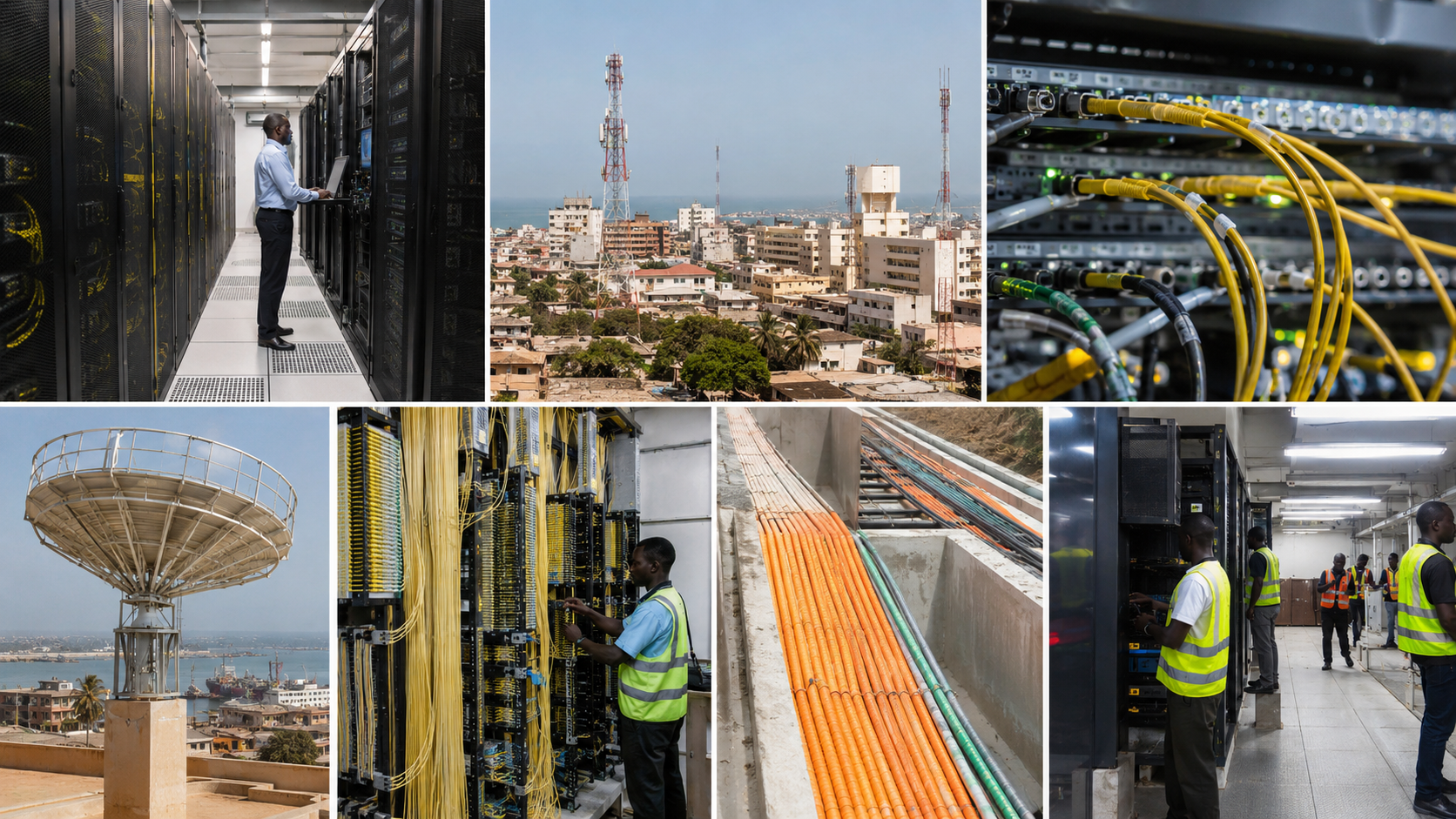
That distinction matters. In telecoms, the difference between a “brand seller” and an “infrastructure owner” is the difference between marketing margin and economic rent. SONATEL’s route origination, peering visibility, carrier activity, subsea landing role, and enterprise presence all point to the second category. The company’s own wholesale profile emphasizes terrestrial links, satellites, international voice, messaging, submarine cables, and a sub-regional hub position. Economically, that means SONATEL operates not only where consumer demand is visible, but also where other operators and large clients must buy reliability, transit, and access.
The cash machine beneath the brand
If the inherited franchise explains why SONATEL exists, the mobile-data and mobile-money engine explains why it is valuable. In 2025, data generated XOF 743 billion, or 38.7% of group revenue; Orange Money generated XOF 208.9 billion, or 11% of revenue; and fixed high-speed internet generated XOF 130.1 billion, or 6.8% of revenue. The group had 22.5 million mobile data customers, nearly 22.0 million active 4G customers, 1.16 million fixed-internet customers, 640,783 fiber customers, 1.20 million connectable homes, and 13.0 million active Orange Money customers executing 3.787 billion transactions. Those are not the statistics of a legacy voice telco. They are the statistics of a mass-market digital utility.
The revenue mix shows the direction of travel. Between 2024 and 2025, consolidated revenue rose 8.3%, driven by data, Orange Money, and fixed broadband, while EBITDAaL margin held at 47.9%. In 2024 revenue had already risen to XOF 1,776.4 billion from XOF 1,620.7 billion in 2023, with EBITDAaL increasing from XOF 747.5 billion to XOF 839.2 billion and net profit from XOF 331.7 billion to XOF 393.7 billion. That means SONATEL has now posted at least three consecutive years in which revenue, operating cash generation, and bottom-line profit all moved upward despite rising competitive and regulatory pressure. A business with that profile is not merely defending an old monopoly; it is still monetizing structural demand growth.
The more important point is where those gains come from. Voice still exists, but it is no longer the strategic center. The tariff-sensitive, high-penetration African telecom model has increasingly shifted from minutes to monetizable digital behavior: mobile internet usage, mobile financial services, cash-in/cash-out density, home broadband substitution where fixed-line economics work, and enterprise connectivity where state and business digitization demand higher quality. SONATEL sits almost perfectly on those vectors. In 2025, fixed broadband customers grew 26.2%, fiber customers 35.4%, and Orange Money revenue 11.3%, while mobile data remained the largest revenue block by far. That is why SONATEL can carry both capex and dividends without visible earnings collapse: the company is not simply harvesting a declining copper asset; it is migrating its rent base into faster-growing digital products.
Q1 2026 suggests that the machine is still working. SONATEL’s first-quarter 2026 publication reported consolidated revenue of XOF 504.2 billion, EBITDAaL of XOF 242.6 billion, capex of XOF 83.4 billion, free cash flow of XOF 114.7 billion, and net income of XOF 113.8 billion, with revenue up 6.9% year over year and EBITDA up 9.8%. This matters because it shows no immediate post-2025 slowdown from the combination of continued investment and shifting competition. The capital cycle remains heavy, but not visibly self-defeating.
That capital cycle is the decisive economic fact. SONATEL spent XOF 300.5 billion in 2024 and XOF 288.6 billion in 2025, roughly 16.9% and 15.0% of revenue respectively. The capex is not discretionary window dressing. It is what defends the incumbent rent against the two threats that usually kill African telecom margins: congestion and geographic irrelevance. If the leading operator stops investing, the challenger wins high-usage urban customers and the state turns hostile in rural and social-policy debates. SONATEL’s answer has been to keep spending enough to remain the default network.
The fixed-broadband and fiber story is especially important because it is where many investors understate the franchise. Telecom incumbents in emerging markets are often valued mostly on mobile, but mobile-only models eventually become price wars. SONATEL is trying to prevent that trap by thickening the household and enterprise network with fiber and fixed-wireless layers. Its December 2025 satellite-and-fiber announcement pledged one million additional fiber drops between 2026 and 2028, taking planned optical “prises” to nearly two million by end-2028, while also using satellite in partnership with Eutelsat/Konnect to claim 99% territorial coverage across fiber, 5G, 4G, and satellite. These targets are company claims, not neutral verification. But commercially they show the logic: SONATEL wants to turn ubiquity itself into the moat.
The rural-coverage side of the story reinforces that thesis. In May 2025, SONATEL and the universal service fund FDSUT announced 4G service in Gourel Diatta under the universal-access project. That single village does not move group earnings. What it does show is that SONATEL is embedded in the state’s territorial-connectivity agenda. For an incumbent, that matters because universal-service alignment can soften the political cost of market leadership. It also helps explain why SONATEL is still the operator policymakers lean on when the challenge is not just selling SIMs but wiring the nation.
The payout record is the other side of the equation. SONATEL’s 2025 annual report shows a gross dividend of XOF 193 billion for fiscal 2025, or net dividend per share of XOF 1,740, with a stated dividend yield of 7.4% at the 2025 year-end share price and a distribution ratio of 78% at SONATEL SA level. The same report says the company has distributed XOF 2,700 billion in dividends since 1998, roughly XOF 600 billion of that to free float, and that it had about 27,000 shareholders worldwide. Economically, the message is blunt: SONATEL is not a speculative growth story. It is a listed rent distributor that also reinvests aggressively enough to preserve the rent.
That combination is rare and unstable. It works only if margins remain thick enough to support both commitments. As of 2025, the evidence says they do. But it also means that any regulatory shock, pricing intervention, or capex overshoot hits SONATEL twice: once through earnings, and again through the implicit contract with shareholders that this is a dividend machine, not merely a network builder.
Orange as both accelerator and tax
The Orange relationship is central to SONATEL’s economics, but the usual “strategic shareholder” language is too soft. Orange is simultaneously a source of capability, a governance anchor, and a claim on SONATEL’s economics. Orange’s 2025 investor databook explicitly treats the “Sonatel Subgroup” as a defined unit inside Orange’s Africa & Middle East business, covering Senegal, Mali, Guinea, Guinea-Bissau, and Sierra Leone. That framing matters because it places SONATEL not at the edge of Orange, but inside one of the group’s core African operating clusters.
For SONATEL, the benefits are tangible. Over several annual reports, the company documents cooperation agreements under which Orange MEA transfers know-how and support in technology, marketing, strategy, and operations, and provides access to group expertise. The 2025 annual report states that Orange MEA’s collaboration agreement with SONATEL was renewed by the board in December 2025, and that management fees of XOF 3.894 billion were recognized in 2025 under that convention. The same report lists additional Orange MEA-linked service arrangements, including data and AI service agreements, SIM-toolkit support, support tooling, and digital-platform agreements. In plain terms, SONATEL buys competence from the controlling group, and that probably lowers execution risk in product rollout, procurement, cybersecurity, and architecture.
But Orange is also an economic tax collector. SONATEL’s annual reports describe brand-license obligations to Orange Brand Services Limited and cooperation-fee mechanisms with Orange MEA, including capped and floored arrangements linked to turnover. Earlier reports laid out a ceiling rate of 1.29% for the global fee and recorded millions to billions of CFA in annual charges tied to Orange MEA services and brand-related arrangements. These charges do not invalidate the strategic benefit. They do, however, mean that some of SONATEL’s incumbent surplus is upstreamed before minority investors or the Senegalese state fully enjoy it. For minority holders, the Orange link is therefore not “free support.” It is a transfer-pricing relationship whose fairness depends on whether the imported capability generates more value than it extracts.
The evidence so far suggests the bargain has worked. SONATEL’s operating metrics, fiber rollout, Orange Money scale, 5G launch, satellite service introduction, and stable profitability are hard to reconcile with a thesis of group parasitism alone. Orange likely increases SONATEL’s strategic speed. At the same time, the fact that multiple regulated-party agreements recur year after year is a reminder that SONATEL is not an arm’s-length public utility. It is a listed subsidiary within a multinational control structure. That usually deserves a valuation discount, especially in markets where disclosure is improving but still not as deep as in Europe or the United States.
The Orange relationship also supports SONATEL’s capital-market credibility. In January 2024, IFC announced anchor investments in SONATEL’s first receivables securitization; IFC described it as the first securitization in West Africa’s telecom sector, with proceeds supporting 4G expansion, fiber connectivity in rural Senegal, and higher bandwidth. BRVM later recorded the first listing of FCTC SONATEL C-1 and C-2, while SONATEL’s own disclosures show the 2023 receivables securitization raised XOF 75 billion. This is not just financing trivia. It shows SONATEL turning predictable cash collections into fundable paper in regional capital markets, which is exactly what mature infrastructure businesses do when they want cheaper capital without destroying dividend narratives.
The financing stack widened further in 2024 when IFC, BII, and Proparco backed a local-currency sustainability-linked loan package for SONATEL to expand towers and cables, particularly in rural areas. SONATEL therefore now sits at an unusual intersection: it is simultaneously a dividend-heavy equity story and a bankable infrastructure-credit story. That dual identity is valuable because it lowers marginal funding risk and helps the company keep investing even when the policy environment becomes hostile to high consumer prices.
The real economic conclusion is this: Orange makes SONATEL more investable and more scalable, but not necessarily cheaper. It increases SONATEL’s execution reach while also institutionalizing a group claim on the income statement. Investors should treat Orange neither as a pure blessing nor as a pure agency problem. It is better seen as a levered trade: some autonomy surrendered in exchange for capability, procurement power, and strategic speed.
Regional reach, infrastructure proof, and market signals
SONATEL’s regional footprint is not a side business. It is part of the operating thesis. The company’s website states that the group is present in five African countries: Senegal, Mali, Guinea, Guinea-Bissau, and Sierra Leone, with expansion beginning in Mali in 2002, then Guinea and Guinea-Bissau in 2007, and Sierra Leone in 2016. Orange’s investor databook uses the same five-country perimeter under the “Sonatel Subgroup.” This matters because it gives SONATEL regional scale that is large enough to spread procurement, know-how, platform costs, and management structures across multiple markets, but still concentrated enough to be operationally coherent.
The footprint also diversifies demand, but not necessarily risk. SONATEL’s 2025 annual report keeps emphasizing that the group maintained leadership in all countries of presence, citing 2025 market shares of 55.9% in Senegal, 54.5% in Mali, 76.2% in Guinea, 72% in Guinea-Bissau, and 48.6% in Sierra Leone. That is commercially impressive. It means SONATEL is not a Senegal-only operator with peripheral experiments; it is a multi-country incumbent system. At the same time, those are also markets where inflation, politics, energy instability, and tax/regulatory shifts can hit fast. SONATEL’s diversification therefore smooths demand, but it also imports sovereign risk from multiple directions.
There is further evidence that SONATEL is not merely present in those countries but actually controls them operationally. SONATEL’s 2025 results and annual-report disclosures show full consolidation of entities across the five-country perimeter; the 2025 annual report specifically notes that Orange Sierra Leone, though held at 50%, is globally consolidated because the shareholder pact gives control to SONATEL while Orange Group holds the other 50%. That is a subtle but important fact. It shows SONATEL is sometimes structured less as a passive owner and more as the operating brain of the asset. In African telecoms, control often matters more than strict percentage ownership.
The network evidence supports the idea of regional leverage rather than isolated country silos. SONATEL has visible BGP scale under AS8346; PeeringDB identifies the network as a high-traffic African ISP; BGPHurricane shows multiple SONATEL-announced Senegalese prefixes and longstanding AS records; and SONATEL’s own wholesale profile emphasizes terrestrial links, satellites, submarine cables, messaging, and international voice. Annual-report disclosures also mention participation in cable consortia including 2Africa, MainOne, ACE, and Cross Gambia, plus ongoing transmission and interconnection projects such as Dakar branch installation for 2Africa and the IKASIRA Senegal–Mali–Mauritania interconnection program.
This matters commercially because West African telecom economics reward operators that can combine domestic access dominance with international bandwidth control and cross-border transport. In markets where international capacity has historically been bottlenecked, the owner or effective gatekeeper of landing stations and inland backhaul can capture wholesale rents beyond the retail SIM business. SONATEL’s February 2026 announcement on 2Africa fits exactly that pattern: it says SONATEL is the owner of the Senegal 2Africa landing station, in charge of associated terrestrial backhaul construction and operation, and responsible for technical operations routing international traffic. That is not marketing fluff. It is evidence of where transport power sits.
The subsea story is economically crucial because cable resilience is a pricing and quality-of-service advantage, not just a technical detail. The Internet Society’s analysis of the March 2024 West Africa cable outage found that failures across WACS, ACE, MainOne, and SAT-3 degraded or nearly extinguished connectivity in 13 African countries. Cloudflare likewise documented widespread disruption from multiple undersea cable failures on March 14, 2024. In May 2026, Orange Wholesale used that event to argue for additional subsea-route diversification and explicitly cited 2Africa as already contributing new connectivity capacity across 33 African countries. SONATEL’s 2Africa commissioning therefore should be read less as a prestige project than as a direct attempt to reduce one of the biggest structural threats to West African telecom margins: fragile international transport.
The competitive data from ARTP show both the strength and the erosion of SONATEL’s dominance. ARTP’s Q4 2024 telecom report put Orange’s consumer mobile share at 58.68%, versus 20.93% for Free and 15.79% for Expresso, with Orange carrying around 75.87% of outgoing traffic on quarterly average. At the same time, ARTP also showed a broader field that now includes Promobile and Hayo at the edges and a much more contested internet market than in the monopoly period. SONATEL’s own 2025 results later cited a 55.9% Senegal share. The exact comparison is not perfect because methodologies may differ, but directionally it says the same thing: SONATEL is still the leader by a wide margin, but the market is no longer static. Dominance survives, yet rent compression has begun.
This is why the move into 5G, satellite, and fixed fiber matters more than the incremental revenue each service produces today. Orange’s Senegal site says 5G is available in Dakar, Saint-Louis, Louga, Kaolack, Diourbel, and Gorée for homes without fiber. SONATEL’s history page marks 2024 as the commercial launch of 5G in Senegal. SONATEL’s December 2025 satellite announcement positions satellite not as a fringe product but as part of a technology mix designed to keep the company relevant even when terrestrial last-mile economics weaken. In effect, SONATEL is trying to remain the default connectivity layer regardless of access mode. That is what a modern incumbent does when legal monopoly disappears but network optionality can still preserve economic centrality.
Frictions, verdict, evidence ledger, and watchpoints
The bullish case for SONATEL is straightforward: dominant share, very strong margins, still-growing digital revenue, real infrastructure ownership, credible access to capital, and a multi-country operating platform that is difficult to replicate. The bearish case is also straightforward: the business is politically visible, regulator-exposed, labor-conscious, partly controlled by Orange, and forced to keep spending heavily to defend a rent base that governments and consumers increasingly view as too profitable. The right judgment has to hold both truths at once.
Regulatory friction is not hypothetical. In 2021 ARTP sanctioned operators for quality-of-service failures; after adjustment in 2022, ARTP still stated a penalty of XOF 2.509 billion for SONATEL. SONATEL publicly defended itself at the time, arguing that its 4G obligations were being met and that the ARTP campaign was based on provisional results. In 2023, ARTP intervened after consumer complaints over Orange’s Flybox 4G pricing, asking SONATEL to adjust the offers. None of that proves a hostile anti-SONATEL regulator. What it proves is more practical: when Senegalese authorities want to discipline the market, the incumbent is the first place they look. That is the tax of size.
Labor is another recurring tax. In May 2023, SONATEL’s inter-union workers’ group announced a strike and justified it by demanding a fairer distribution of the fruits of company growth. By December 2025, the SYTS union congress was still framing its agenda around technological change, employment, social dialogue, and economic justice. More recently, when Starlink’s arrival became a public topic in early 2026, SONATEL’s union criticized the process as lacking transparency and questioned the regulatory framework. These signals do not prove imminent labor disruption. They do show that SONATEL’s workers understand that they sit atop a rent-bearing asset and intend to bargain accordingly.
The Starlink issue deserves careful treatment. There is not yet enough public evidence to say Starlink will materially damage SONATEL’s economics in Senegal. What the public record does show is that Starlink’s possible entry has already changed the political conversation around connectivity, competition, and rural access. Local commentary in Le Soleil captured the union’s fear directly: if satellite entrants are allowed in a way that bypasses incumbent economics, operators may become less willing to finance fiber deployment. That is not a settled fact; it is a strategic warning from a threatened incumbent ecosystem. Commercially, the key point is that non-terrestrial broadband weakens the old assumption that national fixed investment is the only route to rural connectivity. SONATEL’s rapid launch of its own satellite offers in December 2025 reads like a preemptive response to that threat.
Policy direction in Senegal adds another layer. The presidency’s “New Deal Technologique,” launched in February 2025, explicitly described SN2025 as under-executed and set out a new state-led digital strategy. The U.S. Commercial Service later summarized key targets including digitizing 90% of public services, bringing internet to 95% of the country, and creating 150,000 tech jobs and 500 startups by 2034. For SONATEL, that agenda is both opportunity and pressure. Opportunity, because a state that wants digitization needs networks, interconnection, and secure enterprise-grade infrastructure. Pressure, because state digital ambition often translates into demands for lower prices, wider coverage, interoperability, and stronger national control over critical communications assets.
The political economy of mobile money illustrates the same tension. SONATEL’s Orange Money is large enough to matter systemically: 13 million active customers and nearly 3.8 billion transactions in 2025. At the same time, Senegal’s debate over higher taxes on electronic financial services in 2025 showed how quickly a successful financial-inclusion platform can become a tax target. When a telecom subsidiary becomes financial plumbing, it acquires new revenue opportunities, but it also enters a more politicized fiscal space. That is a source of upside and vulnerability at once.
There is also a geographic risk that operating metrics can hide. Orange’s and SONATEL’s own disclosures note exposure to Mali, Guinea, Guinea-Bissau, and Sierra Leone. SONATEL’s 2025 annual report describes Mali as constrained by energy crisis, fragile security conditions, and a more demanding tax and regulatory environment, and describes Guinea as under sustained tax and regulatory pressure in a reconfiguring market. These are not remote macro footnotes. They are direct threats to the very operating leverage investors like about SONATEL. Regional diversification helps when one country slows. It hurts when several become simultaneously harder to operate.
The category judgment, then, is clear. SONATEL is not a monopoly in the old legal sense, but it still deserves to be classified as a cash-generative regional incumbent infrastructure operator. Its value does not rest on a single monopoly privilege. It rests on the accumulation of scale, rights-of-way, brand power, routing depth, subsea and terrestrial transport roles, mobile-money distribution, institutional embeddedness, and access to Orange’s operating system. That bundle is resilient enough to sustain high returns for now. It is not resilient enough to make regulation, labor, and competition irrelevant.
The investment conclusion is equally clear. SONATEL looks strongest when treated as a public-market infrastructure compounder with regulated-utility characteristics and emerging-market risk, not as a normal consumer telecom. The bull case is a high-yield, low-multiple incumbent that still grows because it is migrating from voice to data, fiber, money, and enterprise infrastructure. The bear case is a rent pool that too many constituencies can see and too many technologies can now attack. Between those two, the evidence still leans constructive. But the discount exists for reasons, and those reasons are not going away.
Evidence ledger
SONATEL 2025 Annual Report — URL:
https://sonatel.sn/wp-content/uploads/2026/04/R.A_SONATEL-25_WEB_VF.pdf— Company annual report / PDF. Supports the current shareholding split, dividend history, 2025 operating commentary, and Orange MEA related-party agreements. Does not prove that every group-service charge is economically fair to minorities. It matters because it shows who controls the rent and how that rent is shared.SONATEL 2025 Financial Results — URL:
https://sonatel.sn/wp-content/uploads/2026/03/BRVM-FY-2025-ENG-VF.pdf— Company results presentation / PDF. Supports 2025 revenue, EBITDAaL, free cash flow, capex, net income, customer counts, product mix, and Q1 2025/2024 comparisons embedded in the report. Does not prove cash conversion quality beyond disclosed statements. It matters because it is the core source for SONATEL’s current unit economics.SONATEL 2024 Financial Results — URL:
https://sonatel.sn/wp-content/uploads/2025/02/sonatel-group-2024-financial-results-version-anglaise.pdf— Company results presentation / PDF. Supports the step-up from 2023 to 2024 in revenue, EBITDAaL, capex, and net income. Does not prove that 2024 growth was fully organic or permanent. It matters because it shows the growth trend before 2025.SONATEL 2023 Annual Report — URL:
https://sonatel.sn/wp-content/uploads/2024/06/Annual_report-_Sonatel_Orange_2023.pdf— Company annual report / PDF. Supports 2023 revenue and net income, receivables securitization, workforce trends, 2Africa/MainOne progress, and Orange MEA contractual structure. Does not prove unchanged economics in 2026. It matters because it shows the recent roots of the current capital cycle.BRVM market capitalization page — URL:
https://www.brvm.org/en/capitalisations/0— Exchange market data webpage. Supports share count, market cap, and closing price at June 29, 2026. Does not prove long-term valuation attractiveness by itself. It matters because the public-market angle is central to SONATEL’s story.ARTP Q4 2024 telecom market report — URL:
https://artp.sn/sites/default/files/2025-03/RAPPORT%20MARCHE%20TELECOMS%20T4%202024_0.pdf— Telecom regulator report / PDF. Supports Orange’s market share, traffic share, and competitive structure in Senegal at Q4 2024. Does not prove group-level profitability or exact 2025 share on the same methodology. It matters because it is the best independent public check on SONATEL’s domestic dominance.Orange investor databook 2026 — URL:
https://assets.orange.com/medias/domain12751/media101762/528642-5ucrick9re-75.pdf— Parent-group investor document / PDF. Supports Orange’s treatment of the “Sonatel Subgroup” within Africa & Middle East and gives operational/KPI context. Does not prove how much strategic autonomy SONATEL truly has. It matters because SONATEL’s value partly comes from being inside the Orange system.AFRINIC member data — URL:
https://stats.afrinic.net/index.php/download/memberData.csv— RIR membership data. Supports SONATEL’s RIR identity, Senegal country classification, 1999 membership date, and ISP classification. Does not prove legal headquarters or market share. It matters because it anchors network-resource identity and avoids confusing SONATEL with a non-network entity.AS8346 records and PeeringDB — URLs:
https://bgp.he.net/AS8346,https://www.peeringdb.com/net/17605,https://radar.cloudflare.com/routing/as8346— BGP/peering/network-signal sources. Support SONATEL’s autonomous system, announced address space, connectivity, traffic scale, and peering visibility. Do not prove retail subscriber counts or exact service quality. They matter because they show SONATEL is real infrastructure, not just a resale brand.SONATEL 2Africa commissioning release — URL:
https://sonatel.sn/sonatel-annonce-la-mise-en-service-du-cable-sous-marin-2africa-le-plus-performant-jamais-deploye-en-afrique/— Company press release. Supports SONATEL’s role in Senegal’s 2Africa landing, backhaul, and international traffic operations. Does not independently verify the ultimate performance uplift. It matters because subsea control is one of the strongest markers of transport rent.Internet Society West Africa outage report — URL:
https://www.internetsociety.org/resources/doc/2024/2024-west-africa-submarine-cable-outage-report/— Technical-policy analysis. Supports the commercial importance of cable resilience after the March 2024 regional outage. Does not prove SONATEL alone solved that problem. It matters because resilience explains why SONATEL keeps investing in international capacity.IFC securitization press release — URL:
https://www.ifc.org/en/pressroom/2024/ifc-invests-in-sonatels-first-securitization-to-expand-connectiv— Development-finance press release. Supports the importance of SONATEL’s 2024 receivables ABS for 4G, fiber, and bandwidth expansion. Does not prove the full IRR of the funded projects. It matters because it shows SONATEL has infrastructure-grade access to capital markets.Senegal Presidency New Deal Technologique — URL:
https://www.presidence.sn/fr/assets/new-deal/Doc_NDT.pdfand related presidency release — Official state strategy / PDF and press release. Supports the shift from SN2025 to the new digital-policy framework. Does not specify exactly how future regulation will affect SONATEL margins. It matters because SONATEL’s fate is tied to Senegal’s digital-state agenda.Local press and signal sources on labor and competition — URLs:
https://www.dakaractu.com/Mouvement-d-humeur-a-la-Sonatel-L-intersyndicale-des-travailleurs-en-greve-a-partir-de-ce-mercredi_a233291.html,https://www.dakaractu.com/Telecommunications-l-arrivee-annoncee-de-Starlink-au-Senegal-fait-reagir-le-syndicat-de-la-Sonatel_a268858.html,https://lesoleil.sn/le-decodeur/chronique/starlink-au-senegal-entre-polemique-et-promesses-de-connectivite-par-abdoulaye-diallo/— Local news / signal evidence. Support the existence of union pressure, strike risk, and Starlink-related political friction. Do not prove future earnings damage. They matter because rent-bearing incumbents are most vulnerable where politics and labor meet technology.
Watchpoints
Watch the Senegal mobile-share trend for Orange in ARTP releases. If Orange’s share keeps sliding from the high-50s toward the low-50s without corresponding ARPU uplift, SONATEL’s “incumbent premium” starts to look more like a temporary advantage than structural rent.
Watch the fiber-versus-dividend balance. SONATEL’s own plan for one million additional optical drops by 2028 is ambitious, but the company is also culturally committed to high dividends. If capex must rise materially above the recent 15–17% of revenue range, something will have to give.
Watch the Orange MEA related-party line items in future annual reports. The Orange relationship is productive, but minority investors should care whether service fees, management fees, and brand charges rise faster than the measurable benefit from group platforms.
Watch subsea and international transport resilience after 2Africa commissioning. If international-capacity economics improve without recurrent outage shocks, SONATEL’s wholesale and enterprise logic strengthens. If more cable failures or backhaul bottlenecks appear, the infrastructure premium weakens.
Watch state digital policy translation into telecom regulation. The New Deal Technologique can create enterprise demand and public-sector contracts, but it can also generate price and interoperability pressure. The real signal is not the strategy document; it is the implementing rulebook.
Watch Starlink and satellite-policy execution, not headlines. The most important question is whether Senegal allows a non-terrestrial access layer to compete on terms that bypass the investment obligations borne by terrestrial incumbents. If yes, SONATEL’s rural fiber economics become harder. If no, SONATEL keeps the advantage of hybrid terrestrial-plus-satellite bundling.
Watch Mali and Guinea more closely than Senegal. SONATEL’s regional operating leverage is valuable precisely because it spreads systems across markets, but the same structure transmits political and energy stress back into the consolidated accounts. In a five-country incumbent, the “foreign subsidiaries” are not optional upside. They are part of the core machine.