
Summary
- What it says: SmartSat's public trail leads from Pernambuco radio and corporate access into Algar control, current AS28310 records and a redirected legacy domain.
- Main topic: Regional ISP economics; Local support labour; Telecom spectrum and security; Satellite connectivity
- Context: market / company research report / Brazil; Pernambuco; Recife
The customer at the edge of the road
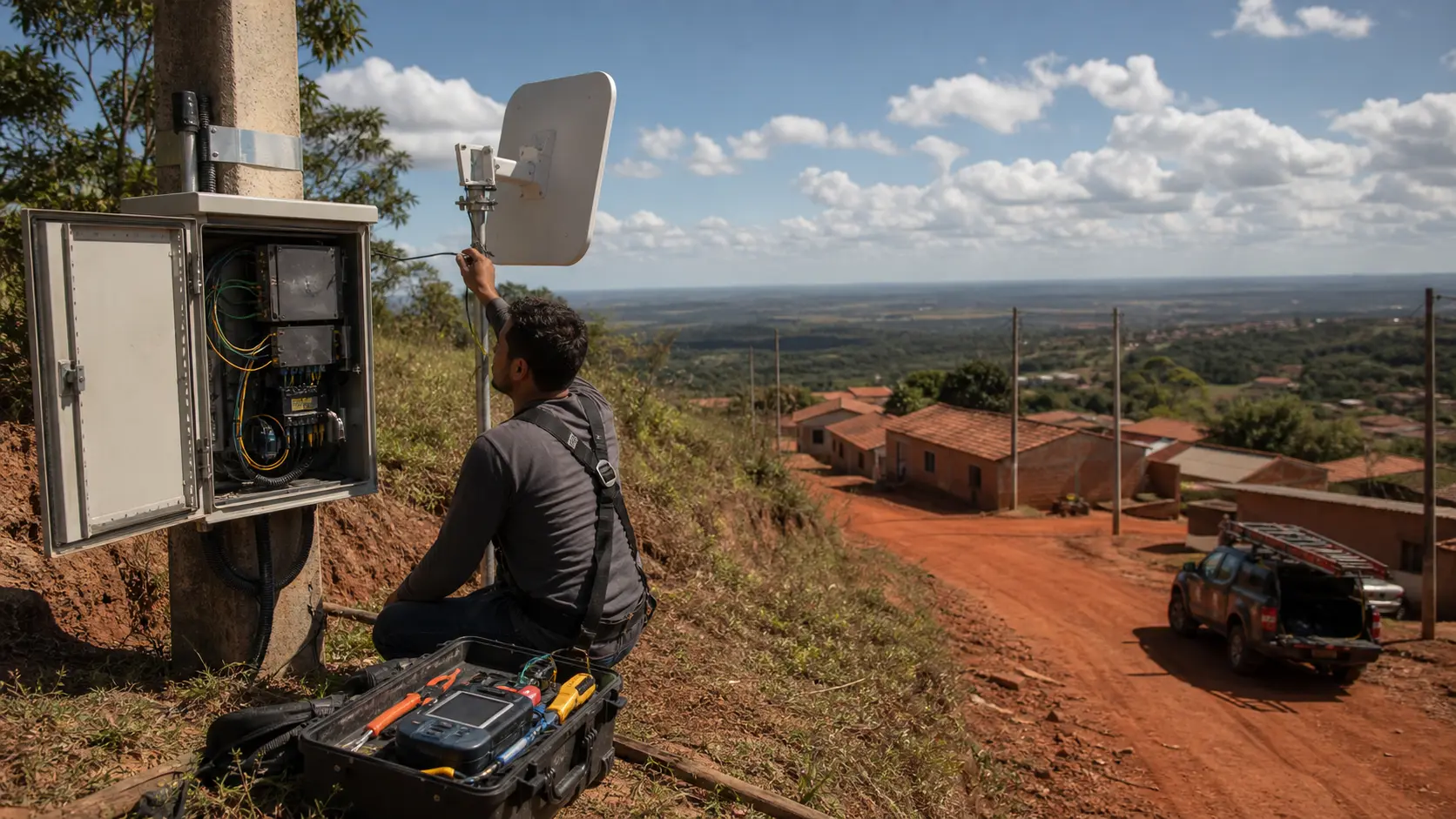
Start with a customer outside the easy fibre grid. The location could be a small warehouse near a Pernambuco highway, a rural municipal office between the coastal city and the interior, a farm administration room with two computers and a card terminal, or a clinic that sits just far enough from the nearest fibre route to turn a cheap broadband slogan into an engineering problem. The customer does not begin by asking whether the service is satellite, radio, fibre, LTE or a dedicated circuit.
The customer asks a more practical question: how much will it cost to have a connection that works when payroll, telemedicine, WhatsApp orders, tax filings, cameras and cloud software need it?
The answer is a bundle of trade-offs. Satellite can reach places where terrestrial networks do not, but equipment, power, weather, plan terms, latency and field support still matter. Fixed wireless can avoid some civil works and reach rooftops quickly, but it depends on line of sight, spectrum discipline, tower access, power and skilled technicians. Fibre can deliver lower latency and lower unit cost once the network is built, but the first customer beyond the existing route may face a build that is too expensive for a single monthly bill. A provider serving that customer is not selling megabits alone.
It is selling the decision not to wait for a future overbuild, not to rely only on mobile coverage, and not to treat every support call as a distant call-centre problem.
That is the useful way to read SmartSat. The public alias attached to the target is smart.net.br. The cleanest current routing evidence identifies AS28310 in PeeringDB as "SmartSat", a regional Cable/DSL/ISP network with the website http://www.smart.net.br, one IX.br Recife public peering record, 1-5 Gbps traffic, mostly inbound ratio and a note saying the provider offered internet access in the Brazilian Northeast (https://www.peeringdb.com/api/net?asn=28310). The same PeeringDB organisation and facility trail places "SMART NETWORKS" at Rua da Soledade in Recife, linked to the SmartSat organisation and IX.br Recife (https://www.peeringdb.com/fac/5345). But current registry and corporate evidence also show that the legacy is no longer a simple standalone local-ISP story. Registro.br RDAP for AS28310 now names Algar Telecom S/A as the registrant, with a July 2025 change date (https://rdap.registro.br/autnum/28310). BrasilAPI's CNPJ record for Smart Telecomunicacoes e Servicos Ltda. shows the company as "baixada" after activity that began in September 1999, with SCM as its main activity and Algar Telecom S/A in the shareholder record (https://brasilapi.com.br/api/cnpj/v1/03423730000193).
The economic question therefore has two layers. The first is historical and operational: what kind of business did SmartSat or Smart Networks represent in the Pernambuco access market? The answer points to wireless, fibre, corporate and government connectivity for customers whose value came from being reached and supported, not merely from being counted as homes passed. The second is strategic: what happens to that business model after a stronger parent, fibre competitors, Starlink-style satellite substitution and state-scale contracts all change the price of reach?
The answer is not that SmartSat should be valued as a live independent retail brand. The answer is that its records show a recurring Brazilian regional-ISP problem: the first operator to solve difficult access can lose the margin if competitors later turn difficulty into commodity coverage.
Identity is a moving target, but not an empty one
The public identity trail has to be handled with caution because several names sit on top of each other. "SmartSat" appears in PeeringDB as the organisation and network name for AS28310. "SMART NETWORKS" appears in PeeringDB as a Recife facility connected to that organisation. Older operator references use "Smartsat Telecomunicacoes" and the smart.net.br address. Brazilian corporate records point to Smart Telecomunicacoes e Servicos Ltda., CNPJ 03.423.730/0001-93, founded in 1999, with SCM as its main activity and a Recife headquarters record. TeleSintese reported in March 2019 that Algar Telecom announced the purchase of Smart Telecomunicacoes e Servicos Ltda. for up to R$49.8 million, describing Smart as a Pernambuco broadband provider with a little more than 3,700 customers according to Anatel data (https://telesintese.com.br/algar-compra-a-smart-telecomunicacoes/). In May 2023, TeleSintese reported that Anatel approved the incorporation of Smart by Algar, conditioned on transfer of SCM authorisations, associated radiofrequency-use rights and tariff-review treatment; the same report said the acquisition brought 700 km of fibre in Greater Recife, 300 km toward the interior and corporate customers (https://telesintese.com.br/a-anatel-aprova-a-incorporacao-da-smart-pela-algar/).
That combination is more useful than a single branding page. It says that SmartSat should be read as a legacy Pernambuco access operator whose public network and domain traces remained visible after corporate control moved to Algar. It also says that simple search-based identity can mislead. The current smart.net.br RDAP record is active but was registered in May 2022, uses Cloudflare name servers and has technical contact context tied to Smartlink. A live HTTP request to www.smart.net.br redirects through https://www.smart.net.br/ to https://smartlink.net.br/, whose "Quem somos" page says Smartlink is an 18-year managed-IT company with more than 900 active users in Brazil and services in infrastructure, communication, collaboration and security (https://smartlink.net.br/quem-somos/). That is current domain evidence, not proof that the old SmartSat retail access brand is still being sold from that page.
The right analytical stance is therefore neither to collapse SmartSat into Algar nor to pretend it remains a clean standalone ISP. SmartSat is a live public network label in PeeringDB and in third-party route records; Smart Telecomunicacoes is a Brazilian legal entity record now shown as discontinued after Algar control; Smart Networks is the Pernambuco operational name used in local coverage and PeeringDB facility records; Algar is the current registrant in the main AS and IP-resource evidence. The name is messy, but the operating surface is not imaginary.
It is the surface of a Recife-centred access business that helped connect corporate, government and residential users in a market where radio and fibre were both part of the practical answer.
The old business model was reach plus trust
The strongest description of the pre-acquisition business comes from local coverage. Diario de Pernambuco wrote in December 2018 that Smart Networks would partner with Embratel in the second phase of Pernambuco Conectado, a state project whose tender reached R$180 million. The report described Smart Networks as a company created by Ricardo Leite and Andre Medeiros and said it had customers including Unimed, Pernambuco emergency-care units, local media vehicles, state courts and many private universities. It also described the company as the first and largest Pernambuco company to implement networks based on digital radio and optical fibre in the region, and said much of the state's corporate internet and data-network service passed through Smart Networks (https://www.diariodepernambuco.com.br/noticia/economia/2018/12/smart-networks-sera-parceira-da-embratel.html).
That language is promotional in tone and should not be treated as audited revenue data. But it matches the economics of the asset. A provider with a radio-and-fibre history in Recife and the interior is not only competing for households with symmetric fibre plans. It is also competing for institutions that need a route, a managed installation, a service desk, a technician who understands local rooftops, and a provider that can work around physical gaps in the network. In those accounts, the monthly bill is only part of the price.
The real comparison is between an access method that can be deployed now and an alternative that might be cheaper after the next fibre build reaches the site.
The same Diario report said Smart planned a data centre in Porto Digital and private LTE access in the Recife metropolitan region, and it linked the company to a backbone supported by fibre, interconnection with other autonomous systems and direct connection to traffic-exchange points. That is an important clue to the operating model. A radio-only provider can solve last-mile reach but remain dependent on upstream paths and limited scale. A fibre-only provider can solve capacity but may struggle where civil works are slow or uneconomic.
A hybrid provider with exchange access, local engineering and institutional customers can package availability rather than only bandwidth.
The business model was therefore likely a mix of corporate dedicated access, government circuits, metro and interior extension, building-level or condominium access, radio reach and later fibre. The March 2019 TeleSintese purchase article's customer count of just over 3,700 is small if read as a mass residential ISP, but meaningful if the portfolio included corporate and government accounts. A transaction ceiling of R$49.8 million divided by 3,700 customers would be roughly R$13,459 per customer, before considering earn-out conditions, network assets, contract mix, customer quality and the fact that the final price was not disclosed.
That back-of-envelope number should not be mistaken for a valuation multiple. It is a sign that the asset was being bought for more than ordinary household access lines.
Pricing the trade-off without inventing a tariff
The public record does not expose a current SmartSat household price card. That absence matters. The core economics can still be priced, but it must be priced from adjacent evidence: the historical acquisition value, public Pernambuco project data, current parent-company retail pricing, current satellite pricing, and current local broadband market structure.
Start with the satellite side. TeleTime reported in April 2025 that Starlink's standard residential plan in Brazil cost R$236 per month, while the Starlink Mini travel plan cost R$315 per month for 50 GB or R$576 for unlimited data, with equipment at R$1,799 at that time (https://teletime.com.br/25/04/2025/starlink-mini-chega-ao-brasil-plano-custa-ate-144-mais-que-residencial/). Starlink's Brazil page, observed in July 2026 search results, advertised residential service from R$189 per month and selected-region equipment from R$499 until 31 July. Those prices are dynamic and promotion-sensitive, but they show the pressure: satellite is no longer a symbolic option for remote users. It is an actual price anchor.
Now compare terrestrial fibre. Algar's current public store page shows a 600 Mbps fibre offer at R$109.90 and separate Super Wi-Fi equipment pricing of R$30.00 in the visible price explanation, with bundled digital services and self-service support links (https://loja.algar.com.br/). This is not a SmartSat tariff and should not be presented as one. It is a useful parent-market comparison. A customer within a fibre footprint may see an advertised terrestrial price that is less than the standard Starlink monthly level and far below some portable satellite options. A customer outside the footprint may face the reverse: fibre can be cheap only after somebody else pays the extension cost.
That is where the economics are sharpest. Suppose a remote customer can buy a satellite kit and pay roughly R$189 to R$236 a month during a residential promotion or standard plan. The equipment cost may be discounted, but it is still a real cash decision if the selected-region offer does not apply or if the customer needs a higher tier. Suppose the same customer can persuade a local terrestrial provider to extend fibre. If a short drop or nearby cabinet is available, the monthly price may look like ordinary fibre.
If the route requires poles, civil permissions, field labour, optical equipment, splice work, backhaul and a truck roll, the operator needs either a long payback, a business contract, an anchor tenant or a cluster of nearby customers. Fixed wireless can sit between those options. It can reach faster than fibre and may be cheaper than dedicated build-out, but the provider carries tower, radio, spectrum, interference and support complexity.
SmartSat's legacy sits exactly in that middle. The company name itself evokes satellite, but the strongest evidence points to radio, fibre, corporate access and exchange-connected networking rather than a simple satellite-reseller model. For a customer beyond easy fibre, the historical SmartSat or Smart Networks proposition would have been: we know the terrain, we can connect difficult sites, we can integrate radio and fibre, and we can support the service locally. That proposition is valuable when the customer's alternative is waiting.
It is less valuable when Starlink can be installed quickly or when a fibre competitor reaches the building with a lower price.
AS28310 shows a network that still exists, under a different control frame
The routing record is one of the strongest pieces of evidence because it separates marketing from operational residue. PeeringDB lists AS28310 as SmartSat, with a regional scope, open peering policy, 10 IPv4 prefix guidance, one IPv6 prefix, 1-5 Gbps traffic and IX.br Recife presence (https://www.peeringdb.com/api/net?asn=28310). The same API shows a public IX.br Recife netixlan entry at 10G speed, operational, created in 2014 and updated in 2018 (https://www.peeringdb.com/api/netixlan?asn=28310). PeeringDB's SMART NETWORKS facility record was updated in September 2025 and shows two networks and one local exchange tied to the Recife site (https://www.peeringdb.com/fac/5345).
Registro.br and RIPEstat put the current holder context under Algar. Registro.br RDAP for AS28310 names ALGAR TELECOM S/A as registrant, with registration on 10 July 2007 and last changed on 28 July 2025 (https://rdap.registro.br/autnum/28310). RDAP for 177.38.32.0/21 names Algar Telecom as registrant and still includes "Gerencia de Redes - SMART Telecom" as a technical role, a useful sign that old Smart operational labels remain embedded in the resource history (https://rdap.registro.br/ip/177.38.32.0/21). RIPEstat's AS overview reports "AS28310 - ALGAR TELECOM S/A" and announced status, while its announced-prefixes endpoint showed five prefixes during the 19 June to 3 July 2026 observation window (https://stat.ripe.net/data/as-overview/data.json?resource=AS28310 and https://stat.ripe.net/data/announced-prefixes/data.json?resource=AS28310). BGP.tools likewise presents AS28310 as Algar Telecom S/A, active under NIC.br, with four IPv4 prefixes and one IPv6 prefix originated and a website still set to http://www.smart.net.br (https://bgp.tools/as/28310).
These records do not prove retail quality. They do not disclose customer count, service level, traffic utilisation, outage history, transit contracts, packet loss or whether SmartSat's old brand has active direct subscribers. But they do prove that the technical footprint did not evaporate into a slogan. There is a public AS, prefixes, IX.br Recife presence and a facility trace associated with the old Smart identity. That matters because the economics of remote access improve when a provider can combine last-mile reach with local interconnection and parent-network resources.
It also changes the risk. A standalone small provider with one upstream can be fragile. A network now registered to Algar may gain stronger upstream depth, billing systems, procurement, legal compliance and cross-regional customer reach. But it may also lose the local responsiveness that made the original access operator attractive. A difficult customer outside easy fibre does not care who owns the AS if the field technician cannot come, the equipment replacement is slow, or the call path becomes bureaucratic.
Pernambuco is no longer an empty competitive map
The remote-access thesis should not be confused with the claim that Pernambuco lacks broadband competition. Radar da Telecom's Pernambuco page, using public Anatel and IBGE-derived data, showed 1,373,600 fixed-broadband accesses in the state, 84.35 percent fibre participation, a 2022 census population of 9,058,931 and 45.5 accesses per 100 households; it identified Brisanet as market-share leader with 11.99 percent, followed by Dtel in the access ranking (https://www.radardatelecom.com/uf/PE). Radar's Recife page showed 271,109 fixed-broadband accesses, 78.05 percent fibre participation, 158 prestadoras with city access records, and Claro as leader with 35.34 percent market share, followed by Vivo (https://www.radardatelecom.com/municipio/pe/recife).
Those numbers frame SmartSat's problem. In the capital and much of the metropolitan market, the customer no longer has to treat a local radio/fibre provider as the only serious alternative. National brands, regional fibre specialists, local ISPs and satellite providers all compete for the same economic decision. The regional operator's historical advantage, local reach into hard locations, remains relevant only where it is coupled with price, support and reliability.
The interior is different. Pernambuco Conectado II coverage named Recife as the network concentration point and listed regional infrastructure points including Goiana, Fernando de Noronha, Palmares, Caruaru, Toritama, Garanhuns, Arcoverde, Petrolandia, Serra Talhada, Sao Jose do Belmonte, Ouricuri and Petrolina (https://www.diariodepernambuco.com.br/noticia/economia/2018/12/smart-networks-sera-parceira-da-embratel.html). TeleTime's coverage of the same project said the main backbone lot had Embratel in a consortium with local corporate operator Smart Networks, and that without partnerships a large operator would struggle to reach all municipalities with fibre in less than 12 months (https://teletime.com.br/01/02/2019/pernambuco-quer-agilizar-inicio-de-programa-pe-conectado-mas-ha-risco-de-judicializacao/). Terra's Dino-distributed coverage listed more than 3,600 dedicated accesses, 4,000 private LTE chips, 12,500 indoor Wi-Fi access points, 2,950 outdoor Wi-Fi points and integrated operation for more than 80,000 technology items in the project (https://www.terra.com.br/noticias/dino/embratel-vence-licitacao-do-governo-de-pernambuco-para-oferta-de-novas-tecnologias-para-a-populacao,97f799914b117d1a579adfc7ae4a285aei2pr4h6.html).
The public-project evidence matters because it shows the route from local access provider to institutional infrastructure partner. Remote access is not only a household sitting beyond fibre. It is also the public-sector problem of connecting schools, health units, administrative offices, police facilities, island locations and interior agencies where the state's customer concentration can fund routes that ordinary residential ARPU cannot. For a company like SmartSat/Smart Networks, those contracts can validate engineering reach. They can also raise the bar.
A state contract does not tolerate the same informal troubleshooting that a small local ISP might use in a single building.
The revenue story is asset-heavy, not subscriber-heavy
The 2019 acquisition figure gives a useful scale marker. If the Smart purchase ceiling of R$49.8 million is compared with "a little more than 3,700 customers" cited by TeleSintese from Anatel data, it implies that Algar was not buying a low-value base of ordinary subscribers. Even if the final payment differed from the ceiling and future conditions changed the economics, the stated value points to network assets, corporate contracts, government possibilities, radio rights, fibre routes and local expertise.
TeleSintese's 2023 Anatel approval report reinforces that interpretation by stating that the acquisition incorporated 700 km of fibre in Greater Recife and 300 km toward the interior, along with corporate customers. A 1,000 km fibre footprint, if documented and serviceable, is not just a customer list. It is optionality. It can support enterprise access, public-sector circuits, wholesale backhaul, tower connections, data-centre access, private-network projects and future residential or SME overlays.
But fibre kilometres are only valuable if they are on useful routes, have legal access, have maintainable plant records, connect to paying demand and are not stranded by overbuild.
The revenue risk is therefore not simply churn. It is mix deterioration. A difficult access customer might once have paid a premium for a radio or dedicated solution because there was no credible substitute. If fibre reaches the same site, the premium can collapse unless the provider owns the fibre or can bundle higher-value service. If satellite reaches the site with good enough latency and a lower setup burden, the provider may lose the customer who only needed basic resilience. If a national operator wins a government or enterprise framework, the local provider may be pushed into subcontracting margin.
If a local fibre altnet overbuilds residential clusters, the access lines that helped amortise a route can erode.
The best defence is to move up the value chain: managed connectivity, support, security, private LTE, Wi-Fi, dedicated links, monitoring and integration. That is consistent with the Smartlink domain's current managed-IT language, but the domain evidence should not be overread as direct continuity from SmartSat. It is safer to say that the domain trail demonstrates a broader shift from access identity toward IT-service positioning. The remote-access provider's margin is likely to survive when the customer sees the provider as the operator of a working system, not only as the supplier of an internet line.
Costs decide whether reach is a moat or a trap
The cost side of the business is harder to observe, but the public evidence lets us identify the key line items. First is equipment. Satellite asks the customer or provider to solve antenna, power, mounting and replacement. Fixed wireless asks the provider to manage radios, towers, roof access, alignment, power events and interference. Fibre asks for drops, optical terminals, splitters, splicing, route maintenance and customer premises equipment. In all three cases the headline monthly fee hides an equipment balance sheet.
Second is field labour. A remote or hard-to-reach customer can be expensive even when the monthly payment looks attractive. A single failed radio alignment, damaged outdoor unit, tree obstruction, pole issue or misdiagnosed Wi-Fi complaint can consume the contribution from several months of service. In a dense fibre building, a technician can solve multiple customers in one visit. On a rural route or island location, a technician's time, travel, boat, vehicle, ladder, spare parts and scheduling uncertainty become part of the service cost. SmartSat's historical advantage would have been knowing how to do that locally.
Its risk is that field memory becomes expensive when scale, parent processes or competing technologies change.
Third is upstream and interconnection. AS28310's IX.br Recife presence and prefix history give the operator a public network surface, but public peering records do not reveal upstream contract cost, private peering, transit price, burst terms or whether legacy Smart paths are now folded into Algar's wider network. If Algar can use parent scale to lower upstream cost and improve resilience, the old Smart footprint becomes more valuable. If the footprint is small, operationally isolated or expensive to maintain, the parent may rationalise it.
Fourth is compliance. Brazil's fixed-broadband market has moved toward greater formalisation. Anatel's Internal Resolution 449 of 27 June 2025 approved an action plan to combat unfair competition and regularise SCM fixed-broadband provision, with explicit attention to small providers, data obligations and authorisation conditions (https://informacoes.anatel.gov.br/legislacao/resolucoes-internas/2030-resolucao-interna-449). Anatel also began collecting data on contracts for shared pole infrastructure from SCM providers using electric-distributor poles, with the collection starting on 1 December 2025 and described as mandatory regardless of provider size (https://www.gov.br/anatel/pt-br/dados/infraestrutura/coleta-de-dados-contratos-de-uso-de-postes). A provider whose advantage lies in fibre routes and difficult access cannot ignore pole, route and radio documentation. The same records that make a network financeable can also expose a weak plant file.
Supplier dependency changed after Algar
Before the acquisition, Smart Networks' supplier dependency was likely concentrated in upstream links, fibre leases or route access, radio equipment, IX connectivity, public-sector consortium partners and customer-premises hardware. A 2013 Brazilian outage-list message from a SmartSat network administrator asked about slowness on a GVT link in Recife and signed as Smartsat Telecomunicacoes at Rua da Soledade (https://eng.registro.br/pipermail/caiu/2013-January/018859.html). That is an old operational signal, not a current incident record. It still illustrates the kind of supplier relationship a regional operator had to manage: a local service problem could depend on another carrier's performance.
After Algar control, the supplier picture changes. The old Smart footprint becomes part of a larger operator with broader procurement, national products and enterprise capabilities. Algar's investor-relations strategy page says its retail franchise model lets franchisees close to the region manage network expansion, technical teams, installation, maintenance and customer experience, from first assistance to post-sales (https://ri.algar.com.br/en/algar-telecom/strategy-and-operation/). Algar's public corporate profile describes the company as a Brazilian telecom provider with national operations and main focus on B2B customers, headquartered in Uberlandia and part of Grupo Algar (https://ri.algar.com.br/a-algar-telecom/perfil-corporativo-e-historico/). Those parent capabilities can reduce some local fragility.
But parent scale does not remove every dependency. The service still depends on access routes, power, poles, exchange facilities, field crews, radio rights where wireless is used, customer equipment and the operating discipline required to serve hard locations. It may also depend on maintaining the trust of customers who originally bought from a local Pernambuco provider rather than a national brand. Acquisitions often improve finance, compliance and product depth while weakening the emotional contract that local providers built with customers.
The value of SmartSat's old footprint depends on whether Algar preserved the local know-how while adding scale.
Customers depend on the provider in different ways
A residential customer beyond easy fibre is price-sensitive. If Starlink works, if mobile data is adequate, or if a fibre competitor reaches the road, the customer's switching cost falls. A small business depends on support in a different way. It may need a fixed address, a router configuration, camera connectivity, payment-terminal reliability, cloud software uptime and someone who can diagnose whether the problem is the access line, Wi-Fi, firewall, device or upstream path. A public-sector customer depends on contract performance, SLA reporting, security, coverage and documentation.
SmartSat's old economics look better as the customer moves from casual household access toward operational dependency.
The Pernambuco Conectado evidence shows why public customers matter. The project involved internet, data transmission, voice, security, Wi-Fi, private LTE, contact centre and integrated operations. A provider that participates in such a project is selling more than broadband. It is selling responsibility across many sites and technology categories. This can produce durable revenue if performance is strong. It can also create correlated risk: a service failure can affect public agencies, political stakeholders and reputational trust at once.
Consumer chatter provides a different lens. Reclame Aqui's Smartsat page, retrieved through a reader view, showed "Sem reputacao definida" because it did not have enough evaluated complaints for a reputation score, no complaints in the six-month period from 1 December 2025 to 31 May 2026, and a historical list showing five of 40 active complaints, many from seven to nine years earlier, with titles about internet failures, days without service and support delays (https://www.reclameaqui.com.br/empresa/smartsat/lista-reclamacoes/). A 2009 Adrenaline forum thread about GVT in Recife includes a user saying the building had SmartSat as an option but the user was waiting for GVT (https://forum.adrenaline.com.br/threads/gvt-recife-jaboatao-dos-guararapes.262982/post-5008820). These are weak, self-selected signals. They are not representative satisfaction data. They are still useful because they show the two customer truths that define regional access: people remember outages, and they compare availability against the next network arriving in their building.
The conclusion is not that SmartSat had uniquely poor service. The conclusion is that any provider in this segment lives or dies by the gap between the promise of reach and the reality of support. The harder the location, the more customer dependency rises. The more customer dependency rises, the less forgiving the customer becomes when the provider cannot repair the link.
Satellite is the new outside option
Satellite once strengthened local wireless and fibre operators because it was often expensive, high-latency, quota-constrained or enterprise-only. Low-earth-orbit service has changed the outside option for many Brazilian users. Starlink is not a perfect substitute for every enterprise or public-sector circuit. It can still require equipment purchase, clear sky view, power, proper mounting, local support and service-plan fit. It may not satisfy every security, SLA, private-network or integration requirement. But it gives remote customers a credible alternative to waiting for a terrestrial route.
Viasat's Brazil site says the company offers satellite internet for residential, business, government, direct-to-device, aviation and digital-bus uses and describes its mission as bringing high-speed connectivity to remote regions where traditional connections do not arrive (https://www.viasat.com/pt-br/). Light Reading's 2022 Viasat Brazil coverage said Viasat reached 50,000 sites in Brazil, described the company as the first ISP to offer residential connectivity in 100 percent of the country, and said satellite can reach regions where other ISPs cannot (https://www.lightreading.com/satellite/viasat-s-satellite-internet-reduces-brazil-s-digital-gap). The details have evolved since 2022, but the structural point remains: satellite is now part of the normal competitive set.
For SmartSat's legacy, satellite competition is ironic. The brand name suggests reach from above, but the strongest operating evidence is terrestrial radio and fibre tied to local support. The satellite providers compete against the "reach" part of that proposition. They do not fully replace the "support and integration" part. A local provider's task is to make that second part valuable enough that customers do not choose only on availability and monthly price.
Fibre overbuild is the bigger margin killer
Satellite is dramatic, but fibre overbuild may be more dangerous to margin. When a customer has no fibre, the provider with a wireless route or expensive extension can price for scarcity. When two fibre providers reach the same address, the customer starts comparing speed, price, installation, Wi-Fi equipment and support. In Recife, Radar shows a large broadband market with 158 fixed-broadband prestadoras and 78.05 percent fibre participation. At state level, Pernambuco's 84.35 percent fibre participation shows that fibre is no longer a niche access method. It is the baseline for much of the market.
This matters for any valuation of the Smart footprint. A route that was valuable because it was first can become vulnerable when others overbuild it. A fibre line to an enterprise district can be excellent if it terminates in sticky customers and connects to high-value services. It can be mediocre if a rival can trench, lease or aerially overbuild and sell a lower-cost commodity link. A radio sector that once solved a hard coverage gap can become a backup product when fibre arrives. A state backbone route can be valuable if it leads to managed services, not just if it passes municipalities.
The buyer's calculus is therefore about future-proofed demand. Does the old Smart network connect routes and sites that Algar could not otherwise serve economically? Does it deepen Algar's B2B position in Pernambuco? Does it reduce delivery cost for public-sector and enterprise contracts? Does it give local access to IX.br Recife and Porto Digital customers? Or is it mainly a legacy footprint that needs maintenance while competitors squeeze access pricing? Public sources support the first set of possibilities, but they do not prove which has happened.
Regulation can reward formal operators and punish messy routes
Smart's incorporation into Algar likely improves formal compliance compared with a smaller standalone operator. The Anatel approval report itself shows the regulatory steps: transfer of SCM outorgas, associated radiofrequency rights and tariff-review issues. Algar's 2025 financial statements state that on 1 April 2024 Algar Telecom S.A. incorporated its subsidiary Smart Telecomunicacoes e Servicos Ltda., as approved by an extraordinary general meeting; the same filing discusses Anatel-related provisions and broader administrative and judicial exposures (https://api.mziq.com/mzfilemanager/v2/d/7431e698-4a93-4948-b09e-ecd397b3cde8/d1555c9e-b806-0e4c-a00e-98ab0d11e9e3?origin=2). This is exactly the kind of formal record that a lender or large customer wants to see.
The regulatory upside is that serious operators may benefit when informal providers face pressure. Anatel's 2025 regularisation plan and pole-contract data collection increase the cost of operating without clean records. A parent-backed footprint with proper route, radio, pole and authorisation files can become more valuable as weaker competitors struggle. The downside is that formalisation surfaces liabilities. If a route lacks clean pole arrangements, if radio rights need transfer, if customer contracts are not aligned, or if old infrastructure documentation is incomplete, the cost of cleaning the asset can be material.
The public record reviewed here does not show a Smart-specific pole-contract defect or current regulatory breach. The correct risk statement is narrower: the very kind of access business SmartSat represented is exposed to regulation because its value rests on physical routes, radio permissions, customer contracts and public-sector performance. Formal parent control lowers some risk. It does not erase the cost of proof.
What would change the view
The first fact that would change the view is a clean post-incorporation operating map: which old SmartSat/Smart Networks routes remain active, which are folded into Algar, which customer contracts survived, and which towns or institutional sites are still served from the legacy footprint. Without that, the public evidence supports an important historical and network role, but not a precise current revenue estimate.
The second fact is customer mix. A base of 3,700 mostly high-value corporate, government and dedicated-access customers is very different from 3,700 price-sensitive residential users. The public acquisition reporting points toward corporate value, but the exact mix is not disclosed. ARPU, churn, renewal schedule, SLA penalties, installation cost, field-service intensity and gross margin would decide whether the acquisition price ceiling was cheap, fair or optimistic.
The third fact is route economics. The reported 700 km in Greater Recife and 300 km toward the interior could be strategically excellent if they pass enterprise demand, public sites, towers and underbuilt municipalities. They could be less attractive if they require heavy maintenance, face overbuild, lack clean pole documentation or serve accounts now contested by fibre and satellite alternatives. Kilometres alone are not a moat.
The fourth fact is support performance. Historical complaints and forum comments are weak signals, but they point to the right operating metric. The valuable data would be first-contact resolution, truck-roll frequency, mean time to repair, repeat faults, missed appointments, outage communication time and churn after incidents. Remote-access economics can survive high unit cost when support is excellent. It decays quickly when support is slow.
The fifth fact is satellite substitution at the edge. If Starlink and Viasat remain expensive enough, constrained enough or unsupported enough for serious institutional customers, local terrestrial providers keep an integration advantage. If satellite equipment prices fall, monthly prices remain near fibre-adjacent levels and local installers build a service layer around satellite, the old "we can reach you" premium compresses.
The balanced judgement
SmartSat is best understood as a legacy Pernambuco access business whose public records now sit inside a larger Algar control frame. The evidence is strongest for identity, network resource continuity, acquisition, incorporation, Recife interconnection, local corporate/government history and the broad economics of hard-to-reach Brazilian connectivity. It is weaker for current standalone brand activity, live SmartSat pricing, current subscriber counts and direct customer satisfaction.
The economics are neither obsolete nor easy. Reach still matters. Pernambuco's interior, public-sector network requirements, island and rural sites, small institutions and businesses outside easy fibre all need practical connectivity. SmartSat/Smart Networks built value by solving those problems before every address looked like an ordinary fibre address. But reach is less scarce than it used to be. Satellite has become a normal outside option. Fibre has overbuilt much of the state. Parent scale has changed the brand's relationship with customers. Regulatory formalisation has made route and radio records part of the cost base.
The company therefore matters less as a live consumer-facing name than as a case study in the price of access. A hard-to-reach customer will pay for coverage, but not forever if latency, equipment, support labour and future fibre arrival are not priced correctly. A local provider can earn a premium for knowing the terrain, but only if that knowledge becomes faster repair, better integration and lower customer anxiety. A parent operator can extract value from an acquired regional network, but only if it keeps the local operational memory while adding compliance, procurement and route discipline.
The view would turn more positive if Algar can show that the old Smart footprint remains active in high-value enterprise and public-sector routes, with low churn, clean pole and radio records, strong repair metrics and a credible managed-service layer. It would turn negative if the asset is mostly a legacy AS and domain trail around customers now exposed to fibre and satellite price pressure.
For now, SmartSat's public record supports a cautious conclusion: the reach was real, the network evidence is real, the acquisition rationale was credible, but the margin now depends on whether hard access has become a managed service rather than just an old solution to a place fibre had not reached yet.