
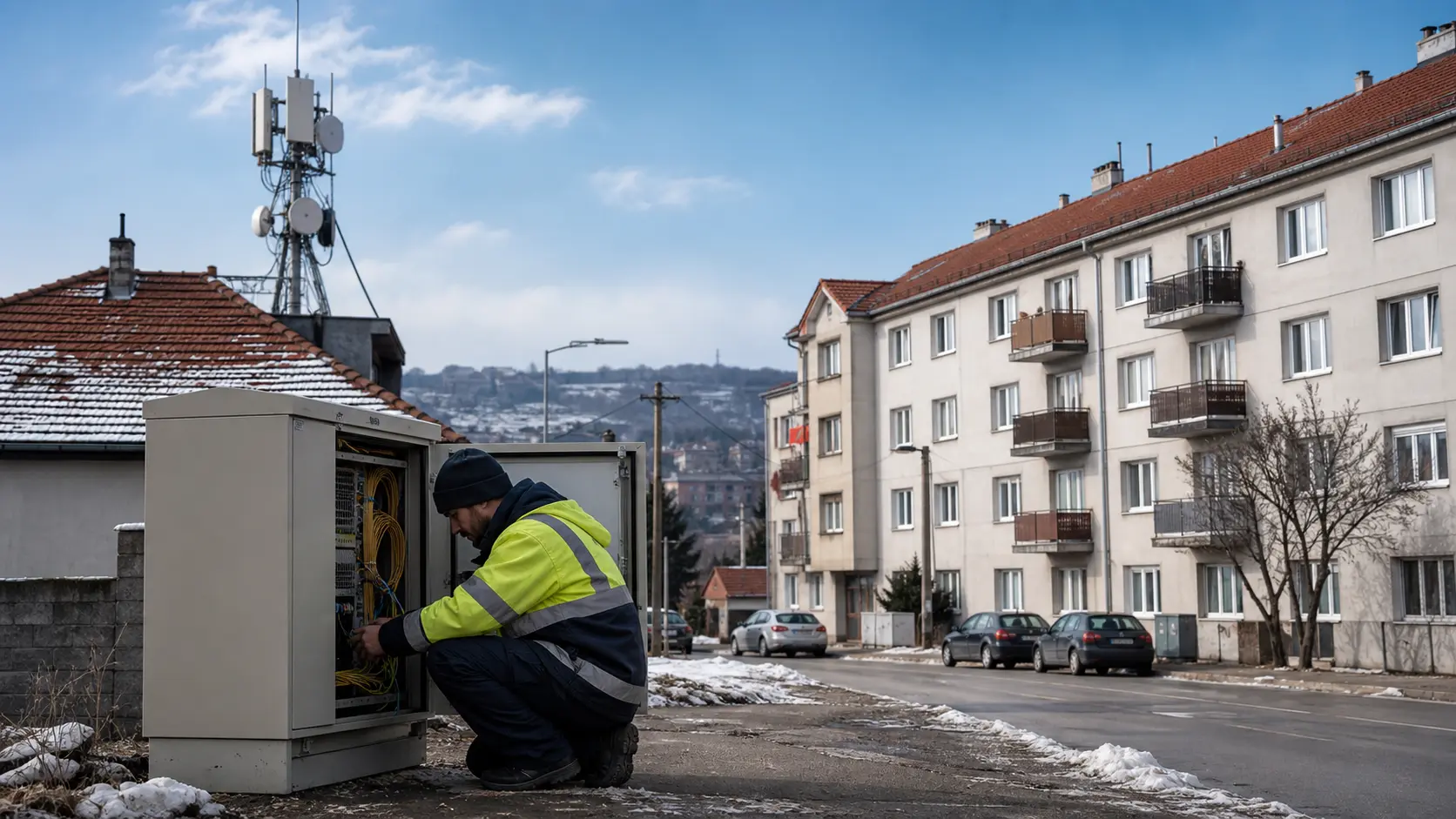
Summary
- What it says: Slovanet/RadioLAN is a Slovak broadband consolidation story with a retail margin problem at its center.
- Main topic: Regional ISP economics; Operator consolidation; Telecom spectrum and security
- Context: market / company research report / Europe - Slovakia
The choice starts at a kitchen table or behind the counter of a small workshop, not in a network diagram. A household on the edge of a Slovak town has a router blinking in the hallway, a television package that older relatives still use, and a mobile plan that promises enough data to make fixed broadband feel less sacred than it used to be.
A small accountant, dental office, repair garage or guesthouse has a more severe version of the same question: keep paying the legacy regional provider that knows the roofline, the radio path, the fibre cabinet and the technician who has visited before, or move to a national fixed or mobile substitute that looks cleaner on the bill and bigger in advertising.
That is the economic problem around Slovanet/RadioLAN. The product is described as internet, television, telephone service, cybersecurity, data services, cloud and business connectivity. The decision margin is more human and more physical. Does support answer quickly? Does the backhaul hold up during the evening peak? Did the RadioLAN integration preserve the local repair memory customers valued? Is the old wireless path being upgraded, replaced or merely billed under a new brand?
Are prices close enough to national alternatives that a household will stay, and are business services strong enough that a small enterprise will not buy purely on the cheapest headline speed?
Slovanet's own retail site starts with a familiar modern offer: internet and TV for the first year at a 50% discount, Wi-Fi Mesh language, an availability checker and a warning that service availability and product mix depend on the technology at a precise address (https://www.slovanet.net/). That address-by-address caveat is not marketing filler. It is the core of the case. A customer buying fibre in a upgraded town, a former RadioLAN customer using a fixed-wireless path, a VDSL customer and a business customer on managed data service are all inside the same public brand but not inside the same cost curve. The operator can advertise nationally; it still has to satisfy locally.
The RadioLAN inheritance sharpens the issue. Slovanet says the RadioLAN websites remained online after the April 2023 merger for archival reasons, but the operation of www.radiolan.sk ended in June 2024 because current product and support information had moved to Slovanet's sites (https://www.slovanet.net/radiolan/). A merger is therefore no longer just a transaction line. It is a customer-interface migration. A former RadioLAN customer no longer has the same public website as the first support instinct; the brand memory now has to be carried by Slovanet's billing, portals, support hours, field crews and actual network performance.
The evidence supports a serious operator, not a loose web alias. The Slovak financial register lists Slovanet, a.s., Ico 35954612, SK NACE 61100 for wired telecommunications, an address at Galvaniho 19 in Bratislava-Ruzinov, a large-company accounting category and domestic private ownership (https://www.registeruz.sk/cruz-public/domain/accountingentity/show/603171). Slovanet's English business page describes an operator with Slovakia-wide coverage serving households, smaller companies, large organizations and corporations with internet communications, data, telephone, security and entertainment services (https://biznis.slovanet.net/en/about-us/). PeeringDB lists the main Slovanet network as AS8778 (https://www.peeringdb.com/net/6896) and the RadioLAN network as AS43451, with RadioLAN shown as a Cable/DSL/ISP network, also known as Slovanet/RadioLAN, with 50-100Gbps of traffic and the old radiolan.sk site in the profile fields (https://www.peeringdb.com/net/13181).
The judgement is not that Slovanet/RadioLAN is small. It is that its competitive problem is the opposite of a pure scale story. It has enough scale to buy, integrate and modernize networks; it does not have enough monopoly power to let support, price or trust decay. Its 2023 annual report reported consolidated sales of EUR52.565 million, 270 employees and more than 96,000 customers at year end (https://www.slovanet.net/wp-content/uploads/2025/02/Rocna-sprava-2023-1.pdf). The same report frames the RadioLAN merger as the most significant milestone in Slovanet's retail history. That is not a casual phrase. It signals that RadioLAN was not just another list of subscribers; it changed the regional retail shape of the company.
Identity after the merger
Slovanet's public identity is a mix of national business-provider ambition and accumulated regional access networks. The 2023 report says RadioLAN merged into Slovanet on 1 April 2023, making Slovanet the legal successor. It also records earlier 2022 mergers involving LIPINA - REAL and RadioInvest, and names SNET GROUP a.s. as the direct holder of Slovanet shares. Older annual-report language explains that SNET became the 100% shareholder in 2014 and that a 2015 merger made Slovanet one of the few telecommunications operators with exclusively Slovak capital. The ownership point matters because customers do not only buy Mbps.
Regional broadband customers often attach trust to who will still be around after the next outage, tariff change or consolidation wave.
The RadioLAN transaction had a clear retail footprint. Broadband TV News reported in March 2022 that Slovanet had agreed to buy RadioLAN for an undisclosed price and that RadioLAN operated mainly in western Slovakia and Povazie, providing triple-play services to more than 30,000 customers (https://www.broadbandtvnews.com/2022/03/03/slovakias-slovanet-to-buy-radiolan/). Telecompaper later described Slovanet as having almost 100,000 users after acquiring RadioLAN (https://www.telecompaper.com/news/slovanet-buys-radiolan-plans-to-further-expand-network--1448742). Those figures align with Slovanet's own 2023 customer count, but they also show why integration risk was real: a large block of customers came with local service habits, old technical assumptions and a pre-existing comparison set.
The old RadioLAN archive reinforces the nature of the inherited business. RadioLAN's final archived tariff for publicly available services, valid from 15 November 2022, described all prices as including VAT, services without time or data limits unless a contract or purpose said otherwise, maximum parameters that could fluctuate with network load, theoretical maximum transmission speeds measured inside RadioLAN's own network, and no guarantee that end users would actually reach those maxima (https://www.radiolan.sk/dokumenty/last/tarifa_last.pdf). That is exactly the language one would expect from a wireless and regional access provider: capacity is real, but it is shared, location-sensitive and heavily dependent on the last-mile environment.
The post-merger identity therefore has two faces. Slovanet wants to be read as a broad Slovak telecommunications and managed-services operator. RadioLAN's legacy reminds the market that a meaningful share of the customer relationship was built in fixed wireless, local television and regional service. The value of the acquisition is not only the customer count. It is the right to continue charging those customers after the website, invoice, support workflow and network management culture move under Slovanet.
Business model: bundles, business services and local credibility
The business model is broader than consumer broadband. Slovanet sells to households, small businesses, large organizations and public institutions. Its business page describes internet communications, data services, telephone service, security and entertainment bundles (https://biznis.slovanet.net/en/about-us/). The 2023 annual report says the company concentrated much attention on business, corporate and institutional customers, modernized infrastructure for existing clients, increased network transmission speeds and expanded smart, cloud IT, cybersecurity and information-security services. It also refers to tenders for telecommunications solutions for institutions, cities and other entities, including cybersecurity, smart-city work and waste-management infrastructure in Prague.
That mix is economically important because retail broadband alone can be unforgiving. A household plan has heavy price transparency, high support volume and limited tolerance for outages. A business service can carry higher margin if it includes data circuits, managed routers, security monitoring, voice, cloud or project work. The more Slovanet can use the same backhaul, engineering team and billing platform across residential and business customers, the more rational the RadioLAN integration becomes. The risk is that business customers demand service discipline while residential customers consume the support queue.
Slovanet's retail product positioning reflects price pressure. The current home page advertises a 50% first-year internet and TV offer and pushes users toward address-level availability checking (https://www.slovanet.net/). Search-visible Slovanet product text for internet packages has shown examples such as Optik 100 at EUR17 per month and Optik 500 with a discounted first-year price before a higher standard monthly price, but the live availability flow is the relevant customer gate because technology differs by location (https://www.slovanet.sk/internet/?tab=vdsl-internet). The basic economics are clear without overclaiming one universal tariff: Slovanet must price close to national fibre and cable alternatives while still carrying the cost of mixed inherited access technologies.
The RadioLAN tariff archive adds a second retail fact. The legacy network was sold with unlimited service language but with explicit caveats about shared load, customer equipment quality, server load and local network conditions (https://www.radiolan.sk/dokumenty/last/tarifa_last.pdf). That is not a defect by itself; it is the operating reality of any contended broadband service. But the retail market increasingly lets customers compare a local provider's caveats with fibre, cable, 5G fixed-wireless and satellite alternatives. If the old provider wins, it wins because the real service feels credible. If it loses, the tariff text becomes a reminder that maximum speed is not the same as dependable experience.
Network evidence and what it can prove
Public network records are useful, but they need to be read as evidence about the company, not as the company itself. Slovanet's main AS8778 PeeringDB entry shows a mature public network profile with technical, NOC and abuse contacts (https://www.peeringdb.com/net/6896). BGP tools show AS8778 as a long-running Slovak network with substantial peering and multiple exchange presences, including NIX.CZ, NIX.SK, Peering.cz and SIX.SK in the search-visible summary (https://bgp.tools/as/8778). That gives Slovanet more public interconnection substance than a purely local reseller.
RadioLAN's AS43451 profile tells a different but complementary story. PeeringDB identifies it as Slovanet/RadioLAN, AS43451, IRR set AS-RADIOLAN, Cable/DSL/ISP, 30 IPv4 prefixes, 10 IPv6 prefixes, mostly inbound traffic and a European geographic scope (https://www.peeringdb.com/net/13181). BGP tools presents AS43451 as a small network now upstreamed by AS8778, with 22 IPv4 and 4 IPv6 originated prefixes, and it preserves legacy prefix descriptions such as RadioLAN public IPs for end users and RadioLAN NAT-related space (https://bgp.tools/as/43451). The precise route table will change over time, but the structural signal is stable: the RadioLAN network footprint has been folded into Slovanet rather than simply disappearing.
The absence of listed public exchange points or facilities on the AS43451 PeeringDB page should not be overread. It does not prove there is no private interconnection, no internal handoff, no wholesale path and no CDN quality. It proves only that the public PeeringDB profile for that network does not show those entries. For a customer, the practical question is simpler. Does the old RadioLAN access path now benefit from Slovanet's broader backbone and peering? Or does it remain a regional edge whose performance depends on local wireless capacity, backhaul and the quality of integration work?
Slovanet's 2023 report gives partial answers. It says a special project interconnected wireless network infrastructures using a technical concept adopted from RadioLAN. It also says several existing Slovanet Wi-Fi networks were technologically modified and their transmission speed increased, while an existing field-service management system would be used for technical maintenance, connection setup and more sophisticated quality control of technicians' work. That is the language of real integration: not just renaming, but staff teams, systems, network practices, maintenance workflow and service-quality control.
Integration as a cost event
The most revealing part of Slovanet's 2023 annual report is not the customer count. It is the operational description of the RadioLAN merger. The company says the most extensive operational activity of 2023 was the merger of Slovanet and RadioLAN networks and systems. Integration had to start at staff level and included creating several new regional teams focused mainly on network management. It required analysis of production and information systems, gradual migration or merging, and the August transfer of RadioLAN customer and service databases into Slovanet's information system.
Billing and payment processing for existing RadioLAN customers moved over, and Slovanet launched a new payment gateway for all retail customers.
Those details matter because they locate the acquisition cost. A regional broadband roll-up does not end when a purchase agreement closes. It ends, if it ends, when customer data is clean, invoices are trusted, payment flows work, support sees the right service history, field staff can find the right equipment, and the old network's quirks have been absorbed into a common planning system. Any error at that stage has a retail consequence. A wrong bill, a broken portal login, a delayed repair order or a technician without historical site knowledge can make a loyal RadioLAN customer reassess the whole relationship.
The cost was also technical. Slovanet says the wireless infrastructure integration borrowed from RadioLAN's concept and modified existing Wi-Fi networks to improve speed. That suggests RadioLAN contributed operational know-how, not only customers. It also complicates a simple fibre-modernization story. Fixed wireless may be less fashionable than fibre, but in areas where civil works are slow, terrain is awkward or density is not ideal, a well-engineered radio network can remain economically rational. The problem is that customer expectations now come from gigabit marketing.
Wireless can be credible, but it must be maintained as a serious access layer, not as a stranded legacy product.
The 2023 report says Slovanet planned to complete remaining systems integration by the end of 2024. The 2024 and 2025 public financial filings do not explain customer experience in the same narrative way, but they show that the combined business continued to carry a large operating base. The 2024 filed individual financial statement reported net turnover of EUR51.099 million, service revenues of EUR47.195 million, operating costs of EUR52.124 million and a net loss of EUR1.358 million (https://www.registeruz.sk/cruz-public/domain/financialreport/show/9609896/552). The 2025 filed statement then showed net turnover rising to EUR69.986 million, service revenues to EUR54.532 million, operating profit to EUR3.972 million and net profit to EUR2.352 million (https://www.registeruz.sk/cruz-public/domain/financialreport/show/10169906/552). The recovery is encouraging, but the cost stack remains heavy.
Fibre investment and the wireless-to-fibre bargain
Slovanet is not defending RadioLAN by pretending all access technologies are equal. Its 2023 report says it completed a long-term project to increase capacity of existing residential fibre networks to 1Gbps, replacing more than 2,000 network devices in nine Slovak cities with more modern and efficient ones at a total investment of more than EUR1.5 million. It also says further upgrades were planned in Stara Tura, Banovce nad Bebravou and Myjava, and that Slovanet had worked with electricity distributors VSD and ZSD to bring high-speed fibre connections to 26 more villages.
Those are the concrete assets behind the company's claim that it can keep regional broadband credible.
The partnership with electricity distributors is especially important. Fibre economics depend on rights of way, poles, ducts, cabinets, make-ready work and local construction costs. Where a broadband operator can reuse or partner around distribution infrastructure, village coverage becomes more plausible. Where it cannot, rural and small-town fibre can remain slow, expensive or limited to selective streets. A household deciding between Slovanet and a national substitute does not care about the capex category. It cares whether the chosen address gets a stable line before a competitor arrives.
The report also says Slovanet faced a 2024 project to gradually replace fixed LTE connections with other available technologies because the relevant frequency licence was expiring. That is a quietly important sentence. It means some access economics were being forced by spectrum life, not only by customer demand. A fixed-wireless customer can look profitable until the spectrum, equipment, interference environment or upgrade path changes. Then the provider must migrate the customer, invest in another technology, renegotiate expectations or risk losing the account.
Wireless-to-fibre migration is therefore a bargain with time. Fibre is capital-intensive up front but can support higher speeds and lower per-bit operating strain once deployed. Fixed wireless is faster to deploy and useful in awkward coverage areas, but it must manage contention, line of sight, spectrum, tower and rooftop equipment, and weather or interference conditions. Slovanet/RadioLAN's central economic question is whether the company can use RadioLAN's regional customer base to fund enough fibre and backhaul modernization before national alternatives make the old relationship feel stale.
Cost base and margin pressure
The filed 2025 statement shows why the company cannot treat support quality as a soft issue. Net turnover reached nearly EUR70 million, but operating costs were also high. Services costs were EUR32.516 million, personnel costs EUR11.248 million, depreciation and amortization EUR8.469 million, and taxes and fees EUR1.976 million (https://www.registeruz.sk/cruz-public/domain/financialreport/show/10169906/552). In 2024, services costs were EUR26.520 million, personnel EUR10.587 million and depreciation EUR9.510 million against lower turnover (https://www.registeruz.sk/cruz-public/domain/financialreport/show/9609896/552). This is a business with significant purchased services, labour and asset wear, not a lightweight software subscription model.
The asset side confirms the infrastructure burden. The 2025 balance sheet showed total assets of EUR41.522 million net, non-current assets of EUR30.751 million, tangible fixed assets of EUR18.682 million and intangible assets of EUR12.045 million (https://www.registeruz.sk/cruz-public/domain/financialreport/show/10169906/550). The 2024 balance sheet had total assets of EUR41.839 million net, non-current assets of EUR33.855 million, tangible fixed assets of EUR20.427 million and intangible assets of EUR13.403 million (https://www.registeruz.sk/cruz-public/domain/financialreport/show/9609896/550). Depreciation is not an accounting curiosity here. It is the financial shadow of cabinets, radio equipment, customer systems, software, fibre upgrades, routers, television platforms and acquired network rights.
The customer-facing implication is blunt. A provider can advertise a discounted first-year bundle, but the discount has to be recovered through retention, upsell, lower churn, efficient installation, cheaper service delivery or higher-value business accounts. A regional customer who leaves after a promotion consumes installation, support and billing cost without paying back enough margin. A SME that stays because support is reliable can subsidize a stronger network. A household that keeps a television bundle and accepts a reasonable price can be valuable.
A customer who sees repeated faults and switches to mobile or national fibre is not just lost revenue; it is failed payback on local access cost.
That is why the support margin matters. Slovanet's support page lists customer service on business days from 8:00 to 17:00, technical support daily from 8:00 to 20:00, product information by freephone and chat, and tools including service status, speed test, Webmail, customer portal and a still-visible Moj RadioLAN link (https://www.slovanet.net/pomoc-a-podpora/prevadzkove-oznamy/). Those hours and portals are part of the product. A national brand can sometimes hide behind scale. A regional inheritance cannot. The customer remembers whether the old RadioLAN-style responsiveness survived the Slovanet process.
Pricing against national substitutes
Slovak broadband is not priced in a vacuum. The European Commission's 2026 publication on 2024 retail broadband prices said fixed broadband prices in the EU fell by an average of 5% compared with 2023, mobile internet prices fell by up to 14%, and converged broadband prices fell by 5.8% (https://digital-strategy.ec.europa.eu/en/library/mobile-and-fixed-broadband-price-europe-2024-insights-european-broadband-market). The methodology looked at the largest internet and mobile providers in each EU country. Even if Slovanet's exact local tariff differs by address, the broad direction is clear: customers are trained to expect more bandwidth and more bundle value for less real money.
The largest Slovak competitors intensify that expectation. Slovak Telekom and Orange have national brand recognition, mobile bases and fixed-network assets. O2 Slovakia's parent, e& PPF Telecom Group, announced in December 2025 that O2 Slovakia had signed a binding agreement to acquire UPC Broadband Slovakia for EUR95 million, taking over a provider whose network reached nearly 80 Slovak cities and more than 600,000 households (https://www.ppf.eu/en/press-release/e-ppf-telecom-group-subsidiary-o2-slovakia-acquires-upc-broadband-in-slovakia). That deal is a competitive fact even before every integration detail is visible to the customer. It means another mobile-led group is trying to deepen fixed broadband, television and convergence.
There is also reported consolidation pressure around Slovanet itself. Symsite Research summarized March 2026 Slovak press reporting that SWAN, associated with the 4ka brand, had agreed to acquire Slovanet and would gain around 100,000 fixed-line internet customers and access to fibre networks serving 100,000 households (https://www.symsite.sk/single-post/swan-to-acquire-slovanet). This should be treated as a market signal, not as a completed transaction in the absence of a direct company closing announcement in the source set reviewed here. Still, the signal is important. It shows that Slovanet/RadioLAN is being read by the market as an asset in the next phase of Slovak convergence, not merely as a legacy operator.
For the household or SME, the sale rumor is not abstract. If customers think ownership could change again, they ask whether the next owner will preserve local support, raise prices, migrate packages, shut old technology, or invest in fibre faster. A national buyer might improve backhaul and procurement. It might also rationalize support and remove the local habits that made RadioLAN attractive. The margin is trust during transition.
Customer trust and unofficial market signals
Public customer chatter is not proof, but it is useful because broadband reputation is formed locally and emotionally. A 2022 discussion thread under Zive's RadioLAN acquisition coverage includes a customer who described being satisfied with RadioLAN's service and prices, with minimal outages and a responsive hotline that followed up within a day. The same thread also contains a customer who remembered bad Slovanet experience in Bratislava and worried that RadioLAN service would worsen after the change; another commenter complained that the deal raised fears of higher prices and worse usability (https://zive.aktuality.sk/diskusia/9px8yq1/slovanet-kupuje-operatora-radiolan-ziska-desiatky-tisic-klientov-nacrtol-dalsie-fungovanie/). Those comments are anecdotal, self-selected and cannot be generalized statistically. They are still exactly the type of signal that explains churn risk after an ISP roll-up.
The substance of the comments fits the economics. RadioLAN's perceived strength was not only a line speed. It was service memory, practical installation, willingness to support odd local setups and a sense that the provider was not over-managed. Slovanet's perceived weakness, among skeptical commenters, was the fear of a bigger bureaucracy, remote handling and price increases. A merger can create better network economics and still destroy perceived value if the customer experiences it as loss of control.
This is also why the old RadioLAN website shutdown matters. Slovanet says current product and support information moved to Slovanet pages after the merger and that radiolan.sk was closed in June 2024 after more than a year of archive operation (https://www.slovanet.net/radiolan/). That is reasonable from a systems perspective. It is also a trust event. The customer who bookmarked the old site, used the old portal, remembered an old support rhythm or recognized old documents now has to accept a new public surface. The company has to make that surface better enough that the change feels like modernization rather than disappearance.
Unofficial signals also show the competitive floor. Some Slovak forum and discussion references compare fixed wireless, fibre availability, Starlink and mobile substitutes in a highly location-specific way. A customer who has no fibre and poor DSL may tolerate more from Slovanet/RadioLAN than a customer with Telekom or Orange fibre at the door. A rural SME may value a working fixed-wireless link if it beats unstable alternatives. A suburban household may leave quickly if national fibre arrives. The company cannot solve this with one brand promise; it has to win address by address.
Backhaul, suppliers and the hidden dependency chain
For the customer, broadband appears as one bill. For the operator, it is a chain of dependencies. Slovanet/RadioLAN needs access infrastructure, backbone capacity, peering and transit, power, customer-premise equipment, television content and platform supply, software systems, payment systems, field-service workflow, billing accuracy, and increasingly cybersecurity capability. The 2023 annual report is explicit that Slovanet worked on automation for repeated and mass configuration tasks, monitoring-service provisioning, IoT endpoint configuration and backbone circuit management.
It also says the company replaced equipment at 40 backbone nodes with more efficient devices, in some cases reducing consumption up to three times, revised supplier contracts to reduce energy costs, and used photovoltaic sources in a growing number of telecommunications hubs.
Those details matter because backhaul quality is often invisible until it fails. A former RadioLAN customer may have a good radio path to a local site, but the experience still depends on how that site is aggregated into Slovanet's wider network. A fibre customer may have a strong optical line but still feel evening congestion if upstream capacity, local aggregation or content paths are weak. A business customer may buy an SLA, but the real cost of honoring it includes monitoring, escalation, spares and trained people.
Supplier dependence can be constructive. The VSD and ZSD distribution-infrastructure partnerships let Slovanet reach more villages with fibre than it might have reached alone. Peering and exchange participation help national and international performance. Hardware modernization lowers energy cost and can improve reliability. The problem is that every dependency has its own renewal cycle, cost inflation and operational risk. Energy prices, supplier lead times, software migrations, payment gateway reliability and spectrum expiry can all turn into customer-facing broadband quality.
Backhaul economics also decide whether the company can defend wireless. Fixed wireless is not obsolete if the backhaul behind it is strong, radio planning is disciplined and support is responsive. It becomes weak when advertised packages outrun the shared capacity, when interference accumulates, or when field teams cannot keep rooftop and customer equipment aligned. Slovanet's adoption of RadioLAN's wireless concept suggests there was practical knowledge worth preserving. The question is whether that knowledge receives capital and process support after the integration period.
Competition is becoming more converged
Slovanet/RadioLAN competes against at least four different substitute types. The first is national fixed fibre or cable from larger operators. The second is fixed-mobile convergence, where a customer bundles mobile, home internet and television with one group. The third is 5G or LTE fixed-wireless substitution, especially where the fixed line is mediocre. The fourth is local alternatives, including smaller fibre or wireless operators that can be faster to respond in one town or street than a national provider.
The UPC-O2 deal illustrates the direction of travel. e& PPF said the UPC acquisition would complement O2 Slovakia's existing service offering and broaden customer services, while UPC brought a well-invested network reaching more than 600,000 households in nearly 80 cities (https://www.ppf.eu/en/press-release/e-ppf-telecom-group-subsidiary-o2-slovakia-acquires-upc-broadband-in-slovakia). That is the strategic pressure on Slovanet/RadioLAN. A customer comparing Slovanet with a mobile-led converged group may see a broader bundle, simpler household discount and stronger brand. Slovanet has to answer with locality, business competence, service quality and credible fibre expansion.
The reported SWAN interest in Slovanet, if ultimately confirmed by direct transaction records, would fit the same logic. A mobile or alternative fixed group can buy Slovanet to add customers, fibre reach, business relationships and regional access assets. But consolidation can cut both ways. It can fund upgrades, eliminate duplicated overhead and improve procurement. It can also remove the local identity that made the acquired customers valuable in the first place. The RadioLAN experience is therefore a preview of the next consolidation test.
For a SME, convergence is attractive but not always decisive. A dental office or small factory may prefer a provider that can discuss static addressing, backup, voice, security, router management and on-site response. A guesthouse may care about Wi-Fi coverage, TV stability and weekend support more than a mobile discount. A household may follow price. Slovanet's advantage is that it can talk to all these segments. Its risk is that doing so requires a cost base more complex than a pure consumer broadband operator.
Regulation, security and operational risk
The regulatory and operational risk set is not theoretical. Slovanet itself noted the need to replace fixed LTE connections with other available technologies because of expiring frequency licences. It also described cybersecurity and information security demand as increasingly important, and said it had started building its own security operations centre while expanding product families and implementing SD-WAN solutions for major customers. The public company is therefore exposed both as an access provider and as a provider of services to organizations that may themselves be under stricter security expectations.
Slovak and EU communications policy adds pressure through the gigabit transition. Customers are encouraged by public policy and advertising to see high-speed broadband as normal infrastructure. The European Commission's price study shows retail broadband becoming cheaper in real terms across categories, which increases the pressure to deliver more while charging carefully (https://digital-strategy.ec.europa.eu/en/library/mobile-and-fixed-broadband-price-europe-2024-insights-european-broadband-market). If regulation, competition and customer habits all point toward faster and cheaper packages, a mixed wireless and fibre operator has to find efficiency faster than price erosion.
Operationally, the most visible risks are integration fatigue, support delays, technology fragmentation, power cost, field crew availability and customer confusion. Slovanet has already had to migrate RadioLAN customer and service databases, unify billing and payment processing, create regional teams, manage wireless infrastructure integration and plan further systems completion. Even if all this is rational, each step can generate errors. Broadband customers are unforgiving because the service is noticed only when it fails.
Geopolitical and macroeconomic exposure is indirect but real. The 2023 report referred to high inflation and high interest rates in Slovakia's business environment. Higher interest rates matter for network upgrades; inflation matters for labour and supplier contracts; energy cost matters for backbone nodes and access sites. Slovanet's equipment replacement and photovoltaic use show management attention to energy efficiency, but they also show that power cost is part of the margin equation.
What would change the judgement
The base judgement is constructive but conditional. Slovanet/RadioLAN looks like a real, revenue-generating Slovak operator with credible network assets, a meaningful customer base, a documented RadioLAN integration plan, fibre upgrade activity and broader business-service capabilities. It also carries visible risks: mixed access technologies, post-merger customer trust, price pressure from national converged competitors, heavy services and personnel cost, depreciation, spectrum-driven migration and uncertainty around future ownership.
Several facts would improve the judgement materially. First, published post-2024 data showing lower churn among former RadioLAN customers would prove that support and billing migration preserved trust. Second, a clear disclosure of completed wireless-to-fibre migrations, including locations and customer counts, would show that the legacy base is being modernized rather than merely maintained. Third, evidence of improved service metrics - repair time, outage frequency, first-contact resolution or support queue performance - would turn the qualitative support story into operating proof.
Fourth, current package data by technology and address type would clarify whether Slovanet is discounting aggressively or preserving ARPU through bundles.
Several facts would weaken the case. A confirmed sale that led to service disruption, customer confusion or abrupt tariff increases would challenge the trust premium. Persistent complaints from former RadioLAN geographies about billing, support or speed would suggest integration damage. Failure to replace fixed LTE and older wireless paths before spectrum or equipment constraints bite would create churn risk. A sharp rise in debt service or renewed operating losses would make capex harder.
A major competitor's fibre or cable expansion into RadioLAN's strongest towns could expose whether the customer relationship is durable or merely a function of limited alternatives.
The most important missing evidence is not a route record or a brand slogan. It is local customer retention after integration. Did the former RadioLAN household stay when the old website closed? Did the SME still get a technician who understood its installation? Did the fibre upgrade arrive before a national competitor's sales team? Did the bill remain close enough to alternatives that support and familiarity could carry the decision? That is where Slovanet/RadioLAN's economics will be decided.
The margin is credibility
A regional broadband provider does not need to be loved in the abstract. It needs to be believed at the moment of choice. The household compares a discounted national fibre bundle, a mobile data fallback, maybe a satellite option, and the provider that knows the local roof and cabinet. The SME compares the monthly line cost with the cost of card terminals failing, bookings dropping, cloud software slowing or customers losing Wi-Fi. In that moment, Slovanet/RadioLAN is not selling a legacy acquisition. It is selling credible continuity.
The company has assets that make credibility plausible. It has a public national brand, a meaningful customer base, a documented RadioLAN customer migration, broader business services, peering and backbone evidence, fibre upgrade investment, village fibre partnerships, support channels and a financial rebound in 2025 filings. It also has liabilities that make credibility expensive. It inherited customers who may remember a more local provider. It faces competitors with larger converged bundles. It must maintain wireless and fibre at the same time. It has to invest while prices fall.
It may be caught in another consolidation cycle before the last one has fully faded from customer memory.
That is why Slovanet/RadioLAN is best read as an economics test, not simply a Slovak ISP entry. The price of keeping regional broadband credible after consolidation is not paid only in acquisition consideration or fibre capex. It is paid in support hours, accurate invoices, clean portal migrations, backhaul upgrades, energy-efficient nodes, field-service discipline, honest availability checking, and the restraint not to treat former RadioLAN customers as anonymous lines in a national bundle. If Slovanet keeps that discipline, the RadioLAN acquisition can remain a durable regional access asset.
If it does not, the market has enough substitutes to turn a legacy relationship into a churn list.