
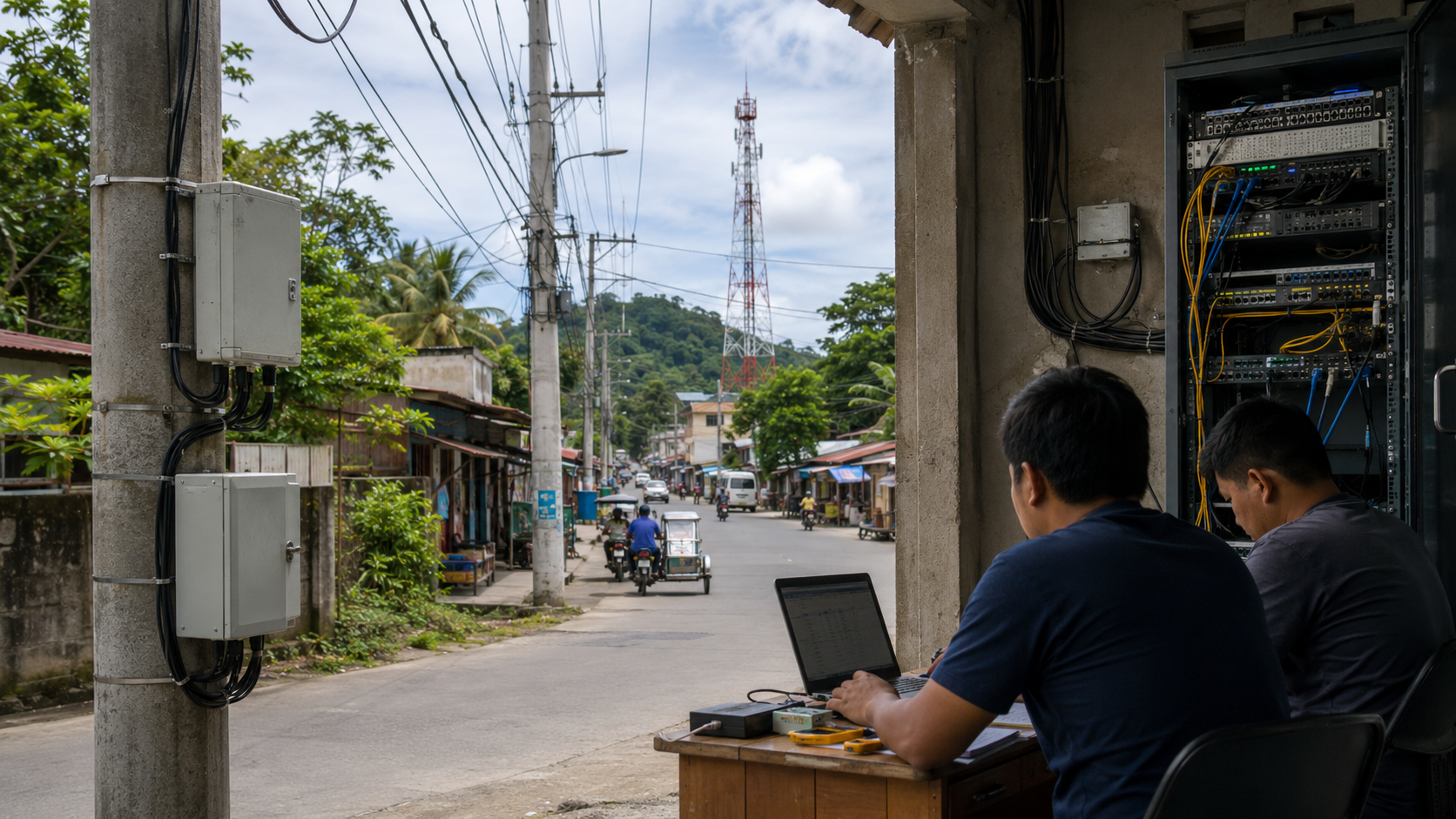
Provincial broadband is not primarily won by brand, app design, or national advertising. It is won or lost on repair distance, backhaul scarcity, payment collection, and trust. A household does not buy “the internet” in abstraction; it buys a working drop line, a modem that stays provisioned, a technician who can reach the subdivision or barangay after a storm, a billing record that will not trap the account in disputed arrears, and a provider that can move traffic from the town to a national or international network without collapsing at peak hours. In an archipelago, that operating problem is structural, not cosmetic. The Philippines’ own connectivity plan says fixed broadband construction is challenging because the country is archipelagic, and the World Bank identifies weak rural investment, weak competition, and poor broadband infrastructure as binding constraints on national connectivity.
SkyBroadband Provincial Network is best read through that lens. The central economic question is not whether it has national scale. The public evidence says it does not, at least not as an independently visible network today. The better question is how a provincial broadband identity can hold local market power without national scale. The answer is that last-mile broadband power is often neighborhood-specific. If a company controls the installed cable route, the customer account, the local repair workflow, the payment relationship, or the only practical upgrade path in a building or area, it can have market power even while renting upstream scale from someone else. Conversely, if it loses field trust, loses access to ports, or cannot coordinate the migration from legacy plant to fiber, that local power becomes a churn machine.
The hard evidence for SkyBroadband Provincial Network is narrow but real. APNIC’s WHOIS record lists AS45622 as “SKYBB-PILIPINOCABLE-AS-AP,” described as “SkyBroadband Provincial Network,” with country PH, imports from AS6648 and AS23944, organization ORG-SPN2-AP, and a sponsoring organization ORG-SI1-AP. The same record points to BayanTel/Skyinet maintenance, BayanTel address history, SkyCablenet IP administration, and a Globe abuse contact validated in 2026. That proves an RIR-registered network identity and lineage. It does not prove a currently active standalone sales company, a live provincial customer base under that exact name, or a current independent operating footprint.
The name is real; the live network is not visible
The cleanest canonical identity is not a corporate website. It is AS45622. APNIC’s registry gives the name, the AS handle, the country, the routing-policy relationships, the organization object, and the maintainer trail. The aliases that matter commercially are “SKYBB-PILIPINOCABLE-AS-AP,” “SkyBroadband Provincial Network,” “Sky Internet,” “SKYCablenet IPadmin,” “SKYBROADBAND,” and the current customer-facing Sky Cable/SKY Fiber/SKY TruFiber ecosystem. Those names are not interchangeable legal entities. They are a lineage of routing objects, operating brands, broadband products, and corporate control relationships. APNIC itself classifies the SkyBroadband Provincial Network organization as “OTHER,” tied to a BayanTel address and skyinet.net contact, not as a consumer-facing corporation with a standalone evidence trail.
The routing table is more important than the name. BGP.tools states that AS45622 is “not currently in the global routing table” and shows zero originated IPv4 and zero originated IPv6 prefixes, even though the ASN is still “Active, Allocated under APNIC.” PeeringDB likewise lists SkyBroadband Provincial Network under ASN 45622, organization Sky Internet, with zero IPv4 prefixes, zero IPv6 prefixes, no public peering exchange points, and no interconnection facilities. That is the strongest current-status signal: this is not behaving like an actively visible autonomous network that originates customer traffic on the global internet.
There are, however, residual route and address clues. AbuseIPDB’s WHOIS view for 182.18.238.75 lists the ISP as SKYBROADBAND, usage type fixed-line ISP, domain mysky.com.ph, and city Davao; its raw APNIC WHOIS section shows a SKYBB-PH block and a route object for 182.18.238.0/24 with origin AS45622 and description “Sky Cable Corporation.” That matters, but it is not enough to override the live BGP evidence. A route object can remain after operational topology changes; it can document intended or historical authorization without showing that the prefix is currently announced by the ASN. A third-party downstream listing also places AS45622 under AS23944 SKYBroadband/SKYCable Corporation, alongside other Sky-related ASNs, but that again is a relationship signal rather than proof of present traffic origination.
The likely current status is therefore: real registry identity, likely legacy or residual network object, commercially tied to the Sky/BayanTel/Sky Cable broadband lineage, but not a clearly active standalone ISP in the public routing table. For an infrastructure-market reader, that is not a weak conclusion. It is the conclusion. The absence of visible prefixes, facilities, peering, website clarity, and direct sales collateral is itself the market signal.
BayanTel and Sky Internet explain the fossil record
The SkyBroadband Provincial Network record looks strange only if treated as a modern clean-room ISP profile. It makes more sense as an artifact of the older Sky Internet, BayanTel, Sky Cable, and Lopez-group broadband stack. APNIC’s AS45622 object imports from AS6648 and AS23944; the notification and maintainer contacts include bayan.com.ph and SKYINET; the abuse record uses Globe’s cybersecurity mailbox, while the organization address points to BayanTel’s Roosevelt Avenue building. Globe’s 2015 Philippine Stock Exchange disclosure says Globe agreed to buy equity in BayanTel from Bayan Telecommunications Holdings and Lopez Holdings, increasing Globe’s equity interest in BayanTel from 56.87% to 98.57%. This does not prove Globe owns SkyBroadband Provincial Network as a consumer business, but it explains why a Sky/BayanTel-era resource can carry Globe abuse handling today.
The historical operating logic is visible in an old but useful De La Salle University business thesis on Sky Internet. It described Sky Internet as one of the top ISP players of the period, dependent on upstream backbone providers and local-loop carriers, affiliated with BayanTel and Sky Cable, and weakened by billing/collection problems, low subscriber base, and mismatch between revenue and expenses. It also identified prepaid services, improved billing/collection, convergence, capacity improvement, and acquisition of smaller ISPs as strategic levers. The document is from 2000, so it cannot establish current operations. Its value is structural: the same economic variables recur in the current evidence—backbone dependence, billing discipline, convergence, local access infrastructure, and subscriber-base scale.
That history matters because provincial broadband assets often outlive the corporate story that created them. An ASN may remain registered; an abuse mailbox may be updated; a route object may still exist; a customer brand may migrate from cable broadband to fiber; a billing relationship may survive even after the physical plant is outsourced. The commercial object is therefore not a neatly bounded company called SkyBroadband Provincial Network. It is a residual provincial broadband identity inside a larger Sky Cable/Sky Internet/BayanTel/SKYBROADBAND ecosystem.
The customer-facing business has moved to Sky Cable, Sky Fiber, and Sky TruFiber
The current public-facing Sky broadband story is no longer centered on the exact SkyBroadband Provincial Network name. It is centered on Sky Cable Corporation, SKY Fiber, SKY TruFiber, SKY TV, and SKYBIZ. MySky describes SKY Cable Corporation as the pay TV and broadband arm of ABS-CBN, offering broadband through SKY Fiber and business connectivity through SKYBIZ. The same official Sky history says Sky introduced high-speed internet under the SKYbroadband brand in 2008 and later relaunched broadband as SKY Fiber in 2018. That is the consumer lineage into which SkyBroadband Provincial Network most plausibly fits.
The product evidence is also narrower than the national brand might imply. MySky’s current SKY Fiber plan page shows residential plans from 100 Mbps at ₱999 per month to 1 Gbps at ₱3,500 per month, with the page specifying availability in selected Metro Manila areas and a guaranteed speed of 30% of subscribed speed. That page does not prove provincial AS45622 activity. It does prove the current retail price benchmark and service positioning of the Sky broadband brand. It also shows why a legacy provincial network would face price compression: a provider selling below-gigabit local broadband must compete against a market where headline speeds are cheap and where the differentiator shifts from peak speed to actual uptime, installation availability, and dispute handling.
Sky’s official upgrade page is more commercially revealing than the plan page. It states that, following the Converge arrangement, SKY is on a pure fiber network; traditional SKY cable service and plans will no longer be offered in the covered transition; the free upgrade is available to active Metro Manila subscribers with no overdue balance; authorized representatives will conduct home visits; and customers who do not upgrade will see service end when the legacy network in their area is decommissioned. It also says SKY TV requires a SKY TruFiber connection and will not work with other ISPs, while Sky remains the service provider and biller after the upgrade. Those details are unit economics, not marketing. They define who controls the account, who controls the customer’s migration path, and where switching costs sit.
Converge supplies the new scale; Sky keeps the customer relationship
The central current transaction is Sky’s commercial arrangement with Converge ICT. Sky says it will use Converge’s pure fiber network to upgrade services for new and existing SKY Fiber subscribers. The official page says the agreement allows Sky to use Converge’s FTTH network; Converge, for its part, says the arrangement increases port utilization and provides a revenue boost. ABS-CBN’s corporate release adds scale: Converge had more than eight million FTTH ports, a fiber footprint over 700,000 kilometers, reach to 16 million Filipino homes, and 2.3 million residential broadband subscribers as of end-March 2024.
This turns Sky’s economics from “own and operate the access network” toward “monetize the customer base while using another operator’s fiber plant.” That is not automatically bad. A distressed or subscale broadband operator can improve service quality by moving customers onto a stronger FTTH network, while the network owner monetizes excess ports. But it also creates supplier concentration. If Converge ports are unavailable, local boxes are missing, migration records are incomplete, or dispatch responsibility is unclear, the customer sees one service failure even if the blame is split across two firms.
The arrangement also appears strategically important enough to trigger market rumor and official denial. Converge and Sky issued a joint statement on June 26, 2026 saying the commercial arrangement remains “in full force and effect,” contrary to a news report that it had been terminated. The economic read is simple: continuity of the Converge arrangement is now a primary variable in Sky’s broadband value. Sky’s own legacy network decommissioning language makes that unavoidable. If the replacement FTTH path is stable, Sky can convert a decaying plant into a customer-service and billing business riding Converge infrastructure. If it is unstable, the migration period destroys trust faster than it saves capex.
The paradox: declining broadband can still have local power
A network can be losing subscribers and still have market power in the places where households are locked into its physical route or account structure. ABS-CBN’s 2024 quarterly report shows Cable TV & Broadband revenue of ₱4.122 billion for the first nine months of 2024, down 24% from ₱5.456 billion in the comparable 2023 period, mainly due to subscriber decline; Cable TV & Broadband still produced ₱1.120 billion of EBITDA but had a ₱418 million net loss for the period. In 2025, ABS-CBN said Cable TV and Broadband revenue fell another 39% to ₱3.27 billion, while the segment’s recurring net loss narrowed to ₱1.34 billion and reported net loss fell to ₱776 million due to cost reductions. Philstar, citing the financial report, added that Sky Cable debt fell 26% to ₱3.3 billion after refinancing with lenders that extended payment terms up to 2032.
Those numbers describe distress, not dominance. But local power in broadband is not the same as consolidated financial health. A provider can have weak corporate financials and still have high local switching frictions. The customer may need an available port from a rival provider; a condo or subdivision may have limited in-building wiring; a household may need to settle an outstanding balance before termination or upgrade; an IPTV bundle may require the same fiber service; a technician may be scheduled only through a specific contractor chain. Sky’s upgrade page makes the payment and account gating explicit: only active subscribers with no overdue balance qualify for the free upgrade, customers are told to keep accounts in good credit standing, and Sky remains the biller after the upgrade.
This is how local market power survives without national scale. It is not a monopoly in the textbook national-market sense. It is a series of micro-monopolies around drops, ports, account status, local repair knowledge, contractor access, and decommissioning schedules. A customer may dislike the provider and still be unable to switch quickly if the alternative lacks a nearby network access point. In provincial broadband, the customer’s outside option is not “PLDT or Globe or Converge exists nationally.” The outside option is “a working port and a technician are available at this address this week.”
The balance sheet sits in the field force
The highest-cost moments in an access network are not always bandwidth purchases. They are truck rolls, failed installations, repeat visits, and unpaid accounts. A technician dispatched to a distant barangay who discovers no available fiber port has generated cost without revenue. A household that is billed while service is unstable becomes a collection risk and a complaint risk. A customer who refuses to settle an arrear because service was down can block termination, migration, or equipment recovery. These are not edge cases; they are core broadband economics.
ABS-CBN’s 2024 report gives a useful accounting view of this. Sky Cable pays sales commissions to agents for subscriber contracts, capitalizes those costs as incremental costs of obtaining contracts, and amortizes them over the service period. The same report describes contract liabilities including subscription fees billed and received in advance, nonrefundable installation fees received in advance, and customer deposits, with ₱2.841 billion of contract liabilities at September 30, 2024. That means the business is not just selling bandwidth. It is managing an account ledger with deposits, prepaid elements, installation economics, agent commissions, and service-performance obligations.
Payment collection is also visible in the broader market. A CIMB/GCredit merchant list from 2021 groups Sky Broadband, SkyCable, Skydirect Postpaid, Converge ICT, Bayantel, PLDT, Globe At Home, and numerous local cable/internet operators into biller categories. The document is old and not proof of current acceptance, but it demonstrates how cable/internet service in the Philippines has long been embedded in third-party bill-payment rails. Economically, this matters because collection channels are part of the moat. A local ISP with easy payment options, accurate posting, and fast reconnection can outperform a technically stronger network with poor billing reconciliation.
The abuse-handling trail is another operational clue. AS45622’s APNIC record points abuse to a Globe cybersecurity mailbox; older SkyCablenet role data points abuse incidents to skyinet.net; the SKYBB-PH IP block shown in AbuseIPDB has a separate Sky abuse mailbox validated in 2026. That split is not necessarily a problem, but it shows the inherited complexity. Abuse desks matter economically because consumer ISPs generate spam, malware, botnet, and copyright complaints. Poor abuse responsiveness can raise upstream risk, create blacklisting, and damage interconnection relationships. For a currently dormant ASN, the abuse path is less about live AS45622 traffic and more about whether inherited Sky/BayanTel/Sky Cable resources remain cleanly administered.
Backhaul and ports are the real upstream dependency
The public routing evidence says AS45622 has no live global visibility; the commercial evidence says Sky’s current broadband improvement path relies on Converge FTTH. Those two facts point to the same economic model: the scarce asset is no longer AS45622’s independent transit posture. It is access to a working physical last mile and the ability to ride someone else’s scaled network. Converge wants port utilization; Sky wants service continuity and a capex-light upgrade path.
This shifts the risk from transit price to operational coordination. If Converge’s national network has available ports and local boxes, Sky can preserve subscribers without rebuilding plant. If it does not, the customer becomes stuck between a legacy network being decommissioned and a new fiber network not yet ready. The official Sky upgrade text already creates that tension: upgrade timing depends on area, authorized representatives will contact customers, the legacy network will eventually be decommissioned, and the free upgrade is conditioned on account status.
In provincial terms, backhaul is still decisive. A local provider can own the home drop but depend on a larger carrier for transport to Manila, a regional hub, or an international gateway. The 2000 Sky Internet thesis observed the same upstream dependency in an earlier form: ISPs needed upstream internet providers and were dependent on backbone providers and local-loop carriers. The technology changed from dial-up/cable/IPLC to FTTH and wholesale fiber, but the bargaining problem remains. The company closest to the home may not own the route that determines congestion, latency, and restoration after major cuts.
Price pressure is national; trust is local
Sky’s published residential plan page shows how intense headline-price pressure has become: 300 Mbps at ₱1,500, 500 Mbps at ₱2,000, 700 Mbps at ₱2,500, and 1 Gbps at ₱3,500 in selected Metro Manila areas, with 30% guaranteed speed. Even if those prices are not a provincial AS45622 product sheet, they anchor consumer expectations. A provincial ISP selling 50–100 Mbps at similar prices must win on uptime, fast repairs, payment convenience, or lack of alternatives. If it cannot, its only remaining moat is customer inertia.
The competitive set is not only PLDT, Globe, Converge, and DITO. It includes local cable operators, small WISPs, building-specific providers, resellers, and municipal-area broadband firms. The DICT connectivity plan’s stakeholder list includes regional private operators such as DCTV Cable Network Broadband Services, Leyte Cable Network, Mindanao Cable Television, and other local communications and cable entities. The GCredit biller list likewise shows a fragmented cable/internet payment ecosystem, with names such as Angeles Cable, BICORE, Cavite Cable, Central Luzon Cable, PARASAT, Royal Cable, Shama Broadband & CATV, and Sky Broadband appearing alongside national brands. This fragmentation is the relevant competitive environment for a provincial broadband network.
Small local ISPs can be inferior on scale and superior on dispatch. A Reddit user in an InternetPH thread claimed a small local provider fixed outages the same day while Sky’s restoration times were repeatedly moved; that is anecdotal, but it captures a real economic counterfactual. A local operator with worse upstream pricing can beat a national brand in a neighborhood if it has a nearer technician, fewer call-center layers, and direct control over the drop. Local service quality is often a labor-coordination problem before it is a bandwidth problem.
Hyperscalers are not direct competitors to SkyBroadband Provincial Network. AWS, Google, Microsoft, Netflix, and content-delivery networks affect traffic volumes, cache placement, and customer expectations for video quality, but they do not install the household drop. Exchanges and data centers are also not the right category for AS45622 today. PeeringDB shows no public peering exchange points and no interconnection facilities for AS45622. The category is access ISP or legacy regional broadband network, not cloud, hosting, exchange, or national telecom.
Control has been strategically unstable
The Sky broadband business has been through a visible control and strategy cycle. In January 2024, GMA reported Sky Cable would sign off from cable broadcast as part of preparations for the PLDT-Sky acquisition, while Sky Fiber services would continue. The same report said the Philippine Competition Commission had allowed the sale, and that PLDT agreed to acquire 100% of Sky Cable’s outstanding capital stock for ₱6.75 billion. Then in February 2024, GMA reported the sale was canceled after ABS-CBN and PLDT jointly decided not to proceed, with Sky saying cable TV would continue and SKYFiber remained unaffected.
That failed transaction matters because it shows the asset was strategically valuable but difficult to absorb. The buyer logic was clear: broadband coverage, especially remote-area coverage, could improve under a larger telecom group. The seller logic was also clear: Sky’s broadband asset had customer relationships but required capital and operational renewal. The cancellation left Sky needing another route, and the Converge arrangement became that route.
By 2026, the key control risk was no longer PLDT acquisition; it was Converge partnership continuity and lender accommodation. Converge’s joint statement says the Sky arrangement remains in force despite a termination report. Philstar’s 2026 report says Sky Cable trimmed debt to ₱3.3 billion after a refinancing deal extending payment terms up to 2032. The implied constraint is balance-sheet time. Sky needs enough runway to complete migration and preserve accounts; Converge needs enough confidence that wholesale economics and customer conversion will pay; lenders need evidence that the segment can stop shrinking faster than costs can be removed.
Chatter is not proof, but it is a leading indicator
The unofficial evidence is commercially important precisely because the official evidence is thin. Internet service quality failures appear first as call-center scripts, local Facebook posts, Reddit threads, technician gossip, and complaint screenshots long before they become formal disclosures. These signals are not representative samples. They are biased toward angry customers. But in broadband, angry customers are the right early-warning set because service failures are local, clustered, and time-sensitive.
A Reddit thread from a long-time Sky Fiber customer describes repeated outages after a switch toward Converge lines, a failed migration because there was allegedly no Converge box nearby, months of intermittent service, continued billing, and no technician resolution. The same thread includes comments claiming zero-balance requirements for termination or upgrade, limited availability of Sky TruFiber, and long waits tied to Converge availability. Another Reddit thread describes more than a month without SKY internet, a delayed migration to Converge, difficulty getting clear answers, bounced or unanswered Sky email attempts, and intent to report to NTC and DTI. A third thread focuses on moving restoration estimates, unclear outage causes, cable-theft explanations, and the perception that old Sky infrastructure was being replaced by Converge-powered fiber.
These threads do not prove systemic failure. They do prove that some customers experience the migration as a three-party coordination failure: Sky account, Converge infrastructure, and local technician availability. The commercial meaning is larger than the anecdotes. If customers believe they are being billed during unusable service, trust falls. If termination requires zero balance while the balance itself is disputed, churn becomes adversarial. If there is no local port or box, the “free upgrade” is a promise without capacity. If restoration dates are repeatedly moved, the provider loses the only asset that matters in a local outage: credibility.
A low-authority tech blog intensified those claims, alleging widespread November 2025 Sky Fiber outages, Converge transition failures, unavailable fiber ports, missing distribution boxes, incomplete barangay runs, support-template responses, and regulator-rebate exposure. That source should not be treated as verified fact; it uses broad claims that would require stronger corroboration. But it is useful market gossip because it names the exact operational bottlenecks an analyst would expect during a forced HFC-to-FTTH migration: port exhaustion, incomplete local fiber runs, reduced maintenance on legacy plant, and unresolved complaint channels.
If the rumor pattern is materially true, the value transfer is severe. Converge gains wholesale utilization only where ports are ready; Sky retains billing exposure but loses customer goodwill; local competitors acquire dissatisfied subscribers; regulators receive complaint volume; lenders see slower retention. If the rumor pattern is mostly false or isolated, then the economics are more benign: a messy but finite migration period creates noise, while the new FTTH service improves retention after conversion. The watchpoint is not whether customers complain; all ISPs have complaints. The watchpoint is whether complaints cluster around the same scarce assets: no port, no box, no technician, no bill adjustment, no clean termination.
What the registry silence means economically
There is no strong public evidence that SkyBroadband Provincial Network, under that exact name, currently sells services, operates a customer website, hires field staff, wins procurement contracts, or peers as an independent network. That absence should not be filled with speculation. It should be interpreted.
The first interpretation is dormancy: AS45622 may be an allocated but non-announcing network object retained for administrative continuity or possible future use. BGP.tools and PeeringDB support this. The second is absorption: traffic and customers formerly tied to provincial Sky broadband may now sit under other Sky/SkyCable ASNs, Converge infrastructure, or larger upstream arrangements. APNIC’s links to AS23944, Sky Internet, BayanTel, and Globe abuse handling support an inherited-resource view. The third is local invisibility: some access networks can serve customers without their own ASN appearing as the retail brand, especially when traffic is NATed, tunneled, wholesaled, or routed under a parent network. That is possible, but the public evidence does not show it specifically for AS45622 today.
This distinction matters for valuation and risk. A live independent ASN with growing prefixes, IX presence, and clean peering would have optionality as a network asset. A dormant ASN embedded in a distressed broadband migration has different value: customer lists, billing relationships, local plant knowledge, brand recognition, and possible residual numbering resources. The former is an internet-infrastructure asset; the latter is an access-market/customer-migration asset.
Category recommendation
SkyBroadband Provincial Network should be categorized as a regional ISP or legacy provincial broadband access-network identity in the Asia-Pacific access-infrastructure market. It should not be categorized as cloud/hosting, national telecom, exchange/interconnection platform, or data-center operator. The routing record is too thin for interconnection; the customer-facing evidence is tied to residential and business broadband; the corporate trail points to Sky Cable/Sky Internet/BayanTel; and the current operating economics are dominated by FTTH migration, local service continuity, billing, and supplier dependence.
The sharper label is: “legacy regional ISP / cable-broadband access network object within the Sky Cable-Sky Internet broadband lineage, now commercially affected by Sky’s Converge FTTH migration.” That category preserves the evidence boundary. It recognizes the hard registry facts without pretending AS45622 is a visible live network. It also keeps the economics focused on the true asset: local access power without national routing scale.
The investment-quality conclusion is not that SkyBroadband Provincial Network is a hidden national broadband player. It is that provincial broadband market power can survive as a local control point even after national-scale economics move elsewhere. Sky’s power, where it exists, comes from customer accounts, legacy access, migration gating, billing continuity, and repair coordination. Its weakness comes from the same places: disputed balances, delayed technicians, decommissioned plant, no available fiber ports, and dependence on Converge for the new physical network. A small provincial ISP with direct field control can beat it locally; a national provider with ports ready can absorb its churn; Sky can preserve value only where it converts customers faster than trust decays.
Evidence ledger
Source name: APNIC WHOIS for AS45622. URL: https://wq.apnic.net/apnic-bin/whois.pl?object_type=aut-num&searchtext=AS45622. Source type: RIR/WHOIS registry. Supports: AS45622 identity, “SKYBB-PILIPINOCABLE-AS-AP,” “SkyBroadband Provincial Network,” PH country, imports from AS6648 and AS23944, ORG-SPN2-AP, BayanTel/Skyinet maintainer trail, Globe abuse contact. Does not prove: active service, current subscribers, legal incorporation, or live global routing. Economic importance: establishes the canonical network identity and inherited control/abuse chain.
Source name: BGP.tools AS45622. URL: https://bgp.tools/as/45622. Source type: BGP/routing intelligence. Supports: AS45622 is allocated and active in APNIC but not currently in the global routing table, with zero originated IPv4 and IPv6 prefixes. Does not prove: absence of private routing, resale, internal use, or historical service. Economic importance: indicates dormant or residual public-network status rather than an independently visible active ISP.
Source name: PeeringDB AS45622. URL: https://www.peeringdb.com/asn/45622. Source type: interconnection registry. Supports: organization listed as Sky Internet, ASN 45622, zero IPv4 and IPv6 prefixes, no public peering exchanges, no interconnection facilities. Does not prove: all private interconnects or wholesale traffic paths. Economic importance: rules against classifying the entity as an exchange, hosting, or peering-centric network.
Source name: AbuseIPDB WHOIS for 182.18.238.75. URL: https://www.abuseipdb.com/whois/182.18.238.75. Source type: WHOIS cache / abuse-intelligence platform. Supports: SKYBROADBAND fixed-line ISP label, mysky.com.ph domain clue, Davao location signal, SKYBB-PH IP block, and a route object for 182.18.238.0/24 with origin AS45622 and description Sky Cable Corporation. Does not prove: current BGP announcement by AS45622 or a live Davao customer footprint today. Economic importance: shows provincial and Sky Cable linkage in numbering records, while reinforcing the need to separate route objects from live routing.
Source name: Ditatompel AS23944 downstream list. URL: https://www.ditatompel.com/asn/23944/downstreams. Source type: third-party BGP aggregation. Supports: AS45622 appears as a downstream/related ASN under AS23944 SKYBroadband/SKYCable Corporation. Does not prove: real-time route origination or current traffic volume. Economic importance: supports the view that AS45622 sits inside a broader Sky/SKYCable routing family.
Source name: MySky “SKY-Converge” page. URL: https://www.mysky.com.ph/sky-converge. Source type: official company page. Supports: Sky will use Converge FTTH to upgrade services; Converge has large FTTH port and fiber footprint; upgrade is area-scheduled; customers remain on same fees at that stage. Does not prove: AS45622 involvement or exact provincial coverage. Economic importance: identifies the current network-refresh model and supplier dependence.
Source name: ABS-CBN corporate release on Sky-Converge. URL: https://corporate.abs-cbn.com/newsroom/news-releases/2024/7/22/sky-cable-converge-fiber-network?lang=en. Source type: official corporate release. Supports: Converge arrangement, port-utilization logic, Converge network scale, Sky transformation plan, financial discipline. Does not prove: contract economics, revenue share, or customer conversion rates. Economic importance: explains why Converge benefits from wholesale utilization and why Sky needs a capex-light upgrade path.
Source name: Converge/Sky joint statement. URL: https://corporate.convergeict.com/newsroom/joint-statement-of-converge-ict-solutions-inc-and-sky-cable-corp. Source type: official corporate statement. Supports: the Converge-Sky commercial arrangement remained in full force and effect on June 26, 2026 despite a termination news report. Does not prove: long-term renewal, lender conditions, or absence of operational friction. Economic importance: partnership continuity is now a primary risk variable for Sky broadband.
Source name: MySky upgrade page. URL: https://www.mysky.com.ph/upgrade-skycable. Source type: official customer-operational page. Supports: traditional Sky cable plans being discontinued in covered transition, Sky TruFiber/IPTV migration, free upgrade only for active subscribers with no overdue balance, legacy network decommissioning, Sky remains service provider and biller. Does not prove: the same terms apply nationwide or specifically to AS45622. Economic importance: shows switching costs, payment gating, account control, and decommissioning pressure.
Source name: MySky SKY Fiber plan page. URL: https://www.mysky.com.ph/skyfiber. Source type: official retail plan page. Supports: current retail price/speed benchmarks and 30% guaranteed speed language for selected Metro Manila areas. Does not prove: provincial pricing or AS45622 product offering. Economic importance: sets the price-pressure baseline against which regional and local ISPs compete.
Source name: ABS-CBN 2024 quarterly report. URL: https://data-corporate.abs-cbn.com/wp-content/uploads/sites/3/2025/07/23020520/Quarterly-Report-as-of-September-30-2024_Final.pdf. Source type: SEC/financial report. Supports: Cable TV & Broadband revenue decline, subscriber-decline explanation, EBITDA, net loss, sales commissions, contract liabilities, customer deposits, debt repayment schedule. Does not prove: standalone SkyBroadband Provincial Network financials. Economic importance: shows the broadband segment’s stressed but cash-generating access economics.
Source name: ABS-CBN 2025 results release and Philstar report. URLs: https://corporate.abs-cbn.com/newsroom/news-releases/2026/4/24/abs-cbns-content-revenues-hit-p12-59b-narrows-losses-in-2025?lang=en and https://www.philstar.com/business/2026/04/21/2522354/abs-cbn-trims-losses-debts-2025-profit-return-nears. Source type: official corporate release and business press. Supports: 2025 Cable TV & Broadband revenue fell 39% to ₱3.27 billion; segment losses narrowed; Sky Cable debt declined after refinancing. Does not prove: customer-level churn, ARPU, or migration success. Economic importance: shows balance-sheet pressure and why external FTTH capacity matters.
Source name: GMA News reports on PLDT-Sky transaction. URLs: https://www.gmanetwork.com/news/money/companies/895536/sky-cable-announces-final-broadcast-sign-off-on-feb-26-2024/story/ and https://www.gmanetwork.com/news/money/companies/898264/sale-of-sky-cable-to-pldt-canceled/story/. Source type: trade/business news. Supports: attempted ₱6.75 billion PLDT acquisition, PCC approval context, planned cable shutdown, later transaction cancellation, Sky Fiber continuity statement. Does not prove: current ownership of AS45622 or post-cancellation strategy terms. Economic importance: demonstrates strategic volatility and the perceived value of Sky’s broadband customer/assets.
Source name: Globe PSE disclosure on BayanTel. URL: https://edge.pse.com.ph/downloadHtml.do?file_id=154514. Source type: exchange disclosure. Supports: Globe’s purchase of Bayantel equity increasing ownership to 98.57%. Does not prove: direct ownership of Sky Cable or SkyBroadband Provincial Network. Economic importance: explains why Globe abuse handling can appear in an old BayanTel/Skyinet network-resource trail.
Source name: InternetPH Reddit threads and TechPipino outage article. URLs: https://www.reddit.com/r/InternetPH/comments/1jk9anm/longtime_issue_with_sky_fiber/?tl=en, https://www.reddit.com/r/InternetPH/comments/1kakxt1/help_wala_pa_ring_internet_at_walang_mabigay_na/?tl=en, https://www.reddit.com/r/InternetPH/comments/1lq46u8/sky_internet/?tl=en, and https://techpipino.com/sky-fiber-service-meltdown/. Source type: unofficial customer chatter, forum evidence, low-authority tech blog. Supports: anecdotal complaints around delayed Converge migration, no local box/port, outages, billing disputes, support-channel frustration, and claims about legacy infrastructure transition. Does not prove: representative failure rates, regulatory violations, or exact technical causes. Economic importance: functions as early-warning intelligence on repair trust, migration friction, and churn risk.
Watchpoints
Monitor whether AS45622 begins originating any IPv4 or IPv6 prefixes again, especially any return of 182.18.238.0/24 or other SKYBB-PH route objects into live BGP.
Track APNIC changes to ORG-SPN2-AP, MAINT-PH-SKYINET-INC, MAINT-PH-SKYBB, IRT-BAYANTEL-PH, and Sky abuse contacts; a move toward Converge, Sky Cable-only contacts, or Globe-only handling would clarify control.
Watch PeeringDB for new exchange points, facilities, traffic levels, or prefix counts under AS45622; any update would materially change the dormant-network interpretation.
Track Sky’s area-by-area upgrade pages for expansion beyond Metro Manila, firm decommission dates, and explicit provincial schedules.
Watch Converge disclosures for Sky wholesale revenue, port-utilization benefits, customer migration counts, contract renewal language, lender-consent dependencies, or termination-risk language.
Track ABS-CBN/Sky segment revenue, subscriber decline, Sky Cable debt, and capex; the key signal is whether revenue stabilizes after the Converge migration or keeps shrinking despite cost cuts.
Monitor NTC and DTI complaint references involving Sky Fiber, Sky TruFiber, billing during outages, rebates, termination fees, or failure to provide complaint channels.
Track social complaints by geography, not volume alone; clustered reports of “no box,” “no port,” “migration pending,” or “legacy decommissioned” in the same city or barangay are stronger signals than generic ISP anger.
Watch local ISP and cable-operator marketing in former Sky areas; aggressive offers from small providers after Sky outages would indicate local share leakage.
Monitor Sky payment-center changes, biller-list removals, account-number changes, and posting delays; payment friction is a direct predictor of involuntary churn and complaint escalation.
Watch job posts and contractor notices for field technicians, fiber installers, NAP-box deployment, HFC removal, and customer-migration teams; field-labor intensity will reveal whether the migration is operationally funded.
Track customer reports of CGNAT, IPv6 availability, latency shifts, and public-IP changes after migration; these clues show whether Sky customers are truly moving onto Converge network architecture.
Monitor cable-theft and storm-restoration chatter separately from normal outage chatter; repeated “cable theft” explanations without restoration proof erode trust and accelerate switching.
Track PLDT, Globe, DITO, Converge, and local WISP buildouts in the specific areas where Sky migration complaints cluster; the outside option is address-level, not national-level.
Watch for revived acquisition rumors involving Sky Cable, Converge, PLDT, Globe, or financial investors; a buyer would be purchasing accounts, migration economics, and local access relationships more than AS45622 itself.