

- Scientists at Sandia National Laboratories are using computer simulations and laboratory experiments to see if depleted oil and gas reservoirs can be used to store this carbon-free fuel.
- Professor Tuan Ho, in collaboration with collaborators at the University of Oklahoma, found that hydrogen does not remain in the sandstone after being pumped out, but up to 10% of the adsorbed gas is stuck in the shale samples. These results were confirmed by Ho’s computer simulations.
- Tuan Ho believes further research is needed to understand how microbes and other chemicals in depleted oil reservoirs interact with stored hydrogen.
Why is the problem of storing hydrogen underground worth solving?
The reason why this problem is worth solving is that hydrogen, as one of the keys to clean energy, has great potential in energy transition and carbon reduction. Efficient storage of hydrogen can promote its widespread use, promote the development of clean energy technologies, and reduce the dependence on traditional fossil fuels, thereby reducing greenhouse gas emissions and mitigating the impact of climate change. Therefore, solving the problem of how to efficiently and safely store hydrogen underground is important to advance the clean energy revolution.
OUR TAKE:
Scientists at Sandia National Laboratories are investigating the possibility of using depleted oil and gas reservoirs to store carbon-free fuels. The results show that although hydrogen does not remain in the sandstone, up to 10 percent of the hydrogen is trapped in the shale samples. In addition, studies of montmorillonite clay layers show that hydrogen rarely enters water-filled voids, which has positive implications for underground hydrogen storage. Although further experimental verification is required, if successful, the technology could provide a new way to store carbon-free fuels, with important implications for power and heavy industry. However, scientists have also raised concerns about the safety and pollution of hydrogen storage, pointing to the need for widely distributed ways to store large amounts of hydrogen to realize the vision of a hydrogen economy.
—-Fei Wang, BTW Reporter
Important clean fuels: hydrogen
Hydrogen can be stored underground in salt caverns, but salt mines are not common in the United States, said Don Conley, Sandia’s underground hydrogen storage program manager. Tuan Ho’s team is therefore investigating whether hydrogen stored in depleted oil and gas reservoirs can get stuck in rocks, leak or become contaminated. Tuan Ho’s group recently shared their findings in a paper published in the International Journal of Hydrogen Energy.
Hydrogen has many useful properties, so it has a wide range of uses. Hydrogen is easy to combine with non-metallic elements, can also form metal hydrides, at high temperatures hydrogen can take oxygen from many compounds, so that oxide reduction. In the modern industrial production process, we increasingly widely use hydrogen, involving in the electronics industry, metallurgical industry, chemical industry, nylon production, gas manufacturing and other industries have hydrogen participation.
In addition, hydrogen is used as a general fuel, and it also has a very outstanding advantage: more heat when burned and less pollution. And it’s worth noting that hydrogen can be stored for months and used when energy demand exceeds renewable energy supply. Renewable energy is something we’ve been talking about.
Also read: Amazon takes further steps toward green operation with hydrogen fuel ambitions
Also read: Microsoft hires nuclear expert to fuel its data centres
Test project feasibility – safe storage
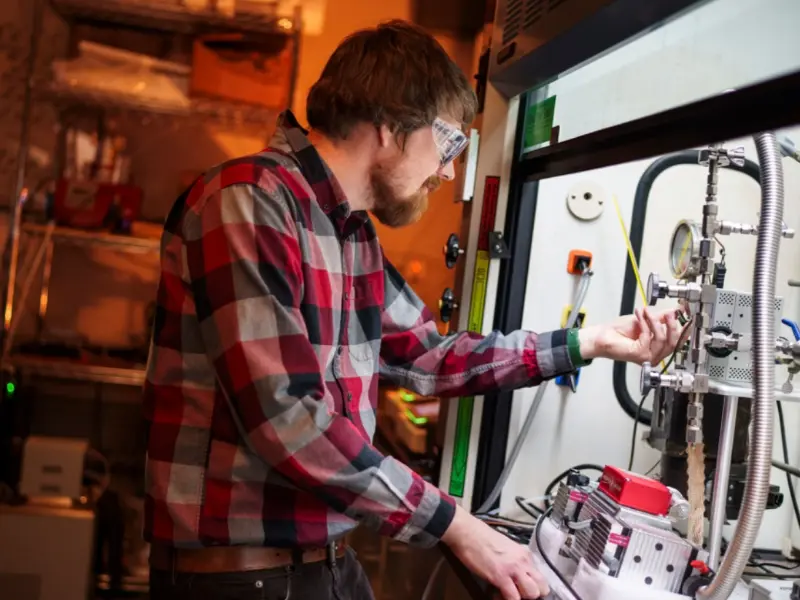
Chief research officer Tuan Ho and his team have delved into the question of whether hydrogen, when formed within sandstone or shale, becomes trapped, thus sealing itself around numerous oil and gas reservoirs or risking leakage. Sandstone, composed of mineral and rock particles compressed over millions of years, features numerous gaps between particles, facilitating water storage or the formation of oil and gas reservoirs. In contrast, shale is a slurry compressed from smaller mineral particles rich in clay, capable of forming a sealing layer around sandstone, thereby sealing in petroleum and natural gas.

“Tuan Ho stated: ‘We aim for the injected hydrogen to remain in situ, rather than migrating out of the storage area, thereby avoiding waste. This is a significant concern for all storage facilities.'”
Professor Tuan Ho, alongside collaborators from the University of Oklahoma, conducted experiments to investigate the interaction between hydrogen and samples of sandstone and shale. They found that while hydrogen does not linger within sandstone after extraction, up to 10% of adsorbed gas remains trapped within shale samples. These findings were corroborated through computer simulations conducted by Ho.
To further explore a specific type of clay commonly found in shale surrounding oil and gas reservoirs, Ho conducted computer simulations of the molecular interactions between montmorillonite clay layers, water, and hydrogen. He discovered that hydrogen gas has minimal access to the water-filled gaps between these clay mineral layers.
Tuan Ho highlighted that this suggests minimal loss of hydrogen within clay due to adhesion or penetration, which bodes well for underground hydrogen storage. These findings concerning clay have been published in last year’s Sustainable Energy & Fuels journal. He added that additional experiments are underway at Stevens Institute of Technology and the University of Oklahoma to validate the results of the molecular simulations.
Also read: Bitcoin surges to all-time high, fuels altcoin recovery
“A huge porous sandstone reservoir, once filled with oil and gas, is now filled with a different, carbon-free fuel – hydrogen.” If this technology can be realized, whether it is a huge new development, it must be a great news for the power and heavy industry.
Can hydrogen be contaminated?
“If we want to create a hydrogen economy, we really need widely distributed ways to store large amounts of hydrogen,” said Conley, manager of the Sandia section of the Underground Hydrogen Assessment, Storage and Technology Acceleration Program in the U.S. Department of Energy’s Office of Fossil Energy and Carbon Management. “It’s nice to store it where there’s salt, but it can’t be the only option.” So we’re turning to depleted oil and gas reservoirs and aquifers as a more decentralized way to store large amounts of hydrogen. All in the name of decarbonizing the energy sector.”
Through experiments and simulations, Tuan Ho’s team has discovered that when hydrogen is injected into depleted natural gas reservoirs, residual natural gas can be released from the rock into the hydrogen. Ho explains that this implies that when hydrogen is extracted for use, it will contain small amounts of natural gas.
“This isn’t alarming, as natural gas still holds energy, but it contains carbon, so when this hydrogen is burned, it will produce small amounts of carbon dioxide,” says Ho. “This is something we need to be mindful of.” Tuan Ho’s team, primarily comprised of postdoctoral researcher Aditya Choudhary from Sandia National Laboratories, is currently utilising molecular simulations and experimental methods to investigate the impact of hydrogen on depleted oil reservoirs and how residual oil may contaminate hydrogen or interact with it.
Ho’s findings could be used to guide large-scale field tests of underground hydrogen storage, Conley said. He added that the SHASTA project plans to conduct such field-scale tests in the future to prove the feasibility of hydrogen storage from depleted oil and gas. Ho believes further research is needed to understand how microbes and other chemicals in depleted oil reservoirs interact with the stored hydrogen.
Sandia’s tasks
Since 1949, excellence in service to the national interest has been Sandia’s core purpose.
As a multidisciplinary national laboratory and federally funded Research and development Center (FFRDC), Sandia accomplishes its mission, which is integral to the mission and operations of our grantmaking agency, in the following ways:
- Anticipate and address emerging national security challenges
- Innovate and discover new technologies to enhance national technological advantages
- Create value through products and services that address important national security challenges
- Inform the national debate that technology policy is critical to maintaining security and freedom around the world.