
The company visible in infrastructure traces
REDWISP INC is not visible in the public record like a scaled broadband carrier. It does not present itself, at least in the accessible U.S. evidence trail, through a clean retail website, a published plan table, a broad review corpus, a public network status page, a current PeeringDB profile, a visible U.S. autonomous-system footprint, or a large FCC-facing broadband identity. It appears instead in the way small communications companies often appear before they become legible institutions: through an ARIN organization record, a tiny AT&T-reassigned IPv4 block, a Texas corporate trace, a named network contact, a local internet-service directory listing, and one weak field-operations clue from transportation records. The economic question is therefore not whether REDWISP is a famous ISP. It is whether the small amount of public evidence points to a defensible local broadband position or merely to a thin corporate/network registration with little commercial substance.
The first anchor is ARIN. The ARIN Whois-RWS organization record lists “ACC-REDWISP INC,” handle ACCRE-93, with a Houston, Texas address, a U.S. country field, and a registration and last-update date of August 22, 2018. A related ARIN network record lists 12.184.197.208 through 12.184.197.215, CIDR 12.184.197.208/29, named ACC-REDW12-197-208, parent ATT, net type “Reassigned,” and organization ACC-REDWISP INC. The related point-of-contact record names Rob Gladney at ACC-REDWISP INC, with an Angleton, Texas address, phone number, and rob@redwisp.net; ARIN also states that it attempted to validate that POC data but had received no response since August 21, 2019. These are hard network-resource facts, but they are narrow facts. They establish a U.S. network-registration identity and an AT&T-linked edge allocation. They do not prove a continuing retail ISP, active subscribers, tower sites, service coverage, or revenue. (whois.arin.net)
A second anchor is corporate. CorporationWiki, citing Texas Secretary of State data, describes Redwisp Inc. as a Texas domestic for-profit corporation filed on May 23, 2018, active in existence, with Robert Gladney listed as director. This corroborates the ARIN-era identity but does not turn the company into a proven broadband operating platform. Corporate existence is not operating scale. A Texas domestic corporation can be active while holding few customers, no customers, or legacy assets. It can also be active while doing real local work that is invisible to national datasets. For REDWISP, the public evidence supports the existence of a Texas legal/network entity; it does not support a confident subscriber or margin estimate. (Corporation Wiki)
The retail signal is weaker but relevant. ShowMeLocal’s New Caney, Texas directory lists “Redwisp Internet Service” among local internet service providers and shows a Porter, Texas address at 24160 Highway 59, with zero reviews and an update roughly five years old. That is the kind of trace a small fixed-wireless ISP might leave: a directory listing rather than a polished acquisition funnel. It is not enough to prove active service. It is enough to suggest that REDWISP was not merely a shell created for ARIN paperwork. It had, at least in the public marketplace, a name that looked like a local internet-service offer. (ShowMeLocal)
The result is a deliberately restrained thesis. REDWISP’s strategic value, if it exists, is unlikely to reside in the visible IP allocation or public brand. A /29 reassigned from AT&T is not a numbering moat. The visible record does not show independent routing scale. The value would have to sit below the internet-numbering layer: tower access, backhaul arrangements, local installations, technician knowledge, customer accounts, neighborhood reputation, and possibly private permissions in exurban or rural Texas pockets. Those assets can be commercially valuable. They are also easy to overstate because the public evidence does not show them directly.
The small-WISP model: cheap first-mile avoidance, expensive local operations
A fixed-wireless ISP earns money by avoiding the largest visible cost in rural wireline broadband: pulling a physical line to every premise. Instead of trenching or stringing fiber to each house, it puts radios on elevated sites, connects those sites to upstream capacity, installs customer-premises antennas, and sells monthly internet service. This is why fixed wireless has remained relevant in rural and exurban markets. It can reach a house that cable and fiber ignore, and it can do so quickly when a tower path and backhaul are already in place. WISPA, an interested trade association, describes WISPs as thousands of local entrepreneurs serving rural areas where cable and high-speed wireline options may be absent, and argues that fixed wireless can be installed with a small antenna in days rather than waiting for slower wireline construction. That is the industry’s best self-description, but it is also a good description of the operating logic.
The model’s weakness is that it does not eliminate infrastructure cost. It converts construction cost into operating complexity. A WISP does not trench every road, but it must secure height, power, radios, mounting rights, backhaul, monitoring, customer equipment, installation labor, support labor, truck rolls, spares, and field judgment. The monthly margin is not simply the customer bill minus wholesale bandwidth. It is the bill minus backhaul, tower rent, pole or roof access, equipment amortization, customer-install subsidy, support time, failed payments, storm damage, radio upgrades, spectrum-management cost, and the opportunity cost of a small field crew.
This distinction matters because rural broadband scale is not only measured in subscribers. It is measured in subscribers per vertical asset, subscribers per backhaul circuit, subscribers per technician, and subscribers per serviceable cluster. A WISP with 300 customers concentrated around a few clean sectors can be economically healthier than a WISP with 900 customers scattered over a large area with weak paths and long drive times. The same monthly recurring revenue can produce very different earnings depending on whether customers are clustered, line-of-sight is clean, towers are cheap, and service calls are rare.
The fixed-wireless gross margin is attractive when a tower sector fills gradually with low-support customers. Once a site is paid for and the backhaul is in place, each additional customer can contribute meaningfully to cash flow. The model breaks when the last customers added to a sector degrade peak-hour performance, when foliage blocks lines of sight, when customer premises equipment requires repeated adjustment, or when a competitor takes the best accounts and leaves the WISP with the hardest-to-serve homes. This is why the sector has a dual reputation: cheap and scrappy on the way in, fragile when competition and customer expectations rise.
REDWISP’s public record has to be read through that model. The company does not need a large public IP footprint to be a small WISP. A small provider can operate behind upstream-assigned addresses, private addressing, or carrier-grade NAT. But if the public footprint is only an AT&T /29, then the underwriting focus moves away from internet-numbering assets and toward physical and social assets. The important diligence questions become: where are the radios, who owns or controls the tower positions, what is the backhaul cost, how many paying customers are under each sector, how often do technicians roll trucks, and whether fiber or subsidized satellite is about to remove the local scarcity.
Identity: REDWISP INC, ACC-REDWISP INC, and the Gladney trail
The ARIN records use “ACC-REDWISP INC,” while the corporate trail uses “Redwisp Inc.” That difference is not unusual in network-resource records, but it should keep the analysis disciplined. The ARIN record is not a state corporate filing. It is a registry record for internet-number resources. The “US” field is a service-area or country field in the RIR context, not a substitute for a verified headquarters record. The Houston address in the organization record and the Angleton address in the POC record give two Texas location clues. They do not prove where the company’s customers were or are.
The Rob/Robert Gladney connection is the strongest human link. ARIN names Rob Gladney as the POC for ACC-REDWISP INC; the corporate-record aggregator lists Robert Gladney as a director of Redwisp Inc. The timing also aligns: Texas incorporation in May 2018, ARIN organization and reassigned network in August 2018. That sequence is consistent with a small broadband or telecom operation being formed and then obtaining an upstream-assigned address block for service or infrastructure. It is also consistent with a small business circuit, a planned ISP project, or a micro-network that never scaled. (whois.arin.net)
The stale ARIN POC validation note is economically meaningful. ARIN’s note that it had received no response to POC validation since 2019 does not prove the company is dead. Small operators often under-maintain registry records. But registry hygiene matters in telecom. It is how abuse desks, upstreams, regulators, network operators, and counterparties identify operational contacts. A stale POC is a weak-signal marker of either low administrative maturity or inactivity. In due diligence, it would not be a reason to write the asset to zero; it would be a reason to demand current customer, network, and contact evidence before assigning platform value. (whois.arin.net)
The visible IP allocation also narrows the interpretation. The ARIN network record shows eight IPv4 addresses in a /29 reassigned from AT&T. In a small network, that can be enough for an edge router, NAT, monitoring, or a few public services. It is not enough to indicate a large public-addressing plan. Nor does it show independent routing. ARIN’s own explanation of autonomous systems says an autonomous system is a group of IP prefixes run by one or more network operators under a single routing policy, and that ASNs are used to control routing and exchange routing information with other ISPs; it also distinguishes multi-homed networks from stub networks connected to only one other AS. REDWISP’s cited public trail points to an AT&T reassignment, not to a clearly independent autonomous network. (whois.arin.net)
This is not a technicality. A visible independent ASN, multiple upstreams, a larger IPv4 block, or a PeeringDB presence would support a stronger infrastructure story. The absence of those visible signals does not disprove operations, but it discounts them. A buyer cannot pay for a routing asset that is not evidenced. The commercial value must instead be justified by tower agreements, backhaul contracts, subscriber accounts, and local market position.
The wrong Redwisp problem
The name creates false positives. redwisp.cl is a Spanish-language Chilean telecom website, and PeeringDB lists “Redwisp Teleco” as AS273834 with a Chilean organization, Chilean contact details, and a website at redwisp.cl. That is not REDWISP INC in Texas. It is a separate named entity in another country. Using Chilean PeeringDB data, Spanish-language pages, or foreign forum chatter to infer the U.S. company’s network would be wrong. (Redwisp)
This matters because informal broadband evidence is messy. Small ISPs often appear in Facebook comments, local directories, outage complaints, speed-test screenshots, Reddit threads, and old forum posts before they appear in clean official databases. That kind of evidence can change commercial interpretation when it is correctly attributed. A dozen neighborhood complaints about evening congestion, unanswered phones, or storm outages would be valuable evidence. So would neighborhood praise for a local installer who solved a problem cable ignored. But the REDWISP name is not unique enough to import complaints across countries or unrelated domains. The correct posture is narrower: there is useful informal evidence that “Redwisp Internet Service” was listed in the Porter/New Caney area, but no verified U.S. review or outage corpus surfaced in the public trail strong enough to underwrite customer reputation. (ShowMeLocal)
That absence cuts both ways. A poor review corpus would damage the case. A strong review corpus would improve it. No meaningful corpus means the business is either very small, inactive, referral-driven, poorly indexed, operating under another brand, or serving a customer base that does not leave public reviews. For a rural WISP, that is not unusual. It is still a valuation problem because local reputation is one of the few durable advantages a small operator can own.
What REDWISP sells, if the evidence is read commercially
The public evidence does not contain a current plan sheet, terms of service, coverage map, or customer contract for REDWISP INC. The most defensible description is therefore conditional: REDWISP appears to have been organized around internet services, likely fixed-wireless or WISP-like broadband, in Texas. The name itself points toward wireless ISP activity; the ARIN assignment and local directory support an internet-service interpretation; the USDOT-derived listing under “REDWISP INTERNET SERVICES” adds a field-operations clue. But none of those sources prove current residential plans, business service, wholesale transport, managed Wi-Fi, installation contracting, tower leasing, or another adjacent telecom activity. (ShowMeLocal)
The USDOT-derived record is especially suggestive but weak. Bubba, a trucking-data aggregator, lists Redwisp Inc. DBA REDWISP INTERNET SERVICES with USDOT 3285926, 10 units, 20 drivers, inactive status, interstate operation, and private-property classification, while saying carrier profiles are compiled from FMCSA public data and should be verified directly. This is not primary FMCSA evidence in the article’s source trail, and the inactive status limits its value. Still, the business meaning is plausible. A small ISP with trucks is not strange. Fixed wireless is a field-service business: antennas, mounts, roof work, tower visits, CPE replacements, power supplies, trench-adjacent handoffs, and storm repair all require vehicles and technicians. If the listing corresponds to REDWISP’s real operations, it points toward an installation/service model rather than a purely virtual telecom entity. (Hey Bubba!)
The key point is that the product in rural wireless is not just bandwidth. The customer buys working internet at a particular house. The operator sells a bundle of signal path, CPE, support, billing, weather resilience, and local accountability. In urban telecom, customers often compare headline speeds and price. In rural wireless, the decisive question is whether the installer can get a stable path from the customer’s roof to the access point and whether the company will answer when it fails. That makes the product partly technical and partly relational.
REDWISP’s sparse public identity makes this product hard to evaluate. There is no verified public evidence of speed tiers, installation fees, data caps, service-level commitments, or customer support hours. That forces a sceptical reading. The company cannot be analyzed as a proven broadband platform. It can only be analyzed as a possible local access operator whose value would depend on private operating data.
Tower access: the first scarce asset
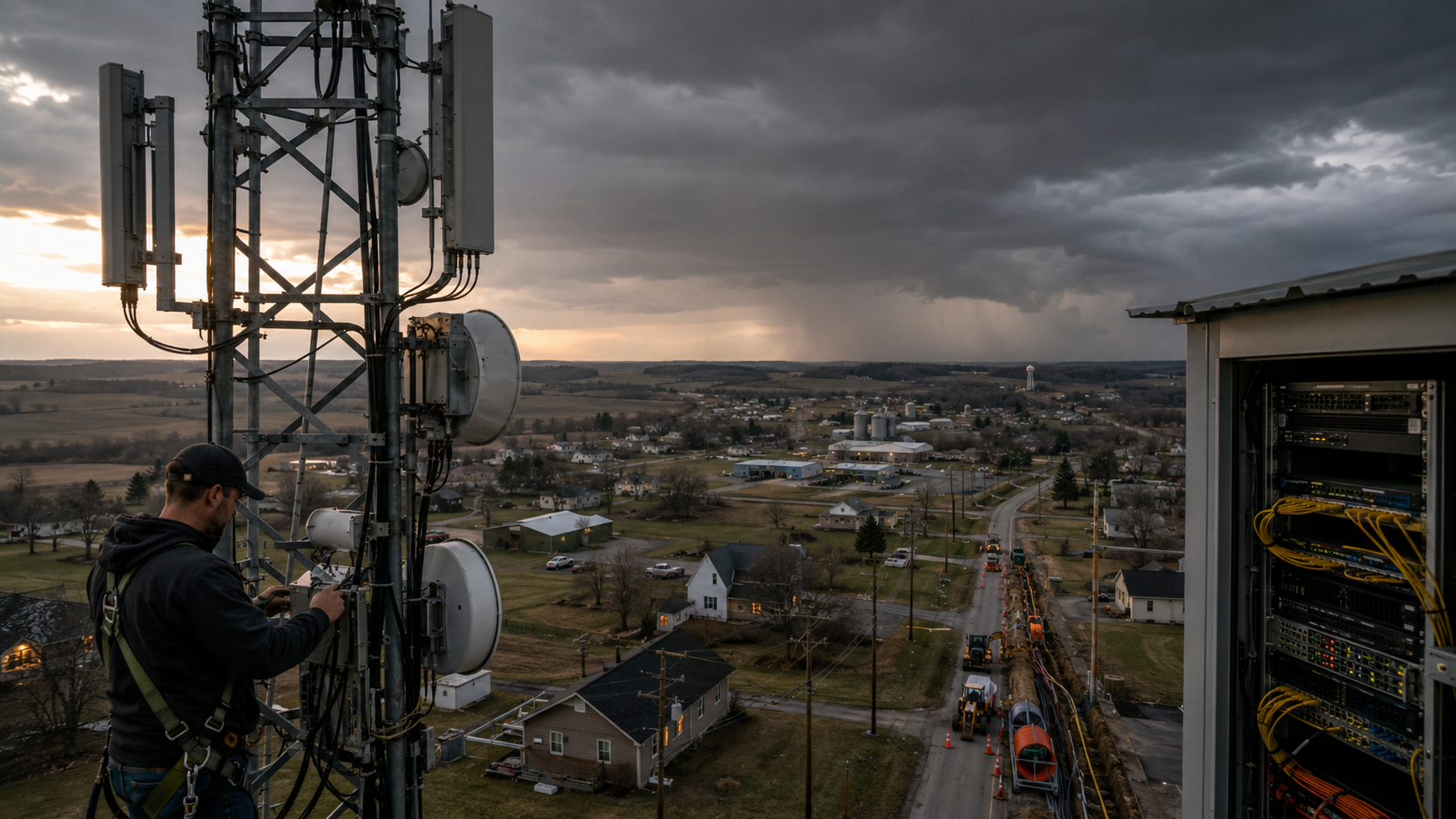
In fixed wireless, the first scarce asset is not the customer’s modem or the upstream IP address. It is height in the right place. A tower, water tank, grain elevator, rooftop, church steeple, silo, hilltop, or privately leased mast can become a local broadband gateway if it has line of sight to enough premises, power, permission, and backhaul. Without height, there is no last-mile wireless business. With the wrong height, there is still no business. A beautiful tower five miles away from the wrong cluster is less valuable than an ordinary rooftop overlooking an unserved subdivision.
The economics of tower access are asymmetric. A small WISP does not need to own a steel tower to control a market. It needs a durable site right on the correct vertical asset. If a provider has the only viable mount on a municipal water tower, a rural grain facility, or a landlord-controlled structure with clear views, it may own a defensible local advantage even with modest equipment. Conversely, if the provider only has generic rented space on commercial towers that any competitor can lease, tower access is less of a moat and more of a cost line.
No public evidence in the cited trail establishes REDWISP-specific tower leases, municipal antenna agreements, FAA/FCC antenna-structure registrations, right-of-way permissions, or rooftop contracts. That is not proof that REDWISP lacks them. Many WISP sites do not require new registered towers, and many private site agreements are not public. But it means the most valuable possible asset is unverified. For a buyer, the tower schedule would be the first real document to request: site address, landlord, rent, term, renewal rights, assignment rights, power responsibility, equipment inventory, backhaul path, line-of-sight coverage, and customer count served from each site.
Tower access also affects exit value. A neighboring WISP or fiber builder may care less about REDWISP’s brand than about its install base and site permissions. If REDWISP controls two or three excellent vertical positions in underserved pockets, it could be worth more than the public record suggests. If it does not, the business may be no more than customer accounts hanging from replaceable upstream service. The difference is not cosmetic; it is the difference between infrastructure value and retail churn value.
Backhaul: the margin underneath the margin
Backhaul is the second scarce asset and often the hidden margin killer. A fixed-wireless last mile is useful only if the tower or access point has enough upstream capacity to the internet. That upstream can be fiber, carrier Ethernet, business-class cable, licensed microwave, unlicensed point-to-point wireless, or a chain of relays. Each choice has a different cost, latency, reliability, and upgrade path.
The AT&T /29 reassignment is therefore more than an IP detail. It suggests that at least one visible REDWISP edge depended on AT&T service. That may be perfectly rational. AT&T can supply a stable handoff; a small operator may not want the cost or complexity of independent routing. But upstream dependence changes gross margin and negotiating power. If a WISP buys expensive upstream capacity at each site, it has less room to absorb customer churn, support calls, or price competition. If it controls cheap backhaul across multiple sites, it can scale the same physical footprint more profitably. (whois.arin.net)
Backhaul also determines whether a WISP can survive success. Early customers may work well on modest capacity. As take-rate rises and streaming/video demand grows, evening peak load can degrade. The operator then faces a capital decision: upgrade backhaul, split sectors, add radios, add spectrum, or disappoint customers. If the upstream circuit is costly or capacity-constrained, customer growth can reduce reputation before it increases profit. A small WISP can therefore fail from both under-demand and over-demand.
This is the central margin mechanism. The customer sees “internet speed.” The operator sees contention ratios, busy-hour utilization, CPE signal quality, upstream commit rates, tower rent, install labor, and support tickets. A WISP with cheap, scalable backhaul can sell lower-priced plans and still maintain margin. A WISP with expensive, fragile backhaul may need high ARPU just to break even, but rural customers may not pay urban-fiber prices for wireless service once alternatives appear.
REDWISP’s visible record does not show whether AT&T was its only upstream, one site’s circuit provider, or simply an old reassignment that no longer reflects operations. It does not show microwave backhaul, private fiber, redundancy, or oversubscription. A buyer should treat the ARIN record as a dependency clue, not a complete network map.
Spectrum: useful permission, rarely enough by itself
Spectrum is the third layer. Fixed-wireless operators use unlicensed and licensed-by-rule spectrum, including common unlicensed bands and CBRS in the 3.5 GHz range. Spectrum is important because it governs capacity, interference, propagation, and upgrade path. It is not automatically a moat. Unlicensed spectrum is cheap but shared. CBRS can provide more structured access but brings regulatory and equipment complexity. Licensed spectrum or priority access can improve defensibility, but only if paired with tower sites and customers.
The CBRS policy fight illustrates the sector’s dependence on regulatory permission. Light Reading reported in December 2025 that WISPA and rural ISPs asked the FCC to reject relocating current CBRS users or redesignating part of the band for high-power use; the article notes that WISPA represents roughly 500 rural fiber and wireless providers, that more than 60 WISPA members won CBRS PAL licenses in 2020, and that rural operators warned relocation could force equipment replacement, redesign, redeployment, outages, and degraded service. The same report also describes the other side: large wireless interests and national-security spectrum arguments favoring more high-power 5G use. That is the correct commercial frame. Spectrum rules are not abstract to WISPs; they can change capital requirements and service quality. (Light Reading)
No REDWISP-specific spectrum evidence appears in the public trail. There is no cited record showing CBRS PALs, GAA use, licensed microwave, 5 GHz sectors, 60 GHz backhaul, or other RF architecture. That absence is economically important because the value of a WISP changes depending on spectrum posture. A pure unlicensed operator may be viable in low-interference rural pockets but exposed to congestion and competitor interference. A CBRS-heavy operator may offer better non-line-of-sight performance and capacity but may carry equipment and policy risk. A licensed-microwave-backed operator may have more reliable backhaul. REDWISP’s public record does not let the analyst choose among those cases.
Spectrum also interacts with foliage and weather. Lower frequencies penetrate and bend better but have less capacity per hertz and may be more regulated. Higher frequencies can deliver high capacity but demand cleaner line of sight and can be affected by path conditions. The business implication is that not all “fixed wireless” is equal. One operator’s network may be engineered for reliability and another’s may be a chain of low-cost radios operating near capacity. Without radio inventory, site list, and customer signal metrics, REDWISP cannot be valued as a high-quality wireless network.
Density: where rural wireless earns or loses money
Customer density is the most important non-obvious variable. A WISP wants customers who are underserved by wireline providers but close enough to be served profitably. The best market is not the emptiest countryside. It is a cluster of homes beyond good cable or fiber, within range of a good tower, with manageable tree cover and enough willingness to pay. The worst market is sparse, heavily wooded, storm-exposed, support-intensive, and soon to be reached by subsidized fiber.
The local clues around Porter/New Caney and Angleton matter because those are not wilderness markets. They are Texas exurban or small-city edges near larger broadband economies. That geography can produce exactly the WISP opportunity: subdivisions, rural roads, commercial edges, and unincorporated pockets with uneven wireline coverage. It also produces the WISP threat: cable and fiber providers can expand outward as density improves, and public subsidy can fund the rest.
Angleton’s own broadband page is a useful analogue for this kind of market. The city says it recognized broadband deficiencies, began a broadband initiative, met with local ISPs, contracted for a city-wide internet inventory, and stated that no charter or contract was limiting ISPs from building in Angleton. It also says Comcast Xfinity had already covered commercial markets and was expanding home internet throughout Angleton and well-populated surrounding areas; the city also described T-Mobile 5G Home Broadband, AT&T fixed wireless, possible AT&T Fiber construction, WISPs, and satellite options. REDWISP is not named there. The point is the local market structure: demand gaps exist, but multiple technologies are closing them. (Angleton)
Porter shows a similar pressure pattern. Brightspeed’s own Porter page markets fiber internet in Porter, Texas, with 2 Gig, 1 Gig, 500 Mbps, and 200 Mbps fiber offers, while repeatedly stating that availability depends on address. The exact overlap with any REDWISP footprint is unproven, but the competitive meaning is clear: any local WISP near Porter is not competing only against old DSL. It is competing against fiber and cable at least in parts of the market, plus fixed wireless from larger players, mobile home internet, and satellite. (Brightspeed)
A small WISP can survive this if it owns neglected pockets. It cannot survive if its best customers are in the path of fiber expansion. Fiber and cable do not need to cover every rural road to damage a WISP. They take the densest roads and highest-value customers first. The WISP’s average customer then becomes harder to serve: farther away, more tree-blocked, more price-sensitive, and more likely to call support. This is adverse selection in infrastructure form.
Support cost: the unglamorous determinant of margin
The support model is where many small ISPs win or fail. A roof install that looks like a one-time cost can become a long-term liability if signal quality is marginal. One customer may require a site survey, a failed first install, a taller mast, a return visit, a router replacement, a seasonal foliage adjustment, and multiple calls about evening speed. Another customer may install cleanly and pay for three years without a ticket. The headline ARPU may be identical. The profit is not.
This is why technician density matters. A small WISP with customers clustered near each other can schedule installs and repairs efficiently. A WISP with scattered customers sends technicians on long drives for low-value jobs. Every truck roll must be compared with monthly contribution margin. If the customer pays $70 or $90 per month and one visit consumes labor, fuel, equipment, and opportunity cost, the payback period lengthens quickly. A few difficult customers can consume the margin of many easy ones.
Support cost also determines pricing power. A small WISP may be able to charge more than a commodity provider if it answers the phone and knows the local terrain. But once fiber or cable arrives with better headline speeds, the WISP’s support advantage must be strong enough to offset technical inferiority. Some customers will stay with a local provider because the service is good enough and the people are reachable. Others will switch immediately for symmetrical fiber, lower latency, higher speed, or promotional pricing.
REDWISP’s customer signals are too thin to assess this. The ShowMeLocal listing shows zero reviews, not a reputation base. No verified outage posts or complaint clusters surfaced in the public evidence trail for REDWISP INC in Texas. That should not be converted into a positive claim. It means customer experience is unknown. Economically, unknown customer experience increases diligence risk because support quality is one of the largest private determinants of WISP value. (ShowMeLocal)
Weather reliability and the local-reputation balance sheet
Wireless networks live outdoors. Towers need power. Backhaul radios need alignment. Customer antennas need mounting integrity. Outdoor CPE must survive heat, humidity, wind, lightning, insects, and corrosion. Tree growth changes paths. Storms can interrupt power at a tower, a relay, or the customer premise. A network can have a resilient core and still fail at the edge because one customer’s roof equipment shifted or a relay lost power.
This makes reliability expensive in a way that does not always appear in capex comparisons. The low-cost version of fixed wireless can be deployed quickly, but the durable version requires spare equipment, backup power, monitoring, competent mounting, surge protection, good documentation, and a field crew that can triage failures after bad weather. A WISP with disciplined engineering can deliver strong service. A WISP with underbuilt sites may look profitable until weather exposes the fragility.
Local reputation is the accounting entry that captures this. In rural markets, a provider’s reputation is often built through installation stories and destroyed through outage stories. When service fails, customers do not care whether the cause is upstream, tower power, interference, a tree, rain fade, a PoE injector, or a misaligned dish. They care that it works or does not. A small WISP’s advantage is that it can be locally accountable. Its disadvantage is that local accountability becomes personal and costly when failures cluster.
REDWISP has no visible reputation balance sheet in the cited record. There is no large body of local reviews, no accessible status page, no known customer forum, and no identified social-media outage trail tied cleanly to the Texas company. That keeps the valuation conservative. A buyer should not assume poor service; it should assume unproven service. The facts that would matter are ticket volumes by month, average time to repair, truck rolls per customer, repeat-call rate, customer tenure, outage causes, and churn following major weather events.
FCC maps and the politics of being counted
Broadband mapping is not neutral market decoration. It changes who gets subsidized, who gets challenged, and who gets overbuilt. The FCC’s National Broadband Map displays service availability as reported by ISPs through the Broadband Data Collection and allows consumers and stakeholders to dispute or challenge that information. The fixed broadband map covers technologies including fiber, cable, DSL, satellite, and fixed wireless at home and small-business locations, with reported speed information. (help.bdc.fcc.gov)
For a small ISP, being counted can protect a market, but it can also create accountability. If a WISP reports coverage that customers cannot actually obtain at advertised speeds, it can face challenges and reputational damage. If it does not report coverage, locations it serves may appear unserved or underserved and become eligible for grants to competitors. The map can therefore convert a customer base into either a defended footprint or a target list for subsidy-funded overbuild.
The public evidence reviewed here does not establish REDWISP’s current BDC status. That is a major unresolved issue. If REDWISP filed current fixed-wireless availability data under its own name or another operating name, that would be a strong sign of ongoing ISP operations. If it did not, either because it is inactive, too small, nonresidential, or operating under another identity, the strategic case weakens. A WISP that is not visible to the map process may find its territory designed by other people.
The mapping issue is particularly important because the old Form 477 world was less granular, and the current BDC world is more location-specific. The Broadband DATA Act framework requires more precise location-by-location fixed broadband availability reporting. The business result is that subsidy and challenge processes can now move closer to individual premises. In that environment, a small WISP’s survival depends not only on radios and customers but also on administrative competence: knowing what it serves, documenting availability, challenging false claims, and defending its actual footprint. (Federal Register)
Subsidy and fiber overbuild: the existential threat
The largest external risk to a small rural WISP is not another small WISP. It is subsidized construction. The federal BEAD program is a $42.45 billion grant program intended to connect every American to high-speed internet, with funds available for planning, infrastructure deployment and upgrades, and broadband adoption work in unserved and underserved areas. That program is now moving through state-level implementation. (BroadbandUSA)
Texas is central to the REDWISP question because REDWISP’s public identity is Texas-based. The Texas Broadband Development Office says Texas was allocated up to $3.3 billion in BEAD funding; after NTIA’s 2025 restructuring guidance, the Texas office says all technologies meeting minimum standards were allowed to compete under the Benefit of the Bargain approach. Texas says its Final Proposal was approved on December 4, 2025, with 22 applicants selected to serve more than 240,000 broadband serviceable locations and more than 2,700 community anchor institutions, using $1.2 billion in federal grant funds plus $177 million in state match. The state also says projects are expected to begin construction as soon as summer 2026. (德克萨斯州审计长办公室)
The overbuild threat is not theoretical. Telecompetitor’s June 2026 comparison of Texas final BEAD awards says Texas finalized subgrantee agreements to 17 providers covering more than 208,000 locations. The award list includes fiber-heavy recipients, fixed-wireless winners, mixed fiber/fixed-wireless projects, and a Starlink low-Earth-orbit satellite award of about $108.8 million for 63,887 locations. It also lists Nextlink with a fixed-wireless award for 34,417 locations and Nexstream with a large fiber-and-fixed-wireless award. This is the competitive set a small Texas WISP must face: subsidy is not going only to fiber, but it is funding multiple technologies that can attack underserved pockets. (Telecompetitor)
For a small WISP, subsidy can be fatal through selective erosion. It may not remove all customers at once. It removes the best customers first. The densest roads, easiest drops, and highest-ARPU premises become attractive to fiber or another subsidized provider. Remote workers, small businesses, and heavy-streaming households are likely to churn first when symmetrical fiber or credible gigabit service appears. The remaining base has lower density and higher support cost. The WISP’s tower and backhaul costs remain, but revenue quality falls.
This is the rural wireless margin compression cycle. First, the WISP enters because wireline economics are poor. Second, it builds a customer base in gaps left by incumbents. Third, subsidy or density growth changes the wireline economics. Fourth, larger competitors take the easier accounts. Fifth, the WISP either upgrades, pivots, sells, or becomes a residual provider for the hardest premises. The public evidence does not show where REDWISP sits in that cycle. It does show why any REDWISP valuation must include BEAD overlap at the broadband-serviceable-location level.
Competition: cable, fiber, mobile fixed wireless, satellite, and other WISPs
The competitive set in a plausible REDWISP market is broader than “small ISP versus small ISP.” It includes cable, telco fiber, DSL remnants, national mobile fixed wireless, local fixed wireless, satellite, and subsidized hybrid providers. Pew’s rural broadband industry overview describes fixed wireless, DSL, satellite, and fiber as part of the rural provider mix, and it identifies marketing, operational, competitive, political, franchise, and right-of-way risks as relevant to rural broadband businesses. That framework is useful because small WISPs are not just technical operators; they are local political and operational firms.
Cable and fiber are most dangerous when they enter the profitable pockets. In Angleton, the city’s own page describes Comcast Xfinity expanding home internet into well-populated areas and AT&T fixed wireless plus possible AT&T Fiber activity. In Porter, Brightspeed markets fiber plans and says service depends on address. These facts do not prove overlap with REDWISP customers, but they show the local competitive logic: the exurban edge is not static. It is actively contested by larger providers with deeper capital and stronger brand recognition. (Angleton)
Mobile fixed wireless adds a different threat. National carriers can use existing cellular infrastructure and spare capacity to sell home internet without building a neighborhood fiber network. They may not serve every rural premise well, and performance can vary with signal and congestion, but their acquisition cost and brand reach are powerful. Satellite, especially LEO satellite, is another substitute for remote customers. It bypasses local tower leases and middle-mile constraints, though it may be limited by trees, equipment cost, latency requirements, weather perception, and customer support preferences.
Other WISPs remain relevant because a better tower angle can defeat a local incumbent. If one provider has a cleaner path into a subdivision, another provider’s reputation can collapse even if it was first to market. This makes WISP competition intensely local. The operator with the best RF geometry and support response may win despite weaker branding. The operator with inferior geometry may lose even with loyal customers.
Industry reporting shows that many WISPs understand this and are moving toward fiber where possible. Fierce Network reported that WISPs are facing a “breaking point” as fiber players and public/private funding overbuild their territories, with some operators evolving into fiber-first businesses under pressure from costs, staffing, spectrum, succession, and grant-funded competition. The article’s examples are not REDWISP-specific, but the sector diagnosis applies. Fixed wireless can be a beachhead; it is not always a permanent moat. (fierce-network.com)
Who depends on REDWISP?
The public record does not identify REDWISP customers. No school district, library, public-safety agency, municipal anchor, business park, homeowners association, MDU, or named subdivision appears in the cited trail as a REDWISP customer. No verified E-rate, public tender, BEAD award, or municipal contract was found in the evidence used here. That absence matters. Anchor customers can stabilize a small ISP. A school, tower-site landlord, commercial customer, or municipal relationship can justify backhaul and tower investment even when residential density is thin. Without named customers, the dependency story remains hypothetical.
If REDWISP has active customers, the likely dependency would be at the household and small-business edge: customers beyond reliable cable/fiber, customers with weak cellular alternatives, or customers who prefer a local installer. Those customers may be operationally dependent even if the provider is small. A rural household can be more dependent on a small WISP than an urban household is on a national carrier because there may be no equivalent substitute at the address.
The dependency question must still be discounted by overbuild probability. A customer dependent today may not be dependent after BEAD construction, Brightspeed fiber, Comcast expansion, mobile fixed wireless improvements, or Starlink availability. The value of dependency is therefore temporal. It is worth more when the customer cluster is outside funded builds and outside wireline expansion. It is worth less when the customer cluster is on a near-term subsidy map.
For REDWISP, no public source establishes which side of that divide its possible customers occupy. This is why a BSL-level overlap analysis would be more valuable than another general ISP profile. It would show whether REDWISP’s likely served areas are protected niches or grant-funded targets.
Ownership and regulatory context
The visible ownership context is narrow. The corporate aggregator lists Robert Gladney as director. ARIN lists Rob Gladney as POC. No broader ownership structure, parent company, acquisition, investor, bankruptcy, FCC license holding, or public financing record appears in the cited evidence. That means ownership should be treated as founder/operator or small-private-company style until contrary evidence appears. (Corporation Wiki)
Founder/operator ownership changes the economics. A small WISP can look profitable because the owner underpays himself, uses personal vehicles, answers calls directly, and carries institutional knowledge in his head. That can be an advantage while the owner remains involved. It can be a liability in acquisition because the real asset may be undocumented know-how rather than transferable systems. A buyer must separate owner-operated cash flow from institutional EBITDA.
Regulatory context also matters because broadband is now a subsidy, mapping, and spectrum business. A small operator needs not only radios but also filing discipline. The Texas BEAD process included service-availability challenges and rebuttals, with the state saying service availability challenges ran December 3–17, 2024, rebuttals January 10–24, 2025, and NTIA approval of Texas’s challenge process results on May 8, 2025. A small ISP that failed to engage in that process may find locations it considers served treated differently by the funding system. (德克萨斯州审计长办公室)
This is where public invisibility becomes dangerous. A small WISP may believe it owns a market because customers pay monthly. The state may see those same locations through the BDC and challenge process. A competitor may see them as eligible locations. A local government may see them as part of a broadband deficiency. If REDWISP is active but not administratively visible, its commercial territory may be weaker than its customer relationships suggest.
The network evidence and what it really proves
The strongest technical evidence proves very little beyond identity and dependency. The ARIN organization record proves ACC-REDWISP INC existed in ARIN’s registry. The reassigned /29 proves AT&T-linked public numbering. The POC record proves a Gladney contact and a stale validation status. Those facts are reliable because they come from ARIN. Their commercial interpretation is limited. (whois.arin.net)
What the network evidence does not prove is just as important. It does not prove a customer access network. It does not prove towers. It does not prove routing autonomy. It does not prove multi-homing. It does not prove public peering. It does not prove backhaul diversity. It does not prove customer addresses. It does not prove service quality. It does not prove that the company is active today.
This matters because a network-resource record can create false confidence. An ARIN record gives a company telecom legitimacy, but the scale may be tiny. A /29 can support real operations, but it can also support only a business circuit. The correct conclusion is that REDWISP has enough network evidence to be treated as a real communications-market subject, but not enough to be treated as a proven facilities-based ISP.
The lack of a visible U.S. PeeringDB profile or obvious autonomous-system footprint in the cited trail also directs attention away from wholesale or backbone value. The only PeeringDB “Redwisp” evidence found in the source trail belongs to the Chilean Redwisp Teleco entity, not the Texas REDWISP INC. Therefore REDWISP’s possible U.S. value is not evidenced as peering, transit, or IP-resource value. It is local-access value if anything. (PeeringDB)
The commercial case for REDWISP
The upside case for REDWISP is plausible but private. A small Texas WISP could have entered underserved exurban pockets in 2018, built tower or rooftop access, installed customers, used AT&T backhaul, and operated mostly through local referrals. It could have a compact customer base with low churn, good installer reputation, and site permissions that are difficult for outsiders to replicate. Its public web weakness would not matter much if demand came from neighbors, phone calls, Facebook groups, and local contractors. In that case, the ARIN /29 is only a visible corner of a larger private operating system.
The strongest version of the upside case is not “REDWISP has spectrum” or “REDWISP has a brand.” It is “REDWISP controls the last practical path into a set of underserved premises.” That path could be a tower lease, a rooftop, a water-tower relationship, a private landowner, a backhaul route, or a field crew with intimate local knowledge. The asset is scarcity of access. If that scarcity is real, the company could be valuable to a neighboring ISP, a fiber overbuilder, or a larger rural broadband consolidator.
The middle case is that REDWISP is or was a micro-operator. It may have served a small number of residential or business customers but lacked the capital, public presence, and regulatory participation to become a platform. That kind of company can still have value, but usually as an tuck-in acquisition: customer accounts, usable equipment, some site agreements, and perhaps one or two technicians. The valuation would be based on retained recurring revenue and avoided customer-acquisition cost, not on strategic infrastructure.
The downside case is that REDWISP is inactive, semi-active, or never scaled beyond setup. The stale ARIN POC, tiny visible IP block, old directory listing, absence of strong customer evidence, and lack of verified FCC/BGP/PeeringDB signals all support caution. The corporate entity may remain active, but operating value may be minimal. In that case, REDWISP is not a rural broadband platform; it is a thin legacy identity with uncertain assets.
The public evidence cannot choose decisively among these cases. It can only rank what would matter. The company is worth little if it owns only a name and an old AT&T reassignment. It is worth more if it owns active subscribers. It is worth materially more if those subscribers are clustered under defensible tower/backhaul assets outside near-term overbuild. It is worth less if the customer base lies inside Texas BEAD-funded construction, cable expansion, or new fiber availability.
The strategic buyer’s view
A financial buyer should be cautious. The public record does not support platform underwriting. There is no demonstrated scale, no visible independent network, no verified active coverage map, no public customer base, and no clean service website in the cited U.S. trail. A financial buyer would need private records before assigning meaningful enterprise value.
A neighboring WISP might see more. If REDWISP controls tower access in a useful pocket, another operator could combine sites, reduce redundant backhaul, consolidate support, and migrate customers to better network management. The value would come from operational synergies, not brand. The buyer would need to audit customer signal quality, CPE compatibility, tower leases, and churn risk.
A fiber overbuilder might see a bridge asset. Buying REDWISP could supply customers, local goodwill, installers, and temporary wireless revenue while fiber is constructed. This is a common logic in rural broadband consolidation: fixed wireless funds and preserves the customer relationship until fiber reaches the premise. But the buyer must avoid paying for customers who will churn anyway when fiber arrives from someone else.
A tower or infrastructure actor might value site relationships. If REDWISP has private vertical permissions, those could matter beyond its subscriber base. But again, the public record does not identify such permissions.
The least attractive buyer is one that pays for “the WISP” without verifying the hard assets. The fixed-wireless label can hide very different businesses: a well-engineered rural network with defensible sites, or a fragile operator hanging customers from oversubscribed sectors and expensive upstream. REDWISP’s public evidence is too thin to assume the first.
Evidence ledger
Source name: ARIN Whois-RWS organization record for ACC-REDWISP INC. URL: https://whois.arin.net/rest/org/ACCRE-93. Source type: official RIR/WHOIS organization record. It supports the existence of ACC-REDWISP INC as an ARIN organization handle, with a Houston, Texas address, U.S. country field, and 2018 registration/update dates. It does not prove headquarters, active operations, subscribers, tower assets, revenue, or ownership. It matters economically because it is the cleanest identity anchor and proves that REDWISP entered the internet-number-resource system. (whois.arin.net)
Source name: ARIN Whois-RWS network record for ACC-REDW12-197-208. URL: https://whois.arin.net/rest/net/NET-12-184-197-208-1.html. Source type: official RIR/WHOIS network-resource record. It supports that 12.184.197.208/29 was reassigned from parent ATT to ACC-REDWISP INC. It does not prove customer count, active routing, backhaul architecture, or all addresses used by the business. It matters economically because the visible IP footprint is tiny and upstream-dependent, pointing away from independent backbone value and toward local-access value. (whois.arin.net)
Source name: ARIN Whois-RWS POC record for GLADN12-ARIN. URL: https://whois.arin.net/rest/poc/GLADN12-ARIN.html. Source type: official RIR/WHOIS contact record. It supports Rob Gladney as the listed POC for ACC-REDWISP INC, an Angleton, Texas address, a phone number, and the
rob@redwisp.netemail. It also supports that ARIN had not received a POC validation response since August 2019. It does not prove current role, current ownership, or operating status. It matters economically because it links the corporate/network identity to a person while adding administrative-staleness risk. (whois.arin.net)Source name: CorporationWiki Redwisp Inc. profile. URL: https://www.corporationwiki.com/p/31z5ly/redwisp-inc. Source type: secondary corporate-record aggregator citing Texas Secretary of State data. It supports Texas domestic for-profit incorporation on May 23, 2018, active-in-existence status, and Robert Gladney as director. It does not prove certified good standing, active ISP operations, revenue, or customer base. It matters economically because it corroborates a Texas legal entity separate from the ARIN record. (Corporation Wiki)
Source name: ShowMeLocal listing for New Caney/Porter internet providers. URL: https://www.showmelocal.com/internet-service-providers-in-new-caney-tx. Source type: informal local business directory. It supports a public listing for “Redwisp Internet Service” in the Porter/New Caney area, with an address at 24160 Highway 59, Porter, Texas, zero reviews, and an old update signal. It does not prove active service, customer satisfaction, ownership, or service coverage. It matters economically because it is the main public retail-market clue. (ShowMeLocal)
Source name: Bubba trucking-company profile for Redwisp Inc. DBA REDWISP INTERNET SERVICES. URL: https://bubba.ai/trucking-companies/texas/stafford?page=2&sort=fleet-desc. Source type: FMCSA-derived third-party transportation-data aggregator. It supports a weak field-operations clue: Redwisp Inc. DBA REDWISP INTERNET SERVICES, USDOT 3285926, inactive status, and listed units/drivers. It does not prove current FMCSA status, the purpose of vehicles, active ISP service, or customer operations. It matters economically because fixed wireless is a truck-roll business; field capacity would be commercially relevant if verified. (Hey Bubba!)
Source name: ARIN ASN guide. URL: https://www.arin.net/resources/guide/asn/. Source type: official RIR educational/reference material. It supports the meaning of autonomous systems, ASNs, routing policy, and multi-homing versus stub network status. It does not prove whether REDWISP has or lacks undiscovered routing arrangements. It matters economically because REDWISP’s cited public trail shows a reassigned AT&T /29 rather than visible routing independence. (美国互联网号码注册管理局)
Source name: FCC National Broadband Map Help Center. URL: https://help.bdc.fcc.gov/hc/en-us/articles/10467446103579-How-to-Use-the-FCC-s-National-Broadband-Map. Source type: regulator public guidance. It supports that the map displays ISP-reported availability from the Broadband Data Collection and allows disputes/challenges, including fixed broadband technologies such as fiber, cable, DSL, satellite, and fixed wireless. It does not prove REDWISP’s current BDC filing status. It matters economically because map visibility affects subsidy eligibility, overbuild risk, and territorial defensibility. (help.bdc.fcc.gov)
Source name: Texas Broadband Development Office BEAD page. URL: https://comptroller.texas.gov/programs/broadband/funding/bead/. Source type: official state broadband-funding record. It supports Texas BEAD allocation context, Final Proposal approval on December 4, 2025, selected applicants, more than 240,000 broadband serviceable locations, more than 2,700 community anchor institutions, $1.2 billion federal grant funding, $177 million state match, challenge-process timing, and expected construction as soon as summer 2026. It does not prove REDWISP overlap or award status. It matters economically because subsidy-funded builds can erase the scarcity that supports small-WISP margins. (德克萨斯州审计长办公室)
Source name: NTIA BEAD program page. URL: https://broadbandusa.ntia.gov/funding-programs/broadband-equity-access-and-deployment-bead-program. Source type: official federal broadband-program page. It supports the $42.45 billion national BEAD program and its goal of connecting Americans through planning, deployment, and upgrade funding. It does not prove how REDWISP’s locations are treated. It matters economically because BEAD is the largest structural overbuild variable in rural broadband. (BroadbandUSA)
Source name: Telecompetitor Texas final BEAD subgrantee comparison. URL: https://www.telecompetitor.com/how-texas-final-bead-subgrantee-contracts-compare-with-provisional-awards/. Source type: broadband trade press. It supports the mix of Texas final-award recipients and technologies, including fiber, fixed wireless, mixed projects, and Starlink LEO satellite awards. It does not prove official contract details beyond the reported comparison or REDWISP-specific exposure. It matters economically because it identifies the funded competitor set and shows that overbuild pressure includes more than fiber. (Telecompetitor)
Source name: City of Angleton broadband initiative page. URL: https://www.angleton.tx.us/456/Broadband-in-Angleton. Source type: municipal public page. It supports local broadband deficiencies, city meetings with ISPs, an internet inventory, no charter/contract barrier to ISP builds, Comcast/Xfinity expansion, T-Mobile 5G Home Broadband, AT&T fixed wireless, possible AT&T Fiber, WISPs, and satellite options in Angleton. It does not prove REDWISP participation or service in Angleton. It matters economically because Angleton is tied to the ARIN POC address and shows the exurban/small-city broadband gap-and-overbuild pattern. (Angleton)
Source name: Brightspeed Porter, Texas fiber page. URL: https://www.brightspeed.com/local/tx/porter. Source type: provider retail page. It supports Brightspeed’s current marketing of fiber internet in Porter, Texas, including 2 Gig, 1 Gig, 500 Mbps, and 200 Mbps fiber offers, subject to address-level availability. It does not prove overlap with REDWISP’s customers. It matters economically because Porter is the location of the Redwisp Internet Service directory listing and shows fiber competition in the plausible market. (Brightspeed)
Source name: PeeringDB Redwisp Teleco and related organization record. URL: https://www.peeringdb.com/net/36417. Source type: internet-network directory/PeeringDB record. It supports that a similarly named Redwisp Teleco is a Chilean network with AS273834 and
redwisp.cl, not the Texas REDWISP INC. It does not prove anything about the U.S. company’s network. It matters economically because false-positive attribution would materially distort the network-resource analysis. (PeeringDB)Source name: WISPA fixed-wireless marketplace advocacy material. URL: https://host8.viethwebhosting.com/~wisp/docs/6.6._WISPA_Communications_Marketplace_Report_PN_as_filed_6.6.24.pdf. Source type: trade-association filing/advocacy material. It supports the sector claim that WISPs are local entrepreneurs serving rural areas and that fixed wireless can deploy quickly where wireline construction is slow or uneconomic. It does not prove REDWISP’s costs, quality, or coverage. It matters economically because it explains the fixed-wireless entry logic, while requiring discounting because WISPA is an interested source.
Source name: Fierce Network WISP/fiber article and Light Reading CBRS/WISP spectrum article. URLs: https://www.fierce-network.com/broadband/wisps-embrace-fiber-they-face-do-or-die-moment and https://www.lightreading.com/fixed-wireless-access-fwa-/rural-isps-fight-at-t-fcc-over-cbrs-relocation-plan. Source type: broadband trade journalism. These sources support sector-level pressure: WISPs facing fiber overbuild and grant-funded competition, and rural wireless operators exposed to CBRS policy changes that can force redesign, equipment replacement, or outages. They do not prove REDWISP uses fiber, CBRS, or any particular technology. They matter economically because they frame REDWISP’s strategic risk: fixed wireless is viable only while its local scarcity and regulatory/technical assumptions hold. (fierce-network.com)
The Facts That Would Reprice the Margin
The commercial view of REDWISP would change only with operating proof. The first decisive fact would be an active subscriber ledger showing addresses, ARPU, churn, install dates, payment status, service tiers, and customer concentration by tower or sector. The second would be a tower and backhaul schedule showing site rights, lease terms, assignment rights, rent, power backup, upstream contracts, microwave links, capacity, utilization, redundancy, and equipment inventory. The third would be current FCC BDC evidence showing REDWISP-reported availability, technology, and speeds, or proof that service is filed under another operating name. The fourth would be customer-quality evidence: ticket logs, truck rolls per customer, outage causes, repair times, reviews, complaints, and retention after competitor entry. The fifth would be a Texas BEAD overlap analysis at the broadband-serviceable-location level.
Without those facts, REDWISP is best valued as a possible local-access option rather than a proven rural broadband platform. The visible evidence shows a Texas network/corporate identity and WISP-like signals, but it does not show scale, routing autonomy, customer density, defensible tower access, or protected subsidy geography. The scarce asset may exist. The public record does not yet prove it.