
PopUp WiFi and the Economics of Movable Capacity: An Infrastructure Intelligence Report on Project-Based Connectivity in Australia
Thesis
PopUp WiFi is best understood not as a conventional internet service provider, but as a movable-capacity operator: a firm that assembles temporary local networks, bonded cellular backhaul, optional fixed or satellite backhaul, managed routing, remote support, logistics, and event-specific risk underwriting into a short-duration connectivity product. Its economic object is not the megabyte. It is the avoided failure of a time-bound operation.
The public record supports a company with an Australian origin, a current Australia-wide operating claim, an Australian private-company and business-name trail, and a 2024 APNIC routing presence under AS152668. The same operating brand also has a US-facing platform and a separate ARIN ASN. The Australian target is therefore not merely a marketing website. It has identifiable legal, registry, product, pricing, and customer evidence. But the record is also unusually instructive because it is incomplete in exactly the places where temporary-network economics are hardest to observe: fleet utilisation, wholesale carrier costs, failure rates, top-customer concentration, and the division of assets among Elan Projects Pty Ltd, PopUp WiFi Pty Ltd, and PopUp WiFi LLC.
The central economic lesson is that a project-based connectivity operator converts permanent infrastructure owned by others into temporary, mission-specific reliability. It does this by carrying portable hardware, maintaining multi-carrier SIM and backhaul relationships, operating remote management software, accumulating venue and RF knowledge, and accepting logistics risk around narrow event windows. This produces a business with higher unit prices than commodity broadband, but also high gross-margin pressure from freight, hardware depreciation, support labour, mobile data, seasonal idle capacity, and the need to over-provision for peak events. Its pricing power comes from the asymmetry between the cost of a rental unit and the cost of event failure. Its supplier power problem comes from dependence on licensed-spectrum mobile carriers, venue fibre, cloud egress, couriers, and sometimes satellite backhaul.
PopUp WiFi reveals the boundary between an ISP and an infrastructure-services firm. A permanent ISP builds or controls long-lived access infrastructure and monetises it through recurring service annuities. PopUp WiFi appears to monetise temporary control over access conditions: a venue, a crowd, a live stream, a cashless POS system, a ticketing desk, a site office, or a remote festival. Its reusable assets are not trenches and towers; they are deployable appliances, routing resources, operational playbooks, carrier diversity, customer trust, and accumulated knowledge of where networks fail.
Identity: the brand is clear, the legal container is layered
The public identity of the Australian operation has three layers.
The first layer is the operating brand: PopUp WiFi. The current Australian website describes the business as “Managed Internet That Works,” says it is “Australia-wide” and “Sydney-based,” and offers managed networks for rent, lease, or purchase. The website’s economic proposition is explicit: modular hardware, bonded multi-carrier cellular, remote engineers, and event use cases including festivals, trade shows, and 4K broadcast. Its footer uses the name “PopUp WiFi Pty Ltd” and describes the firm as “Hobart-born, Sydney-based.”
The second layer is the Australian business-record trail. The Australian Business Register shows Elan Projects Pty Ltd as an active Australian private company with ABN 14 164 629 547, active from 9 July 2013, GST-registered from 28 November 2013, ACN 164 629 547, and a business name “popup wifi” registered from 8 December 2016. The ABR also shows PopUp WiFi Pty Ltd as an active Australian private company with ABN 37 617 743 656, active from 3 March 2017, ACN 617 743 656, main location in Tasmania, and not currently GST-registered. A historical ABR view records GST registration for PopUp WiFi Pty Ltd from March 2017 to January 2020.
The third layer is the internet-numbering record. APNIC identifies ORG-PW4-AP as “PopUp WiFi,” an Australian local internet registry with address at 24 Davey Street, Hobart, and contact email at the popupwifi.com.au domain. APNIC’s AS152668 object uses the as-name EPPL-AS-AP, describes PopUp WiFi, and points to the APNIC organisation ORG-PW4-AP. The APNIC abuse and administrator records link the role handle EPPL2-AP to “Elan Projects Pty Ltd administrator,” again at 24 Davey Street, Hobart.
The economically relevant conclusion is not that there is a single perfectly transparent legal shell. It is that the PopUp WiFi operating brand sits in a small-company structure where Elan Projects Pty Ltd and PopUp WiFi Pty Ltd both appear in official or operating records. Elan Projects is the older corporate vehicle and is linked to the “popup wifi” business name and APNIC administration. PopUp WiFi Pty Ltd is a named active company and appears in the Australian website footer. Public evidence does not, by itself, prove the shareholding relationship between those entities, nor does it prove which entity owns each fleet asset, contract, domain, ASN, or customer agreement. That ambiguity matters because temporary-network operators often have asset-heavy equipment fleets, software IP, customer lists, SIM agreements, and overseas subsidiaries or affiliates. The economic value may not sit cleanly in the visible trading name.
The US-facing context reinforces this point. The global/US website says “PopUp WiFi LLC” and describes the brand as “Born in australia, based in the USA.” ARIN records AS400944 as POPUP-WIFI-AS, registered to PopUp WiFi LLC in April 2024, with the US website listed in the record. The Australian and US operations therefore appear connected at brand, history, product, and routing-resource levels, but public records do not establish the corporate-control chain. For an intelligence reader, that means the target should be analysed as an operating platform with Australian origin and multi-jurisdictional execution, not as a fully disclosed corporate group.
Origin: a project-management problem became a network product
PopUp WiFi’s own origin story is unusually useful because it explains the economic need behind the product. The company says the product emerged “by accident” in 2014 after Elan Projects, founded in Hobart in 2013 by Andrew Davies, Linden Kurth, and Nina McMahon, needed internet for a government, project, and event use case in regional Tasmania. The initial requirement was not a residential broadband problem. It was a bounded operational problem: a live public-facing process requiring online polling for roughly 200 users where the available connectivity was not reliable enough. The company says the first solution was a multi-carrier cellular unit.
This history fits the economics of temporary infrastructure. Event networks rarely begin as a telecoms venture. They begin as an execution risk inside another activity: a festival, council event, broadcast, site office, construction project, fundraiser, product launch, or conference. The organiser does not want to become a network operator. But once check-in, cashless payment, live-stream upload, access control, guest Wi-Fi, production comms, sponsor activations, and media upload depend on connectivity, the network becomes part of the event’s production stack.
The official About page says the business evolved from early towers using 3G and early LTE with battery backup and onsite support to current gear using bonded multi-carrier 5G and LTE-A, Peplink FusionSIM/SpeedFusion, battery integration, and remote management. It also says the company has delivered more than 20,000 event days across the US and Australia and that its small team is distributed across Los Angeles, Atlanta, Memphis, Sydney, and Hobart. Those claims are company-supplied, but they are directionally consistent with the product evidence: small portable units, heavy reliance on logistics, remote management, and repeated event deployments.
The firm’s path also shows why the market is not identical to telco access. A telco sells coverage and bandwidth across a wide geography. PopUp WiFi sells confidence at a specific place and time. That difference changes the production function. A permanent ISP uses sunk access infrastructure and recurring billing. A temporary-connectivity operator uses movable equipment, routing control, carrier diversity, support labour, and information about venue failure modes. The customer pays not only for throughput, but for somebody else to own the uncertainty.
Product architecture: appliance, backhaul, cloud, support
The Australian product range publicly presents three standard rental appliances: Lite, Workhorse, and Beast. The Lite is positioned for POS, check-ins, site offices, and smaller guest Wi-Fi loads. The public product page lists a first-day rental price from A$485, up to 50 active connections, a 30-metre radius, one 5G plus two 4G bonded cellular links, support for all three major Australian carriers, battery integration, LAN/WAN options, 24/7 support, and the Slipstream dashboard.
The Workhorse is priced from A$715 for the first day and is positioned for larger deployments, with up to 100 active devices, a 50-metre radius, two 5G plus two 4G links, and the ability to bond satellite or onsite connections into the pool. The Beast is priced from A$1,490 for the first day and is aimed at heavy-duty, crowded, or out-of-town deployments, with up to 125 active connections, a 50-metre radius, four modems, high-gain antennas, two LAN ports, WAN input, and battery integration.
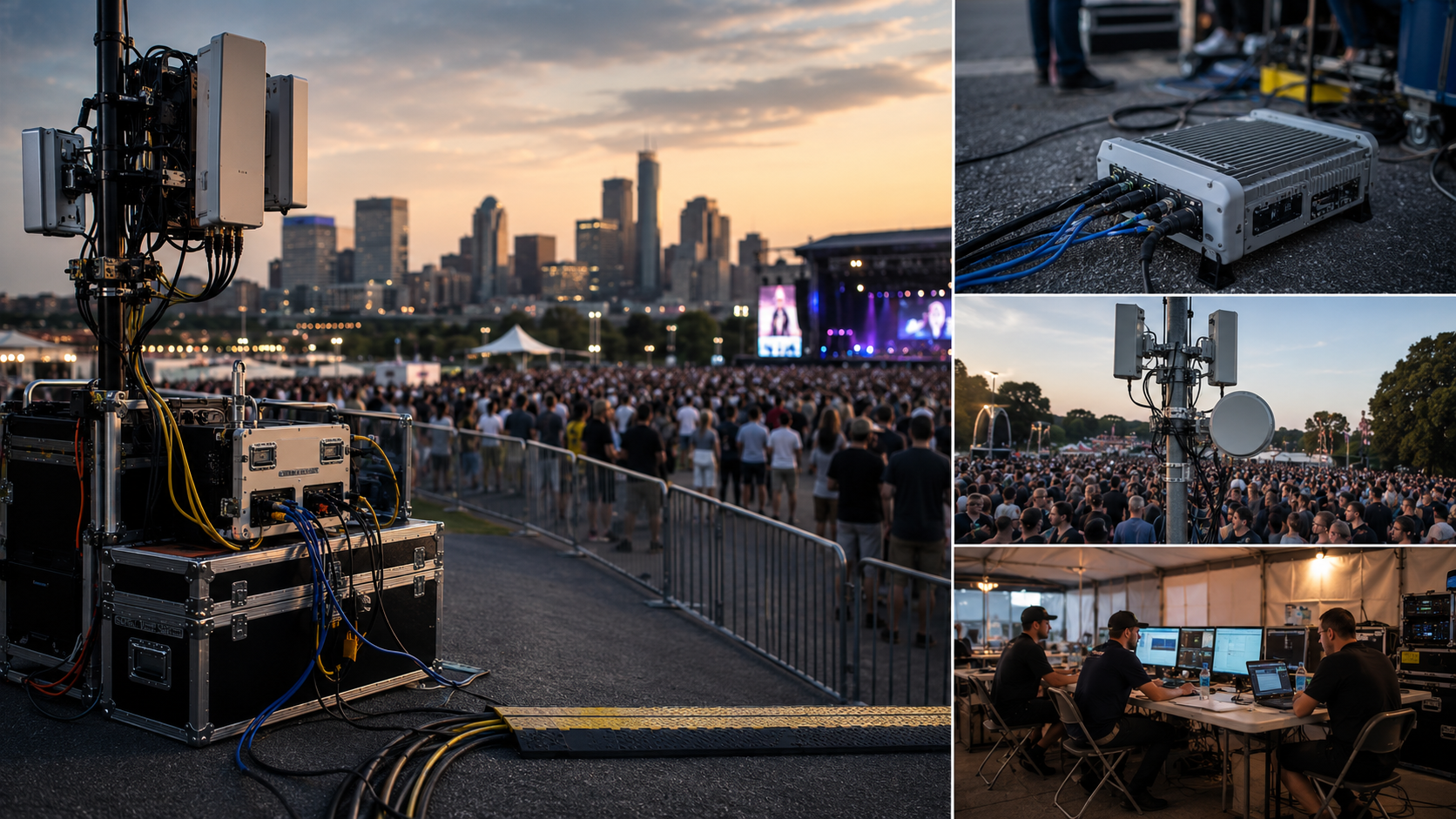
The technical mechanism is not exotic, but the economic packaging is. The company’s FAQ says its units combine several WAN sources through enterprise-grade Peplink bonding routers, 4x4 MIMO antennas, and modems connected simultaneously to Telstra, Optus, and Vodafone 5G/4G networks. It says onsite fibre, satellite, or venue Wi-Fi can also be added to the bonded pool, with traffic routed through PopUp’s routers and remotely managed by support engineers.
The important distinction is between redundancy and independence. Bonding multiple carriers reduces variance if the network failures are not perfectly correlated. If Telstra is congested, Optus or Vodafone may still carry traffic. If a venue fibre handoff fails, cellular may keep a live stream up. But event conditions can also make failures correlated. A dense crowd can overload all nearby mobile cells. A remote valley may have weak coverage from every carrier. A venue’s power, building materials, or backstage location can degrade every radio link. A network operator can diversify backhaul sources, but cannot repeal the physics of radio propagation or the economics of carrier capacity.
PopUp’s own deployment process reflects this. The Australian site says customers can configure a network, receive a couriered unit, place it 4 to 10 feet off the ground, text a photo to technicians, and then have the unit remotely optimised and monitored. The Lite page says the unit can be used without venue permission, but the same page also stresses placement, power, a 30-metre coverage area, and the ability to integrate a venue hardline when available. This is the economic reality of self-install event networks: the product can be shipped like equipment, but its performance remains a function of local conditions.
The company’s “risk-free test” page is a direct admission that geography and venue type are first-order variables. It says PopUp uses a “National Coverage Model” and historical data to analyse a venue, carrier 5G/4G average speeds, and device types; where engineers see red flags, it recommends or offers a test. It identifies windowless or out-of-the-way locations and remote marginal-coverage locations as situations where testing may be needed. This is a key source of information gain: the firm is not just renting routers. It is monetising a private, accumulated map of network uncertainty.
The managed layer: Slipstream and Captivate
The Australian site’s Slipstream dashboard is economically important because it moves the business away from commodity hardware rental. PopUp says Slipstream is included with every rental and lets customers see users, connected devices, data remaining, rental time, support information, throughput, and device-level insights. It says customers can top up data, boot heavy users, and see live upload/download metrics.
This kind of dashboard reduces the transaction cost of a temporary network. Event organisers are often not network engineers. They need to know whether POS terminals are connected, whether a livestream encoder is consuming upload, whether a guest device is exhausting data, and whom to call before the show goes live. A dashboard turns invisible network quality into an observable production variable. It also allows PopUp to retain operational control from a remote support centre rather than dispatching labour to every event.
Captivate, the company’s branded captive-portal product, shows the adjacent monetisation logic. The Australian page says Captivate can provide a branded login screen, collect custom data fields, redirect users to a URL, and even charge users via credit card to connect, with pricing “starting at $199.” The economic function here is twofold. First, it creates sponsor and marketing inventory from connectivity. Second, it turns guest Wi-Fi from a pure cost centre into a potential data-capture or revenue-offsetting tool.
That said, Captivate also increases risk. A basic production network for POS and livestreaming has one set of obligations. A branded login and data-capture tool has another: privacy representations, consent flows, payment handling, retention practices, and sponsor expectations. PopUp’s Australian terms say customer activation and booking data are available up to 30 days after the event and then not retained, and that information is not shared or sold. For most small events this may be adequate. For enterprise, government, schools, health, or political events, the privacy and cyber-assurance burden may become part of procurement.
Internet-numbering evidence: real routing control, not proof of access ownership
AS152668 is the strongest infrastructure record attached to the Australian target. APNIC records it as an Australian aut-num for PopUp WiFi under ORG-PW4-AP, with route maintenance under MAINT-EPPL-AU and administrator/abuse roles tied to Elan Projects Pty Ltd.
BGP.tools identifies AS152668 as PopUp WiFi, registered in March 2024, active and allocated under APNIC. It observes two IPv4 prefixes, no IPv6 prefixes, 512 IPv4 addresses in total, valid RPKI for the two /24s, and upstreams including Amazon and The Constant Company. Hurricane Electric’s BGP view likewise shows two IPv4 prefixes originated, zero IPv6 prefixes, and valid RPKI for the originated IPv4 routes, with observed peers including Amazon and The Constant Company.
The prefix-level record for 117.55.254.0/24 shows announcement by AS152668 and an APNIC delegation covering 117.55.254.0/23. It also shows reverse DNS names such as au1.fh.popup-wifi.com and au1mel.fh.popup-wifi.com, plus APNIC route objects for Elan Projects Pty Ltd and other routing-object artefacts involving Amazon-origin records. Third-party ASN indexes classify the network as Australian, with two IPv4 /24s and no IPv6.
The correct inference is narrow. AS152668 proves that the Australian operation has obtained and originates internet-numbering resources. It does not prove that PopUp owns last-mile fibre, mobile towers, spectrum, or a national access network. In the context of its product pages, the ASN more plausibly supports static addressing, egress control, VPN/bonding architecture, hosted control-plane services, customer routing, or managed-network continuity. The upstream mix—cloud and hosting-style networks rather than a large physical access footprint—supports this interpretation.
The absence of IPv6 in observed BGP records is also informative, but not determinative. For many event uses—POS, livestream encoders, check-in devices, guest Wi-Fi—IPv4 service through NAT or managed egress is sufficient. But for enterprise buyers, government networks, or IoT fleets with future compliance requirements, IPv6 absence may become a procurement friction. Similarly, valid RPKI reduces one class of routing-authentication risk, but it does not speak to Wi-Fi security, captive-portal security, support access controls, device patching, or SIM-level controls.
The US ASN context points to a parallel internationalisation of the same infrastructure logic. ARIN records AS400944 for PopUp WiFi LLC, registered in April 2024. IPinfo and IPLocate report PopUp WiFi LLC as an ARIN network with three IPv4 /24 ranges, no IPv6, and Amazon upstreams. This suggests the brand has moved beyond ad hoc hardware rental into a more formal network-resource posture in both Australia and the US, but still not into the economic category of a full facilities-based access carrier.
The revenue model: the customer buys avoided catastrophe
The published Australian pricing makes the revenue logic visible. A Lite unit begins at A$485 for the first day, Workhorse at A$715, and Beast at A$1,490. Product pages exclude GST, add a A$195 service fee on long-term lease products, and specify a A$250 regional surcharge per unit for Western Australia, the Northern Territory, and Far North Queensland. The terms add A$200 per 200GB data pack, A$5 per GB excess usage, cancellation fees escalating as the event date approaches, customer liability for freight and travel costs in some postponement cases, late-return fees, and A$4,000 liability per lost, stolen, or damaged unit.
This is not broadband pricing. It is equipment, insurance, logistics, and remote-operations pricing.
For a livestreamed corporate event, a A$1,490 first-day rental is small relative to the cost of production crew, venue hire, executives, sponsors, ticketing, refunds, reputational loss, or a failed broadcast. For a remote festival, a few units are small relative to the cost of vendors being unable to transact, patrons being unable to check in, producers being unable to upload media, or digital artworks failing. The customer’s willingness to pay is driven by the loss distribution, not by the wholesale data cost.
This explains why the firm can charge hundreds or thousands of dollars for connectivity over one or two days while residential broadband sells for a monthly fee. In residential broadband, the customer’s use is continuous and substitutable; a brief outage is irritating but often not catastrophic. In event connectivity, the demand curve is discontinuous. Internet that works after the festival closes has almost no value. Internet that works during the check-in rush, keynote, auction, or live broadcast has very high value. The operator is paid for hitting a deadline.
The pricing schedule also reveals margin pressure. Data is metered beyond included allowances. Logistics are material enough to generate regional surcharges and late-return penalties. Inventory is scarce enough that cancellation fees rise sharply near the event date. Customer misuse, theft, and damage are large enough to justify a A$4,000 per-unit liability clause. Support calls and performance logs are material enough that the terms say complaints must be raised with support and that performance data is logged.
The model therefore has attractive high-ticket revenue per job, but not necessarily high structural margins. Gross margin is squeezed by five factors.
First, carrier data and SIM procurement are variable inputs. The company can bond Telstra, Optus, and Vodafone, but it must buy or otherwise contract for those mobile services. The carriers control licensed spectrum and radio access. PopUp controls orchestration, not the underlying mobile network.
Second, fleet utilisation is seasonal and lumpy. Event calendars cluster around festivals, conferences, elections, launches, holidays, and weather seasons. A router that is booked every weekend may be highly profitable. A router idle during off-season still depreciates.
Third, support labour is partly fixed and partly bursty. Remote monitoring scales better than onsite labour, but live-event support requires credible response capacity at inconvenient hours.
Fourth, freight and handling are central to the product. A self-install appliance reduces labour cost, but shifts operational risk into courier reliability, packaging, return compliance, and remote troubleshooting.
Fifth, over-provisioning is economically rational. If failure is costly, the operator will ship larger units, multiple units, battery options, or redundant paths. That reduces failure probability but increases capital intensity and idle-capacity cost.
Customer evidence: the use cases are operational, not decorative
The most useful customer evidence comes from case studies and public payment records. The case studies should be treated as company-published and therefore favourable, but they are still valuable because they identify concrete failure modes and customer applications.
The 2025 Unconformity Festival case study in Queenstown, western lutruwita/Tasmania, reports 3,000 attendees and a solution of Slipstream, four Lite units, and one Workhorse. The network was used for POS, live-streaming upload, media upload/editing, and back-of-house. The customer context was a remote, geographically isolated town with unconventional venues and limited infrastructure. The producer’s quoted problem was not guest convenience; it was that ticketing, vendor transactions, livestreams, and digital activations would otherwise have been compromised in a town with limited cash and variable reception.
The Jane Goodall memorial case study at Taronga Zoo Sydney reports 800 attendees, a livestreaming/upload/back-of-house use case, and use of a “Titan” unit. The customer described Taronga Zoo internet as “notoriously spotty” and said reliable livestreaming was important because Dr Jane Goodall had asked people not to travel. The economics here are reputational and symbolic: the connectivity product protects the meaning of the event, not merely its operational convenience.
A corporate live-stream case submitted by Scene Change for a 2025 Adelaide event reports use of a Beast unit. The customer says the venue hardline showed a “No IP” error, mobile phone tests showed poor speeds, and PopUp’s unit achieved enough throughput for streaming. The case study frames the risk as a major refund and reputational failure if the stream failed. This is one of the clearest public illustrations of PopUp’s pricing power. The customer did not buy backup internet because bandwidth was scarce in the abstract. The customer bought it because a single point of failure would have transferred value from the AV producer to an angry client.
Early public-sector evidence appears in City of Albany payment registers. A July 2017 attachment records a payment to “ELAN PROJECTS PTY LTD T/AS POPUP WIFI” for “Equipment Hire - VAC Festival” of A$968.00. An August 2017 attachment records a payment to the same trading name for “Hire Of Temporary Public Wi-Fi Device” of A$2,970.00. These records are small, but they matter because they corroborate an operating history in temporary public Wi-Fi and event equipment hire before the 2024 ASN registrations.
The customer base appears segmented into at least six categories: festivals and cultural events; corporate live streams; fundraisers and gala events; site offices and temporary workplaces; trade shows and conferences; and media-production or broadcast use cases. The website also mentions schools, SpaceX launch streaming, elections, and rodeos in the broader Australia-US history.
The public record does not establish customer concentration. It does, however, suggest a likely concentration mechanism. Event-connectivity buyers are repeat intermediaries: AV production firms, event agencies, councils, venues, festival producers, broadcast crews, caterers, and technical directors. A small number of trusted repeat channels can drive large revenue without leaving a large public footprint. This makes the company’s visible customer list less informative than its channel relationships. A producer who trusts PopUp after one avoided failure is likely to specify it again, especially if the alternative is relying on venue Wi-Fi or consumer hotspots.
Geography: Australia-wide claim, but economics are local
PopUp’s Australian homepage says it is Australia-wide and Sydney-based; the footer says Hobart-born, Sydney-based. Official Australian business records point to Tasmania. APNIC records use a Hobart address. Case evidence includes Tasmania, Sydney, Adelaide, and earlier Western Australian public-sector payments.
The market is national in sales language but hyperlocal in production. An event Wi-Fi job in central Sydney, a zoo, a remote Tasmanian mining town, a beachfront festival, and a convention centre are economically different products even if the same router is shipped. The demand is national because events occur everywhere. The supply curve is local because radio signal, cell-sector load, fibre availability, venue back-of-house layout, power access, and courier timing are site-specific.
The regional surcharge for Western Australia, the Northern Territory, and Far North Queensland is a small but useful signal. It indicates that freight distance, support risk, replacement-unit timing, or carrier-coverage uncertainty are priced into the product. A permanent ISP builds a network once and amortises geography over years. A temporary-network operator re-prices geography every job.
The company’s risk-test page is also geographically revealing. It says engineers use coverage modelling and historical data, and that they may recommend a test for challenging venues and remote marginal-coverage sites. This means accumulated geography-specific knowledge is a proprietary input. A new entrant can buy routers. It cannot immediately buy a decade of venue outcomes, carrier performance observations, setup photos, and producer feedback across event sites.
Venue dependence: the buyer controls the event, not the radio environment
Venue dependence is the hidden constraint in temporary connectivity. The customer may control the event programme, but not the building materials, roofline, surrounding mobile cells, RF noise, venue IT policy, loading dock, courier reception, or back-of-house location.
PopUp’s deployment instructions—place the unit 4 to 10 feet off the ground, send technicians a photo, use a QR code to access Slipstream, and return by courier—show a product designed to reduce venue friction. But they also show that placement is performance. A self-install unit at ankle height behind a steel counter is a different network from the same unit elevated near a window.
Venue internet can be a complement, substitute, or trap. PopUp’s FAQ says onsite fibre, satellite, or venue Wi-Fi can be added into the bonded connection. That means the company can improve a venue connection rather than replacing it. But the Scene Change case shows why a venue hardline can also create false security: the customer reported a hardline “No IP” failure and therefore relied on PopUp’s bonded backup.
This creates a classic option-value product. Before the event, the buyer may think venue internet is “included.” During the event, discovering that it fails can be catastrophic. A PopUp unit is valuable because it is portable insurance against the venue’s unobservable quality. The firm’s customer is not always buying primary internet. Often it is buying the right not to care whether the venue’s internet is real.
Venue switching costs also change over time. Months before an event, switching between PopUp, another rental provider, a venue hardline, a telco service, or a DIY Starlink/cellular setup is feasible. During event week, switching costs rise sharply. On show day, switching may be impossible. PopUp’s cancellation and postponement terms economically reflect this time gradient: as the event approaches, inventory and logistics become non-redeployable.
Spectrum and mobile-carrier dependence
PopUp’s access model sits on two different spectrum regimes.
The local Wi-Fi layer typically uses class-licensed, shared spectrum. ACMA states that the Low Interference Potential Devices class licence covers short-range devices including Wi-Fi, that users share frequencies, and that no application or fee is needed if rules are followed. This is economically favourable because it allows rapid deployment without site-specific spectrum licensing. But it also means PopUp cannot guarantee exclusive use of the local radio environment. Dense conferences, production crews, venue access points, consumer hotspots, Bluetooth devices, and adjacent networks can all degrade performance.
The wide-area mobile layer depends on licensed mobile carriers. ACMA’s general licensing guidance says radio-transmitting equipment may require a licence depending on service and equipment. In mobile broadband, the economically scarce rights are held by carriers such as Telstra, Optus, and TPG/Vodafone. The value of those rights is visible in spectrum auctions: ACMA reported that the 2021 850/900 MHz auction raised about A$2.09 billion from Optus and Telstra, supporting 4G and 5G services. ACMA’s 2024–25 communications trends report shows the scale of the mobile market: Telstra, Optus, and TPG together accounted for 26.6 million of 30.4 million prepaid and postpaid mobile services at June 2025, with national mobile infrastructure measured in tens of thousands of 4G and 5G sites.
PopUp therefore has supplier diversification but not supplier sovereignty. Its product pages emphasise simultaneous Telstra, Optus, and Vodafone connections. That reduces dependence on any single carrier, but it does not remove dependence on the mobile-carrier sector. If carriers change data-plan rules, prioritisation, fair-use policies, wholesale terms, roaming arrangements, SIM provisioning, or network-management practices, PopUp’s input costs and performance envelope can change. If a festival overloads every nearby mobile sector, carrier diversity may not be enough.
This is the central asymmetry of movable wireless capacity. PopUp can move its appliances to demand. It cannot move a mobile tower, add licensed spectrum, or force carrier backhaul upgrades at a remote site. Its economic role is to combine and manage other people’s networks at the edge. Its constraint is that, in the hardest events, the binding bottleneck may be the carrier network itself.
Backhaul procurement: the art is in mixing imperfect paths
Backhaul is the decisive cost and performance variable. PopUp’s public materials present several backhaul sources: Telstra, Optus, and Vodafone 5G/4G; onsite ethernet or fibre; satellite; and venue Wi-Fi. The Workhorse page specifically says satellite or an onsite connection can be bonded into the WAN pool. The About page says turnkey satellite integration is part of the product direction.
This creates a hierarchy of backhaul economics.
Carrier cellular is fast to deploy and requires no trenching, but performance is shared with the public and can degrade precisely when crowds arrive. Venue fibre can be high-quality and low-latency, but it may be misconfigured, firewalled, unavailable in the right room, controlled by a venue IT team, or priced opportunistically. Satellite can reach remote sites, but it has visibility, congestion, power, weather, latency, and equipment-placement constraints. Venue Wi-Fi can be convenient but may be the least controllable input.
The operator’s value is not that any one path is perfect. It is that imperfect paths can be combined, monitored, and switched. The firm sells an engineered probability distribution: higher probability that enough upload and download capacity exists at the exact event moment.
The public product limits also show that this is not an unlimited-capacity substitute for fibre. The devices advertise active-connection counts and radii, not stadium-scale guarantees. Lite is 50 active connections and 30 metres; Workhorse 100 active and 50 metres; Beast 125 active and 50 metres. For large festivals, multiple units and careful segmentation are needed. The Unconformity case used five units for 3,000 attendees and divided functions across POS, streaming, media, and back-of-house.
This segmentation is economically important. The best event network is not always the one with the broadest guest Wi-Fi. It may be the one that isolates payment terminals, livestream encoders, ticketing devices, staff networks, and guest access so that a non-critical use cannot crowd out the critical one. Slipstream’s ability to show users, data, throughput, and device-level consumption is part of that rationing function.
Permanent ISP infrastructure versus project-based connectivity
A permanent ISP’s economics are dominated by sunk capital, regulated access, wholesale inputs, service contracts, and long asset lives. NBN’s Enterprise Ethernet product illustrates the contrast. It is a dedicated fibre service between business premises and an NBN fibre access node, with symmetrical speeds, scalable options, different classes of service, and availability targets for service providers. NBN also describes broad business-location eligibility and no upfront build cost for providers in many cases under specified terms.
That model amortises network construction over many years and many customers. It is suitable for fixed premises, predictable traffic, and recurring operations. Its weakness is time and place. It cannot easily serve a one-week festival in a remote town, a livestream at a venue with faulty IT, a temporary site office waiting for fibre, or a fundraiser in a ranch, zoo, tent, car park, or beach site.
PopUp’s economics invert the fixed-ISP model. The company has little or no public evidence of owned last-mile plant. Its visible infrastructure is portable devices, ASN/IP resources, remote management, and operational know-how. It monetises the gap between the permanence of telecom infrastructure and the mobility of modern economic activity.
This gap is widening. Events now use digital ticketing, QR check-in, cloud POS, fundraising applications, real-time social upload, live production, sponsor activations, and hybrid attendance. A venue can be physically excellent and digitally fragile. A temporary-network operator profits when digital operations become essential faster than venues upgrade their permanent networks.
The “network-resource residue” after each job is also different. A permanent ISP leaves behind ducts, fibre, cabinets, antennas, customer drops, and recurring accounts. PopUp leaves behind learned venue data, a supported customer relationship, a returned appliance, refined setup processes, perhaps updated coverage expectations, and a more credible sales story for the next event. Its capital does not remain embedded at the customer site. It circulates.
This has two valuation consequences. First, the fleet’s economic value depends on utilisation, not homes passed or premises connected. Second, the firm’s intangible value depends on trust and information: which venues fail, which carriers work, which producers rebook, which units survive shipping, which event types need over-provisioning, and which customer applications deserve priority.
Competition and substitutes
The competitive set is broader than “event Wi-Fi companies.” A buyer can use venue internet, consumer hotspots, a telco-managed service, AV integrator networks, temporary fibre, Starlink or other satellite service, a mobile carrier’s temporary cell solution, a local IT contractor, or a national rental house. Several Australian-facing rental competitors publicly advertise event Wi-Fi, bonded internet, 5G internet, satellite connectivity, and enterprise-grade routers for conferences, festivals, and other events. One World Rental Australia markets event Wi-Fi hire with 5G internet, satellite connectivity, enterprise-grade routers, and 24/7 support. OWR Event WiFi and Technology Rental similarly market bonded internet and event Wi-Fi rental for festivals and conferences.
This means PopUp does not have a monopoly on the hardware concept. Peplink routers, multi-carrier SIMs, antennas, captive portals, and satellite terminals are widely available. The barriers are operational rather than purely technological.
The first barrier is credibility under deadline pressure. Event producers do not want a provider that is learning during a live broadcast. A case history matters because the cost of failure is asymmetric.
The second barrier is fleet logistics. The company must have enough units in the right configuration, with working modems and antennas, clean SIM provisioning, battery options, packaging, courier processes, and return discipline.
The third barrier is remote-support tooling. A dashboard that tells a producer what is happening can reduce support cost and increase confidence. PopUp’s Slipstream and Captivate products suggest an attempt to internalise this barrier.
The fourth barrier is accumulated venue and RF data. The risk-test page’s reference to historical data and a national coverage model implies the company is trying to convert past jobs into future underwriting advantage.
The fifth barrier is channel specification. AV producers, councils, event agencies, and venues can standardise on a provider. Once a technical director has seen a bonded unit rescue a show, the incumbent gains switching advantage. That advantage is behavioural rather than contractual, but it can be powerful.
Buyer power remains significant. Large event agencies and production companies can shop alternatives, pressure price, or internalise connectivity. Venues can bundle Wi-Fi. Carriers can sell direct. Satellite equipment has lowered the cost of remote backhaul. But the more mission-critical and time-bound the use case, the less buyers will optimise for headline price. They will optimise for the provider they trust to answer the phone when the hardline fails.
Supplier power: carriers, cloud, hardware, couriers
The supplier surface is wide.
Mobile carriers are the most important suppliers because they control licensed-spectrum capacity, towers, radio planning, SIM policies, and network prioritisation. PopUp mitigates carrier power by bonding Telstra, Optus, and Vodafone, but it cannot avoid the sector.
Cloud and transit providers matter because the ASN records show upstream relationships involving Amazon and The Constant Company, and the US ASN records also point to Amazon upstreams. If the firm uses cloud or hosted infrastructure for egress, static addressing, dashboards, or control-plane services, cloud reliability and routing economics become part of its delivery risk.
Hardware vendors matter because the public product architecture depends on Peplink routers, modems, antennas, batteries, cases, and possibly satellite terminals. The company says current gear uses Peplink FusionSIM/SpeedFusion and that engineers use proprietary tools and cloud systems. Hardware supply interruptions, firmware bugs, modem certification issues, or carrier compatibility changes could affect service quality.
Couriers and warehouses matter because the product is often shipped. The Australian deployment process describes courier delivery and return. In a project-based model, late delivery can be as damaging as insufficient bandwidth. This is why logistics terms and late-return clauses are not administrative details. They are margin protection and capacity protection.
Labour is also a supplier constraint, even when internal. The company advertises 24/7 engineer support and real-time remote management. A small team can scale through automation, but only to a point. During festival peaks or national event seasons, support concurrency may become a bottleneck.
Ownership, financing, and corporate-control context
Public evidence supports founder identities and operating continuity, but not financing detail. The About page says Andrew Davies, Linden Kurth, and Nina McMahon founded Elan Projects in 2013 and that PopUp WiFi emerged from that project base. The current About page says the company is still small, still builds its own products, has a team across several US and Australian cities, and is moving toward enterprise, IoT, robotics pilots, and purchase-plus-subscription offerings in 2025.
No public record in the evidence reviewed established venture financing, debt financing, M&A, a sale process, litigation-backed ownership dispute, or a formal parent-subsidiary relationship among Elan Projects Pty Ltd, PopUp WiFi Pty Ltd, and PopUp WiFi LLC. This absence should not be overread. Private Australian companies and small US LLCs often have limited disclosure. But for economic analysis, the unresolved control questions matter.
If Elan Projects owns the Australian customer base, APNIC resources, and business name while PopUp WiFi Pty Ltd owns operating assets, the economics of the brand differ from the economics of either entity. If PopUp WiFi LLC owns the software, US fleet, or intellectual property, the Australian unit could be a related but narrower operating arm. If all entities are under common founder control, the brand’s economic value is more consolidated than the public records show. If they are not, counterparties need to know which entity is contracting, indemnifying, holding customer data, and owning equipment.
The ABR detail that PopUp WiFi Pty Ltd is not currently GST-registered while Elan Projects Pty Ltd is GST-registered is also notable but not conclusive. It may reflect which entity currently invoices Australian taxable supplies, dormant or low-turnover status for one company, group structuring, or historical cleanup. It is not enough to infer inactivity of the operating brand, because the website, APNIC records, and case studies are current. It is enough to flag that the canonical contracting identity should be verified in any commercial diligence.
Adverse records, abuse signals, and security posture
The public evidence reviewed did not identify a specific, credible litigation record, major outage report, regulatory licence breach, security incident, or widely documented service-quality complaint tied to the Australian PopUp WiFi operation. That is not proof that none exist. Small event-network failures often resolve privately through refunds, producer relationships, or reputational channels rather than public records.
The observable security and abuse posture is mixed but not alarming on the public facts. APNIC has an abuse contact for the network, and the abuse mailbox is shown as validated in 2026. BGP views show valid RPKI for the Australian originated IPv4 routes and no observed RPKI-invalid originated prefixes. The company’s terms make privacy representations around GDPR compliance, 30-day availability of activation and booking data, and not sharing or selling customer information.
The main risk is not visible abuse. It is trust concentration. A temporary-network provider often holds privileged access to event traffic flows, captive-portal data, support credentials, routing devices, and sometimes payment-related connectivity. The company’s own Captivate product can collect attendee data and support paid access. For low-risk events this is routine. For government, health, schools, political events, or corporate launches, procurement may increasingly ask for security documentation, data-processing terms, device-hardening evidence, incident-response commitments, and cyber insurance.
The ASN records are also not a full security audit. They say something about routing control and route validation. They do not prove endpoint security, Wi-Fi encryption settings, captive-portal safety, support-access controls, SIM security, supply-chain patching, or logging governance.
What the evidence proves
The evidence proves that PopUp WiFi is an active operating brand with an Australian origin, an Australian website, current product pages, published pricing, case-study evidence, and an APNIC internet-numbering presence under AS152668.
It proves that Elan Projects Pty Ltd is an active Australian private company, that it has used the “popup wifi” business name since 2016, and that it is tied to APNIC administrative records for the PopUp WiFi ASN. It proves that PopUp WiFi Pty Ltd is also an active Australian private company and appears as the named entity in the Australian website footer.
It proves that the Australian product uses a portable managed-network model built around bonded Telstra, Optus, and Vodafone 5G/4G links, Peplink-class routing, optional onsite fibre/satellite/venue Wi-Fi, remote monitoring, and shipped appliances.
It proves that published use cases include POS, ticketing, livestreaming, media upload, back-of-house networks, guest Wi-Fi, fundraisers, festivals, corporate events, and temporary work sites.
It proves that the Australian ASN has a small but real IPv4 routing footprint: two /24s, 512 IPv4 addresses, no observed IPv6, valid RPKI, and upstream visibility through Amazon and The Constant Company in third-party BGP views.
It proves that public-sector customers or counterparties used the service as early as 2017, based on City of Albany payment records to Elan Projects trading as PopUp WiFi.
What the evidence suggests
The evidence suggests that PopUp WiFi’s defensible asset is not licensed spectrum or last-mile plant. It is orchestration: equipment, software, routing resources, multi-carrier relationships, operational playbooks, support, and venue knowledge.
It suggests that the firm’s pricing power is strongest when connectivity is tied to direct event revenue or reputational risk: POS, ticketing, live streaming, auctions, fundraising, sponsor activations, broadcast, or executive communications. It is weaker where the use case is casual guest Wi-Fi.
It suggests that the Australian operation may have shifted from a project-management adjacency into a specialist connectivity platform, then expanded into the US with a more formal branded LLC and a parallel ARIN ASN. The product language around purchase, subscriptions, enterprise, IoT, robotics pilots, and satellite integration suggests an attempt to make revenue less purely event-seasonal.
It suggests that the company’s gross margin depends heavily on fleet utilisation and input procurement. Published first-day prices are high, but the cost stack is real: mobile data, hardware depreciation, failed or late returns, couriers, support labour, batteries, replacement units, regional freight, and over-provisioning.
It suggests that the company’s operational data may be a strategic asset. A “National Coverage Model,” historical speed information, and venue testing workflows imply that each deployment improves the underwriting model for the next one.
What remains unresolved
The public record does not disclose revenue, profitability, fleet size, utilisation, churn, top-customer exposure, wholesale data costs, carrier-contract terms, insurance coverage, support staffing, or failure rates.
It does not disclose the exact relationship among Elan Projects Pty Ltd, PopUp WiFi Pty Ltd, and PopUp WiFi LLC. It does not establish which entity owns the brand, software, Australian fleet, US fleet, APNIC resources, ARIN resources, customer contracts, or intellectual property.
It does not show whether AS152668 is used mainly for customer egress, static IP services, VPN/bonding infrastructure, cloud-hosted control systems, internal operations, or some combination.
It does not show whether the company has venue-exclusivity agreements, preferred-supplier relationships with production firms, carrier wholesale arrangements, satellite-reseller agreements, or managed-service contracts with enterprise clients.
It does not show the extent to which long-term lease and purchase offerings are material versus short-term rentals. This is a major unresolved economic question. Short-term event rentals produce lumpy, high-value revenue. Purchase-plus-subscription products could create recurring revenue and higher valuation multiples, but also expose the firm to enterprise support obligations and customer-success costs.
Evidence ledger
- RDAP/APNIC anchor — RDAP AS152668 / ORG-PW4-AP, starting evidence supplied by the user: https://rdap.org/autnum/152668. Used to identify the target as the Australian PopUp WiFi associated with AS152668 and ORG-PW4-AP.
- APNIC Whois, ORG-PW4-AP — https://wq.apnic.net/apnic-bin/whois.pl?form_type=advanced&searchtext=ORG-PW4-AP. Shows organisation name PopUp WiFi, org type LIR, country Australia, Hobart address, and popupwifi.com.au contact.
- APNIC/BGP aut-num record for AS152668 — https://bgp.he.net/AS152668. Shows aut-num AS152668, as-name EPPL-AS-AP, description PopUp WiFi, APNIC organisation ORG-PW4-AP, and route-maintainer context.
- APNIC abuse/admin roles — https://wq.apnic.net/apnic-bin/whois.pl?form_type=advanced&searchtext=AE585-AP. Shows abuse contact and Elan Projects Pty Ltd administrator role tied to the PopUp WiFi network records.
- Australian website homepage — https://popupwifi.com.au/. Shows Australian operating proposition, Australia-wide claim, Sydney-based language, managed-network product, bonded multi-carrier cellular, and footer naming PopUp WiFi Pty Ltd.
- Australian product overview — https://popupwifi.com.au/products/. Shows Lite, Workhorse, and Beast pricing, capacity, active-connection counts, coverage radius, cellular bonding, support, and Slipstream inclusion.
- Australian Lite product page — https://popupwifi.com.au/products/lite/. Shows A$485 first-day pricing, 50 active-connection positioning, Telstra/Optus/Vodafone bonding, venue-permission claim, battery and LAN/WAN details.
- Australian Workhorse product page — https://popupwifi.com.au/products/workhorse/. Shows A$715 first-day pricing, 100 active connections, 50-metre radius, two 5G plus two 4G links, and optional satellite/onsite bonding.
- Australian Beast product page — https://popupwifi.com.au/products/beast/. Shows A$1,490 first-day pricing, heavy-duty use positioning, four modems, high-gain antennas, 125 users, WAN/LAN features, and static-IP availability.
- Australian FAQ — https://popupwifi.com.au/faqs/. Shows Peplink bonding-router architecture, 4x4 MIMO antennas, simultaneous Telstra/Optus/Vodafone 5G/4G use, and optional onsite fibre/satellite/venue Wi-Fi bonding.
- Slipstream page — https://popupwifi.com.au/slipstream/. Shows dashboard functions: users, devices, data, throughput, top-ups, device insights, support information, and remote management.
- Captivate page — https://popupwifi.com.au/captivate/. Shows branded login, data capture, sponsor ROI, URL redirect, and paid-access gateway functionality.
- Australian terms and conditions — https://popupwifi.com.au/terms/. Shows cancellation schedule, postponement terms, data-pack pricing, excess-data charges, support logging, setup obligations, late-return fees, lost/damaged-unit liability, and privacy statements.
- Risk-free test page — https://popupwifi.com.au/risk-free-test/. Shows coverage modelling, historical data, venue-risk assessment, remote-location risk, and test economics.
- About page — https://popup-wifi.com/about/. Shows origin in Elan Projects, founders, 2014 emergence, evolution from early 3G/LTE towers to bonded 5G/LTE-A, Peplink FusionSIM/SpeedFusion, 20,000 event-day claim, team locations, and enterprise/IoT/product roadmap.
- ABN Lookup, Elan Projects Pty Ltd — https://abr.business.gov.au/ABN/View/14164629547. Shows active Australian private company, ABN/ACN, GST registration, and business name “popup wifi” from 2016.
- ABN Lookup, PopUp WiFi Pty Ltd — https://abr.business.gov.au/ABN/View/37617743656. Shows active Australian private company, ABN/ACN, and GST status.
- BGP.tools AS152668 — https://bgp.tools/as/152668. Shows AS152668 registration/active status, two IPv4 /24s, valid RPKI, no IPv6, and upstreams.
- Hurricane Electric BGP AS152668 — https://bgp.he.net/AS152668. Shows observed originated prefixes, RPKI status, peers, and APNIC Whois context.
- Hurricane Electric prefix 117.55.254.0/24 — https://bgp.he.net/net/117.55.254.0/24. Shows announcement by AS152668, APNIC delegation context, reverse DNS names, and route-object evidence.
- IP2Location ASN AS152668 — https://www.ip2location.com/as152668. Third-party ASN index showing Australian classification, domain, two IPv4 prefixes, and no IPv6.
- TheIpAPI AS152668 — https://theipapi.com/asn/152668. Third-party ASN index showing description, country, two IPv4 prefixes, and no IPv6.
- ARIN Whois, AS400944 PopUp WiFi LLC — https://whois.arin.net/rest/asn/AS400944. Shows US ASN registration for PopUp WiFi LLC in April 2024 and the US website reference.
- IPinfo AS400944 — https://ipinfo.io/AS400944. Shows PopUp WiFi LLC US ASN profile, IPv4 ranges, no IPv6, RPKI status, and Amazon upstreams.
- IPLocate AS400944 — https://www.iplocate.io/asn/AS400944. Third-party corroboration of US ASN, ARIN allocation, IPv4 ranges, and upstreams.
- The Unconformity 2025 case study — https://popupwifi.com.au/case-study/the-unconformity-festival-2025/. Shows remote Tasmanian festival use case, 3,000 attendees, five-unit solution, POS/livestream/media/back-of-house functions, and infrastructure constraints.
- Jane Goodall memorial case study — https://popupwifi.com.au/case-study/live-streamed-memorial-celebrating-dr-jane-goodalls-life/. Shows Taronga Zoo livestream use case, 800 attendees, Titan unit, and value of reliable streaming.
- Scene Change corporate live-stream case study — https://popupwifi.com.au/case-study/live-stream-corporate-event-adelaide-and-melbourne/. Shows hardline failure, poor mobile phone test speeds, bonded-unit performance, refund/reputation risk, and live-stream economics.
- City of Albany July 2017 payment register — municipal payment attachment showing Elan Projects Pty Ltd trading as PopUp WiFi for VAC Festival equipment hire.
- City of Albany August 2017 payment register — municipal payment attachment showing Elan Projects Pty Ltd trading as PopUp WiFi for temporary public Wi-Fi device hire.
- ACMA Low Interference Potential Devices class licence page — https://www.acma.gov.au/licences/low-interference-potential-devices-class-licence. Shows Wi-Fi class-licensed shared-spectrum framework and no application/fee requirement if compliant.
- ACMA radiocommunications licensing guidance — https://www.acma.gov.au/licences/radiocommunications-licences. Shows that radiofrequency equipment may require licences depending on service and equipment.
- ACMA 850/900 MHz auction outcome — https://www.acma.gov.au/auction-summary-850900-mhz-band. Shows licensed-spectrum value and 4G/5G relevance, including A$2.09 billion auction revenue.
- ACMA communications trends 2024–25 — ACMA PDF. Shows Australian mobile market scale and carrier concentration context.
- NBN Enterprise Ethernet page — https://www.nbnco.com.au/business/product-and-technical-information/enterprise-ethernet. Shows permanent fibre business-service characteristics, classes of service, availability targets, and business-location eligibility.
- ACMA mobile coverage-map rules — https://www.acma.gov.au/articles/2025-10/new-rules-mobile-coverage-maps. Shows standardised 4G/5G coverage-map requirements from 2026 and prior comparability problem.
- One World Rental Australia event Wi-Fi page — competitor/substitute evidence for event Wi-Fi, 5G internet, satellite connectivity, enterprise-grade routers, and 24/7 support.
- OWR Event WiFi Australia page — competitor/substitute evidence for bonded internet and festival/conference Wi-Fi rental.
- Technology Rental Australia event Wi-Fi page — competitor/substitute evidence for personalised bonded internet and event Wi-Fi rental.
Watchpoints
The first watchpoint is whether PopUp WiFi becomes more ISP-like. More IPv4 resources, IPv6 announcements, additional upstreams, exchange peering, PeeringDB presence, customer route objects, or more visible static-IP products would indicate movement from appliance rental toward controlled managed-network infrastructure. Remaining at two Australian /24s with no IPv6 would imply continued dependence on lightweight egress and orchestration rather than deeper network ownership.
The second watchpoint is the legal-container question. Any filing, contract, trademark update, financing, or acquisition that clarifies the relationship among Elan Projects Pty Ltd, PopUp WiFi Pty Ltd, and PopUp WiFi LLC would change how the operating value is attributed. The key issue is not naming. It is which entity owns the fleet, software, customer contracts, internet-numbering resources, and liabilities.
The third watchpoint is the mix shift from rental to recurring subscription. The company’s public language around purchase, long-term lease, enterprise, IoT, robotics pilots, and purchase-plus-subscription products would become economically material if recurring revenue exceeds event rentals. That would reduce seasonality but increase support obligations and working-capital needs.
The fourth watchpoint is carrier-input cost. Changes in Telstra, Optus, or Vodafone mobile data terms, fair-use enforcement, network prioritisation, wholesale availability, SIM provisioning, or enterprise mobile pricing could directly compress margins or reduce performance. Multi-carrier bonding mitigates single-carrier risk; it does not eliminate sector-level supplier power.
The fifth watchpoint is standardised mobile coverage mapping in Australia. ACMA’s 2026 coverage-map rules may improve pre-event modelling and reduce buyer uncertainty. Better public maps could lower PopUp’s information advantage, but they could also validate the need for professional redundancy in marginal or crowded locations.
The sixth watchpoint is LEO satellite substitution. If Starlink-class services become cheaper, more accepted by venues, and easier for producers to self-install, remote-event backhaul becomes more competitive. If PopUp integrates satellite better than event organisers can, satellite becomes an input that strengthens the service rather than a substitute.
The seventh watchpoint is venue bundling. Convention centres, stadia, zoos, festivals, and large venues may attempt to lock in preferred connectivity suppliers or charge for external network deployment. Venue exclusivity would raise switching costs and could either help PopUp, if it wins preferred status, or block it from high-value sites.
The eighth watchpoint is fleet scarcity during peak seasons. Evidence that inventory is repeatedly booked out, that cancellation fees rise, or that regional surcharges expand would indicate utilisation-driven pricing power. Conversely, heavy discounting or abundant last-minute availability would imply commoditisation.
The ninth watchpoint is security and privacy assurance. Captive portals, data capture, paid Wi-Fi, and managed routing create audit exposure. A public cyber incident, privacy complaint, or enterprise security certification would change buyer perception. For higher-value customers, security paperwork may become as important as speed tests.
The tenth watchpoint is failure publicity. One high-profile livestream, POS, ticketing, or fundraising failure can damage a temporary-network brand because the product is reliability. Conversely, public evidence of rescuing failed venue internet strengthens the brand’s pricing power.
The eleventh watchpoint is public procurement. More council, government, university, emergency-management, or arts-funding procurement records would reveal average contract size, repeat behaviour, and whether PopUp is moving from ad hoc event hire into institutional framework agreements.
The twelfth watchpoint is ownership of proprietary data. The firm’s reference to historical coverage data and a national coverage model is economically meaningful. If that dataset becomes demonstrably large, proprietary, and integrated into quoting, it becomes a defensible underwriting asset. If it remains informal, the barrier to entry is lower.
The thirteenth watchpoint is hardware standardisation. If commodity Peplink-plus-SIM-plus-Starlink packages become easy for AV firms to operate internally, PopUp’s advantage narrows to support and logistics. If PopUp’s own software, fleet design, and remote-support process materially outperform generic kits, it keeps a service moat.
The fourteenth watchpoint is event-market cyclicality. Festivals, conferences, and corporate events are exposed to weather, insurance costs, discretionary marketing budgets, local-government funding, and macroeconomic conditions. A downturn does not merely reduce volume; it can reduce the willingness to pay for premium redundancy except where connectivity is tied to revenue collection.
The fifteenth watchpoint is whether mobile networks become good enough at venues that redundancy is less valued. If 5G densification and venue fibre upgrades make ordinary connectivity reliable, the emergency-insurance premium falls. If digital event dependence grows faster than venue infrastructure improves, PopUp’s addressable risk pool expands.