
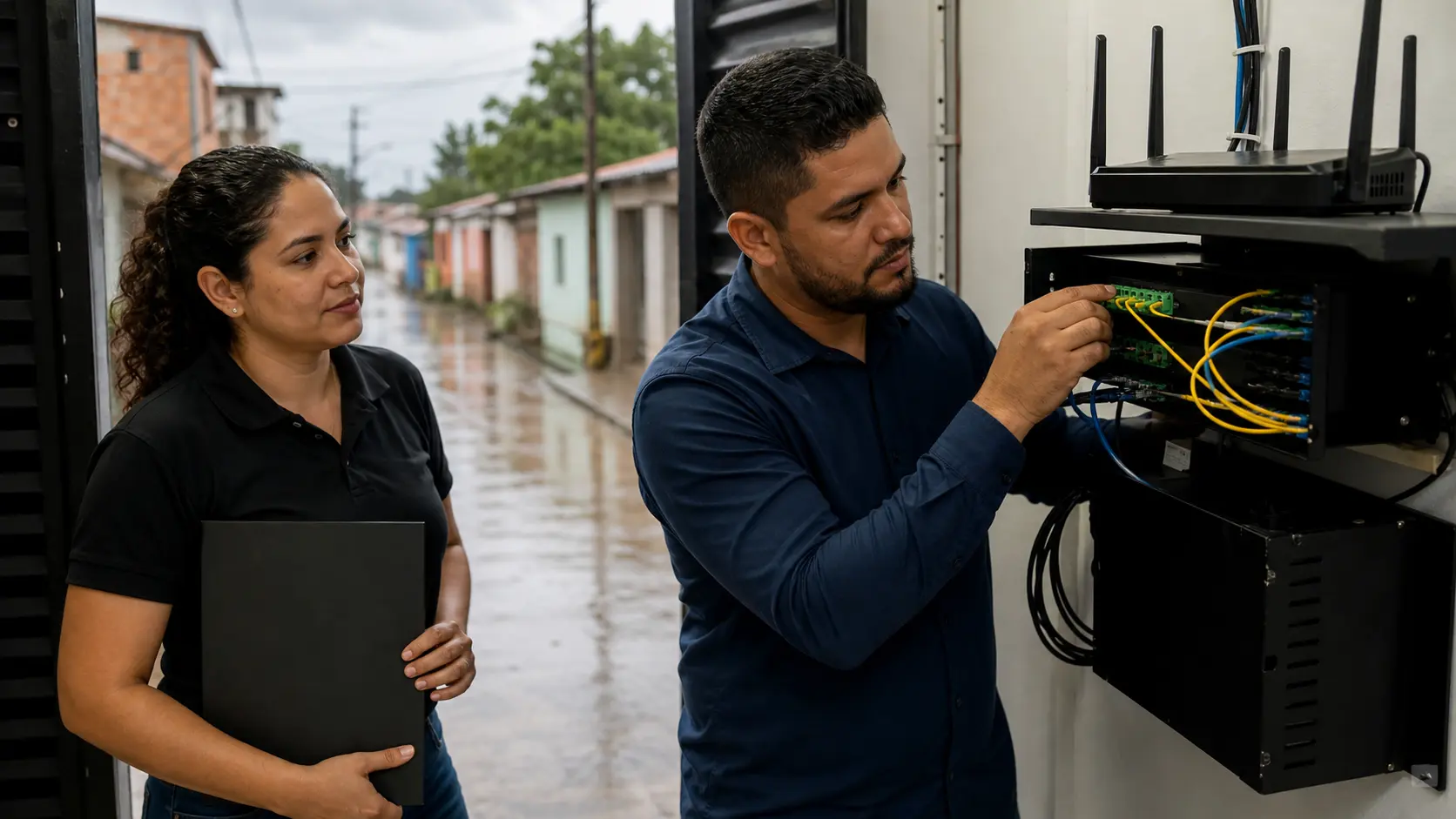
Summary
- NETLINK LTDA - ME should be read as a local Brazilian connectivity provider whose public proof rests on identity, coverage, contract, support, billing and routing-resource records, not on a generic brand label or on assumptions about every company called Netlink.
- The available evidence supports a cautious thesis: Netlink exposes the main operating surfaces a local fiber provider needs, but public sources do not prove live speed, uptime, peering quality, outage recovery or customer production outcomes.
The name is not the evidence
The problem with a company called NETLINK LTDA - ME is that the name sounds more conclusive than it is. "Netlink" is a common construction in telecom, software and managed-service markets. It can describe a link, a network, a product, a voice provider, a reseller, a local ISP, a regional carrier, a software shop or a customer-owned internal system. That makes the first editorial task simple but unforgiving: hold the company to a specific record rather than letting the name do the work.
For this Brazilian entity, the useful record begins with CNPJ 20.384.800/0001-60, the official Netlink Telecom website at netlink-pa.net.br, Brazilian public company-record pages, and Registro.br resource records that tie AS275630 and the IPv6 block 2804:978c::/32 to NETLINK LTDA - ME. Those references do not make the company large, mature or operationally resilient. They do make the subject identifiable. That matters because the real question for a local connectivity provider is not whether a name can be found online. It is whether a customer, partner, regulator or network buyer can trace the same entity through commercial identity, service offer, account handling, field support, billing state, public contract terms and Internet resource registration.
That is the handoff at issue. A local access provider is tested between customer request and network state: whether the address is inside a coverage area; whether the installation is viable; whether the account is created correctly; whether the monthly billing state matches the service state; whether a support request becomes a field visit when remote troubleshooting is not enough; whether an address change or cancellation is handled without orphaned equipment or unclear charges; whether Internet resource records describe the same legal company that appears on the customer contract. Public sources can show that such handoff surfaces exist.
They rarely prove how well they operate.
This distinction is more than caution. It is the difference between registry evidence and service evidence. A CNPJ record says that a business entity exists and has a declared economic activity. A web plan page says that the company markets broadband service. A contract says what the provider claims as obligations and exceptions. An ASN record says that an Internet number resource has been allocated or registered.
None of those facts, alone, says that a customer in Ananindeua receives the paid speed on a rainy evening, that a field technician arrives within the promised window, or that a route is visible with a stable upstream during a failure. Each record is therefore a layer, not a shortcut.
The resulting picture is of a local provider with enough public structure to be evaluated, but not enough open evidence to certify service performance. That is still a meaningful finding. Many small broadband operators leave only scattered commercial traces. Netlink's public materials expose the parts of the operating model that a serious buyer would ask about: coverage, plans, payment state, support, field visits, equipment custody, address changes, and resource identity.
The harder proof would require private operational data, customer-side measurements, authenticated account access, NOC logs, peering or transit records, and time-stamped outage handling. Those are not public in the evidence reviewed here.
The company boundary starts with the CNPJ
The cleanest boundary for NETLINK LTDA - ME is the Brazilian company identifier. Public CNPJ aggregators identify Netlink Ltda. or NETLINK LTDA. - ME, with the trade name Netlink.com, under CNPJ 20.384.800/0001-60. The same record family places the company in Ananindeua in the state of Para, records the opening date as 04/06/2014, marks the cadastral situation as active, and describes the main activity as providers of access to communication networks. Econodata's page adds the CNAE framing J-6190-6/01 and a micro-company classification. Serasa Experian's page gives the same core identity and activity description in its metadata.
Those records are not an operating audit, but they are valuable because they tie the public-facing Netlink.com label to one legal entity.
That boundary matters because public telecom records surface other Netlink-like names. Teleco's 2017 SCM provider list includes not only NETLINK LTDA. - ME (NETLINK.COM) but also other similarly named entries, including Netlinks, Netlink Provedor de Internet and other variants. That is not unusual in a large telecom market. It does mean that a buyer or analyst should not collapse every Netlink reference into this company. The exact entity here is the one behind CNPJ 20.384.800/0001-60, the official netlink-pa.net.br site, and the AS275630 resource record.
The official site helps tighten the boundary. Its public pages present the company as NETLINK TELECOM, show a Para-focused contact number, and link the same service surface to broadband plans, a coverage page, a customer center, contact forms and a contract. The contract itself names NETLINK TELECOM, gives CNPJ 20384800000160, and ends with NETLINK LTDA - ME as the provider signature line. That is stronger than a generic marketing page because it connects the public brand to a legal/contractual identity. It also creates an accountability surface.
If a customer is deciding whether "Netlink" is a real provider or just a vague online name, the contract and CNPJ alignment are among the first useful checks.
The company boundary also helps prevent a common mistake in local ISP analysis: treating nearby providers, upstream carriers, customers, route records, streaming bundles or software modules as if they are the same entity. Netlink's site mentions services and links that are part of the customer experience, such as speed testing, billing second copy, contact and support. Those are not separate companies in this analysis. Likewise, the presence of AS275630 in registry data does not turn every route-adjacent name into Netlink. The entity remains the Brazilian company.
All other records are evidence about its market, service surface or resource footprint.
This is the right level of confidence for public evidence. The sources support an identifiable company and a local Internet-access posture. They do not support claims about ownership depth, undisclosed corporate group structure, exact employee count, audited revenue, customer satisfaction or hidden network architecture. Even the trade name can invite over-reading. "Netlink.com" sounds like an Internet brand, but the company should be evaluated through its documented local service and registry record, not through the broad semantics of the name.
The public service surface is local and operational
Netlink's official pages present a straightforward local broadband business. The homepage says NETLINK TELECOM has broadband Internet and plans for residences, with call-to-action links for subscription, a speed-test link, a second-copy billing link, support contact, and the public contract. The plans page shows fiber Internet packages, with plan labels such as 100, 220, 320, 400 and 500 mega tiers, framed as monthly plans. The coverage page says the company's fiber coverage extends across urban and rural areas of Ananindeua, Marituba, Igarape-Acu and Primavera, then lists neighborhoods, condominiums and local areas.
The contact page gives phone/WhatsApp, email, weekday and Saturday hours, and a form with subject choices that include service, support and finance.
Those details are useful not because the marketing proves service quality, but because they reveal the operational handoff that the company has to manage. A local broadband sale starts with geography. The provider must decide whether a customer address is inside the fiber coverage footprint and whether the installation path is viable. If the address is viable, the provider must create an account, schedule or perform the installation, assign equipment, associate the customer with a plan, and keep the billing state synchronized with access.
If the customer later reports a fault, the provider must decide whether the issue is remote, customer-premise equipment, local fiber plant, power, upstream connectivity or billing suspension.
The official customer center is especially important. Its public login surface lists registered data, financial control, access items and technical support. That is not proof of the quality of the portal; no authenticated account was tested. It is still evidence that Netlink's customer workflow is organized around four durable states: who the customer is, what the customer owes or has paid, what access items are associated with the account, and what support state is open. For small ISPs, this is often where reliability becomes administrative.
A perfectly repaired fiber line is not useful if the account remains suspended in the billing system. A paid account is not enough if the access item is not mapped to the correct address. A support promise is weak if it cannot be tied to a customer record.
The contact page also separates support from finance. That separation matters. Local connectivity failures often begin as technical symptoms but become billing or account questions. A user who cannot connect might have a damaged drop cable, a misconfigured router, a broader outage, an unpaid invoice, an account suspension, or a move request that has not been completed. A public form with support and financial subject categories is a small but real sign that the company recognizes more than one type of handoff. It does not prove triage discipline. It does show the public entry points a customer would be expected to use.
The coverage page gives the strongest local signal. It does not describe a national cloud service. It describes a Para access footprint with specific localities. This matters for the assigned category because "cloud service" can be misleading if read as hyperscale infrastructure or abstract software. For Netlink, the service evidence is closer to last-mile and regional access infrastructure. The cloud relevance is indirect: households, branch offices, local businesses and public agencies use the provider's access service to reach cloud applications, administrative systems, streaming services and remote work tools.
The provider's job is to make those external dependencies reachable from a local premise, not to prove it operates a cloud platform.
That is why the public record should not be overstated. Netlink's site supports claims about advertised broadband, local coverage, plan tiers, billing access and support contact. It does not support claims about dedicated enterprise links, managed security, cloud hosting, peering depth, measured latency, SLA credits beyond what the contract states, or a guaranteed number of customers. A serious reading keeps the service local and operational.
The contract shows where reliability becomes paperwork
Netlink's public contract is the most revealing operating document in the evidence pack. It describes the provision of Internet connection service through fiber-optic network access, with a chosen plan, a minimum guarantee clause, monthly payment, availability exceptions, support boundaries, equipment treatment and address-change terms. The language is not polished enterprise documentation, but the value of the contract is not style. It shows what has to be coordinated when a local provider turns connectivity into a recurring service.
The availability clause is the first example. The contract says service is available 24 hours a day, seven days a week, subject to interruptions caused by lack of electrical power for the provider, third-party upstream issues, transmission-system failures, maintenance, third-party action, force majeure and other exceptions. It also says interruptions beyond 72 consecutive hours under listed causes are discounted proportionally. This is a useful public statement, but it should not be mistaken for an audited uptime record. It creates a customer-facing rule for interruption handling.
It does not show how many interruptions occurred, how quickly they were detected, how the provider determines cause, or how often credits are actually applied.
That distinction matters because interruption classification is a difficult part of local broadband operations. A customer may experience downtime from the customer's own Wi-Fi, power, optical terminal, local drop cable, neighborhood distribution fiber, provider equipment, upstream transit, DNS, content platform failure or billing state. The contract lists categories that move responsibility around. The operational challenge is evidence: can the provider show what failed, when, who owned the fault, what was done, and whether a credit should be applied? Public contract text cannot answer that.
It does, however, show the logic a customer would need to challenge or confirm a recovery decision.
The support clause is equally concrete. The contract says telephone support follows the limits of the contract, and if a site visit is needed the company has a 48 to 72 business-hour window to attend the request. It also states that phone support and technical visits occur on weekdays and Saturday morning, with exceptions for general provider problems. This creates a labor model. Field support is not an abstract help desk; it is a schedule, a queue, a territory, a vehicle or technician, and a judgment about whether a problem is remote or physical. The public source does not prove staffing, dispatch quality or average repair time.
It shows that Netlink's service promise depends on local support labor, not only on routers and fiber.
The billing clauses show another handoff. Non-payment can lead to service suspension, monthly payments are tied to due dates, and late charges are described. Whether or not a customer likes those terms, they expose a core operating dependency: access state and billing state must remain synchronized. If finance marks an account unpaid, the network or access system may suspend service. If payment is made but not reconciled, the technical system may still block the customer. If a dispute or credit after a long outage is not recorded correctly, the customer relationship becomes a finance problem even after the physical service is restored.
The equipment clauses add a third handoff. The contract treats installed cables, fiber, modem, ONU and routers as equipment ceded to the customer under a custody arrangement, with obligations to conserve and return material at the end of the contract. It distinguishes manufacturing defects from misuse and includes a penalty for not returning equipment in some cancellation or move scenarios. This is ordinary local-ISP work, but it is also a source of friction. A provider that cannot track which equipment is at which address will struggle with replacement, cancellation, theft, inventory and support diagnosis.
Again, the public source does not prove that Netlink tracks equipment well. It shows that equipment custody is part of the service model.
The address-change clause is one of the most telling operational statements. It says the company will perform an address change within a stated window when the new address is viable, with a listed cost, and warns that lack of viability can trigger proportional penalty terms. In a local fiber provider, moving an account is not just updating a billing address. It can require new feasibility checks, physical drop work, retrieval and reinstall of equipment, change of access item, and potential contract renegotiation if the provider cannot serve the new location. That makes address change a useful stress test for the whole handoff chain.
The contract therefore supports a practical conclusion: Netlink's public operating model is not mainly about a brand promise. It is about whether account records, payment state, support decisions, field labor, equipment custody and network access stay aligned. Public evidence shows the categories. It does not prove the execution.
The routing-resource record is real but narrow
The technical resource evidence is clear enough to anchor identity, but too narrow to carry a reliability claim. Registro.br RDAP records show AS275630 as a direct allocation in Brazil with NETLINK LTDA - ME as the registrant and CNPJ 20.384.800/0001-60 as the public identifier. The same RDAP chain links to the IPv6 network 2804:978c::/32, marked active and associated with nicbr_autnum 275630. IPIP's WHOIS-style mirror also lists AS275630 for NETLINK LTDA - ME and the 2804:978c::/32 inetnum. IP2Location similarly shows AS275630, Brazil, Netlink Ltda - ME and the IPv6 netblock, while indicating no IPv4 ranges in its view.
That is good identity evidence. It connects the legal company to Internet number resources. For a local access provider, that can matter commercially because resource registration is part of the path from resale-like access to more accountable network operation. An ASN can support direct routing relationships, traffic engineering, provider independence, IPv6 deployment and clearer abuse or administrative contact paths. It can also make a provider visible in technical systems that customers or partners use to understand network ownership.
But an ASN is not a service outcome. CAIDA's AS Rank page and structured API response show AS275630 with very limited visible topology: country BR, the NETLINK LTDA - ME organization, customer cone of one, zero listed prefixes/addresses in that view, zero provider/peer/customer degree, and seen false in the API response. FORT Monitor's monthly report lists ASN 275630 with 0 valid, 0 invalid and 2 not found. Those signals do not mean the company has no network or no customers. They mean that, in the public measurement systems checked, the visible routing-security/topology evidence is thin.
This is exactly where a careful reading has to avoid two opposite errors. The first error would be to ignore the ASN and say there is no technical record. There is one. Registro.br's RDAP data ties AS275630 and 2804:978c::/32 to the company. The second error would be to turn the ASN into proof of mature routing, deep peering, redundant transit or production-grade recovery. The public records do not establish that. They show resource allocation and limited independent visibility.
They do not show an upstream contract, BGP session state, route-origin authorization coverage beyond the FORT summary, route stability, IPv4 service, traffic volume, IX participation or failover practice.
For customers, this matters less as an abstract BGP topic and more as a governance question. If a provider advertises local connectivity but has a thin public routing footprint, a serious business buyer should ask how service reaches the wider Internet. Is traffic carried through one upstream or more than one? Is IPv6 active for customers or only allocated? Are route-origin authorizations created for every originated prefix? How are outage events correlated between customer tickets and routing events? What happens if an upstream fails? What monitoring view can the provider share without exposing sensitive internal data?
None of those questions imply misconduct. They are ordinary due-diligence questions for a connectivity provider whose public resource record is still young or lightly visible. AS275630's Registro.br record has a 2026 registration timestamp, which makes it especially important not to infer a long track record from the ASN alone. The CNPJ and service business are older; the autonomous-system evidence is newer. That difference should be kept visible.
The resource record therefore improves Netlink's verifiability, but it does not complete the proof. It is one component in the local connectivity handoff: legal identity to number resource, number resource to routing practice, routing practice to customer reachability, customer reachability to support and recovery evidence. Public sources establish the first component and partly illuminate the second. The remaining components require direct operational evidence.
Market signals show a provider, not a benchmark
Public market sources place Netlink in Brazil's broadband-provider environment, but they do not remove the need for caution. Teleco's list of SCM providers authorized by Anatel includes NETLINK LTDA. - ME (NETLINK.COM) with the date 03/01/2017. That is useful because it ties the company to the Brazilian multimedia communication-service context. It also shows why exact naming matters: the same list includes multiple similarly named providers, and only the CNPJ-linked Netlink.com record belongs to this company profile.
Radar da Telecom provides a more dynamic signal. Its public page describes Anatel-derived market data for NETLINK.COM, CNPJ 20384800000160, and its structured endpoint reports monthly broadband access figures for NETLINK from June 2025 through May 2026. The series shown in the API moves from 1,473 broadband accesses in June 2025 to 1,550 in July, 1,521 in August, 1,513 in September, 1,435 in October, 1,470 in November, 2,321 in December, 2,013 in January 2026, 1,957 in February, 1,022 in March, 1,023 in April and 650 in May 2026.
Those figures are source-backed enough to discuss as market-signal records, but not as customer testimonials or audited service facts. An "access" in a telecom market dataset is not necessarily the same thing as an active happy customer, a paying household, a business account, a fiber endpoint with stable service, or an enterprise circuit. Nor does the sharp movement in the series prove churn, acquisition, reporting correction, sale of customer base, outage, migration, seasonality or business distress. It tells readers that a public Anatel-derived source records changing broadband access counts for the company.
The evidence does not justify inventing an explanation that the data does not provide.
Even with that caution, the series has analytical value. It suggests that Netlink is not merely a name in a registry record. It appears in a market data context with reported broadband access counts. It also suggests that a buyer should ask about continuity. When a local provider's public access record changes materially, the commercial question is not only "how many subscribers do you have?" It is "what changed in the base, and how did you preserve service, billing and support continuity through that change?" A falling count could reflect many legitimate or administrative causes.
The important point is that changing access records put pressure on handoff discipline: installation, disconnection, credit, equipment recovery, porting, address changes and support queues.
Local listing sources add weaker context. Solutudo lists Netlink Ltda. as an Internet-provider business in Aguas Brancas, Ananindeua, with the same CNPJ. Cybo's local directory places Netlink Ltda - Me among other nearby Internet-service providers around the Ananindeua/Benevides area and points to the netlink-pa.net.br website. These sources are not authoritative enough to prove quality or market rank. They are useful for one limited claim: Netlink is part of a local provider landscape, not a globally distinctive software brand.
That local landscape affects customer dependence. In a dense local broadband market, switching may look easy because multiple providers exist. In practice, switching can still be expensive for a household, branch office or small business. The customer may need a new installation window, new premises equipment, revised Wi-Fi setup, changed payment arrangements, downtime during cutover, different support channels and possible contract exit charges. If the old provider's equipment must be returned and the new provider's fiber path is not identical, the customer bears coordination work even where alternative providers are nearby.
This is why market signals should be read beside the contract and support pages. A reported access base gives a sense of operating scale. The contract tells us what happens when payment, outages, equipment and address changes become disputes. The support pages show the public entry points. Together, they point to a local operations problem, not an abstract brand story.
What public evidence still cannot prove
The largest risk in writing about Netlink is over-certainty. The public sources are sufficient to identify the company, describe its official service surface, record its CNPJ and local market context, and tie it to AS275630 and 2804:978c::/32. They are not sufficient to grade its live network.
No public source reviewed here provides an uptime history, outage timeline, mean time to repair, latency distribution, packet-loss data, speed-test panel, customer trouble-ticket statistics, support staffing levels, route flap history, upstream-carrier list, IX participation, route-origin authorization inventory, customer-satisfaction survey, complaint-resolution dataset, audited subscriber number, business-continuity plan, backup power inventory or field-technician dispatch record. The official contract mentions availability and support windows, but a clause is not a measurement.
The official site links to speed testing, but a public Speedtest link is a customer tool, not proof of Netlink's performance.
That leaves only narrow inferential claims. It is fair to say Netlink's public materials show a local fiber broadband provider with billing, support, coverage, contract and customer-center surfaces. It is fair to say registry data ties NETLINK LTDA - ME to AS275630 and 2804:978c::/32. It is fair to say market sources list the company in Brazilian access-provider contexts. It is not fair to say the company has a specific uptime, route quality, speed delivery rate, enterprise-grade SLA, NOC maturity, peering diversity or customer satisfaction level.
The uncertainty is not a footnote. It shapes the buyer's risk. A household customer may care most about price, speed and repair responsiveness. A small business may care about billing clarity, predictable support, router replacement, and whether a technician can coordinate around operating hours. A public agency or branch office may care about formal responsibility, documentary evidence, escalation paths, data privacy, procurement records and continuity during address changes.
An IT administrator may care about whether IPv6 is available, whether the provider can explain routing outages, whether customer-premise equipment is under custody, and whether a backup circuit is needed.
The thin public routing record increases the need for direct questions. If AS275630 is visible in resource registries but not strongly visible in independent topology data, a buyer should ask how traffic is handled today rather than assuming. If the provider has IPv6 resources but no public IPv4 range in one third-party view, the buyer should ask about IPv4 service, CGNAT, public IP options, IPv6 customer rollout and application compatibility. If FORT lists not-found route-origin status for the ASN row, the buyer should ask about RPKI coverage and whether future prefixes will have route-origin authorizations.
The public contract also suggests questions. What exactly happens after 72 consecutive hours of interruption? How is the interruption clock started and stopped? Who determines whether the cause is power, upstream, maintenance, third-party action or force majeure? How does a customer request the proportional discount? Does the billing system apply it automatically, or is it manual? What evidence does the customer receive? These are not accusations. They are governance questions created by the provider's own public terms.
The same is true for field support. A 48 to 72 business-hour site-visit window can be reasonable in some local markets and inadequate for others. The operational issue is priority. Does a business with a payment terminal, clinic system, school administration office or municipal service get a different escalation path from a residential streaming problem? Are faults triaged by area outage, customer premise, equipment or account state? How are technicians assigned? What happens outside the published support window when there is a general provider problem?
The public pages cannot answer those questions, but they show where the questions should go.
What a serious buyer should ask Netlink to show
The practical due-diligence checklist for Netlink is not complicated. It begins with identity: ask the provider to confirm that the contracting party is NETLINK LTDA - ME, CNPJ 20.384.800/0001-60, and that the public netlink-pa.net.br materials are the current service documents. That confirmation prevents confusion with similarly named companies. It also gives procurement, finance and technical teams the same reference point.
The next step is coverage and installation evidence. A buyer should not rely only on a city or neighborhood name. The provider should confirm address-level feasibility, installation lead time, required access to poles or conduits, customer-premise equipment, power requirements, router or ONU responsibility, and any costs for moving service later. If the customer is a business, school, health site or public office, the buyer should also ask whether the installation path has a documented handover: service activation date, plan, account number, equipment serials, support contacts and escalation process.
Billing deserves its own check. Netlink's public materials expose second-copy billing and financial control surfaces. A buyer should ask how invoice delivery works, what happens after payment, how suspensions are triggered, how credits after long interruptions are applied, and how disputes are recorded. The goal is not to negotiate every term away. It is to prevent a common local-provider failure mode: service is technically working or repaired, but the billing state lags behind and causes avoidable downtime or dispute.
Support and field service need evidence before commitment. A buyer should ask for support hours, after-hours treatment of general provider failures, expected response time for business-critical sites, ticket number practice, technician visit window, remote troubleshooting process, and documentation after repair. If a provider says a fault was caused by customer equipment, it should be able to describe the diagnostic basis. If a provider says a failure was upstream or force majeure, it should be able to explain what customer evidence will be provided.
Network-resource questions should be proportionate. Not every small customer needs to understand AS-level routing. But a business or public buyer should ask whether service is delivered through AS275630, whether IPv6 from 2804:978c::/32 is available to customers, whether public IPv4 is available or NAT is used, whether RPKI route-origin authorization is maintained for originated prefixes, and whether there is more than one upstream path. A provider that cannot answer every question may still be suitable for residential or low-criticality use. For high-dependence sites, the answers determine whether a backup link is needed.
Recovery evidence is the final check. The public sources do not show outage history, so a buyer should ask for example recovery records: an anonymized outage notice, a support-ticket lifecycle, a credit process, or a maintenance communication. A local provider does not need enterprise theater to be credible. It does need a repeatable way to show what happened, who acted, and how the customer was restored. That is especially important where the provider's own contract assigns different consequences to power failure, upstream failure, technical maintenance, third-party action and force majeure.
For Netlink, this checklist is more useful than a generic star rating or a one-time speed test. The central question is coherence. Can the company keep one account coherent across coverage, installation, billing, support, equipment, routing identity and recovery? Public evidence says those categories exist. A buyer's job is to ask for the operating proof before dependence becomes painful.
The verdict: a verifiable local provider with unproven execution
NETLINK LTDA - ME has a public record that is stronger than a name and weaker than a performance audit. The company can be identified through CNPJ 20.384.800/0001-60, public company records, the official Netlink Telecom site, a service contract, a customer center, local coverage materials, SCM-list context, Anatel-derived market signals, and Registro.br resource records for AS275630 and 2804:978c::/32. That is enough to write about it as a specific Brazilian local connectivity provider rather than as a generic Netlink reference.
The same evidence also limits the claim. It does not show that Netlink has durable peering, redundant transit, measured availability, fast outage recovery, high customer satisfaction or enterprise-grade support. It shows the surfaces on which those outcomes would have to be proven. The company's public materials make billing, account state, support visits, equipment custody and address changes central to the customer relationship. Its registry record makes resource identity inspectable. Its market signals suggest real access-provider activity. None of that removes the need for direct operational evidence.
That is the point of the local connectivity handoff. A local ISP succeeds when the handoffs do not splinter: legal identity to contract, coverage to installation, plan to account, invoice to access state, trouble report to technician, equipment record to premises, ASN to routing practice, outage to recovery evidence. Netlink's public record gives readers enough to map those handoffs. It does not let anyone skip them.
For households, the practical question is whether Netlink's price, local availability and repair process are good enough for everyday use. For businesses and public agencies, the question is sharper: can the provider document service state when something goes wrong? On the public evidence reviewed here, the honest answer is that Netlink offers a plausible local access surface, but the burden of proof remains on operational records. The company is visible. The execution still has to be evidenced.