
Summary
- MultiFOX is a Radom-based Polish access provider trading publicly through the Cyberfox brand. The strongest evidence for the company is not a growth story, but a visible bundle of local retail tariffs, telecom-registry status, fibre and fixed-wireless service pages, and active AS48119 routing.
- The economic unit is a household or small-business access account. On the public offer, MultiFOX uses fibre where it can reach the address, FiberHost open-access fibre where that gives a practical route to the home, and radio where line-of-sight and interference conditions are good enough to avoid the civil cost of fibre.
- The main watchpoint is substitution. Orange, Play, Vectra, T-Mobile, mobile 5G home internet and Starlink all make the Radom-area broadband decision less loyal and more price-sensitive, so MultiFOX's margin depends on installation discipline, support labour, wholesale terms and keeping the radio layer useful where fibre is not yet the obvious answer.
The account that defines the company
The cleanest way to understand MultiFOX is to start with a family outside the densest parts of Radom. The household wants a line that can handle video calls, school work, streaming, game downloads and a few phones on Wi-Fi. It may be close enough to a fibre route to order a fibre product. It may instead sit where a radio link is quicker, cheaper or the only workable option. It may also see national offers from Orange, Play or Vectra online, a mobile-home product from Orange, Play or T-Mobile, or Starlink if terrestrial options disappoint.
In that small household calculation, MultiFOX has to make a local promise: it can check the address, fit the access method to the site, rent the router if needed, and send local support when the connection fails.
That is a narrow business, but not a trivial one. A regional internet service provider sells trust in a monthly line. It is not only selling megabits. It is selling the belief that a technician understands the road, the pole route, the roofline, the tree cover, the Wi-Fi dead zone and the subscriber's patience. MultiFOX's public pages make that mix visible. Cyberfox, the customer-facing brand, advertises fibre, POPC fibre, standard radio access, radio PLUS, television and mobile phone products.
The company's homepage presents internet access "from 39 zloty" and a fibre plan "from 69 zloty" with installation and activation economics that make sense only if the operator is trying to hold both price-sensitive and higher-speed households in the same local market.
The public identity link is unusually direct. Cyberfox describes itself as "the MultiFOX company brand" in its page header and footer, gives a Radom address at Gen. Okulickiego 58/70, and lists the same customer contact number used across the offer pages. The Polish telecom regulator's register lists Firma Handlowo-Uslugowa "MULTIFOX" Rojek Arkadiusz under PT number 339, with NIP 9482257072, location in Radom, website www.cyberfox.pl, network activity covering fibre and unlicensed wireless, and retail fixed internet access service. Business directories also identify the same sole-trader business, address, NIP and REGON. Those sources do not prove subscriber numbers or service quality, but they do establish that Cyberfox is not a disconnected marketing site: it is the public face of the MultiFOX access business.
The commercial logic follows from that identity. MultiFOX is not trying to be a national converged operator. Its strongest current evidence is regional access around Radom and Radom county. The MultiFOX fibre page says the company builds fibre networks in Radom county, especially in the communes of Kowala Stepocina, Wolanow, Zakrzew, Przytyk, Potworow, Oronsko, Gozd, Jedlnia Letnisko, Skaryszew and neighbouring communes. The POPC fibre page says MultiFOX is also an operator on infrastructure built by FiberHost in Radom county and nearby counties. The radio page says the radio network covers Radom and surrounding areas, but that each access order needs an individual spatial analysis. This is the operating surface: a small local ISP deciding, address by address, whether owned fibre, wholesale fibre or radio produces the account at an acceptable cost.
The fibre tariff as an anchor
MultiFOX's fibre offer is the anchor because it gives the customer a simple reference price against the national fibre market. On the POPC fibre page, Cyberfox lists 24-month fibre plans at 69 zloty per month for 100 Mbps down and 20 Mbps up, 79 zloty for 300/300 Mbps, 89 zloty for 600/600 Mbps and 109 zloty for 1 Gbps/1 Gbps. It says installation is 0 zloty and activation is 50 zloty, with Wi-Fi Standard from 5 zloty per month and Wi-Fi 6 Premium from 9 zloty per month.
The page also tells the customer that the contract is signed with a local company that services the line, a line that matters because the underlying network may be built by FiberHost rather than by MultiFOX itself.
The tariff says several things. First, the low-end 100 Mbps product is not a throwaway; it is a price point for households that want fibre stability without paying for the headline gigabit tier. Second, the 300 and 600 Mbps tiers create a ladder that lets MultiFOX raise average revenue without pushing everyone to 1 Gbps. Third, the router rental fees turn home Wi-Fi into a small but recurring margin line. Fourth, the 50 zloty activation charge and zero installation on fibre keep the initial bill near the level a national operator would use in a promotion.
The offer is built to make local service look compatible with national pricing, not like a premium niche.
The wholesale part is just as important as the retail price. FiberHost's public materials describe "multi-fibre" as a fibre network made available to different internet and television providers, allowing those providers to sell services without building all of the access infrastructure themselves. FiberHost's home page and wholesale offer page frame the arrangement as open access. Cyberfox's own POPC page then maps that arrangement to Radom county: MultiFOX can be the retail operator on FiberHost infrastructure. This matters because an ISP of MultiFOX's size cannot economically trench every road, pass every farmhouse, and still price against Orange or Play at the household level. Wholesale fibre gives it a way to extend the retail brand beyond its own construction envelope.
Wholesale access also changes the risk profile. A fibre account on owned MultiFOX infrastructure exposes the company to construction quality, damage repair, pole or duct availability and local maintenance, but it keeps the access economics closer to the operator's own control. A fibre account on FiberHost infrastructure reduces the need to build, but it introduces wholesale dependency. The customer sees MultiFOX, pays MultiFOX and calls MultiFOX, yet part of the physical plant and the economics sit with another network owner. That is not unusual in European broadband; it is the point of open access.
But it means the company's gross margin and service responsiveness can differ sharply between an owned-fibre address and a wholesale-fibre address even if both are sold as Cyberfox fibre.
For the customer, the difference may appear only when something goes wrong. A price table can promise speed, but repair responsibility moves through the physical owner, the retail provider and the home installation. MultiFOX tries to turn that into a local-service advantage. Its fibre page says the customer signs with a local company that services the line. It also says local support is near at hand, and that technicians can come, help and extend Wi-Fi coverage inside the home. Those are marketing claims, but they fit the economics of a regional ISP: if the company cannot beat national scale, it has to beat national distance.
The radio layer is the hedge, not the past
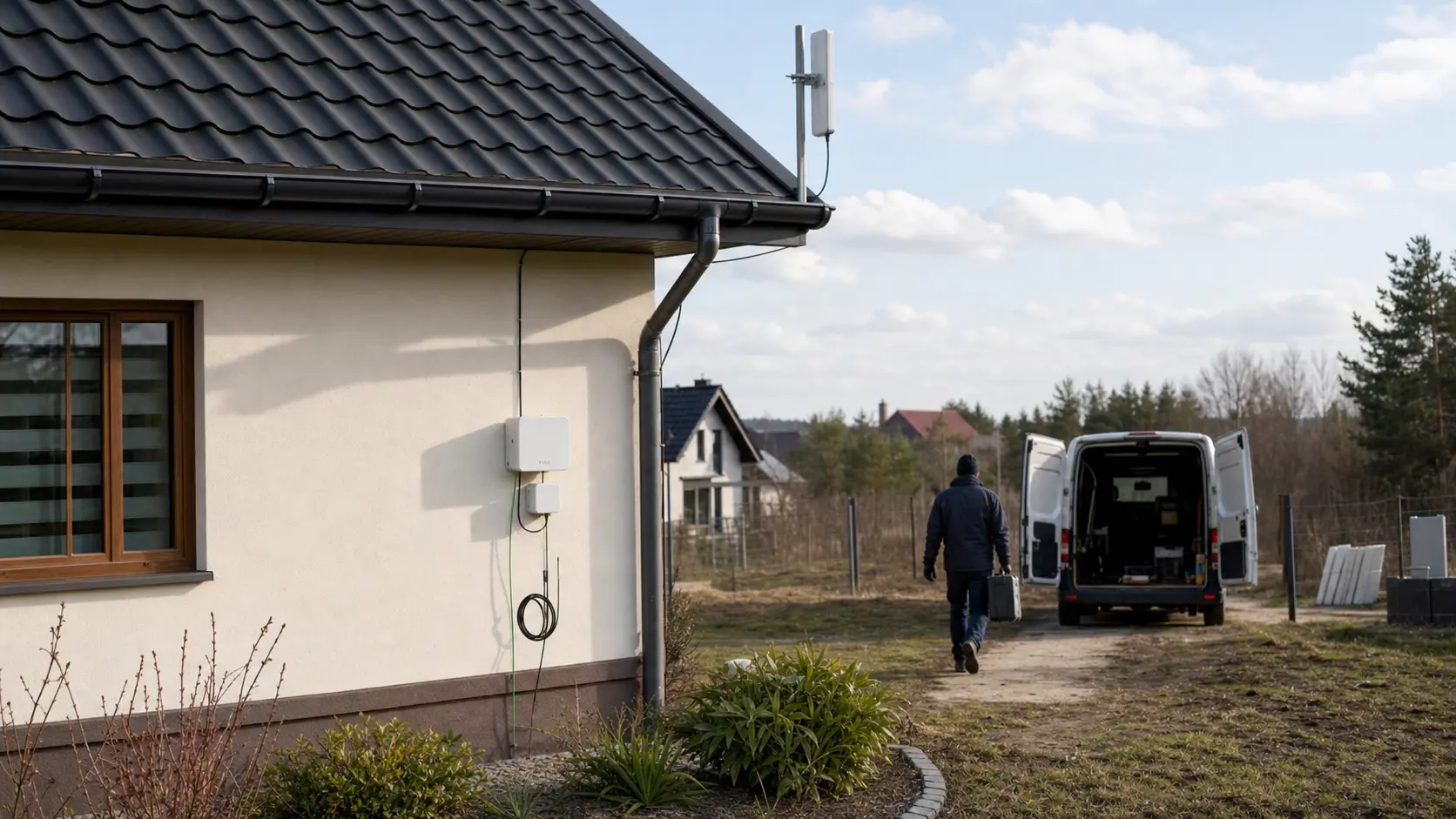
The radio offer is not just a legacy product kept alive until fibre arrives. It is a hedge against Radom-area geography, build cost and address uncertainty. Cyberfox's standard radio access page says wireless distribution can reduce the cost of internet access, claims weather has little practical impact on the data link, and stresses that each order requires a spatial analysis of the access location. That last point is the one to trust most. Fixed wireless depends on line of sight, tower or mast location, interference, roof height, customer-premises equipment, tree growth and the quality of the final indoor Wi-Fi setup. It can be very efficient in one house and uneconomic two roads away.
The old and current public price signals show how MultiFOX uses radio to defend the lower end of the market. The Cyberfox radio pages advertise a 30-day trial from 39 zloty per month, with the subscriber paying the monthly fee and an installation fee tied to the selected package. The radio PLUS page lists 24-month products at 39 zloty for airFOX PLUS 40, 49 zloty for airFOX PLUS 50, 59 zloty for airFOX PLUS 60 and 69 zloty for airFOX PLUS 100. Upload speeds range from 4 Mbps to 10 Mbps, installation is 199 zloty on the lower PLUS plans and 99 zloty on the higher ones, and Wi-Fi rental starts from 5 zloty per month or 9 zloty for Wi-Fi 6 Premium. A tariff aggregator, Dostawcy Internetu, also lists older MultiFOX airFOX products from 8 Mbps to 30 Mbps, with monthly fees from 39 zloty to 109 zloty and availability in places including Zakrzew, Wola Taczowska, Wsola, Jedlinsk, Radom, Wolanow and Wielogora.
The radio price ladder matters because it creates a different account from fibre. A 40 Mbps or 50 Mbps radio customer paying 39 or 49 zloty is not the same economic object as a 600 Mbps fibre customer paying 89 zloty. The radio customer may be cheaper to connect if the site is easy, but may consume more support labour if the antenna alignment, roof access, tree growth or interference changes. The fibre customer may require access to a physical network and a cleaner provisioning process, but once connected the line should be easier to standardise.
MultiFOX's job is to keep those two economics from contaminating each other: do not overpromise radio like fibre, and do not price fibre so low that radio remains the only profitable rural option.
Cyberfox tries to position radio PLUS as "competition for fibre." That phrase should be read carefully. The page says MultiFOX can prepare a radio link or dedicated radio line adjusted to requirements up to 1 Gbit/s, but also says the offer is territorially limited and asks customers to inquire about availability. The useful claim is not that every rural house can get fibre-like radio. It is that MultiFOX wants a high-performance wireless path for addresses where laying or buying fibre is slower, harder or more expensive. In a regional ISP, the radio layer is a portfolio layer.
It turns some otherwise unreachable demand into revenue and creates a fallback when fibre construction or wholesale eligibility is incomplete.
The constraint is spectrum and attention. The UKE register identifies MultiFOX's wireless network activity as unlicensed spectrum. Unlicensed spectrum keeps access costs lower and deployment more flexible, but it also means the operator shares the radio environment with other users. Cyberfox's radio PLUS page openly refers to crowded radio conditions and scarce spectrum. That honesty is economically relevant. The more households and cameras a local operator loads onto fixed wireless, the more careful it has to be about sector capacity, interference and customer expectations.
The customer who buys a 39 zloty radio plan may be profitable only if the link is clean and support visits are rare. The customer who needs repeated roof work can quickly turn a low monthly fee into a weak account.
Installation and support are part of the product
A small ISP's cost base is not only transit and wholesale fees. It is vans, technicians, antennas, routers, calls, failed visits, payment follow-up and the awkward work of explaining why Wi-Fi in the far bedroom is not the same as line speed at the optical terminal. MultiFOX's public offer puts that labour into the product. The fibre and radio pages repeatedly mention comprehensive installation, local service support, router rental and Wi-Fi extension. The pages do not give staffing numbers or service-level guarantees, so the support claim cannot be graded as an outcome.
But they do show that field support is part of the company's commercial positioning.
The router rental line is small but revealing. On fibre, Cyberfox lists Wi-Fi Standard from 5 zloty per month and Wi-Fi 6 Premium from 9 zloty per month. On radio PLUS, Wi-Fi starts from 5 zloty per month and Wi-Fi 6 Premium from 9 zloty. For the customer, this is an easy add-on: a few zloty to avoid buying and configuring equipment. For MultiFOX, it can be a way to standardise home equipment and reduce avoidable support calls, while adding recurring revenue. The downside is that the operator becomes responsible in the customer's mind for the whole home experience, not only the line.
If a cheap router performs badly through thick walls, the brand takes the blame.
The 30-day radio trial has the same economic logic. Cyberfox says a customer can order radio internet for 30 days without obligation, paying the full monthly fee and installation charge for the selected package. That kind of trial can reduce sales friction in locations where the customer cannot know in advance whether the link will work well. It also protects the operator by keeping installation costs visible. A free trial with free installation would invite expensive churn. A paid trial lets MultiFOX test uncertain sites while making sure the customer has some stake in the visit.
Public customer comments on Cyberfox's site and review platforms point in the same direction but should not be overread. The company's own pages include named testimonials praising help, next-day service outside Radom, problem solving with an additional antenna, and fast reaction. GoWork lists the firm under telecommunications with the same address, NIP and REGON, but also states that it does not verify every opinion before publication. These signals are useful because they show what customers and the company talk about: local responsiveness, not just speed.
They are not proof of average repair time, churn, satisfaction or coverage quality.
The support question is central because local labour is both MultiFOX's differentiator and its bottleneck. A national operator may struggle to make a remote call-centre process feel personal. A local operator can send someone who knows the road. But if the support queue grows faster than the subscriber base, the local advantage can collapse. The best evidence to watch would be hard data: missed appointments, repair intervals, complaint rates, churn, equipment swaps and repeat trouble tickets by access type. None of that is public.
The public record supports only a cautious conclusion: MultiFOX is selling local support as part of the access account, and that support claim is economically material.
How the margin survives the mixed network
The margin test starts with the shape of the first bill. On fibre, MultiFOX can advertise zero installation and a 50 zloty activation charge. That makes the offer easy to compare with national operators, but it also means the company has limited room for a costly first visit unless the access process is clean. Router rental then becomes more than a convenience line. A 5 or 9 zloty monthly rental is small for the household, yet over a 24-month term it can recover equipment cost, simplify support and slightly lift account value. The key is standardisation.
If the operator knows which router is in the home, the support call is shorter and the technician has fewer surprises.
Radio shifts the first-bill balance in the opposite direction. Cyberfox's radio PLUS page lists installation fees of 199 zloty on the lower plans and 99 zloty on the higher plans. Those fees look high beside a low monthly tariff, but they are economically understandable. A radio install may require a visit, bracket work, antenna alignment, cable routing, signal testing and a judgement about whether the address is worth serving. If that labour is not recovered at the start, a 39 or 49 zloty monthly plan can become unattractive very quickly. The installation fee also signals that radio is not simply a SIM in a router.
It is a field-engineered access line.
The difficult middle is the 60 to 100 Mbps radio tier. At 59 or 69 zloty, radio PLUS moves close to the 69 zloty 100 Mbps fibre entry price. That can look odd until the geography is considered. If fibre is already available, the household will usually prefer fibre for latency, stability and upgrade headroom. If fibre is absent, a well-built fixed-wireless link at those prices can be the difference between a customer staying with a local provider and buying a national mobile plan. MultiFOX therefore has to price radio high enough to pay for careful installation, but not so high that mobile 5G or Starlink becomes the easier answer.
Wholesale fibre adds another margin shape. A FiberHost-based account avoids much of the capital spending of owned access construction, but the retail provider gives up part of the economics to the network owner. The customer still sees the local brand. That means MultiFOX has to handle sales, billing, router support and first-line service even when the underlying access plant belongs elsewhere. The upside is reach: MultiFOX can sell fibre at addresses that might not justify its own build. The downside is that a wholesale account can be less forgiving if the retail price is forced down by Orange, Play or Vectra promotions.
Owned fibre is the most strategic account when the density is present. It supports symmetric high-speed plans, can carry television and add-on services, and should need fewer radio-style interventions once installed. But owned fibre also ties cash to poles, ducts, drops and repairs. A storm, a cut line or a cluster of low-paying customers on an expensive stretch can hurt a local operator more than a national one. That is why the access mix matters. MultiFOX does not need every address to be served by the same technology. It needs enough addresses to be served by the right technology at the right initial cost.
The practical question is whether the company can keep operational complexity below the extra value created by local choice. Three access modes mean three sets of customer expectations. Fibre customers expect speed and stability. Radio customers need honest explanation of visibility, interference and weather-resistant installation. Wholesale-fibre customers expect local accountability even when another network owns the plant. If MultiFOX prices all three as if they were identical, it loses discipline. If it explains the differences and installs accordingly, the mixed network becomes a defensible Radom-area niche.
AS48119 shows a real but small routing footprint
The network evidence supports the same picture: real, current and small. Public BGP views identify AS48119 as Firma Handlowo-Uslugowa MultiFOX, registered in 2008, active under RIPE, operating in Poland, and originating three visible IPv4 routes: 91.207.126.0/24, 91.207.126.0/23 and 91.207.127.0/24. One BGP route database records valid RPKI on those prefixes, no IPv6 originated, and UNITEL-MEDIA AS58307 as the visible upstream. The embedded RIPE data also records AS3257 and AS58307 in import and export policy. Qrator Radar shows AS58307 as the active neighbour over the recent observed period, while db-ip associates AS48119 with MultiFOX in Poland and places the visible address space around Radom and Zakrzew.
This is strong network-resource evidence for a regional ISP, but it should not be mistaken for service-quality evidence. Active BGP and valid RPKI tell us that MultiFOX has routed internet resources and is visible in the global routing system. They do not tell us how many customers are attached, how much capacity is bought upstream, whether evening congestion occurs, whether radio sectors are oversubscribed, or how quickly faults are repaired. The two-/24 scale of unique IPv4 space implied by the announced /23 and component /24s is consistent with a micro-scale access provider, but it is not a subscriber count.
Customer premises can sit behind private addressing, carrier-grade NAT or dynamic pools. One public IP block can support different customer numbers depending on network design.
The routing footprint also reveals dependencies. A small AS with one visible upstream has less path diversity than a multi-homed regional carrier connected at several exchanges. The RIPE policy mentions GTT AS3257 as well as UNITEL-MEDIA, but current public BGP views emphasize UNITEL-MEDIA. If the live service depends heavily on one upstream path, upstream outage, capacity pricing or routing disputes can matter. If the GTT policy is available but not currently visible in some public views, it may still be a backup or historical entry. The public evidence is not enough to decide that.
It is enough to frame the risk: MultiFOX's access value is local, but its internet reach depends on upstream transit relationships it does not control.
RPKI is a positive detail, not a magic shield. A valid route-origin authorization helps other networks validate that AS48119 is allowed to originate its prefixes. It reduces one class of routing mistake or hijack risk, and it is a sign that the routing objects are maintained. It does not encrypt traffic, guarantee uptime or eliminate all BGP risk. The absence of visible IPv6 is a separate watchpoint. Many small access networks have delayed IPv6 without immediate commercial damage, but over time it can create technical debt for customers, support and peering.
For a regional ISP competing on reliability and modernity, the lack of originated IPv6 is not fatal; it is a marker to revisit.
The competitive set is larger than local fibre
MultiFOX's market is not bounded by other small ISPs around Radom. The household compares a practical monthly bill. Orange's current fibre page advertises 24-month home fibre at 0 zloty for the first six months and then 80 zloty for 600 Mbps, 90 zloty for 1 Gbps, and 100 zloty for 2 Gbps, with average 24-month costs displayed on the page. Orange also offers no-term fibre, with the first month at 0 zloty and then 80 zloty for 300 Mbps, 90 zloty for 600 Mbps and 100 zloty for 1 Gbps. Those offers are national, heavily promoted and easy for a household to understand.
MultiFOX's fibre prices are close enough to compete on the local-service promise, but not so low that price alone would beat a national promotion at every address.
Play is another fixed substitute. Its Radom fibre page tells residents that it offers fibre in selected areas, uses FTTx technology, and sells several speed variants, sometimes bundled with television. The public page is more of an availability funnel than a detailed price table, but that is how national operators compete: they turn a city landing page into an address check and then price into the building. Play's wireless internet page also matters because it markets mobile broadband as a substitute for customers who do not want a long-term fibre contract or cannot get a wired line. It says the service can slow down after the full-speed package, but the customer should not be left offline.
Vectra makes the Radom comparison even more direct. Its Radom internet page says Vectra offers home fibre in the city at 300 Mbps, 600 Mbps and 1 Gbps, with 24-month or no-commitment options. One current 600 Mbps offer shown on the page gives four months at 0 zloty and then 74.99 zloty per month from months five to twenty-three, with a 4.99 zloty modem rental and 9.99 zloty activation. That puts a national cable/fibre operator directly into the same monthly range as MultiFOX's 300 to 600 Mbps fibre tiers. MultiFOX can still win at addresses where Vectra is unavailable, where its local reputation is stronger, or where radio is the pragmatic answer. But in areas with dense national coverage, the price umbrella is thin.
Mobile-home internet is the more disruptive substitute because it competes without a wire. Orange's mobile 5G home page describes a 500-metre home zone, full-speed use inside that zone depending on the plan, a 20 zloty charge to change the zone, and router options including external antennas. Play sells wireless internet with full-speed packages up to 3000 GB and slower access after the package in some variants. T-Mobile's Polish "Po prostu" communication and trade coverage describe unlimited home 5G outside fibre reach at sharply promoted monthly prices, especially for existing customers. These products do not replace a clean fibre line for every household, because radio conditions, cell loading, indoor signal and router placement still matter. But they do replace the sales conversation. A Radom-area household can now ask whether it needs an installer at all.
Starlink is a final outside option. It is not usually the cheapest home broadband substitute in Poland, and its latency and equipment economics are different from local fibre or fixed wireless. But its Polish public site advertises residential home internet from 135 zloty per month with unlimited data. For a hard-to-reach house, that creates a ceiling on frustration. If local fibre is unavailable and terrestrial wireless disappoints, satellite becomes the non-local escape route. MultiFOX does not need to beat Starlink in normal Radom addresses.
It does need to make sure that rural radio and wholesale fibre accounts do not feel so difficult that a household starts viewing 135 zloty satellite as the cleaner option.
What scale can and cannot be inferred
The evidence does not support a confident subscriber or revenue estimate. A sole-trader registration, an active telecom register entry, a customer-facing tariff, a small AS and a few public reviews show a functioning local ISP, not its size. The address space is small. The geography is local. The access mix is practical rather than expansive. That points to a micro-scale or small regional operator, but not to a precise count.
Revenue logic can still be reasoned from the tariff. A 69 zloty 100 Mbps fibre account, with optional 5 or 9 zloty router rental, produces a modest monthly gross bill. A 109 zloty gigabit fibre account produces better revenue but may attract heavier users and higher expectations. A 39 zloty radio PLUS account is cheap enough to fill a coverage gap, but leaves limited room for repeated visits unless the installation fee covers the initial work and the link stays stable. Television and mobile resale can raise account value, but the evidence for MultiFOX remains strongest in fixed access.
The company needs the household to buy more than a bare low-end line where possible, but it also needs a low entry price to stop the national mobile and fibre operators from taking the address before the local brand gets a technician through the door.
The cost base has four visible layers. The first is access construction or wholesale access. Owned fibre requires local build and maintenance; FiberHost fibre requires wholesale terms and coordination. The second is wireless infrastructure: sites, antennas, spectrum management, customer-premises equipment and alignment. The third is internet transit and routing, visible through AS48119's upstream dependencies. The fourth is customer support, including installation, router setup, repairs and billing. In a small ISP, the fourth layer can dominate the customer experience even when it is not the largest cash cost.
Churn risk follows the same layers. A fibre customer may churn because Orange or Vectra offers a promotional price, because a mobile bundle cuts the household bill, or because a repair takes too long. A radio customer may churn because trees, interference or speed expectations make the link feel inferior to mobile 5G. A wholesale fibre customer may churn because the customer does not distinguish between the retail operator and the infrastructure owner when a delay occurs.
MultiFOX's best defence is to make switching feel unnecessary: clear installation, honest access-method selection, usable Wi-Fi, quick fault handling and price points that do not force the customer to shop every promotion cycle.
Regulation and public accountability
The regulatory evidence is stronger than the commercial evidence. UKE's telecom-entrepreneur register is a public accountability point. It lists MultiFOX's entry date in November 2004, legal form as a natural person conducting business activity, Radom address, fibre and unlicensed wireless network activity, and retail fixed internet access. That register does not certify quality, but it places MultiFOX inside Poland's telecom framework. The company is not merely a website selling routers; it is recorded as a telecom operator.
Poland's broader broadband environment raises the standard around MultiFOX. UKE's 2025 market report says fibre reached 80.1% of Polish households, about 13 million homes, by the end of 2025, making fibre the primary fixed-access technology in the country. UKE's 2024 report said 83.6% of households had access to broadband of at least 100 Mbps with a path toward gigabit speed, while also noting that a meaningful minority still lacked fixed retail internet availability.
Those figures matter locally because they compress the space in which a regional ISP can sell "any broadband" and expand the need to sell the right broadband. As fibre coverage grows, radio access must either serve the remaining gaps well or move upmarket into dedicated links and difficult addresses.
The Polish public internet.gov.pl map and SIDUSIS availability data also change customer behaviour. A household can now check declared fixed broadband availability by address. That reduces information asymmetry. It helps customers find alternatives, but it can also help a local ISP prove it is present where national marketing is vague. For MultiFOX, transparent address-level availability cuts two ways: it can generate leads where the company has real coverage and expose weakness where it does not.
Public funding and open access are the second policy layer. POPC and later broadband programmes pushed fibre deeper into towns and rural areas, often through wholesale or open-access arrangements. FiberHost is part of that landscape. MultiFOX's POPC fibre offer is therefore not just a commercial product; it is an example of a local retailer using broader shared infrastructure to reach households it might not build to alone. That arrangement can help small ISPs survive national consolidation, but it also makes them price takers in part of the access chain.
What would make the local promise stronger
The next useful evidence would be operational, not decorative. MultiFOX would become easier to judge if it published or otherwise made visible the share of new connections completed on the first visit, typical repair intervals by access type, the number of addresses passed by owned fibre, and the practical distinction between owned fibre and FiberHost-based fibre. Those metrics would not need to disclose sensitive customer data. They would show whether the local-service promise is measurable.
IPv6 is another marker to watch. The public AS48119 view does not show originated IPv6. A small ISP can operate without visible IPv6 for some time, especially in a household market where customers mostly care that common applications work. But a provider that sells itself as modern fibre and radio access will eventually face more pressure to support native IPv6, cleaner address planning and fewer workarounds around scarce IPv4. Deployment would not transform the business by itself. It would signal that the network layer is being modernised alongside the retail tariff.
The final strengthening point is transparency around radio. Cyberfox already says each radio order needs spatial analysis and that radio PLUS is territorially limited. A clearer public explanation of what makes a good radio address, how trees and roof position affect service, and when the company recommends fibre or mobile instead would improve trust. It could also reduce bad-fit installations. The best fixed-wireless economics usually come from saying no to the wrong address before a technician spends time on a link that will never behave like fibre.
The judgement
MultiFOX's evidence is strongest when the question is narrow: does this Radom-area company sell real fixed access under the Cyberfox brand, with fibre, POPC fibre and radio offers, and does it operate a visible small network? Yes. The public record supports that. The UKE register, Cyberfox tariff pages, FiberHost open-access context and AS48119 routing data all point in the same direction.
The evidence is weaker when the question moves from existence to quality. There is no public subscriber base, audited revenue, complaint rate, average repair time, evening speed sample, radio-sector load data or churn figure. The customer testimonials are positive but selective. Third-party business listings confirm identity but not performance. Routing data proves an internet footprint but not capacity or access reliability. A careful investor, supplier or local buyer should not treat the public pages as proof of service outcomes.
The operating thesis is therefore practical rather than promotional. MultiFOX can matter in Radom county because broadband remains address-specific. Even in a country where fibre reaches most households, the last local choice depends on the road, the pole, the building, the roof and the customer support visit. MultiFOX's advantage is its ability to offer several access methods under one local brand and to price them close enough to national offers that the household can choose local service without feeling overcharged.
Its vulnerability is that each part of that advantage has a cost: fibre construction, wholesale dependency, radio support, router responsibility and upstream concentration.
The most important facts that would change this judgement are concrete. A larger or smaller verified subscriber base would change the scale reading. Evidence of multi-upstream live routing or IPv6 deployment would improve the network-resilience view. Published service-level metrics or complaint data would clarify whether local support is a durable advantage. New FiberHost terms or national wholesale price changes would alter the fibre margin. A stronger mobile 5G offer in the same villages would pressure the radio layer. A public acquisition of nearby access networks would change the footprint.
Until those facts appear, MultiFOX should be read as a micro-regional access operator with credible local evidence, real but limited routing resources, and operating logic that depends on choosing the right access technology for each Radom-area account.