
Summary
- Monta should be judged less by the size of its fulfilment network than by whether webshop orders, stock reservations, warehouse tasks, shipment labels, carrier handoffs and returns stay synchronized when many sales channels and physical sites are active at once.
- The public evidence supports Monta as a substantial Dutch e-commerce fulfilment and WMS operator, but the buyer risk is clear: inventory mismatch, late carrier handoff, connector failure, return-state confusion, warehouse congestion, support ambiguity and the loss of direct warehouse control.
The Accepted Order State Is The Product
Fulfilment companies like to talk about scale because scale is visible. Warehouses can be counted. Square metres can be photographed. Carrier logos can be displayed in a grid. A late cut-off time is simple to understand. So is a promise that thousands of webshops use the service. Monta has public evidence for all of that. Its own site says it works with more than 3,000 webshops, offers more than 35 ready-to-use integrations, connects with more than 50 shipping carriers and operates more than 20 warehouses across the Netherlands, the United Kingdom, Germany and France.
It presents Monta Fulfillment as end-to-end inventory management, shipping and returns, and MontaWMS as the warehouse management system for retailers that want to run their own operation with Monta's software.
That is the outer frame. The inner test is the accepted order state.
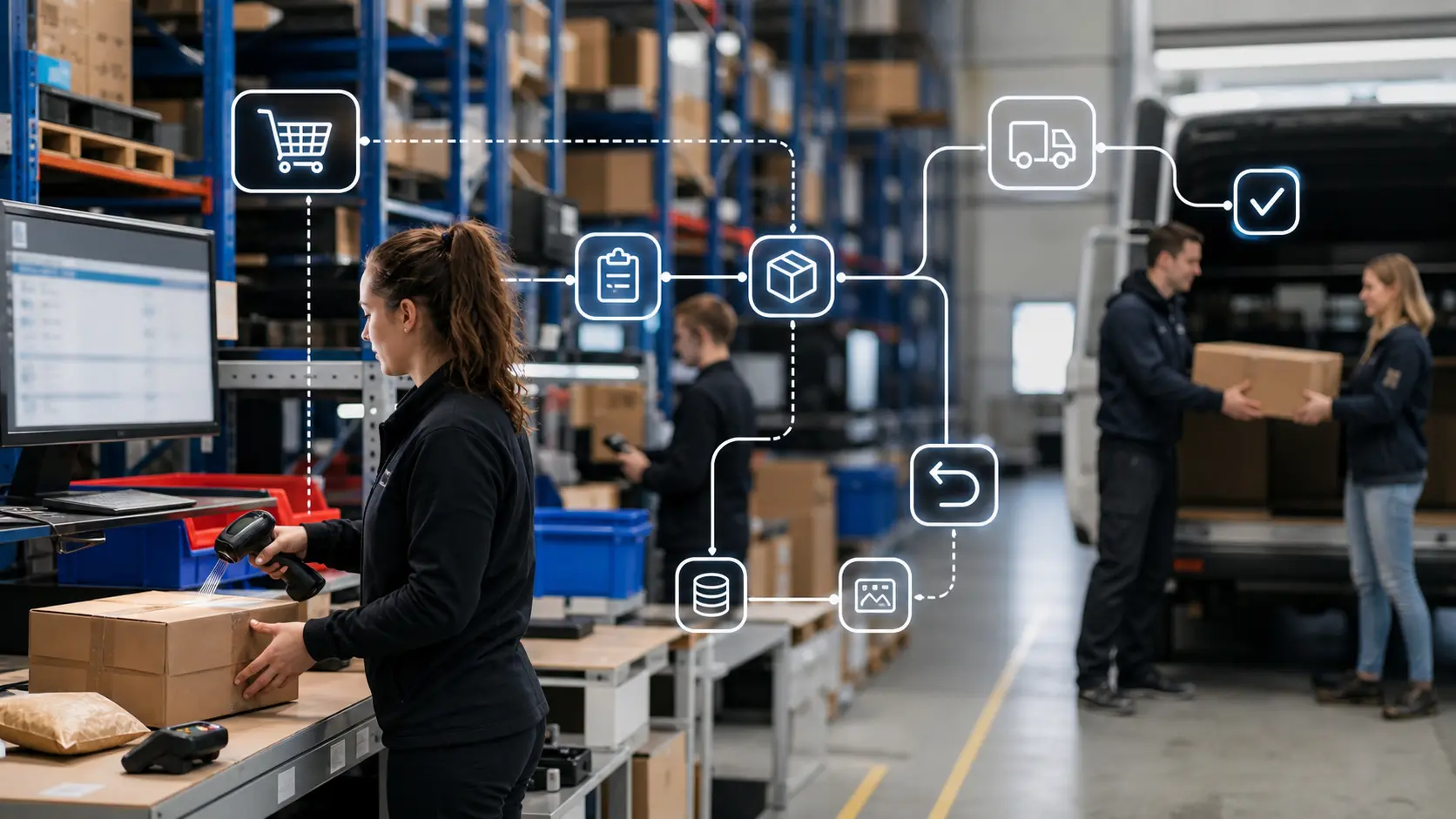
An online order is not valuable because it exists in a webshop. It becomes operationally valuable when the fulfilment system accepts it, validates the address and products, reserves the right stock, exposes any exception, releases a warehouse task, confirms the pick, creates the right packing and shipping work, hands the parcel to a carrier, returns tracking evidence to the merchant and remains intelligible if the customer asks what happened. The same is true in reverse when a return arrives. The platform has to know whether the parcel is expected, received, checked, restocked, quarantined, refunded, exchanged or disputed.
If that state is unclear, the merchant pays in support time, margin leakage and customer trust.
Monta's public materials describe a company built around exactly that crossing point between software state and warehouse action. MontaPortal is described as the fulfilment software included when Monta performs the physical fulfilment. It gives the webshop real-time insight into orders, inventory and returns. MontaWMS is the separate WMS product for merchants operating their own warehouse. The REST API lets clients submit to and retrieve information from Monta's systems, with endpoints for orders, order events, product stock, shipping labels, returns and return forecasts.
The Shopify listing says orders are sent directly to Monta, inventory levels are synchronized and returns can be managed. Returnless says its MontaWMS connection synchronizes return data and can automate follow-up actions such as refund or customer notification.
Those are important facts, but they do not by themselves prove operational control. In this category, the real product is not the portal screen, the integration list or the pick accuracy claim. The real product is the order record that remains accepted, current and actionable as it crosses several systems: the webshop, marketplace, ERP, MontaPortal or MontaWMS, scanner, packing bench, carrier label system, customer-service inbox, returns module and financial workflow. A retailer buying Monta is buying the hope that this record does not fragment.
That is why Monta Services should be tested by the order's state, not by fulfilment scale alone.
The Company Boundary
This article concerns the Dutch e-commerce fulfilment and warehouse software business associated with Monta Services B.V. and the GoMonta/Monta fulfilment and WMS offering. Public company directories and Monta's own locations page place Monta Services B.V. at Weide 30, 4206 CJ Gorinchem, with company number 11045086 and VAT number NL807692700B01. Creditsafe describes Monta Services B.V. as incorporated in 1999 and operating in packing and sorting work.
Company.info, using Dutch chamber data dated June 29, 2026, lists activities tied to packaging companies and land-transport services, and also classifies computer consultancy and other IT services.
That mixture is the point. Monta is not only a warehouse labour provider and not only software. The public proposition is a hybrid operating system for e-commerce logistics. The legal and service boundary is therefore more complex than it first appears. Monta's general terms define "Monta" to cover a group of Dutch legal entities including Monta Holding, Monta Services, Monta Platform, Monta Packaging and several warehouse entities. The same terms make clear that transport and delivery after handover to the carrier, postal service or parcel service are not part of Monta's contractual obligations unless otherwise agreed.
The data-processing appendix says the processing operations concern current fulfilment activities and includes name and address details for addressees.
That matters commercially. A merchant may experience Monta as one brand and one dashboard, but the order's operating surface is split among group entities, software, warehouse sites, carriers, data processors and the merchant's own sales channels. The value proposition is that Monta coordinates this surface better than the merchant can do alone. The risk is that, when an exception happens, the buyer discovers too late where the responsibility line sits.
Monta's recent expansion also affects the boundary. Ecommerce News reported in February 2025 that Monta opened its first warehouse in France and had 19 European locations at that time, while Monta's current site presents more than 20 fulfilment centres. Monta's own Bleskensgraaf announcement describes a new sustainable fulfilment centre with a size-fitting packing machine, an AutoStore system with robotic arm, renewable energy, LED lighting and rainwater reuse. Expansion increases reach and redundancy, but it also raises the state-management test.
More sites mean more local warehouse rules, more cut-off calendars, more carrier relationships, more stock-position decisions and more ways for a multi-site order promise to drift from the truth inside the warehouse.
For a buyer, the identity question is therefore not simply "who is Monta?" It is "which Monta system, which Monta entity, which warehouse, which carrier, which connector and which support path will own this order when it stops behaving like the happy path?"
The Workflow Monta Has To Preserve
The ordinary workflow is easy to state and hard to execute repeatedly. A shopper places an order in Shopify, WooCommerce, Magento, bol, Amazon or another sales channel. The order reaches Monta through a standard connector, marketplace feed, ERP connection, custom integration or the REST API. The system validates the delivery address, checks whether the SKUs are known, assesses whether stock can be reserved, applies fulfilment rules, picks a carrier or delivery option, and decides whether the order can move into warehouse work.
Once accepted, the order becomes a warehouse task. It may be a single-line order, a multi-line order, a preorder, a backorder, an order with batch or expiry constraints, a serial-number product, a hazardous item, a fashion item with size and colour variation, a food or supplement item with shelf-life rules, or an order that depends on the customer's chosen delivery promise.
Monta's WMS pages describe industry features such as RFID integrations, preorders and backorders, RMA, best-before and batch registration, carton functions, high-care processing, batch picking, purchase modules, multi-carrier links, ABC analysis, serial-number registration, dangerous goods and insured shipping. These features are not decorative. They are the reasons an order can be accepted with enough detail to be fulfilled correctly.
The warehouse then has to convert the digital order into a physical sequence. The product has to be found, scanned, checked, moved, packed and labelled. Monta describes barcode scanners, put-to-light, e-checkwall, bulk sorting, size-specific packaging, packing machines, AutoStore and robotic arms across its public pages. Those systems can reduce walking time and picking errors, but they also make order state dependent on correct configuration. If the WMS releases the wrong task, the automation will not save the order. It may simply execute the wrong instruction faster.
The next state change is carrier handoff. Monta's carrier integration page lists Asendia, Budbee, Deutsche Post, DHL, DPD, Dynalogic, FedEx, GLS, PostNL, Trunkrs, UPS and Dragonfly as carrier options. The public site also says Monta connects to more than 50 European carriers. Carrier choice is commercially important because checkout conversion, delivery speed, cost, local trust and return convenience differ by country and parcel type. But carrier choice is also a dependency. After handoff, the buyer needs tracking evidence and exception status, while the carrier controls much of the final delivery experience.
The final state may be delivery, return, exception, investigation or customer-service intervention. MontaPortal advertises real-time views across orders and stock, order-status visibility, relevant data, and the ability to start a postal investigation from the dashboard. Partner pages show why that matters. NexReply's Monta integration pitch says customer-service agents otherwise switch among inbox, webshop, fulfilment system and shipping tools to answer one simple question about delivery, tracking, inventory or backorders. That is the hidden cost of weak state management. Every unclear order becomes a support search.
This workflow is the basis of Monta's value. The question is whether the state remains coherent through repetition, exceptions, seasonal peaks and channel changes.
Inventory Truth Comes First
The accepted order state begins before the order. It begins with inventory truth.
If stock is wrong, every later workflow is compromised. A webshop can sell an item that is not available. A warehouse can reserve stock that belongs to another order. A customer-service agent can promise a replacement that cannot be shipped. A returns team can restock an item that should have been quarantined. Finance can issue a refund before the product has been inspected. The merchant can reorder late or overbuy because available stock, reserved stock and sellable stock are being read differently by different systems.
Monta's public materials correctly put inventory near the centre of the offering. The homepage says Monta Fulfillment covers inventory management, shipping and returns. The stock-management page frames stock as a core part of e-commerce fulfilment. MontaPortal is described as giving control over inventory, orders and returns after a merchant outsources fulfilment. The reporting page says MontaPortal reports cover stock management, inbound and outbound information, order history, dynamic forecasting, track-and-trace codes, minimum stock alerts and return logistics information.
The API includes product stock and stock mutation endpoints, and an endpoint for retrieving stock for a product by SKU.
The practical issue is not whether the screens exist. It is whether the stock concepts are aligned. A serious deployment needs at least these distinctions: physically present stock, sellable stock, reserved stock, blocked stock, quarantined stock, in-transit stock, returned but unchecked stock, damaged stock, batch-limited stock, expiry-limited stock and stock reserved for marketplace or B2B promises. Monta's API example for batches exposes stock fields such as all stock, quarantine, blocked, in transit, reserved and available. That is a good signal because it shows the model has more than one stock number.
It also shows why integration quality matters. If a merchant's webshop only consumes one simplified field, or updates too slowly, the warehouse's truth can become more precise than the merchant's selling truth.
Inventory truth is especially hard in a multi-channel environment. Monta advertises integrations with Shopify, WooCommerce, Magento, Amazon, bol, Blokker, Decathlon, Fonq, ChannelEngine, Channable, EffectConnect, AFAS and Exact Online. The more channels connected, the more important reservation timing becomes. Which channel wins the last unit? How quickly is a stock mutation pushed back? What happens if a marketplace order is cancelled after the pick begins? Does the merchant see a difference between "not yet picked," "reserved," "being verified," "already being picked" and "shipped"?
The API's invalid-reason examples are revealing because they include cases such as unknown SKU, invalid quantity, an order already being picked, an order that cannot be cancelled or edited, a shipped order that needs to be set to not-shipped before changes, and stock reservation that cannot be removed once an order is enqueued.
Those are not edge curiosities. They are the operational line between software convenience and warehouse reality. Once a picker has a task, once a parcel has a label, or once stock is committed to another process, the system must stop pretending the order is freely editable. Monta's value depends on making that boundary visible to the merchant before the customer's promise becomes impossible to honour.
Acceptance Is The Point Of No Easy Undo
The most important moment in Monta's workflow is not delivery. It is acceptance. Acceptance is when the order becomes warehouse work.
Before acceptance, a merchant can often change the address, cancel a line, correct a SKU, apply fraud checks, adjust shipping method or hold the order for payment. After acceptance, the order is part of a physical queue. Someone or something may already be moving toward the product. Stock may already be reserved. A shipping label may have been created. A cut-off clock may be running. Packing material may be selected. If a change arrives late, the warehouse has to decide whether to stop, split, block, rework or let the order continue.
Monta's REST documentation helps expose this boundary. It includes endpoints to create a new order, fetch order information, update an order, delete an order, fetch order events, retrieve colli, shipping labels, batches, return labels, RMA links and expected processing timeframes, and split an order. It also uses standard HTTP status logic and provides error responses for cases where the requested action is no longer valid.
The rate limits are generous enough for ordinary integration traffic, but the existence of a rate limit also reminds buyers that event polling, bulk updates and near-real-time synchronization have to be designed rather than assumed.
The accepted order state is therefore a contract between the merchant and the warehouse. The merchant is saying: this order is ready to become physical work. Monta is saying: the order has passed enough checks to enter our operation. That contract can be broken by bad data on either side. The merchant may send a malformed address, unknown SKU, invalid quantity, inconsistent invoice data or a late cancellation. Monta may fail to expose a state change quickly enough, or a connector may misread the order's position. The carrier may reject an address or service. The warehouse may hit congestion.
The customer's selected delivery option may no longer be available.
This is why the buyer's technical due diligence should focus on state transitions, not feature names. What are all possible order states? Which states allow edits? Which states allow cancellation? What exactly happens when an order is already being picked? How does the system represent a partial shipment? How does it represent backorder and preorder lines? How does it expose split orders? How long does it take for an event to return to the webshop? What happens if the webshop connector fails after Monta accepts the order? Can customer support see the same state as warehouse operations?
Can a merchant prove when Monta accepted the order and when the carrier took over?
If those answers are clear, Monta can reduce operational ambiguity. If they are not clear, Monta may simply move ambiguity from the merchant's warehouse to a vendor portal.
Warehouse Discipline Is Still Human Work
Monta's public pages rightly emphasize automation: barcode scanners, put-to-light, e-checkwall, robotic storage, packing machines, dashboards, APIs, custom integrations and cloud-based software. The Bleskensgraaf announcement describes an AutoStore system with robotic arm that processes orders around the clock and a packing machine that reduces empty box space. The homepage says MontaWMS can process orders up to five times faster and reduce costs by up to EUR 2 per order. The WMS pages also claim 99.98 percent picking accuracy and present more than 100 dedicated developers.
A buyer should read those claims as a hypothesis to test, not as a substitute for process diligence. Warehouse automation performs best when product data, storage location, barcode quality, replenishment, pick routes, exception handling and labour supervision are disciplined. A barcode scanner can prevent many errors, but it cannot make a wrong barcode right. Put-to-light can speed sorting, but it depends on the order and tote logic. A packing machine can reduce air in boxes, but it depends on product dimensions and packaging rules.
A robotic storage system can move goods quickly, but it depends on slotting, replenishment, maintenance and correct integration with the order queue.
Order picking is one of the most labour-intensive and costly parts of fulfilment. Academic and logistics literature repeatedly treats picking, batch construction, route choice and returned-product restocking as central efficiency problems. That context is useful because it keeps Monta's claims grounded. The value of MontaWMS is not that software replaces the warehouse. It is that software gives the warehouse repeatable instructions, reduces avoidable walking and checking, and captures evidence when work is done.
The labour question is therefore not whether Monta automates. It is how much supervision is still required. A merchant that outsources fulfilment is not outsourcing commercial responsibility. It still owns the promise to the customer. It still has to define product master data, packaging preferences, return rules, carrier choices, service exceptions and support escalation. Monta can run the floor, but the merchant has to keep the product and promise data clean. In a MontaWMS deployment inside the merchant's own warehouse, the labour burden is even more explicit.
The merchant receives the software and hardware logic but must still staff, train, supervise and improve the operation.
There is also a local-support dimension. Monta presents itself as personal and flexible, with a fixed contact person in quote flows and dedicated support as part of its customer approach. That may be a strength against large global fulfilment platforms, especially for Dutch and European webshops that need practical help rather than only a self-service console. But local support does not remove the need for measurable service.
A buyer should ask how support tickets are triaged during peak season, how warehouse exceptions are escalated, whether technical connector issues and floor issues share one support path, and whether Monta's local flexibility is still available when the merchant expands across multiple countries.
The accepted order state is made by systems, but it is maintained by people. That is true even in a highly automated warehouse.
Carrier Handoff Is A Commercial And Legal Boundary
Carrier choice is one of Monta's strongest commercial claims. More carriers mean more delivery options, more local trust, more fallback paths and potentially better rates. Monta's public pages emphasize multi-carrier links, checkout choice, evening or next-day options, international shipping and local carriers for cross-border growth. The French expansion article specifically describes the use of French carriers such as Colis Prive and Colissimo to serve orders in France faster and with local trust.
Bol's partner page says Monta supports storage, order processing, shipping and return handling, and that every step can be followed in the process.
The handoff to a carrier is also where Monta's responsibility becomes more limited. Monta's general terms state that transport and delivery to the customer are not part of Monta's contractual obligations and that Monta is not responsible for things that go wrong after handover to the carrier, postal service or parcel service. That is a normal kind of boundary in logistics, but it matters because the shopper rarely sees that boundary. The shopper sees the merchant. The merchant sees Monta's dashboard and the carrier's tracking. The carrier sees a parcel moving through its own network.
This creates a commercial test. Does faster fulfilment and lower operational complexity outweigh the loss of direct warehouse and carrier control? For many webshops the answer may be yes. Monta's volume, integrations and carrier network can offer late cut-offs and shipping options that a smaller merchant could not easily negotiate alone. But the merchant's risk changes shape. A late carrier scan may look like a Monta problem to the customer. A damaged parcel may involve packing evidence, carrier liability and customer-service judgement. A missing tracking update may require a postal investigation.
A service failure may be outside Monta's obligation but still inside the merchant's brand damage.
MontaPortal's ability to expose tracking, order status and investigation workflows is therefore not a convenience feature. It is the merchant's evidence layer. The buyer should test whether the evidence is detailed enough. When was the label created? When did the parcel leave the warehouse? Which carrier service was selected and why? Was the parcel handed over before cut-off? Did tracking fail before or after handoff? Can the merchant export the record? Can support staff see it without asking the warehouse? If a carrier is changed at checkout or fulfilment time, is that visible to the customer and the merchant?
Carrier integration is valuable only if the order state can survive the handoff. The legal boundary may sit at transfer to the carrier. The customer experience boundary does not.
Returns Are Not The End Of The Order
Returns are often treated as a postscript to fulfilment, but in e-commerce they are a second order. They have their own intake, authorization, label, transport, receipt, inspection, disposition, stock update, refund and customer communication. A return can create as much state confusion as the original shipment, especially in fashion, electronics, cosmetics, food, supplements and other categories where size, serial number, batch, safety or resale condition matter.
Monta's public materials include returns throughout the proposition. The homepage frames fulfilment as inventory management, shipping and returns. MontaPortal says it gives control over stock, orders and returns, with a return module. The WMS industry pages mention RMA for fashion and other vertical controls for batch, expiry and serial number. The API exposes return endpoints, return forecasts, return labels, return label changes, return reasons and return status updates.
Returnless describes an integration through which returns are automatically registered, return data is continuously synchronized, and return status can trigger follow-up actions such as refunds or customer notifications.
That is the right shape for a modern fulfilment system. The risk is that a return can be misread at every step. A customer may return the wrong item. A label may be generated but not used. A parcel may arrive without a clear authorization. The warehouse may receive it but not inspect it quickly. An item may be restockable, damaged, incomplete, expired, counterfeit, missing packaging or tied to a serial-number dispute. A refund may be due only after inspection, but the customer may expect immediate confirmation. Stock may appear available before the item is actually sellable.
A customer-service tool may see the return as in progress while finance sees the refund as blocked.
The accepted return state has to be as explicit as the accepted order state. "Returned" is not enough. The system needs expected, in transit, received, inspected, approved, rejected, restocked, quarantined, refunded, exchanged, repaired, destroyed or escalated states, depending on product category and merchant policy. Monta's public API suggests that return state is part of the digital model, but the buyer has to determine how much of that state is exposed to its own systems, customer-service team and finance workflow.
Returns also change unit economics. A fulfilment partner can reduce warehouse burden, but return handling can still consume margin through inbound handling fees, inspection time, repackaging, loss of resale value, customer-service contact and refund timing. The more a merchant relies on high conversion through easy returns, the more it needs evidence that the returns process is not quietly eroding the gain from faster outbound fulfilment.
Monta's value in returns is therefore not merely label generation. It is the ability to preserve product truth after the customer sends the item back.
Cloud And Connector Dependence
Monta is a cloud-service dependency for the merchant even when it is also a physical fulfilment provider. MontaPortal, MontaWMS, the REST API, webshop connectors, marketplace connections and carrier integrations all sit in the path between sale and shipment. That dependency is attractive because it reduces the merchant's need to build warehouse software and carrier links. It is risky because a connector failure can become an operational failure.
The REST API documentation is unusually useful because it exposes how merchants are expected to integrate. Clients can submit and retrieve information. Authentication uses username and password through HTTP basic authentication, created in MontaPortal. IP whitelisting can be configured per user account. JSON is used for requests and responses. The API uses normal REST methods and status codes including too many requests. The published rate limits are 4,500 requests every five minutes, 27,000 an hour and 270,000 a day, with a specific tighter bucket for one product update endpoint.
Those details are practical. They show that a merchant can build direct integration rather than relying only on a plug-in. They also show several diligence questions. How are API credentials rotated? Is basic authentication enough for the merchant's security policy? Are IP allowlists used or left open? Is event polling efficient enough? Can order events be consumed incrementally? What happens when a connector exceeds limits? How quickly do product stock changes propagate? Does the merchant rely on Monta as the system of record, or does it keep an independent order and inventory ledger?
The Shopify app listing gives the simple version of this model: orders go directly to Monta, are picked, packed and shipped through carrier networks, inventory levels are automatically synchronized and returns can be managed. That is what merchants want. The operational question is what happens when the simple version fails. A Shopify webhook may be delayed. A marketplace may retry an order. A custom integration may send a duplicate identifier. An ERP may update a SKU after the warehouse has already received goods. A product may be changed in the webshop but not in Monta. A customer-service automation tool may answer using stale order data.
Monta's PeeringDB entry and public network footprint are not proof of service resilience, but they are useful reminders that this company has an internet-facing operational layer in addition to warehouses. The buyer should treat Monta as part of its production stack. That means monitoring integration health, testing outage behavior, documenting fallback steps, and deciding what customer promise is allowed when MontaPortal, an API, a connector, a marketplace feed or a carrier endpoint is impaired.
Cloud software turns warehouse state into a shared operating record. It also means fulfilment depends on authentication, rate limits, network reachability, data contracts and vendor support.
Control Is The Price Of Outsourcing
Monta's commercial pitch is that merchants can focus on growth while Monta handles operational complexity. That is credible as far as it goes. A fast-growing webshop may not want to lease warehouse space, hire pickers, negotiate carrier contracts, choose scanners, configure WMS logic, manage returns benches, staff evening operations or build integrations. Monta can turn those fixed and managerial burdens into a service relationship. For a merchant with volatile demand, cross-border ambitions or limited logistics expertise, that can be rational.
The price is control.
In-house fulfilment gives a merchant direct authority over staffing, layout, packing rules, exception priority, carrier handoff and last-minute judgement. Outsourced fulfilment replaces direct authority with service design, contract rights, system visibility and escalation paths. MontaPortal and MontaWMS are meant to preserve control through data. Monta's Bol partner page says entrepreneurs can professionalize logistics without losing control, and that the dashboard gives insights and advice without many extra licences. The phrase is important because loss of control is the buyer's obvious fear.
The buyer should not accept "without losing control" as a slogan. It should define what control means. Can the merchant stop an order after acceptance? Can it change carrier selection? Can it prioritize a VIP customer? Can it choose packaging at SKU level? Can it see warehouse congestion before a promise is missed? Can it export data if it leaves Monta? Can it audit a pick error? Can it require photo evidence for certain returns? Can it retrieve stock at contract end without disrupting Monta's operation?
Monta's general terms say that, after termination, items must be retrieved from Monta's premises by the end of the notice period and the timing and method must be mutually agreed so retrieval does not disrupt Monta's business. That is reasonable, but it is also a switching-cost warning.
The same applies to software. Monta's terms restrict copying, reverse engineering and unauthorized modification of its software. Customers must use the latest available version unless Monta says otherwise and report errors quickly. For a MontaWMS customer running its own warehouse, that means control is shared: the customer controls the physical floor, but Monta controls the software rights, update model and maintenance boundary. That may be acceptable. It should not be invisible.
Monta's proposition is strongest when a merchant wants operational discipline more than bespoke control. It is weaker when the merchant's warehouse process is a source of brand differentiation, product expertise or highly customized exception handling that cannot be represented cleanly in Monta's systems.
Unit Economics Depend On Exception Rate
The commercial question is whether faster fulfilment and lower complexity beat integration cost, margin leakage, service exceptions, carrier dependence and loss of direct warehouse control. The answer depends less on average orders than on exception rate.
The happy path is attractive. Monta's public claims include cut-off times up to 23:59, next-day possibilities, carrier options, stock insight, returns handling, picking accuracy, faster processing and lower per-order cost. A merchant with reliable product data, standardized packaging, stable demand, ordinary returns and common carriers may be able to convert those advantages into lower management burden and better customer experience. The more Monta can pool warehouse scale, shipping volume and software development across many webshops, the harder it is for a small merchant to replicate the same capability alone.
Exceptions eat that value. A wrong SKU, missing barcode, damaged inbound shipment, mismatched stock count, late marketplace cancellation, address validation failure, returned item without authorization, carrier outage, customer-service ambiguity or connector issue can turn one order into several support contacts. The direct cost may be small, but the total cost includes manual investigation, customer compensation, lost repeat purchase, refund timing, warehouse rework, carrier claim and management attention.
This is why Monta's reported metrics should be matched to the merchant's own economics. A picking accuracy claim is useful, but the buyer needs to know the denominator, product mix and remedy. A late cut-off is useful, but the buyer needs to know how many orders actually make carrier handoff before the promised time. A carrier network is useful, but the buyer needs to know delivery performance by country and service. A return module is useful, but the buyer needs to know how quickly returns are inspected and how accurately return status feeds finance and customer support.
A cost saving per order is useful, but the buyer needs to compare it with onboarding, integration, storage, special handling, returns, support, postal investigations and switching cost.
Monta's scale can improve unit economics by spreading software, hardware, carrier and warehouse investment across many clients. But the merchant's economics remain specific. A simple cosmetics brand, a high-SKU fashion seller, a food supplement seller with expiry rules, a refurbished electronics merchant with serial-number disputes and a B2B seller with store replenishment are not buying the same operational risk. MontaWMS's industry features show that Monta understands these differences. The buyer still has to test its own exception mix.
In fulfilment, the average order pays the bill. The exception order decides whether the service is trusted.
Market Evidence And Substitutes
The public market evidence supports Monta as a meaningful European fulfilment and WMS company, not a thin brochure operation. Monta's own pages show a broad fulfilment and WMS proposition, customer logos, a European warehouse network, a dedicated software layer and multiple integrations. The Bol partner platform lists Monta as certified and describes the seven-step process of connecting a webshop, receiving items, storing items, processing orders, shipping orders, processing returns and following every step. The Shopify app page describes a direct order, inventory and returns workflow.
Kaufland's e-Commerce Day exhibitor page says Monta handles fulfilment for more than 1,800 webshops and operates decentralized warehouses with a strong IT focus. Ecommerce News independently places Monta's origin in 1999 and describes its expansion beyond the Netherlands.
The count varies across sources because Monta is growing and different pages were written at different times. Some public pages say nearly 2,000 or more than 1,800 webshops; Monta's current homepage says more than 3,000. Some pages refer to 19 locations in early 2025; Monta's current site says more than 20 warehouses. That variance is not a major contradiction, but it is a reminder to avoid false precision. The safer conclusion is that Monta is a substantial, expanding European fulfilment and WMS operator with a strong Dutch base.
Competitors and substitutes fall into several groups. A merchant can keep fulfilment in-house and buy a different WMS. It can use another third-party logistics provider with its own portal. It can use marketplace fulfilment, such as platform-controlled logistics from a major marketplace. It can use a global logistics integrator, a parcel carrier's fulfilment service, a local warehouse partner, a specialist returns provider, or a hybrid model where high-value or complex products remain in-house while standard lines go to a 3PL.
It can also use separate tools for order management, carrier management, customer-service automation and returns rather than a bundled fulfilment partner.
Monta's differentiation appears to be the bundle: physical fulfilment plus MontaPortal for outsourced clients, MontaWMS for own-warehouse clients, carrier integrations, returns, checkout options, custom integration and local European fulfilment presence. The risk of a bundle is dependency. The benefit of a bundle is fewer seams for a small or mid-sized merchant to manage.
The buyer's substitute analysis should therefore ask what capability it is really buying. If the need is mainly low-cost storage, Monta may be more software-rich than necessary. If the need is a sophisticated WMS for a merchant-owned warehouse, MontaWMS competes with specialist WMS products and warehouse automation stacks. If the need is international carrier access, a shipping platform or TMS may be enough. If the need is full operational relief, Monta's combined fulfilment and portal model is more relevant.
Monta is most compelling when the buyer wants one operating partner for the whole e-commerce logistics loop and is willing to accept shared control in exchange for speed, visibility and reduced management burden.
Failure Modes To Watch
The first failure mode is inventory mismatch. If product master data, SKU aliases, barcode data, incoming goods, returns and stock reservations are not synchronized, Monta can pick accurately from a wrong premise. Buyers should test last-unit sale, returned-stock release, batch-limited products, stock mutation feeds and marketplace cancellation timing.
The second failure mode is missed pick or late release. Cut-off promises are only valuable if orders enter the warehouse queue early enough, are not blocked by validation errors, and make it to carrier handoff. Buyers should test the path from order creation through acceptance, pick start, pack completion, label creation and carrier scan.
The third failure mode is carrier handoff ambiguity. Monta can integrate with many carriers, but carrier performance sits outside Monta's full control after handover. Buyers should test tracking latency, failed pickup, damaged parcel, lost parcel, customs or cross-border delay, and postal investigation workflows.
The fourth failure mode is return-state confusion. Returns need clear expected, received, inspected, restocked, quarantined and refunded states. Buyers should test wrong-item returns, partial returns, late returns, damaged returns, exchange requests and return label changes.
The fifth failure mode is connector failure. A webshop plug-in, marketplace feed, ERP link, custom API job or customer-service integration can quietly become the weak link. Buyers should monitor API errors, duplicate order IDs, webhook delays, stock update latency, failed credential rotation and rate-limit behaviour.
The sixth failure mode is warehouse congestion. Expansion and automation do not remove peak-season stress. Buyers should ask how Monta exposes congestion, how it prioritizes orders, whether extra handling rules slow specific product categories, and what service evidence is available after a missed promise.
The seventh failure mode is customer-support ambiguity. If support agents cannot see the same live order, stock, shipment and return state as the warehouse, every exception becomes manual work. Integrations like NexReply exist because customer service still needs direct fulfilment data.
The eighth failure mode is ownership transition risk. Leaving Monta may require retrieving stock, changing connectors, exporting data, migrating carrier rules and rebuilding warehouse processes. The switching path should be planned before the first order is sent.
What A Serious Buyer Should Test
A serious buyer should run a practical order-state exercise before committing critical volume. The test should begin with a normal order from the main webshop, then follow the record through Monta acceptance, stock reservation, pick, pack, label, carrier handoff, tracking return and customer-service visibility. The buyer should verify that each state is visible where it needs to be visible: webshop, merchant operations, customer service, finance and the customer notification layer.
Then the buyer should make the test harder. Submit an order with an unknown SKU. Submit a duplicate order ID. Cancel an order after acceptance. Change an address after the pick begins. Sell the last unit across two channels. Send a partial shipment. Trigger a backorder. Use a product with serial-number or batch requirements. Ask for a carrier service that is unavailable for the destination. Generate a return label, return the wrong item, receive a damaged item and test whether stock stays blocked until inspection.
The buyer should also test support. Open a ticket for a stuck order. Ask when the order was accepted. Ask why it was not editable. Ask where the parcel was when responsibility moved to the carrier. Ask which stock field is sent back to the webshop. Ask whether the customer-service team can see the return inspection result without asking the warehouse. Ask for an export of order events and return events.
For a MontaWMS deployment in the buyer's own warehouse, the test should include different pick methods, scanner failure, bad barcode, replenishment, cycle count, packaging exception, worker permission, shift handover, returns bench and reporting. The buyer should know what Monta supports, what the customer must configure and what happens when the latest software version changes behaviour.
Finally, the buyer should test economics. Compare Monta's quoted order, storage, returns and special-handling costs with current warehouse labour, carrier rates, software licences, management time, support contacts, error costs and customer compensation. The right comparison is not warehouse rent versus fulfilment fee. It is total cost per accepted and correctly completed order, including exceptions.
The Judgment
Monta Services looks strongest as a practical European e-commerce logistics operating layer: enough warehouses to serve cross-border growth, enough software to expose order and stock state, enough integrations to connect common sales channels and carriers, and enough category-specific WMS functions to handle more than the simplest parcels. Public evidence supports the existence of a serious hybrid company combining fulfilment, WMS, portal, API, carrier and returns capabilities.
The weakness is not that Monta lacks a story. The weakness is that the story can be too easy. "We handle the complexity" is only true if the complexity is represented accurately in the accepted order state. Inventory truth, edit cut-offs, pick status, carrier handoff, return disposition, customer-service evidence and support ownership decide whether the merchant has gained control or merely moved control into a vendor's system.
For many growing webshops, that trade may be worthwhile. Faster fulfilment, late cut-offs, multi-carrier options, returns handling and reduced operational hiring can be more valuable than direct warehouse control. But the trade should be made with eyes open. Monta is not simply a parcel machine. It becomes part of the merchant's production stack, customer promise and margin model.
The right question is therefore not whether Monta can ship packages at scale. It is whether Monta can keep the order, stock, warehouse-task, carrier and return record consistent across many webshops and physical sites when the order stops being simple. If it can, Monta is a control system for e-commerce growth. If it cannot, scale only makes the confusion travel faster.