
Summary
- Kalasznet Kabel TV Kft has a real operating footprint, but the public evidence points to a fixed-access and cable-TV economics problem rather than a high-growth network platform: the company site sells household internet, television and voice, while RIPE and BGP records show AS44651 originating a small IPv4-only footprint with Magyar Telekom routing dependence.
- The core judgment turns on utilisation quality. More homes passed, towns listed, channels carried or prefixes routed only matter if they become durable paid load at prices that absorb field service, content, customer support and renewal costs without sacrificing margin through retention discounts.
- The strongest positive evidence is parent-group backing, visible product pricing, active service-area documents, and parent-level fixed broadband revenue growth. The biggest negative evidence is the small public AS footprint, no visible IPv6 origination, limited independent peering disclosure, a maturing HFC market in Hungary, and a legal/operating boundary that now requires close reading of VGreen and ViDaNet-related service documents.
Utilisation Is The Economic Incentive
The incentive begins with a simple rule of fixed networks: once the street has been built, the cable has been hung or buried, the cabinet has been powered, the headend and backhaul have been arranged, and the customer support operation has been staffed, empty capacity is expensive. A regional cable and broadband operator cannot treat utilisation as a cosmetic metric. It is the mechanism by which fixed costs become bearable. Each paying household that takes internet, television, voice or a bundle spreads the same access plant over more revenue.
Each household that downgrades, churns, suspends service, uses a low-margin introductory offer or keeps only the cheapest access tier leaves more of that cost base sitting on the remaining customers.
That is why Kalasznet Kabel TV Kft should be read through the difference between reported activity and value-creating load. The public materials show activity: a current website, service-area pages, tariff pages, customer-service channels, changes to television terms, a fixed internet price ladder, a cable-TV package ladder, and public routing records for AS44651. But activity is not the same thing as economic proof. A service area can be wide while take-up is thin. A network can route prefixes while carrying modest customer traffic. A television package can look broad while content costs and customer retention offers absorb the upside.
A parent group can invest in fixed networks while expecting each local brand to fit a larger portfolio discipline.
The article therefore starts with utilisation rather than identity. The question is not whether Kalasznet has evidence of existence as a telecom operator. It does. The question is whether the operating surface can stay full enough, and priced well enough, to turn local infrastructure into margin. That answer is not available in a single public subscriber table for Kalasznet. It has to be inferred from service offers, territory, public network records, parent-company disclosures, regulator market reports and the terms under which customers are served.
That inference is cautious. Kalasznet sells products that can carry recurring revenue. It sits in a parent-group orbit with Magyar Telekom, giving it access to purchasing, routing, support and capital discipline that a pure independent cable company would struggle to replicate. It also faces the classic squeeze of a regional fixed operator: competition from fibre, mobile broadband substitution for some households, larger bundles from national brands, content-provider changes in television, inflation-linked fee adjustments, and the capital burden of moving customers from legacy coaxial economics into higher-capacity access.
The utilisation test is therefore not whether every technical asset is active. It is whether those assets are loaded with the right paying units. A 700 Mbit/s product sold only where capacity exists may be useful for defending the high end, but it only creates value if customers pay enough above the cost of upgrade and support. A low entry tier may protect universal-service obligations or price-sensitive households, but it will not carry much renewal burden by itself. A combined internet, television and phone offer may reduce churn, but if the discount needed to hold the bundle is too high, the bundle hides the weakness rather than fixing it.
The Boundary Is A Cable And Fixed Broadband Operator, Not Just A Name In A Registry
Kalasznet's public boundary has several layers. The public website presents KalászNet as a provider of television, internet and voice services, and describes KalászNet Kft as part of the Magyar Telekom group. Its home page says the predecessor had more than ten years in the cable television service market and that Magyar Telekom acquired the company in 2011, becoming its 100% owner. That matters because it changes the reading of strategy. Kalasznet is not best viewed as an isolated local cable company trying to build national scale alone.
It is a local fixed-access brand and operating footprint inside a much larger Hungarian telecom group.
The current site also shows a second boundary question. An October 31, 2025 introductory notice says that from November 1, 2025 the company took over the full operation of VGreen Kft, which had separated from ViDaNet Zrt, and that the change affected former ViDaNet customers and the full network in Győr, Kaposvár, Pécs, Keszü and Gyód. The same notice states that subscriber contracts, home internet speeds, television channel allocations and subscription fees did not change.
Current general terms on the KalászNet site are headed for VGreen Kft, not simply Kalasznet Kabel TV Kft, and identify VGreen as the service provider in the formal subscriber terms.
That is not a minor footnote. It means the economic footprint seen by customers and the legal entity named in historic RIPE records are not perfectly identical in the public materials. The brand, the group address, the RIPE organisation record, the AS44651 records and the VGreen subscriber terms need to be read together. For an investor or supplier, this is a reminder to avoid over-interpreting a single source. The RIPE organisation object still names Kalasznet Kabel TV Kft as a local internet registry, with country HU, company registration number 01-09-997095 and a Budapest address at Könyves Kálmán körút 36.
The VGreen general terms name VGreen Kft with a different company registration number, the same Budapest street address, the KalászNet website, and customer-service offices in Győr, Kaposvár and Pécs.
Economically, the shared address and Magyar Telekom context reduce some continuity risk, but they do not erase the need to track which legal entity carries which customer contract, network obligation and service term. A regional operator can look stable from the customer-facing brand while the operating company, asset ownership or service contract changes underneath. That can be rational if it consolidates local assets and support functions. It can also make performance hard to read from the outside because subscriber load, revenue, debt, leasing and capital obligations may sit across different group vehicles.
The practical boundary is clearer than the legal nuance. Public service pages show a household fixed communications operator: internet access, digital television, voice, customer support, service territories and network-maintenance instructions. That is the operating subject of the utilisation test. Kalasznet should not be treated as a cloud provider, a data-centre operator, an IP transit specialist or a registry business merely because it has RIPE resources. Its visible load is household connectivity and television distribution in Hungarian local markets.
The Paid Unit Is A Household Bundle
The paid unit appears to be the household subscription rather than enterprise transit, cloud usage or wholesale volume. The KalászNet service page markets television, internet and telephone together. It says customers ordering TV, internet and telephone together receive a monthly discount of 1,000 forints. The same public area advertises a Telekom mobile discount for customers with any KalászNet service, and it promotes electronic-billing or light-billing arrangements.
These are classic retail-bundle economics: deepen the household account, reduce churn, lower billing friction and make the customer compare the combined monthly payment rather than a single standalone product.
The internet page sets the access ladder. It lists a universal 12 Mbit/s product at 1,766 forints per month and then retail tiers at 100, 200, 300, 400, 500, 600 and 700 Mbit/s, with listed monthly prices rising from 5,370 forints for 100 Mbit/s to 14,670 forints for 700 Mbit/s. The notes matter. The universal service is available only on an indefinite-term basis at the stated price. Promotional prices on many tiers apply for the first 11 months of a 12-month fixed-term contract, after which list pricing applies. The 600 and 700 Mbit/s tiers are only available subject to technical conditions and available capacity.
That ladder reveals the commercial problem. The lowest product protects affordability and service obligations, but it cannot be the financial engine of a capital-intensive fixed network. The middle tiers are the likely volume battleground. The high tiers defend the brand against fibre competitors and speed-sensitive households, but their availability is explicitly conditional. If customers concentrate at the low end, utilisation may look acceptable by subscriber count but weak by revenue. If too many customers require discounts to stay in the mid and high tiers, the network may be busy without being profitable.
If high-tier availability is uneven by town or street, the company has to carry marketing and support complexity while only part of the footprint can generate high-speed ARPU.
Television is the second paid unit. The TV page lists digital packages ranging from a public-service package at 1,790 forints per month to a digital extra package at 9,520 forints per month, plus paid add-ons such as HBO, premium, film and thematic packages. It also shows streaming-linked or app-linked offers for certain television customers. That gives Kalasznet more ways to monetise a household, but it also introduces content cost, channel-contract and customer-expectation risk. A broadband-only customer consumes network capacity and support.
A television customer also carries programme rights, set-top-box support, channel changes and regulatory obligations around media distribution.
The voice product is more defensive. The site and service terms include fixed voice, and the formal terms discuss fixed telephone and voice service. But the broader Hungarian fixed-market data show fixed voice usage falling sharply. A voice line may help bundle retention, emergency access or legacy household expectations, but it is unlikely to be the growth product. The household bundle therefore has a hierarchy: broadband is the economic anchor, television is a retention and revenue layer with content dependencies, and voice is mainly a defensive or completeness product.
That hierarchy frames how utilisation should be measured. A household taking only a discounted entry internet service is not equivalent to a household taking a mid-tier or high-tier internet product plus television. A connected address is not the same as a profitable subscriber. A service area is not the same as take-up. Kalasznet's public tariffs make the revenue opportunity visible, but they also show how much depends on product mix.
The Price Ladder Reveals The Margin Question
Kalasznet's public prices are useful because they show where the company is trying to place economic value. The 100 Mbit/s tier at 5,370 forints per month and the 200 Mbit/s tier at 6,610 forints sit in a narrow gap; the 300 Mbit/s tier at 8,290 forints, 400 Mbit/s at 10,080 forints, 500 Mbit/s at 11,650 forints, 600 Mbit/s at 13,110 forints and 700 Mbit/s at 14,670 forints create a steeper path. In theory, that price staircase lets the company monetise speed, recover upgrade spend and segment customers by willingness to pay.
In practice, the staircase only works if customers move up it without requiring margin-damaging concessions. The tariff notes state that some prices are tied to fixed-term promotional treatment. The service page separately promotes discounts for bundles and other offers. That is not unusual in telecom retail, but it complicates the economic reading. A customer at a posted 500 Mbit/s price is very different from a customer at a temporary retention price.
A household that takes television and phone with internet may have higher gross monthly spend, but the 1,000-forint bundle discount reduces the incremental revenue that must cover content and service complexity.
The price ladder also exposes the renewal burden. A legacy cable-access network can often keep selling mid-speed products for years, especially in towns where fibre alternatives are patchy. But as national operators push fibre and gigabit positioning, a 700 Mbit/s ceiling sold only where capacity exists becomes both a defence and a warning. It defends the brand where the coaxial or upgraded access plant can support higher speeds. It warns that not every service address can be treated as equally valuable unless the company keeps investing.
The parent-group context changes the pricing calculus. Magyar Telekom's Q1 2026 report says fixed line revenue rose moderately to HUF 78.3 billion, broadband retail revenue grew 3.7% year on year to HUF 31.0 billion, and broadband growth was supported by customer-base expansion and ARPU increases at both operations. The same report says TV revenue was moderately lower at HUF 19.8 billion, reflecting the negative impact from the deconsolidation of ViDaNet, partly offset by underlying growth.
That is the group-level version of the same problem: broadband can still grow through better load and ARPU, while television is more exposed to portfolio changes and content economics.
The group also planned a 4.4% fee adjustment from July 1, 2026, in line with the 2025 average consumer price index cited in the report. Inflation-linked repricing is economically helpful because it protects nominal revenue against cost growth. It is not automatically value creation. If a customer accepts the increase and keeps the same or higher product tier, fixed-cost absorption improves. If the customer downgrades, cancels television, switches to a competitor or waits for a retention offer, the repricing becomes a churn test.
For Kalasznet, the margin question is therefore not just "what are the prices?" It is "where is the realised mix after discounts, churn and upgrades?" Public sources do not disclose that mix. They show a company with the tools to earn recurring household revenue, and a parent group that publicly emphasises ARPU and value over volume. They do not prove that Kalasznet's specific local footprint is moving up the ladder fast enough to fund renewal.
Service Area Breadth Turns Local Scale Into A Management Problem
The service-area pages show that KalászNet is not a single-neighbourhood operation. Its map page lists multiple Hungarian counties. County pages identify named towns and cities, including Dány, Dányszentkirály, Kartal, Kóka, Kosd, Pilisjászfalu, Tóalmás, Vác, Vácszentlászló, Valkó and Zsámbok in Pest county; Győr in Győr-Moson-Sopron; Kaposvár in Somogy; and Pécs, Keszü and Gyód in Baranya. The 2025 VGreen notice adds that the Vidanet-related change affected Győr, Kaposvár, Pécs, Keszü and Gyód.
That geography is both an opportunity and a cost. The opportunity is that Kalasznet is not dependent on one single street cabinet or one town's housing stock. A wider footprint can spread brand operations, customer service and procurement. It can also give the parent group a way to consolidate cable territories that might be too small as standalone operations. The cost is that dispersed towns create operational variation. Each locality can have different legacy plant, household density, competitive alternatives, permitting conditions, fault patterns, customer equipment, content expectations and upgrade economics.
The contact page reinforces this operating spread. It lists telephone customer service on 1235, a personal customer-service office in Vác, and a Győr postal address. The formal VGreen general terms list customer-service locations in Győr, Kaposvár and Pécs. For a fixed network, those are not decorative details. Customer service, field support and billing are part of the cost base. If customers are spread across several towns and regions, the company needs truck rolls, support knowledge and local fault response that match the physical network, not just a central brand.
The service-area breadth also changes the competition question. A town such as Vác or Győr does not face exactly the same substitution set as a smaller settlement. In denser urban areas, fibre upgrades, larger national operators, mobile broadband and alternative TV platforms can put more pressure on price and speed. In smaller settlements, the local cable footprint may be more defensible, but household count may be lower and upgrade costs per address can be higher. The same price list across service areas may therefore produce different returns depending on local take-up and competition.
The VGreen transition makes this more important. If the company took over operation of former ViDaNet network areas while keeping subscriber contracts, speeds, channel allocations and fees unchanged, then the immediate aim was continuity. Continuity prevents churn, but it does not by itself raise utilisation quality. The economic benefit comes later if the operator can improve support efficiency, migrate customers to better packages, reduce duplicate systems, negotiate content and upstream terms more effectively, and target upgrades where they defend or increase ARPU.
That creates a realistic alternative benchmark. Kalasznet does not have to prove it can become a national challenger. It has to prove that a group-backed regional cable and broadband footprint can be managed better inside the Magyar Telekom orbit than it could as a set of separate local assets. If the footprint is loaded with paying households and upgraded selectively, consolidation helps. If it is a patchwork of low-ARPU, high-maintenance plant, consolidation simply moves the cost into a larger group.
AS44651 Shows A Real Network Footprint But Not A Revenue Answer
The strongest network-resource evidence is AS44651. RIPEstat identifies AS44651 as held by "COMUNIQUE Kalasznet Kabel TV Kft" and reports it as announced. The RIPE database shows an aut-num with as-name COMUNIQUE, organisation ORG-CTSK1-RIPE, assigned status, creation in 2008 and last modification in 2024. The same WHOIS data shows import and export relationships with AS5483 and AS5507. BGP tools identify AS5483 as Magyar Telekom and describe AS5507 as part of the BIX route-server context through the AS-BIX set.
RIPEstat's announced-prefixes data for AS44651 shows three IPv4 prefixes visible in the two weeks to July 13, 2026: 85.159.48.0/21, 93.92.56.0/21 and 178.21.54.0/23. Its routing-status data reports IPv4 visibility from 325 of 325 RIPE RIS full-feed peers at the query time, no IPv6 visibility, three IPv4 prefixes, 4,608 IPv4 addresses, and one observed neighbour. The RIPE database organisation object for ORG-CTSK1-RIPE names Kalasznet Kabel TV Kft as the organisation, country HU, LIR type, Budapest address, Magyar Telekom maintainer references and a May 2026 last modification.
This is real evidence. It shows that Kalasznet is not merely a marketing label with no number-resource footprint. It has an autonomous system, visible IPv4 route origination and registry records. It also shows the limits of that evidence. Three IPv4 prefixes and no visible IPv6 origination do not support a claim of broad independent internet backbone strategy. One observed neighbour and the Magyar Telekom maintainer/upstream context suggest a narrow interconnection posture.
The public PeeringDB API returned no network entity for AS44651, which means there is no obvious self-published PeeringDB profile to describe facilities, traffic levels or public peering policy.
That matters because network evidence can be seductive. An autonomous system can look strategic, but the economic question is what paid customer load flows through it and whether that traffic is monetised at a return above cost. For a regional ISP, an ASN can support local routing, address management and operational autonomy. It does not prove wholesale demand, content-delivery importance, enterprise connectivity scale or bargaining power.
In Kalasznet's case, the better inference is conservative: AS44651 supports the fixed-access operating footprint, while Magyar Telekom-related routing and maintenance reduce some operational burden but also limit evidence of independent peering leverage.
Unofficial routing tools are useful as market signals, not as audited facts. bgp.tools labels AS44651 as an eyeball network, shows one upstream, three IPv4 prefixes and no IPv6 prefixes, and ranks it within Hungary for estimated eyeballs, unique domains and originated IPv4 space. Those rankings can help place the network's relative scale, but they should not be treated as verified subscriber data. Hurricane Electric's BGP Toolkit also shows three IPv4 prefixes, zero IPv6, valid RPKI-originated routes and one observed IPv4 peer.
That cross-check supports the broad picture: active, small, IPv4-only public routing with Magyar Telekom visible as the peer or upstream.
The absence of public IPv6 origination is worth watching. It does not prove a bad customer experience, because a provider may use other arrangements or have internal transition plans not visible in these sources. But in a fixed broadband market where modern routers, content platforms and operating systems increasingly assume IPv6 availability, lack of visible IPv6 from the ASN is a signal that the public routing footprint is not showcasing next-generation capability. If Kalasznet is selling higher-speed tiers, the long-term value case would be stronger with clearer evidence of modernised access and address strategy.
Parent-Group Economics Raise The Hurdle For Standalone Load
Magyar Telekom's public reporting supplies the economic backdrop. In Q1 2026, the group reported revenue of HUF 238.1 billion, EBITDA AL of HUF 101.4 billion, and capex after leases excluding spectrum of HUF 25.3 billion, up 17.9% year on year. Management attributed the capex increase to accelerated investment in fixed and mobile networks and data-centre capacity in Hungary. The CEO commentary cited continued fibre uptake, growing mobile data usage, stable ARPU development and targeted investments in fibre and data-centre capacity.
For Kalasznet, that context is positive and demanding at the same time. It is positive because a local fixed-access footprint inside the Magyar Telekom group can benefit from capital planning, supplier purchasing, billing capability, content negotiation, customer-service systems and upstream network arrangements that a standalone local operator would struggle to match. It is demanding because group capital has alternatives. Every forint spent on upgrading a local cable footprint competes with fibre rollout, mobile capacity, spectrum, data-centre expansion and other network acquisitions.
The group's Q1 2026 fixed-line detail is especially relevant. Fixed-line revenue rose only 0.3% year on year to HUF 78.3 billion, while broadband retail revenue rose 3.7% to HUF 31.0 billion. TV revenue was moderately lower at HUF 19.8 billion, with the ViDaNet deconsolidation cited as a negative factor. This suggests that the parent group is already separating the stronger broadband economics from the more complex TV line. If Kalasznet can lift broadband ARPU and defend customer base, it fits the group's better fixed-line trend.
If it mainly preserves lower-margin television load, it sits closer to the pressured part of the portfolio.
The same report makes clear that the group is managing for profitability, not just headline revenue. Gross profit rose, direct costs fell, and management highlighted value over volume and cost discipline. That language is important for a local brand whose public offers include bundle discounts and promotional prices. The parent group is unlikely to reward volume that fails to contribute. A subscriber base that is retained only through aggressive discounts may keep churn down but weaken the capital case for access upgrades.
There is also a portfolio signal in acquisitions. The Q1 report says payments for subsidiaries and business units increased year on year because of acquisitions of telecommunications networks and associated customer contracts in Q1 2026. That is the type of group activity into which Kalasznet and VGreen-related operations can fit. Acquired local networks are valuable if the group can integrate them, improve product mix, reduce duplicate cost and defend customers. They are less valuable if integration reveals a need for expensive upgrades without sufficient ARPU.
The realistic alternative is therefore not "Kalasznet builds everything alone." It is "Magyar Telekom deploys capital and operating attention elsewhere." That raises the hurdle. Kalasznet's local assets must justify themselves against parent-level opportunities. Utilisation must be measured against the cost of keeping the local network competitive, not merely against the fact that customers still pay monthly bills.
Fixed Costs Are Absorbed At The Cabinet, Truck And Headend Level
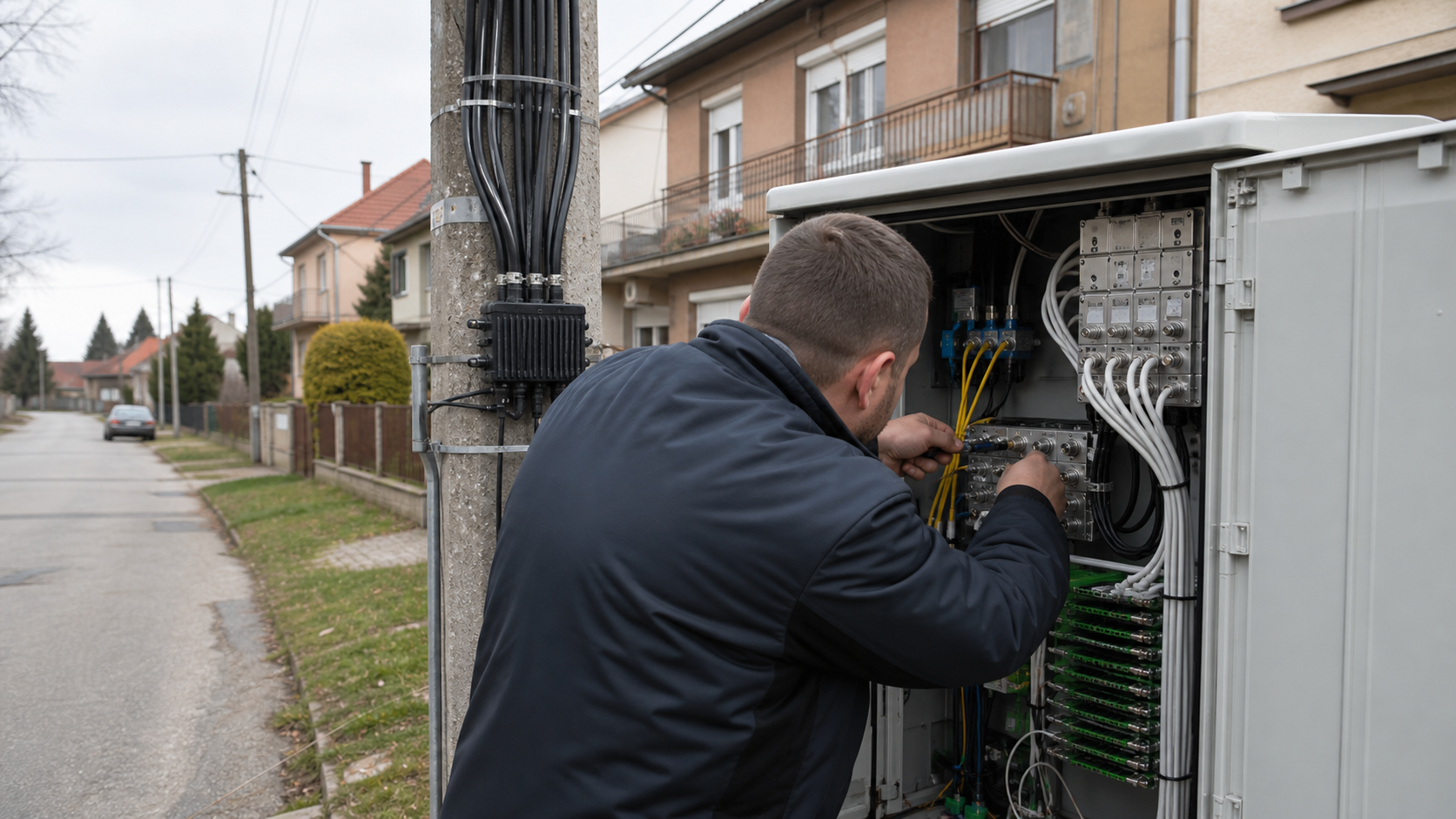
The public documents show several layers of fixed cost. The KalászNet network-development page gives customer guidance for digital television re-tuning and references set-top boxes and receiver equipment. The VGreen terms describe fixed internet access, fixed telephone or voice service, and fixed media-distribution service. They also state that speeds at the network endpoint depend on the access type, line technical parameters and momentary traffic conditions, and that customer-side wiring, cables, connectors, split points and other in-home conditions can affect service.
These are physical access-network economics, not software-only economics.
The cost base starts with the outside plant: coaxial or fibre access lines, splitters, amplifiers or optical equipment, cabinets, utility-pole attachments, power, headend or aggregation facilities, monitoring and maintenance. It continues into customer equipment: modems, set-top boxes, routers, adapters and in-home cabling. It then adds service support: calls, fault reports, truck rolls, billing, customer education and channel retuning. It also includes content and interconnection: television channel agreements, rights changes, upstream connectivity and internet routing.
The VGreen terms contain a revealing operational clause: if use of an endpoint's maximum performance negatively affects the quality of service for that subscriber or other subscribers, the provider may optimise the endpoint's speed while taking contractual targets into account. That is a technical rule with economic meaning. Shared access networks have congestion management costs. High headline speeds are not free if the local segment is underbuilt or if a small number of heavy users degrade service. The provider must balance product promises, customer satisfaction and investment timing.
Fixed costs are also exposed through service intervals and customer-support obligations. The terms discuss service establishment, fault reporting, quality targets, billing frequency, payment methods, suspension, limitation, provider switching and compensation. These rules make the network more reliable and consumer-protective, but they also turn poor operations into direct cost. A missed installation, repeated fault or mishandled provider switch is not just reputational damage; it can create support load, compensation or churn.
The key point is that utilisation quality must be local. It is not enough for group-level fixed broadband to grow. A cabinet with low take-up, a street segment with high maintenance cost or a town with aggressive fibre competition can destroy the economics of that local area. Conversely, a compact service pocket with high bundle penetration and low fault rates can be valuable even if the public AS footprint is small. Kalasznet's cost base is therefore granular, and the public sources only partially reveal it.
This is why reported capacity must be distinguished from value-creating load. The 600 and 700 Mbit/s products are available only where technical conditions and capacity permit. That is sensible, but it also shows that capacity is not uniform. Where the high tiers are available and purchased, they can improve fixed-cost absorption. Where they are unavailable, the company may still bear maintenance costs while competitors sell simpler speed stories. Where they are available but heavily discounted, capacity is consumed without the intended margin.
Upstream Dependence Limits The Independent Strategy
AS44651's public routing posture points to dependence rather than broad interconnection independence. RIPE WHOIS shows import from AS5483 and AS5507, export to the same, and Magyar Telekom maintainer references. bgp.tools shows Magyar Telekom as upstream and one peer. Hurricane Electric also observes one IPv4 peer. The route evidence is consistent with a local access network whose upstream path is anchored in Magyar Telekom rather than a company that markets itself through independent peering breadth.
That dependence is not necessarily negative. For a regional ISP, buying or using group-backed upstream connectivity can reduce cost, simplify operations and improve resilience compared with negotiating many separate arrangements. Magyar Telekom has national scale, supplier relationships and core-network capability. A Kalasznet customer likely cares more about reliable speed and latency than about whether AS44651 has a long public peering roster.
The downside is strategic optionality. A small public interconnection footprint gives limited bargaining leverage with transit providers, content networks or enterprise customers. It also provides fewer visible data points for outsiders trying to judge traffic scale. If Kalasznet were trying to become a wholesale connectivity platform, the current public routing evidence would be thin. But the retail evidence does not require that thesis. The better view is that Kalasznet's internet connectivity is a support function for household broadband and television, not the core product sold to other networks.
The absence of a PeeringDB network profile reinforces that reading. PeeringDB is voluntary and incomplete, so a missing record is not proof of weakness. But a provider that wants to advertise public peering, exchange presence, traffic policy and facilities often uses it. The lack of such a profile for AS44651 means there is no public claim of that kind to underwrite an interconnection story. That keeps the article's conclusion grounded: RIPE and BGP records establish number-resource and routing evidence, not wholesale market power.
Upstream dependence also affects risk. If a local outage, routing change, maintainer action or group network policy affects AS44651, Kalasznet's room to manoeuvre may be limited. The counterweight is that the group can likely solve issues with more capability than a standalone local operator. The utilisation question again decides the interpretation. If customer load is profitable, group dependence is efficient. If load is weak, dependence does not create value; it merely reduces some operating friction while the access plant remains underused.
The Customer Concentration Risk Is Geographic And Product-Led
Kalasznet's customer concentration risk is not visible as a named-account problem. It is a local-market and product-mix problem. The service pages show towns and counties rather than enterprise accounts. The company appears exposed to households in specific Hungarian localities, especially where former ViDaNet/VGreen operations are now visible through the KalászNet site. If a town's housing stock, income profile, competitor activity or fault history shifts, the local contribution can change materially.
Product concentration is clearer. Broadband is the anchor. TV adds revenue and retention, but also introduces content dependence. Voice likely supports completeness rather than growth. That means Kalasznet is exposed to any change that weakens the household bundle. If households decide that mobile data is enough for light use, broadband take-up falls. If households keep broadband but cancel television in favour of streaming, TV ARPU and channel scale weaken. If households keep only the lowest internet tier, the access network remains active but does not absorb enough cost.
The public TV change notice illustrates the content side. KalászNet's 2026 ASZF extract said certain channels would no longer be available in Hungary because their owner and distributor were ending broadcast availability, and that related changes were being made to the television terms. This is not under Kalasznet's direct control. A cable operator sells a bundle whose components can be changed by content owners, distributors, regulation and viewer behaviour. Each change can trigger customer calls, retuning, complaints, package reassessment and churn.
Customer concentration also appears in support expectations. The contact page asks customers emailing support to include their customer identifier and telephone contact details. The network-development page gives detailed guidance on set-top-box and TV retuning. These are signs of a customer base that still needs managed support for traditional television and fixed access. Support-heavy customers are not necessarily unprofitable, but they require enough ARPU to pay for that support.
The VGreen transition intensifies the concentration issue. The notice says contracts, speeds, channel lineups and fees would remain unchanged for affected former ViDaNet customers. Continuity is good for customer trust, but it also freezes the initial economics. The operator inherits not only customers, but also their legacy expectations, service terms and local network condition. The value is created only if it can subsequently migrate the base toward a better product and cost structure without triggering churn.
For an outside reader, the missing evidence is customer count by town, package mix, churn, fault rate, upgrade cost and realised ARPU. Without those, the article should not declare success or failure. It can say that the risk is concentrated where fixed-network economics usually bite: local take-up, bundle mix, service quality and customer retention cost.
Competition Comes From Fiber, Mobile Substitution And Larger Bundlers
The competitive set is broader than another cable company on the same street. NMHH's 2025 second-half fixed-market report shows the Hungarian residential fixed internet market moving away from older access types and toward fibre. Residential HFC connections in the report declined from about 1.349 million in the first quarter of 2022 to about 1.287 million in the fourth quarter of 2025, while FTTX rose from about 1.230 million to about 1.690 million over the same span. The report also says non-NGN residential connections fell from about 6% to about 2% by the end of 2025.
This market trend is central to Kalasznet's strategy. HFC remains large, so cable economics are not obsolete. But fibre is gaining share and shapes customer expectations. If a competitor can sell a simple fibre story at high headline speeds, Kalasznet must either match the experience, defend with price and bundle value, or rely on local service relationships. Matching experience may require capital. Defending with price can hurt margin. Relying on local service works only if support quality is strong enough to matter.
Mobile substitution is the second competitor. It will not replace fixed broadband for every household, especially heavy streaming or work-from-home users. But it can weaken the low end, especially where mobile data allowances, 5G coverage or household usage patterns make a fixed line feel optional. Magyar Telekom's own Q1 report cites growing mobile data usage alongside fibre uptake. That is an opportunity for the parent group, but not always for Kalasznet's local fixed plant. A parent group can win a mobile-only household while the local fixed asset loses utilisation.
Larger bundles are the third competitor. National brands can combine mobile, fixed broadband, television, device financing and loyalty offers. KalászNet's site counters partly through group-linked offers, including the Telekom mobile discount. That is rational. It turns a regional fixed brand into part of a larger household account. But it also means Kalasznet's economics are tied to group bundle strategy. If the group uses KalászNet as a retention tool, local margins may be acceptable within a broader household relationship. If the local product must stand on its own, the same discounts may look more expensive.
The fourth competitor is streaming and app-based television. The KalászNet TV page includes app-linked offers, but the broader trend is that linear channel bundles have to defend their value against internet-delivered alternatives. This does not kill cable TV immediately. Many households still like a familiar channel lineup and a single bill. But it changes the burden of proof. Television can no longer be assumed to add high-margin stickiness forever.
The realistic alternative for customers is not always better technology. Sometimes it is a simpler bill, a more attractive promotion, a mobile bundle, a fibre line from a larger operator, or cancellation of television while keeping broadband. That is why Kalasznet's utilisation test must distinguish household count from profitable bundle composition.
Regulation And Service Terms Define The Downside
Hungarian electronic communications regulation shapes the downside. NMHH supervises electronic communications markets, publishes fixed and mobile market reports, maintains registers and operates Szélessáv.net as an independent measurement service for internet users. The market reports are based on data from the largest fixed providers, and the fixed report analyses subscribers, technology development and market shares. That means local operators live in a market where regulators, consumers and competitors can compare technology, speed and service quality.
The VGreen general terms make this practical. They discuss customer rights, fault reporting, service limitation, suspension, provider switching, number portability, billing, compensation and dispute processes. They also set out the provider's responsibility boundary at the network endpoint and discuss factors affecting internet speed, including access type, technical line parameters, network traffic, customer equipment and in-home wiring. These terms protect the provider against unrealistic expectations, but they also define the circumstances under which service quality becomes a customer or regulatory issue.
Provider switching is particularly important. The terms describe processes for internet-access provider change and compensation when switching or number-portability problems cause service outage beyond certain thresholds. This makes it harder for an operator to rely on inertia alone. Customers can move, and the market has formal processes to support movement. In a competitive area, poor service or weak pricing can translate into churn rather than mere dissatisfaction.
Regulation also interacts with content. The 2026 KalászNet notice about channel changes cites media-law requirements and contracts with media service providers. Television packages are not purely discretionary retail menus. They sit within content agreements and media rules. If channels are removed, replaced or repriced, Kalasznet has to communicate, update terms and manage customer response.
The economic downside is therefore asymmetric. A good network month produces recurring revenue. A bad network, billing or content month can create support spikes, churn, compensation, reputational damage and retention discounting. In fixed broadband and cable TV, many costs are hidden until something breaks. The utilisation test must therefore include quality, not just sign-ups. High utilisation on a congested or support-heavy plant can be worse than moderate utilisation on a stable plant.
Unofficial Signals Are Helpful Only If They Stay In Their Place
Unofficial market signals add texture but should not carry the thesis. bgp.tools calls AS44651 an eyeball network and provides relative rankings inside Hungary. Hurricane Electric reports route counts, RPKI validity and an observed peer. These signals are useful because they independently confirm that AS44651 is visible and small. They are not audited subscriber counts, customer satisfaction measures or revenue data.
The same caution applies to public service pages. A listed tariff does not prove take-up. A named service area does not prove penetration. A channel package does not prove profitability. A parent-group report does not disclose the local Kalasznet contribution. A RIPE LIR record does not prove that addresses are efficiently used by paying customers. The company could be economically stronger or weaker than these sources reveal.
The absence of a PeeringDB profile is also a signal, not a verdict. It suggests that Kalasznet is not publicly presenting itself as a peering-heavy network. But PeeringDB is voluntary, and many access providers have incomplete profiles. The proper conclusion is narrower: public interconnection evidence is limited, so the article should not build a wholesale or content-network story.
Customer-facing promotions are another signal. The 20% Telekom mobile discount for KalászNet customers, the 1,000-forint bundle discount for TV, internet and phone, and electronic-billing incentives point to retention and bundle deepening. They do not reveal whether discounting is disciplined or reactive. In telecom economics, promotions are valuable when they reduce churn or raise lifetime value more than they reduce monthly contribution. They destroy value when they train customers to wait for concessions.
The best unofficial signal would be consistent customer evidence about service reliability, upgrade availability, real speeds and support quality by town. This article did not rely on scattered comments or isolated anecdotes because they are easy to overstate and hard to verify. For now, the market-signal layer supports a cautious view: Kalasznet is a real regional access operator with limited public network scale, working inside a larger group, and facing the same fibre and bundle economics that pressure cable operators across Europe.
The Facts That Would Change The Judgment
The current judgment is cautious rather than bearish. Kalasznet has real assets, public tariffs, visible service territories, a number-resource footprint and group backing. It also has visible constraints: a small IPv4-only public AS footprint, limited interconnection disclosure, television content dependence, dispersed local service areas, and a market moving toward fibre. The available evidence does not prove that the infrastructure is underutilised. It shows why utilisation is the central question.
The first fact that would improve the judgment is local take-up by service area. If Kalasznet can show high penetration in Vác, Győr, Kaposvár, Pécs or the smaller Pest-county towns, the fixed-cost absorption story becomes much stronger. Penetration matters more than homes passed. A compact town with high bundle adoption can produce better economics than a broader footprint with low take-up.
The second is realised ARPU and package mix. A rising share of customers on 300 Mbit/s and above, especially with television or value-added services, would support the case that the price ladder is working. Heavy reliance on entry-level internet, expiring promotions or defensive discounts would weaken it. The same applies to churn: low churn after fee adjustments and product migrations would signal pricing power; high churn or repeated retention offers would signal margin risk.
The third is upgrade economics. Evidence that high-speed tiers are available across most of the footprint, with manageable capex per passed home and improving service quality, would make the utilisation story more attractive. Evidence that 600 and 700 Mbit/s availability is limited, costly or congestion-prone would make the strategy more defensive. Fibre migration plans, node-split data, capacity utilisation by segment and fault-rate trends would be decisive.
The fourth is network modernisation. Public IPv6 visibility from AS44651, clearer peering or routing disclosures, updated RPKI and route objects, and evidence of resilient upstream arrangements would improve confidence in technical renewal. These would not by themselves prove profitability, but they would reduce the concern that the public number-resource footprint is merely a legacy support layer.
The fifth is the legal and operating boundary. Clearer disclosure of how Kalasznet Kabel TV Kft, VGreen Kft, former ViDaNet assets and Magyar Telekom group responsibilities divide customer contracts, network ownership, revenue and support obligations would reduce uncertainty. The current public materials can be reconciled, but they require careful reading.
Until those facts are available, Kalasznet should be viewed as a group-backed regional fixed-access operator whose economics depend on disciplined utilisation. The assets are real. The tariff ladder is visible. The service areas are identifiable. The parent group has capital and operating scale. But the economic prize is not reported activity. It is profitable, durable load on infrastructure that must keep earning its place in a fibre-led, bundle-driven Hungarian market.