
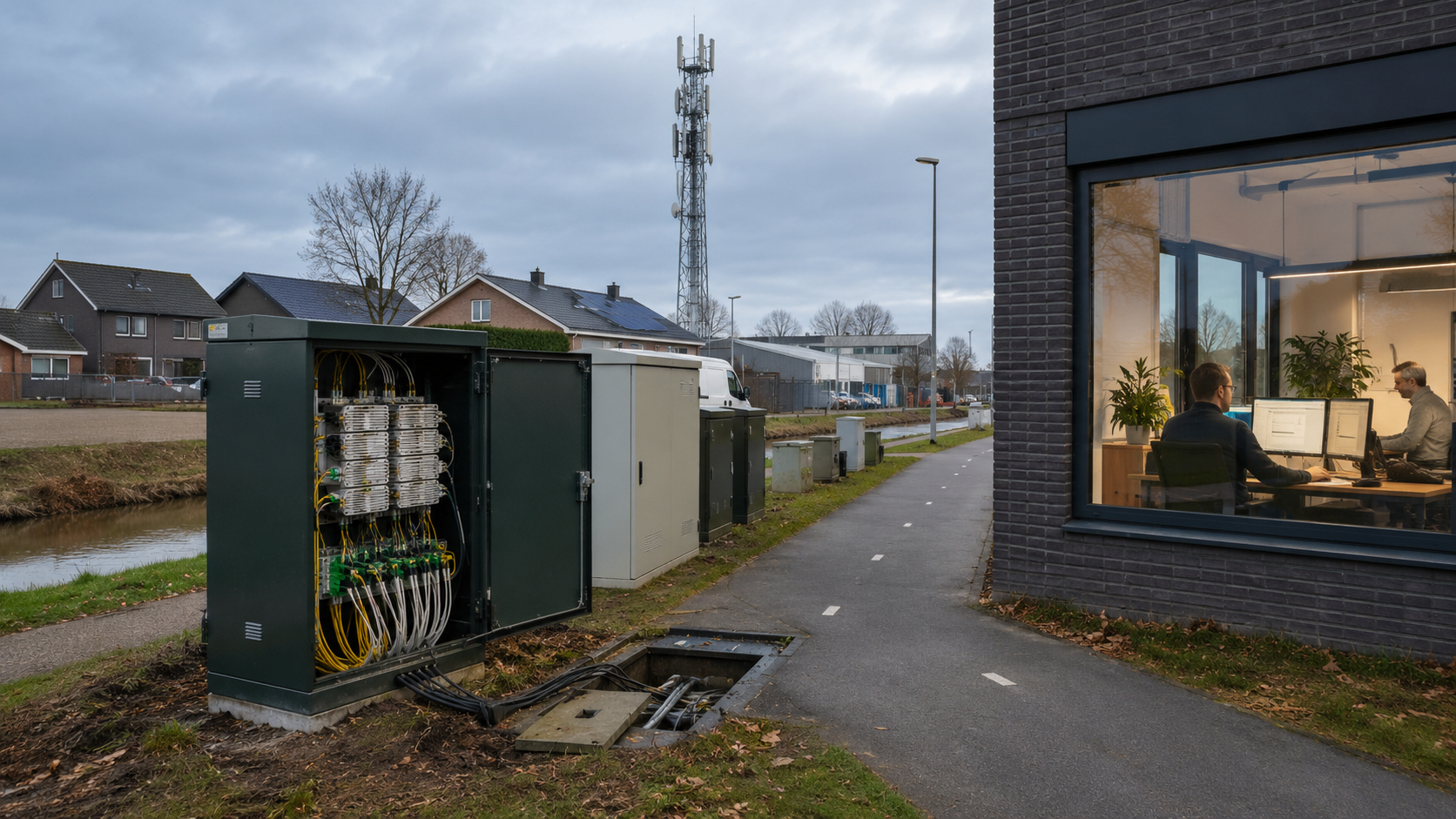
When a market matures, growth stops being the most interesting variable. The harder question is survival: why have customers not left? That is the right way to read Internet Service Europe BV. The company does not look like a venture-scale cloud challenger, a national broadband network, or a telecom infrastructure consolidator. It looks like a durable Dutch hosting, domain, serverhousing, and internet-operations company that has survived because its customers are entangled in domains, DNS, email, old PHP sites, control panels, IP addresses, backups, reseller relationships, and local support habits. In that kind of business, the moat is not glamour. It is accumulated inconvenience.
The public evidence points to a company with a Roosendaal operating base, a Steenbergen datacenter footprint, a RIPE/LIR identity, a portfolio of hosting and domain brands, and a small-operator economics profile. Its official site presents Internet Service Europe BV as the parent/operator behind Dutchwebhosting, Open Domain Registry, Backupmaster, Spamprotector, and Start-up; it describes services including domain registration, web hosting, virtual and dedicated servers, backup, anti-spam, and serverhousing. The same official pages claim more than 1,000 active web servers in the Nedzone datacenter in Steenbergen, more than 65,000 webhosting accounts, and more than 195,000 domains, though those figures should be treated as company-stated commercial scale rather than audited proof.
The economic interpretation is narrower and more useful than the label “ISP.” Internet Service Europe BV is best understood as a regional Dutch internet-infrastructure operator: hosting provider, domain/registrar platform, LIR/resource holder, and colocation-adjacent service company. “Regional ISP” is not wrong if used loosely, because the company owns internet-numbering relationships and operates internet services, but it is misleading if it implies consumer access lines, national last-mile scale, or large transit independence. The evidence points to a business whose survival depends less on selling new connectivity and more on keeping old operational bundles functioning cheaply enough that customers do not rationally migrate.
The company is easier to understand as a bundle than as a brand
The legal and operating identity is reasonably clear at the public level. Internet Service Europe BV uses the website i-s-e.nl, lists contact and bank details under that name, and gives Dutch Chamber of Commerce number 54395453 and VAT number NL851288650B01. Its official contact page places the office at Rucphensebaan in Roosendaal and identifies a Nedzone datacenter location at Drukkerij in Steenbergen. Creditsafe’s company-index page independently lists Internet Service Europe B.V. with company number 54395453, incorporation in 2011, and the Roosendaal address. Dutchwebhosting’s contact page also says payments are to be made to Internet Service Europe BV and describes it as the parent company responsible for invoicing and payments.
The dates require caution. The operating story says the group was founded at the end of the 1990s, while public company-index data points to a 2011 BV incorporation. That is not necessarily a contradiction. Hosting businesses often move through trade names, entities, acquisitions, or reorganizations while customer-facing brands continue. The right economic conclusion is continuity, not a single clean founding event. Internet Service Europe BV appears to have inherited or consolidated a longer hosting operation, and the public-facing group identity now sits around a BV incorporated in 2011.
The company’s own brand architecture is the first clue that this is not a simple access ISP. Dutchwebhosting is the mainstream hosting brand; Open Domain Registry is the B2B domain-registration system; Backupmaster is the backup product; Spamprotector is the anti-spam product; Start-up is the cheaper, self-service hosting brand. Internet Service Europe BV’s site explicitly calls these “dochterondernemingen,” or subsidiaries, though the legal precision of that term is not independently verified from statutory filings in the public evidence reviewed here. The commercial meaning is still clear: the company has segmented the same underlying operational stack into different customer acquisition channels.
That segmentation matters because small hosting companies cannot afford to serve every customer in the same way. Dutchwebhosting markets experience, Dutch location, RIPE membership, a Dutch datacenter, Plesk/DirectAdmin hosting, domains, email, VPS, dedicated servers, reseller hosting, daily backups, and anti-spam. Open Domain Registry markets real-time domain registration and transfers, a REST API, low prices, prepaid operation, and a B2B-only posture for IT companies, ISPs, resellers, agencies, and developers managing many domains. Start-up markets cheap hosting with limited support, explicitly saying its sharp pricing is maintained by offering support through email/ticket rather than high-touch channels.
This is a classic mature-market pattern: brands are not just marketing labels; they are support-cost filters. The same server, DNS, billing, and support capabilities can be sold as premium-ish Dutchwebhosting, automated B2B Open Domain Registry, and low-cost Start-up. The economics improve if customers self-select into the correct cost envelope. A €2-per-month hosting customer cannot consume the same labor as a managed-server customer. A reseller using an API can be profitable if the workflow is automated. A domain customer can be profitable if renewal, billing, and DNS changes are routine. Survival depends on matching customer behavior to support burden.
The product is old-fashioned in the profitable sense
The product set is not fashionable, but it is commercially coherent. Internet Service Europe BV and its brands sell the boring items that still sit under a large part of the European small-business web: domain names, shared hosting, Plesk hosting, DirectAdmin hosting, email boxes, DNS, SSL certificates, VPS, dedicated private servers, backup, anti-spam, reseller packages, and serverhousing. Dutchwebhosting advertises Plesk hosting, DirectAdmin budget hosting, domains across more than 500 TLDs, dedicated email, VPS/DPS offers, reseller packages with anonymous nameservers, daily backups through Backupmaster, and MailChannels for email deliverability.
The visible prices show a low-ARPU, high-automation business. Dutchwebhosting advertises very low monthly figures for basic hosting packages, including Plesk and DirectAdmin entry pricing; Start-up lists hosting plans at €2, €4, and €8 per month; ISE’s serverhousing order page lists 15U, 22U, and 46U options at €295, €445, and €695 per month before extras. Serverhousing includes setup fees, minimum terms, power allowances, IP allocations, uplinks, and overage prices. These prices do not prove actual average revenue, but they show the commercial envelope: the company is competing in a market where many services are bought as recurring operational utilities, not strategic transformations.
That low-ARPU structure changes what “quality” means. In enterprise cloud, quality may mean elastic APIs, global regions, certification, SOC reports, and managed compliance. In local hosting, quality more often means that old email works, the DNS does not break, the control panel behaves, support answers enough tickets, and the provider does not force the customer into a migration that the customer is not competent to perform. Dutchwebhosting’s own pitch leans into this: “no overselling,” Dutch datacenter, direct dealing with the source rather than a reseller, SLA availability, daily backups, and support for familiar control panels.
This is not a growth story in the startup sense. It is a retention story. Many customers of such firms are not constantly benchmarking hosting providers. They are associations, small firms, agencies, webshops, schools, clubs, web designers, and resellers whose web presence is important enough to keep alive but not important enough to justify a full migration project. For those customers, leaving means finding a new host, moving mailboxes, validating DNS, adjusting SPF/DKIM/DMARC, transferring domains, preserving old PHP compatibility, checking SSL issuance, moving databases, updating cron jobs, and hoping the new provider’s support does not misunderstand a ten-year-old configuration. In that world, a provider survives by keeping the pain of staying below the pain of leaving.
RIPE evidence proves infrastructure relevance, not telecom scale
The routing and registry evidence is commercially important because it separates real infrastructure operators from mere storefront resellers. Internet Service Europe BV appears in the RIPE NCC member directory for the Netherlands. RIPE/RDAP-style records for IPv4 and IPv6 resources link Internet Service Europe BV or ISE-related netnames to hosting-style descriptions: dedicated, virtual, co-located, and managed internet solutions. The IPv6 record for 2a02:cec0::/32 lists netname NL-ISE, org Internet Service Europe BV, and route6 origin AS25459.
The commercial meaning is not “large carrier.” It is that ISE is more than a pure web-design shop or affiliate reseller. It has number-resource identity, abuse contact obligations, and a network footprint tied to hosted infrastructure. BGP.he lists AS25459 with IPv4 and IPv6 prefixes, including ISE-related 83.172.x.x ranges and IPv6 prefix information, while showing Eurofiber Cloud Infra as a key peer/upstream context. IPIP’s RIPE-derived record for 83.172.128.0/22 also ties the netname NL-ISE to AS25459/Nedzone/Eurofiber Cloud Infra context and lists ISE abuse contact information.
The size of the address footprint is modest but economically meaningful. A RIPE allocation analysis page using RIPE allocation data as of June 29, 2026, lists Internet Service Europe BV / nl.ise with 3,584 IPv4 addresses, representing 0.013% of Dutch LIR IPv4 addresses and ranking far below national-scale Dutch operators such as KPN, Ziggo, Odido, and other large holders. That figure should not be treated as a perfect measure of usable inventory or live services, but it is enough to show the scale class: ISE is a small infrastructure resource holder, not a national access carrier.
IPv4 scarcity also makes the resource base economically relevant even if the company is small. RIPE NCC’s current IPv4 waiting-list page explains that recovered IPv4 addresses are allocated through a waiting list, that each eligible LIR can receive only one /24 allocation, and that only LIRs that have never received an IPv4 allocation from RIPE NCC can request via that waiting list. That scarcity gives existing IPv4 holders an embedded advantage in hosting, VPS, colocation, and dedicated-server markets, because customers still need IPv4 reachability for compatibility even where IPv6 exists.
This is one of the company’s non-obvious assets. A few thousand IPv4 addresses do not make an empire, but they can support meaningful hosting density, customer stickiness, and pricing power in a niche. Moving a customer off an old IP address can break allowlists, DNS assumptions, mail reputation, external integrations, and inherited configurations. An IPv4 address with stable reputation is not just a number; it is a coordination point across other parties’ systems. That makes IP stewardship part of the switching-cost stack.
The datacenter footprint is local, concentrated, and economically rational
The strongest physical-infrastructure evidence is the Steenbergen datacenter story. ISE’s serverhousing page says the company has a complete private suite in NedZone II in Steenbergen, with 24 racks and an option to expand to 48. The page offers 15U, 22U, and 46U cabinet products and lists included power, bandwidth, IP addresses, uplink speeds, access, and related features. It also describes NedZone II as using direct free cooling, 2N power, and dark-fiber connectivity over a physically separated Steenbergen–Rotterdam–Amsterdam–Steenbergen ring using CWDM/DWDM and multiple 10G wavelengths.
The history matters. A 2011 West-Brabant Business cover story hosted on ISE’s site describes a major move from euNetworks in Amsterdam to a private suite in Nedzone II in Steenbergen, involving Internet Service Europe and brands including DutchWebhosting, BackupMaster, SpamProtector, and OpenDomainRegistry. The article says more than 1,000 servers and more than 60,000 accounts were moved, with tens of thousands of customers affected during the overnight migration, and that almost all customers were online again within five hours. It also describes 24 cabinets in use and room for 48 cabinets.
The economic rationale is straightforward. A regional datacenter footprint can be cheaper and more operationally convenient than maintaining a larger Amsterdam presence, especially for a provider whose customers value Dutch hosting and reliability but do not necessarily need hyperscale features. Physical proximity from Roosendaal to Steenbergen lowers technician travel time. A private suite gives control over equipment and customer-serverhousing products. Fixed racks and power turn into a platform for shared hosting, VPS, dedicated servers, backup storage, anti-spam services, and colocation sales. The business survives if utilization is high enough and support incidents are controlled.
But the same footprint creates concentration risk. ISE’s own June 2026 outage notice says Eurofiber Datacenter Nedzone suffered an unexpected connectivity outage on June 11, 2026, during maintenance on three core switches; ISE says its own core switches, servers, storage, and power remained operational, while services dependent on external connectivity were reduced or unreachable for roughly half an hour. ISE also says the maintenance had not been communicated to it and that other parties in the datacenter were affected.
That post is economically revealing. It shows a provider trying to defend its own operational reputation by distinguishing between internal competence and supplier failure. Customers, however, often experience both as “the host was down.” For a small infrastructure company, supplier incidents are dangerous because they consume support labor, erode trust, and create churn risk without necessarily being under the company’s direct control. The incident also illustrates why the word “private suite” should not be confused with full vertical independence. ISE may control racks, servers, software, and customer relationships, but it still depends on datacenter and network counterparties for external reachability.
Support labor is the scarce input
The visible support model is lean. ISE’s contact page points users toward an online support ticket system at helpburo.eu, says the system is monitored by one or more employees, and gives office phone availability. Dutchwebhosting gives phone hours, separate billing/account contact channels, and tells customers to use the online support ticket system for support-related matters. Start-up explicitly limits support to email/ticket because of its sharp pricing. Dutchwebhosting’s budget DirectAdmin offer also says no telephone support is included because of the low price.
This is not a weakness by itself; it is the only way the arithmetic works. A €0.50-per-month or €2-per-month service cannot include much human intervention. A single ten-minute support interaction can consume months of gross margin on the cheapest plans. Low-price hosting is viable only when provisioning, renewal, billing, DNS templates, control-panel workflows, backup restores, and abuse handling are standardized. The minute the customer’s problem becomes bespoke, the provider has to either ration support, charge more, or accept margin leakage.
ISE’s own public notices show support triage in action. In 2026, ISE posted that some KPN customers had FTP-connection problems due to KPN/router settings and said tickets about only KPN/FTP issues would be closed. That is blunt but economically rational: a small hosting provider cannot afford to become unpaid support for an access-provider-side problem.
The hiring page exposes the operational workload behind the scenes. ISE advertises for a Linux system and network administrator in a small team, with responsibilities across hosting/network maintenance, upgrades, urgent support, and projects. The required skills include Linux, OpenVZ, CentOS, Ubuntu, Debian, Cisco/HP, PHP, Perl, Bash, Python, DNS, TCP/IP, FTP, Nagios, DirectAdmin, Plesk, Apache, MySQL, HeartBeat, SSH, and high-availability clusters. A support vacancy mentions tickets and phone calls about spam listings, full partitions, DNS, server load, backup restore, DirectAdmin, Plesk, Linux, SSH, CentOS, and OpenVZ.
That skill list is a map of the company’s real production function. The constraint is not software innovation in the abstract; it is keeping a heterogeneous estate alive. Old operating systems, control panels, customer scripts, mail queues, blacklists, disk partitions, DNS mistakes, and backup restores all become labor claims. Mature hosting companies accumulate technical sediment. The customer base becomes sticky partly because migrations are painful, but the provider also inherits the cost of that stickiness.
Supplier inflation pushes directly into customer prices
The company is exposed to supplier-cost inflation in control panels, hardware, energy, datacenter services, IP resources, and email reputation tooling. Its own November 2025 notice says Plesk licensing prices would be adjusted for 2026 and that ISE was forced to pass changes through; it lists Plesk Web Pro and Web Host increases, higher Plesk Extended Lifecycle Support costs for CentOS 7.x servers, and DirectAdmin Legacy pricing increases. It also tells customers that CentOS 7.x reached end of life in June 2024 and advises migration to AlmaLinux 8.x, while warning that migrations could only be planned for 2026 because of existing commitments and work in progress.
This is a compact statement of the mature-hosting squeeze. Control-panel vendors raise prices. Legacy OS environments require paid extended support. Customers delay migrations because migrations are risky and irritating. The hosting provider cannot absorb all cost increases because ARPU is low. Passing through prices risks churn, but not passing through prices erodes margin. The provider’s best defense is operational credibility: customers accept price increases if the alternative is a migration they do not want to manage.
The AI-hardware cycle appears indirectly in ISE’s news list as well: the official site includes a notice title about strong price increases for memory and enterprise SSDs due to the rise of AI, though the details were not necessary to establish the broader economics. Combined with the control-panel notice, the message is that a small hosting operator does not control key input costs. It buys or leases datacenter capacity, power, networking, licenses, hardware, and deliverability services in markets shaped by larger buyers.
This is why low-cost hosting businesses have to make hard product decisions. They can keep old systems alive and charge for extended support; they can push migrations and consume labor; they can simplify the product stack and lose customers with special configurations; or they can let complexity accumulate and accept operational fragility. None of these paths is clean. Survival is not avoiding trade-offs; it is choosing the trade-off that produces the fewest customer exits.
The domain base is the annuity, but the annuity is under pressure
The domain-registration side looks economically central. Open Domain Registry says it has more than 200,000 domains “in the service,” more than 700 customers, a REST API, no membership fee, prepaid operation, and a B2B-only model aimed at IT companies, ISPs, resellers, internet agencies, and developers managing large domain portfolios. ISE’s own homepage claims more than 195,000 domains across the group, while Dutchwebhosting advertises domain registration across more than 500 TLDs and .nl/.eu pricing.
A domain portfolio is attractive because renewals recur. A domain customer may stay for years without requiring much support. The registrar platform becomes especially sticky when it is tied to DNS, email, hosting, reseller billing, and customer-facing nameservers. Open Domain Registry’s B2B posture also indicates a wholesale/reseller layer: the end customer may not even know ISE/ODR sits underneath the domain workflow. That can stabilize volume if resellers keep using the API and nameserver stack.
But the domain market is mature and slightly contracting in the Netherlands. SIDN reported that .nl domains declined from 6,179,686 in 2024 to 6,059,392 in 2025, with the contraction linked to business closures, fewer startups, and stagnation in the international domain market. SIDN also reported that the number of registrars declined from 1,114 in 2024 to 1,052 in 2025, and separately described .nl as down 1.92% in 2025, with 758,000 new registrations and 812,000 cancellations.
That context changes the interpretation of ISE’s claimed domain scale. In an expanding market, a domain platform’s growth can come from new registrations. In a mature or shrinking market, the economics shift toward retention, price pass-through, reseller consolidation, and operational reliability. SIDN Labs has noted that even small declines in renewal rates can have significant financial impact because a large share of registry revenue comes from renewals and because predictability matters. That logic applies even more strongly to a small registrar/hosting operator whose domain base supports other services.
The deeper risk is not merely fewer domain names. It is a decline in the perceived necessity of owning and maintaining independent web infrastructure. SIDN has discussed a shift in user behavior driven by AI and platform environments, warning that domain utility and value may be affected as digital identity and discovery change. That does not mean domains disappear. It means generic small-business hosting faces pressure from marketplaces, SaaS storefronts, social platforms, AI-generated pages, and bundled productivity ecosystems.
ISE’s defense is installed base. A company with old domains, mailboxes, DNS records, and hosting packages does not need every customer to be enthusiastic. It needs customers to keep renewing. That is the economics of survival in mature hosting: the annuity is profitable if churn is low, abuse is contained, support cost is rationed, and supplier inflation can be passed through without causing a migration wave.
Why customers have not left
Customers have not left because the service is embedded in operational routines. Domain names are not isolated purchases; they are connected to DNS zones, mail exchange records, hosting, SSL certificates, billing contacts, reseller accounts, backup policies, and control panels. A move is a project. Many customers are rationally underinformed about the project’s hidden dependencies. Their default decision is to stay unless the current provider becomes intolerable.
Email is a particularly strong anchor. Dutchwebhosting markets dedicated email hosting and says it uses MailChannels so that outgoing mail does not end up on blacklists. Whether every customer experiences that benefit is not independently proven, but the product positioning is economically important: mail deliverability problems create urgent pain, and stable deliverability creates loyalty. A business may move its website to a SaaS platform, but mailboxes, aliases, SPF records, archived messages, and user habits can keep the old provider in place.
Old PHP and control-panel compatibility are another anchor. Dutchwebhosting advertises support for PHP 8, PHP 7.4, and PHP 5.6 fallback in some packages; ISE’s support and hiring materials show Plesk, DirectAdmin, CentOS, OpenVZ, Apache, MySQL, and related legacy stack expertise. This matters because a small business website built years ago may break on a modernized hosting environment. The provider that keeps it alive can retain the customer even if the stack is technically unattractive.
Reseller anonymity is also sticky. Dutchwebhosting advertises reseller packages with anonymous nameservers. That allows web agencies and small IT providers to sell hosting under their own customer relationship while depending on ISE/Dutchwebhosting underneath. The end customer may not see ISE at all. For the reseller, switching upstream providers risks exposing the dependency, breaking customer DNS, and creating support chaos.
The local-Dutch identity reduces perceived risk for a certain customer segment. Dutchwebhosting emphasizes being 100% Dutch, using a Dutch datacenter, being a full RIPE member, and dealing directly with the source rather than a reseller or third party. This is not a hyperscale feature, but it is a trust feature for customers that value local language, Dutch invoices, Dutch phone support, and a provider that understands the .nl ecosystem.
The switching-cost thesis is not sentimental. It is measurable in labor. Every DNS change, mailbox migration, server move, and domain transfer creates a risk-weighted cost. The incumbent survives when the annual price difference between staying and leaving is lower than the expected cost of migration failure. In a low-growth market, that is the central moat.
The reputation signal is asymmetric: strong review evidence, old complaint residue
The public review trail is not neutral, but it is useful. Webhosters.nl lists Dutchwebhosting with a high “Hall of Fame” position, 388 experiences, a 4.9 score, and a distribution heavily weighted toward five-star reviews. Individual reviews visible on the page praise uptime, fast helpdesk response, and long-term use across multiple sites and domains. Review sites can be biased by selection effects, solicitation, survivorship, and non-response from unhappy customers, so they do not prove service quality. They do prove something economically relevant: Dutchwebhosting has an active enough satisfied-customer/reviewer base to generate a strong public trust asset.
The unofficial negative trail is older and weaker, but should not be discarded. An old Dutch Google Groups post alleged serious early-era downtime, poor restitution, difficulty reaching the company, and an employee-related incident; an old Tweakers thread included a complaint about poor treatment of new medium-sized customers. These are not verified facts, they are old user claims, and they should not be treated as current evidence of service quality. Their value is different: they show the kind of reputational failure mode that matters for small hosting companies—support responsiveness, downtime, and trust under stress.
More recent forum chatter around Open Domain Registry is commercially sharper. In a 2019 Tweakers discussion, one user said they were satisfied with ODR but that it came across as a “one-man-show”; another discussed links between ODR and Dutchwebhosting/holding structure. In a 2021 continuation of the same forum thread, a user alleged that after registering with ODR, their password arrived in plaintext by email. These claims are not adjudicated and should not be presented as established security facts. But as market signals they matter: buyers of registrar APIs care about key-person dependency and security process maturity.
The correct weighting is not “official good, unofficial bad.” The correct weighting is recency, volume, and economic relevance. The high Dutchwebhosting review score has more current commercial weight than two-decade-old complaints. The ODR forum chatter has limited evidentiary weight but high diagnostic value because it touches B2B operational trust. For a domain API provider, one credible perception of small-team fragility can influence a reseller’s supplier-risk assessment even if day-to-day service is good.
Abuse is not peripheral; it is part of the operating model
Hosting companies sit between customers, registries, other networks, law-enforcement requests, copyright complaints, spam reports, phishing, bot traffic, and blacklists. Abuse handling is not a compliance footnote; it is a production cost and a reputation risk. Dutchwebhosting’s Notice-and-Take-Down page says ISE and its subsidiaries offer customers a platform to express opinions but also maintain a procedure for unlawful content complaints, forwarding complete complaints to the customer first. Its acceptable-use policy says prohibited activities can lead to suspension or termination and bans unlawful material, unsolicited bulk email, and related abusive use.
ISE’s 2026 Azure-blocking notice gives a live example of abuse economics. The company said technicians had seen increased connections from Microsoft Azure network ranges to older server environments, with traffic resembling scanners, bots, brute-force attempts, and light DDoS-like load. It temporarily blocked multiple Azure IP ranges, argued that single-IP blocking was ineffective because attackers move within ranges, and said it had checked as far as possible that the ranges did not serve direct Office 365 or Exchange mail functions.
That decision is commercially revealing. Blocking hyperscaler ranges can reduce abuse load and protect older customer servers, but it risks false positives and customer complaints if legitimate traffic is affected. A large cloud provider might solve this with more granular filtering, distributed telemetry, managed WAF features, or account-level controls. A smaller hosting operator may choose coarse network-level blocks because it is the lowest-cost effective intervention. That is not necessarily wrong; it is a resource allocation decision under pressure.
SIDN’s broader transparency reporting shows why abuse handling is a permanent cost in the Dutch domain ecosystem. SIDN’s 2025 transparency report says it works with registrants, registrars, hosting providers, and authorities to keep .nl secure, and reported 87 notice-and-takedown requests in 2025, with 22 domain names made unreachable. It also reported more than 2,000 unilateral cancellations and more than 1,600 domain names made unreachable through data-verification measures.
For ISE, abuse risk has three economic channels. First, direct labor: tickets, investigations, customer communication, and takedown workflow. Second, reputation: blacklisted IP space or poor abuse response can hurt deliverability and upstream relationships. Third, churn: legitimate customers leave if neighbors on shared infrastructure cause collateral damage. Abuse handling is therefore a margin-protection function, not merely legal hygiene.
Competitors are not just other Dutch hosts
ISE’s competitive set is broader than a list of Dutch hosting companies. It competes against large Dutch hosting/registrar brands, European VPS providers, global hyperscalers, SaaS website builders, Microsoft and Google mail suites, Shopify-like storefronts, agency-hosting bundles, and “do nothing” inertia. The last competitor is the most underappreciated: many customers do not actively choose the best provider; they continue paying the incumbent because the service works well enough.
Large providers can outspend ISE on automation, brand, certification, marketing, and interface polish. Hyperscalers can offer global infrastructure, APIs, security primitives, and ecosystem integration that no regional host can match. SaaS platforms remove whole layers of hosting administration for customers who only need a website or shop. Microsoft 365 and Google Workspace reduce the need for traditional hosted email. In a new-business market, those alternatives are powerful.
But ISE’s customer base is likely not a pure new-business market. The company’s own product language and technical stack point to legacy and semi-managed workloads: Plesk, DirectAdmin, old PHP fallback, CentOS migration issues, OpenVZ, reseller nameservers, dedicated mail, dedicated private servers, serverhousing, and manual support patterns. Those workloads do not move automatically to SaaS or hyperscale. They need translation work.
The strongest competitors are therefore not always the technically superior providers. They are providers that can absorb the migration work or hide it from customers: web agencies, MSPs, domain/hosting consolidators, and larger Dutch hosts with migration tooling. If a competitor can move a customer’s domain, DNS, mail, website, SSL, backup, and control-panel dependencies with minimal interruption, ISE’s inertia moat weakens. If the migration is still painful, ISE remains protected.
The broader market data supports the consolidation pressure. SIDN reports a decline in .nl registrars and notes that domain registration is increasingly specialist, with hosting providers and web designers acting as resellers. That creates two opposing forces for ISE. As a registrar/API platform, it can benefit from resellers who want an underlying domain engine. As a small operator, it can also lose share if resellers consolidate onto larger platforms.
Ownership and control signals point to small-company continuity, not institutional scale
Public control evidence is thinner than product and network evidence. The West-Brabant Business article names John van der Lingen as director in the context of the 2011 move and describes the company as having grown through multiple hosting and IT activities. RIPE-derived records and official contact material include operational contact channels tied to ISE, but the reviewed public evidence does not establish a full current shareholder register or ultimate beneficial ownership chain.
Semi-public company aggregators add clues but should be weighted carefully. Creditsafe gives the BV identity, company number, address, and incorporation date. A Dutch company-directory result lists many trade names connected with the same company number, including Dutchwebhosting, OpenDomainRegistry, Start-up, NL-Backbone, TweakHosting, and others; Drimble-style snippets also suggest active status and a small employee count. Those aggregators are useful for identity triangulation, but they are not substitutes for official chamber extracts or audited filings.
The economic inference is still strong: this is likely a closely held, operator-led business rather than a broadly institutionalized infrastructure company. The evidence shows a small-team operating model, a long-lived founder/operator continuity story, and a portfolio of brands that appear to have accreted over time. That can be an advantage. Small firms can make fast practical decisions, know their infrastructure intimately, and maintain customer relationships with less bureaucracy. It is also a risk. Key-person dependency, succession risk, documentation gaps, and uneven process maturity matter more when the company is small.
The market should not over-penalize smallness. In hosting, small can be efficient if the estate is standardized and the customer base is stable. But the market should not romanticize it either. A small company operating thousands of servers, many domains, control panels, abuse processes, backup systems, and colocation services needs discipline. The failure path is rarely one dramatic strategic mistake; it is a gradual accumulation of deferred migrations, supplier price increases, support bottlenecks, and trust-eroding incidents.
The company’s strongest asset is not growth; it is installed operational trust
The official scale claims—more than 1,000 web servers, 65,000 webhosting accounts, and around 195,000 to 200,000 domains depending on the page—should be treated carefully because they are company-published and may not be continuously updated. But they are directionally consistent with the historical article, current brand pages, ODR’s domain claims, Dutchwebhosting’s review footprint, and the visible routing/address footprint.
The point is not whether the exact count is 195,000 domains today. The point is that ISE has operated at a scale where automation, support rationing, and recurring renewals matter. A company with tens of thousands of hosting accounts and six-figure domain claims is not economically comparable to a boutique web agency. It is also not comparable to a national telecom incumbent. It lives in the middle: too operationally complex to be a simple storefront, too small to dictate supplier economics, and too mature to depend on explosive category growth.
That middle position can survive for a long time. The business has natural renewal revenue, sticky customer configurations, local trust, an IPv4 resource base, a physical datacenter footprint, and multiple brands aimed at different willingness-to-pay segments. Its customers may not love it enough to evangelize; they only need to trust it enough not to leave. In mature infrastructure services, that is often enough.
But the middle position is vulnerable to three pressures. First, simplification pressure: customers move websites to SaaS platforms and mail to Microsoft/Google, shrinking the need for traditional shared hosting. Second, consolidation pressure: larger domain/hosting platforms can spread compliance, automation, licensing, and support costs over bigger bases. Third, technical-debt pressure: old OS/control-panel/customer stacks become more expensive to secure and migrate. ISE’s public notices about Plesk/DirectAdmin licensing and CentOS 7 migration show that this pressure is already present.
The company’s rational strategy is therefore not to chase hyperscale cloud. It is to defend the installed base, monetize support where complexity rises, keep reseller and registrar workflows efficient, maintain deliverability and DNS reliability, and avoid visible trust failures. Growth, if it comes, is likely to be incremental: more reseller volume, small hosting migrations from weaker competitors, serverhousing customers who value local physical access, or domain accounts attracted by ODR pricing/API. The downside path is also incremental: rising ticket load, stale infrastructure, supplier incidents, license inflation, abuse drag, and quiet churn.
The category recommendation: not a national ISP, not cloud, not merely hosting
The best category for Internet Service Europe BV is “regional internet infrastructure / hosting and domain registrar operator.” More specifically: Dutch hosting provider, domain registrar/reseller platform, LIR/resource holder, and colocation/serverhousing-adjacent operator. “Cloud” is too broad and too modern-sounding unless restricted to VPS/backup/storage products. “National telecom” is wrong. “Exchange/interconnection” is not supported. “Regional ISP” is acceptable only if “ISP” is used in the older European sense of internet-service company rather than consumer broadband access provider.
The category distinction matters because it changes the survival thesis. A regional broadband ISP survives by controlling access lines, local rights-of-way, wholesale economics, and subscriber acquisition. A cloud company survives through developer adoption, elastic scale, API depth, and platform lock-in. A domain/hosting/LIR operator survives through renewals, DNS continuity, control-panel familiarity, IP reputation, reseller workflows, and support cost discipline. ISE belongs in the third group.
The company’s RIPE and routing evidence gives it infrastructure substance. The domain and hosting pages give it recurring-service economics. The datacenter suite gives it physical operating footprint. The public review and forum trail gives it market-perception signals. The supplier and outage notices give it the risk map. Put together, the evidence does not support a glamorous company profile; it supports a durable small infrastructure operator whose economic question is exactly the mature-market question: what makes customers stay when alternatives exist?
The answer is not one thing. Customers stay because moving is risky, because domains renew automatically, because old PHP still runs, because mail still arrives, because resellers have hidden nameservers, because the provider knows its own stack, because local Dutch support is good enough, because a new provider would not necessarily be better, and because the annual savings from switching are often smaller than the one-time cost of migration. Internet Service Europe BV’s survival is the economics of operational inertia disciplined by just enough competence.
Evidence ledger
Source name: Internet Service Europe BV official homepage. URL: https://www.i-s-e.nl/. Source type: official company website. Supports: company name, main services, subsidiary/brand structure, claimed scale of servers/accounts/domains, current public notices. Does not prove: audited revenue, exact current customer count, profitability, or legal ownership of every named brand. Economic importance: establishes the product bundle and the company-stated installed base that underpins the retention thesis.
Source name: Internet Service Europe BV contact page. URL: https://www.i-s-e.nl/contact.php. Source type: official company contact/legal page. Supports: Roosendaal office, Steenbergen datacenter location, KVK number 54395453, VAT number NL851288650B01, support-ticket model, phone availability. Does not prove: headquarters title in legal-registration terms, shareholder control, or actual staffing levels. Economic importance: anchors the operating identity and shows a lean support workflow.
Source name: Internet Service Europe BV serverhousing page. URL: https://www.i-s-e.nl/serverhousing.php. Source type: official product/infrastructure page. Supports: private suite in NedZone II, rack/cabinet products, power/bandwidth/IP inclusions, dark-fiber and datacenter connectivity claims. Does not prove: current rack utilization, actual uptime, margin, or contractual rights over the facility. Economic importance: shows physical infrastructure commitment and supplier/datacenter dependence.
Source name: Internet Service Europe BV serverhousing order page. URL: https://www.i-s-e.nl/bestellen.php. Source type: official pricing/order page. Supports: monthly pricing for 15U/22U/46U serverhousing, setup fees, power and traffic overage pricing, minimum term and cancellation conditions. Does not prove: actual realized pricing after negotiation or current sales volume. Economic importance: reveals unit-economics constraints and the need for recurring utilization.
Source name: RIPE NCC member directory. URL: https://www.ripe.net/membership/member-support/list-of-members/nl/. Source type: regional internet registry membership directory. Supports: Internet Service Europe BV appearing as a RIPE NCC member entry under the Netherlands. Does not prove: headquarters, customer geography, or service category. Economic importance: confirms infrastructure-resource relevance and helps separate the company from pure storefront resellers.
Source name: IPIP / RIPE-derived IPv4 record for 83.172.128.0/22. URL: https://whois.ipip.net/AS25459/83.172.128.0/22. Source type: routing/RIR-derived network record. Supports: NL-ISE netname, ISE abuse contact, AS25459/Nedzone/Eurofiber context, and description of dedicated, virtual, co-located, and managed internet solutions. Does not prove: all customer assignments, live service quality, or independent transit ownership. Economic importance: demonstrates that ISE’s commercial product is tied to real internet-numbering and hosting infrastructure.
Source name: BGP.he AS25459 page. URL: https://bgp.he.net/AS25459. Source type: public BGP/routing observation. Supports: announced IPv4/IPv6 prefixes and Eurofiber-related routing context for AS25459. Does not prove: exact contractual transit terms, live capacity, or redundancy. Economic importance: shows routing dependence and small-network scale rather than national-carrier independence.
Source name: Telecom-SudParis RIPE IPv4 allocation statistics. URL: https://www-public.telecom-sudparis.eu/~maigron/rir-stats/ripe-allocations/ipv4/by-number/nl-ipv4-by-number.html. Source type: RIPE allocation data analysis. Supports: Internet Service Europe BV / nl.ise listed with 3,584 IPv4 addresses and 0.013% of Dutch LIR IPv4 addresses as of June 29, 2026. Does not prove: how many addresses are in active use or monetized. Economic importance: quantifies the company as a small but real IPv4 resource holder.
Source name: RIPE NCC IPv4 waiting-list page. URL: https://www.ripe.net/manage-ips-and-asns/ipv4/ipv4-waiting-list/. Source type: official RIR policy/operations page. Supports: scarcity of new IPv4 allocations and the recovered-address waiting-list mechanism. Does not prove: market value of ISE’s specific addresses or transferability. Economic importance: explains why existing IPv4 resources are commercially meaningful for hosting and VPS economics.
Source name: Dutchwebhosting homepage and product pages. URL: https://dutchwebhosting.nl/. Source type: official brand/product website. Supports: hosting/domain/VPS/email/reseller product set, low entry pricing, no-overselling claim, RIPE/Dutch datacenter marketing, backup and anti-spam bundling. Does not prove: service quality, margin, or exact active-customer counts. Economic importance: shows how ISE monetizes the underlying infrastructure through segmented retail hosting products.
Source name: Open Domain Registry homepage. URL: https://www.opendomainregistry.net/. Source type: official B2B registrar/reseller platform website. Supports: B2B-only positioning, REST API, prepaid model, 200,000+ domain claim, 700+ customer claim, and reseller/agency target market. Does not prove: audited active domains, churn rate, or registrar accreditation status for each TLD. Economic importance: identifies the domain-renewal annuity and reseller switching-cost engine.
Source name: West-Brabant Business article hosted by ISE. URL: https://www.i-s-e.nl/west-brabantbusiness.pdf. Source type: historical trade/local business press PDF. Supports: 2011 migration from Amsterdam to Nedzone II, >1,000 servers, >60,000 accounts, 24 cabinets with room for 48, and continuity of Dutchwebhosting/BackupMaster/SpamProtector/OpenDomainRegistry under the ISE story. Does not prove: current capacity, current customer count, or present ownership. Economic importance: gives the historical capital-allocation logic behind the Steenbergen datacenter footprint.
Source name: SIDN annual/domain-market materials. URLs: https://www.sidn.nl/en/news-and-blogs/annual-report-2025 and https://www.sidn.nl/en/news-and-blogs/the-nl-domain-in-2025. Source type: registry/operator market analysis. Supports: .nl market contraction in 2025, registrar-count decline, domain-market maturity, renewal sensitivity, and platform/AI pressure on domain utility. Does not prove: ISE-specific churn, revenue, or market share. Economic importance: frames ISE’s domain business as an annuity under mature-market pressure.
Source name: Webhosters.nl Dutchwebhosting reviews. URL: https://www.webhosters.nl/webhosting-providers/dutchwebhosting/. Source type: third-party customer-review site. Supports: strong visible review profile, 388 experiences, 4.9 rating, and heavily positive distribution. Does not prove: unbiased satisfaction, full customer-base sentiment, or absence of unresolved complaints. Economic importance: represents a public trust/reputation asset that can reduce churn and acquisition friction.
Source name: Tweakers and Google Groups user discussions. URLs: https://gathering.tweakers.net/ and https://groups.google.com/. Source type: unofficial forum/user chatter. Supports: historical complaints, ODR small-operator perception, and a user allegation about plaintext password email. Does not prove: factual occurrence, current practice, or systemic failure. Economic importance: maps the reputation and key-person/security-process risks that commercial buyers would monitor even when evidence is not conclusive.
Source name: ISE public notices on supplier and abuse events. URLs: https://www.i-s-e.nl/ and related notice pages. Source type: official operational notices. Supports: Eurofiber/Nedzone connectivity incident, KPN/FTP support triage, Azure-range blocking for alleged malicious traffic, and Plesk/DirectAdmin/CentOS cost pass-through. Does not prove: SLA breach, fault allocation beyond ISE’s account, or exact customer impact. Economic importance: exposes the real operating risks: supplier concentration, external-network blame, abuse cost, and license inflation.
Watchpoints
Monitor RIPE database changes for Internet Service Europe BV, especially org objects, admin-c/tech-c changes, maintainer changes, abuse-mailbox changes, route objects, and any transfer activity affecting 83.172.x.x or 2a02:cec0::/32.
Watch AS25459 origin and upstream patterns. A move away from Eurofiber/Nedzone routing, new transit providers, new RPKI ROAs, or withdrawn prefixes would be more economically meaningful than ordinary website copy changes.
Track whether the public claims of more than 1,000 servers, 65,000 hosting accounts, and roughly 195,000–200,000 domains are updated, removed, or left static. Static numbers over long periods become a staleness signal; revised numbers become a rare growth/churn signal.
Watch ODR’s API, login, password, and reseller-policy behavior. Any credible repeated complaint about security hygiene would matter more for ODR than for ordinary shared hosting because API users are upstream resellers with compounded customer exposure.
Track SIDN registrar counts, .nl renewal trends, registry pricing, and takedown-policy changes. ISE’s domain economics are sensitive to renewal rates and compliance workload, not just new registrations.
Monitor Eurofiber/Nedzone incident history and maintenance communication. A second public supplier-blame event would increase the probability that concentration risk becomes customer churn.
Watch Plesk, DirectAdmin, MailChannels, backup-storage, SSD, memory, and power-cost pass-throughs. Supplier inflation is the main margin squeeze in low-ARPU hosting.
Track hiring pages and public employee signals for Linux/network/support roles. Persistent open vacancies in a small team would be a support-capacity risk; disappearance of technical hiring while legacy services remain would be a different risk.
Monitor Webhosters review velocity, not just rating. A sudden increase in recent low-star reviews about support, email deliverability, outages, or migrations would matter more than the historical average.
Watch abuse reputation across ISE-related IPv4 ranges, including RBL listings, outbound mail complaints, phishing reports, and collateral blocking. In hosting, IP reputation is working capital.
Track any corporate-record changes involving Internet Service Europe BV, Webhost BV, Dutchwebhosting, OpenDomainRegistry, or the Roosendaal address. Ownership or address changes would be strategic signals because the public evidence currently points to operator-led continuity.
Monitor pricing pages for support restrictions. If phone support narrows, ticket-only models expand, or migration fees become explicit, that would indicate labor pressure; if managed support expands, it would indicate an attempt to raise ARPU rather than defend low-end volume.